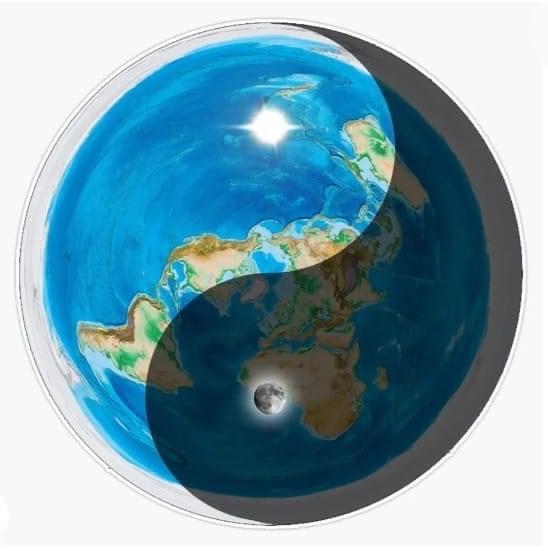
The existence of crepuscular rays is too big to ignore. We should have parallel rays, but we don't. We have hot spots and angled rays that can only come from a local light source, not a light source millions of miles away. Eratosthenes experiment would have the same results whether or not the Earth is curved for flat, so it renders the entire experiment useless. The evidence favors a flat Earth, and there's much more to prove the point.
Not only that, but it appears as if the Sun and the Moon are not what we think they are at all. We tend to believe that the Moon is a solid object that can be landed on. As if it's some sort of floating rock like we see in the movie Avatar. However upon closer inspection, the Moon has some glaring anomalies that start to prove that it just might be made of something other than rock. That it might in fact not even be a solid object at all.
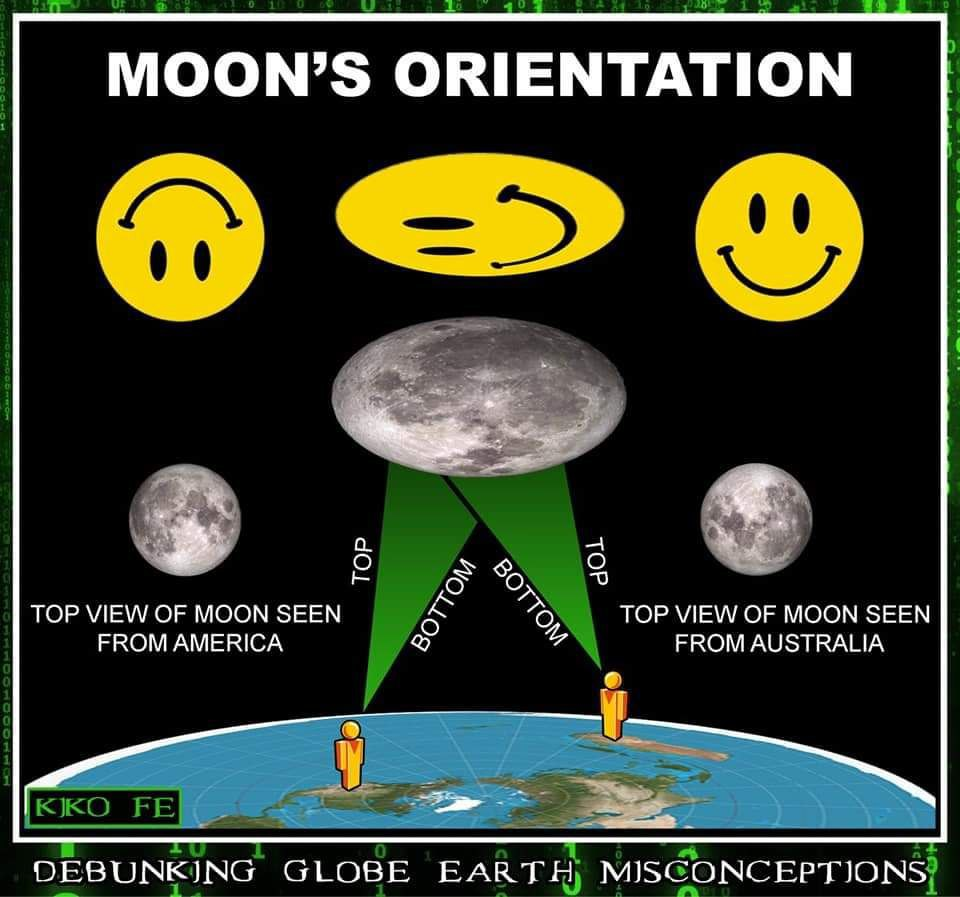
One of these observations is tied to the fact that we see the exact same face of the Moon, at all times, no matter where we are on Earth.
Now, the problem here, is that these perspectives and locations, should give completely different views of the Moon. It shouldn't just re-orient the Moon from :) to ): it should give people a view of the sides of the moon, and even the backside of the Moon. You can watch the Moon rise in the East, like the Sun, and if you're patient and paying attention, you can watch the Moon travel across the sky, directly above you. This means you should see the oncoming side of the Moon, the underside of the Moon, and the backside of the Moon, all in a single night!
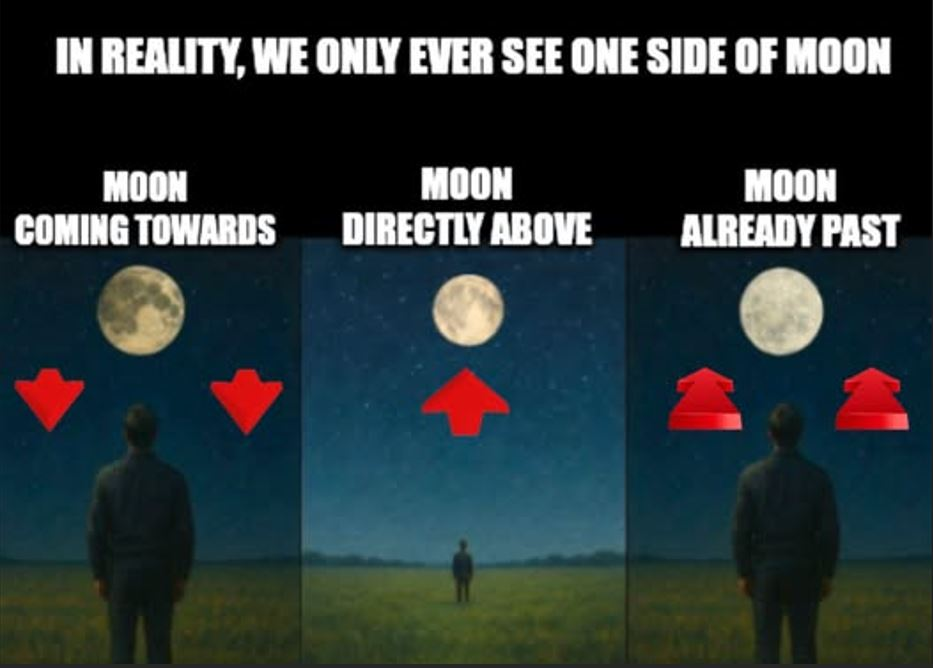
Yet we only ever see the same side, with zero deviation. This is impossible on a Globe thats zipping, twisting and orbiting. To never see a different side of the Moon is crazy. Now, NASA tells us that the Moon conveniently rotates in exact lock-step with the Earth, so the same side is always facing us, but even if that were true, which it isn't, people a great distance apart would see opposite sides of the Moon simply based on viewing angle. Yet they don't. We see the same time at all times, and this gives us a clue that the Moon isn't actually a solid spherical object. The only way the same side of the Moon is facing us at all times, is if it is a 2 dimensional object. Like a beam of light from a flashlight can sit on the ceiling and two people on opposites sides of the room will see the " same side" of the sphere, because there is only one side.
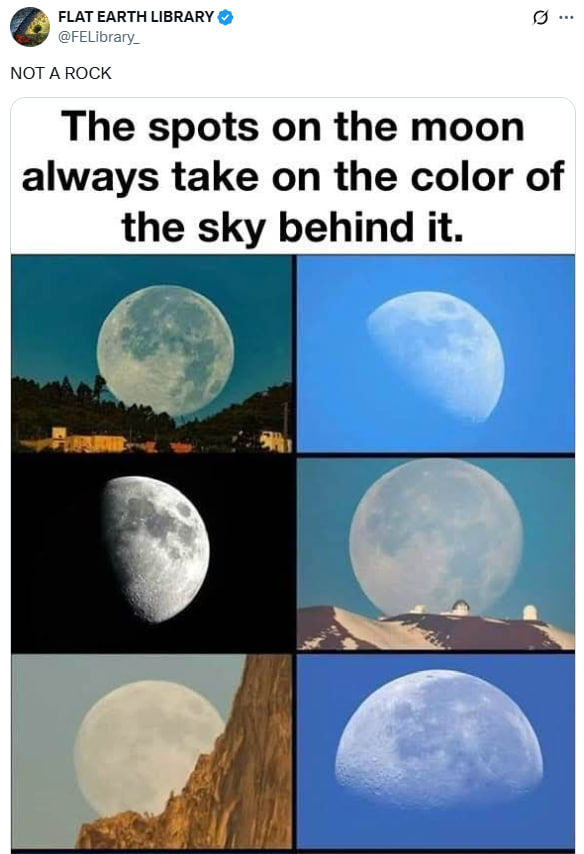
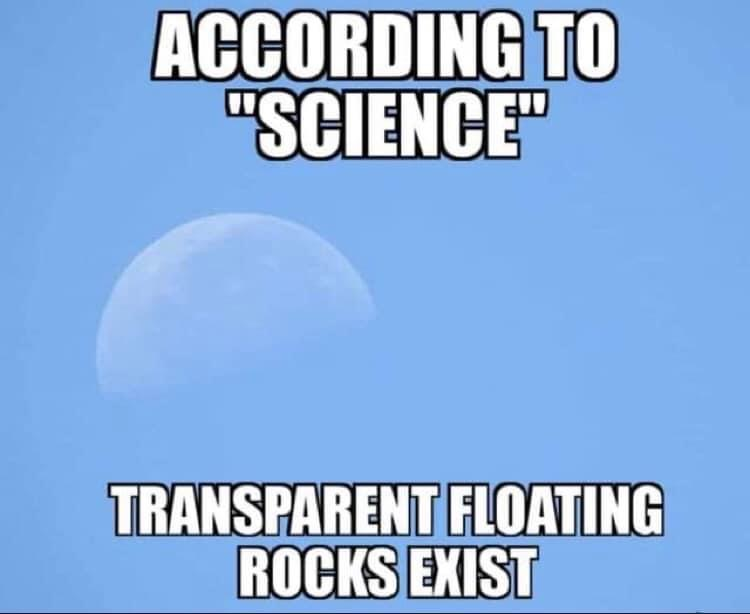
There's another curious observation about the Moon, have you ever noticed that it always appears to take on the color of the background, as if it might even be transparent?
So is our Moon actually transparent? It appears that it might be.
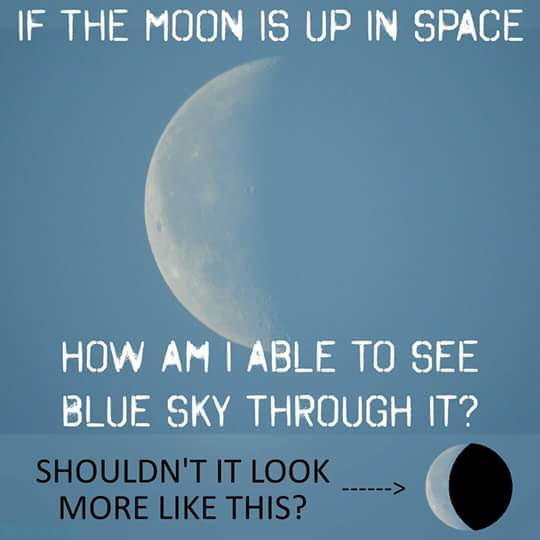
Have you ever questioned why you can't see the unlit side of the Moon during the day? Wouldn't the dark side of the Moon get darker, not lighter?
It's almost as if Moon phases are like a flashlight beam that gets partially blocked to make part of the beam disappear. This is further proof that Moon is emitting it's own light. However, the Moon itself may be the result of a beam of light, and not actually emitting it's own light, similar to how you witness a flashlight beam on a ceiling and see a round object, but you don't realize it's coming from a flashlight. I will be discussing more on this in later episodes. But the fact that you don't see the unlit side of the Moon appearing darker, just leads more credibility to the fact that the Moon isn't a solid object and is actually transparent.
If you want to understand more about what the Moon is, this 1 hour and 22 minute episode from The Lost History of Flat Earth is worth your time to watch.
I will leave you with that documentary, but there are still more observations coming in the next episode about the Sun and the Moon that will show you that what we've been told is not at all representative of what's actually true.