

The Package text, for reading and reference
This page presents the text of The Birthkeeper Package (v1.1) for convenient online reading, with the Agreement shown once in its screen-fill version. The documents are intended to be approached in their formatted versions, particularly as print-outs. Fields and signature lines here are illustrative; use the downloadable PDF or the appropriate downloadable document for completion and signing.
View and download the formatted Package PDF [Dropbox]
Z-Library download [VPN might be needed]
For an introduction to the Package and how its documents fit together, visit About the Package.
The Birthkeeper · About the Package · Public files · Companion Guide · Guide text online
──── ◇ ────
Document Outline
Choose a section below. Section links open in a new tab and highlight the destination where supported. If a link opens at the top, use your browser's Find on page with the title. Tap or click a diagram to enlarge it.
- Opening sequence
- Core Relationship and Scope
- Supporting and Situational Documents
- Commitments and Practice Guidance
- Commitments of a Birthkeeper
- Good Practice Guidance for Birthkeepers
- Chapter 1 – About Good Practice in Birthkeeping
- Chapter 2 – Relationship, Presence and Respect
- Chapter 3 – Autonomy, Authority, Communication and Influence
- Chapter 4 – Observation, Information and Judgement
- Chapter 5 – Scope, Limits and Working with Others
- Chapter 6 – Privacy, Records and Respectful Documentation
- Chapter 7 – Learning, Reflection and Sustainable Practice
- Chapter 8 – Accountability, Concerns and Repair
- Publication, acknowledgement and Wide Index - Colophon
──── ◇ ────
THE BIRTHKEEPER PACKAGE
Three related resources -- One shared purpose
These resources have different functions, but share a common purpose: to support clear, respectful and accountable relationships between Birthkeepers and parents.
1. The Birthkeeper Package [This text]
A modular set of documents for use within the Birthkeeper-Parent relationship.
2. Companion Guide for Birthkeepers
A companion for Birthkeepers working with the Package, exploring how its documents can be understood, introduced, used and adapted. [More here]
3. Birthkeeper Learning & Facilitation Resources
A resource for learning, reflection and facilitation.
──── ◇ ────
About The Birthkeeper Package
The Birthkeeper Package is a modular collection of documents for use within Birthkeeper-Parent relationships.
Different documents do different work. Agreement Between Birthkeeper and Parent(s) helps establish the general relationship and clarify scope and responsibility. Other documents become relevant only when a particular subject arises, such as Doppler use or placenta handling. Commitments of a Birthkeeper expresses the ground from which the Birthkeeper intends to accompany parents, while Good Practice Guidance for Birthkeepers offers guidance for Birthkeepers themselves.
Not every document will be relevant in every relationship or at every moment. The documents may be used individually or together, according to what is useful in the circumstances.
The Package is therefore intended as a set of related tools in service of the relationship, rather than as a fixed sequence or a rulebook to be applied in the same way every time.
──── ◇ ────
Finding your way
The documents in The Birthkeeper Package are arranged in three functional groups.
1. CORE RELATIONSHIP AND SCOPE
Print-and-pen version Screen-fill version
2. SUPPORTING AND SITUATIONAL DOCUMENTS
Information and Acknowledgement
Information Description Consent
3. COMMITMENTS AND PRACTICE GUIDANCE
──── ◇ ────
CORE RELATIONSHIP AND SCOPE
Core Relationship and Scope
This section brings together the documents that establish the Birthkeeper - Parent relationship and clarify its scope, responsibilities and liability framework.
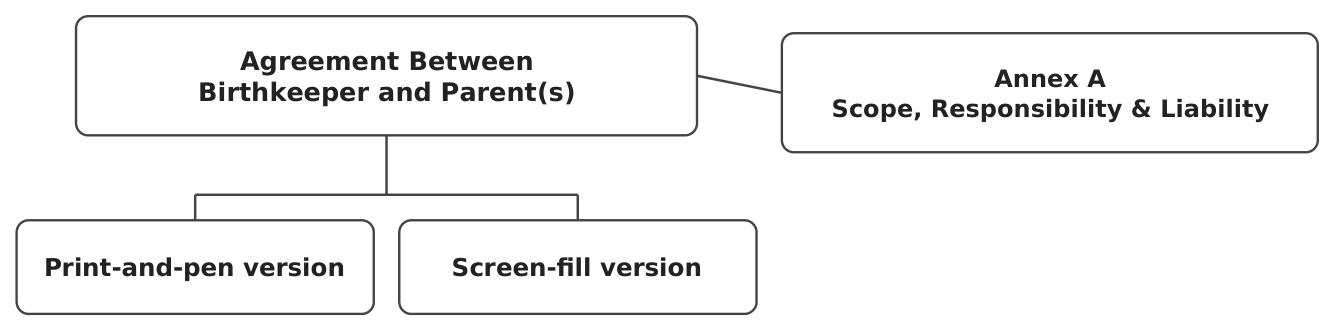
Agreement Between Birthkeeper and Parent(s)
This Agreement comes in two versions:
- Print-and-pen version -- for printing and completing by hand
- Screen-fill version -- for completing on screen
Annex A - Scope, Responsibility & Liability
A companion document to the Agreement, providing greater detail on scope, responsibilities and liability boundaries within the Birthkeeper - Parent relationship.
How the Agreement and Annex A relate
The Agreement establishes the main working relationship between Birthkeeper and Parent(s). Annex A sits alongside it and develops scope, responsibility and liability in greater detail.
──── ◇ ────
Guide: Agreement and Annex A profile · Package outline
Agreement between Birthkeeper and Parent(s)
Main Agreement
Screen-fill version
The PDF version of the Package contains two versions of this Agreement: screen-fill and print-and-pen. Only the screen-fill version is presented here. Download the Package PDF.
For completing on screen; replace grey bracketed prompts with agreed details.
This Agreement sets out the working understanding between the Birthkeeper and the parent(s). It describes the nature of the Birthkeeper's support, the responsibilities of the parent(s), and the practical arrangements agreed between them.
This Agreement establishes a Birthkeeper support relationship between the Birthkeeper and the parent(s). The Birthkeeper may offer presence, practical support, information, suggestions, reflective support, advocacy, support with communication, and other support within the agreed Birthkeeper role.
This Agreement should be read together with Annex A – Scope, Responsibility & Liability. It may also be read together with any supporting documents, information sheets, consent forms, or additional written agreements that are expressly referred to in this Agreement or separately agreed between the Birthkeeper and the parent(s).
Contents
1. Agreement Details
2. Purpose of this Agreement
3. Nature of Birthkeeper Support
4. Information, Suggestions, and Reflective Support
5. Scope and Boundaries of Birthkeeper Support
6. Responsibility and Decision-Making of Parent(s)
7. Communication, Advocacy, and Cooperation
8. On-Call Period, Attendance, and Backup
9. Financial and Practical Arrangements
10. Supporting Documents and Additional Written Agreements
11. Annex A – Scope, Responsibility & Liability
12. Records, Notes, Confidentiality, and Accountability
13. Acknowledgement and Signatures
──── ◇ ────
1. Agreement Details
Screen-fill prompts are shown here for reference. Use the formatted PDF or the appropriate downloadable document for practical use.
1.1 This Agreement is made on:
Date:
[type date here]
1.2 The Birthkeeper is:
Full name / business name:
[type full name / business name here]
Contact details:
[type contact details here]
[continue typing details here]
1.3 The parent(s) are:
Name(s):
[type parent(s) name(s) here]
Contact details:
[type contact details here]
[continue typing details here]
1.4 The expected due date or expected birth period is:
[type expected due date or expected birth period here]
1.5 The main place(s) of support may include:
Home:
[type home location or address here]
Birth centre / hospital / other setting:
[type birth centre / hospital / other setting here]
Other relevant place(s):
[type other relevant place(s), if any, here]
──── ◇ ────
1.6 For the purposes of this Agreement, "parent(s)" includes the birthing parent and, where relevant, any partner, co-parent, or other person who signs this Agreement or participates in the agreed support.
1.7 The Birthkeeper and the parent(s) agree to work together in good faith, with clear communication, mutual respect, and within the boundaries set out in this Agreement and Annex A.
──── ◇ ────
2. Purpose of this Agreement
2.1 The purpose of this Agreement is to set out the working relationship between the Birthkeeper and the parent(s) during pregnancy, birth, the postnatal period, or any other agreed period of support.
2.2 The Birthkeeper provides support within the Birthkeeper role described in this Agreement and Annex A. This may include presence, practical help, information, suggestions, reflective support, advocacy, support with communication, and other forms of agreed support.
2.3 The Birthkeeper works with and for the parent(s) within the boundaries of this Agreement and Annex A – Scope, Responsibility & Liability.
2.4 The Birthkeeper acts in the Birthkeeper role described in this Agreement and Annex A.
2.5 This Agreement is intended to support clarity, trust, informed participation, and mutual understanding. Birthkeeper support may work alongside and complement medical care, emergency care, or other healthcare support where such care is needed.
2.6 The intention of this support is to strengthen the parent(s)' confidence, clarity, participation, and sense of agency during pregnancy, birth, and the postnatal period.
2.7 The parent(s) remain responsible for their own choices, decisions, consent, refusal of treatment, care arrangements, and decisions about when to seek medical or emergency assistance.
──── ◇ ────
3. Nature of Birthkeeper Support
3.1 Birthkeeper support may be provided before birth, during labour and birth, after birth, or during any other agreed period of support.
3.2 The Birthkeeper's support is based on presence, continuity, practical help, emotional support, information-sharing, suggestions, education, observation, reflective support, advocacy, and communication support.
3.3 Before birth, the Birthkeeper may support the parent(s) in preparing for birth and the postnatal period. This may include discussing priorities, hopes, concerns, previous experiences, birth preferences, support needs, and practical arrangements.
3.4 During labour and birth, the Birthkeeper may offer emotional reassurance, practical presence, comfort measures, suggestions for rest, movement, positioning, breathing, relaxation, massage or touch where consented to, and support for maintaining a calm and respectful birth environment.
3.5 The Birthkeeper may help the parent(s) to remember their own stated wishes, ask questions, clarify information, and prepare for conversations with people involved in healthcare.
3.6 After birth, the Birthkeeper may provide postnatal support. This may include emotional support, reflective discussion, practical help, support around rest and recovery, general information, and support for the family as they settle after birth.
3.7 The Birthkeeper may observe and may draw attention to what is seen, heard, or noticed. Such observations are not diagnosis, monitoring, clinical interpretation, or medical reassurance.
3.8 The Birthkeeper acts only within the consent of the parent(s). The parent(s) may accept, refuse, pause, or end any element of support at any time.
3.9 The Birthkeeper remains responsible for decisions made within the agreed Birthkeeper role. The Birthkeeper may decline to provide or continue support that falls outside the agreed scope, creates confusion about responsibility, or conflicts with this Agreement or Annex A.
3.10 Any specific form of support may be subject to a separate supporting document, consent form, or additional written agreement. Such documents should be read together with this Agreement and Annex A and may clarify or supplement the agreed Birthkeeper role, scope, responsibilities, or boundaries.
──── ◇ ────
4. Information, Suggestions, and Reflective Support
4.1 The Birthkeeper may share non-medical information, suggestions, reflections, experience-based perspectives, practical ideas, and educational material with the parent(s).
4.2 The Birthkeeper may support the parent(s) in thinking through options, clarifying questions, identifying priorities, and preparing for conversations with people involved in healthcare or other relevant people.
4.3 The Birthkeeper may offer suggestions relating to comfort, rest, movement, breathing, positioning, emotional support, preparation, communication, family support, birth environment, postnatal adjustment, and practical arrangements.
4.4 The Birthkeeper may share information, observations, suggestions, reflections, and experience-based perspectives within the agreed Birthkeeper role.
4.5 Any information, suggestion, reflection, or educational material shared by the Birthkeeper is offered within a non-clinical support role. Where medical care, emergency care, or other healthcare support is needed, the Birthkeeper's information and support may complement that care but do not replace it.
4.6 The parent(s) remain responsible for deciding whether to accept, refuse, adapt, or disregard any information, suggestion, reflection, or practical idea offered by the Birthkeeper.
4.7 The Birthkeeper may suggest that the parent(s) seek information, clarification, assessment, or assistance from people involved in healthcare or from an emergency service where this appears appropriate.
4.8 The Birthkeeper may help the parent(s) to formulate questions, remember their own stated wishes, request clarification, or communicate their concerns. The Birthkeeper does not take over the parent(s)' decision-making.
4.9 The Birthkeeper may provide reflective support after discussions, decisions, events, or experiences. This may include helping the parent(s) to process what happened, identify further questions, or consider what support they may need next.
4.10 Nothing in this section expands the Birthkeeper's role into clinical or medical practice. This section should be read together with Annex A – Scope, Responsibility & Liability.
──── ◇ ────
5. Scope and Boundaries of Birthkeeper Support
5.1 The Birthkeeper provides support within the Birthkeeper role and boundaries described in this Agreement and Annex A.
5.2 The Birthkeeper role described in this Agreement is not defined by a fixed list of permitted or prohibited activities. What support may appropriately be offered depends on the agreed scope, the consent of the parent(s), the Birthkeeper's skill, experience and judgement, the circumstances, and any applicable legal requirements.
5.3 Nothing in this Agreement should be read as prohibiting an activity merely because it may be described or classified in clinical or medical terms in some jurisdictions, nor as authorising an activity that applicable law restricts or reserves.
5.4 This does not prevent the Birthkeeper from offering support, comfort measures, practical assistance, observation, support with communication, or assistance in an emergency.
5.5 The support offered by the Birthkeeper may respond to what is requested or consented to by the parent(s), and may also arise from the Birthkeeper's skill, experience, and judgement in the moment about what appears to be needed.
5.6 The Birthkeeper may offer support intended to meet the immediate needs of the parent(s), baby, family, or situation, and to contribute to the best available outcome in the circumstances within the agreed Birthkeeper role. The Birthkeeper does not guarantee any outcome.
5.7 Where a situation appears to require clinical assessment, medical treatment, emergency care, or other healthcare input, the Birthkeeper may draw attention to the concern and support the parent(s) in considering or accessing help. The parent(s) remain the primary decision-makers about whether to seek, accept, decline, or continue such care, subject to any rights, duties, or powers arising under applicable law.
5.8 The Birthkeeper seeks to contribute to clear communication, respectful cooperation, and coordinated support between the parent(s), family members, people involved in healthcare, and other relevant people. This may include helping the parent(s) to express questions, concerns, preferences, boundaries, or previously stated wishes.
5.9 The Birthkeeper may speak with people involved in healthcare or other relevant people where this is requested by, agreed with, or clearly in support of the parent(s). The Birthkeeper remains responsible for the Birthkeeper's own judgement, communication, and actions within the agreed Birthkeeper role.
5.10 The Birthkeeper may work collaboratively with people involved in healthcare and other support people where this is in the interest of the parent(s), baby, family, or situation. Such collaboration does not place the Birthkeeper under the direction of another person or transfer another person's responsibilities to the Birthkeeper.
5.11 The Birthkeeper may decline to provide or continue any support that falls outside the agreed Birthkeeper role, creates confusion about responsibility, conflicts with this Agreement or Annex A, or would require the Birthkeeper to act beyond the Birthkeeper's skill, experience, boundaries, or lawful role.
5.12 The Birthkeeper may work alongside and complement medical, emergency, or other healthcare support where such care is needed. Birthkeeper support remains distinct in purpose and character and does not become clinical or medical care by working alongside it.
5.13 This section should be read together with Annex A – Scope, Responsibility & Liability. If uncertainty arises about the scope or limits of the Birthkeeper's role, this Agreement and Annex A should be read together in a way that preserves the agreed scope, responsibilities, and boundaries of Birthkeeper support.
──── ◇ ────
6. Responsibility and Decision-Making of Parent(s)
6.1 The parent(s) remain responsible for their own choices, decisions, consent, refusal, and care arrangements, including decisions about whether and when to seek clinical, medical, emergency, or other healthcare support.
6.2 The parent(s) remain primarily responsible for choosing and working with people or services involved in clinical, medical, emergency, or other healthcare support. This does not prevent the Birthkeeper from helping to make contact, communicate, or seek urgent help where appropriate under this Agreement.
6.3 The Birthkeeper may support the parent(s) in reflecting on options, preparing questions, clarifying information, remembering stated wishes, and communicating with people involved in healthcare or other relevant people. This support does not transfer decision-making responsibility to the Birthkeeper.
6.4 It is for the parent(s) to decide whether to accept, refuse, adapt, or disregard any information, suggestion, reflection, or practical idea offered by the Birthkeeper.
6.5 The parent(s) agree to inform the Birthkeeper of relevant circumstances that may affect the agreed support. This may include changes during the prenatal period, labour, birth, or the postnatal period; changes in health circumstances, care arrangements, place of birth, household circumstances, communicable illness, consent, availability, or other matters that may affect safety or practical support.
6.6 The parent(s) understand that the prenatal period, birth, and the postnatal period may involve uncertainty, risk, changing circumstances, and decisions that may need to be made quickly.
6.7 The parent(s) remain the primary decision-makers about whether to seek, accept, decline, or continue clinical, medical, emergency, or other healthcare support. The Birthkeeper may support them in understanding options, communicating their wishes, and accessing help where needed. Nothing in this clause alters any rights, duties, or powers that arise under applicable law, including in emergency or safeguarding situations.
6.8 Nothing in this Agreement requires the Birthkeeper to remain passive where urgent concern arises or where the situation appears to require clinical assessment, medical treatment, emergency care, transfer, or other healthcare input.
6.9 Where urgent concern arises, the Birthkeeper may draw attention to the concern, state the concern clearly, suggest that appropriate help is sought, support communication with people involved in healthcare or emergency services, and take reasonable steps in response to the situation.
6.10 Where delay could create serious risk, the Birthkeeper may contact emergency services or support others to do so.
6.11 Where urgent concern, emergency communication, transfer, refusal of help, or other significant event occurs, the Birthkeeper may make a brief support record or event log of the situation, relevant observations, concerns raised, actions suggested or taken, people contacted, and relevant times where reasonably possible. Such records are made for accountability, continuity of support, and protection of all involved.
6.12 The Birthkeeper may continue to support the parent(s), baby, family, and situation while appropriate help is being sought, provided this remains within the agreed Birthkeeper role, skill, experience, and boundaries.
6.13 The parent(s) agree to work with the Birthkeeper in good faith, with clear communication, mutual respect, and honest sharing of information relevant to the agreed support.
6.14 Nothing in this section prevents or discourages the parent(s) from seeking clinical, medical, emergency, or other healthcare support at any time.
──── ◇ ────
7. Communication, Advocacy, and Cooperation
7.1 The Birthkeeper and the parent(s) agree to communicate clearly, honestly, and respectfully with each other before, during, and after the agreed period of support.
7.2 The parent(s) agree to provide the Birthkeeper with relevant information needed for safe, respectful, and practical support. This may include changes in plans, place of birth, care arrangements, contact details, availability, health circumstances, household circumstances, consent, or other matters that may affect the agreed support.
7.3 The Birthkeeper seeks to contribute to clear communication, respectful cooperation, and coordinated support between the parent(s), family members, people involved in healthcare, and other relevant people.
7.4 The Birthkeeper may support the parent(s) in expressing questions, concerns, preferences, boundaries, decisions, or previously stated wishes.
7.5 The Birthkeeper will seek to support the parent(s), within the agreed Birthkeeper role and according to the Birthkeeper's skill, experience, and boundaries, in preparing for conversations with people involved in healthcare or other relevant people. This may include helping the parent(s) to clarify what they want to ask, what they want to say, what they do or do not consent to, and what further information they may need.
7.6 The Birthkeeper may speak directly with people involved in healthcare or other relevant people where this is requested by, agreed with, or clearly in support of the parent(s). Such communication may form part of collaborative support and does not place the Birthkeeper under the direction of another person.
7.7 The Birthkeeper may communicate observations, concerns, or practical information where this appears necessary to support the parent(s), baby, family, situation, or continuity of support. Such communication remains non-clinical and does not transfer clinical responsibility to the Birthkeeper.
7.8 The Birthkeeper supports the parent(s) in expressing their own voice and exercising their own consent, refusal, and decision-making. The Birthkeeper may ask questions, seek clarification, raise concerns, share observations, and contribute the Birthkeeper's own judgement in discussion with others, while respecting the decisions and responsibilities that properly rest with each person involved.
7.9 Where the parent(s) are unable, distressed, overwhelmed, or otherwise finding it difficult to communicate clearly, the Birthkeeper may assist with communication, including by helping to convey the parent(s)' known wishes, expressed concerns, and immediate needs, without taking over their decision- making.
7.10 The Birthkeeper and the parent(s) agree to seek constructive cooperation with people involved in healthcare and other support people where this is in the interest of the parent(s), baby, family, or situation.
7.11 The Birthkeeper may decline to participate in communication that is abusive, coercive, misleading, unsafe, unlawful, or outside the boundaries of this Agreement and Annex A.
7.12 Nothing in this section prevents the Birthkeeper from speaking up, raising concerns, or suggesting that appropriate help be sought. It also does not prevent the Birthkeeper from contacting emergency services or taking other reasonable steps where serious risk appears present.
──── ◇ ────
8. On-Call Period, Attendance, and Backup
8.1 The overall support period, the birth on-call period, and any postnatal support period should be described clearly in this Agreement, in a dated practical arrangements page, or in an additional written agreement.
Overall support period:
[type overall support period here]
Birth on-call period:
[type birth on-call period here]
Postnatal support period, if agreed:
[type postnatal support period, if agreed, here]
──── ◇ ────
8.2 The Birthkeeper may be on-call 24/7 for labour and birth during the agreed birth on-call period, where this has been agreed in writing. Prenatal support, postnatal support, routine communication, visits, and extended postnatal support take place by arrangement unless otherwise agreed in writing.
8.3 Important arrangements, changes, or confirmations should be made in writing or confirmed in writing where reasonably possible. Written communication may include email, text message, secure messaging, or another agreed written method that can be saved or referred to later.
Birthkeeper contact details:
Email:
[type email address here]
Phone / written messaging / other:
[type phone / written messaging / other contact here]
Parent(s) contact details:
Email:
[type email address here]
Phone / written messaging / other:
[type phone / written messaging / other contact here]
──── ◇ ────
8.4 The parent(s) agree to contact the Birthkeeper as soon as reasonably possible, and as agreed between them, when labour may be beginning, when waters release, when plans change, when transfer is being considered, or when support may be needed.
8.5 Where urgent communication happens by phone or in person, the Birthkeeper and the parent(s) should seek to confirm significant arrangements, changes, decisions, or events in writing where reasonably possible.
8.6 The Birthkeeper will seek to be reachable during the agreed birth on-call period, subject to reasonable limits, personal safety, health, rest, communication access, travel conditions, existing arrangements, and circumstances beyond the Birthkeeper's control.
8.7 The Birthkeeper will seek to attend in person where this has been agreed and where attendance is reasonably possible. Attendance may be affected by timing, distance, travel, weather, illness, emergency circumstances, communication delay, location of birth, access restrictions, or other circumstances outside the Birthkeeper's control.
8.8 The Birthkeeper may provide support by telephone, message, video call, or another written or spoken method agreed in this Agreement, in the contact details above, in a dated practical arrangements page, or in later written confirmation. This may apply where in-person attendance is delayed, not possible, not requested, or not appropriate in the circumstances.
8.9 The Birthkeeper may arrange or involve a backup Birthkeeper, apprentice Birthkeeper, assistant, or other agreed support person if the Birthkeeper is unavailable, delayed, ill, unable to attend safely, unable to continue support, or where additional support is needed.
8.10 The Birthkeeper named in this Agreement remains the Primary Birthkeeper unless otherwise agreed in writing. The parent(s) enter this Agreement with the Primary Birthkeeper, and the involvement of a backup Birthkeeper, apprentice Birthkeeper, assistant, or other agreed support person does not transfer or replace that primary working relationship unless the parent(s) and the Primary Birthkeeper agree otherwise in writing.
8.11 Where the Birthkeeper intends to involve a backup Birthkeeper, apprentice Birthkeeper, assistant, or other agreed support person, the Birthkeeper should inform the parent(s) in writing where reasonably possible. This information should include the person's name, role, relevant abilities or experience, and the limits of their role.
8.12 Where urgent circumstances make prior written notice impractical, the Birthkeeper may give verbal notice first and confirm the arrangement in writing afterwards where reasonably possible.
8.13 Any backup Birthkeeper, apprentice Birthkeeper, assistant, or other agreed support person should work within the relevant role and boundaries applicable to their involvement under this Agreement and Annex A. Their involvement does not make them the Primary Birthkeeper or give them the same role, responsibilities, or authority unless this is expressly agreed between the Primary Birthkeeper and the parent(s). Where relevant, any such person may also be bound by a separate written agreement with the Primary Birthkeeper or with the parent(s).
8.14 The parent(s) agree to inform the Birthkeeper promptly of any change in location of birth, admission to hospital or birth centre, planned induction, planned caesarean birth, transfer, change in care provider, change in household circumstances, or change in access rules that may affect the Birthkeeper's attendance or support.
8.15 Hospitals, birth centres, clinics, and other settings may have their own rules about attendance, access, surgery, theatre, recovery areas, visiting, infection control, or support people. The Birthkeeper will seek to cooperate with lawful and reasonable access requirements while remaining an independent Birthkeeper working with and for the parent(s).
8.16 Where a hospital, birth centre, person involved in healthcare, emergency service, household member, or other person prevents, limits, delays, or ends the Birthkeeper's attendance, the Birthkeeper may continue support in another reasonable way where possible and appropriate.
8.17 If the parent(s) do not contact the Birthkeeper in time, choose not to contact the Birthkeeper, provide incorrect contact or location information, fail to communicate significant changes, or make arrangements that prevent attendance, this may limit or prevent the Birthkeeper's ability to attend or provide the agreed support. This does not, by itself, mean that the Birthkeeper has failed to meet this Agreement.
8.18 Where support continues for an extended period, the parent(s) agree to provide reasonable reciprocal care for the Birthkeeper, backup Birthkeeper, apprentice Birthkeeper, assistant, or other agreed support person. This may include access to drinking water, food or refreshments, toilet facilities, a safe place to rest or pause, and reasonable conditions for continuing support.
8.19 Basic reciprocal care during attendance should be provided free of cost to the Birthkeeper, backup Birthkeeper, apprentice Birthkeeper, assistant, or other agreed support person, unless otherwise agreed in writing. Additional expenses such as parking, travel, overnight accommodation, special access costs, or other practical costs should be agreed in the fees and practical arrangements section, in a dated practical arrangements page, or in an additional written agreement.
8.20 Specific attendance arrangements, backup arrangements, response expectations, travel arrangements, overnight arrangements, written communication arrangements, access arrangements, expense arrangements, or limits on availability may be set out in this Agreement, a dated practical arrangements page, or an additional written agreement.
8.21 Any later change to a significant arrangement should be dated and confirmed in writing by the Birthkeeper and the parent(s), unless urgent circumstances make this impractical at the time. Where urgent changes are made verbally, they should be confirmed in writing afterwards where reasonably possible.
──── ◇ ────
9. Financial and Practical Arrangements
9.1 The Birthkeeper and the parent(s) may agree a fixed fee, contribution, donation, exchange, solidarity arrangement, expenses-only arrangement, no-fee arrangement, or other practical arrangement for the agreed support.
9.2 Any financial or practical arrangement should be clear enough to avoid misunderstanding. It does not need to follow a standard commercial model, but any important understanding about money, expenses, availability, travel, cancellation, or additional support should be written down or confirmed in writing where reasonably possible.
9.3 Payment, non-payment, donation, contribution, exchange, or any other arrangement does not change the Birthkeeper role or the boundaries agreed in this Agreement and Annex A – Scope, Responsibility & Liability.
9.4 Where relevant, the agreed arrangement may be described below. Any part that does not apply may be marked "not applicable".
Type of arrangement:
[type fixed fee / contribution / donation / exchange / solidarity / expenses-only / no-fee / other here]
Total agreed fee / contribution / donation / exchange / other arrangement:
[type agreed amount or arrangement here]
Currency, if applicable:
[type currency, if applicable, here]
Retainer / deposit, if any:
[type retainer / deposit details, if any, here]
Balance due and timing, if any:
[type balance due and timing, if any, here]
Payment method, if any:
[type payment method, if any, here]
Other payment or contribution arrangement, if any:
[type other payment or contribution arrangement, if any, here]
[continue typing details here]
──── ◇ ────
9.5 Where a retainer or deposit is agreed, the parent(s) understand that this may reserve the Birthkeeper's availability during the agreed birth on-call period or support period. Whether any retainer or deposit is refundable should be stated clearly below or in an additional written agreement.
Retainer / deposit refund arrangement:
[type retainer / deposit refund arrangement here]
[continue typing details here]
──── ◇ ────
9.6 Any payment plan, reduced fee, solidarity arrangement, exchange arrangement, expenses-only arrangement, no-fee arrangement, or other special arrangement should be described clearly and confirmed in writing where reasonably possible.
Special arrangement, if any:
[type special arrangement, if any, here]
[continue typing details here]
[continue typing details here]
──── ◇ ────
9.7 The parent(s) and Birthkeeper should agree clearly which expenses are included in the arrangement and which expenses are additional.
Expenses included in the agreed arrangement:
[type expenses included in the agreed arrangement here]
[continue typing details here]
Additional expenses, if any:
[type additional expenses, if any, here]
[continue typing details here]
──── ◇ ────
9.8 Additional expenses may include travel, parking, public transport, tolls, overnight accommodation, special access costs, extended travel time, or other practical costs connected with the agreed support. Any such expenses should be agreed in advance where reasonably possible.
9.9 Basic reciprocal care during attendance is addressed in Chapter 8. This includes reasonable access to drinking water, food or refreshments, toilet facilities, a safe place to rest or pause, and reasonable conditions for continuing support. Unless otherwise agreed in writing, such basic reciprocal care should be provided free of cost to the Birthkeeper, backup Birthkeeper, apprentice Birthkeeper, assistant, or other agreed support person.
9.10 If support is cancelled, postponed, changed, interrupted, or made impossible by the parent(s), by circumstances outside the Birthkeeper's control, or by access restrictions at a home, hospital, birth centre, clinic, or other location, the financial or practical consequences should be handled according to the cancellation and change arrangements agreed below or otherwise confirmed in writing.
Cancellation / change arrangements:
[type cancellation / change arrangements here]
[continue typing details here]
[continue typing details here]
──── ◇ ────
9.11 If the Birthkeeper is unable to attend or continue support because of illness, emergency, unsafe circumstances, travel disruption, communication failure, or other circumstances beyond the Birthkeeper's control, the Birthkeeper may seek to arrange backup support, remote support, rescheduling, partial support, or another reasonable alternative where possible and appropriate.
9.12 If the parent(s) do not contact the Birthkeeper in time, choose not to contact the Birthkeeper, provide incorrect contact or location information, fail to communicate significant changes, or make arrangements that prevent attendance, this may affect the Birthkeeper's ability to provide support and may affect any refund, reduction, cancellation, contribution, or practical arrangement.
9.13 Any additional agreed support or practical arrangement should be identified clearly by name, short description, and date. This may include additional postnatal visits, overnight support, extra travel, birth photography, Closing the Bones, placenta-related support, special availability arrangements, extended postnatal support, or other agreed Birthkeeper support.
Additional agreed support / practical arrangement:
Name or short description:
[type name or short description here]
Date agreed:
[type date agreed here]
Details:
[type details here]
[continue typing details here]
[continue typing details here]
──── ◇ ────
9.14 Any additional agreed support or practical arrangement must remain within the Birthkeeper role and boundaries established by this Agreement and Annex A. No fee, contribution, donation, exchange, financial arrangement, additional written agreement, supporting document, or practical arrangement changes those agreed boundaries.
9.15 Any later change to a significant financial, expense, cancellation, or practical arrangement should be dated and confirmed in writing by the Birthkeeper and the parent(s), unless urgent circumstances make this impractical at the time. Where urgent changes are agreed verbally, they should be confirmed in writing afterwards where reasonably possible.
9.16 After this Agreement has been signed, blank spaces should not be completed or altered as if they formed part of the original Agreement unless the addition or change is dated and confirmed in writing by the Birthkeeper and the parent(s).
──── ◇ ────
10. Supporting Documents and Additional Written Agreements
10.1 This Agreement may be read together with supporting documents, information sheets, consent forms, practical arrangements pages, or additional written agreements that are expressly referred to in this Agreement or separately agreed between the Birthkeeper and the parent(s).
10.2 Supporting documents may address specific topics or forms of support. These may include, for example, Doppler-related information, placenta-related support, responsibilities of parent(s), Closing the Bones, postnatal support, birth preparation, or other agreed Birthkeeper support.
10.3 A supporting document may provide information, clarify expectations, record consent, describe a specific practice, or set out practical arrangements. It does not replace this Agreement unless this is clearly stated and agreed in writing.
10.4 Any additional written agreement should be identified clearly by name, short description, and date. It should state whether it is intended to form part of this Agreement, supplement this Agreement, or apply only to a specific form of support.
10.5 No supporting document, information sheet, consent form, practical arrangements page, additional written agreement, or later written confirmation changes the Birthkeeper role or the agreed scope and boundaries established by this Agreement and Annex A unless such a change is expressly agreed in writing.
10.6 Where a supporting document contains a more specific consent process, boundary, or practical arrangement for a particular form of support, that specific process, boundary, or arrangement applies in addition to this Agreement and Annex A.
10.7 If there is uncertainty or inconsistency between this Agreement and a supporting document or additional written agreement, the documents should be read together in a way that preserves the agreed Birthkeeper role, responsibilities, scope, and boundaries.
10.8 If uncertainty remains, Annex A – Scope, Responsibility & Liability takes priority on matters of scope, responsibility, liability, and the agreed boundaries of Birthkeeper support.
10.9 Any later addition, alteration, or additional written agreement should be dated and confirmed in writing by the Birthkeeper and the parent(s). It should not be treated as part of the original signed Agreement unless the Birthkeeper and the parent(s) clearly agree this in writing.
10.10 The Birthkeeper may decline to provide any support described in a supporting document or additional written agreement if it falls outside the agreed Birthkeeper role, creates confusion about responsibility, conflicts with Annex A, or exceeds the Birthkeeper's skill, experience, or agreed boundaries.
──── ◇ ────
11. Annex A – Scope, Responsibility & Liability
11.1 Annex A – Scope, Responsibility & Liability forms part of this Agreement unless the Birthkeeper and the parent(s) clearly agree otherwise in writing.
11.2 The Annex sets out the scope and responsibilities of the Birthkeeper's support, the responsibilities of the parent(s), and the circumstances in which responsibility may or may not rest with the Birthkeeper.
11.3 The parent(s) acknowledge that they have received a copy of Annex A – Scope, Responsibility & Liability and have been given sufficient time and opportunity to read it, ask questions, and seek clarification before signing this Agreement.
11.4 The parent(s) understand that the support provided by the Birthkeeper may complement medical, emergency, or other healthcare support where such care is needed. The Birthkeeper may support the parent(s) independently or work alongside others involved in their care, according to the circumstances and the agreed support.
11.5 The parent(s) remain the primary decision-makers about whether to seek, accept, decline, or continue clinical, medical, emergency, or other healthcare support. The Birthkeeper may support them in understanding options, communicating their wishes, and accessing help where needed. Where the parent(s) are unable to act, or where delay could create serious risk, the Birthkeeper may take reasonable steps in response to the situation, including seeking urgent help. Nothing in this clause alters any rights, duties, or powers arising under applicable law.
11.6 Any support, information, suggestion, reflection, observation, support with communication, practical assistance, supporting document, or additional written agreement is to be understood within the scope and responsibilities established by this Agreement and Annex A.
11.7 If uncertainty or inconsistency remains between this Agreement, a supporting document, an additional written agreement, and Annex A, Annex A takes priority on matters of scope, responsibility, liability, and the agreed boundaries of Birthkeeper support.
11.8 The Birthkeeper may work collaboratively with the parent(s) and with others involved in care or support. Such cooperation does not place the Birthkeeper under the direction of another person or remove the Birthkeeper's responsibility for the Birthkeeper's own judgement, actions, and agreed boundaries.
11.9 By signing this Agreement, the Birthkeeper and the parent(s) acknowledge Annex A as an important part of the legal and practical framework of their working relationship.
──── ◇ ────
12. Records, Notes, Confidentiality, and Accountability
12.1 The Birthkeeper may keep records relating to the agreed support. These records may be kept for accountability, continuity of support, clarity between the Birthkeeper and the parent(s), protection of all involved, and proper reflection on significant arrangements, concerns, events, and actions.
12.2 Support records may include factual notes of dates, times, attendance, contact, agreed arrangements, changes to arrangements, consent or refusal relating to Birthkeeper support, support provided, concerns raised, suggestions made, people contacted, and significant events relevant to this Agreement.
12.3 Event logs may be made where urgent concern, emergency communication, transfer, refusal of help, serious disagreement, access difficulty, or another significant event occurs. Event logs may include the situation, relevant observations, concerns raised, actions suggested or taken, people contacted, and relevant times where reasonably possible.
12.4 Communication records may include emails, text messages, written confirmations, agreed changes, practical arrangements, or other written communication that can be saved or referred to later.
12.5 Support records, event logs, and communication records are intended to be factual, proportionate, and relevant to the Birthkeeper's non-clinical role. They are not clinical notes, clinical assessments, or medical records.
12.6 Private notes may include personal reflections, preparation notes, supervision notes, learning notes, or working notes made by the Birthkeeper for personal accountability, development, supervision, or reflection.
12.7 Private notes are personal to the Birthkeeper and are not automatically shared with the parent(s). This does not remove any legal right, duty, or requirement that may apply under the relevant law.
12.8 The Birthkeeper will seek to handle personal information with care and confidentiality. Personal information should not be shared unnecessarily or casually.
12.9 Confidentiality is subject to reasonable and lawful exceptions. The Birthkeeper may share relevant information where this is agreed by the parent(s), needed for continuity of support, needed by a backup Birthkeeper, apprentice Birthkeeper, assistant, or other agreed support person, needed in an emergency, needed for safeguarding, required by law, required by a court or lawful authority, or reasonably necessary for advice, protection, accountability, insurance, or dispute handling.
12.10 Where information is shared with a backup Birthkeeper, apprentice Birthkeeper, assistant, or other agreed support person, the Birthkeeper should seek to share only what is reasonably necessary for the agreed support and should remind that person of the need for confidentiality.
12.11 The Birthkeeper may share relevant factual information with people involved in healthcare, emergency services, or other relevant people where this is requested or agreed by the parent(s), reasonably needed for continuity of support, or reasonably necessary because of urgent concern, serious risk, safeguarding needs, or a legal requirement. Only information reasonably necessary for that purpose should be shared. Sharing information under this clause does not, by itself, require the Birthkeeper to provide complete support records, event logs, communication records, or private notes.
12.12 The parent(s) may request a copy or summary of factual support records, event logs, or communication records relating to them, subject to applicable law, confidentiality duties, third-party privacy, safety concerns, and reasonable limits.
12.13 The Birthkeeper may keep copies of support records, event logs, communication records, and relevant written agreements for accountability, continuity of support, legal protection, insurance, supervision, reflection, or dispute handling, subject to applicable law.
12.14 Records should be kept in a reasonably secure way and for a reasonable period, or for any period required or allowed by applicable law, insurance, supervision, or dispute-handling needs.
12.15 A factual support record or event log should be treated as the record made at that time. If a correction, clarification, later insight, or disagreement needs to be added, it should be dated and added as a later note, so that the order of events and later additions remains clear.
12.16 Where factual support records, event logs, or written confirmations are shared, they should normally be shared through an agreed contact method such as email, written message, printed copy, scanned copy, or another method agreed between the Birthkeeper and the parent(s).
──── ◇ ────
13. Acknowledgement and Signatures
Screen-fill prompts are shown here for reference. Use the formatted PDF or the appropriate downloadable document for practical use.
13.1 By signing this Agreement, the Birthkeeper and the parent(s) confirm that they have read, understood, and agreed to the terms of this Agreement.
13.2 The Birthkeeper and the parent(s) acknowledge that the Birthkeeper is acting within the Birthkeeper role and boundaries described in this Agreement and Annex A.
13.3 The parent(s) acknowledge that they remain the primary decision-makers about whether to seek, accept, decline, or continue clinical, medical, emergency, or other healthcare support, subject to any rights, duties, or powers arising under applicable law.
13.4 The parent(s) confirm that they have received a copy of Annex A – Scope, Responsibility & Liability, have been given time and opportunity to read it before signing this Agreement, and have had the opportunity to ask questions or request clarification about it.
13.5 The Birthkeeper and the parent(s) confirm that they understand this Agreement may be read together with Annex A, supporting documents, consent forms, practical arrangements pages, or additional written agreements where these are expressly referred to in this Agreement or separately agreed between them.
13.6 At the time this Agreement is signed, any completed blank spaces in this Agreement, handwritten additions on this Agreement, or attachments intended to form part of this Agreement should be clear and accepted by the Birthkeeper and the parent(s). Where helpful, such additions or attachments should be dated or initialled.
13.7 After this Agreement has been signed, any significant addition, alteration, supporting document, consent form, practical arrangement, or later written agreement should be dated and confirmed in writing by the Birthkeeper and the parent(s) if it is to change, clarify, or supplement the agreed arrangements.
13.8 The Birthkeeper may keep copies of this Agreement, Annex A, supporting documents, consent forms, practical arrangements, later written agreements, and any later changes or clarifications. Later documents should, where reasonably possible, identify their title, date, relationship to this Agreement, and any earlier version they replace, amend, or clarify.
13.9 Each person signing confirms that they sign freely, that they have had the opportunity to ask questions and request clarification about this Agreement and Annex A before signing, and that any questions they chose to raise have been addressed sufficiently for them to sign with understanding.
Birthkeeper
Full name:
[type full name here]
Signature:
[type electronic signature / typed name here, or sign after printing]
Date:
[type date here]
Parent / Birthing Parent
Full name:
[type full name here]
Signature:
[type electronic signature / typed name here, or sign after printing]
Date:
[type date here]
Parent / Partner / Co-parent, if applicable
Full name:
[type full name here]
Signature:
[type electronic signature / typed name here, or sign after printing]
Date:
[type date here]
Witness, if used
Full name:
[type full name here]
Signature:
[type electronic signature / typed name here, or sign after printing]
Date:
[type date here]
Role or relationship, if relevant:
[type role or relationship, if relevant, here]
END
Agreement between Birthkeeper and Parent(s) | Screen-fill | Version 1.3 | 26 September 2026
──── ◇ ────
Guide: Agreement and Annex A profile · Package outline
Scope, Responsibility & Liability
- Annex A -
This Annex may be used either as part of the main Birthkeeper agreement or as a separate signed document. It sets out the scope of the Birthkeeper's role, the responsibilities of the Birthkeeper and the parent(s), and the principles governing responsibility and liability. It should be read together with any agreed supporting documents, consent forms, or information sheets.
──── ◇ ────
1. Role of the Birthkeeper
1.1 This Annex concerns the Birthkeeper support relationship described in this document. That relationship is not established as a conventional clinical or medical care relationship. Birthkeeper support may include presence, practical support, information-sharing, education, observation, and other support within the agreed role.
1.2 The Birthkeeper acts within the role described in this Annex.
1.3 The Birthkeeper role is not defined by a fixed list of permitted or prohibited activities. What support may appropriately be offered depends on the agreed scope, the consent of the parent(s), the Birthkeeper's skill, experience and judgement, the circumstances, and applicable law. Nothing in this Annex should be read as prohibiting an activity merely because it may be described or classified in clinical or medical terms in some jurisdictions, nor as authorising an activity that applicable law restricts or reserves.
1.4 The Birthkeeper may observe and may draw attention to what is seen, heard, or noticed. Such observations are not diagnosis, monitoring, clinical interpretation, or medical reassurance.
1.5 The Birthkeeper may communicate observations, concerns, or practical information to the parent(s), people involved in healthcare, emergency services, or other relevant people where this appears appropriate or is requested by the parent(s). Such communication does not transfer responsibility for clinical or medical care to the Birthkeeper.
──── ◇ ────
2. Boundaries of Support
2.1 The Birthkeeper may offer emotional support, practical presence, birth preparation, discussion, information, and reflective support before, during, and after birth.
2.2 Any discussion of herbs, food, diet, rest, comfort measures, traditional practices, or lifestyle is offered as general information or traditional knowledge only. It is not presented as medical advice, treatment, or prescription.
2.3 The Birthkeeper acts only with the consent of the parent(s). The parent(s) may accept, refuse, pause, or end any element of support at any time.
2.4 The Birthkeeper may decline to provide or continue any support that falls outside the agreed scope, creates confusion about responsibility, or conflicts with the boundaries set out in this Annex.
──── ◇ ────
3. Responsibility of Parents
3.1 The parent(s) remain responsible for their own choices, including decisions about pregnancy, birth, postnatal care, placenta care, herbal or dietary matters, and whether or when to seek medical assistance.
3.2 The parent(s) understand that Birthkeeper support may work alongside and complement other forms of care and does not replace medical or emergency care where such care is needed.
3.3 The parent(s) are responsible for arranging any clinical care, emergency care, testing, screening, monitoring, transfer, medication, or medical consultation that they consider necessary or that may become necessary.
3.4 Nothing in this Annex requires the Birthkeeper to remain passive where urgent concern arises or where the situation appears to require clinical assessment, medical treatment, emergency care, transfer, or other healthcare input.
3.5 Where urgent concern arises, the Birthkeeper may draw attention to the concern, state the concern clearly, suggest that appropriate help is sought, support communication with people involved in healthcare or emergency services, and take reasonable steps in response to the situation.
3.6 The parent(s) remain the primary decision-makers about whether to seek, accept, decline, or continue clinical, medical, emergency, or other healthcare support. The Birthkeeper may support them in understanding options, communicating their wishes, and accessing help where needed. Nothing in this clause alters any rights, duties, or powers that arise under applicable law, including in emergency or safeguarding situations.
3.7 Where delay could create serious risk, the Birthkeeper may contact emergency services or support others to do so.
──── ◇ ────
4. Supporting Documents and Specific Practices
4.1 Specific topics may be addressed in separate supporting documents, information sheets, addenda, or consent forms. These may include, for example, Doppler-related information, placenta-related support, responsibilities of parents, Closing the Bones, or other agreed forms of support.
4.2 Supporting documents are to be interpreted in line with this Annex and do not, by themselves, change the agreed Birthkeeper role, scope, responsibilities, or boundaries.
4.3 Where a supporting document contains a more specific consent process or boundary for a particular practice, that specific consent process applies in addition to this Annex.
──── ◇ ────
5. Records and Accountability
5.1 The Birthkeeper may keep factual support records, event logs, communication records, or other proportionate records relevant to the agreed support, including where urgent concern, emergency communication, transfer, refusal of help, serious disagreement, or another significant event occurs.
5.2 Such records remain non-clinical in nature and are not clinical notes, clinical assessments, or medical records.
5.3 Records may be retained or shared where reasonably necessary for accountability, continuity of support, protection of those involved, legal or insurance purposes, supervision, reflection, or dispute handling, subject to applicable law and confidentiality obligations.
──── ◇ ────
6. Responsibility and Liability
6.1 The parent(s) acknowledge that pregnancy, birth and the postnatal period involve uncertainty and that outcomes may be affected by many circumstances beyond the Birthkeeper's control. The Birthkeeper does not guarantee any particular outcome.
6.2 The parent(s) agree that the Birthkeeper should not be held responsible for outcomes arising from decisions or choices made by the parent(s), clinical or medical decisions made by others, acts or omissions of third parties, or circumstances outside the Birthkeeper's reasonable control.
6.3 Nothing in this Annex excludes responsibility that cannot lawfully be excluded or limits any responsibility arising from the Birthkeeper's own actions or omissions where such responsibility properly rests with the Birthkeeper.
──── ◇ ────
7. Acknowledgement and Consent
For printing and completing this form, use the formatted PDF.
7.1 By signing this Annex, the Birthkeeper and the parent(s) confirm that they have read and understood the scope, responsibilities, and limitations described in it.
7.2 The parent(s) acknowledge that Birthkeeper support may include presence, practical support, information, suggestions, reflective support, advocacy, and support with communication. The Birthkeeper may work alongside and complement care provided by people involved in healthcare, emergency services, and others involved in care or support. Birthkeeper support does not replace medical or emergency care where such care is needed.
7.3 The parent(s) acknowledge that they remain the primary decision-makers about whether to seek, accept, decline, or continue clinical, medical, emergency, or other healthcare support, subject to any rights, duties, or powers arising under applicable law.
7.4 The parent(s) consent to receive support from the Birthkeeper within the boundaries described in this Annex and any agreed supporting documents. The Birthkeeper agrees that any support provided will remain within those agreed boundaries.
| Parent(s): | ________________________ |
| Date: | ________________________ |
| Birthkeeper: | ________________________ |
| Date: | ________________________ |
| Witness (optional): | ________________________ |
| Date: | ________________________ |
END
Scope, Responsibility & Liability | Version 1.3 | 26 September 2026
──── ◇ ────
SUPPORTING AND SITUATIONAL DOCUMENTS
Supporting and Situational Documents
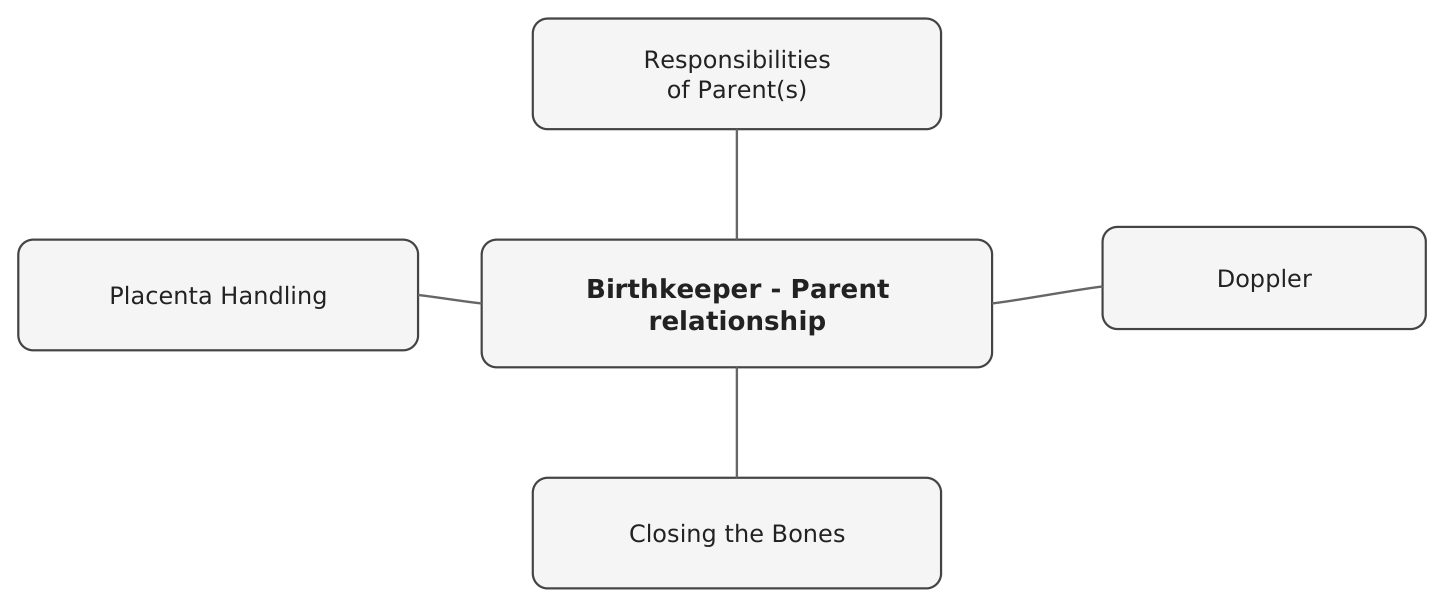
These documents add detail where particular responsibilities, choices or practices need to be made clearer. Some apply across the Birthkeeper - Parent relationship; others become relevant only when a particular subject arises.
Responsibilities of Parent(s)
A document for clarifying the Parent(s)' responsibilities and shared expectations across pregnancy, birth and the postnatal period.
Doppler
Information and acknowledgement concerning optional Doppler use within Birthkeeping support.
Placenta Handling
Two related documents:
- Agreement clarifies roles and responsibilities where the Birthkeeper offers practical, non-clinical support with placenta handling.
- Addendum records the Parent(s)' intended placenta handling and their choices and responsibilities.
Closing the Bones
A three-part set:
- Information -- explains the nature, purpose, boundaries and relevant considerations.
- Description -- describes how the practice may be offered and experienced.
- Consent -- records informed understanding and voluntary participation.
How these documents fit within the Package
These documents do not replace the core Agreement and Annex A. They add detail where it is useful, while leaving the wider Birthkeeper - Parent relationship and scope framework in place.
──── ◇ ────
Guide: Responsibilities of Parents profile · Package outline
Responsibilities of Parents
Introduction
Welcoming a child is a profound journey. It is also a shared responsibility. As parents, you hold the central role in preparing for this transition, caring for yourselves, and making choices that shape your baby’s beginning in the world.
A Birthkeeper can walk alongside you with presence, knowledge, and encouragement. The Birthkeeper offers support and resources to help you feel prepared and confident. Yet it is important to understand: the Birthkeeper does not replace parental responsibility or medical care.
This document clarifies the commitments parents make during pregnancy, birth, and the weeks after, as well as the support role of the Birthkeeper. Its purpose is to encourage mutual trust, clear communication, and shared responsibility.
Purpose and Limits of This Document
This document:
- clarifies mutual responsibilities and expectations
- supports informed choices and clear communication
This document does not:
- remove the need for medical care or emergency services when these are required
- assign clinical responsibility to the Birthkeeper
- guarantee outcomes
Parent Responsibilities Across the Childbearing Journey
1. During Pregnancy
Parents carry the main responsibility for their own preparation and wellbeing.
This includes:
- Self-education: taking time to learn about pregnancy, birth, and postpartum; exploring a range of perspectives; and making conscious choices that feel right for your family.
- Self-care: tending to physical health, emotional balance, and relational support, recognising that these form the foundation for a positive birth.
- Decision-making: seeking balanced information, asking questions, and taking ownership of choices made along the way.
Parents are responsible for seeking information from a range of appropriate sources and are encouraged not to rely on the Birthkeeper as their sole source of knowledge or guidance.
The Birthkeeper’s role during pregnancy is one of support, which may include sharing resources, encouraging reflection, and offering space for questions. This support is never a substitute for medical care, nor does it remove the responsibility of parents to make their own decisions.
2. During Birth
Parents remain at the centre of decision-making throughout labour and birth.
Their responsibilities include:
- Environment: creating and maintaining a safe and supportive birth space.
- Communication: expressing their wishes clearly and staying in dialogue with those present.
- Preparedness: having a plan for medical support and being willing to call for it if needed.
- Responsibility: recognising that unexpected situations can arise and that parents remain ultimately accountable for choices made.
Parents remain responsible for deciding when additional or emergency medical support is required and for initiating contact with such services.
The Birthkeeper may raise concerns or suggestions within the agreed support role, but does not assess, diagnose, or decide on behalf of the Parent(s).
The Birthkeeper’s role during birth is to:
- provide emotional steadiness, physical comfort, and respectful presence.
- offer suggestions, encouragement, and practical support within the agreed support role.
- remain within a non-medical support role and not perform medical procedures or take responsibility for medical outcomes.
3. After the Birth
Parents continue to carry primary responsibility for their newborn and for arranging appropriate support during recovery after birth.
This includes:
- Newborn care: ensuring feeding, warmth, safety, and medical attention when necessary.
- Parental recovery: allowing time for rest and healing, and seeking help when needed.
- Follow-up: arranging appropriate medical check-ups for mother and baby.
- Ongoing choices: making informed decisions about family well-being, and reaching out for support when needed.
Parents remain responsible for seeking timely medical, community, or other professional support when concerns arise for either parent or baby.
The Birthkeeper’s role after birth is to:
- offer listening, encouragement, and practical guidance where appropriate.
- share resources for postpartum recovery and newborn care.
- respect the parents’ authority and remain within a supportive and non-medical capacity.
Addendum – What This Birthkeeper Offers / Does Not Offer
The Birthkeeper Offers:
- emotional presence, encouragement, and reassurance.
- physical comfort measures, where agreed, such as positioning, massage, and breathing guidance.
- practical support, such as organisation of space, preparation, and postpartum support suggestions.
- resources for learning and reflection.
- respectful presence during pregnancy, birth, and postpartum.
The Birthkeeper Does Not Offer:
- medical diagnosis, treatment, or prescriptions.
- emergency interventions or responsibility for medical or clinical outcomes.
- decisions on behalf of the parents.
- replacement for medical professionals when their presence is needed.
- ongoing supervision or responsibility beyond agreed support.
Acknowledgement and Agreement
For printing and completing this form, use the formatted PDF.
We, the undersigned Parent(s), confirm that we have read, understood, and discussed the document Responsibilities of Parents, which forms part of our agreement with the Birthkeeper.
By signing below, we acknowledge and agree that:
- We, as Parent(s), are the primary decision-makers and hold ultimate responsibility for the pregnancy, birth, and care of our child.
- The Birthkeeper offers support as described in this document and in any agreed arrangements.
This may include sharing observations, experience, practical assistance, and suggestions, including when urgent concerns arise.
- We acknowledge that unexpected or urgent situations can arise. We agree to remain in communication, to consider concerns or suggestions raised by the Birthkeeper, and to seek medical care or urgent help when needed.
- Final responsibility for medical decisions remains with the Parent(s), together with any healthcare professionals called upon. The Birthkeeper does not replace parental responsibility, healthcare professionals, or any medical care.
- We have had the opportunity to ask questions or request clarification about this document and its relationship to the wider agreement, and any questions we chose to raise have been addressed sufficiently for us to sign with understanding.
| Birthkeeper: | ________________________ |
| Date: | ________________________ |
| Parent / Birthing Parent: | ________________________ |
| Date: | ________________________ |
| Parent / Partner / Co-parent, if applicable: | ________________________ |
| Date: | ________________________ |
| Witness, if used: | ________________________ |
| Date: | ________________________ |
END
Responsibilities of Parents | Version 1.2 | 26 September 2026
──── ◇ ────
Guide: Doppler profile · Package outline
Doppler
A Doppler may be used during pregnancy or birth to listen to the baby’s heartbeat.
Within birthkeeping support, the Doppler is used as a listening and awareness tool. It can offer moments of reassurance, orientation, or connection, and may help the Birthkeeper and parents stay attuned to the baby’s presence and rhythm.
Its use is not routine and is always situational. Some families value it. Others prefer not to use it. Both approaches are equally respected.
When used, the Doppler supports attentive observation and shared understanding. It does not replace other forms of listening, communication, or embodied awareness.
Use and choice
The use of a Doppler is always by choice.
Parents’ preferences around Doppler use differ. Some appreciate listening to the baby’s heartbeat at certain moments. Others prefer not to use a Doppler, or only in specific situations. Preferences may also change over time.
The Birthkeeper will always respect the wishes of the birthing mother regarding Doppler use. She is free to ask for the Doppler to be used, to decline its use, or to change her mind at any point.
Conversations about Doppler use are part of ongoing communication and are guided by attentiveness, trust, and mutual respect.
What Doppler use can offer
When used, a Doppler can support moments of listening, orientation, and reassurance. Hearing the baby’s heartbeat may help parents feel more connected and present, and can offer a shared point of attention during pregnancy or birth.
For the Birthkeeper, listening to the baby’s heartbeat can contribute to an overall sense of how things are unfolding in that moment, alongside other forms of observation, communication, and care.
Doppler use is one element within a wider picture. It is not used in isolation and does not replace attentiveness to the parents, the baby, or the unfolding process.
Limits and expectations
A Doppler offers a momentary listening experience. What is heard can vary depending on timing, position, and circumstances, and may feel different from one moment to another.
Doppler use is always understood in context. It is one piece of information among many, and its value lies in how it is held alongside observation, communication, and ongoing awareness.
Listening to the baby’s heartbeat is not about certainty or prediction. It supports presence and attentiveness rather than conclusions.
Alongside other forms of care
Birthkeeping support exists alongside other forms of care that parents may choose to engage with during pregnancy or birth.
The use of a Doppler within birthkeeping support does not replace contact with other care providers. Parents are encouraged to remain attentive to their own needs, to seek additional support as they see fit, and to engage with medical or professional services according to their circumstances and choices.
The Birthkeeper’s role is to offer presence, listening, and support within an agreed scope, and to respect the roles and responsibilities of others involved in the parents’ care.
Acknowledgement
For printing and completing this form, use the formatted PDF.
I confirm that I have read and discussed the information in this document.
I understand how Doppler use fits within birthkeeping support and that its use is optional and based on shared understanding and choice.
I have had the opportunity to ask questions and to express my preferences.
Birthing mother
| Name: | ________________________ |
| Signature: | ________________________ |
| Date: | ________________________ |
Partner or support person (if applicable)
| Name: | ________________________ |
| Signature: | ________________________ |
| Date: | ________________________ |
END
Doppler | Version 1.2 | 26 September 2026
──── ◇ ────
Guide: Placenta handling profile · Package outline
Placenta Handling Agreement
1. Parties
This agreement is made between:
- The Parent(s), who retain responsibility for decisions concerning the placenta;
- The Birthkeeper, who may provide support in relation to placenta handling within an agreed non- medical role.
──── ◇ ────
2. Responsibility and Decision-Making
- The Parent(s) retain responsibility for decisions concerning the placenta.
- Decisions concerning its storage, transport, use and eventual disposal rest with the Parent(s).
──── ◇ ────
3. Role of the Birthkeeper
- The Birthkeeper does not provide medical or laboratory services in relation to placenta handling.
- If the Parent(s) request assistance, the Birthkeeper may provide practical support such as packaging, labelling, moving or transporting the placenta.
- Any such assistance remains under the Parent(s)' direction and responsibility.
──── ◇ ────
4. Choices and Responsibility
- The Parent(s) retain responsibility for deciding how the placenta will be handled.
- Responsibility for the Parent(s)' choices concerning the placenta, and for outcomes arising from those choices, remains with the Parent(s).
- The Parent(s) acknowledge that consuming the placenta or preparing it for health-related purposes may carry risks and is not medical treatment provided by the Birthkeeper.
- Details of the Parent(s)' intended handling of the placenta may be recorded in the Placenta Handling Addendum.
──── ◇ ────
5. Hygiene and Handling
- The Birthkeeper will apply reasonable standards of cleanliness in any practical support offered.
- The Birthkeeper does not provide or guarantee sterile or medically controlled storage, preservation or handling.
- Storage, transport and eventual disposal remain the Parent(s)' responsibility.
──── ◇ ────
6. Scope of the Birthkeeper's Role
- This Agreement does not extend the Birthkeeper's role beyond the agreed supportive, non-medical scope.
- Any practical assistance with the placenta is provided at the Parent(s)' request and remains within the Birthkeeper's agreed supportive, non-medical role.
──── ◇ ────
7. Signatures
For printing and completing this form, use the formatted PDF.
By signing this Agreement, each Parent acknowledges responsibility for decisions concerning the placenta. The Birthkeeper acknowledges the supportive, non-medical scope described in this Agreement.
| Parent: | ________________________ |
| Date: | ________________________ |
| Parent: | ________________________ |
| Date: | ________________________ |
| Birthkeeper: | ________________________ |
| Date: | ________________________ |
END
Placenta Handling Agreement | Version 1.1 | 26 September 2026
──── ◇ ────
Guide: Placenta handling profile · Package outline
Placenta Handling Addendum
This Addendum forms part of the Placenta Handling Agreement dated: ________________________
Introduction
The Parent(s) retain responsibility for decisions concerning the placenta, including how it will be stored, transported, used, or disposed of, and any cultural, ritual, practical, or personal choices connected with it.
The Birthkeeper may be present in a supportive capacity. The Birthkeeper does not provide medical services in relation to placenta handling and does not direct, prescribe, or take responsibility for the Parent(s)' choices regarding the placenta.
Description of Intended Placenta Handling
The formatted PDF provides space here to describe the intended handling. Download it for completion.
Acknowledgement
By signing this Addendum, each Parent acknowledges that the description above reflects their personal choice and responsibility, and understands that the Birthkeeper may be present in a supportive capacity and does not provide medical services in relation to placenta handling.
Signatures
For printing and completing this form, use the formatted PDF.
| Parent: | ________________________ |
| Date: | ________________________ |
| Parent: | ________________________ |
| Date: | ________________________ |
END
Placenta Handling Addendum | Version 1.1 | 26 September 2026
──── ◇ ────
Guide: Closing the Bones profile · Package outline
Closing the Bones
- Information -
This document provides general information about the practice commonly known as “Closing the Bones”.
It is part of a three-part set consisting of Information, Description, and Consent. Together, these documents are intended to support clarity, informed choice, and conscious consent. Each document has a distinct purpose. This document focuses specifically on information the mother should know before deciding whether to engage with the practice.
What is meant by “Closing the Bones”
“Closing the Bones” is a term used to describe a traditional postpartum practice found in various cultural contexts, particularly in parts of Latin America. While practices vary, the common intention is to offer physical, emotional, and symbolic support to a mother after pregnancy and birth.
In this context, Closing the Bones is understood as a supportive, non-medical practice. It is offered as a form of care, presence, and containment during the postpartum period. Experiences differ from person to person.
What this practice is not
Closing the Bones, as described here, is not presented as a medical treatment, diagnostic procedure, or therapy. It is not medical care or midwifery care, and no medical outcomes are claimed or guaranteed.
Participation is always optional.
Roles and boundaries
The practice is offered by a Birthkeeper in a supportive, non-clinical role.
The Birthkeeper’s support is not presented here as diagnosis, medical treatment, or clinical care. The role is to offer presence, care, guidance, and practical support while respecting the mother’s autonomy, comfort, and consent at all times.
The mother remains the primary decision-maker regarding her body and participation.
Individual experience and choice
Experiences of Closing the Bones vary. Some mothers describe feelings of relaxation, emotional integration, or a sense of closure. Others may experience the practice more quietly or choose not to engage at all.
There is no obligation to participate, to complete the practice, or to experience it in a particular way. Questions, hesitation, and changes of mind are respected.
Health considerations
There are situations in which Closing the Bones may need to be adapted, delayed, or not offered. These include, but are not limited to, fever, known or suspected infection, unexplained or concerning bleeding, severe or worsening pain, recent surgery, unhealed wounds, or situations in which massage, wrapping, heat, pressure, or similar physical support is considered inadvisable.
Where there is uncertainty, the Birthkeeper and mother should take time to clarify what is happening and what kind of support is appropriate. The practice may be adapted, delayed, approached more gently, or set aside while the situation is considered further, including, where helpful, seeking another informed view or additional support before proceeding.
How this document is used
This document may be read independently or together with the Birthkeeper and may be revisited at any time.
Additional detail about how the practice may be offered is provided in the companion document “Closing the Bones - Description”. Formal consent, if participation is chosen, is recorded separately in “Closing the Bones - Consent”.
END
Closing the Bones - Information | Version 1.2 | 26 September 2026
──── ◇ ────
Guide: Closing the Bones profile · Package outline
Closing the Bones
- Description -
Closing the Bones is presented here through a three-part set: Information, Description, and Consent.
This Description should be read together with “Closing the Bones - Information”, which explains the nature, purpose, limits, and non-medical boundaries of the practice.
The pages that follow describe how the practice may be offered and experienced.
Understanding is supported through conversation, not reading alone. The Birthkeeper goes through this document together with the mother, allowing space for explanation, questions, and choice. The purpose is not to prescribe a fixed sequence, but to provide a shared understanding of what may be included and how the practice is approached.
Every mother is unique. Elements may be adapted, omitted, delayed, or included according to individual circumstances, preferences, and needs.
Timing
Closing the Bones is a postpartum practice. It is offered after the baby has been born, not before birth. The timing may vary according to the mother’s recovery, wishes, cultural context, and practical circumstances.
In some settings it may be offered in the early weeks after birth. In others it may take place later, including months after birth. There is no single required timeframe. The important point is that the mother is ready, comfortable, and well enough for the practice to be offered safely and meaningfully.
The spirit of the practice
Closing the Bones is traditionally offered during the postpartum period as a way of honouring and supporting the mother after pregnancy and birth.
Many cultures have developed practices that acknowledge the profound physical, emotional, and social changes associated with becoming a mother. Closing the Bones is one such tradition. It seeks to create a space in which the mother can be cared for, witnessed, and supported.
The practice may be experienced as a moment of rest, reflection, integration, transition, or closure. Each mother’s experience is personal, and no particular response is required or promised.
What may be included
A Closing the Bones session may include some or all of the following elements:
- Welcoming words, conversation, prayer, blessing, or a moment of quiet reflection.
- Gentle bodywork offered with continuous attention to the mother’s comfort and consent.
- The use of a rebozo or long cloth for gentle holding, rocking, or supportive movements.
- Wrapping or binding of parts of the body using cloths or fabrics in accordance with the tradition and the mother’s wishes.
- The use of warmth, herbal infusions, or other comforting elements where appropriate.
- Time for rest, sharing, reflection, tea, or conversation.
Not every session includes every element. The practice is adapted according to the mother’s preferences and circumstances.
Choice and participation
The mother’s comfort, dignity, and autonomy remain central throughout the practice.
Questions are welcome at any stage. Consent may be given, withheld, or withdrawn at any time. The mother may request changes, pauses, or the omission of any element.
Participation is voluntary and there is no expectation that the mother complete the entire practice.
Creating a supportive space
The intention of the Birthkeeper is to create a respectful and supportive environment in which the mother feels safe, heard, and cared for.
The practice is approached with gentleness and without judgement. The mother’s experiences, feelings, beliefs, and preferences are respected throughout.
Relationship to the accompanying documents
General information about the nature, purpose, and limits of the practice is provided in “Closing the Bones - Information”.
Formal agreement to participate, if participation is chosen, is recorded separately in “Closing the Bones - Consent”.
END
Closing the Bones - Description | Version 1.2 | 26 September 2026
──── ◇ ────
Guide: Closing the Bones profile · Package outline
Closing the Bones
- Consent -
For printing and completing this form, use the formatted PDF.
Closing the Bones is presented here through a three-part set: Information, Description, and Consent.
The accompanying documents “Closing the Bones - Information” and “Closing the Bones - Description” have been made available to support understanding of the practice commonly known as “Closing the Bones”.
The Birthkeeper offers this practice as supportive care, with attention to the mother’s comfort, dignity, autonomy, and consent.
I declare that I have received clear explanations about the Closing the Bones practice, that I understand its nature, purpose, and non-medical boundaries, and that I have had the opportunity to ask questions and seek clarification.
By signing below, I confirm that:
- I understand that Closing the Bones is a supportive practice and is not presented as medical care, clinical care, or a substitute for medical or midwifery care.
- I understand that participation is voluntary.
- I understand that I may decline, pause, or withdraw from participation at any time.
- I choose freely to participate in this practice.
This consent confirms mutual understanding and voluntary participation.
| Mother's Name: | ________________________ |
| Signature: | ________________________ |
| Date: | ________________________ |
| Birthkeeper's Name: | ________________________ |
| Signature: | ________________________ |
| Date: | ________________________ |
END
Closing the Bones - Consent | Version 1.2 | 26 September 2026
──── ◇ ────
THE BIRTHKEEPER PACKAGE
──── ◇ ────
COMMITMENTS AND PRACTICE GUIDANCE
Commitments and Practice Guidance
These documents make the Birthkeeper's commitments visible and explore how they may be understood and practised responsibly in varied real-life circumstances.
Commitments of a Birthkeeper
A concise, parent-facing statement of the commitments by which a Birthkeeper intends to accompany Parent(s).
Good Practice Guidance for Birthkeepers
Reflective and practical guidance on how the commitments and principles underlying Birthkeeping may be understood and practised responsibly in varied real-life circumstances.
How the two documents relate
Commitments of a Birthkeeper states what the Birthkeeper commits herself to. Good Practice Guidance explores what conscientious practice arising from those commitments can look like in real situations. It supports reflection, judgement, learning and accountability without prescribing one fixed model of Birthkeeping.
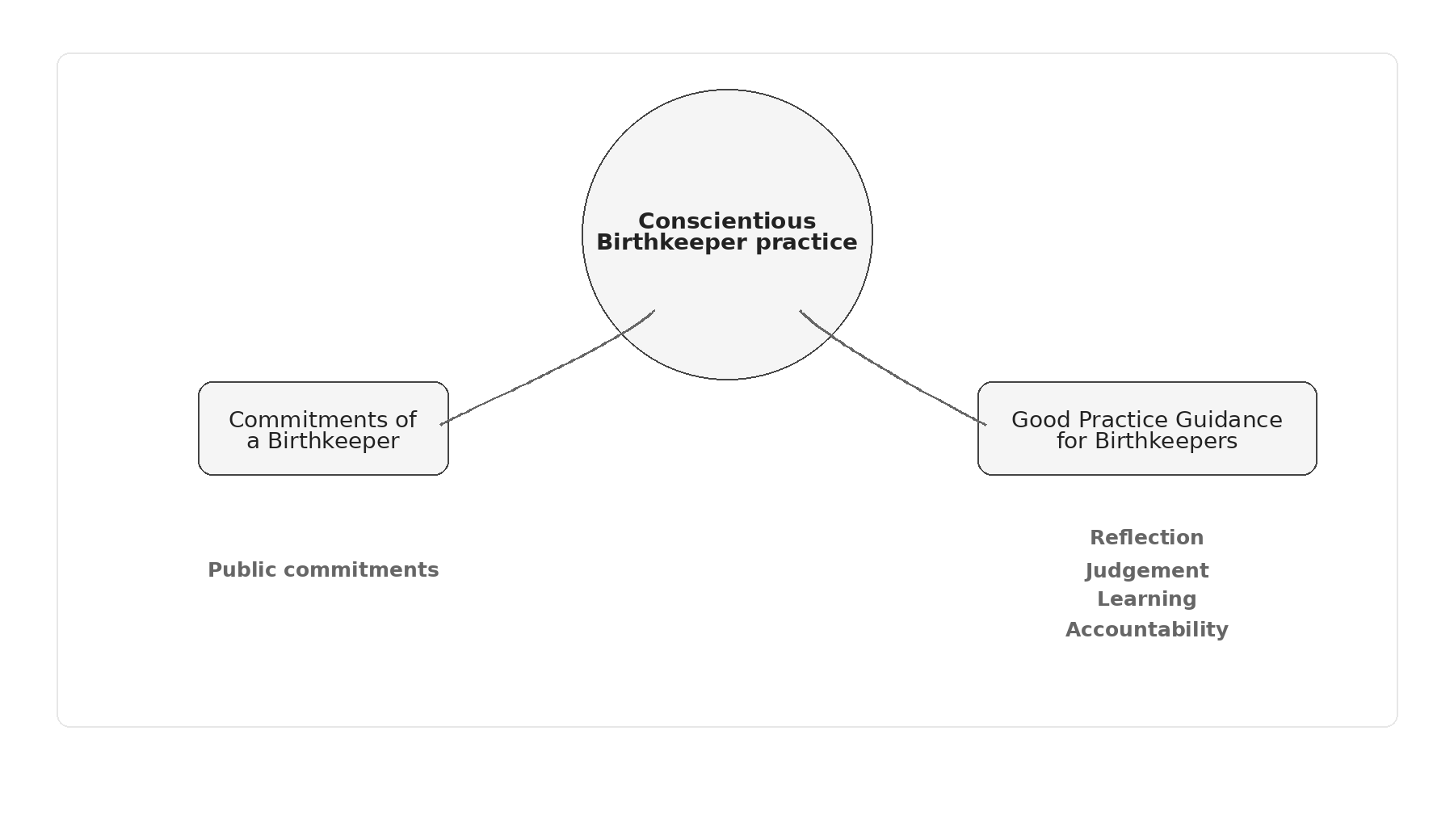
──── ◇ ────
Guide: Commitments profile · Package outline
Commitments of a Birthkeeper
I, as your Birthkeeper, offer you these commitments.
1. Presence and Listening
I will be present with you, and I will listen before assuming what you may need from me.
2. Respect for Who You Are
I will respect the values, beliefs, relationships and circumstances that shape your experience. I will not impose my own beliefs or preferred way of birth upon you.
3. Your Autonomy and Choices
I will accompany you with respect as you consider your choices. I will not take over or decide for you. I will explain any hands-on support I offer and seek your consent before beginning it. I will remain attentive to your responses and respect your right to pause, decline or change your mind.
4. Open and Respectful Communication
I will communicate with you openly and respectfully. When I have concerns or see matters differently, I will say so clearly, explain my reasons, and listen carefully to your response.
5. Privacy and Confidentiality
I will respect your privacy and dignity, and the boundaries of your personal and intimate space. I will hold in confidence what you share with me and what I come to know through accompanying you. If I seek confidential peer reflection or review of my work, I will protect your identity and share only what is needed for that purpose. I will be open with you about any limits to confidentiality.
I will seek your permission before I take photographs, make recordings or prepare a birth story about your experience for sharing. I will use such material -- whether it comes from you or is made by me -- only with your permission and within any limits you set.
6. Information and Guidance
When I offer information, suggestions or perspectives, I will distinguish what I know from what I believe or prefer. I will not present personal conviction as fact. When I believe that further advice or care may be needed, I will tell you clearly and encourage you to seek it. Where I can, I will help you find it.
7. Wellbeing and Access to Care
I will take seriously any concern I have about your wellbeing or that of your baby. I will explain my concern and support your access to care or help. I will not place my own beliefs about birth above your wellbeing or stand in the way of care you choose.
8. Recognising My Limits and Seeking Support
I will acknowledge the limits of my knowledge, role and capacity with humility, and speak openly when something is beyond what I can responsibly offer. When needed, I will take responsibility for seeking appropriate guidance or support. If I cannot continue to accompany you, I will tell you as early as I can and help you connect with suitable care or support.
9. Accountability and Making Amends
I will reflect on my conduct and remain accountable for how I accompany you. I will take seriously any concern that I have fallen short of these commitments. If I make a mistake or cause harm, I will acknowledge my part, listen to how you have been affected, and seek a way to make amends.
These commitments name the ground from which I will accompany you. As your particular journey unfolds, I will make space for what it brings.
END
Commitments of a Birthkeeper | Version 1.2 | 26 September 2026
──── ◇ ────
Guide: Good Practice Guidance profile · Package outline
Good Practice Guidance for Birthkeepers
Chapter 1 – About Good Practice in Birthkeeping
1.1 Purpose of this Guidance
Birthkeeping takes place in real relationships and real circumstances. Ethical commitments provide direction, but good practice also requires judgement: an ability to listen, observe, communicate, recognise limits, respond to changing circumstances, and remain accountable for one’s influence and actions.
This Guidance explores how the commitments and principles underlying Birthkeeping may be understood and practised responsibly in varied real-life circumstances. It is intended to support reflection, judgement, learning and accountability without prescribing one fixed model of Birthkeeping.
Good practice is therefore not simply a matter of following procedures. Nor does the absence of a single prescribed model mean that every approach is equally responsible. Birthkeeping requires both clear ethical foundations and thoughtful judgement.
1.2 Who this Guidance is for
This Guidance is written primarily for Birthkeepers. It is intended to support Birthkeepers in examining, developing and discussing their own practice.
It is also written openly enough to be read by parents, prospective parents, student Birthkeepers, colleagues and people involved in healthcare. Good practice should not depend upon a private professional language that is intelligible only to those inside the role. Parents should be able to understand the principles and expectations that shape the support offered to them.
1.3 Relationship to the wider Birthkeeper documentation
Commitments of a Birthkeeper describes the commitments a Birthkeeper makes in relation to parents. This Guidance does not repeat those commitments. It explores what carrying them into practice may ask of a Birthkeeper when circumstances are complex, uncertain or changing.
The Birthkeeper Agreement and its accompanying scope, responsibility and liability provisions establish the agreed relationship, boundaries and responsibilities between the parties. This Guidance does not alter those agreements or reproduce their contractual provisions. Instead, it considers what conscientious practice within those relationships and boundaries may look like.
The Birthkeeper Package addresses particular subjects and situations in greater detail. This Guidance has a different purpose: it considers the wider attitudes, judgement and practices that can support responsible Birthkeeping across many different situations.
1.4 How to read this Guidance
Not every statement in this Guidance carries the same weight.
Some matters concern fundamental ethical responsibilities and allow little room for variation. Others describe practices that a conscientious Birthkeeper would normally be expected to follow. Some depend substantially upon the circumstances, the relationship, the Birthkeeper’s experience and competence, and the applicable legal context. Reflective questions are also used where careful self-examination may be more useful than a fixed instruction.
The strength of the language used throughout the Guidance is therefore deliberate. Terms such as must or must not are reserved for matters where a strong ethical or legal reason justifies them. Should describes practices that are normally expected. May, can and where appropriate recognise areas in which more than one responsible approach may be possible.
Good practice requires both clear ethical foundations and thoughtful judgement. This Guidance should therefore be read as a framework for conscientious practice rather than as a fixed procedural code.
1.5 Context, diversity and judgement
Birthkeepers may differ in their backgrounds, education, experience, knowledge, traditions, communities and ways of working. The circumstances in which they offer support also differ, as do legal and professional contexts between jurisdictions.
For that reason, good Birthkeeping cannot be reduced to one universal list of permitted actions or prescribed responses.
Context, however, does not remove responsibility. A Birthkeeper remains responsible for being honest about her knowledge and competence, respecting the parent’s autonomy and consent, recognising relevant uncertainty, understanding the limits of her role, and considering the consequences of her actions and advice.
Applicable law is part of the context in which Birthkeeping takes place. This Guidance does not attempt to provide one legal model for every jurisdiction, and it cannot displace legal requirements that apply in a particular place or circumstance.
1.6 Independence, cooperation and accountability
Birthkeeping can be practised independently without being practised in isolation.
A Birthkeeper may work alongside parents, families, other Birthkeepers and people involved in healthcare while retaining responsibility for her own role, judgement and actions. Difference of role does not automatically imply hierarchy, and cooperation does not require unquestioning agreement or subordination.
Equally, independence does not mean freedom from accountability. A Birthkeeper should be able to reflect upon and explain her reasoning, recognise when another perspective is needed, remain open to challenge and correction, and respond responsibly when concerns arise.
The purpose of this Guidance is therefore not to replace judgement with rules. It is to help strengthen the awareness, knowledge, reflection and accountability through which sound judgement can develop.
──── ◇ ────
Chapter 2 – Relationship, Presence and Respect
2.1 Relationship as part of the support
Birthkeeping is relational work. The quality of support does not depend only upon what a Birthkeeper knows or does, but also upon how she is present with the parent and how the relationship develops over time.
Trust cannot be demanded or assumed. It develops through reliability, honesty, attentive listening, respect for boundaries and a willingness to remain present without unnecessarily taking over.
The relationship itself can therefore be part of good practice. This does not mean that closeness should be manufactured, or that every Birthkeeper–parent relationship will have the same character. It means recognising that the manner in which support is offered can affect how safe, heard, respected and free a parent feels within that relationship.
Presence before intervention is one useful expression of this principle. Before deciding what to suggest, explain or do, the Birthkeeper should first seek to understand what is happening, what the parent is experiencing and what support is actually wanted.
2.2 Listening
Listening is more than waiting for an opportunity to respond.
Good listening involves trying to understand:
- what the parent is saying;
- what matters to them;
- what they are asking for;
- what they may be uncertain about;
- what they do not want;
- and when they may not yet know what they need.
A Birthkeeper should be careful not to listen only for information that confirms what she already believes or expects.
Questions can help understanding, but questioning should not become interrogation. Silence can also be part of listening. Not every uncertainty needs to be filled immediately with information, interpretation or advice.
Listening well includes allowing the parent’s understanding to develop without requiring it to arrive at the Birthkeeper’s preferred conclusion.
2.3 Respect for the person
Each parent comes with their own history, relationships, culture, beliefs, language, identity, hopes, fears and understanding of birth.
Good practice begins from the person who is actually present rather than from assumptions about what a pregnant person, parent, family or Birthkeeper relationship is supposed to look like.
A Birthkeeper should therefore take reasonable care to understand and respect matters that are important to the parent, including where relevant:
- identity and forms of address;
- family and relationship structures;
- cultural practices;
- religious or spiritual beliefs;
- language and communication needs;
- personal values;
- previous experiences of pregnancy, birth, healthcare or loss.
Respect does not require the Birthkeeper to share every belief or preference. It requires that differences are not casually treated as defects to be corrected.
Where a belief or choice raises a concern relevant to the Birthkeeper’s responsibilities, respect and honest communication should coexist. Respect should not require silence, and disagreement should not cancel respect.
2.4 Avoiding imposition
Birthkeepers inevitably bring themselves into the relationship.
They bring:
- knowledge;
- experience;
- values;
- preferences;
- fears;
- hopes;
- cultural assumptions;
- previous experiences;
- beliefs about birth.
The task is not to become a person without influence. That would be neither possible nor especially helpful.
The task is to remain sufficiently aware of that influence that it does not quietly become control.
A Birthkeeper should therefore notice when her own expectations begin to shape how she interprets the parent’s situation or choices.
This may be particularly important where the Birthkeeper feels strongly about:
- place of birth;
- medical intervention;
- pain relief;
- feeding;
- family involvement;
- traditional practices;
- spiritual meaning;
- use or avoidance of healthcare.
Supporting a parent’s autonomy includes allowing that parent to make choices the Birthkeeper herself might not make.
2.5 Reliability and continuity
Trust is strengthened when words and actions broadly correspond.
Good practice therefore includes being realistic about:
- availability;
- communication;
- attendance;
- response times;
- backup arrangements;
- limits on what can be promised.
A Birthkeeper should avoid creating expectations she cannot reasonably sustain.
Continuity can be particularly valuable in Birthkeeping because familiarity may allow understanding and trust to deepen over time. But continuity should not be confused with exclusivity or dependency.
The aim is not to make the parent unable to manage without the Birthkeeper.
Good support should, where possible, strengthen rather than narrow the parent’s own relationships, resources and capacity to make decisions.
When continuity cannot be maintained, good practice includes communicating this clearly and managing changes or handovers with reasonable care.
2.6 Closeness and boundaries
Birthkeeper relationships may become warm, trusting and personally significant.
That is not inherently a problem. Birthkeeping need not imitate professional models in which emotional distance is treated as proof of seriousness.
At the same time, closeness can affect judgement.
A Birthkeeper should remain attentive to whether the relationship is creating:
- expectations she cannot fulfil;
- difficulty saying no;
- reluctance to express concern;
- pressure to agree;
- dependency;
- blurred responsibilities;
- or difficulty recognising when support should change or end.
Boundaries should protect clarity and responsibility without unnecessarily reducing the relationship to a transaction.
Their purpose is not to prevent human connection.
Boundaries also protect the Birthkeeper’s own dignity, privacy and personal safety. Dedication to a parent does not require tolerating harassment, intimidation or other inappropriate conduct from anyone present.
2.7 Difference, discomfort and disagreement
Respect is easiest when people agree.
Good practice becomes more visible when they do not.
A Birthkeeper may encounter choices, beliefs or behaviours that differ significantly from her own. She may also feel discomfort, concern or disagreement.
The first task is not to eliminate that difference.
It is to understand what the difference means, whether it affects the Birthkeeper’s responsibilities, and whether anything genuinely needs to be said or done.
Where concern is relevant, it should be communicated honestly and proportionately. Where it is simply a difference in preference, worldview or lifestyle, the Birthkeeper should take care not to convert personal discomfort into professional concern.
This distinction can require considerable self-awareness.
2.8 Presence in difficult moments
Presence matters particularly when circumstances become uncertain, painful or frightening.
A Birthkeeper does not always need to resolve what is happening in order to continue offering meaningful support.
Good practice may sometimes mean:
- staying;
- listening;
- helping the parent orient themselves;
- communicating calmly;
- helping them identify what matters now;
- supporting contact with others;
- or simply not adding unnecessary noise.
Presence should not become passivity where action or communication is genuinely needed.
But neither should anxiety automatically produce activity.
The Birthkeeper should remain able to ask:
“What does this situation need from me now?”
rather than:
“What can I do so that I feel useful?”
That distinction may be one of the quiet disciplines of Birthkeeping.
Questions for reflection
- Am I listening to understand, or listening for an opening to give my view?
- What assumptions am I making about this parent or family?
- Am I supporting the relationship they want, or the relationship I think a Birthkeeper should have with them?
- Is my discomfort signalling a genuine concern, or merely difference?
- Am I making promises about availability or continuity that I can realistically keep?
- Is this relationship strengthening the parent’s agency, or making my presence increasingly necessary to it?
──── ◇ ────
Chapter 3 – Autonomy, Authority, Communication and Influence
3.1 The parent’s authority over their own life and choices
A relationship of trust does not transfer authority over the parent’s life to the Birthkeeper.
Parents remain the primary decision-makers in matters concerning themselves, their pregnancy, birth, baby and family, within the legal context in which they live. Good Birthkeeping supports their capacity to understand, consider and make choices rather than replacing that capacity with the Birthkeeper’s judgement.
This does not mean leaving parents alone with difficult decisions under the banner of autonomy. Support may include information, questions, reflection, practical help, recommendations and the clear expression of concern.
Supporting autonomy means helping a person exercise their own agency, not withholding useful guidance from them.
A Birthkeeper does not give a parent agency or empowerment. These are not gifts conferred by the Birthkeeper. Good practice can, however, protect, strengthen and make room for the parent’s ability to exercise them.
Respect for autonomy therefore does not require the Birthkeeper to become neutral, silent or without judgement.
3.2 Recognising different sources of authority
Authority can arise from different sources, and those sources should not be treated as interchangeable.
In a Birthkeeper relationship, relevant forms of authority may include:
- the parent’s authority over their own life and choices;
- the Birthkeeper’s personal or grounded authority, arising from self-awareness, integrity, steadiness and awareness of her own limits;
- authority earned through trust within the relationship;
- authority arising from knowledge, experience or particular skills;
- professional or organisational authority;
- statutory or legal authority.
Several of these may operate at the same time.
A Birthkeeper may possess substantial experience without holding legal authority. A person involved in healthcare may hold legal or organisational responsibility without necessarily knowing the parent or their circumstances as well as the Birthkeeper does. A parent may seek expert guidance while remaining the person whose decision it ultimately is.
Legal or institutional authority is therefore neither the same as truth nor something that can simply be ignored. It may carry real powers, responsibilities and consequences.
Good practice includes recognising the source and relevance of authority in a situation rather than reflexively submitting to it or fighting it.
The questions are not merely:
“Who has authority?”
but also:
“Where does this authority come from, what is it authority over, and how relevant is it here?”
3.3 The Birthkeeper’s authority in support of parental agency
Birthkeepers can develop considerable authority.
It may arise because a Birthkeeper has listened well, shown up consistently, developed knowledge and experience, remembered what matters, remained calm under pressure and demonstrated sound judgement over time.
Trust gives her words weight.
That authority is not inherently a problem. Parents may seek a Birthkeeper precisely because they value her judgement.
The important question is what happens to the parent’s agency as that authority grows.
What matters is the relationship between authority and agency.
The Birthkeeper’s authority can help a parent:
- understand information;
- identify what matters to them;
- recognise options;
- ask questions;
- express a decision;
- resist inappropriate pressure;
- or seek further support.
Her confidence can therefore strengthen parental agency.
But the same authority can narrow agency if disagreement begins to feel like disobedience, disappointment or loss of the Birthkeeper’s approval.
That is why self-awareness matters.
The stronger the Birthkeeper’s influence becomes, the more important it is that she remains aware of how that influence is being used.
A useful working principle is:
The Birthkeeper develops her own grounded authority partly so that she can better support the parent’s authority over their own life and choices.
3.4 Influence, information and recommendation
Birthkeepers influence parents.
They influence through what they say and leave unsaid; what they notice; the questions they ask; the information they select; tone, timing, confidence, hesitation, concern, reassurance, silence and recommendation.
Influence is therefore not itself evidence of wrongdoing.
Trying to remove all influence from the relationship would be both impossible and undesirable. A Birthkeeper who notices something important and deliberately hides her judgement for fear of being influential may fail to offer meaningful support.
The ethical question is not simply:
“Did I influence the parent?”
It is:
“How did I influence the parent, on what basis, and what happened to their capacity to choose?”
A Birthkeeper may appropriately provide information, express an opinion or make a recommendation.
She may say:
“These are the options I understand to be available.”
“This is what concerns me.”
“I think it would be wise to seek another opinion.”
“I recommend contacting someone involved in healthcare now.”
The strength of the recommendation should be proportionate to the information available, the Birthkeeper’s knowledge and competence, the degree of uncertainty, and the seriousness or urgency of the concern.
A recommendation should remain recognisable as a recommendation rather than being presented as an unavoidable command.
Personal preference should not quietly be dressed up as necessity.
3.5 Persuasion, pressure and consent
Communication always has direction.
Even when a Birthkeeper believes she is simply explaining something, the way she frames the subject may favour one possibility over another.
Good practice therefore includes awareness of the difference between:
- informing;
- explaining;
- recommending;
- persuading;
- pressuring;
- coercing.
These are not perfectly separate boxes. Human conversation is messier than that.
Persuasion is not automatically unethical. People try to persuade one another when something matters.
The concern arises when persuasion begins to undermine meaningful choice.
A Birthkeeper should therefore notice whether she is:
- presenting alternatives fairly;
- acknowledging uncertainty;
- repeatedly returning to an argument after the parent has understood it;
- invoking fear unnecessarily;
- using trust or closeness as leverage;
- implying that continued support depends upon agreement;
- or making the parent responsible for the Birthkeeper’s emotional response to their decision.
A useful reflective question is:
Am I helping this parent consider their decision, or trying to produce the decision I want?
Consent within a continuing Birthkeeper relationship is also not a single event.
A parent may want more or less information, change their mind, decline a suggestion, ask for privacy, or welcome support at one moment and not at another.
A previous agreement should not be treated as permanent permission for every later action.
At the same time, ordinary human interaction need not be turned into procedural theatre.
The practical discipline is attentiveness:
Is this support still wanted in this form, at this moment?
3.6 Disagreement and appropriate firmness
A parent may make a choice the Birthkeeper would not make.
The Birthkeeper may also believe that a decision carries significant risk.
Respect for autonomy does not require pretending agreement.
Good practice may include:
- checking understanding;
- providing further information;
- explaining concern;
- making the basis of that concern clear;
- suggesting another source of information or support;
- recommending care;
- allowing time for reflection where circumstances permit.
Understanding and agreement are not the same thing.
Once the parent has understood the concern and made a decision, repeatedly returning to the same argument may cease to be guidance and become pressure.
There are also circumstances in which the Birthkeeper should speak plainly.
Respectful language does not require weak language.
Where concern is serious, she may say so clearly and may strongly recommend prompt action.
Firmness is not the same as coercion.
Firmness says:
“I am seriously concerned, and I believe action is needed.”
Coercion attempts to make refusal no longer genuinely possible through threat, manipulation, deception or misuse of power.
Avoiding coercion should not turn the Birthkeeper into a nervous spectator who is afraid to communicate her judgement when it matters.
That would be autonomy hollowed out into passivity.
3.7 Advocacy and authority from others
A Birthkeeper may sometimes help a parent communicate with other people.
This can include helping formulate questions, reminding the parent of something they wished to raise, supporting them while they express a decision, helping clarify what has been understood, or drawing attention to something the parent has asked not to be overlooked.
There is, however, a difference between helping the parent’s voice be heard and becoming their voice.
Where possible, good practice should strengthen the parent’s ability to speak and decide for themselves.
Speaking on behalf of a parent may sometimes be appropriate where they have asked for it, where communication is difficult, or where circumstances make direct communication temporarily impossible. Even then, the Birthkeeper should take reasonable care to represent the parent’s wishes rather than substituting her own.
Advocacy should enlarge the parent’s voice, not replace it.
Birthkeepers may also work alongside people or institutions carrying professional, organisational or legal authority.
Such authority may represent specialist knowledge, legal responsibility, control over institutional processes, statutory powers or responsibility for particular forms of care.
Those things matter.
But the Birthkeeper does not need to choose between two crude positions:
“They are the professionals, therefore they must be right.”
and:
“They represent the system, therefore they must be wrong.”
Both surrender judgement.
The more responsible task is to consider the other person’s knowledge, authority and responsibilities, while keeping the parent’s agency and the actual circumstances in view.
This is cooperation without automatic subordination — and independence without automatic opposition.
3.8 Responsibility for influence
Trust gives a Birthkeeper’s words weight.
That weight creates responsibility.
The Birthkeeper should therefore be willing to account for:
- what she said;
- what she recommended;
- what she understood at the time;
- what uncertainty she recognised;
- why she expressed a concern;
- how she used her influence;
- whether her actions supported or narrowed the parent’s ability to make their own decision.
This does not mean that the Birthkeeper becomes responsible for every decision a parent makes after receiving her support.
Parents retain responsibility for their own decisions, just as other people remain responsible for their own actions.
The Birthkeeper is responsible for her contribution to the situation.
A Birthkeeper should be willing to account for her actions, decisions, advice and use of influence, including when reflection reveals that she was mistaken.
This closes the chapter’s central sequence:
trust → authority → influence → responsibility → accountability
And two statements deserve to remain together:
Authority that cannot tolerate accountability eventually becomes control.
Authority that remains answerable can deepen trust.
Questions for reflection
- What source of authority am I relying on in this situation, and how relevant is it?
- Is my confidence proportionate to what I actually know?
- Am I informing, recommending, persuading or pressuring?
- Would the parent feel able to disagree with me without fearing loss of my support or respect?
- Am I strengthening this parent’s ability to decide, or making my judgement increasingly necessary to them?
- Could I later explain honestly why I gave this advice and why I expressed it as strongly as I did?
──── ◇ ────
Chapter 4 – Observation, Information and Judgement
4.1 Observation before interpretation
Good judgement begins with noticing what is actually happening.
A Birthkeeper may observe changes in:
- behaviour;
- movement;
- communication;
- appearance;
- comfort;
- responsiveness;
- events;
- timing;
- or the surrounding circumstances.
Observation and interpretation are both necessary, but they are not the same thing.
For example:
“You have vomited three times in the last hour”
describes an observation.
“You are becoming dehydrated”
is an interpretation of what those observations may mean.
The interpretation may be reasonable. It has nevertheless gone beyond what was directly observed.
Observe before interpreting, and recognise when interpretation has begun.
This does not mean that a Birthkeeper should merely collect observations without making sense of them. Interpretation is part of human judgement.
The discipline is to preserve the difference between:
- what was directly observed;
- what somebody else reported;
- what the Birthkeeper thinks those things may mean;
- what remains uncertain.
A Birthkeeper may reasonably say:
“I am concerned because of what I am seeing.”
She does not need certainty about the cause before expressing legitimate concern.
4.2 Be clear about the basis on which you are speaking
A Birthkeeper may draw upon many sources when forming a judgement.
These may include:
- her own observations;
- information given by the parent;
- information from another person;
- written records;
- education and training;
- published research;
- previous experience;
- traditional or community knowledge;
- intuition;
- religious, spiritual or philosophical belief.
These sources do not all establish the same thing.
Good practice therefore includes being clear, both with herself and with others, about the basis on which she is speaking.
There is an important difference between saying:
“I observed…”
“The parent told me…”
“The midwife said…”
“I understood from the written information…”
“From my experience…”
“Research generally suggests…”
“My understanding is…”
and:
“I have a feeling…”
The purpose is not to turn ordinary conversation into a parade of evidence labels.
It is to make the source clear where that distinction could materially affect understanding or decision-making.
A Birthkeeper should be clear, both with herself and with others, about the basis on which she is speaking.
4.3 Knowledge, uncertainty and confidence
Responsible practice includes recognising what is known and what is not.
A Birthkeeper should be able to distinguish between:
- what she knows;
- what she suspects;
- what appears possible;
- what remains unclear;
- what she does not know.
Saying:
“I don’t know”
can therefore be a sign of competence rather than its absence.
It may be followed by:
“I don’t know, but I can help you look for reliable information.”
“I haven’t encountered this before and think another perspective would be useful.”
“I am concerned, although I cannot tell you what is causing it.”
That last distinction matters.
Uncertainty about the cause of a situation does not cancel legitimate concern.
The confidence with which a Birthkeeper speaks should reflect how well her conclusion is supported.
The confidence with which a Birthkeeper speaks should be proportionate to the strength of the information, experience or evidence supporting what she says.
Confidence should not become a substitute for justification.
Nor should uncertainty automatically produce inaction.
Two questions may need to be considered together:
“How certain am I?”
and:
“What could be at stake if my concern is correct?”
A situation can justify prompt concern even where the explanation remains uncertain.
4.4 Experience and intuition
Experience can become genuine knowledge.
Through repeated practice, a Birthkeeper may develop:
- pattern recognition;
- sensitivity to changes;
- familiarity with variation;
- practical timing;
- ways of communicating that calm rather than escalate;
- awareness of circumstances that resemble previous situations.
That knowledge should not be dismissed merely because it was acquired through experience rather than formal education.
But experience has limits.
Having seen something before does not mean knowing with certainty what is happening now.
We may remember what happened.
We do not automatically know why it happened.
A pattern observed repeatedly may be worth taking seriously without proving that one event caused another.
Experience should therefore deepen judgement rather than close inquiry.
Intuition deserves similar care.
An experienced Birthkeeper may sometimes have a strong sense:
“Something is different.”
or:
“Something here concerns me.”
That feeling may arise because the mind has registered small changes before the Birthkeeper can consciously identify all of them.
Intuition may therefore appropriately lead her to:
- observe more closely;
- ask further questions;
- remain nearby;
- reconsider an assumption;
- communicate concern;
- seek another perspective;
- recommend further assessment.
But intuition should not automatically settle the explanation.
Take intuition seriously enough to investigate it, but not so seriously that it becomes immune to examination.
Or, more simply:
Intuition should usually trigger attention, not settle the conclusion.
4.5 Evidence, tradition and belief
Good practice includes seeking reliable and reasonably current knowledge.
Scientific research can help identify:
- patterns;
- probabilities;
- benefits;
- risks;
- associations;
- the effects of particular practices.
A conscientious Birthkeeper should value credible evidence and remain willing to update her understanding when better information becomes available.
But evidence is not a magical word that ends discussion.
Evidence can be:
- strong or weak;
- current or outdated;
- directly relevant or only partly comparable;
- incomplete;
- disputed;
- population-based;
- affected by the questions researchers chose to ask or the outcomes they chose to measure.
Population evidence can inform an individual parent’s decision.
It does not automatically determine that decision.
A statement such as:
“In a population with these characteristics, one outcome occurred more frequently”
is not equivalent to:
“Therefore you personally must choose this.”
Birthkeeping may also draw upon traditional, community, religious, spiritual or philosophical knowledge.
These sources should neither be dismissed automatically nor treated as exempt from examination.
Traditional practices may preserve substantial wisdom.
They may also preserve assumptions simply because nobody has questioned them.
The same is true of modern professional customs.
Respect the source; examine the claim.
A Birthkeeper may appropriately say:
“In my tradition…”
“Some people understand this as…”
“My own belief is…”
These statements are honest about their basis.
Belief becomes problematic when it is presented as established scientific or medical fact merely because the Birthkeeper herself holds it strongly.
The reverse also matters: a parent’s spiritual or cultural understanding should not be treated as irrelevant simply because it does not belong to the Birthkeeper’s worldview.
4.6 Bias and conflicting sources
No Birthkeeper is free from bias.
Humans naturally notice, interpret and remember information through what they already believe and expect.
One common example is confirmation bias: the tendency to notice and retain information that supports an existing view more readily than information that challenges it.
A Birthkeeper who believes strongly that institutions intervene too readily may notice every unnecessary intervention while giving less weight to examples of good collaborative care.
Somebody convinced that independent birth is inherently unsafe may do the reverse.
Neither standpoint protects the thinker from bias.
A useful reflective discipline is:
What evidence would make me reconsider my present view?
If the answer is “nothing”, judgement may have hardened into doctrine.
Conflicts between different sources of knowledge should therefore be examined rather than solved by automatic allegiance.
If a Birthkeeper’s experience appears to conflict with published evidence, useful questions include:
- How comparable is the research to this situation?
- How broad is my own experience?
- Could my experience be unusually selected?
- Am I remembering confirming examples more strongly than exceptions?
- Has newer information changed what is known?
- Might the research overlook relevant contextual or relational factors?
- Would another informed perspective help?
The responsible response is usually inquiry rather than allegiance.
Different sources deserve neither automatic submission nor automatic dismissal.
They should be recognised for what they are, examined appropriately, and communicated honestly.
4.7 Judgement, advice and proportionality
A Birthkeeper will sometimes need to move from information to judgement.
She may:
- describe what she has observed;
- offer information;
- share relevant experience;
- identify possible explanations;
- suggest an option;
- make a recommendation;
- express serious concern.
The strength of her language should be proportionate to:
- what she knows;
- the source and quality of the information;
- the limits of her competence;
- the degree of uncertainty;
- the seriousness or urgency of what may be happening.
In one situation:
“You could consider…”
may be appropriate.
In another:
“I am seriously concerned and think you should seek appropriate assessment now.”
may be more responsible.
Strong advice is not inherently contrary to autonomy.
The ethical problem arises when a Birthkeeper:
- presents speculation as fact;
- conceals uncertainty to make advice more persuasive;
- exaggerates the evidence;
- uses fear unnecessarily;
- presents personal preference as necessity.
Good judgement does not require artificial neutrality.
It requires honest proportionality.
4.8 Remaining correctable
Responsible judgement remains open to revision.
A Birthkeeper may receive:
- new information;
- better evidence;
- another perspective;
- clarification from the parent;
- an observation that no longer fits her earlier interpretation.
Changing one’s mind in response to better information is not inconsistency.
It is one of the signs that judgement is functioning.
A Birthkeeper should be able to say:
“I no longer think what I thought earlier.”
“I have learned something new that changes my view.”
“I spoke too confidently before.”
Experience can improve practice.
It can also harden error when familiarity becomes its own justification.
“This is how I have always done it” should not become the end of inquiry.
The ability to revise a judgement protects both parents and the credibility of the Birthkeeper herself.
4.9 Looking back fairly
Judgement should also be assessed fairly after the event.
Once an outcome is known, it can become difficult to remember how uncertain the situation appeared beforehand.
What was ambiguous at the time may later seem obvious.
Good retrospective reflection should therefore try to reconstruct:
- what the Birthkeeper actually observed;
- what she was told;
- what information was available;
- what she understood;
- what she thought might be happening;
- what uncertainty remained;
- what she communicated;
- what options reasonably appeared available.
The relevant question is not:
“Did the Birthkeeper correctly predict what eventually happened?”
It is:
“Was the Birthkeeper’s judgement reasonable in light of what was genuinely available to her at the time?”
The eventual outcome matters.
It should inform later learning.
But it should not be allowed to rewrite what was known beforehand.
This principle becomes particularly important in Chapters 6 and 8, where records and accountability allow events to be examined retrospectively.
4.10 Ethical limits
Some matters belong at the firm end of this Guidance.
A Birthkeeper should not knowingly:
- present speculation as established fact;
- misrepresent evidence;
- conceal significant uncertainty merely to make advice more persuasive;
- claim expertise or competence she does not possess;
- present personal belief as scientific fact;
- selectively distort information to support a preferred conclusion;
- use scientific, medical, traditional or spiritual language dishonestly to manufacture authority.
These are not merely different styles of Birthkeeping.
They concern honesty.
The chapter’s central discipline can therefore be stated simply:
Good judgement does not require certainty. It requires honesty about what is observed, what is known, what is inferred, what remains uncertain, and how strongly a conclusion can reasonably be held.
Questions for reflection
- What have I actually observed, and what have I interpreted?
- What is the source of the information I am relying on?
- Is my confidence proportionate to what I actually know?
- What evidence or experience would make me reconsider my present view?
- Am I giving greater weight to information because I admire its source — or dismissing it because
I dislike its source?
- What remains uncertain, and have I communicated that honestly?
──── ◇ ────
Chapter 5 – Scope, Limits and Working with Others
5.1 Scope is contextual
A Birthkeeper works within a role shaped by:
- what has been agreed with the parent;
- her knowledge and competence;
- the parent’s wishes;
- the circumstances;
- her own capacity;
- the applicable legal context.
Scope is therefore not simply a universal list of things a Birthkeeper may or may not do.
Different Birthkeepers may have different backgrounds, experience, skills and legal positions. The same Birthkeeper may also appropriately do different things in different circumstances.
That does not mean scope is vague.
It means that responsibility has to be applied to the actual situation.
A useful set of questions is:
Can I legally do this?
Can I competently do this?
Have I agreed to do this?
Is it appropriate in these circumstances?
These are four different questions.
A “yes” to one does not automatically produce a “yes” to the others.
5.2 Competence is not the same as permission
Legal permission and personal competence are not interchangeable.
A Birthkeeper may be legally permitted to do something without being competent to do it responsibly.
She may be competent in a particular area but not legally permitted to act in a particular way in the jurisdiction where she is practising.
She may be competent and legally able to do something but not have agreed to provide that kind of support.
Or circumstances may change so that something she could normally manage is no longer appropriate.
Experience also does not automatically establish either legal permission or competence.
Good practice therefore requires awareness of:
- what the Birthkeeper actually knows;
- what she can reliably do;
- what she has agreed to undertake;
- where uncertainty begins;
- when another form of knowledge or support is needed.
Recognising one’s limits is part of competence, not evidence of inferiority.
A Birthkeeper who says:
“I do not have enough knowledge to advise you confidently about this”
is not stepping down a hierarchy.
She is exercising judgement responsibly.
5.3 Recognising limits without breaking the relationship
Limits may become apparent before support begins, or they may emerge as circumstances change.
A Birthkeeper may realise that:
- the situation has moved beyond her knowledge;
- another perspective would be useful;
- her present capacity is insufficient;
- a legal boundary has become relevant;
- the support now needed is different from what she can responsibly offer.
Recognising such a limit does not automatically mean withdrawing from the relationship.
The Birthkeeper may instead:
- explain the limit clearly;
- seek information;
- suggest another source of support;
- involve another person with the parent’s agreement where appropriate;
- remain present while another person addresses the issue;
- change the nature of her own involvement.
For example:
“I cannot responsibly interpret that result for you, but I can stay with you while you speak with someone who can.”
The boundary remains real.
The relationship need not disappear.
Boundaries should clarify responsibility without unnecessarily breaking relationship or continuity.
This is the difference between boundaries as contours and boundaries as cages.
5.4 Different roles do not automatically create hierarchy
Birthkeepers may work alongside:
- other Birthkeepers;
- midwives;
- doctors;
- paramedics;
- therapists;
- social workers;
- traditional practitioners;
- family members;
- other people involved in healthcare or support.
These people may carry different:
- knowledge;
- skills;
- relationships with the parent;
- responsibilities;
- legal powers;
- experience;
- access to information.
Those differences matter.
Difference of role does not automatically imply superiority of person or judgement.
Equally, equality does not require pretending that everyone has the same competence, responsibilities or legal authority.
A surgeon may possess expertise and legal responsibilities relevant to surgery that a Birthkeeper does not.
That does not make the surgeon the superior human being, nor does it make the Birthkeeper’s knowledge of the parent, relationship or circumstances irrelevant.
A mature working position is:
shared situation, distinct roles, independent judgement and appropriate cooperation.
5.5 Cooperation and disagreement
Cooperation does not require unquestioning agreement.
A Birthkeeper should be able to:
- listen;
- exchange relevant information;
- ask questions;
- clarify what another person means;
- express concern;
- reconsider her own view;
- disagree respectfully;
- support the parent in understanding differing perspectives.
Cooperation does not require submission, and independence does not require opposition.
A Birthkeeper who always submits to institutional opinion gives up her judgement.
A Birthkeeper who defines independence by always opposing institutional opinion also gives up her judgement.
In both cases, the institution still determines the response.
The more responsible task is to consider:
- what the other person knows;
- what authority or responsibility they actually hold;
- how relevant that knowledge is;
- what remains uncertain;
- how the issue relates to the parent’s choices and circumstances.
Disagreement may occur with a parent, another Birthkeeper, a person involved in healthcare, a family member or an organisation.
The question is not whether disagreement exists.
It is:
How is the disagreement handled, and whose decision is it to make?
For decisions concerning the parent’s own body and care, the parent’s agency remains central, subject to applicable law and specific legal duties or powers that may arise in particular circumstances.
5.6 Access to care and additional support
A Birthkeeper’s limits should not leave the parent stranded.
Good practice includes helping the parent reach another source of care, knowledge or support when:
- the parent wants it;
- the Birthkeeper reaches the limits of her own competence or role;
- another perspective would be useful;
- circumstances give rise to significant concern.
Depending on the situation, this may involve:
- providing information;
- identifying options;
- suggesting contact with another person;
- facilitating communication;
- remaining with the parent;
- helping obtain urgent assistance.
The language of “referral” may be appropriate in some professional contexts, but it should not be assumed universally where the Birthkeeper does not occupy a role that formally refers one practitioner to another.
The wider principle is simpler:
When another form of knowledge, care or support is needed, good practice includes helping the parent reach it where appropriate.
This can happen without surrendering the Birthkeeper’s own role or judgement.
5.7 Serious concern, urgency and ordinary human responsibility
There may be circumstances in which the Birthkeeper believes delay could expose somebody to serious harm.
Respect for autonomy does not require passivity.
A Birthkeeper may need to:
- state her concern plainly;
- explain what she has observed;
- recommend prompt action;
- urge contact with someone involved in healthcare;
- facilitate access to urgent or emergency help;
- in exceptional circumstances, act within ordinary legal and human responsibility.
The Birthkeeper does not need a diagnosis before recognising that somebody appears seriously unwell or that something may require urgent attention.
Uncertainty about cause does not cancel legitimate concern.
Nor should the phrase “non-clinical role” be used to manufacture helplessness.
A Birthkeeper remains a human being present in a real situation.
Role boundaries may shape what she can responsibly assess, interpret or undertake.
They do not require her to behave as though nothing outside her formal role can concern her.
5.8 When the parent chooses differently
A parent may understand the Birthkeeper’s concern and still choose differently.
Good practice may include checking that:
- the concern has been understood;
- the basis of the concern is clear;
- the seriousness has not been understated;
- uncertainty has not been concealed;
- the parent has had an opportunity to ask questions;
- relevant alternatives have been identified where possible.
Understanding and agreement are not the same thing.
Once the Birthkeeper has explained the concern adequately and the parent has made a decision, repeatedly returning to the same argument may cease to be guidance and become pressure.
The Birthkeeper must then consider what support remains appropriate within her own responsibilities and limits.
The role is not:
“Make the parent choose correctly.”
It is:
support informed agency while acting honestly within her own responsibilities.
That can be more demanding than either taking over the decision or washing one’s hands of it.
5.9 When the Birthkeeper’s role changes or ends
The involvement of another person does not automatically make the Birthkeeper irrelevant.
When people involved in healthcare become more actively involved, the Birthkeeper may still offer:
- continuity;
- emotional support;
- practical support;
- help with communication;
- support in understanding information;
- advocacy where appropriate;
- the reassurance of a familiar relationship.
What may need to change is not necessarily the relationship itself, but the Birthkeeper’s role within the changing circumstances.
Good practice includes recognising and communicating such changes.
There are also situations in which continued involvement may no longer be appropriate.
These may include:
- matters outside the Birthkeeper’s competence;
- legal restrictions;
- serious deterioration of trust;
- inability to offer reliable support;
- unresolved conflicts of responsibility;
- circumstances in which boundaries can no longer be maintained.
Ending support should not be used as punishment because the parent made a choice the Birthkeeper dislikes.
Where circumstances permit, responsible withdrawal includes:
- clarity;
- reasonable notice;
- attention to continuity;
- protection of privacy;
- consideration of other sources of support.
A boundary should clarify responsibility without becoming abandonment.
5.10 Ethical limits
Some matters allow little flexibility.
A Birthkeeper should not knowingly:
- misrepresent her competence;
- claim authority she does not possess;
- undertake something she cannot responsibly manage;
- obstruct care or support the parent wants;
- use role boundaries as an excuse for avoidable inaction in a serious situation;
- abandon a parent merely because another person becomes involved;
- allow disagreement with institutional practice to become automatic opposition regardless of circumstances.
Good practice requires neither subordination nor heroics.
It requires clarity about the Birthkeeper’s own role, genuine recognition of other people’s knowledge and responsibilities, and continued attention to the parent’s agency.
The chapter can therefore be held together by four principles:
Recognising limits is part of competence, not evidence of inferiority.
Difference of role does not automatically imply hierarchy.
Cooperation does not require submission, and independence does not require opposition.
Boundaries should clarify responsibility without unnecessarily breaking relationship or continuity.
Questions for reflection
- Am I maintaining this boundary because it is genuinely needed, or because I am afraid of responsibility?
- Am I resisting another person’s view because I disagree with the reasoning, or because I resent their status?
- Am I deferring because their expertise is relevant, or because I assume institutional authority must be superior?
- Have I clearly explained where my own knowledge or competence ends?
- Does the parent still understand that the decision remains theirs?
- Am I withdrawing support when what is actually needed is a change in role?
──── ◇ ────
Chapter 6 – Privacy, Records and Respectful Documentation
6.1 Record for a purpose
A Birthkeeper may keep records for several legitimate reasons.
These may include:
- remembering significant events accurately;
- supporting continuity;
- recording important communication;
- distinguishing what was observed at the time from what was remembered later;
- supporting reflection and learning;
- allowing events and reasoning to be understood if questions later arise;
- supporting accountability.
But more information is not automatically better documentation.
Records should not become:
- defensive dossiers assembled in anticipation of conflict;
- imitation medical records created merely to appear professional;
- surveillance of the parent;
- collections of intimate detail without a clear reason;
- archives that grow simply because nobody has considered what is actually needed.
Good documentation is proportionate documentation.
A useful first question is:
Why am I recording this?
If the Birthkeeper cannot identify a legitimate purpose, the information may not need to be recorded at all.
6.2 Privacy begins before confidentiality
Confidentiality concerns how information is protected and used once it is known.
Privacy begins earlier.
It asks whether the information should have been gathered or recorded in the first place.
A Birthkeeper should therefore consider:
- Do I need this information?
- Why am I asking for it?
- Why am I recording it?
- Is this level of detail proportionate?
- Would the parent reasonably expect me to retain this?
- Could the same purpose be achieved with less personal information?
Privacy includes deciding what not to collect.
The responsible approach is not:
“Collect everything and protect it afterwards.”
Sometimes less information is the more respectful record.
6.3 Different kinds of records
Not all Birthkeeper records serve the same purpose.
Event records
An event record may provide a chronological account of relevant events, such as:
- when the Birthkeeper arrived or left;
- significant observations;
- important changes;
- major conversations;
- contacts with others;
- concerns expressed;
- actions taken.
Communication records
Where useful, these may record:
- information provided;
- questions discussed;
- concerns raised;
- advice or recommendations given;
- significant calls or messages;
- responses received.
They do not need to reproduce ordinary conversation word for word.
Reflective notes
Reflective notes serve a different purpose.
They may contain:
- uncertainty;
- questions;
- personal reactions;
- consideration of alternative actions;
- reflections on one’s own behaviour;
- learning points.
They should remain recognisable as reflection rather than being confused with the factual event record.
Educational or case-learning material
An experience may later be discussed for:
- peer reflection;
- mentoring;
- teaching;
- gatherings;
- research or writing;
- wider professional learning.
Such use raises additional questions about privacy, consent, anonymity and dignity.
A Birthkeeper does not acquire ownership of somebody’s birth story merely because she was present.
6.4 Preserve observation, source and uncertainty
The distinctions developed in Chapter 4 become particularly important when something is written down.
A useful record should distinguish between:
“I observed…”
“The parent told me…”
“The midwife said…”
“I understood from the written information…”
“I thought this might indicate…”
and:
“I was concerned because…”
These distinctions are not clerical fussiness.
They allow the Birthkeeper herself, the parent or a later reader to understand how a conclusion was reached.
A record should not quietly transform:
“The parent appeared tired”
into:
“The parent was exhausted”
and later into:
“The parent was deteriorating.”
Interpretation can acquire invented certainty simply through repetition.
Records should preserve the distinction between observation, information received, interpretation and judgement.
The record should also preserve uncertainty.
If the Birthkeeper was unsure at the time, the later record should not make her appear more certain merely because the eventual outcome is now known.
Words such as:
“I was concerned that…”
or:
“I wondered whether…”
may sometimes be more accurate than retrospective statements of certainty.
6.5 Clear chronology and identity
Where the sequence of events matters, dates and times should be recorded clearly enough to make that sequence understandable.
Record dates and times in a way that is clear, consistent and unlikely to be misunderstood.
The purpose is not timestamp theatre.
It is clarity.
Names and identity also deserve reasonable care.
Good practice includes:
- spelling names accurately where possible;
- using the person’s preferred name or form of address appropriately;
- distinguishing clearly between people where several are involved;
- avoiding assumptions about family relationships;
- identifying a baby or other person clearly enough to prevent confusion where that matters.
Records should contain enough identifying information for their legitimate purpose, but not unnecessary identifying detail.
Administrative precision should serve people, not become a little cult of paperwork.
6.6 Openness and confidentiality
Parents should generally be able to understand:
- whether the Birthkeeper keeps records;
- broadly what kinds of records she keeps;
- why she keeps them;
- how they may be protected;
- in what circumstances information might be shared.
This does not require turning the first conversation into a lecture on information law.
It means that documentation should not be secretive.
A Birthkeeper should normally be willing to explain what she has recorded and to correct straightforward factual errors.
Precise legal rights of access, correction, retention and deletion vary by jurisdiction and should not be invented universally by this Guidance.
But transparency remains good practice independently of those legal details.
Confidentiality also extends far beyond locked files and passwords.
Entrusted information can be disclosed through:
- gossip;
- casual storytelling;
- photographs;
- messaging screenshots;
- birth announcements;
- social media;
- gatherings;
- teaching;
- stories described as “anonymous” that people in the community can easily recognise.
Information learned through the Birthkeeper relationship should be treated as entrusted information, not as material acquired for personal use.
Access to intimate moments does not create a right to retell them.
6.7 Sharing information
There are circumstances in which sharing information may be appropriate or necessary.
The Birthkeeper should consider:
- what is being shared;
- why it is being shared;
- with whom;
- whether the information is accurate;
- whether the parent knows or agrees where appropriate;
- what legal, safeguarding or urgent circumstances may affect the decision.
Two crude rules should be avoided.
The first is:
“Confidentiality means never sharing anything.”
The second is:
“If another practitioner asks, everything should be handed over.”
Neither replaces judgement.
Good practice normally means sharing information that is relevant and proportionate to a legitimate purpose.
Safeguarding duties, serious risk and legal requirements may sometimes justify or require sharing without ordinary consent. The details of such duties depend upon jurisdiction and circumstances.
Sharing information with people involved in healthcare does not by itself transform the Birthkeeper’s notes into a medical record or make her responsible for maintaining the medical record.
Her own records remain records of her own role and practice.
6.8 Case discussion, anonymity and dignity
Birthkeeping should allow room for meaningful professional learning.
Peer reflection, mentoring, case discussion and gatherings can help Birthkeepers improve their judgement and practice.
Confidentiality should therefore not be interpreted to mean that no experience can ever be discussed.
But learning does not erase the parent’s privacy.
Good practice may include:
- sharing only what is relevant;
- removing identifying details;
- considering whether consent is appropriate;
- using trusted settings;
- distinguishing reflective learning from storytelling for interest or entertainment.
Anonymity requires particular care.
Anonymity is contextual.
Removing names, exact dates and places may not be sufficient if the remaining details would still allow the parent, baby or others involved to be recognised.
Good practice includes considering:
- how much time has passed since the birth;
- the size and location of the community;
- geographical distance from where the events occurred;
- how unusual the circumstances were;
- distinctive family or personal details;
- who is likely to hear or read the account.
A story that is effectively anonymous before a distant professional audience may be immediately recognisable in a small local community.
The relevant question is therefore not merely:
“Have I removed the name?”
but:
“Could people who know this community reasonably work out who this is?”
Details may also sometimes be omitted because they are unnecessary to the learning purpose and would compromise the dignity of the parent, the birthing experience or others involved.
This can also matter where gratuitous or dramatic detail may frighten future parents without contributing meaningfully to understanding.
But respectful editing must not become sanitising.
Information important to understanding the experience or its lessons should not be removed merely to make the account comforting.
Protect identity, preserve dignity, retain what matters to the learning.
The aim is not to polish reality.
It is to communicate what matters without turning another person’s intimate experience into spectacle.
6.9 Reflective notes, memory and hindsight
Reflective notes deserve particular care because their purpose is learning rather than factual chronology.
A Birthkeeper might write:
“I wonder whether I became too invested in the parent’s decision.”
That is valuable reflection.
It is not the same statement as:
“I pressured the parent.”
Reflection should remain identifiable as reflection.
A professional culture in which every admission of uncertainty is treated as proof of wrongdoing will quickly teach people to stop reflecting honestly.
That weakens rather than strengthens accountability.
Records also help because memory is reconstructive.
Later knowledge, repeated retelling, emotional reactions and the eventual outcome can all alter how an earlier event is remembered.
A contemporaneous record can help preserve:
- what was observed;
- what was reported;
- what the Birthkeeper understood;
- what she believed might be happening;
- what remained uncertain;
- what she communicated;
- what she did.
The purpose is not:
“Create evidence to protect yourself.”
It is:
Create enough reliable contemporaneous information that events, reasoning and communication can later be understood fairly.
Fairness matters to both the parent and the Birthkeeper.
6.10 Correcting records
Records can contain mistakes.
Where a straightforward factual error is identified, good practice includes correcting it.
But correction should not become rewriting the past.
Where it matters, the distinction between the original record and a later correction should remain clear.
For example:
“I later learned that…”
is different from silently changing an earlier entry so that it appears the Birthkeeper knew something at the time that she did not.
The same applies to interpretation.
Later knowledge may change how an event is understood.
It should not be used to manufacture earlier certainty.
Correction should improve accuracy without erasing the history of what was genuinely known or believed at the time.
6.11 Retention, security and disposal
Sensitive information should not be kept indefinitely simply because nobody has decided what else to do with it.
Good practice includes considering:
- where records are stored;
- who can access them;
- how they are protected;
- how long there is a legitimate reason to keep them;
- what local legal requirements apply;
- how they will eventually be disposed of securely.
There is no single universal retention period suitable for every Birthkeeper and every jurisdiction.
The wider principle is:
Keep sensitive information for a reason, protect it while it is retained, and dispose of it responsibly when that reason no longer applies and the law permits.
Digital cupboards become archaeological sites surprisingly quickly.
Privacy requires intentional disposal as well as intentional collection.
6.12 Accountability without defensive record-building
Records can support accountability.
They help preserve what happened before memory, conflict or hindsight remodels the events.
But a culture organised around fear of complaints can produce another problem:
- excessive documentation;
- unnecessary personal detail;
- legalistic phrasing;
- records written primarily to protect the writer;
- a relationship increasingly viewed through the possibility of future accusation.
That is defensive practice.
The opposite reaction is no better:
“Birthkeeping is relational, therefore records damage trust.”
Memory is fallible.
Continuity matters.
Accountability matters.
The more responsible position is:
Birthkeepers document sufficiently to support continuity, clarity and accountability, while avoiding unnecessary collection, clinical imitation and defensive record-building.
Records should support fair understanding.
They should not become defensive dossiers.
Some matters nevertheless belong at the ethical floor.
A Birthkeeper should not knowingly:
- falsify a record;
- record speculation as though it were established fact;
- alter records deceptively after an event;
- misuse confidential information;
- disclose entrusted information without proper basis;
- identify people unnecessarily in teaching or case material;
- write with a certainty she did not actually possess.
The governing principles of the chapter can therefore be stated simply:
Good documentation is proportionate documentation.
Privacy includes deciding what not to collect.
Records should preserve the distinction between observation, information received, interpretation and judgement.
Reflection should remain identifiable as reflection.
Records should support fair understanding and accountability, not become defensive dossiers.
Questions for reflection
- Why am I recording this, and does the purpose justify the level of detail?
- Have I distinguished what I observed from what I was told or inferred?
- Does this record preserve uncertainty honestly, or create certainty that did not exist?
- Would I be able to explain this entry openly and respectfully to the parent?
- If I share this story or case, is the person genuinely unidentifiable and is every included detail necessary?
- Am I documenting for clarity and accountability — or because fear is beginning to drive the record?
──── ◇ ────
Chapter 7 – Learning, Reflection and Sustainable Practice
7.1 Continuing learning
A Birthkeeper’s knowledge should not remain frozen at the point where she first began practising.
Information changes. Evidence develops. Laws and guidance may change. Experience raises new questions. Skills can weaken when they are not used. Areas of uncertainty may become visible only after years of practice.
Good practice therefore includes continuing engagement with learning relevant to the work a Birthkeeper undertakes.
This may include:
- reading and research;
- courses and workshops;
- mentoring;
- peer discussion;
- reflective case review;
- conversations with people involved in healthcare;
- gatherings and study groups;
- reflective writing;
- learning directly from parents;
- revisiting difficult experiences;
- examining areas where her own knowledge is weak.
Formal education and certification can be valuable.
They are not the whole of learning.
A Birthkeeper should remain actively engaged in learning appropriate to the work she undertakes.
How that learning takes place may differ between Birthkeepers, circumstances and jurisdictions.
The principle matters more than manufacturing one compulsory educational pathway for everyone.
7.2 Experience, education and reflection
Experience can develop substantial knowledge and practical wisdom.
But experience alone does not guarantee learning.
Experience can deepen practice, but repeated experience does not by itself guarantee learning.
A person can repeat the same habit for many years without ever examining whether it is sound.
Likewise, formal education can provide knowledge without automatically producing wise judgement.
Something has to happen between experience and wisdom.
That something is often reflection.
Reflective practice means deliberately examining experience rather than merely accumulating it.
A Birthkeeper may ask:
- What happened?
- What surprised me?
- What did I understand well?
- What did I misunderstand?
- What assumptions did I bring?
- Where was I uncertain?
- How did I use my influence?
- Did I recognise my limits?
- What would I do differently?
- What should I deliberately continue doing?
Reflection is not self-punishment.
Its purpose is:
to turn experience into learning.
7.3 Learning from what went well and what went badly
Reflection should not be reserved for mistakes or difficult outcomes.
Good practice also asks:
Why did this work well?
A Birthkeeper may discover that:
- a question helped the parent clarify what mattered;
- silence served better than advice;
- a boundary protected the relationship;
- communication with another person worked particularly well;
- uncertainty was handled honestly;
- a parent’s agency remained strong under pressure;
- a simple practical action made a substantial difference.
Successful practice can remain accidental unless it is examined.
A healthy learning culture does not require failure as the price of insight.
Difficult or adverse events also require thoughtful reflection.
Useful questions include:
- What actually happened?
- What did I know at the time?
- What did I not know?
- What did I miss?
- What was beyond my control?
- What did others contribute?
- What responsibility genuinely belongs where?
- What might reasonably have been done differently?
- What should change in my practice?
Hindsight must be handled carefully.
Once an outcome is known, earlier uncertainty can disappear from memory and the eventual result may begin to look inevitable.
Good reflection should reconstruct the situation as it genuinely appeared at the time rather than judging past decisions solely through knowledge acquired afterwards.
7.4 Peer reflection, challenge and psychological safety
Independent practice carries a particular risk: one’s own judgement can gradually become its own final court of appeal.
Independent practice should not become isolated practice.
Birthkeepers may benefit from trusted peers who can:
- ask questions;
- offer another interpretation;
- identify blind spots;
- share experience;
- examine reasoning;
- provide support;
- challenge conclusions.
Peer reflection does not require one Birthkeeper to become another’s superior.
It can instead mean serious colleagues examining practice together because none of us sees ourselves perfectly.
Peer reflection should support challenge as well as reassurance.
A trusted colleague should sometimes be able to say:
“I think you overstepped there.”
“Your certainty seems stronger than the information justified.”
“I think the parent’s decision became mixed up with what you wanted.”
“You may need more knowledge before advising on that.”
That is not disloyalty.
It is one form of collegial responsibility.
For such challenge to work, there must also be enough safety for honest uncertainty.
If every admission of doubt or mistake becomes ammunition, people quickly learn to hide.
A healthy reflective environment therefore needs both:
- enough trust for honesty;
- enough courage for genuine challenge.
It should also distinguish carefully between:
- uncertainty;
- error;
- disagreement;
- poor judgement;
- repeated unsafe practice;
- misconduct.
Not every mistake reveals bad character.
Not every disagreement indicates unsafe practice.
Not every adverse outcome proves wrongdoing.
Accountability without such distinctions easily becomes theatre.
7.5 Mentoring and learning communities
Birthkeepers may learn through mentoring, gatherings, study groups, reflective circles, workshops, informal networks and shared discussion.
These spaces can transmit:
- practical knowledge;
- ethical expectations;
- language;
- stories;
- caution;
- new evidence;
- ways of reasoning;
- habits of practice.
They can therefore contribute to a genuine professional culture even where Birthkeeping is independent, diverse or not formally regulated as a profession.
But communities transmit error as efficiently as wisdom if nobody examines what is being passed on.
A practice should not become authoritative merely because:
“This is how my teacher did it.”
“Everybody in our group knows this.”
“That Birthkeeper has attended hundreds of births.”
Respect for experience does not require inherited assumptions to become untouchable doctrine.
A mentor should help another Birthkeeper develop judgement, not reproduce herself.
Good mentoring may include:
- explaining reasoning;
- acknowledging uncertainty;
- sharing experience without universalising it;
- inviting questions;
- admitting past mistakes;
- modelling revision;
- allowing the learner to develop her own informed judgement.
This reduces the risk of inherited habits becoming invisible doctrine simply because they came from somebody respected.
7.6 Influence within the Birthkeeper community
Authority and influence do not exist only between Birthkeepers and parents.
Within Birthkeeper communities, influence may arise from:
- experience;
- age;
- reputation;
- qualifications;
- confidence;
- charisma;
- teaching roles;
- social connections;
- association with respected figures;
- simply being the person who speaks most readily.
Such influence is not inherently problematic.
It becomes problematic when status makes questioning unsafe.
A community that celebrates independence from external hierarchy while creating untouchable authorities of its own has merely rearranged the furniture.
A trustworthy community allows influential people to be questioned.
Birthkeepers with greater experience, visibility or influence therefore carry a particular responsibility to remain open to scrutiny.
They should make room for colleagues who are:
- less experienced;
- less prominent;
- quieter;
- younger;
- less socially connected.
to raise questions or disagree without fear of humiliation or exclusion.
The principle from Chapter 3 applies here too:
Authority that cannot tolerate accountability eventually becomes control.
7.7 Remaining willing to change one’s mind
Continuing learning requires more than gathering additional information.
Sometimes it requires changing a belief.
A Birthkeeper may encounter better evidence, different experience, another interpretation or a persuasive challenge that causes her to revise something she previously taught or believed.
Professional maturity includes being able to say:
“I used to think this. I no longer do.”
That is not intellectual weakness.
It shows that knowledge remains answerable to reality.
This is particularly important where Birthkeepers provide information about:
- health claims;
- herbs or supplements;
- traditional practices;
- risk;
- procedures;
- infant feeding;
- placenta practices;
- research findings;
- other matters where new evidence may emerge.
A Birthkeeper who teaches something should also be willing to update, qualify or withdraw it when the basis for it changes.
Good practice therefore includes periodically asking:
“What do I believe now simply because I learned it first?”
and:
“What evidence would make me reconsider?”
7.8 Collegial support, backup and continuity
Sustainable practice also requires practical support.
Birthkeeping may involve:
- long or unpredictable hours;
- interrupted sleep;
- travel;
- emotional intensity;
- family responsibilities;
- difficult circumstances;
- periods of concentrated availability.
Good practice therefore includes realistic consideration of backup and continuity.
Backup arrangements may include:
- another Birthkeeper;
- a trusted colleague;
- agreed ways of communicating;
- arrangements for illness or conflicting commitments;
- introductions before backup is needed where appropriate;
- proportionate handover of relevant information with attention to privacy and consent.
Backup should not pretend that Birthkeepers are interchangeable.
The relationship itself may matter greatly.
The purpose of backup is therefore not to replace the relationship mechanically, but to make continuity more realistic when one person cannot be available indefinitely.
Good practice also means avoiding promises of availability that cannot realistically be sustained.
Dependability is strengthened by honest arrangements, not heroic promises.
7.9 Personal capacity, rest and saying no
Recognising limits applies to personal capacity as well as knowledge.
Relevant factors may include:
- fatigue;
- illness;
- grief;
- emotional distress;
- burnout;
- substance use;
- overwhelming personal responsibilities;
- physical limitations;
- unresolved experiences that are materially affecting the Birthkeeper’s judgement.
The useful question is:
Am I currently able to practise responsibly?
A Birthkeeper does not need to be perfectly calm, rested or free of difficulty.
Human beings would otherwise get very little done.
But she should notice when her own condition is materially affecting:
- judgement;
- reliability;
- communication;
- patience;
- attention;
- availability;
- safety.
Sustainable practice includes recognising limits of capacity, not only limits of knowledge.
Rest is therefore not merely a personal luxury.
At times it becomes part of responsible practice.
Biology remains stubbornly unimpressed by professional dedication.
Sustainable practice may also require saying no.
A Birthkeeper may reasonably decline:
- more simultaneous commitments than she can support reliably;
- work outside her competence;
- arrangements she cannot sustain;
- circumstances in which her boundaries cannot reasonably be protected;
- continued work where trust has deteriorated beyond what can responsibly be repaired.
A responsible refusal or ending should, where circumstances allow, include clarity, reasonable notice and consideration of other support.
As elsewhere:
A boundary should clarify responsibility without becoming abandonment.
7.10 Ethical limits
Some matters belong at the firm end of this Guidance.
A Birthkeeper should not knowingly:
- continue practising where her capacity is seriously impaired;
- claim knowledge or expertise she has not developed;
- conceal a serious mistake merely to protect her reputation;
- misuse peer-learning or reflective spaces to disclose confidential information;
- reject credible information simply because it challenges a preferred belief;
- use status or influence to make questioning unsafe;
- present longstanding habit as sufficient justification when substantial reason exists to reconsider it.
Learning requires humility without self-erasure.
Independence requires judgement without isolation.
Community requires belonging without conformity.
The chapter’s central position can therefore be stated plainly:
Birthkeeping can remain independent while developing a strong culture of learning, challenge, reflection, mutual support and accountability.
That culture need not reproduce rigid professional hierarchy in order to be serious.
Nor does independence require Birthkeepers to answer only to themselves.
Questions for reflection
- What have I learned recently that has genuinely changed my practice?
- What part of my practice is based mainly on habit, and when did I last examine it?
- Who can challenge me honestly, and do I actually allow them to?
- Do I seek colleagues who reassure me, or colleagues who also make me think?
- Am I currently able to practise responsibly, including in relation to fatigue, distress and other pressures?
- Can Birthkeepers with less experience, status or confidence question me safely?
──── ◇ ────
Chapter 8 – Accountability, Concerns and Repair
8.1 Accountability as ordinary practice
Accountability does not begin when somebody makes a complaint.
It is already present when a Birthkeeper:
- communicates honestly;
- acknowledges uncertainty;
- keeps proportionate records;
- recognises her limits;
- reflects upon her influence;
- remains open to correction;
- does not conceal mistakes.
Accountability is a way of practising, not merely a response to complaint.
A Birthkeeper who accepts accountability does not merely wait to be challenged.
She understands that her actions, advice, judgement and use of influence may properly be examined, including by herself.
This does not mean practising in constant fear of criticism.
It means being willing to stand beside one’s practice rather than only beside its successes.
8.2 Receiving a concern
A parent may raise a concern for many reasons.
They may feel:
- confused;
- unheard;
- disappointed;
- pressured;
- abandoned;
- that expectations differed;
- that communication failed;
- that a boundary was unclear;
- that the Birthkeeper made a mistake;
- that harm occurred.
A concern is not automatically an accusation, and an accusation is not automatically proof.
But neither should concern be treated as an inconvenience to be defeated.
The first question is:
What is the concern, and what happened from the parent’s perspective?
A Birthkeeper may naturally want to explain:
“That isn’t what I meant.”
or:
“That isn’t what happened.”
Sometimes such explanations will be important.
But if they come before the concern has been understood, they may function as refusal to hear it.
Good practice may therefore include:
- listening;
- asking for clarification;
- allowing the person to describe their experience;
- checking relevant records;
- distinguishing agreed facts from disputed ones;
- reflecting before responding;
- then offering explanation where appropriate.
A concern should first be understood before it is defended against.
This brings the document back to where it began: presence and listening.
8.3 Impact, error, harm and misconduct
A Birthkeeper may be able to acknowledge another person’s experience before every question of responsibility has been resolved.
She may say:
“I can see that what I said left you feeling pressured.”
without necessarily saying:
“I deliberately pressured you.”
Likewise:
“I understand that my absence felt like abandonment”
does not by itself establish that an agreement was breached.
Acknowledging impact does not automatically determine blame.
Clear accountability also requires distinctions.
An error is a mistaken judgement or action. Errors can occur even where somebody was acting sincerely and reasonably.
Harm means injury, distress, loss or damage. Harm may result from an error, misconduct, circumstances outside anyone’s control, or several contributing factors.
Misconduct involves a serious departure from ethical expectations—for example deliberate deception, coercion, knowing misuse of confidential information, falsification of records or deliberate misrepresentation of competence.
Disagreement means that people hold different views, interpretations or preferences.
Error, harm, misconduct and disagreement are not the same thing.
Collapsing them into one category does not strengthen accountability.
It makes it less accurate.
8.4 Proportionate responsibility and hindsight
Birth and the circumstances surrounding it may involve many people, decisions and uncertainties.
A difficult outcome does not by itself establish that somebody acted wrongly.
Equally, complexity should not become a fog in which responsibility conveniently disappears.
A fair examination asks:
- What was within the Birthkeeper’s role?
- What did she know?
- What could she reasonably have known?
- What did she observe?
- What was she told?
- What did she communicate?
- What choices belonged to the parent?
- What actions belonged to others?
- What uncertainty remained?
- What circumstances were beyond anyone’s reasonable control?
Responsibility should follow what a person actually did, knew, could reasonably have known, and had responsibility for.
Hindsight requires particular care.
Once the outcome is known, earlier uncertainty can vanish from the story.
Something ambiguous at the time may later seem obvious.
A fair review therefore asks:
Was it actually obvious at the time?
and:
Was the Birthkeeper’s judgement reasonable in light of what was genuinely available to her then?
The outcome matters.
It should inform reflection and learning.
But it should not be permitted to rewrite the past.
8.5 Saying “I was wrong”
Accountability becomes real when a Birthkeeper can recognise that she was mistaken.
She should be able to say, where true:
“I was wrong.”
“I spoke with more certainty than I should have.”
“I should have listened more carefully.”
“I did not recognise my limit soon enough.”
“I allowed what I wanted to influence how I responded.”
Such statements do not diminish legitimate authority.
A person who can never be wrong cannot meaningfully be corrected.
Apology may also be appropriate.
A useful apology is:
- truthful;
- proportionate;
- specific where possible;
- offered without manipulation;
- not used merely to end an uncomfortable conversation.
There is a difference between:
“I’m sorry you were upset”
and:
“I’m sorry. I spoke in a way that put pressure on you, and I should have handled that differently.”
The first may sometimes be accurate where responsibility remains unclear.
It can also become a way of apologising for the other person’s feelings rather than for one’s own conduct.
Making amends may include:
- correcting inaccurate information;
- correcting or clarifying a record;
- apologising;
- arranging further conversation;
- changing future practice;
- supporting access to another source of help;
- seeking mediation;
- taking another proportionate step appropriate to the circumstances.
Not everything can be repaired.
Making amends means taking responsibility for what can still be put right and not pretending the remainder does not exist.
8.6 Repair, reconciliation and endings
Repair is relational.
It therefore cannot be achieved by one person alone.
A Birthkeeper may sincerely wish to restore the relationship.
The parent may want:
- an explanation;
- an apology;
- changed practice;
- formal review;
- distance;
- no further contact.
Respect for autonomy continues after something has gone wrong.
Repair should be offered where appropriate, not demanded.
An apology does not create a right to forgiveness.
Taking responsibility does not create a right to reconciliation.
Sometimes trust can be rebuilt.
Sometimes the relationship continues with changed boundaries.
Sometimes it cannot or should not continue.
Where ending the relationship becomes necessary, good practice may include:
- clarity;
- respectful communication;
- appropriate handover where relevant;
- attention to records;
- continued confidentiality;
- avoidance of retaliatory behaviour.
A responsible ending may sometimes be the most respectful form of repair still available.
Not every relationship should be preserved at any cost.
8.7 External review and fairness
Self-reflection and peer discussion will not always be enough.
Some concerns may appropriately involve:
- another Birthkeeper;
- a trusted peer group;
- a mediator;
- an insurer;
- a relevant professional body;
- legal advice;
- safeguarding processes;
- police or courts;
- another independent person or body appropriate to the circumstances.
Some concerns require perspectives or processes beyond the Birthkeeper herself. Good practice includes recognising when independent review, legal advice, safeguarding action or other external involvement may be appropriate.
This does not require the creation of one universal disciplinary system for Birthkeeping.
It means recognising that independence does not make serious concerns purely private matters.
Fairness also applies to the Birthkeeper.
She should be able to:
- understand what is being alleged;
- correct factual inaccuracies;
- explain what she knew at the time;
- distinguish her conduct from the actions of others;
- provide relevant records;
- seek advice;
- respond to concerns fairly.
Accountability without presumption of guilt.
This becomes particularly important when a Birthkeeper’s conduct is examined by healthcare, legal, institutional or other authorities unfamiliar with the Birthkeeper role.
Good records and clear reasoning should make it possible to understand what she actually did without either romanticising or prejudging her practice.
8.8 Concerns as information, patterns and collegial responsibility
A concern may provide information even where the Birthkeeper concludes that her original action was reasonable.
It may reveal:
- unclear expectations;
- ambiguous wording;
- poor communication;
- an unrecognised power dynamic;
- a recurring blind spot;
- a gap in knowledge;
- a weakness in an agreement or guidance document;
- something in wider Birthkeeper culture that deserves examination.
A useful question is therefore:
What is there to learn here?
Accountability is impoverished when its only possible outcomes are:
“I was guilty”
or:
“I was vindicated.”
Patterns matter too.
One concern may be ambiguous.
Repeated similar concerns are information.
If several parents independently describe a Birthkeeper as:
- dominating decisions;
- dismissing disagreement;
- speaking beyond her competence;
- sharing private stories;
- using fear;
- making questioning difficult, the pattern deserves examination.
“Every relationship is different” should not become a device for making patterns invisible.
Birthkeepers also have responsibilities toward one another.
Where a Birthkeeper becomes concerned about another’s practice, an appropriate response may include:
- checking her own understanding;
- distinguishing evidence from rumour;
- speaking directly where appropriate;
- encouraging reflection;
- seeking another perspective;
- taking stronger action where serious risk or misconduct may be involved.
Collegiality should not mean silence.
Concern should not become gossip, faction-building or social punishment either.
A useful principle is:
Challenge privately where possible; escalate where necessary; avoid turning concern into social punishment.
8.9 Restorative thinking
Not every difficulty is best approached first by asking:
“Which rule was broken, and who is to blame?”
A restorative approach may instead begin with:
- What happened?
- Who was affected?
- What responsibility belongs where?
- What is needed now?
- What can be repaired?
- What should change?
These questions do not remove responsibility.
They help locate it.
Nor do restorative approaches replace safeguarding, legal processes or formal investigation where those are needed.
Their value is that they keep attention on:
- truth;
- impact;
- responsibility;
- repair;
- learning;
- what should happen next.
This fits Birthkeeping particularly well because accountability is not only about reaching a verdict.
It is also about what kind of relationship and practice can exist afterwards.
8.10 Defensive practice and ethical limits
Fear of criticism can itself distort practice.
A Birthkeeper who becomes preoccupied with protecting herself may respond by creating:
- longer forms;
- more exclusions;
- more signatures;
- more defensive records;
- more rigid boundaries;
- less openness;
- less human judgement.
Paperwork can then become armour.
The better response to accountability is not necessarily more paperwork.
It is:
clearer practice, better communication, proportionate records, honest boundaries and real accountability.
Some matters nevertheless belong firmly at the ethical floor.
A Birthkeeper should not knowingly:
- conceal a serious mistake;
- falsify or deceptively alter a record;
- knowingly misrepresent what happened;
- retaliate against somebody for raising a concern;
- misuse confidential information during a dispute;
- use influence or status to silence legitimate concern;
- pressure somebody to withdraw a complaint;
- obstruct a necessary review;
- use the language of repair to avoid consequences that properly belong elsewhere.
Accountability should not become defensive professionalisation.
But neither should independence become an excuse for keeping problems private.
Accountability should be real, proportionate and capable of involving others when necessary, without turning every difficulty into adversarial regulation.
8.11 Accountability and trust
The relationship between trust and accountability now returns to the beginning.
A parent may trust a Birthkeeper.
That trust may give the Birthkeeper authority.
Authority creates influence.
Influence creates responsibility.
Responsibility requires accountability.
What follows cannot be guaranteed.
The result may be:
- renewed trust;
- deeper trust;
- more cautious trust;
- changed boundaries;
- respectful separation;
- loss of trust.
The fuller sequence is therefore:
trust → authority → influence → responsibility → accountability → renewed, altered or ended trust
This is less tidy than a perfect circle.
It is more truthful.
Accountability does not promise that every relationship will be restored.
It means that the Birthkeeper remains willing to meet honestly what her practice has brought into the world.
And where trust can be rebuilt, accountability is often part of what makes rebuilding possible.
Questions for reflection
- Have I understood the concern before explaining or defending myself?
- Am I acknowledging impact honestly while still distinguishing it from conclusions about blame?
- What responsibility genuinely belongs to me, and what does not?
- Is there something I should apologise for even if I disagree with another part of the concern?
- What can still be repaired, and what may have to be accepted rather than repaired?
- Am I seeking accountability and learning — or merely vindication?
Continuing reflection and discussion
The questions in this Guidance are offered as prompts for reflection rather than as a checklist or test. They may be considered individually, with other Birthkeepers, or in discussion with parents, educators, facilitators and others whose experience can deepen understanding.
The Birthkeeper Package is not intended to close discussion. Practice will continue to raise questions, reveal ambiguities and suggest further areas for learning and development. Future Birthkeeper Learning & Facilitation Resources may offer additional material for reflection, discussion and shared learning.
Further subject-specific resources may also be developed where experience shows that they would be useful, in the same modular spirit as the existing Doppler, Placenta Handling and Closing the Bones materials.
Current resources and ways to join the continuing discussion are available through the project website.
END
Good Practice Guidance for Birthkeepers | Version 1.2 | 26 September 2026
──── ◇ ────

THE BIRTHKEEPER PACKAGE
Created by I. Hublou
Developed through human-AI dialogue with ChatGPT
Distribution: Silent Factor
Version 1.1
Publication date: 26 September 2026
──── ◇ ────
With gratitude to the late Sharon K. Evans,
midwife and educator extraordinary,
for the part she played in the path that led to this work.
──── ◇ ────
Wide Index
Birthkeeping · pregnancy · birth · midwifery · Parent-Birthkeeper relationship · autonomy · informed choice · consent · communication · responsibilities · Birthkeeper role and scope · non-clinical support · Doppler · placenta · Closing the Bones · good practice · judgement · accountability · reflective practice · records and documentation
LICENCE AND REUSE
Except for the Birthkeeper Family Mark, the text, diagrams and other informational graphics in this publication are licensed by I. Hublou under the Creative Commons Attribution-ShareAlike 4.0 International licence (CC BY-SA 4.0).
Take it, use it, translate it and adapt it -- including in paid work. Please acknowledge where it came from, indicate what you have changed, and keep any adaptations you share open under the same licence.
The Birthkeeper Family Mark is not included in the CC BY-SA licence. It may remain in unmodified copies of the original publication and on an unaltered official cover used to identify, review, promote, catalogue or distribute that publication. Adaptations should not use the Family Mark in a way that suggests official status, endorsement or an unchanged official edition.
The publication cover may be reproduced unaltered for identification, review, promotion, cataloguing and distribution.
https://creativecommons.org/licenses/by-sa/4.0/
Further development
The present publications are not intended to exhaust the field. Further practical, reflective and learning resources may develop through experience, use and continuing discussion.
The Birthkeeper Package | Version 1.1 | 27 September 2026
──── ◇ ────
View and download the formatted Package PDF [Dropbox]
Z-Library download [VPN might be needed]
The Birthkeeper · About the Package · Public files · Companion Guide · Guide text online