
The Guide text, for reading and reference
This page presents the full text of Companion Guide for Birthkeepers (v1.3) for convenient online reading. It is based on the paginated PDF. For the intended page layout, full-size diagrams and a copy to print or keep, use the formatted PDF.
View and download the formatted Guide PDF [Dropbox]
Z-Library download
For an introduction to the Guide, visit About the Guide. The Guide is best read alongside the Package.
The Birthkeeper · About the Guide · Package text online · Public files
──── ◇ ────
The Birthkeeper Package family currently includes three related resources:
Modular core documents for Birthkeeper-parent relationships.
2. Companion Guide for Birthkeepers
This publication. Explains the Package, its architecture, design intention and responsible use.
3. Birthkeeper Learning & Facilitation Resources
Resources for teaching, learning, facilitated discussion and deeper exploration.
More information about the Birthkeeper Package family:
──── ◇ ────
Contents
Choose a section below. Section links open in a new tab and highlight the destination where supported. If a link opens at the top, use your browser's Find on page with the title. Tap or click a diagram to enlarge it.
1. What The Birthkeeper Package Is
2. What the Companion Guide Is For
3. Modularity as Relationship Design
4. How the Documents Work Together
5. Using Written Documents Without Turning Them into Scripts
6. Responsible Adaptation and Relational Fidelity
8. Jurisdiction, Local Context and Legal Realism
10. Feedback, Versioning and Evolution
Core Relationship and Scope
Agreement Between Birthkeeper and Parent(s)
Annex A - Scope, Responsibility & Liability
Supporting and Situational Documents
Placenta Handling Agreement and Addendum
Commitments and Practice Guidance
Good Practice Guidance for Birthkeepers
──── ◇ ────
Part I - General Orientation
1. What The Birthkeeper Package Is
The Birthkeeper Package is a modular set of documents intended to support clarity in relationships, responsibility, autonomy, judgement and accountability in Birthkeeping.
It is not an attempt to define Birthkeeping once and for all, or to turn diverse practice into a single regulated model. Instead, it offers practical documents and shared language that can help make the Birthkeeper-parent relationship clearer, easier to discuss and more accountable.
The Package is deliberately loose-leaf. Not every document will be relevant in every relationship or at every moment. Some documents help establish the general working relationship. Some clarify scope, responsibility or practical arrangements. Others become useful only in particular circumstances, while some express commitments or offer guidance for Birthkeepers themselves.
The documents can therefore be used individually or in combination, according to what is relevant. They also belong together. Each carries a particular part of a wider pattern of relationship and responsibility around Birthkeeping.
Keeping those functions distinct is intentional. No single document is meant to carry the whole meaning of Birthkeeping, and no one form should be expected to become agreement, guidance, ethical statement, practical record and teaching material all at once.
The Package is best approached as a set of related tools in service of a living relationship, rather than as a fixed system to be applied to every family in the same way.
2. What the Companion Guide Is For
The Companion Guide sits alongside The Birthkeeper Package.
It is written primarily for Birthkeepers who want to understand the documents more deeply: what each one is trying to hold, why it took its present form, how it relates to the rest of the Package, and what may need attention when it is introduced, used or adapted in a particular context.
The Guide accompanies the Package rather than expanding it into another layer of agreement. Its purpose is explanatory rather than regulatory, and it does not position itself as an authority that grants Birthkeepers permission to use or adapt the documents.
Some parts of the Guide address principles that apply across the Package. Others accompany particular documents or document sets. These profiles do more than summarise the text. They make visible the design intention behind it where that understanding may help another Birthkeeper work with the document thoughtfully and responsibly.
The Guide also has a different purpose from Good Practice Guidance for Birthkeepers. Good Practice Guidance explores what conscientious Birthkeeper practice can look like in real situations. The Companion Guide is concerned more specifically with the Package itself -- how its documents fit together, what they are trying to do, and how they may be brought into a relationship without becoming scripts, barriers or substitutes for judgement.
The Guide may also be useful to Birthkeepers who teach, mentor or facilitate discussion. "Birthkeeper Learning & Facilitation Resources" form a distinct learning layer for teaching, facilitated discussion and deeper exploration.
Throughout the Guide, explanation is intended to support judgement rather than replace it. Local circumstances, culture, law, language and individual relationships will differ. The Guide can help make the reasoning behind the Package visible, while responsibility for working thoughtfully within a real context remains with the people involved.
The aim is to make the Package's underlying relationships and design choices clear enough that the documents can be used, questioned and adapted without losing sight of what they are trying to hold and make possible.
That begins with the Package's modular design.
3. Modularity as Relationship Design
The modular structure of The Birthkeeper Package is deliberate.
Different documents do different work. An agreement serves a different purpose from a statement of commitments. A situational form serves a different purpose from Good Practice Guidance. A document intended to record a particular choice should not also have to explain the whole philosophy of Birthkeeping.
Keeping those purposes distinct helps each document remain clearer and more proportionate.
It also protects the relationship from being overwhelmed by paperwork. When one document is asked to do too much, it can easily become a contract, a manual, a risk-management instrument, an ethical code and an educational text all at once. The result may be comprehensive on paper but difficult to use well in a real relationship.
A modular structure offers another possibility.
The general relationship can be held in the core documents. Particular circumstances can be addressed when they arise. Commitments can remain visible as commitments rather than becoming rules. Good Practice Guidance can explore judgement and practice without becoming something Parent(s) are expected to sign.
In this sense, modularity is not simply a way of organising files. It is part of the relationship design.
It allows different kinds of clarity to appear where they are actually needed, while leaving room for conversation, judgement and circumstances that no document can fully anticipate.
The principle running through the Package is therefore simple: One document should not be expected to carry every purpose.
The documents become more useful by remaining distinct.
4. How the Documents Work Together
The documents in The Birthkeeper Package are related, but they do not form a chain of command.
The relationship between the Birthkeeper and the Parent(s) remains at the centre.
Around that relationship, different documents make different things clearer.
"Agreement Between Birthkeeper and Parent(s)", together with "Annex A - Scope, Responsibility & Liability", helps establish the general working relationship. It makes expectations, responsibilities and boundaries more explicit without attempting to describe every possible circumstance.
The supporting and situational documents add detail where a particular subject becomes relevant. They can clarify choices, practical arrangements, consent or topic-specific responsibilities without redefining the whole Birthkeeper role.
"Commitments of a Birthkeeper" has a different function. It states the ground from which the Birthkeeper intends to accompany the Parent(s): presence, respect, autonomy, communication, confidentiality, guidance, care, recognition of limits and accountability.
"Good Practice Guidance for Birthkeepers" works across the Package in another way. It explores what conscientious Birthkeeper practice can look like when real situations are uncertain, complex or relationally difficult. It offers a wider reflective context for practice rather than supervising the other documents.
"The Companion Guide" sits alongside these documents. Its role is to help another Birthkeeper understand why particular documents took their form, how they relate to the rest of the Package, and what may need attention when using or adapting them.
"Birthkeeper Learning & Facilitation Resources" draw on the Package, "The Companion Guide" and "Good Practice Guidance for Birthkeepers", but serve another purpose again and remain distinct.
Seen together, the documents are better understood as a relational ecology than as a hierarchy.
Some provide a general framework. Some become relevant only in particular circumstances. Some express commitments. Some support reflection and judgement. Their usefulness comes not from making them identical, but from allowing them to complement one another.
The relationship map accompanying this section makes that division of functions visible. It should be read as a map of complementarity, not status.
At the centre is the Birthkeeper-parent relationship.
The documents exist in service of that relationship -- not the other way around.
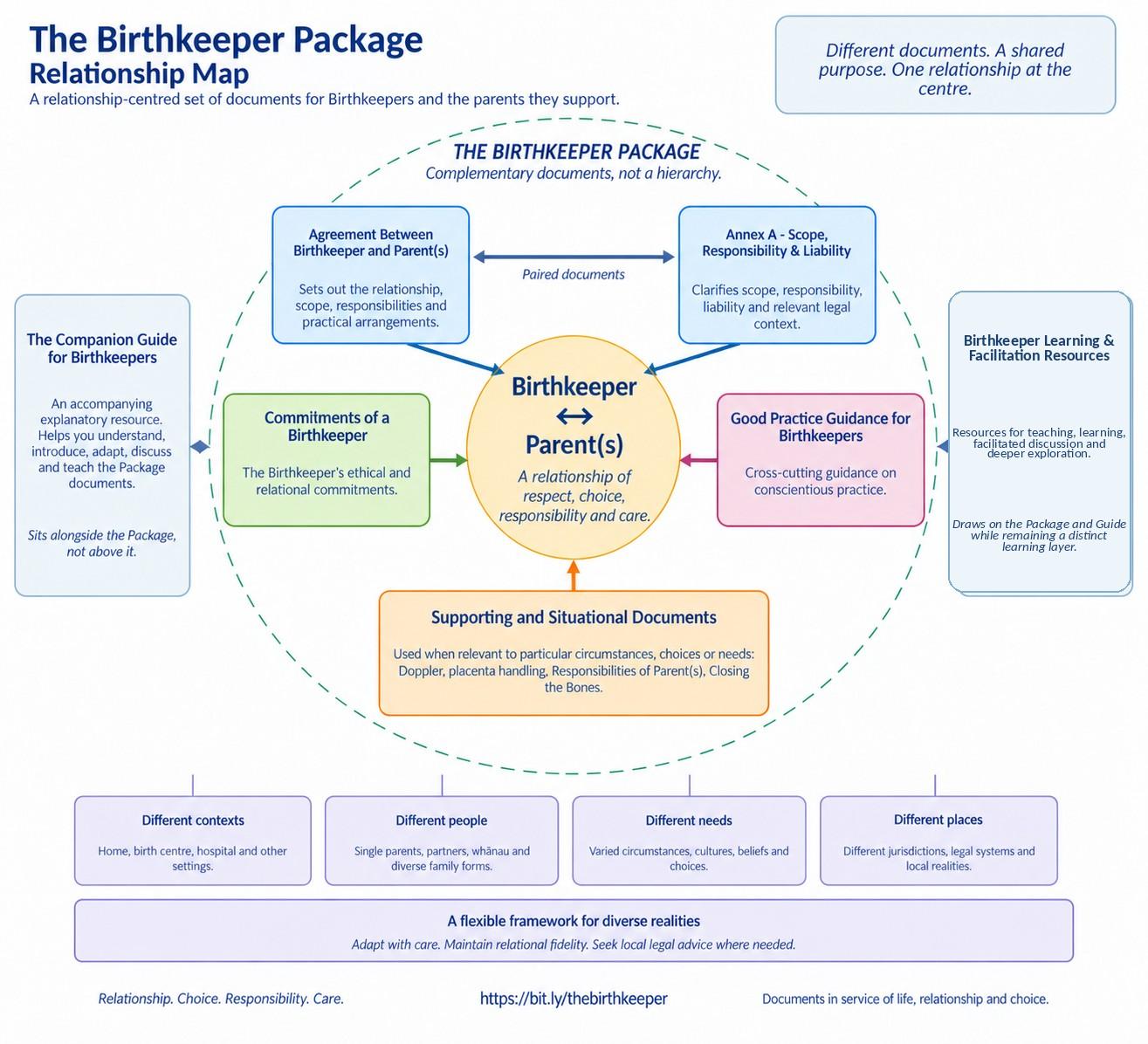
The Birthkeeper Package relationship map
5. Using Written Documents Without Turning Them into Scripts
Written documents can create useful clarity.
They can make expectations visible, record choices, clarify responsibilities, preserve important distinctions and give people something concrete to return to when circumstances become complicated.
But a relationship cannot be fully written in advance.
The documents in The Birthkeeper Package are intended to support conversation and judgement, not replace them. An agreement can record what has been understood. An addendum can make a particular choice visible. A statement of commitments can name the ground from which a Birthkeeper intends to accompany. None of these things removes the need to remain attentive to the people and circumstances in front of us.
This matters especially when a document is signed.
A signature can record agreement, acknowledgement or intention. It does not create parental agency, and it does not turn consent into something that happened once and can therefore be assumed from then on. Where understanding, consent or choice is important, the written record should support the living process rather than stand in for it.
The same is true of guidance.
A useful explanation may suggest questions to ask, matters to consider or distinctions worth making. That does not mean every Birthkeeper must introduce a document in the same words, at the same moment or through the same sequence. Some situations call for fuller discussion. Others may require very little. Some documents may be revisited as circumstances change.
The danger is not paperwork itself. The danger begins when paperwork starts to manage the relationship it was meant to support.
A document can become a script when its wording is treated as more important than what is actually happening. It can become a barrier when completing it matters more than understanding it. It can become a form of control when clarity is confused with compliance.
The answer is not to abandon written agreements, boundaries or records. Clarity matters. Responsibilities matter. A reliable written record can protect everyone involved from later confusion and can help make accountability possible.
The question is whether the document remains in service of the relationship.
Used well, written material can create enough structure for people to know where they stand while leaving room for questions, disagreement, uncertainty, changed circumstances and changed minds.
The Package therefore offers documents to work with, not scripts to perform.
Their value lies not in producing identical relationships, but in helping important parts of each relationship become clearer without pretending that the relationship itself can be reduced to a form.
6. Responsible Adaptation and Relational Fidelity
The Birthkeeper Package is intended to travel.
As it does, it will meet different languages, laws, cultures, practical arrangements and ways of working. Some adaptation will therefore often be necessary.
Adaptation is not a failure to use the Package correctly. In many situations, it is part of using it responsibly.
But adaptation raises a deeper question than whether a sentence still sounds familiar.
The important question is:
Does the adapted wording still describe the same relationship?
A document may preserve much of the original vocabulary while quietly changing where authority sits, how responsibility is understood, or whose judgement is allowed to matter. Conversely, wording may need to change substantially in order to carry the same relational meaning into another language, legal setting or cultural context.
This is what the Guide means by relational fidelity.
Relational fidelity does not require every document to remain word-for-word unchanged. It asks whether the adapted form still preserves the relationships the document was designed to support.
Depending on the document, that may include:
- parental agency;
- Birthkeeper responsibility;
- meaningful consent;
- cooperation without automatic hierarchy;
- honest limits;
- room for judgement;
- accountability;
- non-imposition.
The balance will not be identical in every document.
An agreement may need careful attention to legal wording. A situational document may need to reflect local practice. A declaration such as Commitments of a Birthkeeper may need a translation that carries tone and meaning rather than simply mirroring sentence structure.
Responsible adaptation therefore involves more than copying and more than personal preference.
It asks the Birthkeeper to understand what a document is trying to hold before changing the way it says it.
The Companion Guide can help make that design intention visible without becoming a permission-giving authority. Responsibility for adapting a document thoughtfully remains with the people using it in their own context.
7. Paradigm Drag
Changing terminology does not necessarily change a relationship.
A document may use the language of autonomy while still assuming that authority belongs elsewhere. It may speak of cooperation while quietly preserving subordination. It may describe boundaries in newer language while retaining an older habit of control.
This Guide uses the term Paradigm Drag for this tendency.
Paradigm Drag occurs when assumptions, habits or power relationships from an older model are carried into a newer one, often without being noticed.
It can appear through:
- inherited professional hierarchy;
- defensive legalism;
- clinical assumptions applied where they do not belong;
- procedure replacing judgement;
- responsibility becoming control;
- parental responsibility becoming blame transfer;
- independence becoming opposition;
- guidance becoming instruction;
- boundaries becoming cages.
Paradigm Drag is not something that can be eliminated by choosing the correct vocabulary.
It is better used as a reflective tool than as a label.
Does this sentence merely contain new terminology, or does it actually describe the new relationship?
Is this necessary realism -- or paradigm drag?
Are we clarifying the document, or quietly rebuilding a professional rulebook around it?
These questions are intended to slow down assumptions, not to create a new purity test.
There will be times when legal limits, safety concerns, practical constraints or clear boundaries are entirely appropriate. The point is not to resist every structure associated with professional or institutional life.
The point is to notice when an older pattern is being imported by reflex rather than because it genuinely serves the relationship.
This matters especially during adaptation.
A locally adapted document can be legally careful, professionally familiar and beautifully written while still changing the relationship in ways that were never intended.
Paradigm Drag therefore belongs beside adaptation as a continuing question: What have we changed in the words, and what may have changed underneath them?
8. Jurisdiction, Local Context and Legal Realism
The Birthkeeper Package was not written for one universal legal environment.
Laws, professional boundaries, institutional policies and accepted forms of birth support differ between jurisdictions. The same activity may be described, permitted or restricted differently from one place to another.
For that reason, some parts of the Package will require local checking before they are used or adapted.
Legal wording should not be treated as universally portable simply because it sounds formal or protective. A strongly worded clause is not automatically enforceable, and a document cannot create authority that applicable law does not recognise.
At the same time, legal realism should not become the organising principle of the whole Package.
If every document is rewritten primarily around fear of liability, the relationship can easily become defensive before it has even begun.
The task is to hold both realities.
The Package needs to take law, regulation and institutional policy seriously without allowing them to define the Birthkeeper-parent relationship more narrowly than necessary.
Where local law restricts or reserves an activity, the Package cannot override that restriction.
Where the law leaves room for judgement, variation or ordinary non-clinical support, the Package should not create additional prohibitions merely to appear safer.
This distinction is especially important because legal or local fit and relational fidelity are not the same thing.
Legal or local fit asks whether the document works responsibly within applicable law and its actual context.
Relational fidelity asks whether the adapted document still preserves the relationship it was designed to describe.
Both may matter.
Neither should automatically erase the other.
Local context also includes more than law. Culture, language, institutional practice, geography, available care and family structures can all affect how a document is understood and used.
The Companion Guide can identify where local checking is likely to be important, but it cannot provide a universal legal answer for every jurisdiction.
The aim is to work realistically within the context while preserving as much clarity, agency, responsibility and relational integrity as that context allows.
With these general principles in view, Part II can turn to the individual documents and document sets.
9. Using Document Profiles
Part II of this Guide contains profiles for particular Package documents or related document sets.
The profiles are not intended to be identical in length, structure or emphasis.
Different documents do different work, so the questions that matter most will also differ.
A profile may explain:
- what a document is trying to hold;
- why it took a particular form;
- how it relates to other parts of the Package;
- what may need attention when it is introduced or used;
- what may need adaptation in a particular context;
- where Paradigm Drag is especially likely;
- what has deliberately been left to another document or another kind of guidance.
Some profiles concern one document.
Others may need to explain a pair or group of documents that only make full sense in relation to one another.
Some may include situational considerations.
Others may need to address spoken presentation, legal context, translation, completion method or another feature specific to that document.
The profiles therefore share a common purpose rather than a rigid template.
They are intended to help another Birthkeeper understand the design intention behind a document well enough to work with it thoughtfully.
Development history appears only where it helps explain the finished form.
The Guide does not preserve drafting archaeology for its own sake. Earlier wording, abandoned structures or internal debates matter only when they help make a present design choice clearer.
A profile accompanies the Package document; it does not replace it.
It asks, in effect: What is this document? What is it trying to hold? Why did it take this form? How does it relate to the rest of the Package?
What should another Birthkeeper understand when using or adapting it?
These questions are intended to support understanding, not to create a new layer of compliance.
A profile is useful when it makes the document easier to work with while leaving room for judgement, context and relationship.
10. Feedback, Versioning and Evolution
The Birthkeeper Package and this Companion Guide are intended to be usable in real relationships.
That means practical experience matters.
A document that works well in one setting may reveal an ambiguity in another. Local law may expose wording that needs attention. A Birthkeeper may discover that an explanation is easily misunderstood, or that a situational document does not fit the circumstances for which it was intended.
Such feedback can be valuable.
It does not follow that every difficulty, disagreement or preference requires immediate revision.
Stability matters too.
If documents are changed too quickly or too often, it becomes difficult to know which version is being used, what has actually been tested in practice, or whether a problem lies in the wording, the context or the way the document was introduced.
Revision should therefore be deliberate.
A useful question is not simply:
Could this be worded differently?
but:
Has experience shown a concrete reason why it should be?
A factual error, contradiction, important ambiguity, recurring practical difficulty or jurisdictional problem may provide such a reason. So may evidence that the wording is creating a relationship different from the one intended.
Feedback may also show that no change to the Package is needed.
Sometimes the better response is clearer Companion Guide explanation, a local adaptation, a different situational document, Good Practice Guidance, further discussion or teaching.
Knowing the version of a document matters because it allows people to understand what they are actually using and discussing.
Versioning should support clarity rather than create administrative weight.
The same principle applies to the Companion Guide.
Its explanations may develop as more Birthkeepers use the Package, test it in different settings and identify places where further clarity is helpful.
Evolution does not require constant movement.
The Package can remain stable enough to be trusted while still remaining open to learning.
That balance matters.
A living body of work should be able to change when there is good reason, without treating every new opinion as an instruction to rewrite what has already been carefully developed.
The same openness applies to discussion around the Package. Birthkeepers and others are encouraged to question the documents, discuss the ideas behind them, compare experience of using them and bring different interpretations into conversation. Useful development does not depend on every comment being channelled back to one person; a wider conversation can itself test, carry and refine the work.
Current information and ways to stay in contact can be found at https://bit.ly/thebirthkeeper.
──── ◇ ────
Part II - Document Profiles
Reading online? The formatted Guide PDF keeps the original page layout and diagrams together for printing or saving.
The profiles that follow are grouped by function rather than rank. Their order does not imply that one document is more important or authoritative than another. They may be read in sequence or consulted as relevant to the documents being used.
──── ◇ ────
Core Relationship and Scope
The paired documents that establish the general Birthkeeper-parent
relationship and clarify scope, responsibility and liability.
Documents in this section
Agreement Between Birthkeeper and Parent(s)
Annex A - Scope, Responsibility & Liability
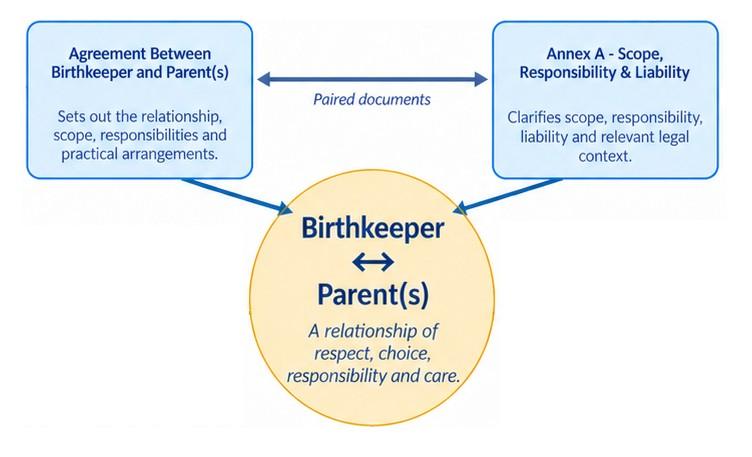
Agreement ↔ Annex A → Birthkeeper - Parent relationship
──── ◇ ────
Package: Agreement · Annex A · Guide contents
Agreement Between Birthkeeper and Parent(s) with Annex A - Scope, Responsibility & Liability
What this document set is
The Agreement between Birthkeeper and Parent(s) is the main relational and practical document for making the agreed working relationship explicit.
It records the broad shape of the support being agreed, the responsibilities of the people involved, practical arrangements, communication, records, confidentiality, accountability and the place of supporting documents.
It exists in two completion formats -- print-and-pen and screen-fill. These are two ways of completing the same Agreement rather than different versions of the relationship.
The Agreement should be read with Annex A -- Scope, Responsibility & Liability.
The two documents form a pair.
The Agreement describes the relationship and its main terms. Annex A carries the companion framework for scope, responsibility and liability. Reading either one without the other can leave an incomplete picture of how the Package understands the Birthkeeper's role.
What the pair is trying to hold
The Agreement is a relationship-design document with legal and practical functions.
Its central purpose is to make the Birthkeeper-parent relationship clear enough to be entered into consciously, worked within flexibly, and accounted for afterwards.
Several things need to be held together:
- parental agency without making autonomy mean abandonment;
- Birthkeeper responsibility without transferring parental decision-making;
- independence without turning independence into opposition;
- cooperation with healthcare without automatic subordination;
- boundaries without defining Birthkeeping through universal prohibition lists;
- legal realism without allowing defensive legalism to organise the relationship;
- accountability alongside appropriate protection;
- flexibility without making scope meaningless.
Financial arrangements can also take different forms. A fee, donation, exchange, solidarity arrangement, expenses-only arrangement or no-fee relationship does not by itself define what a Birthkeeper is.
Why the Agreement and Annex A are separate
The separation between the Agreement and Annex A is part of the Package's modular design.
The Agreement needs to remain a workable relational and practical document. If every question of scope, responsibility and liability were folded into it, legal caution could easily become its organising centre.
Annex A allows those matters to be addressed more directly without making them the defining centre of the relationship.
The two documents therefore divide the work rather than duplicate it.
The Agreement asks, broadly: What relationship are we agreeing to enter, and how will we work within it?
Annex A asks more specifically: How are scope, responsibility and liability understood within that relationship?
Where a question concerns scope, responsibility, liability or agreed boundaries, Annex A carries more of that work within the pair.
This division keeps legal protection in view without allowing it to dominate the whole Agreement.
Why the Birthkeeper role is described positively
An important design shift in the mature Agreement was the move away from defining the Birthkeeper mainly through what she is not.
Earlier approaches relied more heavily on lists of professions the Birthkeeper was not acting as, lists of activities she would not perform, and repeated separation from anything described as clinical or medical.
The mature Agreement kept necessary scope clarity but changed the organising question.
Instead of beginning from: What must the Birthkeeper be prevented from doing?
the final structure works more from: What relationship are these people agreeing to enter, what support can exist within it, and where do responsibility and limits lie?
The section title "Scope and Boundaries of Birthkeeper Support" reflects that change.
The same shift appears in smaller language choices. "People involved in healthcare" avoids building unnecessary rank into the description. "Support with communication" names a relational activity directly. "Observe" rather than "monitor" allows the Birthkeeper to notice and draw attention to what is seen or heard without silently turning observation into clinical surveillance, diagnosis or reassurance.
These are not merely vocabulary preferences. They help describe a different relationship.
Scope is contextual
The Agreement deliberately avoids defining the Birthkeeper role through one universal catalogue of permitted and prohibited activities.
Appropriate Birthkeeper support depends on several things together:
- the agreed scope;
- the consent of the Parent(s);
- the Birthkeeper's skill;
- the Birthkeeper's experience;
- the Birthkeeper's judgement;
- the circumstances;
- applicable law.
This makes scope contextual rather than vague.
The Package itself need not prohibit an activity merely because a jurisdiction, profession or institution may describe it as clinical or medical.
Equally, a private agreement cannot authorise an activity that applicable law restricts or reserves.
Labels therefore do not settle the question by themselves.
What matters is the relationship between what has been agreed, what the Birthkeeper is capable of, what the Parent(s) consent to, what the circumstances call for and what the law permits.
Agency, responsibility and cooperation
The Parent(s) remain the primary decision-makers.
That does not make the Birthkeeper's role empty.
The Agreement holds parental decision-making together with the Birthkeeper's responsibility for her own role, judgement, actions and omissions.
Respecting the Parent(s)' authority over their own choices does not require the Birthkeeper to withdraw attention, communication or judgement where these belong within the agreed role.
The same relational logic applies when other people are involved.
The Agreement and Annex A allow Birthkeeping to work alongside people involved in healthcare and other forms of support.
Cooperation does not require automatic subordination.
Independence does not require opposition.
Each person involved remains responsible for their own role, judgement, actions and decisions.
This makes room for complementarity without pretending that all roles are the same or arranging them into an automatic rank order.
The useful question is what each person is responsible for in the actual circumstances, and how their involvement can support the Parent(s) without creating unnecessary confusion or conflict.
Working through the Agreement with Parent(s)
The Agreement is more useful when it is treated as something to work through rather than simply something to sign.
Its purposes include clarity, trust, informed participation, mutual understanding and agency.
That may mean discussing particular sections, answering questions, clarifying expectations or noticing where the wording does not fit the actual arrangement being considered.
Not every part requires a long conversation.
The signature records the agreement; it does not create the relationship by itself.
A Birthkeeper using the Agreement should therefore understand what its important provisions are trying to make visible -- especially the nature of support, responsibilities and decision-making, scope and boundaries, communication, practical and financial arrangements, records and confidentiality, and the relationship with Annex A and any situational documents being used.
How the pair fits with the rest of the Package
"Agreement Between Birthkeeper and Parent(s)" and "Annex A - Scope, Responsibility & Liability" provide the core working framework.
They are not intended to absorb every subject that may arise.
Situational documents can add information, specific choices, consent or practical arrangements where a particular topic becomes relevant without casually redefining the Birthkeeper role.
"Commitments of a Birthkeeper" states the ethical and relational ground from which the Birthkeeper intends to accompany the Parent(s).
"Good Practice Guidance for Birthkeepers" carries the fuller questions of conscientious practice that cannot sensibly be reduced to agreement clauses.
Keeping these functions separate allows the Agreement to remain an agreement.
Adaptation and local context
For the Agreement and Annex A, local checking is particularly important because legal terminology, enforceability, reserved activities, regulation and institutional expectations differ between jurisdictions.
A legally cautious adaptation can still distort the document if it quietly restores hierarchy, Birthkeeper passivity, fixed-act prohibition models or defensive legalism.
Conversely, preserving the relational philosophy does not justify ignoring applicable law.
The task is to keep legal or local fit and relational fidelity in view together.
This profile cannot provide jurisdiction-specific legal advice. Its role is to make the document pair's design intention clear enough that local legal adaptation need not accidentally undo the relationship the pair is trying to describe.
Paradigm Drag to watch for
In this document set, it can appear especially as:
- defining the Birthkeeper mainly through prohibition;
- treating parental autonomy as a reason for Birthkeeper passivity;
- turning cooperation into subordination;
- turning independence into opposition;
- turning responsibility into control;
- organising legal protection through distrust;
- making boundaries ever narrower simply because narrowness appears safer;
- assuming that formal legal language is necessarily stronger or more enforceable.
The useful question is:
Does this wording merely sound different, or does it still describe the relationship the Agreement is trying to hold?
That is the central purpose of this profile: to make the design of the pair visible enough that another Birthkeeper can work with it without losing the balance of agency, responsibility, cooperation, judgement, accountability and legal realism that gives the documents their shape.
END OF PROFILE
Agreement Between Birthkeeper and Parent(s) with Annex A - Scope, Responsibility & Liability | Companion Guide v1.3 | 27 September 2026
──── ◇ ────
Supporting and Situational Documents
Documents used where a particular circumstance, choice or form of support benefits from its own information, discussion or agreement.
Documents in this section
Doppler
Placenta Handling Agreement and Addendum
Responsibilities of Parent(s)
Closing the Bones
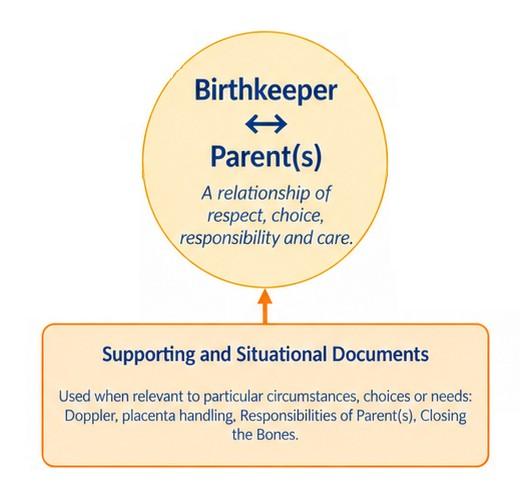
Doppler · Placenta Handling · Responsibilities of Parent(s) · Closing the Bones
↓
situational support within the Birthkeeper - Parent relationship
──── ◇ ────
Package: Doppler document · Guide contents
Doppler
A situational listening document
Doppler is a short information and acknowledgement document about how Doppler use may fit within birthkeeping support.
It does not try to teach Doppler technique or explain the technology in detail.
Instead, it answers a more immediate relational question: What does the use -- or non-use -- of a Doppler mean within this Birthkeeper-parent relationship?
The document presents the Doppler as a listening and awareness tool. Its use is not routine. It is situational, and different families may make different choices about whether or when they want it used.
That is the starting point for understanding this document.
The document is not trying to persuade Parent(s) towards Doppler use or away from it. It creates enough shared understanding for the subject to be discussed without making the device the centre of the relationship.
Meaningful without becoming medical
The document takes the Doppler seriously.
Listening to the baby's heartbeat may offer reassurance, orientation, connection or a shared point of attention. For the Birthkeeper, it may contribute to an overall sense of how things are unfolding in that moment.
At the same time, the document does not organise that meaning around diagnosis, clinical thresholds or medical management.
This distinction matters.
A non-clinical role does not have to be described as passive or unskilled. The Birthkeeper may listen attentively, notice, remain aware of context and bring what she hears into the wider picture of observation, communication and care.
The boundary is therefore not created by pretending that the Doppler is insignificant.
It is created by keeping the use proportionate to the relationship in which it is taking place.
The document gives the Doppler a meaningful place without allowing it to become a substitute for attentiveness to the mother, the baby or the unfolding process.
Choice that can change
The use of a Doppler is always by choice.
The document gives this more substance than a one-time yes or no.
Preferences may differ between families. They may also change over time or according to circumstances.
The birthing mother is the decision-holder regarding Doppler use. She may ask for it to be used, decline its use or change her mind.
This makes consent part of ongoing communication rather than a single formal moment.
The written document supports that conversation, but does not replace it.
For another Birthkeeper using the Doppler document, this is an important point: it should not be introduced as though it is asking Parent(s) to make one permanent decision about Doppler use.
Its language leaves room for preference, situation and relationship to remain alive.
Limits without withdrawal
The section on limits and expectations is deliberately quiet.
It does not rely on a series of disclaimers about what the Birthkeeper cannot do.
Instead, it explains that Doppler listening offers a momentary piece of information. What is heard can vary with timing, position and circumstances. Its value lies in how it is held alongside other observation, communication and ongoing awareness.
The document also avoids presenting listening as certainty or prediction.
This is an important example of a wider Birthkeeper principle: Boundaries should clarify responsibility without erasing active support.
Here, the Birthkeeper does not disappear when the boundary appears.
Presence, observation, communication and judgement remain part of the relationship. What is resisted is the move from meaningful listening into claims of certainty, diagnosis or clinical management.
That distinction protects the seriousness of the support while keeping its scope intelligible.
Alongside other care
The Doppler document places birthkeeping support alongside other forms of care rather than above them or beneath them by default.
Parent(s) may choose to engage with other care providers during pregnancy or birth. The Doppler within birthkeeping support does not replace those relationships.
At the same time, the document does not use automatic referral language or suggest that every question has to be handed upwards into a professional hierarchy.
Parent(s) are encouraged to remain attentive to their own needs, to seek additional support as they see fit and to engage with medical or professional services according to their circumstances and choices.
This is complementarity without abdication.
The Birthkeeper continues to offer presence, listening and support within the agreed scope while respecting the roles and responsibilities of others involved in the Parent(s)' care.
Acknowledgement as a record of understanding
The Doppler document ends with a short acknowledgement and signature area.
The acknowledgement records that the information has been read and discussed, that there has been an opportunity for questions and preferences to be expressed, and that Doppler use is understood as optional.
The signature is therefore best understood as a record of shared understanding.
It is not the whole of consent, and it should not become a compliance ritual.
The form also keeps the birthing mother central and sufficient.
A partner or support person may sign if applicable, but a second person is not assumed and is not made a condition of the mother's choice.
That small structural decision matters. Inclusion is possible without turning one family form into the default.
Language that locates the relationship
The Doppler document uses ordinary parent-facing language rather than forcing administrative terminology into every sentence.
It speaks naturally of Parent(s) in the wider relational passages, while identifying the birthing mother where the decision about Doppler use is specifically hers.
The optional second signature is labelled Partner or support person (if applicable).
The document also uses observation, awareness, listening and attentiveness rather than making monitoring the organising term for the Birthkeeper's role.
These choices help the language follow the actual relationship being described.
Consistency across The Birthkeeper Package remains important, but consistency should not require every document to sound as though it has been written on the same form.
Where Doppler sits in the Package
Doppler is a situational supporting document.
It does not replace the wider relationship and scope architecture established through the Agreement and Annex A - Scope, Responsibility & Liability.
Nor does it need to restate the wider commitments expressed in Commitments of a Birthkeeper.
Its task is narrower: to make one potentially significant element of support understandable enough for choice, communication and shared expectations.
Broader questions about competence, judgement, interpretation, accountability or good practice belong more naturally in "Good Practice Guidance for Birthkeepers" or "Birthkeeper Learning & Facilitation Resources".
The Companion Guide profile should therefore explain the Doppler document's design and use without turning itself into a Doppler training manual.
Paradigm Drag to watch for
The Doppler document sits between several familiar pulls.
Clinical authority, defensive boundary-setting and a focus on technology can quietly re-enter the relationship even when the language has changed. This is one form of Paradigm Drag: an older pattern reshaping a relationship that is trying to work differently.
Information can become a medical leaflet
More technical detail is not automatically more useful. The document needs enough information for meaningful choice, not a compressed course in Doppler science.
Caution can become defensive disclaimer
A boundary is useful when it clarifies the relationship. Repeated statements about what the Birthkeeper is not responsible for can make self-protection more visible than support.
Non-clinical can become passive
Avoiding medical claims does not require the Birthkeeper to be described as inattentive, unskilled or merely present beside a device she cannot meaningfully use.
Choice can become liability transfer
Parental agency should not be turned into: you chose this, therefore the Birthkeeper has no responsibility. In this document, choice remains embedded in communication and active support.
Acknowledgement can become signature ritual
The signature records an informed conversation. It cannot substitute for that conversation.
The device can become the centre
The Doppler remains one element within a wider field of relationship, embodied awareness, observation, communication and care.
That may be the document's most distinctive achievement.
It gives the Doppler enough weight to be meaningful without allowing either the technology or the boundary around it to take over the relationship.
END OF PROFILE
Doppler | Companion Guide v1.3 | 27 September 2026
──── ◇ ────
Package: Placenta Agreement · Addendum · Guide contents
Placenta Handling Agreement and Addendum
What this document set is -- and why there are two documents
The Placenta Handling Agreement and Placenta Handling Addendum are a pair of situational documents.
They are not part of the core paperwork for every Birthkeeper-parent relationship. They become relevant where placenta handling is being considered and, especially, where the Birthkeeper may have some practical involvement.
The two documents have different jobs.
The Agreement provides the relatively stable topic-specific framework: the Birthkeeper's supportive role, the Parent(s)' decision-making position, practical handling, responsibility and the limits of what the Birthkeeper is offering.
The Addendum records what the Parent(s) actually intend to happen with the placenta in that particular situation.
The Addendum forms part of the Agreement, but it does not duplicate it.
This is another example of modularity as relationship design: the recurring framework and the individual choice are kept distinct because they do different work.
What the pair is trying to hold
The placenta handling documents try to hold several things together:
- Parent(s)' authority over what happens to the placenta;
- room for cultural, ritual, practical and personal meaning;
- practical Birthkeeper support where requested;
- clarity that practical help does not silently become medical or laboratory responsibility;
- honest limits around cleanliness, safety, preservation and sterility;
- a written record of intended handling without requiring the Birthkeeper to direct, prescribe or
endorse that choice.
The central relationship is simple but important:
- The Parent(s) choose.
- The Birthkeeper may support.
- Each remains responsible for their own part.
Parent(s)' choice without Birthkeeper direction
An important development in the Addendum was the move away from wording centred on what the Birthkeeper might advise the Parent(s) to do with the placenta.
The mature wording places the choice more clearly with the Parent(s).
The Birthkeeper does not direct or prescribe that choice.
That does not mean the Birthkeeper disappears from the situation.
The Agreement leaves room for requested practical support such as packaging, labelling, moving or transporting.
This practical involvement can be described honestly without either medicalising it or making ordinary requested help seem impossible.
The Addendum itself remains open rather than offering a checklist of approved placenta choices.
That openness allows different cultural, ritual, practical and personal intentions to be recorded without ranking them or turning the form into a protocol.
The written record makes the intended choice visible.
It does not create the choice.
The signature records what has been described and agreed; it is not the source of parental agency.
Introducing and using the pair
The Agreement and Addendum are most useful when the distinction between them is understood.
The Agreement provides the recurring framework.
The Addendum records the Parent(s)' intended handling in the particular situation.
That understanding matters more than following one fixed sequence for introducing the documents.
Depending on the circumstances, the pair may be discussed together or at different moments. The development record does not support one mandatory timing rule.
What matters is that the Parent(s)' choice and any Birthkeeper involvement are actually understood rather than merely recorded.
The Companion Guide can support that explanation without turning it into a script.
Practical support still carries responsibility
The pair is careful not to turn "non-medical" into "no responsibility".
Where the Birthkeeper agrees to practical involvement, she remains responsible for her own conduct within that role.
The Agreement therefore refers to reasonable standards of cleanliness while also making clear that the Birthkeeper is not promising medical-grade preservation, sterility or laboratory conditions.
This is an important middle ground.
Ordinary practical support should not be inflated into clinical responsibility.
But describing the role as practical and non-medical should not become a way of transferring every form of responsibility to the Parent(s).
Where the placenta handling documents sit in the Package
The Placenta Handling Agreement and Addendum add a situational layer to the general framework established by the Agreement and Annex A.
The core Agreement and Annex describe the overall Birthkeeper-parent relationship, scope, responsibility and liability.
The placenta handling documents add detail for one particular subject when that detail is needed. They should not be used to redefine the whole Birthkeeper role around placenta handling.
Responsibilities of Parent(s) addresses Parent(s)' responsibilities across the wider support relationship, so the placenta handling documents need only the placenta-specific responsibilities required for clarity here.
Broader information about placenta meanings, traditions, hygiene or other practical considerations may be useful, but it serves a different purpose from the signed pair.
Keeping that material separate protects the Agreement and Addendum from becoming overloaded and helps prevent general information from quietly turning into instructions about what Parent(s) should do.
Broader questions of judgement and conscientious practice belong in Good Practice Guidance.
The pair works best when allowed to remain situational.
Adaptation and local context
For the placenta handling documents, local checking may be especially important.
Placenta handling can be affected by law, institutional policy and practical conditions concerning matters such as ownership or possession, release from a hospital or other setting, transport, storage, preparation and disposal.
The current Agreement contains definite wording about ownership and responsibility. That wording should not be assumed to have identical legal effect in every jurisdiction.
Local adaptation may therefore be necessary.
At the same time, legal caution should not erase the relational design.
An adapted version should still make clear where the Parent(s)' choice sits, what practical support the Birthkeeper may be offering, what that support does and does not claim to be, the Birthkeeper's responsibility for her own agreed conduct, and the limits around safety, preservation and sterility.
Room for cultural, ritual, practical and personal meaning should remain visible too.
This profile is not a placenta-handling protocol or jurisdiction-specific legal guide. Its purpose is to make the relationship between choice, practical support and responsibility clear enough that local adaptation does not quietly change it.
Paradigm Drag to watch for
In this document set, Paradigm Drag can appear in several directions.
Practical support can be inflated into quasi-clinical work simply because the placenta is biological material.
The opposite reaction can also occur: fear of role confusion can make ordinary requested help seem impossible.
Parent(s)' responsibility can be written in a way that quietly transfers all responsibility away from the Birthkeeper.
Consent can be reduced to a signature.
And a situational agreement can gradually become a universal placenta-handling protocol.
The useful questions are therefore: Are we making practical involvement clear, or medicalising it?
Are we protecting Parent(s)' choice, or transferring blame? Are we recording a choice, or treating the form as though it creates the choice? Are we explaining a situational document, or quietly turning it into a procedure?
The profile has done its work when another Birthkeeper can understand why the Agreement and Addendum have different jobs, and can preserve real practical support without turning Parent(s)' choices into Birthkeeper direction or prescription.
END OF PROFILE
Placenta Handling Agreement and Addendum | Companion Guide v1.3 | 27 September 2026
──── ◇ ────
Package: Responsibilities of Parents document · Guide contents
Responsibilities of Parent(s)
Responsibility made visible
Responsibilities of Parent(s) is a signed supporting document within The Birthkeeper Package.
It makes explicit something that can otherwise remain vague in a support relationship: what Parent(s) continue to hold for themselves across pregnancy, birth and the weeks after, and how the Birthkeeper's role sits alongside that responsibility.
The document does not treat Parent(s) as passive recipients of Birthkeeper support.
It expects active preparation, information-seeking, decision-making, communication and access to appropriate care.
At the same time, it does not use parental responsibility to make the Birthkeeper irrelevant.
The Birthkeeper remains present as someone who may share resources, observations and experience, offer suggestions and practical assistance, encourage reflection and communicate concerns within the agreed support role.
That combination is central to understanding Responsibilities of Parent(s).
The document is not simply saying: The Parent(s) are responsible.
It is trying to make responsibility clearer without breaking the support relationship in the process.
Shared responsibility without responsibility transfer
The Introduction describes the childbearing journey as a shared responsibility while also placing Parent(s) at the centre of preparation and decision-making.
These two statements are not contradictory.
Responsibility can be shared across a relationship without every person carrying the same responsibility.
Responsibilities of Parent(s) does not make the Birthkeeper responsible for parental decisions or clinical care.
Nor does it use Parent(s)' responsibility to remove the Birthkeeper's responsibility for her own conduct within the support she has agreed to offer.
The document instead describes different responsibilities arising from different positions in the relationship.
Parent(s) continue to make decisions about their pregnancy, birth, baby and care.
The Birthkeeper remains responsible for how she participates within the agreed support role.
The distinction matters in both directions.
If the Birthkeeper becomes the practical decision-maker, parental agency is weakened.
If parental responsibility is used to remove the Birthkeeper from the relationship whenever difficulty appears, autonomy becomes abandonment.
The document tries to avoid both.
Across pregnancy, birth and after birth
The document follows the childbearing journey through pregnancy, birth and the weeks after.
That structure makes responsibility continuous rather than something that becomes important only during labour.
During pregnancy, the emphasis includes preparation, self-care, information and decision-making.
One sentence is especially important: Parent(s) are expected to seek information from a range of appropriate sources rather than rely on the Birthkeeper as their sole source of knowledge or guidance.
That protects more than scope.
It also helps prevent relational trust from becoming dependence on one person as the source of what Parent(s) should know or decide.
During birth, Parent(s) remain at the centre of decision-making and retain responsibility for seeking additional or emergency medical support where needed.
The Birthkeeper may still raise concerns or suggestions.
The document distinguishes this from assessing, diagnosing or deciding on behalf of Parent(s).
After birth, parental responsibility continues around newborn care, recovery, follow-up and further support, while the Birthkeeper may continue to offer listening, encouragement, practical guidance and resources.
Across all three stages, the same relationship remains visible: Parent(s) continue to hold their decisions and responsibilities.
The Birthkeeper continues to accompany within the agreed role.
Boundaries without withdrawal
One of the most important developments in Responsibilities of Parent(s) concerned what happens when circumstances become urgent or worrying.
Boundary language can become misleading if it is written mainly in negative terms.
A sentence may correctly say that the Birthkeeper is not a medical professional, does not diagnose and does not carry clinical responsibility -- yet still leave the impression that she should become passive at exactly the moment when communication and practical support matter most.
The mature wording avoids that.
Its Acknowledgement and Agreement describes the Birthkeeper's support positively before restating its limits.
Support may include observations, experience, practical assistance and suggestions, including where urgent concerns arise.
Parent(s) agree to remain in communication, consider concerns or suggestions raised by the Birthkeeper and seek medical or urgent help when needed.
The medical-decision boundary remains clear.
But the relationship does not disappear behind it.
This is one of the document's clearest design choices: a boundary can remain clear without becoming a cage.
The point is not to turn Responsibilities of Parent(s) into an emergency-response guide.
It is to understand why non-clinical support is not being defined as doing nothing.
Discussion, acknowledgement and signature
Responsibilities of Parent(s) began as something that could have remained an educational handout.
During development, it became clear that information alone did not fully serve its purpose.
The finished document therefore combines accessible parent-facing explanation with a signed Acknowledgement and Agreement.
Parent(s) confirm that they have read, understood and discussed the document, and that they have had the opportunity to ask questions or request clarification before signing.
The document also states that it forms part of the wider agreement with the Birthkeeper.
This gives the signature a specific role.
It records that responsibility and expectations have been brought into the open and discussed rather than left to assumption.
The separate Addendum -- What This Birthkeeper Offers / Does Not Offer -- reinforces the same clarity.
The main sections already describe the Birthkeeper's role during pregnancy, birth and after birth.
The Addendum does not replace them.
It gathers the recurring boundary into one place so that it can also be read in isolation.
In this document, some repetition is deliberate.
The stage sections show the relationship in context.
The Addendum provides a compact reference point.
Where Responsibilities of Parent(s) sits in the Package
"Responsibilities of Parent(s)" does not carry the whole responsibility architecture of The Birthkeeper Package.
The general Birthkeeper-parent relationship and the wider questions of scope, responsibility and liability are established through "Agreement Between Birthkeeper and Parent(s)" and "Annex A - Scope, Responsibility & Liability".
The document brings one part of that wider architecture into sharper focus: what Parent(s) continue to hold across the childbearing journey and how Birthkeeper support relates to it.
Read on its own, a responsibility document can easily appear to place most of the relationship's weight on Parent(s).
Within the Package, it sits beside documents that make the Birthkeeper's own role, scope and commitments visible.
"Commitments of a Birthkeeper" approaches the relationship from another direction by stating how the Birthkeeper intends to accompany Parent(s).
The two documents should not be forced into a symmetrical list of Parent(s)' duties and Birthkeeper duties.
They do different work.
"Good Practice Guidance for Birthkeepers" carries the wider questions of how a Birthkeeper should judge concern, communicate difficult information, respond to disagreement or act responsibly in complex circumstances.
This profile needs only enough of those questions to explain why this document is designed as it is.
Introducing and adapting Responsibilities of Parent(s)
Because Responsibilities of Parent(s) is a responsibility document, the way it is introduced can change how it is heard.
Presented narrowly as a form explaining what Parent(s) are responsible for, it can sound as though responsibility is being handed to them so that the Birthkeeper can step away from it.
That is not the relationship described by the finished document.
The document is better understood as making several things visible at the same time:
- what Parent(s) continue to hold;
- what the Birthkeeper continues to offer;
- where responsibilities differ;
- where medical or clinical responsibility does not sit;
- why continuing communication still matters.
Local adaptation may also need particular care around wording about parental responsibility, emergency help, safeguarding, medical decisions and the lawful scope of non-clinical support.
Those matters differ across jurisdictions.
An adapted version still needs to avoid the two distortions that the document itself works against:
turning the Birthkeeper into the decision-maker;
or turning Parent(s)' responsibility into a reason for Birthkeeper withdrawal.
Paradigm Drag to watch for
Responsibilities of Parent(s) is especially vulnerable to Paradigm Drag because responsibility language can reproduce older patterns while appearing to support autonomy.
Parent(s)' responsibility can become blame transfer.
Autonomy can become abandonment.
A clear non-clinical boundary can become withdrawal.
Birthkeeper protection can become defensive legalism.
A signed acknowledgement can become a compliance device rather than a record of discussion and understanding.
The useful questions are therefore specific: Are we clarifying responsibility, or deciding in advance who will carry blame? Are we preserving parental agency, or leaving Parent(s) alone with decisions while still calling that autonomy? Are we making the Birthkeeper's limits clear, or making the Birthkeeper disappear?
Are we using the acknowledgement to record understanding, or allowing paperwork to stand in for relationship? Are we explaining Responsibilities of Parent(s), or quietly turning it into a rulebook for what Parent(s) must do?
The development of Responsibilities of Parent(s) moved from a partly protective impulse toward a more relational form of clarity.
That movement is worth preserving.
The document has done its work when responsibility is explicit enough to reduce role confusion while the relationship still contains support, communication and accountability.
Its central achievement is not simply that it says who is responsible.
It is that responsibility is made visible without being used to break the relationship.
END OF PROFILE
Responsibilities of Parent(s) | Companion Guide v1.3 | 27 September 2026
──── ◇ ────
Package: Information · Description · Consent · Guide contents
Closing the Bones
One practice, three documents
The Closing the Bones document set has three parts:
- Information
- Description
- Consent
The three documents belong together, but each has one primary purpose.
The Information document explains the nature, purpose, limits, roles, boundaries and health considerations of Closing the Bones.
The Description gives a fuller sense of how the practice may be offered and experienced.
The Consent form records informed understanding and voluntary participation.
Keeping those purposes distinct allows explanation, discussion and consent to remain visible without asking one document to do everything.
A useful way to understand the set is:
- Information supports understanding.
- Description supports conversation about what participation may involve.
- Consent records a voluntary choice to participate.
This is not a rigid three-step procedure. The documents can be revisited, and conversation may move backwards and forwards between them. Their value lies in the relationship between their purposes, not in completing paperwork in a prescribed order.
Information without clinicalising support
The Information document presents Closing the Bones as a supportive, non-medical practice.
It also names circumstances in which the practice may need to be adapted, delayed or not offered.
These health considerations do not turn the Closing the Bones set into a clinical assessment document. They acknowledge that physical circumstances matter when considering whether a proposed form of support remains appropriate.
The finished wording deliberately keeps that precautionary clarity without making the Birthkeeper disappear behind the boundary.
The role remains non-clinical. At the same time, a non-clinical role is not described as an absence of observation, judgement, communication or ordinary responsibility.
A clear boundary can clarify the relationship without becoming a cage.
Description without choreography
The Description document gives the practice enough shape for a mother to understand what may be involved.
It describes possible elements such as conversation, quiet reflection, gentle bodywork, the use of a rebozo or long cloth, wrapping, warmth and time for rest.
At the same time, it explicitly resists a fixed sequence.
Elements may be adapted, omitted or delayed. Timing may vary. Not every session contains every element. No particular response is required or promised.
That flexibility is part of the design.
The Description therefore has a particular task: to make an embodied practice understandable without freezing it into choreography.
Its examples describe possibilities. They are not a checklist that has to be completed.
Consent as part of a process
The Consent form is deliberately short and form-like.
It records that clear explanations have been received, that there has been an opportunity for questions and clarification, that the non-medical boundaries are understood, and that participation is voluntary.
It also records the mother's ability to decline, pause or withdraw.
The form therefore makes most sense in relation to the Information and Description documents.
The signature is the visible record of an informed and voluntary process. It is not the whole of that process.
Explanation, understanding, questions, choice and the continuing ability to change one's mind remain part of what gives the signed form meaning.
Using the set as conversation
The documents do not require a scripted presentation.
The Information document may be read independently or together with the Birthkeeper and may be revisited.
The Description is more explicitly conversational. The Birthkeeper goes through it with the mother, allowing room for explanation, questions, preferences and choices.
The written document supports that conversation rather than replacing it.
The practical movement through the set is therefore towards understanding and voluntary choice, not towards completing forms for their own sake.
This is one reason the three documents remain separate: each can do its own work without turning the whole encounter into a single dense agreement or a fixed procedure.
Language, variation and cultural context
Much of The Birthkeeper Package uses Parent(s) where a broader term is appropriate.
The Closing the Bones set deliberately retains mother.
That fits the particular character of this postpartum, mother-facing practice and the embodied experience described in the documents. It is a document-specific choice rather than a new terminology rule for the whole Package.
The set also uses Birthkeeper rather than a generic term such as facilitator, keeping the practice within the relationship and language of the wider Package.
The documents acknowledge that Closing the Bones appears in different cultural contexts and that practices vary. The Description leaves room for physical, emotional, symbolic and sometimes ceremonial elements.
The present Package sources do not establish one authentic ritual, one universal sequence or one settled cultural history. The Companion Guide therefore does not try to supply one.
What the documents do establish is that the form of the practice may vary while the mother's wishes, comfort, dignity, autonomy and consent remain central.
Where Closing the Bones sits in the Package
Closing the Bones is a situational supporting set.
It does not replace the core relationship and scope architecture established through "Agreement Between Birthkeeper and Parent(s)" and "Annex A - Scope, Responsibility & Liability", and it does not need to restate the wider commitments expressed in "Commitments of a Birthkeeper".
Instead, it brings those wider relational foundations into one particular postpartum practice.
Its distinctive contribution is to show how information, lived description and consent can be separated without breaking the conversation between them.
Broader questions about competence, judgement, accountability or good practice belong more naturally in "Good Practice Guidance for Birthkeepers".
This profile therefore explains the documents and their design. It is not a Closing the Bones practice manual.
Paradigm Drag to watch for
The Closing the Bones set has several distinctive places where inherited habits can quietly return.
Here the pull may come through procedure, consent formalities, role assumptions or the wish to make a relational practice more controllable. In this setting, Paradigm Drag names the way those inherited patterns can return inside an apparently different form.
Description can become procedure
The Description names possibilities. Written guidance should not turn those possibilities into mandatory choreography.
Consent can become a signature ritual
The form records informed voluntary participation. A signature cannot replace the explanation, questions and freedom of choice that give it meaning.
Non-clinical can become passive
Clear limits matter. They need not erase observation, communication, judgement or ordinary responsibility from the Birthkeeper relationship.
Three documents can become bureaucracy
The three-part structure is useful because each document has one primary purpose. Repetition for its own sake would weaken that clarity.
The distinctive achievement of the Closing the Bones set is not simply that one topic has been divided across three files.
It is that explanation, lived description and recorded consent remain distinct enough to support clarity, conversation and voluntary participation, while the practice itself remains responsive rather than scripted.
END OF PROFILE
Closing the Bones | Companion Guide v1.3 | 27 September 2026
──── ◇ ────
Commitments and Practice Guidance
Documents that name the Birthkeeper's relational commitments and
support conscientious judgement in practice.
Documents in this section
Commitments of a Birthkeeper
Good Practice Guidance for Birthkeepers
Commitments of a Birthkeeper
↓
Birthkeeper - Parent relationship
↑
Good Practice Guidance for Birthkeepers
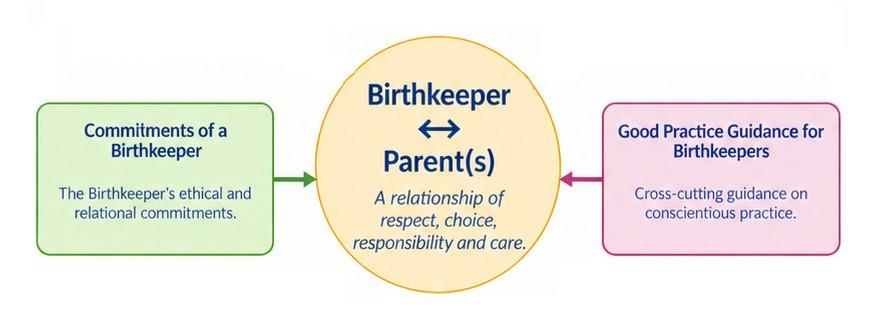
──── ◇ ────
Package: Commitments document · Guide contents
Commitments of a Birthkeeper
What this document is -- and what it is trying to hold
Commitments of a Birthkeeper is a concise, parent-facing declaration of accountable intention.
It is written in the first person:
"I, as your Birthkeeper, offer you these commitments."
The document tells the Parent(s) what this Birthkeeper undertakes to bring into the relationship.
A commitment here is more than a pleasant statement of values, but it is not an outcome guarantee, a contract, a regulatory code, a universal professional standard or a procedure list.
It names an intention to act, a quality of conduct and a basis on which the Birthkeeper can later be asked to explain herself, reflect on what happened and respond when her practice falls short.
The nine commitments are not simply nine separate topics.
Together they describe a relational ground.
They begin with presence and recognition, then move through autonomy and choice, communication, privacy, information and guidance, wellbeing and access to care, recognition of limits, and finally accountability and making amends.
The closing words return the commitments to the relationship as a whole:
"These commitments name the ground from which I will accompany you. As your particular journey unfolds, I will make space for what it brings."
The commitments establish ground. They do not prescribe every future action.
Why the first-person voice matters
The first-person voice locates responsibility in the Birthkeeper who is offering the document.
The Birthkeeper is not announcing requirements for the Parent(s), or rules that every person using the word Birthkeeper must follow.
She is naming what she herself undertakes to bring into this relationship.
That makes the document relational rather than institutional.
It also gives the commitments their accountable quality.
"I will" is not a promise that every outcome can be controlled. It is a statement that the Birthkeeper is willing to place her own conduct under a declared intention and to be answerable for how she has lived it.
Why the sequence matters
The order of the commitments is deliberate.
The development record describes a movement from encounter and recognition, through accompaniment, toward humility and accountability.
Several transitions help carry that movement.
Presence and Listening leads into Respect for Who You Are: presence becomes personal recognition.
Respect for Who You Are then leads into Your Autonomy and Choices: the person is encountered before her choices are discussed.
Later, Information and Guidance moves into Wellbeing and Access to Care, where general guidance meets concrete concern.
Recognising My Limits and Seeking Support then leads into Accountability and Making Amends: humility becomes answerability.
The sequence is therefore relational rather than alphabetical or bureaucratic.
It is not a hierarchy and it is not a procedure to follow in order.
The significance lies in the movement of the declaration when read as a whole, not in attaching special meaning to the number nine.
Recognition, autonomy and consent
The final structure gives Respect for Who You Are its own place before Your Autonomy and Choices.
That distinction matters.
Autonomy is not treated simply as a mechanism for choosing between options. The person whose choices are being respected is first encountered as a whole person, with her own values, beliefs, relationships and circumstances.
Consent then sits within Your Autonomy and Choices rather than as a separate commitment.
This places consent within the wider reality of parental agency rather than treating it as a detached procedural permission.
The commitment connects consent with explanation, attentiveness to responses, and the right to pause, decline or change one's mind.
Consent is therefore held as something lived within the relationship, not completed once and then assumed.
Where Commitments of a Birthkeeper sits in the Package
Commitments of a Birthkeeper is intentionally concise.
Parent(s) should be able to encounter the commitments directly without first having to work through a practice manual.
"Commitments of a Birthkeeper" states what the Birthkeeper commits herself to within the relationship.
"Agreement Between Birthkeeper and Parent(s)" and "Annex A - Scope, Responsibility & Liability" describe the agreed relationship, scope, responsibility and liability framework.
The supporting and situational documents add clarification where particular subjects or choices need their own documents.
"Good Practice Guidance for Birthkeepers" has a different purpose again. It can explore what conscientious Birthkeeper practice may look like in uncertain, complex or relationally difficult situations.
The Commitments name the ground.
Good Practice Guidance explores practice on that ground.
Keeping the two separate protects both documents.
The commitments remain direct enough to be offered to Parent(s), while Good Practice Guidance can go deeper without becoming something Parent(s) are expected to sign, absorb or treat as part of their agreement.
The documents support one another by remaining distinct.
Introducing, speaking and giving the document ceremonial weight
Commitments of a Birthkeeper need not be reduced to paperwork.
It may be handed over, read, discussed, spoken aloud or brought into a wider conversation, according to the relationship and context.
There is no single required way to introduce it.
What matters is that it remains an offering of accountable commitments rather than becoming a performance, credential or test of whether someone qualifies as a "good Birthkeeper".
Commitments of a Birthkeeper was developed with spoken use in mind as well as silent reading.
Where it is spoken, the development notes make a useful distinction:
the headings may be spoken;
the numbers need not be.
Numbers organise the page.
The headings carry meaning in speech.
The notes also recommend allowing the commitments room to land through pauses and breath, with genuine silence after the final commitment before the closing words.
That guidance should remain light.
It is not choreography that must be performed correctly.
If the document is given ceremonial weight, that should mean seriousness, presence and room for the words -- not theatre, mystique or an elevation of Birthkeeper authority.
The usefulness lies in bringing the declaration into a living relationship, not in completing a presentation procedure correctly.
Adaptation and context
Commitments of a Birthkeeper appears less jurisdiction-sensitive than some other Package documents.
Its main adaptation questions are more likely to involve language, translation, cultural context, spoken or written use, family structures, local expectations around Birthkeeper support and the natural voice of the Birthkeeper offering it.
Responsible adaptation does not require every sentence to remain literally unchanged.
It does require the relational meaning to remain recognisable.
An adaptation should still preserve the Birthkeeper speaking from her own responsibility rather than regulating the Parent(s), recognition of Parent(s) as whole people, parental autonomy and ongoing consent, non-imposition, honest communication, support for wellbeing and access to care, recognition of limits, and accountability with repair.
A translation or adaptation can keep familiar words while changing those relationships underneath them.
Relational fidelity therefore matters more than surface resemblance.
Paradigm Drag to watch for
Ethical declarations are especially vulnerable to becoming the kind of structure they were intended to avoid.
In Commitments of a Birthkeeper, Paradigm Drag can appear when:
- commitments become certification criteria;
- autonomy is named while the Birthkeeper still assumes hidden authority over the "right"
decision;
- consent becomes a procedural box;
- respect becomes politeness without real recognition;
- information and guidance drift into persuasion;
- concern for wellbeing becomes automatic hierarchy;
- limits become self-protective withdrawal or universal prohibition;
- accountability becomes disciplinary compliance rather than answerability and repair;
- spoken presentation becomes theatrical performance;
- ceremonial use increases Birthkeeper status or mystique;
- presentation guidance turns into mandatory ritual.
The central question is:
Are these commitments helping the Birthkeeper stand more clearly in relationship and accountability, or are they being turned into a code, credential or performance of authority?
That question is also the best boundary for this profile. Its purpose is not to expand Commitments of a Birthkeeper into a professional code or practice manual, but to help another Birthkeeper understand why its voice, sequence and spoken possibilities matter when the declaration is brought into a living relationship.
END OF PROFILE
Commitments of a Birthkeeper | Companion Guide v1.3 | 27 September 2026
──── ◇ ────
Package: Good Practice Guidance document · Guide contents
Good Practice Guidance for Birthkeepers
What kind of guidance this is
Good Practice Guidance for Birthkeepers is a Birthkeeper-facing framework for conscientious practice.
It begins from a simple difficulty: ethical commitments can name the ground of a relationship, but real situations still require judgement.
Birthkeeping takes place in changing circumstances, with incomplete information, different kinds of knowledge, strong emotions, relationships of trust, and sometimes genuine disagreement or concern. No fixed procedure can decide every situation responsibly.
Good Practice Guidance therefore does not try to prescribe one model of Birthkeeping.
Nor does it suggest that, because context matters, every approach is equally responsible.
Its purpose is to help Birthkeepers reflect on how they listen, observe, communicate, use influence, recognise limits, work with others, keep records, continue learning and remain accountable for their actions.
This makes Good Practice Guidance different from a professional code, a regulatory standard or a procedure manual.
Its authority does not come from an institution standing above Birthkeepers. It comes from the seriousness of the questions it asks and the clarity with which it describes conscientious practice.
The central balance is: clear ethical responsibility without replacing judgement with rules.
Guidance that leaves room for judgement
Not every statement in Good Practice Guidance carries the same weight.
Some matters form an ethical floor and allow little room for variation.
Others describe what a conscientious Birthkeeper would normally be expected to do.
Some depend substantially on context, competence, relationship, uncertainty or local law.
And in some places, a reflective question is more useful than an instruction.
This difference is deliberate.
The Guidance can therefore be understood as working across four levels:
- ethical floor;
- expected good practice;
- context-sensitive guidance;
- reflective practice.
The language of the document changes with the strength of the guidance.
Must and must not are reserved for matters where a strong ethical or legal reason justifies them.
Should describes practices that would normally be expected.
May, can and where appropriate leave room for more than one responsible approach.
Reflective questions are used where the important task is not compliance with a rule but honest examination of judgement, influence, assumptions or conduct.
This layered approach is one of the main safeguards against turning good practice into governance.
It also prevents the opposite problem.
Respect for context does not become an escape from responsibility.
A Birthkeeper may still need to explain what she observed, what she understood, what she was uncertain about, why she acted or spoke as she did, and how her actions affected Parent(s).
What Good Practice Guidance is trying to strengthen
The Guidance is not organised around one technique or one model of care.
It is concerned with the qualities that make judgement more trustworthy.
Across the document, several recurring disciplines appear.
A Birthkeeper is encouraged to be present before assuming that something needs to be done.
She is asked to notice the influence that comes with trust and to consider what that influence does to Parent(s)' agency.
She is encouraged to distinguish what she observed from what she inferred, interpreted, believed or was told.
She is expected to recognise that knowing her limits is part of competence rather than evidence of inferiority.
She is encouraged to cooperate with others without assuming that difference of role automatically establishes hierarchy.
She is asked to keep records for a purpose and in proportion to that purpose rather than imitating medical documentation or collecting information simply because it may one day appear useful.
And she is asked to treat accountability as part of ordinary practice rather than something that begins only when somebody complains.
Several working principles express this stance particularly well:
- presence before intervention;
- authority in relation to agency;
- observe before interpreting;
- limits as part of competence;
- cooperation without submission;
- independence without opposition;
- boundaries as contours rather than cages;
- good documentation is proportionate documentation;
- privacy includes deciding what not to collect;
- accountability without presumption of guilt.
These are not slogans to apply mechanically.
They describe tensions that a conscientious Birthkeeper may need to hold rather than solve once and for all.
How the document is organised
Good Practice Guidance has eight chapters.
Their sequence matters, but they are not eight steps in a procedure.
The document begins by asking what good practice in Birthkeeping means.
It then moves into relationship, presence and respect.
From there it examines autonomy, authority, communication and influence -- the place where trust begins to give the Birthkeeper's words weight.
That leads naturally into observation, information and judgement -- what those influential words are actually based upon.
The next chapter considers scope, limits and working with others.
The document then turns to privacy, records and respectful documentation, followed by continuing learning, reflection and sustainable practice.
It ends with accountability, concerns and repair.
That ending is important.
Accountability is not added as an administrative appendix after the real work of Birthkeeping has been described.
It is where the practice architecture arrives.
The eight chapters therefore move from the immediate relationship outward into judgement, cooperation, records, learning and finally answerability.
The structure also shows why Good Practice Guidance is not simply an expanded version of the nine Commitments.
The Commitments name relational ground.
Practice questions cross those headings.
Autonomy, communication and influence need to be considered together.
Observation, information and judgement form another field.
Learning, collegial culture and accountability support the whole of practice.
Good Practice Guidance therefore develops the commitments without turning itself into a commentary arranged beneath them.
Relationship with the rest of The Birthkeeper Package
"Good Practice Guidance for Birthkeepers" does one kind of work within a wider modular Package.
"Agreement Between Birthkeeper and Parent(s)" and "Annex A - Scope, Responsibility & Liability" establish the agreed relationship, scope, responsibility and liability framework.
"Commitments of a Birthkeeper" names what the Birthkeeper commits herself to within that relationship.
The supporting and situational documents deal with particular subjects and situations that need their own information, consent, acknowledgement or practical arrangements.
"Good Practice Guidance for Birthkeepers" has a different role.
It asks what conscientious Birthkeeper practice can look like across many different situations.
This division of functions matters.
Good Practice Guidance does not alter the Agreement or silently enlarge the Birthkeeper's scope.
It does not replace the commitments with a professional code.
And it does not absorb topic-specific education merely because the same practice principles may apply there.
Some material that might once have become separate standards documents -- for example recurring questions about communication, records and accurate documentation -- found a better home inside Good Practice Guidance because they are cross-cutting disciplines rather than separate topics.
That is modularity serving relationship and clarity rather than file organisation.
The same distinction matters for this Companion Guide.
Good Practice Guidance guides practice.
"The Companion Guide" explains what "Good Practice Guidance for Birthkeepers" is, why it took this form, how it relates to the Package, and what another Birthkeeper may need to understand when using or adapting it.
If a Companion Guide profile begins answering situation after situation with what a Birthkeeper should do, it has stopped explaining Good Practice Guidance and started writing another version of it.
Adaptation and local context
Good Practice Guidance is intended to travel across different Birthkeeper backgrounds, traditions, communities and ways of working.
That does not make context irrelevant.
Legal requirements differ between jurisdictions.
Routes into healthcare differ.
Expectations around confidentiality, records, professional roles and communication may differ.
Language and cultural assumptions may also require adaptation.
Good Practice Guidance does not attempt to supply one legal model for every place.
Applicable law remains part of the context in which a Birthkeeper practises.
But jurisdiction is not the organising centre of the document.
Much of what Good Practice Guidance is trying to protect lies deeper than local wording:
independence with accountability;
relationship with boundaries;
authority with answerability;
knowledge with correctability.
Those relationships should remain recognisable when the Guidance is adapted.
A local version may need different terminology, examples or legal references.
It may need to describe different routes to support or care.
What should not quietly change is the underlying relationship.
An adaptation that turns non-clinical Birthkeeping into a clinical code has changed the relationship.
So has one that treats professional rank as automatically decisive.
So has one that responds to institutional hierarchy by making opposition to healthcare part of Birthkeeper identity.
And so has one that uses respect for intuition or experience to make a Birthkeeper's judgement immune from question.
Responsible adaptation asks not only whether the words fit the local context, but whether they still describe conscientious, autonomy-respecting and accountable Birthkeeping.
Paradigm Drag -- guidance becoming governance
Good Practice Guidance carries a particular risk precisely because it is called guidance.
Guidance can easily become governance.
A reflective framework can become a checklist.
Expected good practice can become an unofficial professional code.
Accountability can become discipline.
Examples can become procedures.
Boundaries can become prohibition lists.
Cooperation can become hierarchy.
Caution can become defensive legalism.
And a document created to strengthen judgement can gradually become a substitute for judgement.
The opposite reaction is equally possible.
Fear of regulation can make every expectation sound optional.
Independence can become opposition.
Non-clinical practice can become passivity.
Respect for different forms of knowing can become unwillingness to examine whether a claim is well founded.
Good Practice Guidance deliberately occupies the space between those reactions.
It asks Birthkeepers to take responsibility seriously without constructing a new regulatory profession around themselves.
It recognises influence without pretending that influence must disappear.
It recognises difference in knowledge, role and legal power without making those differences into one permanent ladder.
It values relationship without making boundaries shameful.
It values independence without turning healthcare or institutions into automatic adversaries.
And it treats judgement as something that should remain open to learning, challenge, explanation and correction.
For another Birthkeeper working with this document, the central question is therefore not:
How closely can I make my practice conform to this text?
A more useful question is:
How does this Guidance help me practise with clearer judgement, greater awareness of my influence and limits, and stronger accountability to the people and relationships affected by what I do?
That preserves the purpose of Good Practice Guidance.
It offers guidance without quietly creating governance.
END OF PROFILE
Good Practice Guidance for Birthkeepers | Companion Guide v1.3 | 27 September 2026
LICENCE AND REUSE
Except for the Birthkeeper Family Mark, the text, diagrams and other informational graphics in this publication are licensed by I. Hublou under the Creative Commons Attribution-ShareAlike 4.0 International licence (CC BY-SA 4.0).
Take it, use it, translate it and adapt it -- including in paid work. Please acknowledge where it came from, indicate what you have changed, and keep any adaptations you share open under the same licence.
The Birthkeeper Family Mark is not included in the CC BY-SA licence. It may remain in unmodified copies of the original publication and on an unaltered official cover used to identify, review, promote, catalogue or distribute that publication. Adaptations should not use the Family Mark in a way that suggests official status, endorsement or an unchanged official edition.
The publication cover may be reproduced unaltered for identification, review, promotion, cataloguing and distribution.
https://creativecommons.org/licenses/by-sa/4.0/
Further development
The present publications are not intended to exhaust the field. Further practical, reflective and learning resources may develop through experience, use and continuing discussion.
Companion Guide for Birthkeepers | Version 1.3 | 27 September 2026
END
Companion Guide for Birthkeepers | Version 1.3 | 27 September 2026
──── ◇ ────
View and download the formatted Guide PDF [Dropbox]
Z-Library download
The Birthkeeper · About the Guide · Package text online · Public files