
Nature on Prescription
Well-Managed Nature Parks Save More Lives Than Doctors
SUMMARY
This article, originally published in Dutch in "Knack" (Belgium) on 7 May 2025, explores the growing trend of doctors prescribing nature visits as a form of medical intervention. Drawing from Canadian and Belgian examples, it shows how contact with nature reduces stress, enhances mental health, and contributes to physical well-being. The article highlights the Canadian PaRx program, scientific research, and pilot initiatives in Flanders, all pointing to a growing awareness that health policy must include access to green spaces.
Nature on Prescription: Well-Managed Nature Parks Save More Lives Than Doctors
Tom Pardoen – 07 May 2025, 05:00 – Maai Mei Niet – Knack
"Our doctors haven't adopted the habit yet, but across the globe, more and more physicians are prescribing nature visits to their patients. We tuned in to Canada, a front-runner in this field."
‘When I look up, I see the Saint Lawrence River—the third-longest river in North America—through my window. It calms me. And later, during lunch, I take a walk on the beach.’
Joining us via video call from Québec, Canada: neurologist and brain researcher Steven Laureys. Laureys has led the Canada Research Excellence Chair in Neuroplasticity at Cervo, a research group at Laval University, for several years, which explains his enviable view.
Scientific Evidence
For neurologist Laureys, the impact of nature on our brain is indisputable: 'We see it on functional MRI scans. Our brains react differently when shown images of natural environments compared to those of plastic and concrete.'
Studies show that people who walk in the forest perform better on cognitive tests than those who walk in urban settings. Blood tests show lowered cortisol and adrenaline levels, affecting blood pressure and cardiovascular disease. The immune system also benefits.
Nature is never a quick fix, Laureys stresses, especially not for severe conditions: ‘You don’t cure a brain tumor with a forest walk. And we must avoid polarization, especially now that science is under pressure since COVID. But contact with nature can be a valuable complement to traditional treatments, just like meditation. We don’t fully understand it yet, but that shouldn’t stop us. Every doctor’s visit should include a conversation about nature.’
Nature Prescriptions in Canada
Chatting with your GP about the birds in the trees is perfectly normal in Canada. Since 2020, healthcare providers there can prescribe nature visits under the PaRx program—pun intended, as Rx is short for prescription in English.
Started in British Columbia, PaRx is now active in all ten provinces. ‘Since 2022, I can prescribe nature here too,’ says Laureys. ‘That means I can recommend patients spend twenty minutes in a park twice a week—and preferably more. I can even prescribe a free year pass to Canada’s spectacular national parks.’
The Role of Dr. Melissa Lem and PaRx
Melissa Lem, a Vancouver-based GP and familiar face in Canadian media, has led PaRx for five years. ‘PaRx was launched under the wing of the BC Parks Foundation, which manages British Columbia's nature reserves. They rightly argued that health is a strong angle to emphasize the value of parks.’
Fifteen years ago, Lem became interested in nature’s health effects. While working in northern BC, she saw bears, mountains, and forests outside her window. Later, in Toronto, she saw only concrete and glass. She felt irritable and stressed. Instinctively, she linked this to nature—or the lack of it. Upon reviewing the literature, she found hundreds of studies confirming nature’s health benefits. ‘Why is nobody talking about this?’ she wondered. That question eventually led her to join PaRx in 2019.
Interestingly, PaRx is not a government program. Lem: ‘True, but we have broad support from the healthcare sector and government. The Canadian Medical Association and the Canadian Institute for Health Policy endorse us. Parks Canada, run by the federal government, is one of our partners. When we prescribe a free annual pass, the government funds it. PaRx is deeply embedded in our official healthcare system, making it unique worldwide.’
Only officially registered health professionals can join PaRx, including doctors, nurses, psychiatrists, and physiotherapists. They receive info packs and custom digital prescriptions. Lem: ‘Some doctors prefer old-school prescription pads, but 70 percent now use e-prescriptions—less paper is better for the environment.’
To date, 17,000 health professionals have signed up. Lem: ‘In BC, 16% of doctors are on board; nationally, 8%. That may seem low, but believe me—it’s a lot. Doctors are quite conservative, and changing minds isn’t easy. But we’re growing every day. Over five years, we've issued 1.2 million nature prescriptions.’
Urban Lessons and Local Initiatives
Can we learn from Canada, a vast country with endless wilderness? Lem reminds us: ‘Don’t be fooled. 80% of Canadians live in cities, where access to nature isn’t easy. That’s why quality city parks are vital. But a meaningful nature experience is defined by you. Gardens, houseplants, or a green balcony can help. Of course, use holidays and weekends to get outdoors.’
In Flanders, thoughts turn to the Forêt de Saint-Hubert or the High Fens. The Hoge Kempen National Park exists thanks to persistent lobbying by Ignace Schops, chair of Bond Beter Leefmilieu and part of Al Gore’s climate leadership corps. He also works on nature and health: ‘In 2014, I met Jonathan Patz at the World Parks Congress. Patz famously said that good nature management saves more lives than doctors.’
That quote was an eye-opener. Schops: ‘We started the Healthy Parks, Healthy People program in Europe to think about how to use nature parks for public health. We emphasized health in communication and even organized guided health walks.’
‘In 2019, together with the University of Hasselt, we studied the effect of nature walks on people suffering from stress and nearing burnout. The effect was significant—not just mentally. Walking thirty minutes a few times per week reduced the risk of heart failure by 30%.’
Economic Argument and European Policy
The COVID-19 pandemic reminded us that our health is inseparably linked to nature. Schops: ‘Visitor numbers in Hoge Kempen rose from 410,000 to 626,000. There was a dip afterward, but we’re still far above pre-pandemic levels. We walk more—and it’s free.’
Compare that to the cost of inactivity: 26% of Europeans don’t exercise. Health issues like cholesterol, diabetes, and breast cancer cost the EU €80 billion annually. Walking in nature can reduce that cost—an obvious cost-benefit win.
Still, nature prescriptions aren’t part of the Belgian health insurance package. Some health funds offer forest bathing sessions or support for therapeutic farms, but funding is minimal. Perhaps inspiration can come from Canada.
Steven Laureys: ‘Recently, I co-authored a guideline with Flemish researcher Sandra Coecke for the European Commission. We urged policymakers to include nature in depression treatment options—not just medication. Our job is more than prescribing pills. It’s time to open our clinic doors to nature.’
The Flemish Experience
Some Flemish GPs are now prescribing nature. Lotte Mortier De Borger, a GP for five years, says: ‘During my training, there was zero attention to nature and health. But the topic interested me. I found a lot of scientific evidence and developed a simple paper prescription. I typically prescribe four 30-minute sessions per week, or two hours total.’
Who receives these prescriptions? Mortier De Borger: ‘Patients with psychological complaints—burnout, depression, insomnia—but also physical issues like hypertension, diabetes, and obesity. Nature works well as a complement to conventional treatment.’
How do patients respond? ‘Some are surprised. Others are glad I confirm what they felt. A few hesitate: “If you say so, I guess it’s true?” We review progress after four weeks.’
What do they do in nature? ‘Walking is ideal, cycling is fine too. Even sitting on a bench helps—if you leave your phone and watch everything that moves.’
Mortier De Borger works in Deurne, where many people with migrant backgrounds live, often without gardens. ‘This audience benefits most from nature prescriptions. People in green neighborhoods are healthier by default. Those in concrete jungles have to make more effort. That’s why I made a map of all the green spots nearby. We choose what fits them best.’
What about poor air quality in local parks, like Rivierenhof near a highway? ‘Some ask: “Can’t you prescribe me a week in the Ardennes, doctor?” But people can’t always take holidays. Transport is a barrier. Making public transport more affordable and efficient would help—but we’re far from that. Meanwhile, we must bring nature to the people. Unfortunately, concrete expansion still outweighs greening. Nature conservation must come first. More parks are needed. It takes time, so meanwhile, let’s open up existing green spaces. Satellite images show more green in cities than we think. I’m not saying everyone should open their garden to the public, but maybe large businesses can open their green zones during the day to local residents.’
https://www.knack.be/nieuws/milieu/natuur/maai-mei-niet/natuur-op-voorschrift-goed-beheerde-natuurparken-redden-meer-mensenlevens-dan-dokters/
Knack - 7 May 2025
Knack is a Belgian Dutch-language weekly news magazine
covering local news, politics, sports, business, jobs, and community events.
PaRx: A Prescription for Nature
https://www.parkprescriptions.ca
PaRx is Canada's national, evidence-based nature prescription program.
PaRx: A Privately Initiated, Publicly Supported Program
* Structure and financing *
Origin and Organisational Structure
-
PaRx was not launched by the government. It originated as a non-governmental initiative:
-
Developed under the BC Parks Foundation, a charitable, non-profit organisation that stewards parkland in British Columbia, Canada.
-
The foundation saw an opportunity to connect nature conservation with public health goals, creating a strategy that would broaden public and political support for park preservation.
Institutional Support
Though not a government program, PaRx now enjoys broad institutional and governmental backing:
-
Endorsed by the Canadian Medical Association (CMA).
-
Supported by the Canadian Institute for Health Policy.
-
Has partnerships with Parks Canada, the federal agency responsible for national parks.
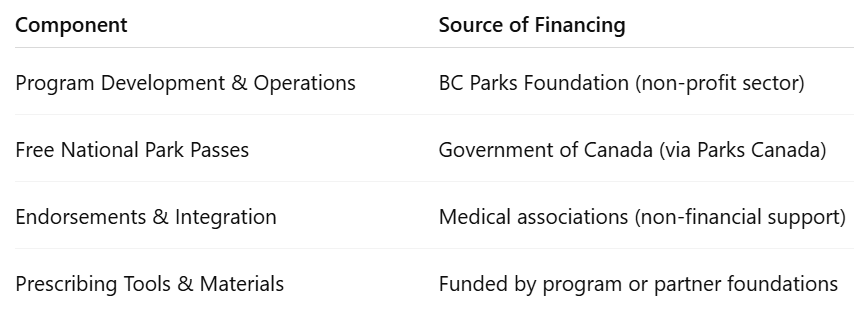
Financing
-
Basic operational funding comes from the BC Parks Foundation, possibly supported by donations, grants, or philanthropic partners.
-
Government funds are used to subsidise specific components:
-
When doctors prescribe free annual passes to national parks, it is the federal government (via Parks Canada) that pays the cost of those passes.
-
This represents a public subsidy of prescription access to nature, rather than funding the entire program’s administration.
Doctor Participation
-
Only registered health professionals (e.g., GPs, nurses, psychiatrists, physiotherapists) can prescribe.
-
Participating professionals receive free digital or paper prescription tools, and information packs for both patients and providers—likely funded by the BC Parks Foundation or partner institutions.
Summary of Financing Model
PaRx: A Prescription for Nature
https://www.parkprescriptions.ca
PaRx is Canada's national, evidence-based nature prescription program.
Nature on prescription in Canada
https://justpaste.it/sp-parx
#GreenPrescription #PaRx #PreventiveCare #SocialEconomy #EcoMedicine #Canada #NHS #Medicair #Wellbeing
* AFTERTHOUGHT *
Prescribing Nature, Administering Control?
As nature becomes absorbed into health policy, it’s worth pausing to consider what may follow. A walk in the forest, once an instinct or an escape, risks becoming a managed activity—tracked, counted, and reimbursed.
Already, CCTV cameras monitor parking zones at the edges of nature reserves, with visitors charged for access. This is framed as good governance. But as public systems begin to fund and prescribe time outdoors, verification mechanisms creep in—and with them, a quiet apparatus of surveillance.
New jobs may arise: facilitators, monitors, coordinators—roles that lend a sense of order, but also reinforce a deeper message: that access to the natural world, and even the tending of one’s own health, is no longer entirely personal.
Yes, we hold a communal responsibility—to care for ourselves, for each other, and for the living world we depend on. But this should grow from shared culture, not institutional control. Health is not only a metric to be managed, and wellness is not a compliance goal. Nature is a right, not a regulated treatment plan.
The question isn't how to encourage healthy lives.
It’s whether, in prescribing the wild, we tame it—and ourselves.
---
Who Is Tony Seba?