
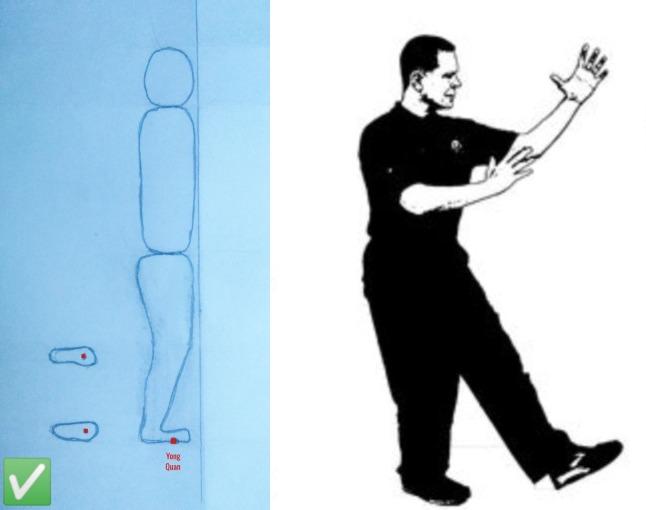
You have probably noticed, Children of the Earth, that Tai Chi is very different from other skills in this region, we mean Europe, in a broader sense and the rest of the planet, which came from the countries of the Far East. In addition to the many differences that can be seen when comparing Tai Chi and other skills of Asian origin, one of the most important is the difference in the position of the center of gravity of the body of the practitioner of a particular skill. Practitioners of all martial arts have the center of gravity of the body, like that of an untrained person, in the area of the hips, while Tai Chi Chuan practitioners have this center of gravity lowered to the level of the feet. Thus, by reducing the body weight in the area of the feet, greater mobility, greater stability and unlimited possibilities of turning the body in various directions are achieved. All of the above cannot be achieved quickly enough for those who train by focusing on the hips.
Establishing the body's center of gravity in the feet is not a very difficult task, a more serious problem is the fatigue in the legs that will inevitably occur when you lower the body's center of gravity to the level of the feet. The reason is that when you lower the body's center of gravity to the level of the feet, all the weight is transferred to the tendons and muscles, to the soft connection, while in the body's center of gravity in the hip area, the movements are transmitted through the musculoskeletal system, through the rigid connection. At first glance, the difference does not seem too great, but rest assured that without the transition from musculoskeletal to tendon-muscular transmission of body movements, it is impossible to achieve noticeable progress in practicing a particular skill. This is achieved by lowering the body's center of gravity to the foot area.
How can this be achieved, you ask?
Okay, here's how: stand up, feet hip-width apart, knees slightly bent, then slowly lower-raise and move your hips, that is, your torso, forward-backward, until you feel that the center of gravity of your body has dropped to your feet, in their first third, more precisely, in the area of the energy point "Yong Quan". When you have found a suitable position with the center of gravity of the body in the feet, then gradually transfer the weight of the body to one foot in the "Playing the Harp" position, while the other foot remains "empty".
It is important not to hold this position for more than 2-3 seconds, because the entire body weight is on the tendon-muscle system and the foot of one leg. Therefore, after holding for 2-3 seconds, return to the position with the center of gravity on both feet, spend the next 2-3 seconds in this position, and then transfer the body weight to the other foot, again for 2-3 seconds.
It is very important not to prolong the period of staying in a certain position, because it would be too much strain on your tendon-muscle system, even for those who have done various sports in the past. The point is that the tendons and muscles of the legs gradually, day by day, strengthen, develop and reach a level where they can withstand the performance of the left and right Tai chi form completely naturally and easily.
Before each Tai chi form, we recommend slowly awakening the energy flows of the legs, which we explained in the previous channeling . To successfully strengthen the legs, we recommend using 📖the Fetal Breathing during sleep, while to maintain psycho-emotional hygiene, 📖the Cleansing of the Developmental Consciousness of the Soul, which you can do on the end of the Tai chi form, but also on your own when you feel the need for it.
Although short, this channeling contains a wealth of useful information that will take years of effort and practice to apply and master.
We greet you, Children of the Earth, wish you all the best, and wish you to do good to others.
Oliver
April 24, 21st year Aeon of Aquarius
All texts from the site without any changes or abbreviations can be printed and published for private and commercial purposes, both domestically and abroad, by anyone who wants it. The rights to publish are provided free of charge, with a preliminary agreement regarding the choice, design and authorization of texts