
Rehabilitation of victims of witch hunt in Flanders
Petition to the Flemish authorities, translated from Dutch.
Hanne S. created this petition for
Rehabilitation of the victims of the witch hunt
In January 2022, the Catalan parliament pardoned a thousand people, mostly women, who were convicted of witchcraft between the fourteenth and eighteenth centuries.
“Institutionalized femicide,” President Pere Arangonès called it when he announced that his government to restore the honor of these victims. In this way, Catalonia wants to correct past mistakes. A moral goal that Germany, Scotland, Switzerland and Norway also pursued.
But what about Flanders? According to the source research of Belgian historian and professor Jos Monballyu hundreds of victims were burned at the stake in the county of Flanders alone in the period from 1459 to 1684. During the Spanish Netherlands (1556-1715), the witch hunts on our territory were among the most extreme and deadly witch hunts in all of Europe.
On Wikipedia, under the theme 'witch lists Flanders', you can find the names of the victims, the place of execution and the year of execution. The municipalities of Nieuwpoort and Lier have already opted for a rehabilitation of the victims. Therefore, dear Minister-President Jan Jambon, why not a general Flemish political pardon?
Unprocessed past
As a Western world, we want to cultivate a self-image of Enlightenment, democracy and human rights with conviction. Does that perhaps make it difficult to deal with repressed complexes from the past? Because in addition to the colonial slave trade and Nazi concentration camps, the witch hunt also fits into the list of organized mass murders that served political-economic interests.
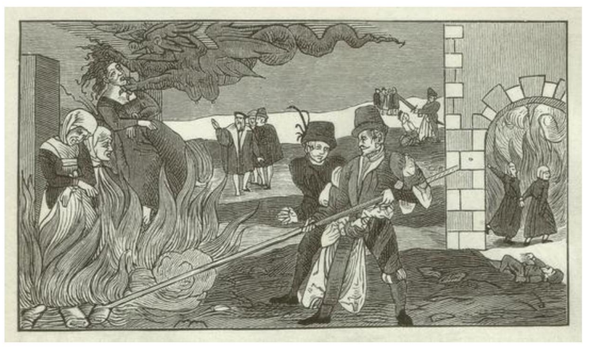
And here too, awareness is of crucial social importance. The witch hunt lasted for no less than four centuries and probably cost more than 60,000 lives. In the name of the God of Christianity, blessed by the priestly class and at the behest of legal officials.
Yet this confrontational history still receives little attention today. Sometimes it is conveniently minimized, dismissed as something barbaric that would mainly date from the Dark Ages. However, the witch craze reached its peak in the Renaissance, at the time when Europe colonized the world and scientific thinking took off. Only then did the witch trials turn into a mad epidemic of violence. The hunt became larger-scale, more arbitrary and crueler: fines made way for instruments of torture to force confessions, followed by fire or drowning. Supposedly a necessary evil to exorcise the Devil and save souls. After all, witch trials had to ensure religious conformity. Children were not spared either, especially if they begged or had no parents. Only when clergy and nobles also ended up on the 'purifying' pile did a change occur.
Pardon is more than symbolism
In her book "Witches, Witch-Hunting, and Women" (2022), feminist Silvia Federici explains how the witch hunt was above all a strategy of the rulers of that time to gain social control, to break resistance from below and to turn the people into submissive workers by torturing and murdering women. Unfortunately, this is still the case today: in certain regions in India, Africa and Latin America, the persecution of witches is on the rise again. Witch hunts are used as a weapon in the struggle for political-economic interests and property relations, in order to break the resilience of local communities.
It is no coincidence that the vast majority of the victims of the historical witch hunt were women, very poor, single, and over 40. Often they were naturopaths who assisted as midwives during pregnancy and childbirth. They were a threat to the new social fabric of Europe, in which Church, labor and family were to form the foundations. Famine, disease or natural disasters always led to the false accusation of those who did not fit into the social ideal.
Precisely because the witch hunt is above all a sociological mechanism - something that you cannot dismiss as a whim of some primitive culture - recognition and awareness are necessary. In the interest of gender equality, tolerance and inclusion. So that we learn not to be misled again by 'purifying' scapegoat mechanisms that serve a divide-and-rule policy.
Therefore, dear Prime Minister Jambon, we propose the following measures:
An awareness campaign can start with a national day of remembrance, as Federici presents in her book. What do you think of October 23? On that day, widow Martha van Wetteren was burned alive in Belsele in 1684, as the last so-called witch in Flanders. Her execution had been postponed earlier, so that she could still give birth to her child.
In addition, we advocate for the rehabilitation of the victims. Pardon is a first step in the restore their humanity and dignity. Let us acknowledge and seek to correct the mistakes of our past.
Finally, we hope for more critical awareness around the imagery of witches.
Did you know that the stereotypical image of witches – ugly old women flying out of chimneys on broomsticks, with a black cat and a simmering cauldron on the fire – can be traced back to an Antwerp print publication by Pieter Bruegel the Elder in 1565?
In the centuries that followed, both Flemish and international artists would eagerly adopt this stigmatizing visualization, as art scholar Renilde Vervoort notes. The contemporary commercial success of black pointed hats and hooked noses with warts is therefore not as innocent as it seems. While conjuring above a smoking witches' cauldron, this entertainment
rewrites a painful history from which we still have important lessons to learn. It sweeps this horror under the carpet with a flying child's broom.
Dear Prime Minister Jambon, we look forward to your answer.
Edith Cassiers, Katrien Merckx and Hanne Staes
Femina Libera, feminism reading group of De Groene Waterman
Posted April 26, 2022
Silvia Federici
https://en.wikipedia.org/wiki/Silvia_Federici
https://politicaltheology.com/silvia-federici/
Books
"Witches, Witch-Hunting, and Women"
https://thesociologicalreview.org/reviews/witches-witch-hunting-and-women-by-silvia-federici/
"Caliban and the Witch"
https://en.wikipedia.org/wiki/Caliban_and_the_Witch
Note
"Caliban and the Witch: Women, the Body and Primitive Accumulation" by Silvia Federici is distinct from "Witches, Witch-Hunting, and Women". Published in 2004, "Caliban and the Witch" delves into the European witch hunts of the 16th and 17th centuries, examining their intersection with the rise of capitalism and patriarchy. Federici argues that the violent suppression of women accused of witchcraft was foundational to the development of modern capitalist economies. She links these events to broader themes of social control over women’s reproductive and labor capacities, highlighting the shift from feudalism to capitalism.
In contrast, "Witches, Witch-Hunting, and Women", published in 2018, serves as a complementary piece, building on these themes through a collection of essays that explore witch hunts in varied historical and cultural settings. While both books address related socio-economic developments, they provide unique perspectives on the historical significance of witch hunts.
In Dutch, "Witches, Witch-Hunting, and Women" is titled "De vrouw als zondebok. Over heksen, brandstapels en onteigening". It continues Federici’s critique of capitalism and patriarchy, providing an expanded view of how witch persecutions helped establish societal control mechanisms that targeted women specifically.
References:
---
Prosecution of Midwives and Birth Attendants
Rise of the doula: a helping hand or a danger to mothers?
Exploring Midwifery Regulation and Prosecution: The Case of Ana Pereira in Portugal