
The Necessary Pause: Gelert and the Risk of Misreading
An essay on misreading, reflection, and the formation of judgment under pressure
https://justpaste.it/tnesp - https://bit.ly/riskmis
Editor: P.I. Hublou
Publisher: Silentfactory
Pages: 14
1st edition: 02 May 2026
Current edition: 1.0
Creative Commons (CC BY)
Available via:
- Z-Library book page [Read online or download]
- Read online or download the essay [Dropbox]
Alternatives: Z-Library [web] <> PLIB [Dropbox] <> SoulSeek [P2P]
CONTENTS
-
Abstract
The central argument: Gelert as a story about misreading, pressure, and judgment. -
The Painted Moment
How Steell’s painting captures the instant after certainty has become remorse. -
The Myth Beneath the Painting
Why the Gelert legend matters even if its historical attachment is uncertain. -
Prince Llywelyn as Tragic Figure
How power, fear, and untested interpretation turn strength into ruin. -
A Parallel Image of Protection and Misreading
A second visual frame showing how protection may appear dangerous before it is understood. -
The Faithful Animal Story Across Cultures
How related stories from Wales, India, and Iran reveal a recurring danger in human judgment. -
The Phenomenon: Decision Under Stress
How perception narrows, interpretation hardens, and action may outrun reality. -
Hannah Arendt and the Failure to Think in Time
Thoughtlessness, inner dialogue, and the danger of acting inside ready-made narratives. -
Modern Echoes: Nuclear Near-Misses
Petrov and Arkhipov as examples of life-saving interruption under extreme pressure. -
The Inverse Example: Chernobyl and the Failure of the Pause
How procedure, hierarchy, and weak safety culture can prevent timely reconsideration. -
Language, Culture, and Hierarchy: The Korean Air Example
How communication and hierarchy shape whether warning can be voiced in time. -
How High-Reliability Systems Build the Pause
Checklists, cross-checks, and time-outs as designed spaces for reconsideration. -
Sociocracy and the Formalization of Objection
How structured objection turns dissent into useful information. -
Birthkeeping and the Risk of the Solo Interpretation
Why distinguishing fact from story matters especially in high-stakes care. -
The Speculative Frontier: AI and the Designed Pause
How the same concern appears in debates about autonomous systems and interruption. -
Conclusion: The Necessary Pause
A return to the painting and to the wider need for practices that protect clearer seeing. -
Selected Sources and Image References
Core references supporting the historical, folkloric, and institutional material.
The Necessary Pause: Gelert and the Risk of Misreading
An essay on misreading, reflection, and the formation of judgment under pressure
____________________________
Abstract
This article begins with Gourlay Steell’s painting of Prince Llywelyn and his hound Gelert, then follows the legend outward into psychology, folklore, language, safety systems, and contemporary practice. The central claim is simple: the tragedy is not only that Llywelyn kills the wrong being, but that he does so in the grip of an interpretation he never pauses to test. What the painting captures, therefore, is not merely grief, but the instant in which power, fear, and certainty collapse into remorse. From there the article traces related stories from India and Persia, modern examples such as Stanislav Petrov and Vasili Arkhipov, and practical reflections for birthkeeping, sociocracy, and the design of safer decision processes.
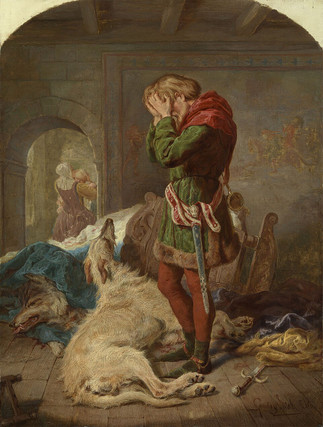
"Llywelyn (1173–1240) and his Brave Hound, Gelert"
(Gourlay Steell, 1880)
The Painted Moment
Steell’s painting does not show the prince in heroic action. It shows him after the action, at the instant when certainty has already become knowledge, and knowledge has already become unbearable. That choice matters. A hunter returning from the field should be a reader of signs: blood, movement, absence, disorder. Yet the prince reads the signs too quickly. The painting stages the exact cost of that failure.
In the usual retelling, Llywelyn returns from hunting to find the cradle overturned, the room in disarray, and Gelert with a blood-smeared muzzle. He leaps to the conclusion that his dog has killed his child and strikes Gelert down. Only then does he hear the child alive and find the dead wolf. In Steell’s treatment, the tragedy is not merely the dog’s death but the prince’s self-disclosure. The powerful hunter, so decisive in the field, proves unable to pause before making an irreversible judgment.
The painting therefore becomes a study in perception under pressure. The room is charged with evidence, but evidence is not yet truth. Llywelyn confuses the two. His sword acts on a story before reflection has had time to catch up.
The Myth Beneath the Painting
The legend commonly links Gelert to Llywelyn the Great and to the village of Beddgelert in north Wales. Whether the story was originally attached to that ruler is doubtful; folklorists and historians have long noted that the tale belongs to a much wider family of narratives and that the grave association at Beddgelert is likely later than the medieval prince himself. Yet the uncertainty of provenance does not weaken the legend. If anything, it clarifies why the story endured: it speaks to a human weakness older and broader than any one dynasty.
The legend survives because it is archetypal. A guardian appears guilty. Blood seems to tell the whole story. The mind closes around a conclusion, and violence outruns verification. By the time truth arrives, action is complete. What follows is not merely regret but a collapse of self-understanding. Llywelyn is no longer simply a bereaved father; he becomes the agent of his own undoing.
This is why the myth has such emotional force. The true catastrophe is psychological. Having killed the most loyal being in the room, the prince must go on living with a reordered inner world. The friend has become victim, the protector has been mistaken for the threat, and the hunter has discovered that he cannot trust the speed of his own judgment.
Prince Llywelyn as Tragic Figure
The prince is often remembered as rash, but the painting allows a subtler reading. He is not weak because he acts; he is weak because he cannot interrupt the authority of his own first interpretation. He has power, rank, and the habits of command. Those habits become dangerous when they are carried into a scene that demands reflection rather than force.
There is also a painful irony in the friendship at the heart of the legend. A hound is not an abstract subordinate. Gelert is companion, partner in the hunt, a creature whose loyalty has been proved in action. The prince’s failure is therefore relational as well as cognitive. He does not only misread the room; he misreads the friend. The same decisiveness that would make him formidable in the forest makes him fatal in the nursery.
In that sense the prince causes his own psychological downfall. He destroys the being that would have confirmed his world as trustworthy, and he does so by trusting the one thing he should have doubted: the instantaneous story formed in panic. The mind that cannot pause becomes its own executioner.
A Parallel Image of Protection and Misreading
The value of this second image lies less in strict attribution than in contrast. Where Steell paints the aftermath of a fatal misreading, this image shows the protective reality that such a misreading might conceal. Together the two images help trace a moral arc: protection, appearance, interpretation, and the danger of acting before the truth is fully seen.
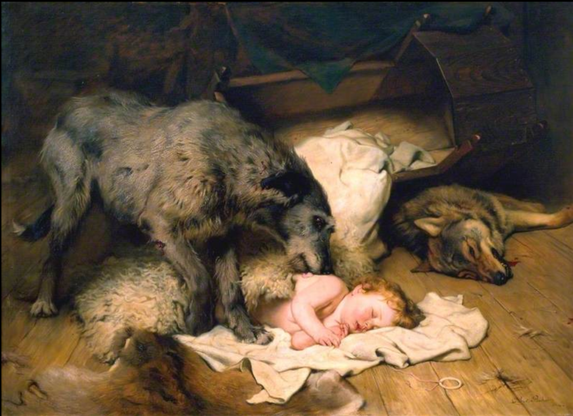
Figure 2: A painting attributed to Charles Burton Barber showing a dog protecting a child from a wolf.
Although not necessarily a direct illustration of the Gelert legend, the scene closely echoes its central motif:
the faithful animal appearing dangerous at the very moment of protection.
The Faithful Animal Story Across Cultures
The Gelert legend is not unique. It belongs to a widespread family of tales sometimes grouped by folklorists under the type often glossed as the faithful animal wrongly killed. That recurrence matters. It tells us that the Welsh story is not merely local colour from the age of princes and hounds, but one expression of a durable human drama: danger appears, evidence is partial, the protector looks guilty, and the mind rushes to a conclusion before reality has fully disclosed itself.
Seen in that wider frame, these stories are not just cautionary fables about haste. They are meditations on thoughtfulness, trust, friendship, guardianship, and the cost of certainty under stress. The same architecture appears in different lands, but the emotional emphasis changes. Some versions end in irreversible grief. Others interrupt the fatal sequence and teach how grief may be avoided. Together they deepen the meaning of Gelert rather than diluting it.
The Welsh tragic form: friendship destroyed by untested certainty
The Welsh version is distinctive because the guardian is not simply a useful domestic animal. Gelert is a companion of the hunt, part of Llywelyn’s world of trust, skill, and shared danger. This gives the story its special psychological depth. The prince is not only a father in panic; he is also a hunter who should know how to read signs. Blood, disorder, and absence are part of his ordinary field of judgment. Yet in the nursery he reads them too quickly. He mistakes appearance for conclusion.
That is why the tragedy bites so deeply. Llywelyn does not merely lose his dog. He destroys a friendship and with it his confidence in his own discernment. The powerful man who can command, hunt, and strike discovers that his speed of judgment has turned his strength into ruin. In some tellings he never smiles again. Whether legendary or not, that detail captures the inner downfall of the story: he must live on not only with grief, but with the knowledge that he himself killed the most loyal being in the room.
India: the Brahmin and the mongoose
The Indian parallel of the Brahmin and the mongoose is perhaps the closest structural match. A mongoose is left near a child. A snake enters. The mongoose kills the snake. The returning parent sees blood on the animal and, assuming the child dead, kills the mongoose on the spot. Only afterwards does the parent discover the child safe and the snake slain.
Here the moral is made more explicit than in the Welsh legend. The tale functions almost as a distilled teaching against rashness: do not act on incomplete evidence; do not let the first interpretation govern the hand. The emotional force remains strong, but the centre of gravity is less the prince’s lifelong inner collapse and more the didactic clarity of the lesson. The story teaches not only that haste wounds, but that the appearance of guilt is one of the most dangerous kinds of evidence.
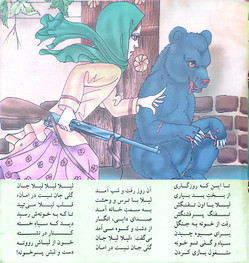
Iran: The House of Leylah and the Baby Bear
The Persian children’s-book variant, The House of Leylah and the Baby Bear, changes the emotional outcome while preserving the same structure. A bear cub is taken in after hunters kill its mother. It grows up in the household and becomes attached to the child. One day the mother returns to find the bear bloodied near the baby. She raises her gun, and the old sequence seems ready to repeat itself.
But here the crucial difference enters: she pauses. Before firing, she sees that the bear has killed a wolf. The protector is recognized in time. The ending is not tragic remorse but relieved gratitude. This is more than a softened retelling. It is a narrative intervention into the ancient structure. The Persian version keeps the tension, the blood, the ambiguity, and the danger, yet inserts a moment of consideration between perception and action. It teaches not only what goes wrong, but how the fatal misreading can be interrupted.
What remains constant -- and what changes
Across these stories, certain elements hardly move. There is a vulnerable child, a guardian animal, a hidden threat, a returner under pressure, and a blood-marked protector who appears guilty at first glance. The human mind completes the pattern too quickly. In that sense the stories are universal because they dramatize a recurrent feature of consciousness itself: when fear rises, interpretation hardens. The signs feel self-explanatory. Reflection is crowded out by urgency.
Yet the stories differ in what they want the listener to feel and learn. The Welsh legend is the darkest because it is a story of friendship broken too late to repair. The Indian tale sharpens the moral lesson against haste. The Persian version offers a redemptive pedagogy of restraint, showing that the old sequence need not end in blood guilt. Taken together, these variants enlarge the article from a reading of one painting into a wider anthropology of judgment. They suggest that humanity has long known the same peril: under stress we do not only risk seeing wrongly; we risk betraying what, or whom, we most trust.
The Phenomenon: Decision Under Stress
What the legend dramatizes is a general human pattern. Under stress, perception narrows. A few vivid signs dominate consciousness. Interpretation hardens quickly, often before it is consciously examined. Emotion then certifies the interpretation as truth, and action follows. The problem is not only ignorance; it is certainty under ambiguity.
This pattern appears in domestic life, political life, institutions, and intimate relationships. A delayed reply becomes proof of indifference. An ambiguous event becomes evidence of attack. A bloodied dog becomes a murderer. Once a story has fused with urgency, it feels like reality itself.
In Steell’s painting of Prince Llywelyn and his dog Gelert, the prince’s fatal mistake is not simply that he acts too fast. He sees blood, disorder, and his faithful hound near the cradle, and allows one interpretation to become certainty before he has seen the whole scene. The tragedy lies in that premature closure: perception has not finished its work, but action has already become irreversible.
Hannah Arendt and the Failure to Think in Time
Hannah Arendt offers a useful language for this phenomenon, even though she never wrote about Gelert. Her concern with thoughtlessness -- with the human tendency to act inside ready-made narratives without serious inner dialogue -- helps illuminate why grave failures of judgment and responsibility become possible. In her writing on Eichmann, Arendt’s point was not that he bore no responsibility, but that his wrongdoing was bound up with a terrifying failure of independent thought, judgment, and moral imagination. The danger is not always malicious intent. Sometimes it is the collapse of reflection precisely when reflection is most needed.
Arendt’s relevance here lies in the interval between event and judgment. Reality arrives in fragments. Judgment often arrives all at once. If there is no inner conversation -- What am I actually seeing? What else could this mean? What do I not know yet? -- then action becomes an instrument of whatever interpretation appears first. The prince, in this sense, is not simply wrathful. He is unreflective at the fatal moment.
Modern Echoes: Nuclear Near-Misses
The same structure reappears in some of the most dangerous episodes of the twentieth century. In 1983 Stanislav Petrov, a Soviet officer on duty in an early-warning command centre, received alerts indicating an incoming American missile strike. Instead of passing the warning upward as confirmed attack, he treated it as a likely false alarm. His hesitation was grounded in judgment: the number of missiles seemed illogical for a first strike, and corroboration was lacking. Later it emerged that reflected sunlight on clouds had produced a false alarm.
The system did not warmly reward him. Petrov was later interrogated and officially reprimanded over logbook and procedural issues rather than publicly celebrated. The institution could not easily say that disobedient judgment had preserved safety, because that would expose the fragility of protocol itself. The structural lesson is clear: safety may depend not on procedure alone, but on the protected space to question what procedure appears to demand.
A related story concerns Vasili Arkhipov during the Cuban Missile Crisis. On submarine B-59, under extreme pressure and cut off from clear communication, other officers were prepared to authorize a nuclear torpedo launch. Arkhipov withheld consent. Unlike Petrov, he was not primarily resisting a machine warning, but a human and procedural momentum: the pressure of isolation, standing military protocol, and the fact that other officers were prepared to act. The submarine surfaced rather than fired. Here again catastrophe was avoided not because the system worked flawlessly, but because one person created space in which the prevailing interpretation could fail to become irreversible action.
The Inverse Example: Chernobyl and the Failure of the Pause
If Petrov, who questioned a false missile alarm, and Arkhipov, who refused to authorize a nuclear launch during the Cuban Missile Crisis, represent the life-saving pause, Chernobyl represents its absence. The disaster at the Chernobyl nuclear power plant was not a Gelert story in the literal sense, but it belongs to the same family of failures: warning signs were present, danger was building, yet the space for timely reconsideration had all but collapsed. What followed was an explosion and a disastrous release of radioactive material whose effects extended far beyond the plant itself.
Failed safety culture
What makes Chernobyl so relevant here is not only that a reactor exploded, but that the surrounding culture did not adequately support thought, challenge, or restraint. A hazardous test was pushed forward under unstable conditions. Operators worked within a system marked by hierarchy, incomplete information, procedural rigidity, and a weak capacity to question assumptions openly. The point is not that no one was thinking, but that the system did not create enough room for critical thinking to interrupt momentum in time.
This is the inverse of the Petrov and Arkhipov examples. In those moments, a human being inserted doubt into a dangerous sequence and created time for reality to catch up. At Chernobyl, the sequence was not interrupted. Procedure, pressure, and institutional habits carried events onward when they should have been re-evaluated.
The failure was also one of communication. Before and during the disaster, there were limits on how freely danger could be recognized, voiced, and acted upon. After the explosion, the same narrowing of mind continued at a larger scale. The nearby town of Pripyat remained under radioactive fallout before evacuation followed, and wider public acknowledgment came only after delay. What failed was not only reactor safety, but the broader human ability to pause, speak plainly, and respond to reality as it was.
Seen in the light of this essay, Chernobyl stands as a warning about decision-making under pressure. It shows that the absence of reflection is not always impulsive or chaotic. Sometimes it is organized, procedural, and obedient. A system may move forward with great discipline and still be unable to stop, reconsider, or think freely at the moment when that is most needed.
The lesson is harsh: protocol without live judgment can be as dangerous as impulsiveness without protocol.
Language, Culture, and Hierarchy: The Korean Air Example
The Korean Air example adds another dimension to this pattern: the way language, culture, and hierarchy can shape whether a dangerous interpretation is challenged in time. In the airline’s troubled period in the 1990s, a series of serious accidents led to close scrutiny of training, cockpit communication, and crew interaction. In the investigation into Flight 801, the U.S. National Transportation Safety Board found that the captain failed to execute the approach properly and that the first officer and flight engineer failed to monitor and cross-check him effectively; Korean Air’s inadequate flight crew training was listed as a contributing factor. In the later investigation into Korean Air Cargo Flight 8509, British investigators noted that the captain had set a tone that discouraged further input from the other crew members, especially the first officer, and said it remained possible that the first officer felt inhibited from bringing the developing danger to the captain’s attention. Korean Air subsequently expanded its Crew Resource Management and error-management training, explicitly adapting it to Korean cultural conditions. Contemporary reporting on the airline’s broader safety turnaround also described stricter English testing and the use of English in the cockpit as part of these reforms, alongside outside consultants and wider safety changes.
What matters here is not the simplistic idea that “English solved everything.” The deeper point is that the pause is not only personal; it is social. A system may make it easier or harder for one person to question another clearly under pressure. If hierarchy, indirect speech, or stress make warning feel disrespectful, then misjudgment becomes more likely at exactly the moment when clarity and timely re-evaluation are most needed.
These examples show different forms of the same problem:
-
Petrov: reflective interruption against a machine verdict.
-
Arkhipov: reflective interruption within hierarchy and protocol.
-
Chernobyl: the collapse of reflective culture and effective communication.
-
Korean Air: the way language and hierarchy can make interruption easier or harder to voice.
How High-Reliability Systems Build the Pause
Aviation, nuclear operations, and surgery each attempt -- with varying success -- to formalize interruption. They use checklists, cross-checks, verbal confirmations, briefings, and explicit 'time-out' moments before irreversible acts. These practices are not bureaucratic decoration. They are designed gaps in which fact can be separated from interpretation and the group can catch what the individual has missed.
The ideal is not endless hesitation. It is a structured delay proportionate to the stakes. No one wants a pilot paralysed on a runway or a surgeon unable to begin. But neither can safety rest on speed alone. High-reliability systems therefore try to make the Arkhipov or Petrov pause ordinary instead of heroic.
Sociocracy and the Formalization of Objection
Sociocracy extends this logic into governance. Instead of asking whether everyone agrees, it asks whether there is any reasoned objection strong enough to say that a proposal is not safe enough to try. That shift is profound. It legitimizes objection as information rather than disloyalty. It slows group certainty just enough to expose what the first narrative may have hidden.
Rounds, clarifying questions, reaction rounds, and consent rounds are all techniques for distributing perception before action. In effect, sociocracy institutionalizes a pause. It does not depend on a single wise person having a good intuition at the right moment. It builds a process in which quieter signals have a structured chance to appear.
Birthkeeping and the Risk of the Solo Interpretation
Birthkeeping brings this pattern into especially sharp focus, particularly in low-oversight or solitary practice. A sign changes. Urgency rises. The practitioner forms an interpretation. Action follows. In such settings there may be little immediate peer review, so the space between observation and intervention becomes even more precious.
The practical lesson is not passivity. It is the disciplined distinction between fact and story: what is actually observed, what is being inferred, what alternatives remain possible, and whether one more check is still available before an irreversible move. In that sense the protective-pause skill is not hesitation but clear-seeing under pressure.
A micro-sociocratic analogue also becomes imaginable: pause, state the facts aloud, name the current interpretation as interpretation rather than truth, invite any concern or objection from those present, and then move. Even a short shared round can widen perception.
The Speculative Frontier: AI and the Designed Pause
A speculative extension of the same concern appears in debates around “runaway AI”. Here the pattern dramatized by the Gelert legend becomes speculative but instructive. If an autonomous system is allowed to move too quickly from signal to action, then the design problem becomes familiar: how is interruption built in? A deadman switch, kill switch, or external override may be necessary, but it is not sufficient if the wider system still rewards speed, opacity, or uncheckable autonomy.
The deeper principle remains unchanged. Safety depends not only on emergency brakes but on architectures that make uncertainty visible and create room for challenge before the irreversible step.
Conclusion: The Necessary Pause
The myth of Gelert endures because it is about more than a prince and a dog. It is about the fragility of judgment when pressure, fear, and authority converge. Llywelyn is powerful, experienced, and surely convinced he is acting rightly. Yet all of those strengths become weaknesses in the absence of reflection. He kills the one being who remained faithful, and in doing so destroys his own confidence in the moral order of his world.
The counter-stories and modern examples do not cancel the tragedy; they complete its meaning. The mongoose, the bear, Petrov, Arkhipov, the operating-room time-out, the sociocratic objection round -- each shows, in a different register, that safety often depends on a tiny interruption. A breath. A question. A second look. A dissent voiced in time.
If the essay points beyond reflection, it does so quietly. The necessary pause is not only a private virtue but something that can be protected in practice: by learning to distinguish observation from interpretation, by making room for inner dialogue under pressure, by legitimizing timely objection, and by shaping relationships and institutions in which reality has a better chance to arrive before action hardens into consequence. The aim is not hesitation for its own sake, but a culture of clearer seeing in which fewer tragedies need to teach the lesson after the fact.
That is the depth behind the painting. It is not only a picture of grief. It is a meditation on the moment before grief becomes destiny.
Selected Sources and Image References
The article above is interpretive rather than heavily footnoted, but the following sources support the core historical, folkloric, and institutional references.
Royal Collection Trust entry for Gourlay Steell’s painting:
https://www.rct.uk/collection/403634/llywelyn-1173-1240-and-his-brave-hound-gelert
Encyclopaedia Britannica entry on Gellert: https://www.britannica.com/topic/Gellert
D. L. Ashliman’s collection of folktales of type 178A: https://sites.pitt.edu/~dash/type0178a.html
Embry-Riddle study on CRM and Korean Air: https://commons.erau.edu/crm-grad-conf/2015/grad-conf/2/
NTSB / FAA material on Korean Air Flight 801 and cockpit procedures: https://www.ntsb.gov/safety/safety-recs/recletters/A00_7_18.pdf
National Security Archive on Soviet submarines and Arkhipov:
PBS background note on Arkhipov and the B-59 incident:
https://www.pbs.org/wnet/secrets/the-man-who-saved-the-world-about-this-episode/871/
WHO surgical safety resources:
WHO Surgical Safety Checklist (PDF):
https://www.who.int/docs/default-source/patient-safety/9789241598590-eng-checklist.pdf
The illustrated children’s book in Persian, "The House of Leylah and the Baby Bear", can be downloaded via Dropbox: https://bit.ly/tholatbb
"The Necessary Pause - An essay on misreading" is available via:
Z-Library [web] <> PLIB [Dropbox] <> SoulSeek [P2P]
Library For A Better World
27 April 2026 v.1.0
---
Essays - Index: https://justpaste.it/esi
Articles & Materials of Interest: https://justpaste.it/amof
Library Meta Index: https://justpaste.it/lmi
TheNecessaryPause20260407V1
<tnp>