JustPaste.it

Sufficiency in principle and practice: An operational definition and typology

Sufficiency in principle and practice:

An operational definition and typology

https://justpaste.it/sufficiency  -  https://archive.ph/9gw40

Source: 

https://www.sciencedirect.com/science/article/pii/S0959652626012795

https://doi.org/10.1016/j.jclepro.2026.148738


Summary:

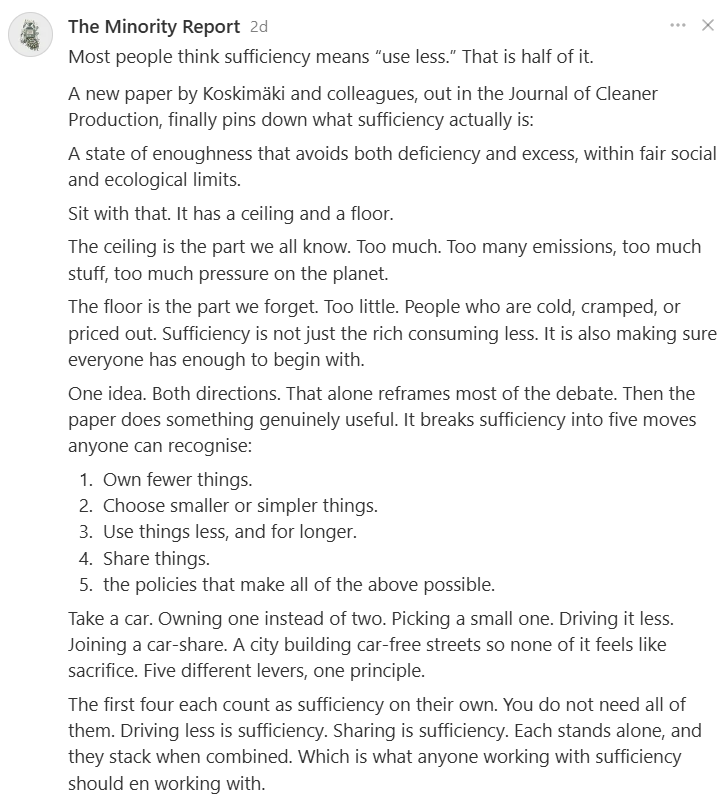
"Most people think sufficiency means “use less.” That is half of it.
A new paper by Koskimäki and colleagues, out in the Journal of Cleaner Production, finally pins down what sufficiency actually is:
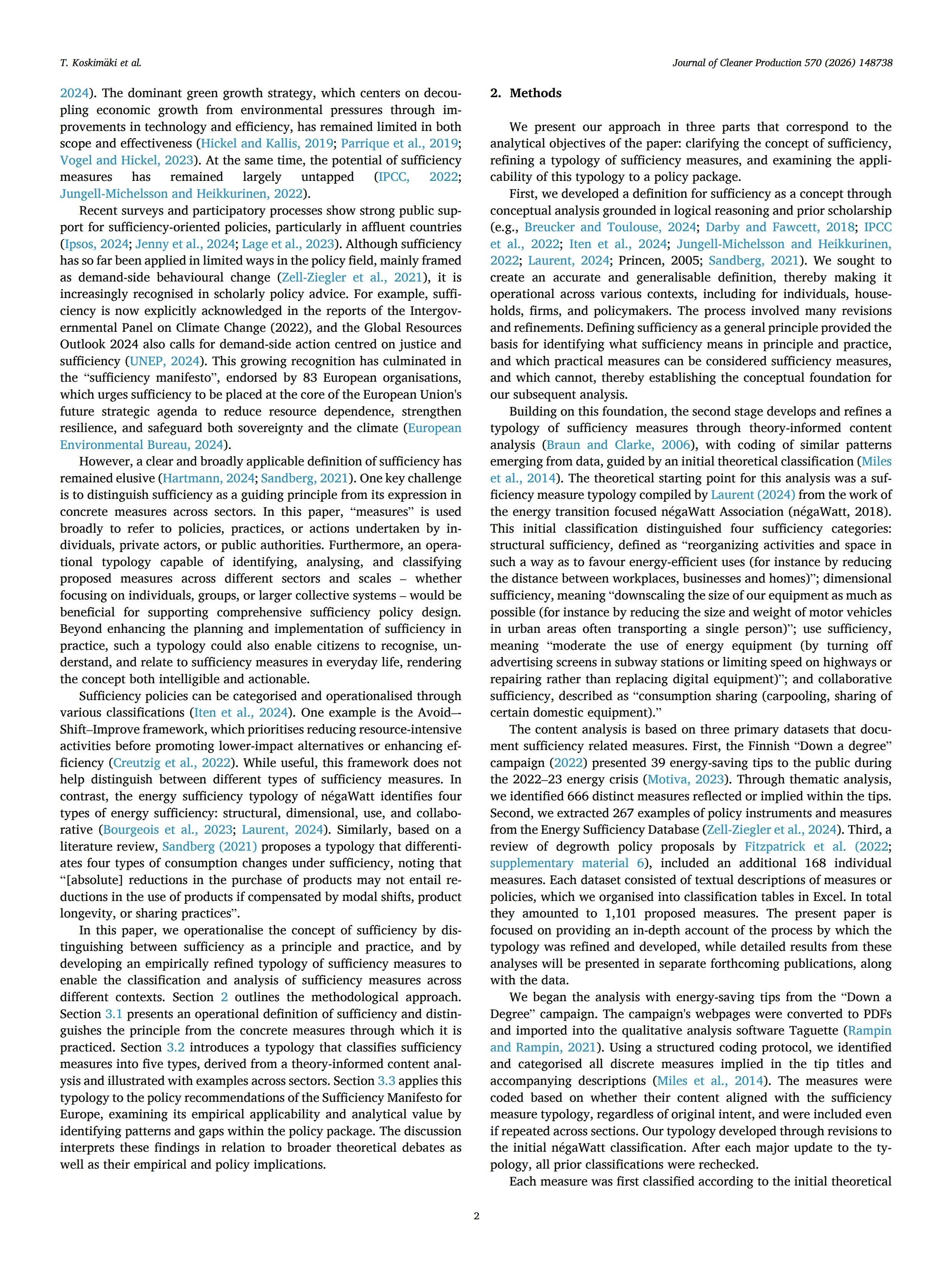
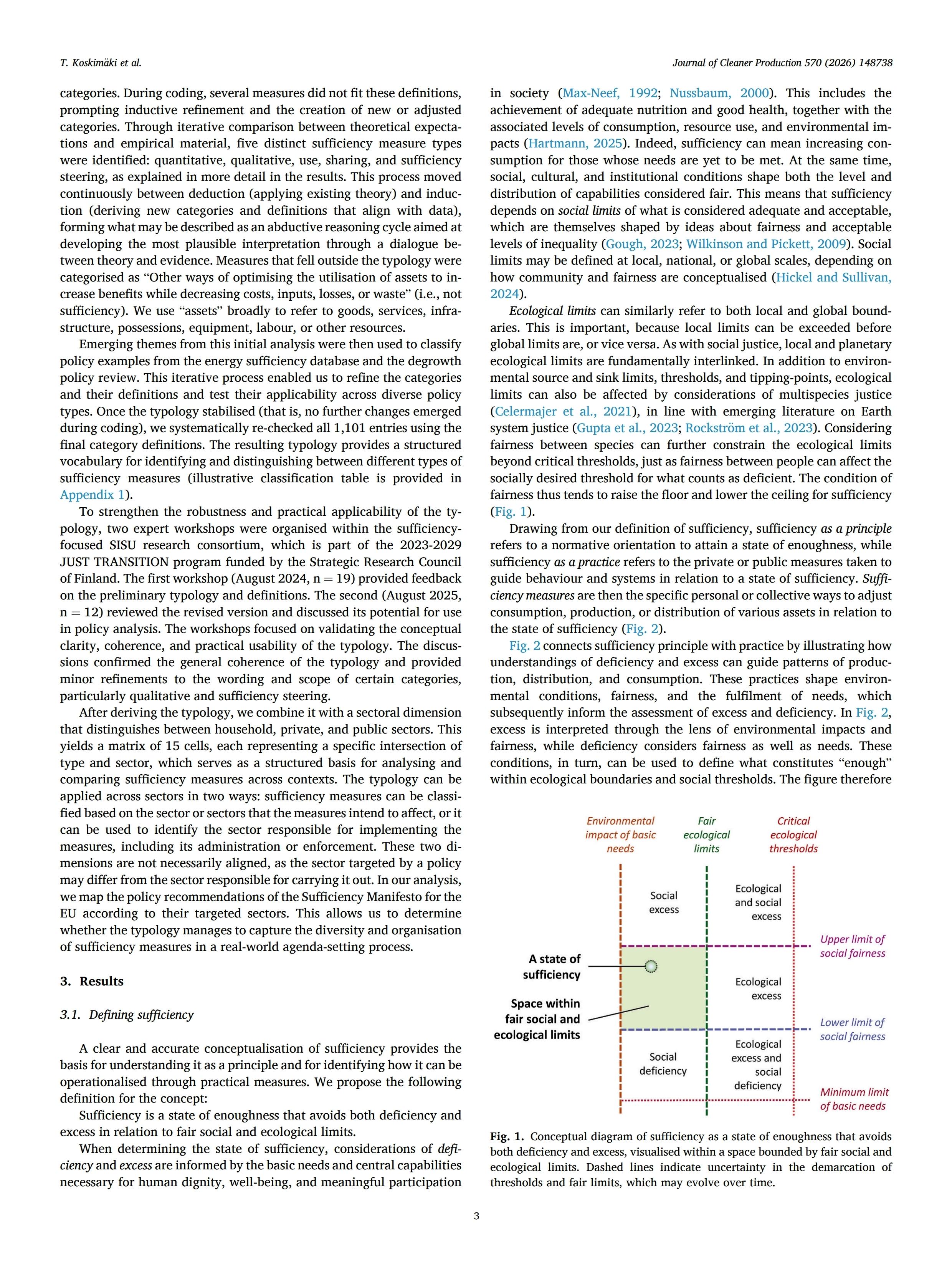
A state of enoughness that avoids both deficiency and excess, within fair social and ecological limits".
~  More further below.

Abstract:
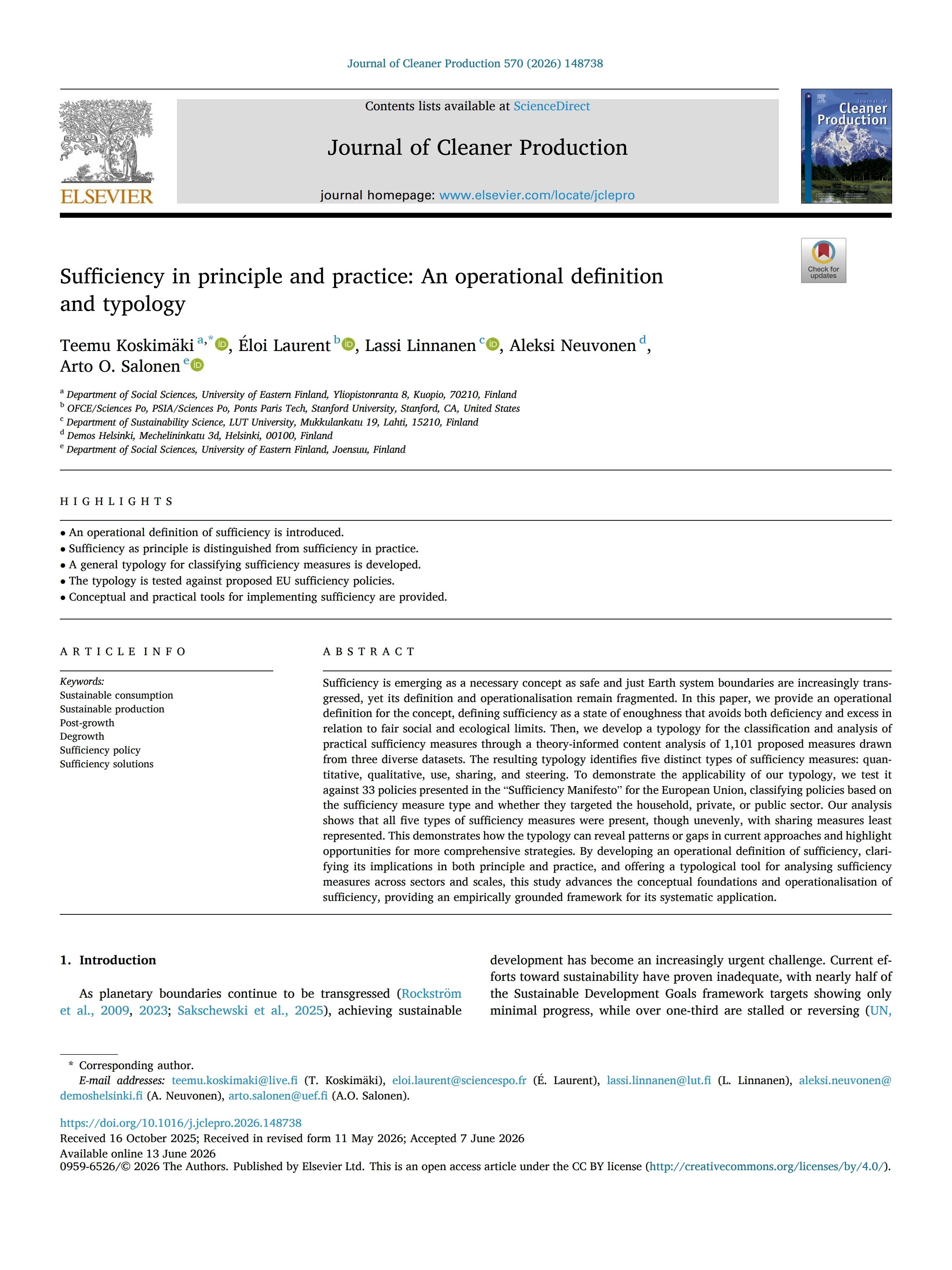
Journal of Cleaner Production
Koskimäki T., Laurent É., Linnanen L., Neuvonen A., Salonen A.


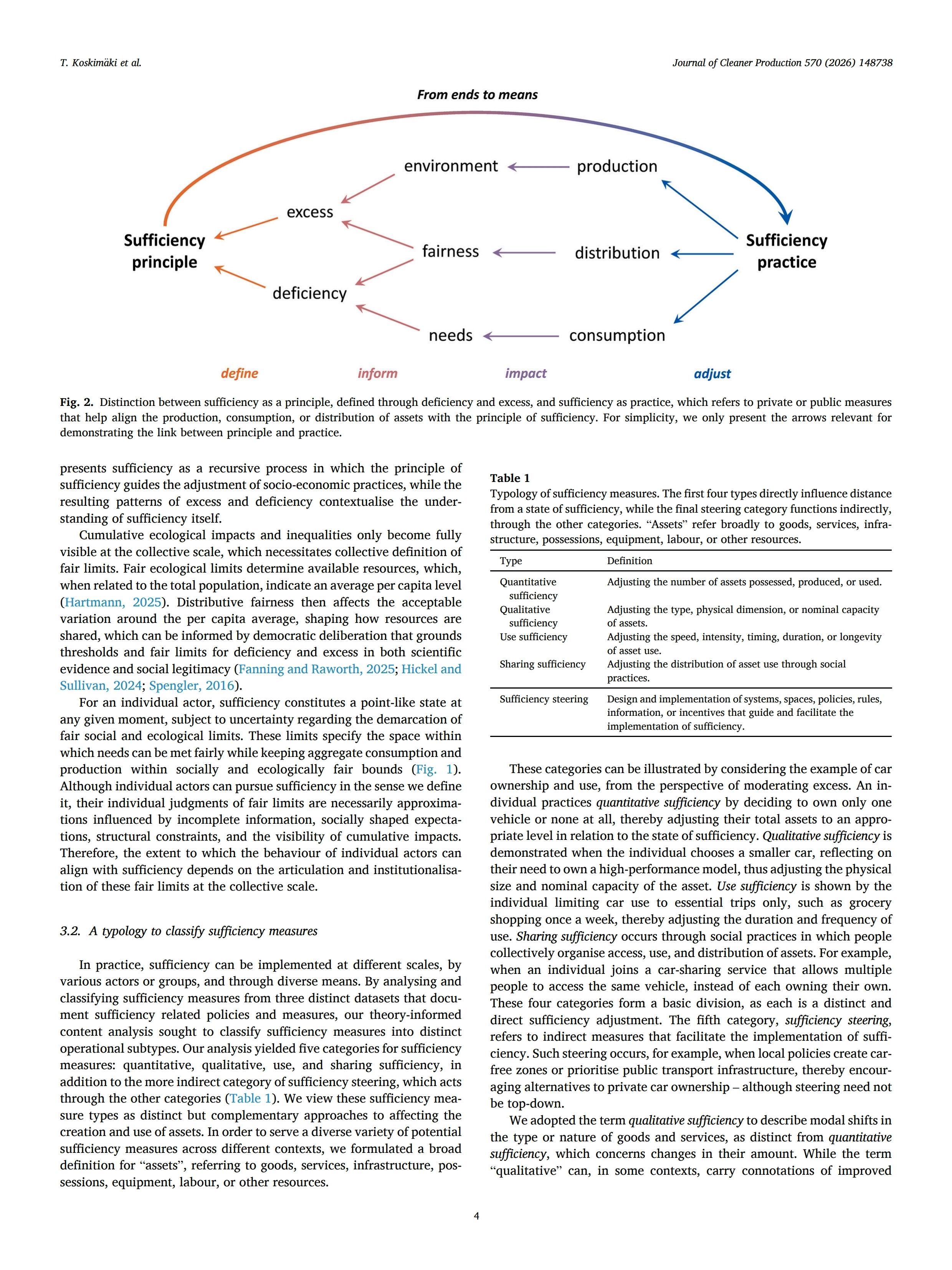
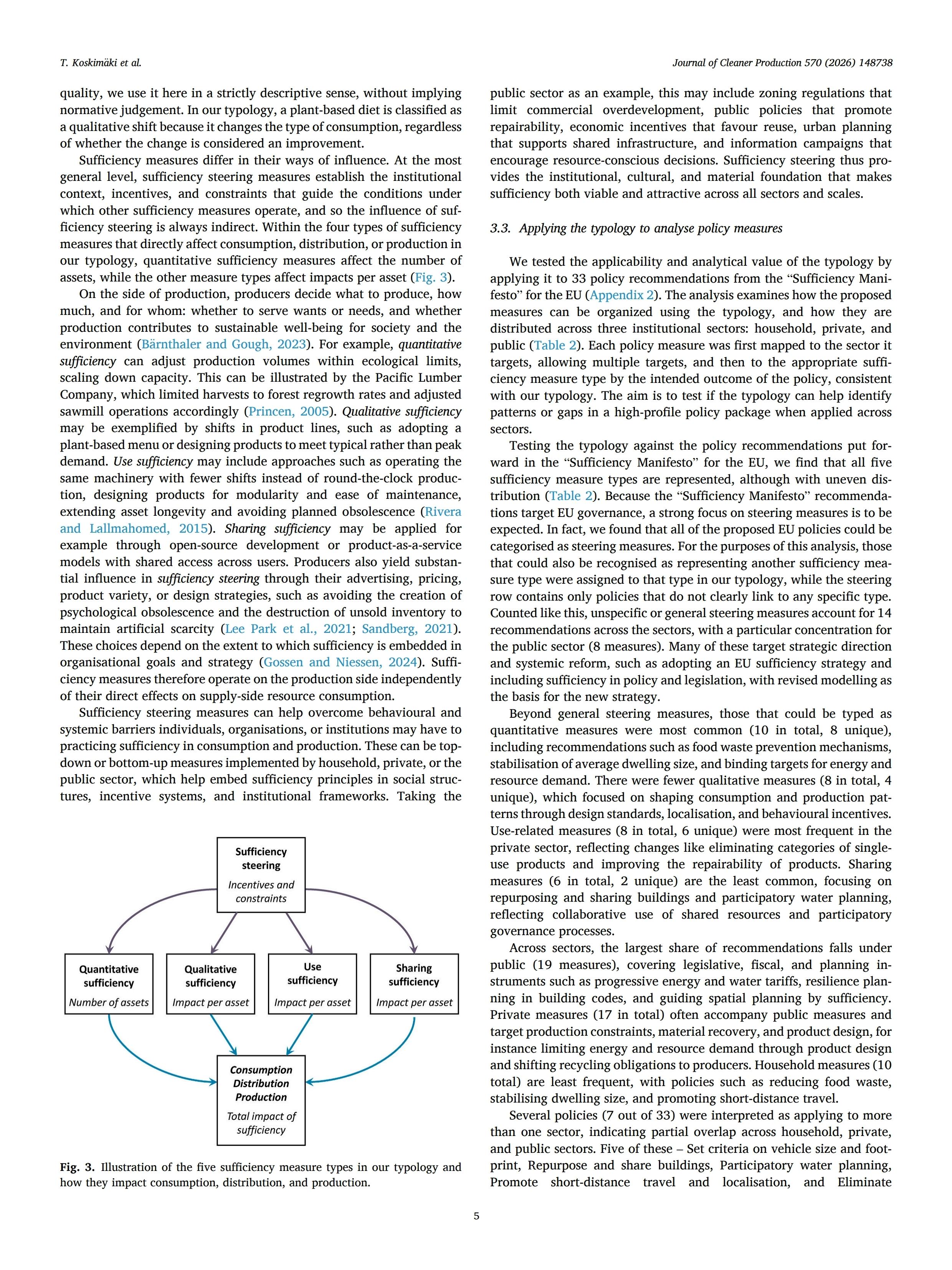
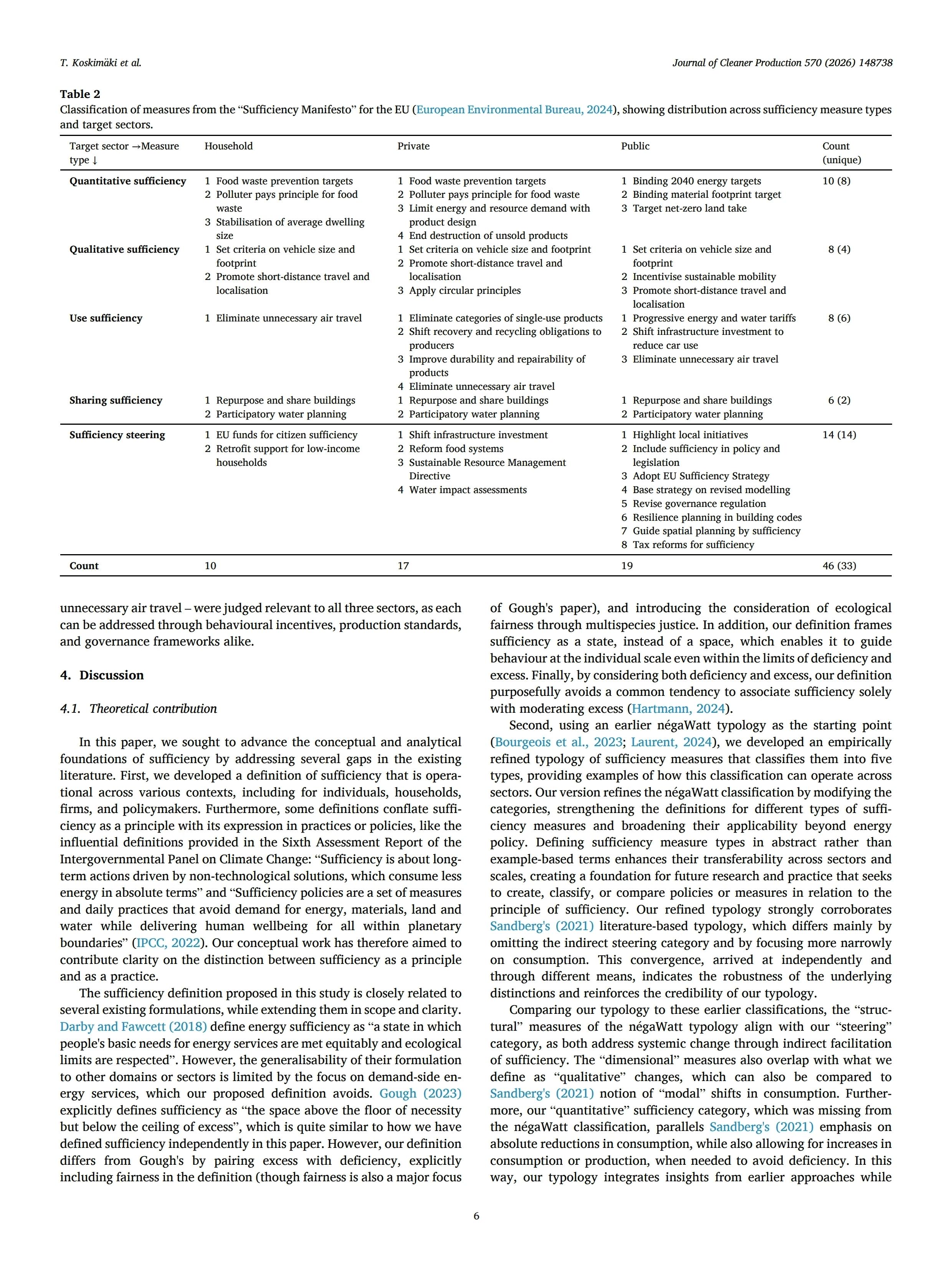
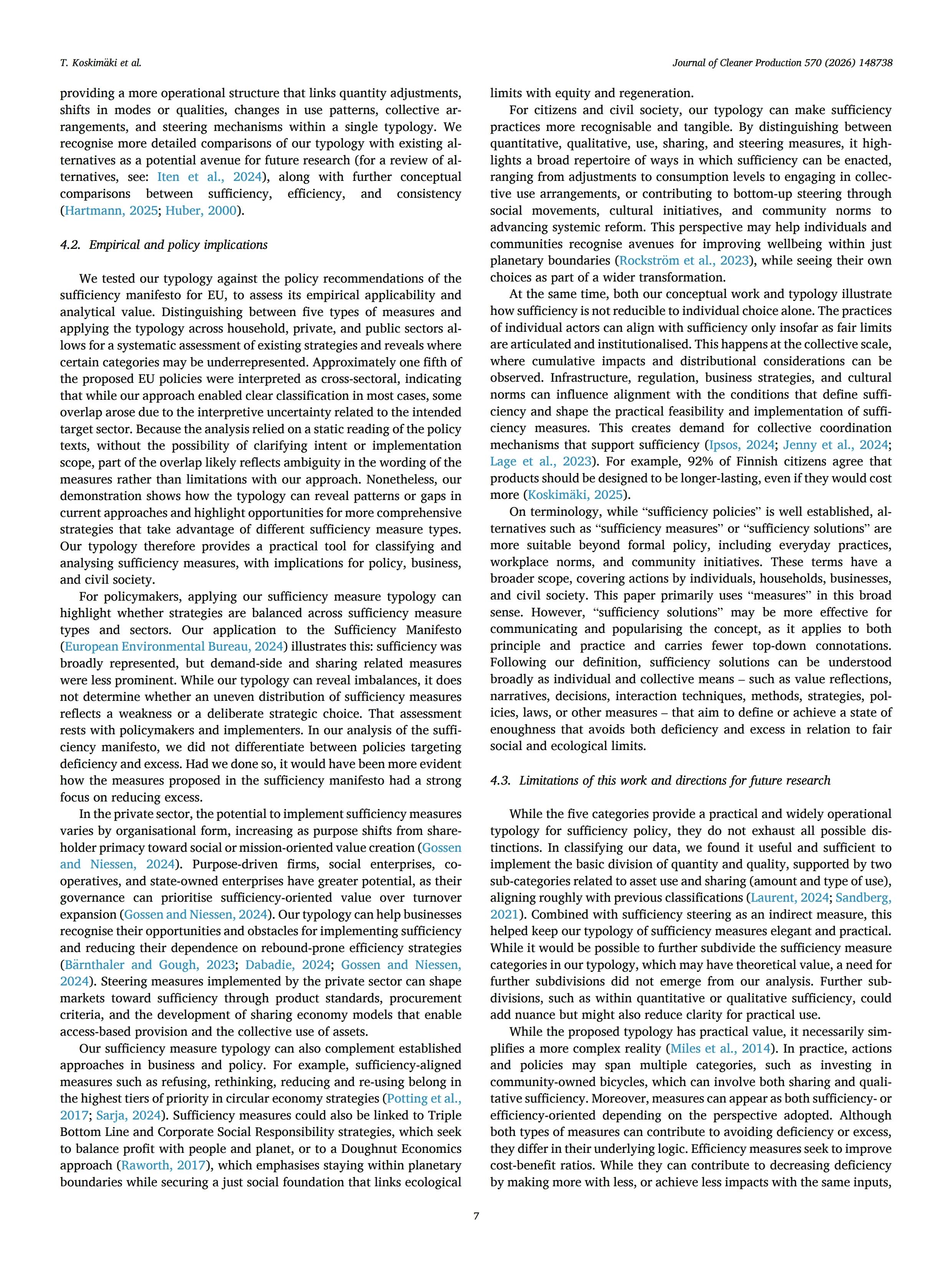
Sufficiency is emerging as a necessary concept as safe and just Earth system boundaries are increasingly transgressed, yet its definition and operationalisation remain fragmented. In this paper, we provide an operational definition for the concept, defining sufficiency as a state of enoughness that avoids both deficiency and excess in relation to fair social and ecological limits. Then, we develop a typology for the classification and analysis of practical sufficiency measures through a theory-informed content analysis of 1,101 proposed measures drawn from three diverse datasets. The resulting typology identifies five distinct types of sufficiency measures: quantitative, qualitative, use, sharing, and steering. To demonstrate the applicability of our typology, we test it against 33 policies presented in the “Sufficiency Manifesto” for the European Union, classifying policies based on the sufficiency measure type and whether they targeted the household, private, or public sector. Our analysis shows that all five types of sufficiency measures were present, though unevenly, with sharing measures least represented. This demonstrates how the typology can reveal patterns or gaps in current approaches and highlight opportunities for more comprehensive strategies. By developing an operational definition of sufficiency, clarifying its implications in both principle and practice, and offering a typological tool for analysing sufficiency measures across sectors and scales, this study advances the conceptual foundations and operationalisation of sufficiency, providing an empirically grounded framework for its systematic application.


Business, Management and Accounting, Social Sciences

sufficiencyinprincipleandpractice_1.jpg

sufficiencyinprincipleandpractice_2.jpg

sufficiencyinprincipleandpractice_3.jpg

sufficiencyinprincipleandpractice_4.jpg

sufficiencyinprincipleandpractice_5.jpg

sufficiencyinprincipleandpractice_6.jpg

sufficiencyinprincipleandpractice_7.jpg

sufficiencyinprincipleandpractice_8.jpg

sufficiencyinprincipleandpractice_9.jpg

sufficiencyinprincipleandpractice_10crop.jpg


Source:

https://www.sciencedirect.com/science/article/pii/S0959652626012795

https://doi.org/10.1016/j.jclepro.2026.148738


Summary:
f1551cbd0c3b7aaff5bf9ee2d23dbe46.png

6cb67d073841ceff504a3fe3057726d0.pnghttps://substack.com/@theminorityreport1#


Sufficiency Manifesto

The Sufficiency Manifesto is a 2024 policy initiative backed by over 80 European civil society, academic, and business organizations (spearheaded by networks like FEDARENE and négaWatt) that urges the European Union to make "energy and material sufficiency" a central pillar of its legislative and climate framework.


The manifesto defines sufficiency as a set of measures and daily practices that avoid the excessive demand for energy, materials, land, and water right from the start, while still delivering human well-being within planetary boundaries.
 

Core Demands
* Binding Resource Targets: The manifesto calls for the EU to set binding targets for raw material and energy reduction, operating alongside existing CO₂ and renewable energy goals.
* Energy Security and Autonomy: Positioning sufficiency as a matter of sovereignty, it argues that reducing overall European resource dependence on third-country suppliers is crucial for a competitive, secure economy.
* Policy Integration: It demands that energy sufficiency be actively embedded across all European climate scenarios, transitioning the EU's focus from just how energy is produced to how much is actually consumed.

Why It Matters
While the concept of energy efficiency focuses on doing the same things with less power, sufficiency fundamentally questions the volume of energy and resources consumed in the first place (e.g., read more on the principles). Proponents argue that sufficiency policies—such as lowering thermostats, reducing unnecessary travel, and extending product lifespans—are the fastest, cheapest ways to curb emissions and adapt to energy shocks.


----

Good Reads: https://justpaste.it/greads

Essays - Index: https://justpaste.it/esi
Library Meta Index: https://justpaste.it/lmi