
Learning from Sparrows: A Social Permaculture Reflection
* based on the transcript *
https://justpaste.it/sp-lfs-spr
Introduction
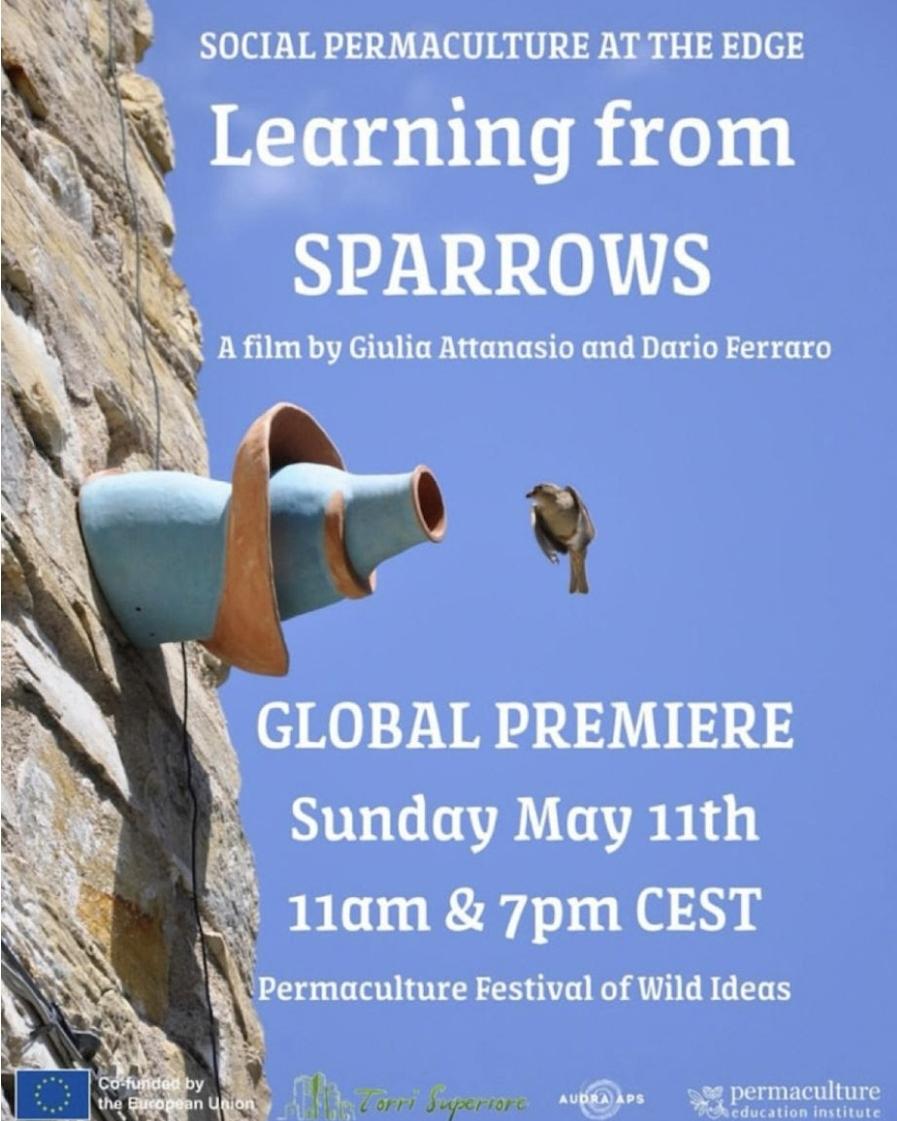
This document is a narrative reworking of the spoken transcript from the documentary Learning from Sparrows – Social Permaculture at the Edge, filmed in a small ecovillage near the town of Ventimiglia, Italy. The film follows a group of around 30 young people exploring social permaculture through communal living, activism, and encounters with migration at the edge of Europe. The title, "Learning from Sparrows", is not only poetic but symbolic: “S.P.A.R.R.O.W.S.” stands for Social Permaculture As a Resource for Regenerative Open and Welcoming Societies — a vision that echoes throughout the project.
Unlike polished texts written for print, the original documentary consists of interviews, shared reflections, fragments of spontaneous dialogue, and improvised action. As such, the raw transcript — derived from subtitle files — was often fragmented and conversational.
The present version has been carefully restructured to preserve the integrity and message of the original, while offering clarity, flow, and readability. No fictional elements have been introduced. Every effort has been made to keep the spirit of the voices intact, distilling their meaning into coherent, readable sections.
Each of the ten thematic segments follows the arc of the documentary and is presented in a way that respects the emotional and intellectual depth of what was shared.
Segment 1: A Climate Summit and a Village on the Edge
As the world's largest climate summit opens in Dubai, 2023 is already on record as the hottest year this planet has ever seen. The 28th annual United Nations climate meeting is underway in one of the world's leading oil-exporting countries. Mitigation, adaptation, and finance are on the agenda. But the real question, echoing beyond conference halls, is: what are the decisions that truly matter at COP28? Is it, finally, the phasing out of fossil fuels?
Amidst these global deliberations, a very different gathering is taking place — rooted not in airconditioned negotiation rooms, but on riverbanks and stony paths. As activists, we ask: how do we challenge the massive infrastructures that fuel our societies? Power grids, economic systems, the machinery of non-renewable extraction?
Permaculture offers tools to shift the world — not by attacking what's broken, but by stepping outside it. It invites us to engage not only in resistance, but in regeneration. Instead of shouting “no,” it teaches us to look differently, to act constructively, and to design life in alignment with both nature and justice.
Right now, we're sitting in a house that's part of the ecovillage Torri Superiore, nestled in the hills just ten kilometers from Ventimiglia — the last town before the French border. The village itself is medieval, with no formal written history, but its stone paths and winding structures speak of centuries past. It likely dates to the 14th century or earlier, shaped during times when this part of Liguria was under threat from the sea. In those days, coastal people moved inland, building shelter not with grand castles or fortresses, but by stacking humble stone rooms on top of one another — family by family — creating a kind of organic fortress made not by rulers, but by villagers.
That same spirit continues here. What once crumbled in ruin has been carefully revived using the very principles of permaculture: mutual aid, thoughtful design, and shared surplus. We didn't know at the start if it would work. But it did — because we supported one another and made every action serve multiple purposes. A guest house supports the local economy. Cooks, farmers, and office workers form an ecosystem, not a hierarchy. No single role stands alone.
And we live on the margin — not just geographically, but philosophically. It is here, on the edge, that permaculture reveals its deeper promise.
Segment 2: From Ethics to Practice: Planting the Seeds
We begin with an invitation to pause and reflect: fifteen minutes to write down expectations, fears, and any thoughts surfacing in the room. Expectations, we're told, are like air — unseen but present, shaping the space between us. Our talents — what we bring — are imagined as fruits hanging from a communal tree. Below, there's soil and compost: the unanswered questions, the raw material of future growth.
This moment isn't just an icebreaker. It's a microcosm of the permaculture process. We are invited to see ourselves not as isolated learners, but as parts of a living ecosystem, held by roots of shared values and nourished by curiosity and care.
At the core of permaculture lie its ethics: Care for People, Care for the Earth, and Fair Share. These aren't slogans — they're orientation points. “Care for People” means creating communities where everyone is given space and dignity. “Care for the Earth” extends beyond flora and fauna — it includes soils, water systems, and the integrity of non-living ecosystems. And “Fair Share” calls us to limit our consumption and population growth — not as austerity, but as humility. Take only what you need. Leave space for others.
But what does it really mean to live a One Planet way of life?
This is the question under the surface — and its answers take many forms: from urban farming experiments to eco-village living, from youth-led programs to community networks both local and global. Permaculture is not one method or model, but a framework for regeneration — applied across economics, households, learning environments, and relationships.
More than anything, it is a lens — and a responsibility — to shape our world not only wisely, but joyfully.
Segment 3: Learning from Sparrows, Building from the Ground Up
There's something to be learned from the sparrows.
They wait quietly in the trees nearby, refusing to enter their nests until everything feels safe, until the people have gone. To truly observe them — to really see — you must be still. You must go out, sit down, quiet yourself, and wait. And then, only after minutes of stillness, the birds begin to reappear.
This, too, is a lesson in how to be with one another.
We often rush forward with goals, driven by linear visions of success. But life in community — like the habits of sparrows — asks us to slow down. To drop the assumption that everything should move according to plan. To notice how others move, how different rhythms coexist, how shared space is negotiated. In this way, observation becomes a social practice. It's not just ecological insight — it's relational wisdom.
Permaculture, once mostly associated with self-sustaining homesteads, is evolving. Those same principles that guided people to plant, harvest, and compost are now being applied to human systems — to social behaviors, to activism, to group processes.
One group of participants summarizes this transformation by naming the shift they're part of: disrupting dominant systems by building new ones from the ground up. It's not about fixing everything at once. It's about tending the details, creating new relationships, and allowing a different structure to emerge — one not copied from the old, but composted from experience.
As one older voice recalls, permaculture first seemed to be about farming — new techniques, better planting. But with time, it revealed something much larger: a philosophy of living. A design for how we inhabit the earth — how we respect its boundaries and create good lives for all, not just the lucky few.
Segment 4: The Intentional Community and the Power of Choice
There's a key difference between communities of the past and those of today. In earlier times, villages like this one — tucked into valleys, sculpting the landscape through generations — were built out of necessity. People didn't choose where to live; they stayed because they had to. Their structures, their routines, their lives were shaped by constraints as much as by connection.
But here, now, in this ecovillage, we call ourselves an intentional community. We choose to be here. Every day, we decide whether to stay, return to town, or move on. This freedom — the freedom of choice — is what defines the difference. And with that choice comes not only autonomy, but responsibility.
We don't pretend that ego disappears in such a setting. We each carry pride, preferences, a need to feel important. These are natural. But we're learning — through open communication, through honest self-reflection — how to avoid letting ego take over. Because when individualism becomes dominant, when one person's vision starts to suffocate the collective, the group loses its purpose.
This is the crucial threshold for any project that dares to be communal: how to balance freedom with cohesion. In non-hierarchical groups — where structure is flexible and authority is shared — every person gains the right to choose. And with that right comes deeper engagement. Each decision becomes an act of stewardship.
So when we speak of community here, we speak of intentionality. Yes, we garden and build and organize together. But more importantly, we celebrate together. We shape the daily rhythm of shared life — not because we must, but because we choose to.
Segment 5: Rank, Privilege, and the Moving Chessboard
Change is constant — like a chessboard in motion.
In every context, the pieces shift. Roles are redefined. Power is rebalanced. Social position, or rank, isn't fixed; it evolves depending on where we are and who we're with.
Take the example of a schoolteacher. In her classroom, she holds clear authority — the kind we easily label as power. But once home, she enters a different dynamic. Her partner may hold another kind of professional status, and within their private life, the lines of influence blur. Her rank, so visible at school, becomes more ambiguous at home.
Now imagine not just one chessboard, but thousands — scattered across the globe. Each one a social field. Each one full of people, moving, responding, adjusting to the forces around them. Rank is the invisible hand that positions us within those games. It reflects not only status but the accumulation of privileges — some visible, others so ingrained we forget they're there.
And what is privilege, really?
It's the ability to choose. The freedom to say yes or no. To move through the world with fewer obstacles. To buy something or not, to travel or stay home, to speak up or remain silent and still be heard.
The challenge is that we often only recognize privilege once we lose it. When illness strikes, when money disappears, when doors begin to close. Only then do we look back and see what we had — the health, the wealth, the ease — and name it for what it was.
So rank is more than just power. It's a tapestry of inherited and accumulated privileges — shaped by where we were born, the color of our skin, our gender, our passport, our health, our education. It's a dynamic, multi-layered force. And it is always, always in motion.
Segment 6: The Weight of Privilege, and the Will to Act
“There's room for improvement.” The words land lightly, almost as understatement — but they point to a deeper reckoning beneath the surface.
As the conversation unfolds, so does the complexity of social rank. Not just as theory, but as lived tension: in dialogue, in self-perception, in the fear of saying the wrong thing. One participant reflects on how difficult it can be to speak openly about social issues when you carry certain identities — being white, European, privileged. Even with good intentions, these labels can become barriers. They shape not only how others see us, but how we censor ourselves.
There's a moment of raw honesty: “The other day, I was even called a solutionist.” The label stings. It creates doubt. Can I still contribute to change if my identity is tied to those who've benefited from systemic harm? What if wanting to help is mistaken for control?
This is where discomfort arises — and where it matters. The group doesn't shy away from it. They speak openly about the collective history of colonization, of exploitation, of being on the benefiting side of power. But they refuse to stay in guilt or paralysis. The point isn't to dwell in shame, but to let it become a motor for transformation.
Acknowledgement becomes a first step. Then comes action.
It's not about having perfect answers. Most people already carry tools — lived experiences, values, questions, small acts of courage. What matters is how we use them, how we show up in conversations that feel fragile, and how we support each other to step forward — not as saviors, but as partners in change.
Segment 7: Designing on the Edge — Refuge, Risk, and Respect
Every edge holds energy. That's one of the principles of permaculture. Where two environments meet — where forest meets field, river meets road, community meets crisis — something potent is always happening. And if we don't design with intention, that energy will express itself anyway, with or without us.
This truth plays out vividly in Ventimiglia, where migrants gather along the river, beneath a viaduct that runs through town. The system managing their presence is broken — or more honestly, it's not managed at all. What unfolds there is not structure, but chaos. Needs unmet. Movements unacknowledged.
Even though the group follows procedure — notifying local authorities, submitting paperwork to the municipality, police, and administrators — the river remains unpredictable. Some days, there are camps. Other days, emptiness. And that changes everything. The presence or absence of people shifts the tone of their action, the approach, the purpose.
Under the bridge, where shadows stretch long into night, migrants sometimes find shelter. But even that is temporary. Police come, and the group disperses. They sleep on beaches. Then, displaced again, they return to the river. It's a pattern with no clear rhythm, shaped more by survival than by any official plan.
And so, those who come to help must tread carefully. If there are people under the bridge, the first step is always the same: approach gently. Announce your presence. Clarify that this is not the police, that there is no danger, no one coming to chase or remove. Only hands willing to help — clean up the waste, restore dignity to a disregarded place.
It is a form of playing on the edge — literally, socially, ethically. And that edge must be approached with design, humility, and care.
Segment 8: Crossing the Line Between Awareness and Witness
In the riverbed, something shifted.
The group met with local activists — people who had spent years facing the human toll of migration — and what they heard was devastating. The kind of devastation that doesn't just provoke tears or anger, but something deeper: an existential tremor. “What’s wrong with us?” one participant asked. Not with them — the migrants, the police, the politicians — but with us, collectively. With humanity. With ourselves. And when such questions arise — What is the purpose of life? — it's rarely a good sign. These are the questions asked not from wonder, but from despair. Because the answers are no longer satisfying. Because the usual logic collapses under the weight of what's been seen.
This wasn't theory anymore. It wasn't an article or a social media headline. This was physical immersion in reality: the smells, the sounds, the feel of broken ground and abandoned belongings. All senses awake, all defenses dropped. It hit hard. And for many, the impact is still echoing.
What made it even more powerful was the act itself: entering the river as a group — forty people strong — to clean a space where even the police are reluctant to go. Normally, if authorities come, it's to clear the camp, destroy possessions, and push people south again, further into Italy. Bulldozers come. Lives are swept away like debris.
But this group did the opposite. They entered gently. They picked up trash. They found jackets, toothbrushes, burned documents. Remnants of lives trying to pass unseen.
Among the most haunting items were papers from Lampedusa’s Red Cross — a reminder of long journeys made by sea, now scattered in the underbrush of a border town. And then, slowly, something remarkable happened: some of the people who had slept under the bridge the night before came forward. And they cleaned alongside the group.
This wasn't symbolic. It was real. Hands working together in silence. Borders temporarily blurred. Something human, raw, and unspoken unfolded there — something the news never quite shows.
Segment 9: From Waste to Message, from Grief to Art
In a quiet corner of western Liguria, they sent a message to the world.
It wasn't through protest or policy. It was through art — born from garbage, from grief, from the debris collected by hand along the beach and riverbank. Plastic bottles, torn fabric, fragments of passage. These discarded things were reshaped into something else — a sculpture, a symbol, a whisper carried on the wind toward the polished stages of Dubai, where COP28 unfolded in grandeur.
At first, the act seemed minor — secondary to the real work of cleaning. But then something shifted. People began to recognize the meaning behind it. The performance gave shape to emotions too tangled to explain. It allowed sorrow to move. It let heaviness rise.
From the rubbish they'd pulled from the soil, they built translucent towers — a playful mimicry of Dubai's gleaming skyline. Transparent 28, they called it. A message made visible. The contrast was sharp, intentional: skyscrapers made not of steel and glass, but of what society throws away.
And through this, something healing happened. The act of transformation — of turning burden into beauty — helped people leave the river with a lighter heart. It became a way of closing the loop. Of stepping back and seeing: we are not alone. Even if few witnessed the moment in real time, the echo would carry.
Change doesn't always begin in parliament. Sometimes it begins with trash — and what we choose to do with it.
Segment 10: Fire, Flight, and the Uncharted Journey
There's a moment of quiet reflection — a voice likening this time in history to being adrift at sea. No compass. No certainty. But still, we must travel. We must move forward. Not with fear, but with openness. With trust in the present, and courage to meet what comes.
It's an image that stays with you: the boat in open water, no fixed destination, and yet... motion. Life continues. And so does the learning.
At the end of the course, the energy shifts into ritual. Repetition becomes incantation.
Voices rise: You came here to set up a fire. To set up a fire.
The refrain echoes — not just as metaphor, but as intention. Fire becomes a symbol of transformation, warmth, disruption, creation. The fire they speak of is not destructive, but catalytic. It's the fire of connection, of shared effort, of lighting new paths through darkness.
And then come the birds.
The birds are calling you.
Their song interweaves with the fire. The message is layered: the birds — creatures of flight, of distance, of perspective — cry out because their home is burning. Because the world we all share is in crisis. Because even flight has its limits when there is nowhere left to land.
Their home is on fire.
The fire grows.
But the call is not only a warning — it is an invitation. To respond. To act. To rise.
This is not the end of a project. It is the spark of something new.
[ End song: ""Birds" by Sil Sol ]
Sources & Context
This reflection is based on the documentary: Learning from Sparrows – Social Permaculture at the Edge
Filmed in the ecovillage Torri Superiore, near Ventimiglia, Liguria, Italy
Original video: YouTube [Offline]
Replays as they become available - a youtube playlist: https://bit.ly/festival-wild-ideas-replays
Alternative: The Way Of The Magpie: https://bit.ly/sp-dbx
Original subtitle source: YouTube SRT file
The project’s title, Learning from Sparrows, forms the acronym S.P.A.R.R.O.W.S.:
Social Permaculture As a Resource for Regenerative Open and Welcoming Societies.
Magpie materials: https://bit.ly/sp-dbx
Public context and related materials available here: https://justpaste.it/lfs-d
This text was collaboratively refined using the original transcript as a foundation, and restructured to enhance comprehension while maintaining the original intentions and sentiments.
Compiled and edited with the help of AI collaboration to support clarity, flow, and accessibility.
Learning from Sparrows - Social Permaculture at the Edge [Landing page]
Social Permaculture - Index: https://justpaste.it/pcspi
On the social aspects of edges in permaculture [Essays]
Indigenous Knowledge & Regenerative Design - Landing page
Social Permaculture - Index: https://justpaste.it/pcspi