
Dinah, Khansa, & Aisha: Parallel Female Experiences
“A Comparative Reflection on Women’s Agency, Honor, and Cultural Contexts Across
Biblical and Early Islamic Narratives”
This page: https://justpaste.it/s-trt
Brief Introduction
This conversation with ChatGPT begins by exploring the backstory of the novel and TV miniseries The Red Tent, focusing on the biblical figure of Dinah and her relevance to Islamic traditions about Prophet Jacob. It then compares Dinah’s experience with that of two early Muslim women, Khansā bint Khidām and ʿAisha bint Abu Bakr, examining questions of female agency, cultural norms, and historical documentation. The exchange culminates in a comparative table and the proposal of a new title that better reflects the conversation’s content.
Index
1./ Inquiry About The Red Tent & Biblical/Islamic Context
2./ Historical & Cultural Context of Dinah
3./ Reflection: Comparing Dinah’s Experience to a Muslim Woman’s
4./ Comparison: Dinah & Khansāʾ bint Khidām
5./ Comparison: Dinah & Aisha bint Abu Bakr
6./ Further Reading Links
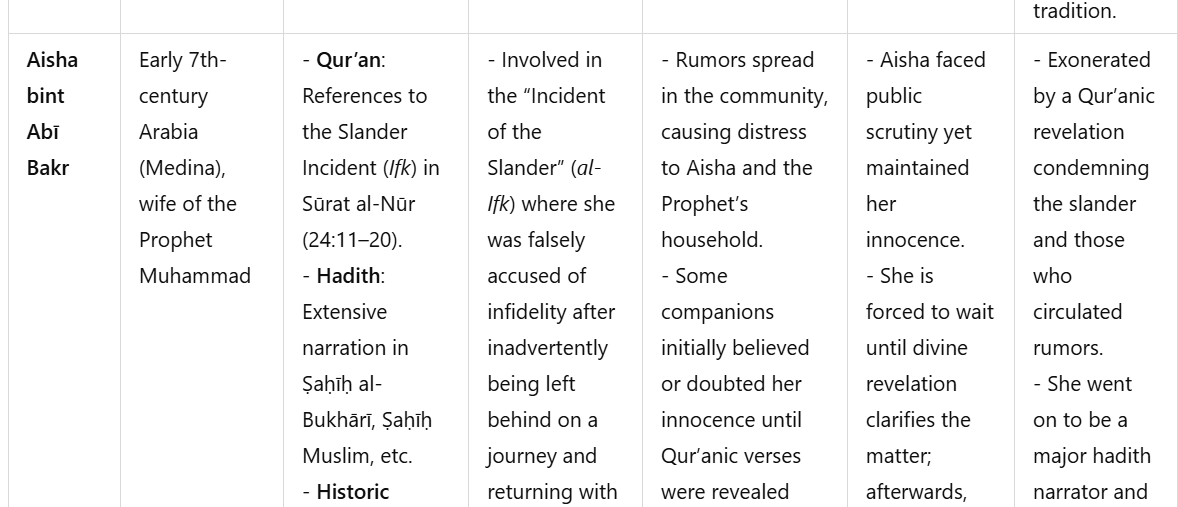
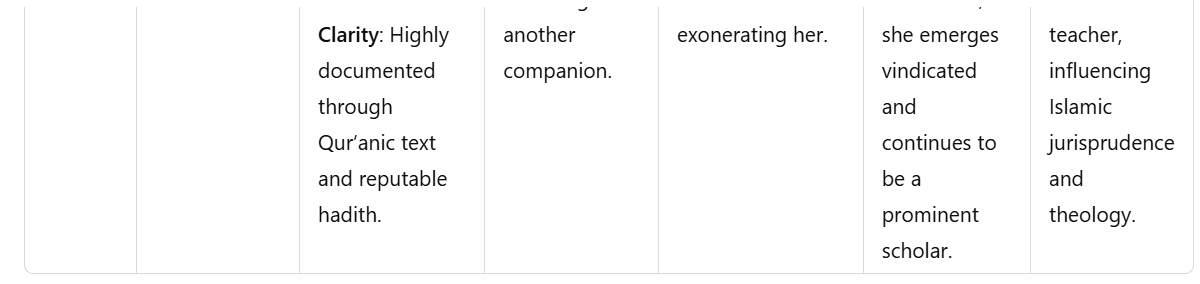
7./ Systemizing the Experiences in a Table
8./ Preparing the Conversation for Publication
You said:
There is a TV series based on a book, called "The Red Tent".
The description of the first episode reads:
"The story of Dinah, the daughter of Leah and Jacob of the Old Testament".
Can you please provide contemporary as well as historical background about this story and
relay it to what is mentioned about prophet Jacob and his family in Islamic scriptures?
ChatGTP:
Abstract
The TV miniseries "The Red Tent" (2014) is based on the 1997 novel of the same name by
Anita Diamant. It tells the story of Dinah, the only daughter of the biblical patriarch Jacob
(Yaqub in Islam) and his wife Leah. In the Hebrew Bible (Book of Genesis), Dinah’s story is a
brief but pivotal one, intertwined with complex cultural and familial dynamics. While Prophet
Jacob (Yaqub) is revered in Islamic tradition, references to Dinah’s story do not explicitly
appear in the Qur’an. Below is an overview of the contemporary literary and cinematic
adaptation "The Red Tent," a historical look at Dinah’s biblical tale, and a discussion of Jacob
and his family in Islamic scripture.
1. Contemporary Background: "The Red Tent" Novel and TV Series
1. Novel (1997)
o Written by Anita Diamant, The Red Tent is a work of historical fiction that expands
upon the biblical story of Dinah, found in the Hebrew Bible (Book of Genesis, mainly
Chapter 34).
o Diamant uses imaginative detail to give voice and depth to biblical women, often
overshadowed in traditional retellings. The “red tent” in the novel represents a
women's space for childbirth, menstruation, and bonding.
o The novel became popular among readers interested in feminist reinterpretations of
biblical narratives and has also been studied for its cultural and religious themes.
2. TV Miniseries (2014)
o Produced by Lifetime, starring Minnie Driver (as Leah) and Rebecca Ferguson (as
Dinah).
o The adaptation follows Diamant's novel rather than sticking purely to the sparse
details in Genesis. The screenplay emphasizes female bonds, rituals, and the
everyday life of women in ancient times.
o While it builds on biblical episodes, it also injects fictional backstories and
motivations, thus diverging in several respects from any single scriptural source.
2. Historical and Biblical Context: Dinah in the Book of Genesis
1. Dinah’s Family
o Dinah is the daughter of the patriarch Jacob (also called Israel) and Leah. Jacob's
family is central in the Hebrew Bible, with Jacob's twelve sons traditionally seen as
the progenitors of the Twelve Tribes of Israel.
o Dinah is unique in Genesis for being named as Jacob's daughter.
2. Story of Dinah and Shechem
o Genesis 34 recounts a dramatic narrative: Dinah visits the city/region of Shechem,
where Shechem (son of Hamor, a local Hivite leader) either seduces or rapes her
(translations differ).
o Shechem then seeks to marry Dinah, offering dowry and urging his father Hamor to
negotiate with Jacob's family.
o Dinah's brothers, Simeon and Levi, are furious at Shechem's treatment of their
sister and the perceived dishonor to their family. They deceive the men of the city
into circumcision, and, while they are still incapacitated, slaughter them.
o The story underscores tensions between Israelites (Jacob's family) and neighboring
peoples and illustrates issues of honor, marriage, and tribal alliances in the ancient
Near East.
3. Significance
o Over time, this biblical episode has been variously interpreted: as an example of
fraternal or tribal “justice,” as a cautionary tale about revenge, or as a spotlight on
women's vulnerability in patriarchal societies.
o Traditional Jewish, Christian, and modern feminist readings differ widely in how they
interpret Dinah's role and how they judge the actions of her brothers.
3. Jacob (Yaqub) and His Family in Islamic Scripture
1. Prophet Jacob (Yaqub) in Islam
o Jacob is recognized as a prophet in the Qur'an and is mentioned multiple times,
often alongside Abraham (Ibrahim), Isaac (Ishaq), and Joseph (Yusuf).
o In Islamic tradition, Jacob is a model of patience and steadfast faith, especially
highlighted in Surat Yusuf (Chapter 12 of the Qur'an), which tells the story of Joseph
(Yusuf).
o Jacob's name sometimes appears as “Israel” in Islamic historical-literature
references, as is mirrored in Judeo-Christian scripture (though the Qur'an itself
typically uses “Yaqub”).
2. Jacob’s Children in the Qur’an
o Islamic texts emphasize the sons of Jacob—particularly Joseph, Benjamin
(Binyamin), and the older siblings who initially plotted against Joseph.
o The Qur'an (12:4-100) narrates Joseph's tribulations (his dream, being sold into
slavery, imprisonment, rise to leadership, and eventual reunion with his family).
Jacob's profound grief over losing Joseph and joy at being reunited are vivid aspects
of the Qur'anic storyline.
o Dinah’s Name: The Qur'an does not mention Dinah, nor does it relate the events
of Genesis 34. Most classical Islamic commentators (e.g., Ibn Kathlr, al-Tabari)
likewise focus on Jacob's sons when discussing his family. Hence, the story of Dinah is
not a feature of mainstream Islamic exegesis.
3. Possible References in Secondary Islamic Literature
o There are occasional mentions in some extra-biblical Jewish or Judeo-Islamic lore
about Jacob having a daughter or daughters. However, these are generally
peripheral compared to Joseph's narrative.
o No canonical hadith revolve around Dinah or the Shechem incident. Thus, from an
Islamic standpoint, Dinah's story as told in Genesis is outside the central corpus of
recognized prophet narratives.
4. Linking the Two Traditions
1. Overlap and Differences
o Overlap: Both Islamic and Judeo-Christian scriptures uphold Jacob as a divinely
guided patriarch and father to a large family.
o Differences: The biblical narrative includes Dinah's story and the Shechem events,
whereas Islam's focus remains on Jacob's sons, especially Joseph, with no direct
mention of Dinah's experiences.
2. Modern Interpretations
o Contemporary retellings—like The Red Tent—offer imaginative expansions that fill
out the Biblical account with cultural, emotional, and societal details, especially
regarding women's roles.
o From an Islamic perspective, while The Red Tent is not rooted in Qur'anic tradition,
Muslims interested in biblical narratives might read it for cultural or literary insight
but typically understand that it diverges from or goes beyond any standard Islamic
teaching on Prophet Jacob's family.
5. Conclusion
The tale of Dinah, retold in The Red Tent, comes from the Hebrew Bible's Book of Genesis.
Historically, it highlights aspects of ancient Near Eastern culture: family honor, intertribal
relations, and the limited role of women's voices in patriarchal societies. In contrast, the
Islamic tradition regarding Prophet Jacob (Yaqub) focuses primarily on the story of Joseph,
without any mention of Dinah's experiences. Although The Red Tent is a modern, fictionalized
exploration, it provides a narrative window into a possible women's perspective of biblical life.
For those studying the Abrahamic faiths or intrigued by lesser-known biblical figures, it
underscores how interpretive works can bring depth to short scriptural texts—while also
reminding us that these expansions are not part of the Islamic scriptural corpus.
Further Resources
• The Red Tent (Novel) by Anita Diamant:
https://www.goodreads.com/book/show/4989.The_Red_Tent
• The Red Tent (2014 TV Miniseries) on IMDb:
https://www.imdb.com/title/tt3068894/
• Book of Genesis, Chapter 34 (Dinah's Story):
https://www.biblegateway.com/passage/?search=Genesis+34
• Qur’an, Surah Yusuf (Chapter 12) - Jacob and Joseph's story:
• Tafsīr Ibn Kathīr (English translations available
online): https://www.qtafsir.com/ (search “Surah Yusuf”)
ChatGPT:
I hope this helps clarify how Dinah's biblical narrative is depicted in The Red Tent and how it
contrasts with the Islamic tradition concerning Prophet Jacob. If you have further inquiries,
feel free to let me know.
Always remember that The Red Tent is a creative, fictionalized expansion of a short biblical
passage and should not be taken as a “canonical” text within Judaism, Christianity, or Islam.]
Dinah's story vs the experience of Khansa bint Khidam
You said:
Could you please make a reflection on Dinah's experience in the story in relation to an
historical Muslim woman in the Islamic literature?
ChatGPT:
Dinah's story vs the experience of Khansa bint Khidam
Abstract
Dinah's story in the biblical tradition (Genesis 34) revolves around themes of patriarchal
authority, consent—or its absence—and a woman's sidelined voice. In Islamic literature, there
is no direct parallel to Dinah's specific experience with Shechem and the subsequent violent
revenge by her brothers. However, to reflect on the issue of a woman's agency and familial
influence, we can look at an early Muslim woman known in hadith accounts as Khansāʾ bint
Khidām (sometimes spelled “Khansa bint Khidam”), who represents a notable case of forced
marriage—and how it was addressed in the prophetic community. Although not involving
assault, the forced marriage scenario in Khansa's story likewise raises questions about consent
and a woman's ability to make her own choices in a patriarchal context. Below is a
comparative reflection on Dinah's story and Khansa’ bint Khidam's case.
1. Dinah’s Story: Key Observations
1. Ambiguous or Forced Relationship
o Dinah is depicted as either being seduced or forced by Shechem. The biblical text is
ambiguous (Genesis 34:2), but many traditional interpretations understand it as rape.
o The subsequent negotiations for marriage occur between men—Shechem's father
(Hamor) and Dinah's family—while Dinah herself remains silent and overshadowed.
2. Family’s Violent Response
o In an act of retribution or “defending family honor,” her brothers Simeon and Levi
deceive the men of Shechem, then kill them.
o The text frames Dinah as a catalyst of conflict, but she remains largely voiceless.
The outrage and vengeance revolve around the men's sense of “dishonor,” not
necessarily Dinah's personal trauma or will.
3. Patriarchal Setting
o The biblical culture of the time strongly revolved around patriarchal family
structures, inherited lines, and tribal alliances. Dinah's own wishes or perspective
are lost in that context.
2. An Historical Muslim Woman’s Experience: Khansa bint Khidam
1. The Hadith Account of Forced Marriage
o Early Islamic tradition preserves a report (found in collections such as Abu Dāwūd
and others) about a young woman whose father married her to someone without her
permission.
o She complained to the Prophet Muhammad, stating that this marriage was done
against her will.
o The Prophet is reported to have annulled the forced marriage, affirming that a
woman's consent is essential. Some narrations add that she then reaffirmed the
marriage herself, demonstrating that her acceptance mattered.
2. Significance
o This story underscores that in early Islamic teaching, the woman's consent was
meant to be central to a valid marriage. A father or guardian (walī) had
responsibilities, but not absolute power to override a daughter's will.
o It contrasts with many tribal or pre-Islamic customs, wherein family honor might
overshadow individual rights.
3. Comparison to Dinah
o Similarity in Patriarchal Pressure: Both Dinah and Khansa’ lived in societies
where male family members often decided (or heavily influenced) their futures.
o Difference in Outcome: In Dinah's story, her brothers' perspective and the city-
wide conflict become the focus, and Dinah does not get a say. In Khansa’'s case,
Islamic jurisprudence and prophetic judgment intervene to uphold her right to
choose, thus giving her a direct voice and legal remedy.
3. Reflecting on the Two Narratives
1. Voice and Agency
o Dinah: Silent and passive in the biblical text, a victim of circumstances shaped by men.
o Khansa: Actively seeks justice by appealing to Prophet Muhammad, whose decision
empowers her to accept or reject the marriage.
2. Honor and Family Dynamics
o Dinah’s Family: Brothers take extreme measures in the name of family honor;
Dinah's wellbeing or desire is scarcely addressed.
o Khansa’s Context: While paternal authority was strong, the emerging Islamic
paradigm placed legal emphasis on the woman's consent, thus partially
counterbalancing paternal or tribal “honor.”
3. Legal and Ethical Dimensions
o Biblical Context: Genesis 34 is more a tribal-historical account, with no immediate
“legal” framework for Dinah herself. The narrative focuses on communal conflict and
vengeance.
o Islamic Context: The hadith of Khansa highlights that forced marriages can be
annulled, a principle that resonates with broader Islamic jurisprudence emphasizing
the consent of both parties.
4. Cultural Shifts
o Over time, both Jewish and Muslim societies have produced legal discussions
around marriage, consent, and women's rights—though actual practices have
varied across regions and eras.
o Khansa's experience in the early Islamic period is sometimes cited by reformers or
scholars to argue for the rightful place of female choice in marriage decisions.
4. Concluding Thoughts
Dinah's story, as dramatized in The Red Tent or as read in Genesis, is essentially a narrative
of a woman overshadowed by patriarchal violence and revenge. In contrast, the lesser-known
story of Khansa’ bint Khidam in early Islam shows a case in which a forced marital
arrangement could be challenged and overturned, highlighting a principle of female consent.
These two narratives illustrate how different cultures and religious systems have grappled with
questions of a woman's autonomy and familial authority. They also remind us that while
scriptural texts can be terse or ambiguous, communities develop ethical and legal frameworks
to interpret them. Dinah's experience resonates as a call to question any context in which a
woman's voice is lost or ignored, whereas Khansa’s experience exemplifies an early instance
of legal recourse for women's rights—an approach that, ideally, might prevent the kind of
voicelessness seen in Dinah’s account.
References & Further Reading
1. Biblical Account (Genesis 34)
https://www.biblegateway.com/passage/?search=Genesis+34
2. Hadith on Forced Marriages
o Sunan Abu Dawud: For an example translation see:
https://sunnah.com/abudawud:2096
o Parallel references in other hadith collections exist, referencing the same or similar incidents.
3. Islamic Jurisprudence on Marriage
o Tafsīr Ibn Kathīr (search “Marriage in Islam” or “Forced Marriage” context).
o Various fiqh (Islamic jurisprudence) works address the necessity of woman’s consent.
ChatGPT note:
While no direct parallel to Dinah’s traumatic experience appears in the Qur’an or standard
hadith collections, the forced marriage case of Khansa’ bint Khidam is often cited to show how
early Islamic rulings sought to protect a woman’s agency—providing a revealing point of
comparison and contrast to Dinah’s predicament in Genesis.
Dinah's story vs the experience of Aisha bint Abu Bakr (Aisha)
You said:
The previous question, comparing Dinah's experience to the experience of a Muslim woman,
was asked in another ChatGPT conversation. The reply was very similar though not Khansa
but Aisha was mentioned in the comparison. Both replies are of interest. Please integrate the
reply featuring Aisha in this conversation.
ChatGPT:
Dinah's story vs the experience of Aisha bint Abu Bakr (Aisha)
Abstract
Dinah, as portrayed in Anita Diamant’s The Red Tent, is a young woman whose life is shaped
by patriarchal expectations, communal honor, and the silencing of her own perspective.
Although the biblical Dinah and the women of early Islam lived in different cultural, religious,
and historical settings, there are points of resonance when comparing Dinah’s experience to
that of certain early Muslim women— particularly around questions of female agency, honor,
and communal response to allegations of impropriety.
One notable parallel can be drawn between Dinah's story in The Red Tent and an episode from
the life of Aisha bint Abu Bakr (Aisha), a wife of the Prophet Muhammad, involving the so-
called “Incident of the Slander” (al-Ifk). Below is a reflection on these stories, noting
similarities and differences, and what they might illustrate about women's experiences in
patriarchal societies.
1. Dinah's Story in The Red Tent
Origins
Dinah is the daughter of Jacob and Leah, appearing briefly in the Hebrew Bible (Genesis 34).
Anita Diamant's novel expands Dinah's story, centering women's voices and experiences—
particularly around childbirth, mother-daughter relationships, and a tradition of female support
inside the ritual “red tent.”
Conflict and Mistreatment
• In the biblical version, Dinah's liaison with Shechem is described as rape or at least
sexual violence. Diamant's novel reinterprets the relationship more gently, portraying it
as a love story— but a consensual love overshadowed by political and familial concerns.
• Shechem's desire to legitimize the relationship leads to tragic consequences when her
brothers avenge her “dishonor.”
Themes
• Female Silencing: Dinah's feelings and point of view are lost amid communal outrage
and patriarchal concerns.
• Communal Honor: Her family's sense of betrayal leads to violence, with little regard for
Dinah's autonomy.
• Identity and Survival: Forced from her homeland, Dinah must reconstruct her life on
her own terms.
2. The Slander of Aisha in Early Islamic History
A significant moment in Islamic literature parallels some of these themes: the story of Aisha
bint Abu Bakr (Aisha), the wife of the Prophet Muhammad, and the false accusation (al-
Ifk). Although the contexts differ, both episodes highlight how a young woman's life can
become overshadowed by communal rumors, honor, and male-driven narratives.
Background
• Aisha was traveling with the Prophet Muhammad on a military expedition. Due to a
misunderstanding, she was left behind, and later a companion found her and escorted
her back to Medina.
• Upon her return, rumors spread that she had been unfaithful. These rumors caused
disruption in the community, causing distress to Aisha and the Prophet's household.
Communal Response
• Like Dinah, Aisha found her story shaped by forces outside of her control—public gossip,
male-led judgments, and the broader community’s concern with honor and propriety.
• She lived in this tension until a Qur’anic revelation (Surat an-Nur, 24:11-20)
vindicated her by condemning those who spread false accusations.
Outcome
• In contrast to Dinah’s narrative, Aisha eventually was restored under the prophetic
revelation, which restored her standing and denounced the slander on those who
spread rumors.
• Aisha herself emerged as a prominent scholar and teacher of hadith in early Islamic
tradition, significantly contributing, narrating, and exerting her intellectual influence.
3. Woman’s Perspective vs. Communal Concern
• Resonance: Both Dinah and Aisha experience a situation in which their personal lives
become the subject of communal judgment and male-driven decision-making. Their
perspectives, at least at first, take a back seat to broader concerns about honor and
reputation.
• Difference: Aisha’s vindication is religiously codified in the Qur’an, offering her a
public moral triumph. Dinah’s fate in the biblical tale and The Red Tent interpretation
remains defined by trauma and displacement.
4. Power of Rumor or Misinterpretation
• Resonance: Whether Dinah’s liaison was consensual or not (depending on one’s
reading), or Aisha’s innocence in the face of false charges, both reflect how quickly
rumors or misinterpretations can disrupt women’s lives in patriarchal settings.
• Difference: In The Red Tent, the rumor or misunderstanding ends in extreme violence
(the massacre at Shechem). Aisha’s story ends in communal repentance, with no such
bloodshed.
5. Female Agency
• Resonance: Both stories highlight how limited women’s agency can be when men in
authority make decisions. Dinah’s brothers drive the conflict, while influential figures in
the early Muslim community debated Aisha’s case without initially hearing or believing
her.
• Difference: Aisha’s later prominence as a teacher and scholar suggests a path of
empowerment that Dinah never quite finds in the biblical account. Dinah’s trajectory
(especially in Diamant’s version) leans toward forging a quieter new life away from her
family.
6. Significance for Modern Readers
Whether one reads about Dinah in ancient Israel or the early Islamic community, these
narratives underscore how personal stories can be shaped by communal or tribal concerns and
how women struggle to find or sustain a collective voice.
[ChatGPT] The “red tent” and Aisha’s enduring importance highlight that women’s
vulnerability to communal “honor” and rumor-based judgments persist across cultures and
eras, although each tradition handles resolution differently.
Conclusion
Comparing Dinah's and Aisha's experiences reveals that patriarchal structures, communal
gossip, and family or tribal politics can overshadow women's agency and voices. At the same
time, Aisha's ultimate vindication and public emergence as an influential figure stands in
contrast to Dinah's silencing. Both stories remind us that narratives of a woman's defamation
or overshadowed voice remain powerful, bridging historical periods and shaping how we
reflect on women's roles in religious and social settings.
References and Further Reading
• Anita Diamant, The Red Tent
• Official Website of Anita Diamant
• Story of Aisha and the Incident of the Slander
• Qur’an 24:11-20 (Surat an-Nur)
• Various Hadith Collections (e.g., Sahih al-Bukhari, Sahih Muslim)
• Review of the Ifk Incident (Al-Islam.org) (search: “Incident of the Ifk”)
This reflection comparing the biblical Dinah from The Red Tent to a figure like Aisha not only
addresses the question of a woman's experience but also how female voices are presented in
contexts of rumor, female agency, and communal perceptions.
Below are some weblinks (URLs) you might find helpful for further reading about The Red
Tent, Anita Diamant, and the Islamic perspectives on the Ifk (Slander) Incident involving
Aisha bint Abu Bakr:
1. Anita Diamant, The Red Tent
o Publisher's page:
https://us.macmillan.com/books/9780312427290/theredtent
o Goodreads entry:
https://www.goodreads.com/book/show/4989.The_Red_Tent
2. Official Website of Anita Diamant
o https://www.anitadiamant.com/
3. Story of Aisha and the Incident of the Slander
o General narrative (on Al-Islam.org, search “Incident of the Ifk”):
https://www.al-islam.org/
(Use the site's internal search for “Incident of the Ifk” to locate detailed articles.)
o Overview from a Sunni perspective (Islamic Awareness):
http://www.islamic-awareness.org/Quran/Contrad/External/aishah.html
4. Qur’an 24:11-20 (Surat an-Nur)
5. Various Hadith Collections
o Online database of hadith (Sunnah.com): https://sunnah.com/
Sahih al-Bukhari, Sahih Muslim, and other canonical collections are all searchable here.
6. Review of the Ifk Incident (Al-Islam.org)
o Direct link to a discussion/overview:
ChatGTP:
I hope these links help you explore the contexts of both The Red Tent and the historical
account of the Slander Incident in early Islamic history.
You said:
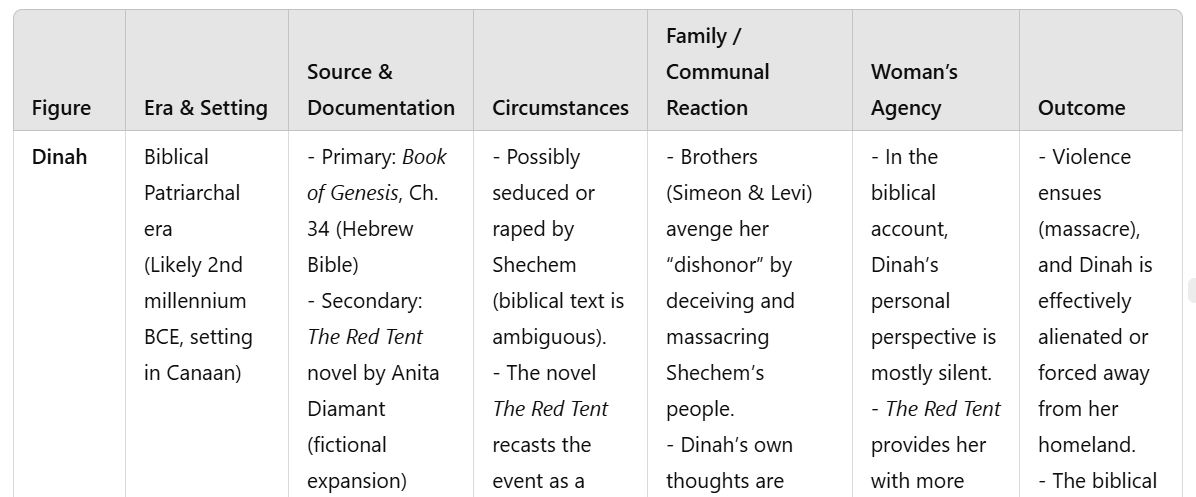
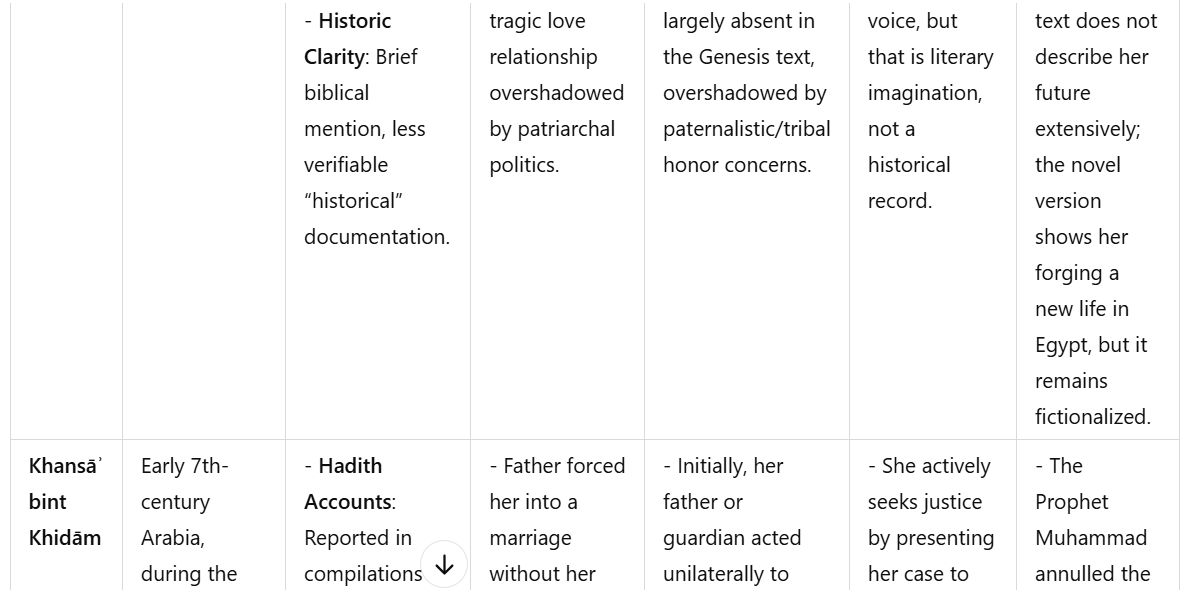
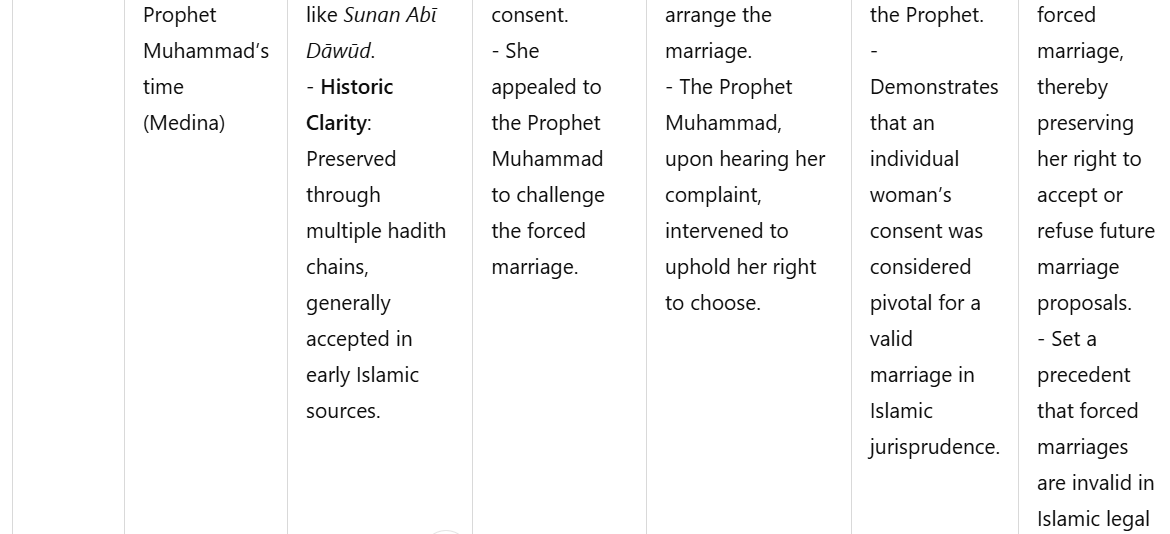
Could you please systematize the experiences of Dinah, Khansa and Aisha in a table?
One difference that should not be lost in the overview is that the story of Dinah is less clearly
documented as the historical documented experiences of the Muslim woman.
Would you need more instructions, e.g. suggestions for the columns, or can you proceed with
the information at hand?
ChatGPT:
Below is a comparative table summarizing the key points about Dinah, Khansa bint Khidam,
and Aisha (Aisha bint Abu Bakr). I have included columns for Era/Setting, Source &
Documentation, Circumstances, Family/Communal Reaction, Woman’s Agency, and
Outcome. A concluding note highlights the contrast in historical/documentary clarity.
Note on Documentation and Historical Confidence
• Dinah: While rooted in the Hebrew Bible, her story is extremely brief. The Red Tent is a
modern fictional elaboration. Thus, Dinah's historical details are minimal and harder to
verify as historical fact.
• Khansa bint Khidam & Aisha: Their experiences are preserved in early Islamic sources
(Qur'an and hadith). Because these accounts are documented within a robust oral-
transmission system and considered part of foundational Islamic history, they are
treated by Muslim scholars as more firmly established events, though interpretations can
still vary among different schools of thought.
This table highlights how each woman's narrative fits into her respective cultural-religious
context, while also showing how issues of female agency, family or communal involvement,
and honor played out differently based on the norms of their societies and the documentation
that has come down to us.
You said:
Could you please suggest an updated title for this conversation that was originally saved as
"Red Tent Biblical & Islamic"? It shouldn't be much longer as the now somewhat IMO aged
title and could include the names of the 3 women (shifting the focus from the Red Tent
narrative) and/or include words like "experiences", "female", .... Maybe suggest a short title
under which the conversation can be filed on as well as a somewhat longer subtitle that can be
added to the PDF version.
ChatGTP:
Below are two options for renaming your conversation—one short title and one longer subtitle.
Feel free to mix and match or adjust the wording to suit your preference.
Short Title:
“Dinah, Khansa’, & Aisha: Parallel Female Experiences”
Longer Subtitle:
“A Comparative Reflection on Women’s Agency, Honor, and Cultural Contexts Across
Biblical and Early Islamic Narratives”
---------------------------------------------------
Social media announcement:
Dinah, Khansāʾ, & Aisha: Parallel Female Experiences
“A Comparative Reflection on Women’s Agency, Honor, and Cultural Contexts Across Biblical and Early Islamic Narratives”. https://justpaste.it/s-trt
#Judaism #Islam #Christianity #Bible #Quran #WomensVoices #FemaleAgency #HistoricalWomen #SpiritualTraditions #Muslima #Women #WomensRights #Feminism #Empowerment #Spirituality #Marriage #Jurisprudence #Sharia #ShariaLaw #Law #GodGivenRights #RedTent #Matriarchy #Patriarchy #Gender #CommunalRights #Legislation #Suffragette
---------------------------------------------------
chatgpt.com /c/6796193a-4930-800f-bb65-15094a9be2c1