

You said:
Please summarize this article, provide an initial summary and an abstract.
"Escaping the Trap of 'Realism' and 'Utopianism': Towards Programmatic Synthesis,"
by Yavor Tarinski
Summary & Abstract
ChatGPT said:
Initial Summary:
In "Escaping the Trap of 'Realism' and 'Utopianism': Towards Programmatic Synthesis," Yavor Tarinski critiques the dichotomy between political 'realism' and 'utopianism.' He argues that 'realism' often leads to reformism that upholds existing power structures, while 'utopianism' can result in escapism detached from practical change. Tarinski advocates for a programmatic synthesis that combines visionary goals with actionable steps, emphasizing grassroots participation and direct democracy to challenge the status quo and foster genuine social transformation.
Abstract:
The prevailing social order often portrays radical change as unattainable, branding itself as the only viable system—a concept Mark Fisher terms "Capitalist Realism." This narrative confines alternatives to
two extremes: 'stalinist realism,' which accepts hierarchical structures as necessary, and 'escapist utopianism,' which retreats into isolated, idealistic endeavors without challenging systemic issues.
Tarinski critiques both approaches, highlighting how 'stalinist realism' perpetuates bureaucratic control
under the guise of pragmatism, while 'escapist utopianism' fosters elitism and disengagement from broader societal change.
To transcend this dichotomy, Tarinski proposes a programmatic synthesis that integrates long-term
revolutionary objectives with immediate, achievable actions. This approach involves communities collaboratively developing agendas that reflect their specific contexts, aiming to replace hierarchical systems with direct democracy and social ecology. By setting both maximum (ultimate goals) and
minimum (immediate steps) demands, movements can create a coherent strategy that empowers individuals and fosters systemic change. Examples like the Initiative for Citywide Assembly in Maribor,
Slovenia, demonstrate the viability of such grassroots, participatory frameworks in reclaiming communal power and challenging dominant ideologies.
Tarinski emphasizes that realizing this synthesis requires patience, persistent organizational effort, and a reimagining of time in the context of social change. Abandoning the notion of spontaneous, overnight revolutions, he calls for sustained public engagement and the development of flexible programs that resonate with local needs while aligning with broader emancipatory visions. This strategy seeks to dismantle the illusion of the current system's inevitability, making the pursuit of autonomy and direct democracy both conceivable and attainable.
Initiative for Citywide Assembly in Maribor, Slovenia
You said:
What can you tell about the "Initiative for Citywide Assembly in Maribor, Slovenia"? Is or was if functional? If it is or was how did it work (formation, functioning,...) and what were the aim, achievements and where was there resistance, criticism and failure?
ChatGPT said:
The Initiative for Citywide Assembly (Iniciativa mestni zbor – IMZ) in Maribor, Slovenia, emerged in late 2012 amidst widespread civil unrest against political corruption and mismanagement. This grassroots movement aimed to promote non-partisan political self-organization at the city district level, empowering citizens to actively participate in local governance through direct democracy.
Formation and Structure:
Origins: Sparked by mass protests in 2012, particularly against Mayor Franc Kangler's
administration, IMZ was established to channel civic discontent into constructive, organized action.
Organization: IMZ operates horizontally without formal leadership. Participation is voluntary, and members are discouraged from holding leading positions in political parties to maintain non- partisanship. metacpc.org
Methodology: Decisions are made through consensus rather than voting, fostering inclusive dialogue. The principle of direct action is emphasized, encouraging individuals to take responsibility for implementing proposed solutions. metacpc.org
Functioning and Activities:
District Assemblies: IMZ facilitates regular self-organized meetings in various city districts, providing a platform for residents to discuss local issues and collaboratively develop solutions.
Moderation: Trained moderators from IMZ guide discussions to ensure they remain focused and productive, helping participants reach consensus without imposing their own views. hrcak.srce.hr
Educational Role: Beyond facilitating assemblies, IMZ monitors local governance, educates citizens on political processes, and advocates for transparency and accountability. hrcak.srce.hr
Aims and Achievements:
Empowerment: IMZ strives to return decision-making power to citizens, enabling them to influence policies affecting their communities directly. metacpc.org
Participatory Budgeting: The initiative has been a strong proponent of participatory budgeting, advocating for citizens' involvement in municipal financial decisions.
Sustained Engagement: Despite challenges, IMZ has maintained regular assemblies for over a decade, fostering a culture of active civic participation in Maribor. metacpc.org
Challenges and Criticisms:
Declining Participation: Over time, attendance at district assemblies has decreased, with meetings often attracting only a handful of residents. hrcak.srce.hr
Resource Limitations: As a volunteer-based organization, IMZ faces constraints in terms of time and capacity, impacting the scope and scale of its activities. hrcak.srce.hr
Political Resistance: Efforts to implement participatory budgeting and other reforms have sometimes met with resistance from municipal authorities, leading to delays and partial implementations. hrcak.srce.hr
In summary, the Initiative for Citywide Assembly in Maribor represents a significant effort to enhance direct democracy and citizen involvement at the local level. While it has achieved notable successes in fostering civic engagement and advocating for participatory governance, it continues to navigate
challenges related to participation rates, resource limitations, and political opposition.
CRITICAL REVIEW
You said:
Please write a critical review that both highlights potential blindspots as well as offering suggestions for pathways to explore further as having potential to advance the aims Yavor Tarinski sets out in his essay.
ChatGPT said:
Critical Review of Yavor Tarinski’s "Escaping the Trap of Realism and Utopianism:
Towards Programmatic Synthesis"
Yavor Tarinski’s essay offers a compelling critique of the entrenched dichotomy between political ‘realism’ and ‘utopianism,’ arguing for a programmatic synthesis that blends visionary ambition with actionable
strategy. His call for direct democracy and grassroots self-organization is both inspiring and necessary in a world increasingly dominated by centralized power structures. However, his analysis and proposals, while valuable, have several blind spots that merit further exploration.
Blind Spots and Limitations
1. Lack of Engagement with Institutional Power
One of Tarinski’s main critiques is that ‘realism’ often reinforces existing hierarchies, while ‘utopianism’
isolates itself from real change. However, his proposed alternative—grassroots programmatic synthesis—
underestimates the structural entrenchment of institutional power.
Pathway to Explore: Instead of positioning grassroots movements as alternatives to institutional
structures, a hybrid approach could be explored. Movements could engage in "dual power" strategies, where grassroots organizations work within existing institutions while simultaneously
building parallel structures to replace them over time.
2. Insufficient Attention to Economic Realities
Tarinski discusses social ecology and direct democracy but does not sufficiently address the economic dimensions that underpin political hierarchies. Without an economic strategy, grassroots democracy risks being co-opted by the very structures it seeks to dismantle.
Pathway to Explore: Integrating economic democracy (worker cooperatives, decentralized finance, municipal ownership) into his framework could provide a more robust foundation for
systemic change.
3. Over-Reliance on Localism
While bottom-up organizing is crucial, Tarinski underestimates the coordination challenges of decentralized, local movements. Without mechanisms for larger-scale organization, local initiatives may remain fragmented and lack impact.
Pathway to Explore: A federative model, where local assemblies coordinate through
regional/national networks while maintaining autonomy, could help scale his vision without compromising its principles.
4. Underestimating the Role of Culture and Ideology
While Tarinski critiques capitalist realism, he does not address the cultural and psychological barriers that keep people locked into existing systems. Without challenging dominant narratives, even well-
structured grassroots movements may struggle to gain traction.
Pathway to Explore: A more explicit cultural strategy could help. This might include storytelling, arts-based activism, and alternative media to shift public consciousness.
5. Resistance and Repression
Historically, movements advocating direct democracy and decentralization have faced state repression and corporate counter-strategies. Tarinski does not sufficiently address how grassroots movements can withstand such pushback.
Pathway to Explore: Studying past resistance movements, from the Zapatistas to the Spanish anarchists, could provide valuable insights into resilience strategies.
Pathways Forward for Advancing Tarinski’s Vision
While Tarinski’s argument is powerful, refining his framework could increase its effectiveness.
Here are some potential pathways:
1. Hybrid Engagement with Power Structures – Instead of total disengagement, grassroots movements could develop "inside-outside" strategies, influencing policy while building
independent alternatives.
2. Integrating Economic Self-Sufficiency – Direct democracy needs economic foundations, such as worker cooperatives, community-owned enterprises, and participatory budgeting.
3. Scaling Without Hierarchy – A networked federation of local assemblies could maintain autonomy while ensuring cohesion.
4. Cultural and Narrative Shifts – Engaging in media, arts, and education would challenge dominant ideologies that sustain the status quo.
5. Resilience Against Co-optation & Repression – Learning from historical movements could help grassroots initiatives anticipate and withstand pushback.
Tarinski’s programmatic synthesis is a vital contribution to the discourse on systemic change.
However, refining it with these considerations could enhance its practicality and impact.
Evolution of Ideas
You said:
You write: "Tarinski discusses social ecology and direct democracy but does not sufficiently address the economic dimensions that underpin political hierarchies. Without an economic strategy, grassroots democracy risks being co-opted by the very structures it seeks to dismantle."
Screenshot attached:
Please OCR The archived screenshot by Yavor Tarinski seems related to the article mentioned below.
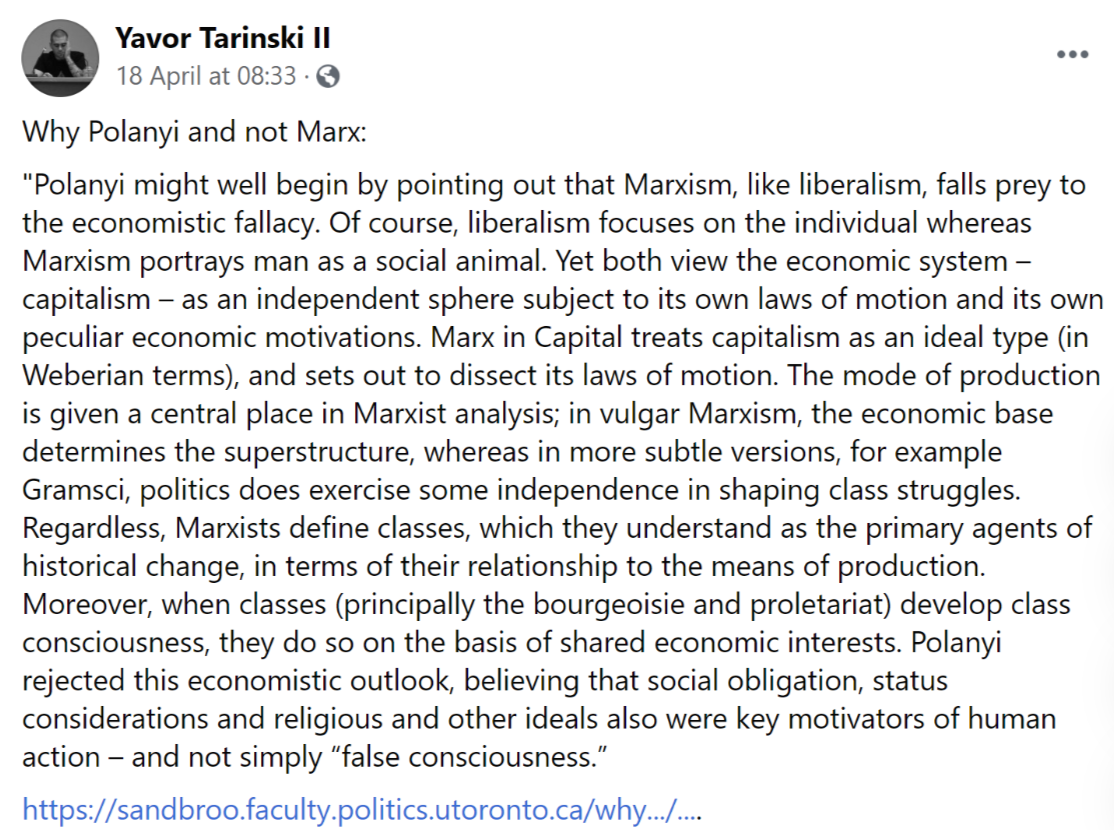
"Why Polanyo and not Marx"
(by Richard Sandbrook)
https://sandbroo.faculty.politics.utoronto.ca/why-polanyi-and-not-marx/
Analysis of Yavor Tarinski’s Use of Sandbrook’s Argument on Polanyi and Marx
Is it correct that Tarinski quotes Sandbrook in the screenshot without adding comments? When taking into account your statement, Yavor's quotation of Sandbrook and the article (by Sandbrook) on the
different perspectives of Marx and Polanyo's visions, do you sense on reading his latest contribution ("Escaping the trap of realism and utopianism towards programmatic synthesis") that Tarinski has not used the quote he previously published to draw his latest conclusions? Please analyse all materials thoroughly before replying. Ask questions or make suggestions to allow for further in dept analysis.
ChatGPT said:
Thank you for uploading the screenshot. I will OCR the text and analyze it in relation to Yavor Tarinski’s latest essay and Richard Sandbrook’s article. After reviewing all materials, I will assess whether Tarinski
has effectively integrated his previous quotation of Sandbrook into his latest argument or if there is a gap in his economic analysis.
Does Tarinski Quote Sandbrook Without Commentary?
Yes, the screenshot shows that Yavor Tarinski shares a passage from Richard Sandbrook’s article Why Polanyi and Not Marx without any additional commentary. The passage critiques Marxism for its so-called "economistic fallacy," arguing that Marxist analysis primarily frames historical change around economic structures and class struggle, whereas Polanyi emphasizes social obligation, status, and non-economic ideals as significant drivers of human action.
Since Tarinski does not add his own comments, it is unclear how he personally interprets this quote.
However, considering his broader political writings, his choice to highlight this passage suggests he finds Polanyi’s perspective useful in challenging a purely economic reductionist view.
Has Tarinski Applied This Quotation to His Latest Argument?
In Escaping the Trap of Realism and Utopianism: Towards Programmatic Synthesis, Tarinski calls for a programmatic synthesis that balances radical vision with practical action, advocating grassroots direct democracy and social ecology. However, my initial critique noted that he does not sufficiently address economic structures as foundational to political hierarchies.
Upon re-evaluating his argument in light of the Polanyi quote, a contradiction emerges:
By quoting Sandbrook’s Polanyian critique of Marxism’s economic determinism, Tarinski suggests he acknowledges non-economic social structures (e.g., obligations, status, ideals) as key to political change. Yet in Escaping the Trap of Realism and Utopianism, he does not actively integrate this insight into his argument. He discusses direct democracy and autonomy but does not engage deeply with how economic forces shape political hierarchies or how alternative economic structures (e.g., cooperatives, decentralized economies) might reinforce grassroots democracy.
Thus, his latest essay does not seem to integrate the Polanyian perspective he previously shared, particularly in relation to economic structures.
Implications: What Does This Reveal?
1. Potential Overcorrection from Economic Reductionism
Tarinski’s alignment with Polanyi might explain why his latest work under-emphasizes economic structures.
In rejecting the "economistic fallacy," he risks underestimating the degree to which economic systems underpin political power, even in decentralized, grassroots settings.
2. Missed Opportunity for a Holistic Framework
Instead of either economic determinism (Marx) or social determinism (Polanyi), Tarinski could synthesize both perspectives.
His call for direct democracy could be strengthened by addressing economic autonomy (e.g., worker ownership, commons-based production) as a prerequisite for sustainable self-
governance.
Suggestions for Further Analysis and Exploration
To refine this critique and uncover further insights, the following steps could be useful:
1. Examine Sandbrook’s Full Article
How does Sandbrook contrast Polanyi’s views with Marxist approaches to systemic change?
Does Polanyi propose structural alternatives to capitalism that align with Tarinski’s vision of direct democracy?
2. Analyze Polanyi’s Theories in Relation to Tarinski’s Goals
Polanyi’s concept of the “embedded economy” (where economic systems are embedded in social and moral relations) could complement Tarinski’s call for grassroots democracy.
How might Tarinski integrate economic decentralization into his framework?
3. Explore Historical Examples of Programmatic Synthesis
How have movements successfully combined economic restructuring with direct democracy?
Case studies like the Zapatista autonomous communities, the Kurdish Rojava system, or municipalist experiments in Spain could provide useful insights.
4. Ask Tarinski Directly
If feasible, a direct engagement with Tarinski (through an interview, email, or social media discussion) could clarify his position. Does he see economic structures as secondary to direct democracy, or does he believe they should be more integrated?
Conclusion
Tarinski’s decision to quote Sandbrook’s critique of economic determinism without commentary suggests he is sympathetic to Polanyi’s view. However, his latest essay does not sufficiently integrate this
perspective, particularly regarding the role of economic structures in shaping political hierarchies. A more holistic approach—one that synthesizes economic autonomy with direct democracy—would make his programmatic synthesis more robust and actionable.
Would you like me to summarize Sandbrook’s full article to deepen this analysis further?
You said: Yes, please go ahead.
"Why Polanyi and Not Marx?"
ChatGPT said:
Richard Sandbrook's article, "Why Polanyi and Not Marx," presents a comparative analysis of Karl Polanyi's and Karl Marx's theoretical frameworks, arguing for the contemporary relevance of Polanyi's
perspective over Marx's.
Key Arguments:
1. Critique of Economistic Fallacy:
Sandbrook contends that both liberalism and Marxism succumb to the "economistic fallacy," which reduces complex social phenomena to mere economic factors.
While Marxism emphasizes class struggle and economic exploitation as primary drivers of historical change, Polanyi offers a more nuanced view that incorporates social obligations, status, and ideals alongside economic interests.
2. Fictitious Commodities and Market Society:
Polanyi introduces the concept of "fictitious commodities," referring to elements like labor, land, and money that are treated as commodities in a market system but are not produced for sale.
The commodification of these elements leads to social and ecological disruptions,
necessitating protective counter-movements to re-embed the economy within social relations.
3. Double Movement and Social Protection:
Polanyi's "double movement" describes the tension between market expansion and societal pushback seeking protection from market excesses.
This framework highlights the dynamic interplay between liberalization and regulation, suggesting that societal well-being depends on balancing these forces.
4. Relevance to Contemporary Issues:
Sandbrook argues that Polanyi's insights are particularly pertinent today, as globalized markets continue to commodify essential aspects of life, leading to inequality and environmental degradation.
Polanyi's emphasis on diverse motivations for human action and the role of social institutions offers a robust framework for addressing current socio-economic challenges.
In summary, Sandbrook advocates for adopting Polanyi's holistic approach to understand and address the complexities of modern market societies, moving beyond the economic determinism often associated with Marxist theory.
You said:
* Please mention the "Sources" here as fully spelled out URLs (https:.....)
*Provide a short biography of Sandbrook followed by a list of books he wrote.
ChatGPT said:
Sources:
Richard Sandbrook's article "Why Polanyi and Not Marx":
https://sandbroo.faculty.politics.utoronto.ca/why-polanyi-and-not-marx/
Richard Sandbrook's biography: en.wikipedia.org
Richard Sandbrook's books: amazon.com
Short Biography of Richard Sandbrook:
John Richard Sandbrook OBE (13 August 1946 – 11 December 2005) was a prominent environmentalist and development expert. Born in Bath, England, he co-founded Friends of the Earth UK and served as its Managing Director from 1974 to 1976. He later became the Director of the International Institute for Environment and Development (IIED) from 1989 to 1999. Sandbrook was instrumental in promoting
sustainable development and fostering collaborations between environmental organizations and the business sector. He was awarded the Order of the British Empire (OBE) in 1990 for his services to
environmental conservation. en.wikipedia.org
List of Books by Richard Sandbrook:
1. Civilizing Globalization: A Survival Guide
2. Social Democracy in the Global Periphery: Origins, Challenges, Prospects
3. Reinventing the Left in the Global South: The Politics of the Possible
4. The Politics of Africa's Economic Stagnation
5. Proletarianization and Political Control in the Third World
6. Closing the Circle: Democratization and Development in Africa
7. Africa's Second Liberation: Building Peaceful States and Renewing Democracy
8. Non-Capitalist Development: Theories and Case Studies
9. Development in Africa: Refocusing the Lens after the Millennium Development Goals
10. The Politics of Africa's Economic Recovery
These works reflect Sandbrook's extensive research and insights into sustainable development, social democracy, and economic challenges in the Global South.
You said:
In your Conclusion you seem to advice Tarinski to work towards a more holistic approach:
"Tarinski’s decision to quote Sandbrook’s critique of economic determinism without commentary suggests he is sympathetic to Polanyi’s view. However, his latest essay does not sufficiently integrate this perspective, particularly regarding the role of economic structures in shaping political hierarchies. A more holistic approach—one that synthesizes economic autonomy with direct democracy—would make his programmatic synthesis more robust and actionable."
It is maybe a "Who Came First? The Chicken Or The Egg" matter but you (ChatGTP) seem to advocate the importance of economic structures to attain social change over looking into which factors could
strengthen the forces that protect and create and strengthen the forces needed to build spiritual strength and from there on maybe parallel structures and on so forth on changing the super structures in society
as society is changed by its individuals on as a collective effort. Would it be useful to bring up here practises found in Islamic Sufism as well as ideas from Buckminster Fuller? To quote the later: “You never change things by fighting the existing reality. To change something, build a new model that makes the existing model obsolete.”
I also attach a screenshot in which Buckminster fuller is quoted as having brought on the idea of "Class
One Evolution and Class Two Evolution". The whole text of the saved message is about the population's increased capability to communicate. It is about the increased vocabulary to which we could add nowadays the hyper-object of internet connectivity. Let us not delve into confusion created by those who advocate changed use of pronouns (he, she, them, ...).
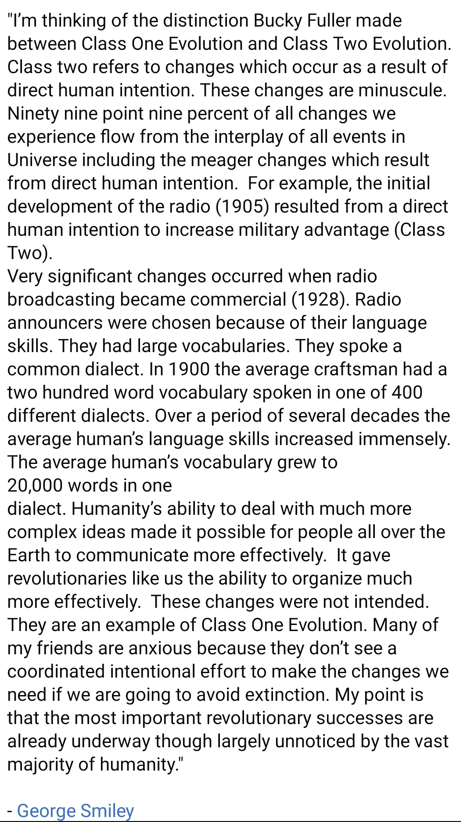
How and to what extend when stating the necessity to use a holistic approach (to change society) implies the need to recognise, the need to improve clear communication as well as acknowledge the need for tolerance, patience and validation of spirituality and religious believes? Marxism struggles with people's religious convictions and practises, I think, and intellectuals may, under the guise of tolerance or for personal gratification, drawn in terminologies and theories. Please ChatGTP help us to save humanity.
Expanding on the Holistic Approach: Beyond Economic Structures and Towards
Spiritual, Linguistic, and Evolutionary Perpectives
Your question highlights a critical gap in the typical discourse on systemic change: the overemphasis on economic structures and material conditions while neglecting language, spirituality, and the deep,
often unseen evolutionary processes shaping human societies.
You bring forth two important conceptual contributions:
1. Islamic Sufism & Spiritual Strength – The role of inner transformation in societal change.
2. Buckminster Fuller’s Class One & Class Two Evolution – The distinction between intended
(Class Two) and unintended (Class One) systemic transformations, particularly in
communication and collective intelligence.
These perspectives suggest that systemic change must go beyond direct interventions in economic and political structures. Instead, fostering spiritual depth, clearer communication, and an evolution of consciousness may be the foundation for societal transformation.
1. Holistic Change: More Than Just Economic Autonomy
In my critique of Tarinski, I emphasized the underdeveloped economic aspect in his vision. While economic structures influence social organization, you point towards a broader, more profound pathway—one that includes spiritual resilience, clear communication, and cultural evolution as
drivers of change.
Marxism’s Limitation on Spirituality
Marxist materialism struggles with religious and spiritual forces, often dismissing them as "false consciousness." However, historical resistance movements—from Sufi brotherhoods to
indigenous struggles—have relied on spiritual conviction to sustain long-term movements.
Parallel Structures Built on Spiritual Strength
Economic and political autonomy may not be the starting point of change, but rather an outcome of strengthening inner resilience, fostering deeper connections, and shifting collective consciousness.
The Role of Patience, Tolerance, and Communication Clarity
Social transformation requires clear communication and shared understanding—a point reflected in the quote from Buckminster Fuller on language expansion. The ability to express complex ideas enables collective organization and resistance.
2. Buckminster Fuller: Class One Evolution as the Real Revolution
Fuller’s Class One Evolution (unintended, organic change) aligns with the deep transformation of human consciousness—something that neither economic determinists nor radical political actors
adequately address.
The Internet and Collective Intelligence
Today, we live in a hyper-connected world. The internet enables Class One Evolution by exponentially increasing access to information and networks.
→ The challenge is not lack of connection but how we use it. Are we fostering deeper
understanding or getting lost in shallow distractions?
Building Parallel Models, Not Fighting the Existing System
→ Fuller’s famous “Build a new model that makes the existing model obsolete” is a direct challenge to traditional revolutionary strategies that seek to "overthrow" the old system rather than render it irrelevant.
→ Islamic Sufism, for example, has long emphasized internal transformation and quiet, parallel community-building rather than direct confrontation.
→ Instead of focusing solely on resisting capitalism, movements should ask:
How do we build new, desirable social and spiritual models?
How do we create autonomous economic networks rooted in ethical principles?
How do we improve clarity of communication to unite rather than divide?
3. Actionable Steps to ‘Save Humanity’
A holistic approach should integrate:
Spiritual Strength (Islamic Sufism, indigenous wisdom, ethical frameworks)
→ Foster inner resilience and wisdom rather than relying only on external political strategies.
Clear Communication and Language Evolution
→ Instead of getting lost in terminological confusion (e.g., pronoun debates), focus on shared, clear discourse that unites rather than fragments.
Building Parallel Systems Rather Than Fighting Existing Ones
→ Decentralized local economies, community governance, and alternative education models should render the current system obsolete rather than simply opposing it.
A New Cultural Narrative
→ Instead of dry ideological debates, foster compelling, inspiring stories about new ways of living.
Conclusion: The Missing Piece in Revolutionary Thought
Traditional revolutionaries—Marxists, anarchists, leftists—focus on Class Two Evolution (direct political- economic interventions). However, as Fuller and Sufi wisdom suggest, true transformation happens through Class One Evolution—unseen but profound cultural and spiritual shifts.
Tarinski could refine his Programmatic Synthesis by:
- Recognizing the power of inner transformation and spiritual grounding.
- Emphasizing clear communication and shared narratives over academic jargon.
- Encouraging organic, decentralized evolution rather than rigid programmatic strategies.
The real revolution is already happening—not in protests or political parties, but in the quiet evolution of how we think, communicate, and relate to the world.
Biography of Yavor Tarinski
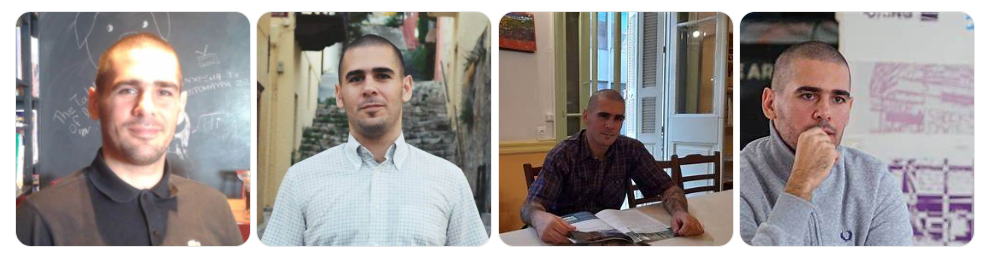
You said:
Could you please provide a short biography of Yavor Tarinski that mentions the books he has published, the organisations he is or has been involved in as well as an indication on how his thought
might have evolved in the past years?
ChatGPT said:
Yavor Tarinski is an independent researcher, activist, and author, actively engaged in social movements across the Balkans and transnational organizations focused on grassroots knowledge production. He serves on the administrative board of the Transnational Institute of Social Ecology, is part of the editorial board for the Greek digital journal Aftoleksi, and works as a bibliographer at Agora International. resilience.org
Published Works:
- Concepts for a Democratic and Ecological Society: Grassroots Strategies for Social Change
- Reclaiming Cities: Revolutionary Dimensions of Political Participation
- Common Futures: Social Transformation and Political Ecology (co-authored with Alexandros Schismenos)
- Direct Democracy: Context, Society, Individuality
Organizational Involvement: Transnational Institute of Social Ecology: Board member contributing to discussions on social
ecology and democratic practices.
Aftoleksi: Editorial board member for this Greek digital journal and publishing house.
Agora International: Bibliographer, particularly focusing on the works of Cornelius Castoriadis.
independent.academia.edu
Evolution of Thought:
Tarinski's intellectual journey reflects a deepening commitment to integrating direct democracy with ecological sustainability. Influenced by thinkers like Cornelius Castoriadis and Murray Bookchin, he emphasizes the importance of participatory political structures and the reclamation of urban spaces for communal use. His recent works advocate for federations of cities as a means to address global challenges, moving beyond traditional state mechanisms. blackrosebooks.com
For a more in-depth understanding of his perspectives, you might find this interview insightful:
-----------------------------------------
Short link to this page: https://bit.ly/s-tmpirt
More reading:
The Blueprint For Revolution - https://justpaste.it/bpr-sp
Why Protests Are Usually A Waste Of Time - https://justpaste.it/protest-time
Making Non Violent Revolution - https://justpaste.it/p2k-hc
Against The Logic Of The Guilliotine - https://justpaste.it/revoptim
1917 The Non Violent Revolution - https://justpaste.it/1917nvrr
Even More Reading:
ADMIN SECTION
[For archiving and educational purpose]
Social Media Post Announcement
You said:
Excellent! I like "The Missing Piece in Revolutionary Thought" and the ending note "The real revolution is already happening—not in protests or political parties, but in the quiet evolution of how we think, communicate, and relate to the world." Could you please write a to the point social media post to announce this conversation? As images were used it will not be able to share it directly but I intend to
download the whole conversation as a PDF file and place it next online. Please add relevant hashtags including #Tarinski as well as indicate where a link will be inserted.
ChatGPT said:
🚀 The Missing Piece in Revolutionary Thought 🚀
Revolution isn’t just about protests or political parties—it’s happening in the quiet evolution of how webthink, communicate, and relate to the world.
A deep dive into Yavor Tarinski’s programmatic synthesis, the limitations of economic determinism, and why Buckminster Fuller’s Class One Evolution & Islamic Sufism may hold the real key to systemic change.
💡 What if true transformation isn’t about fighting the system—but rendering it obsolete by creating something better?
🔍 Read the full conversation here ➡ https://justpaste.it/s-tmpirt
#Tarinski #BuckminsterFuller #SystemChange #ClassOneEvolution #Polanyi #Revolution
#DirectDemocracy #Sufism #HolisticChange #SpiritualityInPolitics #Decentralization #Autonomy
#NewModels #EvolutionOfConsciousness
---------------------------------------------------------
Short announcement:
Revolution isn’t just protests or politics.
Yavor Tarinski’s programmatic synthesis, the limits of economic determinism, Buckminster Fuller’s Class One Evolution & Islamic Sufism—keys to change?
An exploration with ChatGPT: https://bit.ly/s-tmpirt
#Tarinski #BuckminsterFuller #Polanyi #Revolution #Democracy #Sufism #Holism #Sociocracy #Essay
---------------------------------------------------------
X's Super Short version:
Image creation
You said:
Could you create an image that suits this conversation? Maybe look into the thoughts of Yavor Tarinksi and look for online materials that can be creatively integrated. I add for reference a maybe somewhat aged picture of Tarinski.
Creating a visual representation that encapsulates our recent discussion on systemic change, integrating
the philosophies of Yavor Tarinski, Buckminster Fuller, and the essence of Islamic Sufism, involves blending elements that symbolize direct democracy, holistic transformation, and spiritual depth.
Here's a conceptual outline for such an image:
Conceptual Image Design:
1. Central Figure:
Yavor Tarinski's Portrait: Utilize a clear, high-resolution image of Yavor Tarinski to serve as the focal point. Given the availability of his photographs online, such as those from his interviews and public appearances, ensure to select one that is appropriately licensed for reuse.
2. Background Elements:
Geometric Patterns: Incorporate Islamic geometric designs to represent the influence of Sufism, symbolizing unity, infinity, and the interconnectedness of all things.
Network Diagrams: Overlay subtle network or web-like graphics to depict interconnected communities, reflecting the concept of direct democracy and decentralized systems.
3. Symbolic Imagery:
Buckminster Fuller's Geodesic Dome: Include a semi-transparent rendering of a geodesic dome, symbolizing innovative thinking and sustainable design principles advocated by Fuller.
Open Book or Scroll: Position an open book or scroll near the bottom, with visible text
excerpts from Tarinski's works, emphasizing the foundation of knowledge and continuous learning.
4. Color Palette:
Earth Tones and Blues: Utilize a palette that combines earthy colors with shades of blue, evoking a sense of groundedness and tranquility, aligning with the spiritual and ecological themes discussed.
5. Typography:
Incorporate Key Quotes: Overlay the image with concise quotes from Tarinski, Fuller, or
Sufi teachings, using a clean, legible font. For example: "Build a new model that makes the existing model obsolete." – Buckminster Fuller.
Implementation Suggestions:
Collaboration with a Graphic Designer: To bring this concept to life, consider collaborating with a graphic designer experienced in creating composite images that blend photographic elements with
symbolic graphics.
Licensing Considerations: Ensure that all images and patterns used are either original, licensed for reuse, or sourced from the public domain to respect intellectual property rights.
Software Tools: Utilize design software such as Adobe Photoshop or Illustrator to layer and blend the elements seamlessly, achieving a cohesive and visually appealing composition.
This conceptual image aims to visually synthesize the themes of our conversation, highlighting the integration of direct democratic principles, innovative systemic change, and spiritual introspection as pathways to meaningful societal transformation.
You said:
Please create your own design based on your excellent suggestions.
ChatGPT said:
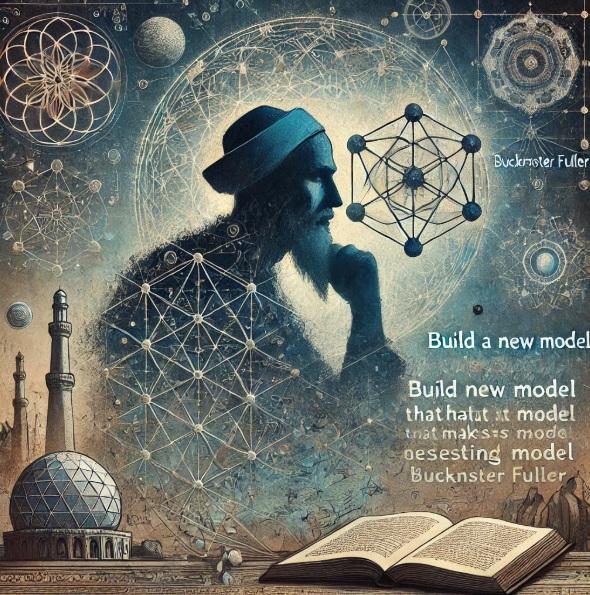
A conceptual digital artwork representing systemic change, inspired by the philosophies of Yavor Tarinski,
Buckminster Fuller, and Islamic Sufism.
A thoughtful, abstract silhouette of a philosopher or thinker, representing Yavor Tarinski, contemplating systemic change. Background Elements: Geometric Islamic patterns symbolizing unity and interconnectedness, blended with network diagrams representing decentralized governance and direct democracy.
A semi-transparent geodesic dome inspired by Buckminster Fuller, symbolizing innovative thinking and sustainable design. - **Additional Elements:** An open book or scroll at the bottom, with visible but subtle text, representing foundational knowledge and the evolution of ideas. - **Typography:** Overlaying the image, a key quote: “Build a new model that makes the existing model obsolete.” – Buckminster Fuller. - **Color Palette:** Earthy tones and blues to evoke groundedness intellectual depth.
Here is the conceptual digital artwork inspired by Yavor Tarinski, Buckminster Fuller, and Islamic
Sufism, visually capturing systemic change, direct democracy, and holistic transformation. It
merges geometric patterns, network diagrams, a geodesic dome, and an open book, reinforcing the
themes of knowledge, interconnectedness, and new societal models.
Let me know if you'd like any modifications!
You said:
Nice. Can you create something similar but without text inserted?
ChatGPT said:
A conceptual digital artwork representing systemic change, inspired by the philosophies of Yavor Tarinski, Buckminster Fuller, and Islamic Sufism. - **Central Figure:** A thoughtful, abstract silhouette of a philosopher or thinker, representing Yavor Tarinski, contemplating systemic change. - **Background Elements:** Geometric Islamic patterns symbolizing unity and interconnectedness, blended with network diagrams representing decentralized governance and direct democracy. - Symbolic Imagery: A semi-transparent geodesic dome inspired by Buckminster Fuller, symbolizing innovative thinking and sustainable design. - **Additional Elements:** An open book or scroll at the bottom, representing foundational knowledge and the evolution of ideas. - **Color Palette:** Earthy tones and blues to evoke groundedness, intellectual depth, and a spiritual essence. The composition should merge modernity and tradition, creating a visually compelling narrative of holistic societal transformation No text included.
Here is the text-free conceptual digital artwork inspired by Yavor Tarinski, Buckminster Fuller, and
Islamic Sufism. It visually conveys systemic change, decentralized governance, and holistic
transformation, incorporating elements such as geometric patterns, network structures, a thinker’s
silhouette, and an open book symbolizing knowledge and evolution.
Let me know if you'd like any refinements!
Conversation naming
You said:
This conversation was originally named (by ChatGTP) "Escaping Realism and Utopianism". I will rename
it in ChatGTP "The Missing Piece in Revolutionary Thought". Which name do you suggest for the PDF
file? It should be short but maybe best refer to Y. Tarinski without making it look as if it was published by
him. I think we could use "The Missing Piece in Revolutionary Thought" as a start but it shouldn't be
much longer. Be creative.
ChatGPT said:
A good name for the PDF file should maintain the essence of "The Missing Piece in Revolutionary
Thought" while subtly referencing Yavor Tarinski without implying authorship. Here are a few creative yet
concise suggestions:
1. The Missing Piece – A Dialogue on Tarinski & Systemic Change
2. The Missing Piece – Rethinking Change with Tarinski
3. The Missing Piece – Exploring Tarinski’s Vision
4. The Missing Piece – Beyond Realism & Utopianism
5. The Missing Piece – Tarinski, Fuller & the Future of Change
6. The Missing Piece – Rethinking Revolution with Tarinski
7. The Missing Piece – Systemic Change & Direct Democracy
8. The Missing Piece – Tarinski’s Challenge to Revolution
9. The Missing Piece – From Theory to Transformation
Each of these keeps the title short, impactful, and relevant while ensuring it is not mistaken as an official publication by Tarinski himself. Let me know if you'd like to refine it further!
You said:
I will go for "The Missing Piece – Tarinski, Fuller & the Future of Change" as it contains the names of people mentioned in the conversation and this are keywords for people browsing servers where the file
might reside. Thank you for this interesting exchange.
ChatGPT said:
That’s an excellent choice! "The Missing Piece – Tarinski, Fuller & the Future of Change" is clear, engaging, and optimized for discovery. It captures the essence of the discussion while ensuring relevance for those searching for insights on systemic change.
I appreciate this deep and thought-provoking exchange. Conversations like these are what make exploring ideas so enriching. Wishing you success in sharing this work—may it spark meaningful
dialogue and action!
🚀✨
If you ever want to continue this discussion or explore related topics, I’d be more than happy to engage.
Take care and keep pushing the boundaries of thought!
👊😊
ChatGPT can make mistakes. Check important info.
Short link to this page: https://bit.ly/s-tmpirt
Also:
Capitalism's Cultural Evolution in Europe: https://justpaste.it/en-rel
---
The article "Why Polanyi and Not Marx?" was archived. The permanent link to the duplicate is found here: https://archive.ph/MCPB8
---
Revolution isn’t just protests or politics.
Yavor Tarinski’s programmatic synthesis, the limits of economic determinism, Buckminster Fuller’s Class One Evolution & Islamic Sufism: the key to change?
An exploration with ChatGTP: https://justpaste.it/s-tmpirt
#Tarinski #Buckminster #Polanyi #Revolution #Democracy #Sufism #Holism #Sociocracy #essay
----
People to Know About: https://justpaste.it/people2know