
Permaculture is Revolution disguised as Organic Gardening
22/07/2015
A perspective on permaculture and resilience, inspired by the foundational ideas of Bill Mollison
and David Holmgren, exploring their relevance to sustainability, spirituality, and community-building.
Abstract:
This text explores the relationship between permaculture, spirituality, and resilience, emphasizing their interconnectedness in fostering holistic well-being and ecological sustainability. It delves into the principles of permaculture as a system of design that mimics natural ecosystems to enhance human and environmental health. The discussion broadens to include spirituality, particularly its role in cultivating inner resilience and aligning individuals with broader ecological and social systems. By integrating spiritual practices, the text argues, permaculture can transcend technical solutions, fostering a deeper connection to the Earth and a collective sense of purpose. The narrative underscores the importance of resilience—both personal and community-driven—as a foundational element for navigating complex global challenges, advocating for a paradigm shift towards regenerative and inclusive practices. The text positions permaculture not merely as a methodology but as a transformative philosophy that interweaves practical action with spiritual and ethical considerations. - ChatGTP 16/01/2025
Over the past thirty-five years, he’s seen the seeds of permaculture grow into a thriving global movement. During
his recent “Transforming the Australian Dream” tour on the east coast of Australia, David shared a glimpse into the early sparks of permaculture and offered insights into some of the simple principles of growing and living that can now help us transform suburbia into a flourishing ecosystem of sustainable living on all levels.
“It is perhaps surprising to people that when I was a student in Hobart Design School in 1974, there was a huge interest in what today we would call sustainability. It was one year after the oil crisis of 1973 that changed a lot of thinking around the world. And it was two years after the Club of Rome Limit to Growth report which really showed that industrial society couldn’t keep going like it was. 1973 was also the year that E.F. Schumacher wrote the very influential book on my thinking, Small is Beautiful: Economics as if People Mattered.”
“So a lot of these ideas were around at that time and my interest was really in the overlap between
landscape architecture as a design profession, the science of ecology and the practice of agriculture.”
It was at that time that David met Bill Mollison, who was teaching at another university in Hobart, and through their friendship and discussions started to gel the idea of what ultimately became permaculture.

Bill Mollison (left) and David Holmgren (right)
“Bill was a generation older than me. He’d had a background in wildlife research and before that as a fisherman, a
hunter, a rabbit trapper and timber cutter. I was 19 and I’d come from a family of political radicals and grown up with the view that we don’t necessarily belong, ‘think for yourself and don’t accept just what you’re told.’ A lineage which was trying to stop the world we didn’t want. Bill Mollison had had a toe in the water of environmental activism too for five years before I met him and had arrived at the same point I was, which was…”
“We want to create the world we do want.”
When seeds first got planted: from early visions to inspired action
According to Holmgren, the original seed of the idea of permaculture might have come for Bill Mollison in the 1950’s while studying wallaby ecology out in the Australian rainforest. He had a huge breakthrough in thinking about how the ecosystem worked which left him with the idea that, “Gee, we could design one of these (an ecosystem).”
“Mollison was one of these huge thinkers, constantly throwing up ideas, but it wasn’t until we met and I explained the idea of the overlap between the profession of landscape architecture, the practice of agriculture and the science of ecology, that he said, “Oh that’s interesting. How about this for an idea…”
“If in most places nature creates a forest as the most efficient and permanent form of ecosystems on the
land, why doesn’t our agriculture look like or at least function like some kind of forest?”
That idea became the seed of the manuscript David worked on for two years then published as Permaculture One in 1978.
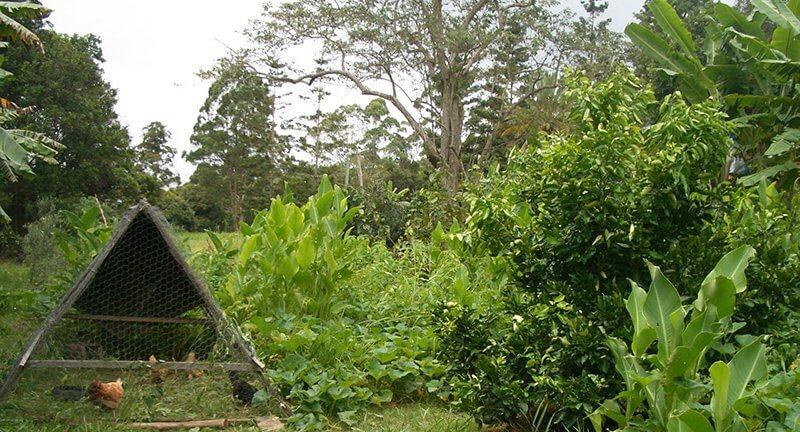
Nature creates a forest as the most efficient and permanent form of ecosystems on the land
At the base of their commitment to find or create a living system that really worked, Holmgren and Mollison were drawn repeatedly back to the places where systems are already working… in nature.
“Nature was the reference point for permaculture to know where are the design rules, the energy laws that
govern natural systems… Understanding the design rules and success pathways that existed in nature was
really the big wellspring for designing something that works for humans.”
“The other big source of permaculture in terms of inspiration was indigenous traditional and sustainable land use that had proven itself over long periods of time. At the time we were discussing what a few years later would be coined by Reece Jones as ‘fire stick farming’ – the notion that Aborigines were actually deliberately managing and manipulating nature, rather than just wandering around accepting the system as it was. There was both, “How do we work with nature and not be so extreme in intervention (wiping away what we think we don’t want and replacing it with something else). But on the other hand, recognizing that even hunter gatherers were actually managing the landscape for human benefit as well as for larger purposes.”
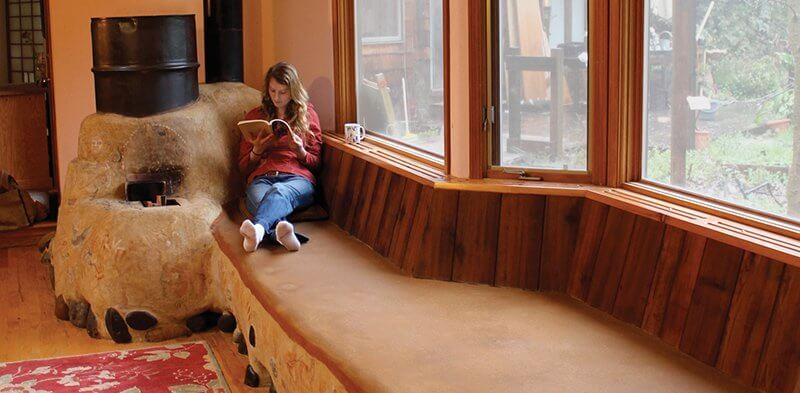
In natural systems we see that everything is catching and storing energy for later use
Nature System 101: catching and storing Energy
“Energy is not just a metaphor but the underlying measure in all natural systems for power or capacity to do anything. No ecosystem exists without a source of energy, and usually multiple sources of external energy. But those energies come in pulsing and chaotic ways. The seasons of sun intensity… dry season, wet season. Rain is an enormous amount of embodied energy. But these things come in waves and pulses that are not always available.
All things in nature catch and store energy for later use. Whereas, in the modern world with regular income going into the bank (from a job, the doll or receipts from stock market investments) people have become used to a steady flow. Go down to the supermarket, get a few tomatoes for this week only and it will be the same next week, right through the year. So the idea of the pulsing erratic supply of money, food from the garden, anything, is foreign to us. But in natural systems we see that everything is catching and storing energy for later use.”
Like the garden, permaculture is evolving
Drawn originally from the words ‘permanent’ and ‘agriculture’” the initial aim of permaculture was to create a design system that was enduring and wouldn’t deplete its resource base. In more recent years, the description of permaculture has broadened to, ‘Consciously designed landscapes which mimic the patterns and relationships found in nature, while yielding an abundance of food, fibre and energy for provision of local needs.’ People, their buildings and the ways in which they organise themselves are central to permaculture and therefore the overall vision for permaculture has evolved from sustainable or ‘permanent agriculture’ to sustainable or ‘permanent culture’.
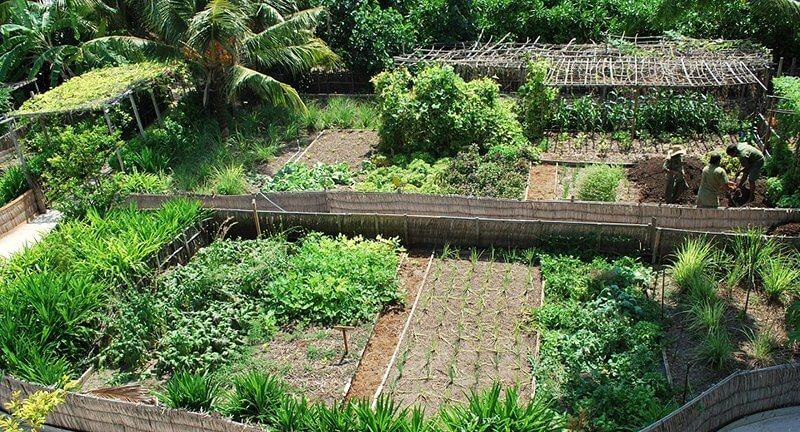
How do we redesign the whole of society, not just our provision of food, but the way we
organize and distribute our very patterns for living?
Holmgren shares that while permaculture has been popularized as a ‘cool form of organic gardening’… as a design
system for both sustainable living and land use it encompasses both the production side (how we plan, grow and build) and the consumption side (how we harvest, share, exchange and consume) of the equation – including our attitudes and our behaviors.
“If we are looking at fundamental changed conditions in the future of sustaining humanity – from millions of
years of stored energy in fossil fuels to once again running on renewable energy – then we have to actually
redesign the whole of society.
When you say the whole thing, often people mean, “Let’s work out the way we organize global finance first,”
whereas a lot of the permaculture strategies are from the bottom up… How do we re-organize our own lives
first? Not just because that’s where we have power and control but because that’s a way of understanding
how whole systems actually work. Crawling before you run.”
In the following video David guides us into a few of the simple, transformational and empowering steps each of us can take to begin to live a more harmonious and sustainable existence on all levels.
Permaculture co-founder David Holmgren shares his vision to “retro-fit suburbia” into a thriving ecosystem
---
This page: https://justpaste.it/perrev
Short link: https://bit.ly/perrev
Announcement
Permaculture is Revolution disguised as Organic Gardening
"Permaculture and the Revolution of Resilience"
- A perspective on permaculture and resilience, inspired by the foundational ideas of Bill Mollison
and David Holmgren, exploring their relevance to sustainability, spirituality, and community-building. -
How do permaculture, spirituality, and resilience intersect to create sustainable communities?
Can these principles guide a shift toward regenerative and inclusive practices?
https://bit.ly/perrev
#Permaculture #Revolution #Resilience #Sustainability #RegenerativeLiving #EcologicalHarmony #BillMollison #DavidHolmgren
Social Permaculture - Index: https://justpaste.it/pcspi
On The Social Aspects Of Edges In Permaculture
Index permaculture material: https://justpaste.it/-o-dhn-p