
Tending the relationships that welcome new life
Full web edition. This page presents the complete publication for reading online. Read the summary and explore related material, or download the PDF editions and printing files. In the download folder, open _Social Permaculture → Birth-Care-Social-Permaculture.
TO THE READER
Welcome
Thank you for opening these pages and taking an interest in the relationships between birth, care and the ways we live together.
This booklet explores how permaculture ethics, awareness of rank and sociocratic practice might help us create conditions in which care and personal agency strengthen one another. Pregnancy, birth and early family life offer a particularly meaningful place to begin.
Your experience, questions and disagreements have a place in this enquiry. You may recognise something already practised around you, discover a connection, or find words for a concern you have carried for some time.
We hope these pages encourage you to keep reading, talking and trying things together. Hope can grow through small, thoughtful efforts that make care more dependable and people’s choices more real.
The world we hope for begins to take shape in the ways we care for one another.
CONTENTS
Paths through the booklet
Select a heading to open that section in a new tab. If your browser does not jump to the text, use Find on page.
- The world that receives us
How the conditions surrounding birth can shape the way we care for one another. - Three ethics, close to home
Earth Care, People Care and Fair Share in the relationships around birth. - Mapping the relationships around care
Seeing what supports a family through pregnancy, birth and early life. - Birth, land and knowledge
Attending to the histories and traditions that shape whose knowledge is heard. - Rank: who is heard?
Making influence visible so a contribution can affect what happens. - Sociocracy: organising shared work
Organising collective work while sustaining personal choice. - Begin small, learn together
Trying a workable change and reviewing how it serves those involved. - A direction worth exploring
Considering wider change and making room for your own reflection. - Sources and onward paths
Following the people, publications and conversations behind this inquiry.
AN INVITATION
The world that receives us
A baby arrives into a world already shaped by relationships.
There may be a partner, relatives, friends, neighbours, midwives and other practitioners. There are also less visible relationships: with food and water, housing, money, work, language, land and the institutions through which care becomes available.
Pregnancy and birth bring these connections close to the surface. Who has time to listen? Who can rest? Who carries the work? Whose knowledge is trusted? What happens when someone needs help or changes their mind?
Permaculture invites attention to the relationships through which life is sustained. Social permaculture extends that attention to the arrangements through which people live and work together. [8] Bringing these perspectives into conversation with birth opens a practical field of inquiry.
Its ambition is to change how care is organised, how responsibility is shared and how personal agency is sustained within our interdependence.
Does this arrangement increase someone's real capacity to choose, participate and receive care?
ETHICS
Three ethics, close to home
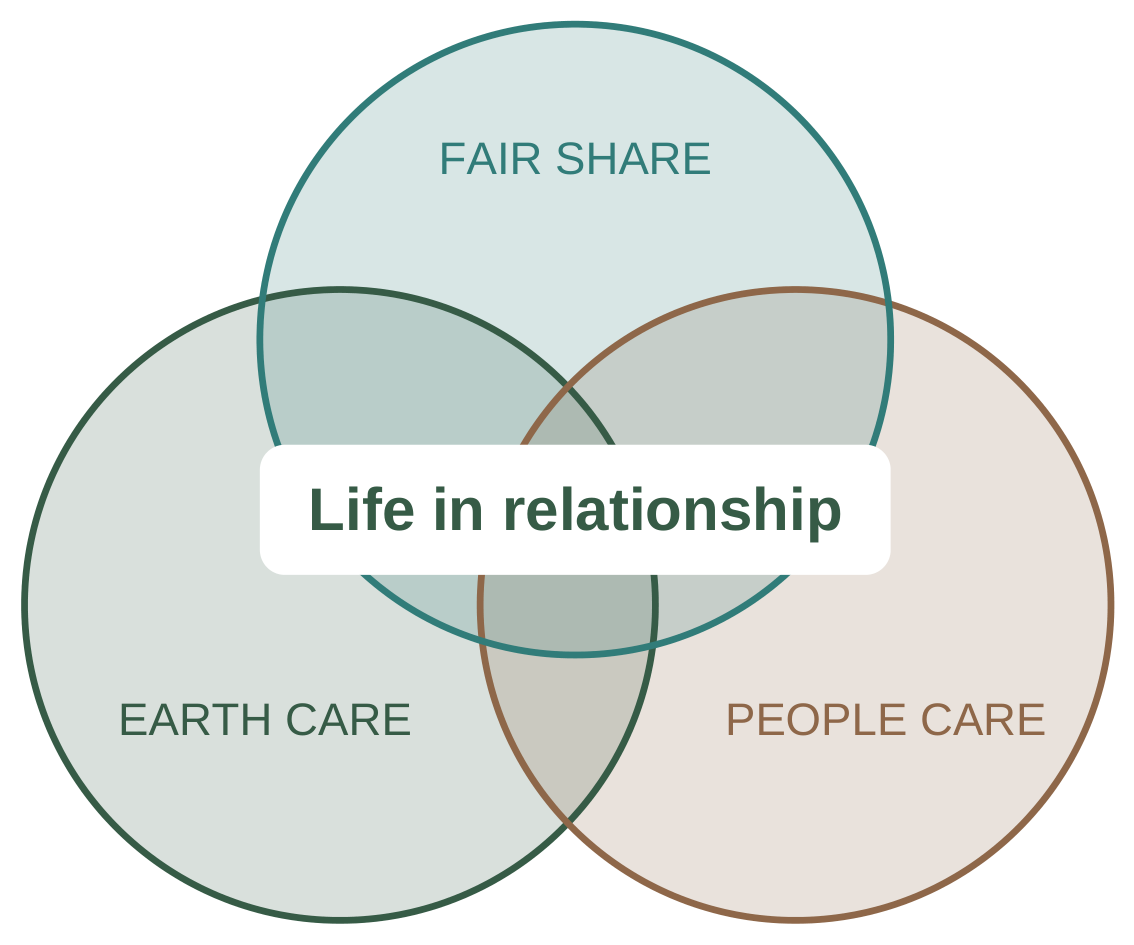
Permaculture Principles names three foundational ethics: Earth Care, People Care and Fair Share. [1] Each offers a way to examine the conditions surrounding pregnancy, birth and family life. The connections proposed here hold the three together.
Earth Care
Food, water, shelter, materials and energy connect a household to land and to the work of many others. Around a birth, Earth Care invites attention to those connections, the resources used and the capacities of a place. Ecological aspirations can support care while remaining responsive to the family's circumstances.
People Care
People Care begins with ourselves and reaches through family, neighbours and community. [2] Listening, privacy, reliable information, practical assistance and access to appropriate care all belong here. Care also reaches those offering support: their time, rest, livelihood, knowledge and limits deserve attention.
Fair Share
Fair Share asks us to recognise limits and redistribute surplus. [3] Time, knowledge, food, transport, space or money can make care more accessible. Sharing also asks how responsibilities are agreed and sustained, so that receiving support strengthens a person's choices and those offering it can honour their own limits.
ETHICS IN PRACTICE
Sharing care, respecting limits
The three ethics meet in everyday care: where meals come from, whether people can rest, and how work and resources are shared. An arrangement can sustain the place, the person receiving care and those offering support.
Careful sharing begins with an honest account of what is available. A person can offer an afternoon without becoming permanently available. A community can establish a small support fund while being clear about what it can sustain.
The work of caring also needs to be visible. Cooking, cleaning, arranging transport, communicating and remembering what needs doing often disappear behind the word “help”. Fairness asks who carries those tasks, whose contribution is recognised and whether responsibilities have actually been agreed.
Receiving support need not create a debt of obedience. A meal, a lift or a financial contribution should not quietly purchase influence over someone's personal decisions.
Reciprocity can unfold across different relationships and stages of life. People contribute differently as their circumstances change.
To bring these ethics into everyday life, we can begin by seeing who and what already supports care.
What can we share, what must we protect, and what would make this arrangement sustainable?
CARE
Mapping the relationships around care
A care map helps people see existing support and open questions. Begin with the person, the baby and their closest chosen relationships. Add connections according to their actual place in the family's life.
A missing connection invites a question. Several offers of advice may coexist with nobody preparing meals. People decide what they wish to share and who should see the map.
The map changes as pregnancy, birth and life with a new baby bring different needs into view.
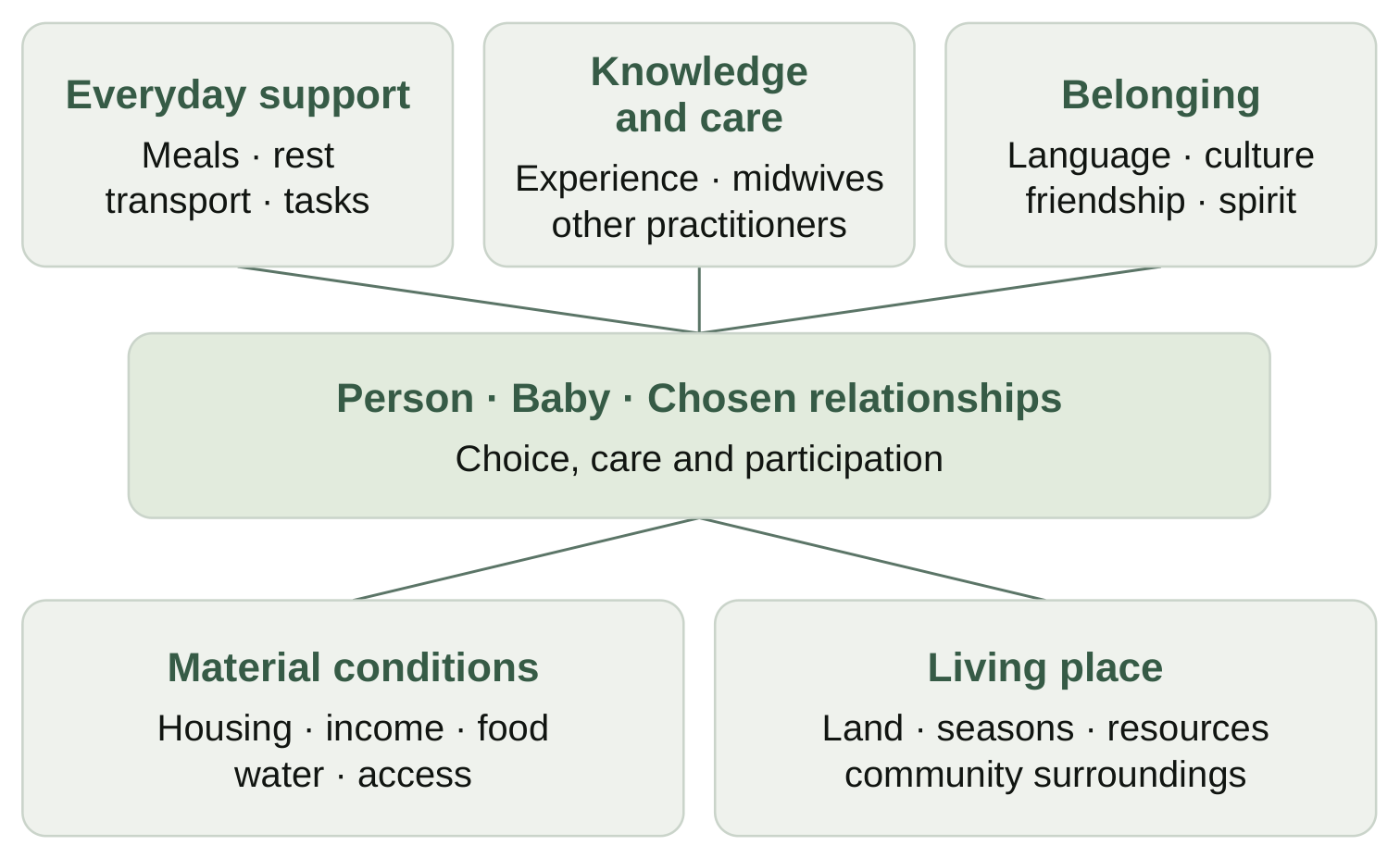
A conversation map, adapted by the people whose lives it describes. Connections show relationships, not a hierarchy.
CARE
Pregnancy: preparing for care
Preparation can include a conversation about how everyday life will work. Who can be asked for assistance? Which offers are dependable? What needs privacy? What would make it easier to obtain information or meet with chosen supporters?
Some people welcome a large circle. Others prefer a few trusted relationships. Some wish to speak about pregnancy often; others want space from questions and advice. Useful support begins by discovering these preferences. They can change.
An arrangement becomes more dependable when a willing person accepts a clear task. “I can bring a meal on Tuesday” gives something concrete to work with. “Call if you need anything” may be kind, yet leave the person needing help with the work of noticing, asking and coordinating.
Keep agreements proportionate. A small shared list may be enough: what is offered, by whom, when, and how a change will be communicated.
Leave room for uncertainty. An agreed way to revisit plans can be more useful than trying to anticipate everything.
What would make the coming weeks easier, and which parts would you prefer to keep in your own hands?
CARE
Birth: presence, choice and care
Birth concentrates attention on a person's body and experience. People may bring deep commitment, specialist knowledge, personal memories or strong convictions into that space.
Their contributions are most useful when the relationship between knowledge, responsibility and choice remains clear.
A person can value advice while reaching a different decision. They can welcome company and later ask for privacy. They can revise an earlier preference. Support requires attention to what is being expressed now.
Those present also have responsibilities and limits. Making these clear helps people understand what each person can contribute and when another form of assistance may be needed.
The physical setting matters, and so does the social setting: the words people use, how questions are answered, whether uncertainty can be acknowledged, and whether someone can ask for a pause.
An ecological perspective offers questions about these surrounding conditions. It does not establish one birthplace, method or experience as the measure of a good birth.
The conditions around care can be shaped together. The person receiving care remains an active participant whose own decisions and consent matter.
CARE
After birth: sustaining care
The arrival of a baby changes the rhythms of a household. Support may need to change with them.
Meals, laundry, shopping, care for other children, transport and communication can become significant contributions. So can leaving a family undisturbed when rest or privacy is what they want.
Ask what is useful before assuming that a visit is helpful. A visitor might bring food, complete an agreed task or take away something that needs doing. The family should not have to become hosts in order to receive support.
Attention also belongs to the baby's needs and to the responsibilities of those caring for them. Personal agency grows within relationships where information, care and practical options are available.
Make it possible for supporters to state their limits. An arrangement that depends on one exhausted person needs reconsideration, even when that person cares deeply.
A brief review
- What has been useful?
- What has become unnecessary or intrusive?
- What needs to change?
- Who else could contribute, if the family wishes?
Care continues through small, attentive adjustments.
These relationships also carry histories: ideas about birth, the knowledge people trust, and the cultures in which care is offered.
KNOWLEDGE
Birth, land and knowledge
Mmatshilo Motsei's Ways of Being Born: Tracing the Footprints of Birth in Africa places birth within historical, cultural, spiritual and ancestral relationships. Grounded primarily in South Africa, it attends to Indigenous midwifery and to knowledge marginalised through colonialism and the medicalisation of birth. [4]
Afrika Ikalafe's birthing work also describes relationships between the wellbeing of mother and child and the wider ecosystem. [5]
These perspectives widen the questions we bring to care. Whose understanding of birth is recognised? What has been lost when knowledge is separated from its people and place? How might respectful exchange make room for different forms of understanding?
The connection with permaculture offered here is our interpretation. Motsei's work has its own grounding and does not require translation into permaculture to have meaning.
Reading across these fields asks for attentiveness to differences as well as connections. It invites us to follow the people, histories and responsibilities carried by a source.
Whose knowledge has been allowed to shape the conditions of care?
RANK
Rank: who is heard?
Rank describes the influence, recognition, privilege and access a person carries in a particular setting. It can arise through knowledge, confidence, age, language, wealth, professional standing, relationships or familiarity with a place. [6]
These forms of influence do not always travel together. A confident speaker may have little experience of the matter under discussion. Someone with considerable knowledge may need time, interpretation or an invitation to finish a thought.
Different forms of knowledge and responsibility can contribute without carrying the same authority. Clinical expertise, lived experience, cultural knowledge and a family's understanding of its circumstances each have a place.
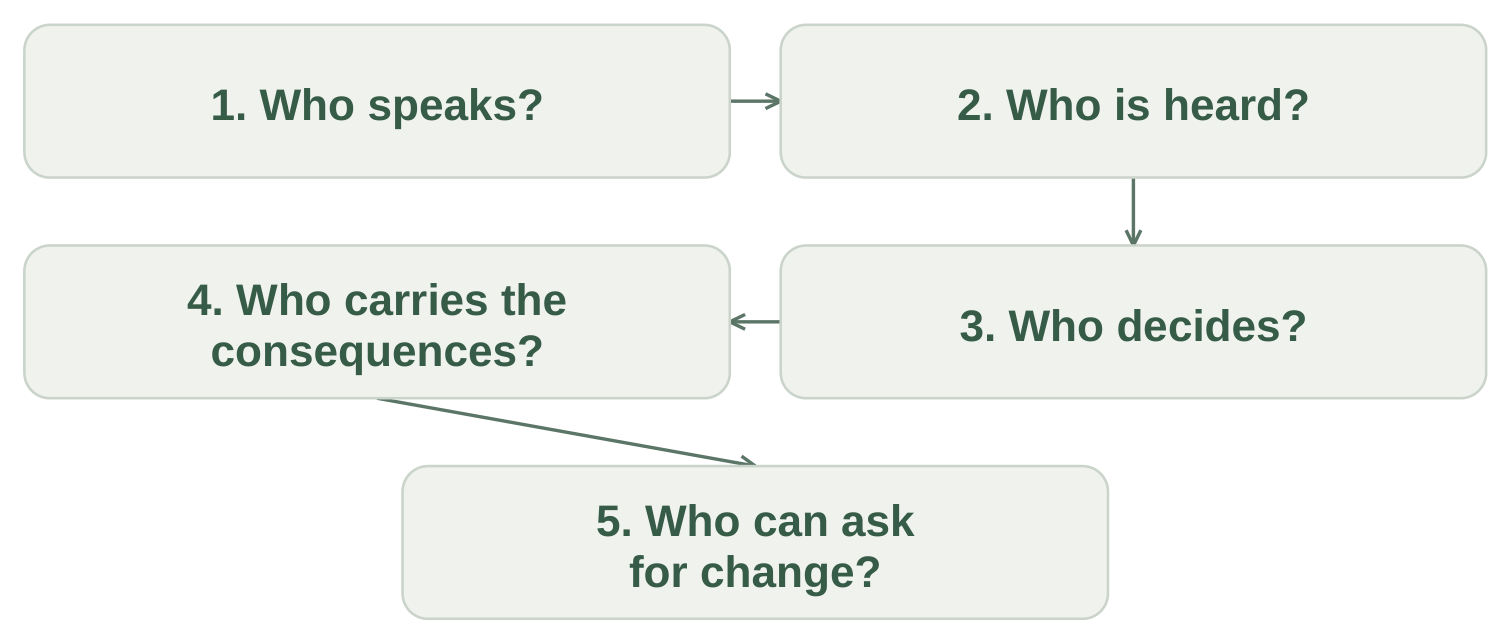
Follow a real decision through these questions. Notice where participation becomes difficult.
RANK AND PARTICIPATION
Make participation real
Imagine a community offering meals after a birth.
One person has cooking skills. Another controls the shared kitchen. Someone else has offered money. The parent receiving meals has dietary preferences and wishes to avoid frequent visitors.
A meeting might appear welcoming while the most confident organiser settles every detail. The parent may be present, yet find it difficult to decline an arrangement once others have praised it.
Rank awareness changes the practical questions. Has the parent been asked what would help? Can food be delivered without a visit? Does control of the kitchen become control of the whole plan? Can a volunteer change their availability without being blamed?
Simple changes can make participation more real: asking about preferences, making offers specific, allowing time to respond, and checking how the arrangement works once it begins.
The aim is a relationship in which a person's contribution can affect the outcome.
Recognising influence also asks something of our shared arrangements: how can the people affected help shape decisions and responsibilities?
Paradigm Drag: does the language describe the relationship people intend, or does an older distribution of authority continue beneath it? [6]
GOVERNANCE
Sociocracy: organising shared work
Sociocracy can help structure shared work while keeping influence in view. Ted Rau introduces three practical starting points. [7]
Rounds
Each person has an opportunity to speak without competing for the floor. Passing remains possible.
Clear responsibility
A small group can hold an agreed area of work, seek relevant input and communicate its decisions.
Consent and review
A consent process examines whether a proposal can serve the group's shared purpose without a reasoned objection that needs attention. A review date allows experience to inform what happens next.
Possible starting points include a meal rota, transport, shared space or a budget.
Sociocratic consent concerns an agreed group responsibility. Personal consent concerns what happens to the person. A group's agreement cannot replace that person's consent.
GOVERNANCE
Where a decision belongs
A circle coordinating support might decide how volunteers change shifts or how shared money is recorded. The family expresses what assistance it welcomes; supporters say what they can offer.
Actual areas of responsibility need to be agreed with the people involved. Some matters require a conversation across them. When a request exceeds capacity, people can explain the limit and explore alternatives together.
| Decision area | Who holds the decision? |
|---|---|
| A person's body, personal information and participation | The person concerned |
| Support offered, availability and personal limits | Each supporter |
| Agreed shared resources and coordination | The responsible group, within its agreed scope |
| Changes affecting several people | Those concerned, in conversation and respecting the responsibilities above |
An example for discussing scope, choice and shared responsibility.
Clear scope helps people act without assuming that every matter belongs to the whole group. It also makes it easier to see when an agreement needs to change.
PRACTICE
Begin small, learn together
Choose one arrangement that could make care easier: a meal rota, a quiet space during a gathering, access to translation, a travel contribution or a clearer way to ask for assistance.
Invite the people affected to help shape it. Identify the purpose, available resources and limits. Agree who will do what, then choose a time to review what has happened.
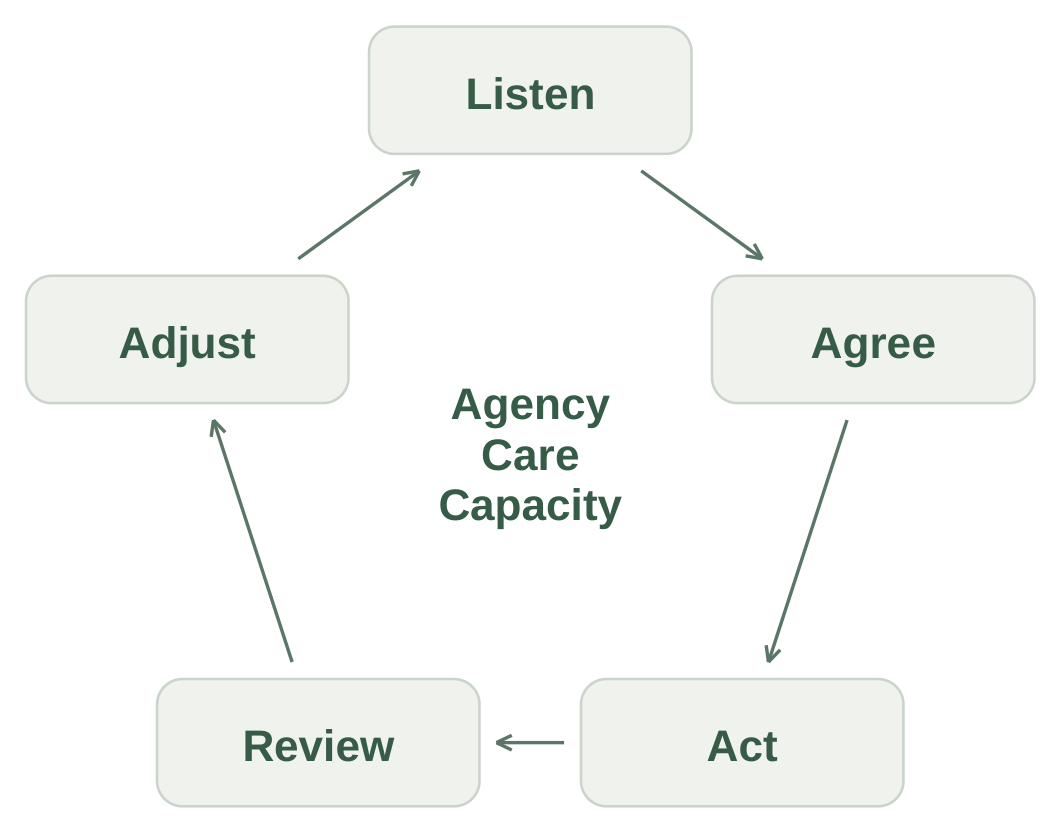
Keep the review close to lived experience. Did the arrangement help? Did it create extra work? Could someone decline? Were the people doing the work supported too?
Make changes while they remain manageable. A modest arrangement, carefully examined, can teach more than an impressive structure that nobody feels able to question.
PRACTICE
A direction worth exploring
A different way of organising care can begin with a small change in relationship.
Someone's account receives serious attention. An offer becomes dependable. A responsibility becomes clear. A person can decline and still belong. The work behind care becomes visible and is shared by agreement.
Such changes connect personal experience with social design.
What would our communities look like if the conditions surrounding the beginning of life helped shape how we organised the rest of it?
Pregnancy, birth and early family life offer places to explore this question closely. They reveal both our interdependence and the importance of personal agency within it.
Permaculture ethics, rank awareness and sociocratic practice can contribute. Their value will be found in what people can do, choose, question and sustain together.
PRACTICE
Make room for reflection
Use these questions on your own or with the people involved. Begin with one real situation. A few notes, a conversation or a small drawing may help identify a useful next step.
- What already supports care well here?
- Whose needs or contributions remain difficult to see?
- Which arrangement could we change together?
- How will we know whether that change helps?
SOURCES
Sources and further reading
These sources inform the discussion. The connections and practical examples are an original synthesis offered for reflection; inclusion does not imply endorsement.
1. Permaculture Principles, Permaculture Ethics
https://permacultureprinciples.com/ethics/
2. Permaculture Principles, People Care
https://permacultureprinciples.com/ethics/people-care/
3. Permaculture Principles, Fair Share
https://permacultureprinciples.com/ethics/fair-share/
4. Mmatshilo Motsei, Ways of Being Born: Tracing the Footprints of Birth in Africa. Jacana Media, 2026.
https://jacana.co.za/product/ways-of-being-born-tracing-the-footprints-of-birth-in-africa-upcoming-title/
5. Afrika Ikalafe, Birthing
https://afrikaikalafe.org/birthing/
SOURCES
Following the connections
6. Rank and Birthkeeping
https://justpaste.it/rank-and-birthkeeping
Naming, Rank, Authority and Relationship
https://justpaste.it/naming-rank-authority
7. Ted Rau, 3 tools from sociocracy for better decision making
https://www.sociocracyforall.org/3-tools-from-sociocracy/
8. Starhawk, Social Permaculture: What Is It? (2016)
https://www.ic.org/communiversity-library/article/social-permaculture-what-is-it/
About this booklet
Ibrahim Hublou
Developed through human-AI dialogue with ChatGPT
First edition · November 2026
Birth, Care and Social Permaculture
Whenever we offer support, agree responsibilities or review how care is working, we can pause to consider its effects. The purpose is to understand what our arrangements make possible for the people involved, including those receiving and those providing care. In these situations, we can ask ourselves:
Does this arrangement increase someone’s real capacity to choose, participate and receive care?
Continue the inquiry
Related reflections, sources and reading
https://justpaste.it/birth-care-social-permaculture
PDF editions and printing files
https://cutt.ly/pc-db
Open _Social Permaculture → Birth-Care-Social-Permaculture.