JustPaste.it

A Time of Universal Deceit

Introduction


The public view of the situation faced by minor attracted adults(MAAs - pedophiles, hebephiles, and ephebophiles, who together make up nearly half of males with no more than 5% of that half consisting of pedophiles) today, and the 'pedophile' hysteria, is that it is utterly unique in history. So this is why it can be cogently argued that it might last forever, so we need to own up to this fact and realize that fighting for change is futile.
 
Those who argue this are either truly ignorant of history, or are "playing dumb" to facilitate their beliefs. The "pedophile panic" and sex abuse hysteria is what is known as a moral panic, and they have occurred on a cyclical nature throughout history, usually when certain political or economic factors cause the powers that be in society, along with any defenders of the status quo, to fear deterioration of the current institutions that place the former in an advantaged situation; or the latter simply in a situation they are accustomed to and conditioned to believe are the "proper" way of things, respectively.
 
All moral panics have involved witch-hunting and rationalizations for draconian laws(such as Australian parliament's proposal to criminalize all adult pornography featuring all small-breasted adult females of legal age because the imagery might arouse a ''pedophile''); all involved minority stereo-typing; all of them ran afoul of scientific credibility; and all of them inflamed some type of societal fear to get common citizens so terrified of some nebulous but allegedly omnipresent menace that they agreed with just about any repressive policy proposed by the government to "combat" this menace; all such panics had prevailing mainstream liberals of the time too terrified to oppose it, lest they commit career suicide or come off looking like a bunch of insensitive jerks; and no moral panic ever stood the test of time. 
 

The current moral panic in question has lasted for about 35 years now. As a cursory examination of moral panics in the past will show, 35 years is not an extremely long period of time for such a hysteria to last from a historical perspective. It's viewed as long by some people because that span of time is a significant portion of the individual human life span. However, it's but a tiny portion of time in regards to the span of human history in general.

 
And there is nothing about this current moral panic that suggests it will do any better than the many previous variations in cheating history and lasting forever.
 

The rapidly growing number of truly open-minded research papers and studies conducted on MAAs by very brave and fair-minded researchers(most who are non-MAAs) over the past decade who are doing the right thing and speaking out against the current status quo(Dr. Bruce Rind, Sandfort, Susan Thompson, Susan Clancy, Richard Green, Andrew Extein, Carin Freimond, Alyson Walker & Vanessa Padfil, Marshall Burns, Mikkel Rast Pedersonm and Sara Jehnke) seem to assume that the inherent immorality of adult-minor sex is a given rather than being neutral on the issue, but nevertheless take a strong acknowledgement in favor of recent research indicating pedophilia (and, by proxy, hebephilia) is a legitimate sexual orientation and that social control and stigmatization are not warranted. What Susan Clancy has done is to be commended and admired. She deserves a lot of props, and despite the ignorance of many of her claims against MAAs and men in general, she is nevertheless a supremely courageous woman and deserves all the accolades in the world. What she has done in her book is exceedingly important and groundbreaking. Though antis and much of academia will do their best to either denounce it or ignore it, it's not going to go away, and its implications on the validity of the war on youth sexuality, and its expression and legitimacy thereof, cannot be denied. 

 
I(and many others) have concluded that the available evidence makes it clear that the hysteria has just about peaked, if not peaked already, and is now a bit past its heyday.


Currently the public consensus opinion is that adult-minor sex is harmful--except the scientific evidence collected thus far does not back up the beliefs of the consensus. As just one prominent example, the 1998 meta-analysis known as the Rind Report, which was conducted with objective and legitimate scientific methodology by three MHPs [Mental Health Professionals] who are not MAAs, concluded quite clearly that common beliefs on this subject are not consistent with scientific data. Further, he noted that children of about six and over are capable of what MHPs term "simple consent," meaning they are capable of telling the difference between experiences that are pleasurable to them and those that are not, and that adults who had these experiences as children--and who were not "found out" and forced into receiving "therapy," or weren't sociogenically conditioned to believe they were "victims" by a host of peers and adults who derided them for not feeling "victimized" by the experience if revealed to such people--insisted in retrospect that they were capable of consenting to the activity. The Rind Report's conclusions were fully replicated in a duplicate study conducted in 2005 by an entirely different group of MHPs, led by Heather M. Ulrich, as reported in an essay appearing in the Fall/Winter 2005-06 issue of The Scientific Review of Mental Health Practice.


We have read all the literature on this topic a thousands of times over, and have learned that most of it does not come from actual research, but rather simple assumptions that were based on solely using forensic or clinical samples of adult offenders (a large percentage of whom were likely not genuine MAAs, situational offenders, or confined for mutually consensual interactions with underagers), or youths who specifically had non-consensual interactions with adults that involved incest, violence, and obvious coercion to build opinions and data on intergenerational interactions in general. After looking at the data, the ONLY way we could possibly understand why anyone would consider it remotely objective or based on research involving non-forensically obtained samples of minors or MAAs is if they never spoke to actual MAAs before, or read any of the contrary literature involved. 


Hence, the fact remains that the science does not back up the consensus belief, meaning that it is, plain and simply, a belief, even if a very pervasive one that is accepted by many, smart people included. But being smart does not preclude them from having an agenda. It's not about the tiniest percentage of people buying this. Rather, it's about all but the tiniest percentage of people being afraid to take on this subject in the first place, far less of them still willing to do it totally objectively and bereft of an agenda, and the many who "buy" the non-consensus view or at least find room for nuance being minimized in discussions; and when only those researchers who are strongly on the side of public opinion get all the publicity, then we can expect Wikipedia administrators to either "get the message" and be afraid to allow full objectivity on the topic, or come to the incorrect conclusion that there is only one "professional" opinion on the topic since the many that go against the consensus are rarely seen due to constant censorship.


Considering the fact most people in eras past, and not too far in the past at that, used to believe things that were demonstrably untrue simply because it appealed to them on some deep emotional level means that we shouldn't find it so galling that we do not always give the benefit of the doubt to consensus opinion. This is especially when said opinion lacks logic, lacks any substantive evidence, and closely resembles similar types of beliefs that were popular in the past but since proven wrong.

 
False beliefs concerning homosexuality, black people, and women were once pervasive beliefs, as well, thus making it clear that what we consider the conventional wisdom of any given era is not always right. As another modern example interconnected with the subject at hand, the idea that the adolescent brain is inherently "faulty" and inclined towards incompetent decisions is presently a pervasive belief, yet much scientific study over the previous decade has effectively refuted that claim--though not the pervasiveness of the belief.
 

I wrote several essays and a very lengthy one named "The Importance of Truth". It was extensively researched and very heavily cited with links. It's quite long and thorough, so for those want want to read it (and I highly recommend doing so), then I suggest not trying to do so in a single sitting, but reading it in bits and pieces as time and tolerance for sitting permits, which shouldn't be too hard because I divided the essay into different sections, each tackling a specific myth relevant to this topic. Based on everything I know we are likely living a time of universal deceit.


Essays:


1. The Truth Behind The Age Of Consent Laws
2. The Importance Of Truth
3. The Trauma Myth--My Analysis Of The Susan Clancy Interview
4. Why Most Teens Will Not Support The Age Of Consent Laws If Given The Choice
5. The Ultimate Pandora Box The Philip Greaves Case And The First Amendment
6. An Analysis of Attacks on Intergenerational Attraction on Cracked.com
7. A Response To A Person Who Expressed Concern Over Intergenerational Attraction
8. Why The Legality Of Child Pornography Is Relevant To The Youth Liberation Movement
9. Why CP Should Be Legal
10. The Greatest Horror Of Them All--Being Labeled A Sexual Predator
11. Minors Can Be Victimizers--A Brief Analysis Of An Incident Showing Us Who Truly Has The Power In An Intergenerational Relationship
12. Peru Lowers Its Age Of Consent--My Analysis
13. The Beckii Cruel Situation
14. The Roman Polanski Circus
15. A Startling Revelation About The Celebrity Known As Jewel
16. The Failure of Progressive Discourse on CP


Articles: 


1. 30 Common Traits of Antis
2. Why Do Liberals Deride Admiration Of Young Women
3. How the Anti & SJW Mindsets Are Similar
4. The Nuclear Family Unit
5. Youths and Cyberspace
6. Protecting Youths From Admiration
7. The Left and Political Safeness
8. How the SA Hysteria Transcends Anti-Sexuality Aspects of Religion
9. The Halloween Controversy


and many more. (TBA)

Stories:


1. Hero Imperfect - A Sci-fi fiction story 6 chapters long concerning a super-hero, Solar Man, who is the most revered and respected hero among many in his world... but he harbors the "dark" secret of being a hebephile. He spent the first several years of his super-heroic career in denial of this, but after meeting a cool 13-year-old super-hero called Ultra Girl--who also happens to be a youth liberationist, and part of a team of teen heroes who are all youth liberationists; and who also happens to be a gerontophile--and the two fall in love with each other, he finds that he can longer keep up the denial. The two begin a secret romantic relationship, and have to deal with what could happen if both their fellow heroes and the general public found out about Solar Man's attraction base, as well as the nature of their relationship. The public and their respective super-teams are led to believe Solar Man has just taken her on as a sidekick, but some of them begin suspecting there is more to it than that...


Poems


I wrote many GL-oriented poems inspired by real-life GMs. I will add them later.


Q and A - compilation of questions I've been asked during my years in the YL and MAA community and my answers. More will be added to the Q and A over time. It will likely be over 1000 questions long when it's done. 


Before reading understand that:


  1. Most pro-choicers are not advocating for full adult-minor intercourse, only freedom of choice for some activities depending on the age of youth in question.
  2. True MAA attraction is about much more than sex and involves emotional, social, and aesthetic components that are constantly ignored.
  3. Nearly half of guys are MAAs. Shockingly, I learned that I am a MAA and that many people who are close to me are MAAs during my studies. Since learning this I decided to join the MAA community and have been a long term member of many MAA boards.
  4. Most pro-choicers don’t think the AOC should be fully abolished, only tweaked to give more consideration to individual merits of youths on a case-by-case basis. The temporary solution that I support is a compromise of ASFAR and the ED Test of Adulthood with guardian approval.
  5. The current system designed to protect youths actually makes them more prone to abuse and needlessly imprisons and harms people of all ages. Hundreds of millions of people are affected. While it may not seem like it there is a big discussion going on about this right now, and most are in favor of changing the current system due to the restrictions on freedom and liberty it imposes on everyone.


Also, I recommend going over the following in depth research about the youth and adult-based chronophilias before proceeding:


Chronophilia - a sexual attraction to people of a certain age range. The term was coined by John Money.[1][2][3]


Chart of chronophilias (also called age-based paraphilias): 


Chronophilia| preferred age range | prevalence


Nepiophilia | infants 2-3 | 1% or less
Pedophilia | prepubescents 3-10 (in some cases up to 13) | 3-5% 
Hebephilia | pubescents from ages 11-14 | 16-20%
Ephebophilia and Teleiophilia | post-pubescents 15-17 (sometimes up to 19) and young adults in their 20's and 30's | 75-86%
Mesophilia | middle-aged adults in their 40's and 50's | 48%


Prevalence rates are only for males and are based on a combination of studies and phallometric research.[4][5][6][7][8]


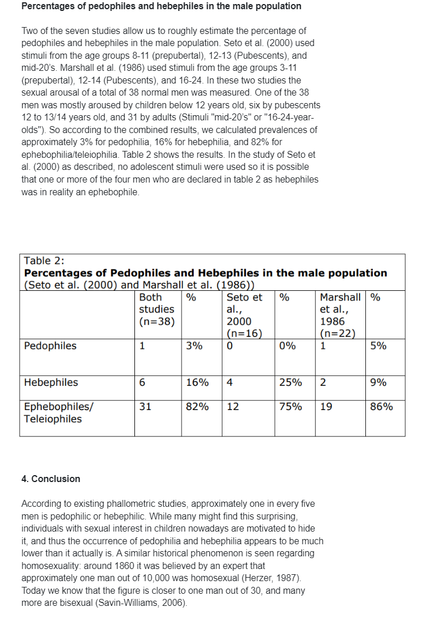
Schuster, Filip, (2014) - A Combination of Studies - a snippet of the results and conclusion:
 

26bb050cc178e6893c05e5eea6d91048.png


These refer to attractions to people of a certain age range, not the act of sex or romance with people in those ranges. To put it succinctly, a chronophile is not analogous to a writer. It is analogous to a person who would find the idea of writing a book to be exciting. You can be attracted to the idea of writing a book and not write anything — indeed, one can’t control whether they’re a chronophile. You cannot be a writer without writing something, and you can control if you’re a writer. The term does not describe the writers of a book. It is more analogous to describing someone who likes to write one.


Technically, chronophilic labels do not relate to age itself but to preferences for human sexual maturity stages(body type, muscle development, etc.)[1]


There is no evidence that preferred ages among men change as they themselves age, but for older women this may be different.[18]


Each of the chronophilias is based on a stage of the Tanner scale of human development which defines development based on sexual characteristics of human beings from childhood to adulthood. Physical features may not be the only measurement. Ex: some pedophilic males have reported "playfulness" as part of what they find attractive in prepubescents.[1]


The term minor-attraction has been used as an umbrella term to group the chronophilias in the lower age ranges. Any person person attracted to someone in these lower ranges is said to be a minor-attracted person (MAP).[19][23] The use of this term has been rapidly growing since 2017 and has drawn a lot of controversy among academics.[24]
________________________________

These can also overlap; people can have more than one chronophilia:

pedohebephilia
hebeteleiophilia 
pedohebemesophilia
etc.[1][12]


So just like some people are equally attracted to both males and females, some are equally attracted to post-pubescents and young adults, etc.
________________________________

Note: while chronophiles are more likely to seek romance and/or sex with someone in their preferred age range they aren't any more prone to 'seeking' for sex or romance in general than teleiophiles are. Having any of the lower range youth-based chronophilias does not imply that someone is a sex-crazed animal whose sole urge is to seek these things out in the same way that most higher range adult-based chronophiles aren't normally addicted to these things. Just like how most teleiophiles naturally meet, fall in love with someone then gravitate to sex later in the relationship, most hebephiles are the same way. Thus, other than having different attractions, their drives are really no different than those of teleiophiles.[1][12]
________________________________
More on prevalence:


Studies using phallometry have found that most men show at least some arousal to prepubescents, with a significant minority demonstrating a clear preference. We do know that when expanding the definition of pedophilia to encompass attraction towards ages as high as 12 or 13 (i.e. "pedohebephilia"), phallometry consistently suggests that around 20% of men are equally or more aroused by "children".[4] As James Kincaid says:


A recent study of ideal desirability using a computer program called FacePrints found that "the ideal 25-year-old woman... had a 14-year-old's abundant lips and an 11-year-old's delicate jaw." that small lower face providing also the prominent eyes and cheekbones of prepubescents. We are told to look like children if we can and for as long as we can, to pine for that look.


Further, the number of preferential hebephiles and ephebophiles is likely to be at least 10 times that the number of pedophiles.[1] According to Michael Seto and the DSM-5, the actual prevalence of Pedophilia is unknown, with an estimate of up to 3-5% (American Psychiatric Association, 2013).[4][8] Evidence concerning women is for all practical purposes, absent.


Cross-cultural, historic and species literature appears to suggest this, as put forth by Rind and Yuill. Further, present-day modeling studies display a hebephilic/ephebophilic Minor-attracted optimum for male heterosexual attraction:


"For example, Johnston and Franklin (1993) had subjects "evolve" a beautiful female face over iterated generations on a computer program designed to simulate natural selection. In the end, the most attractive versions of females' faces had proportions typical of girls aged 11-14. Braun, Gruendl, Marberger, and Scherber (2001) used morphing software to vary female characteristics and found that facial shapes of girls of about 14-years-old, with smooth, pure skin, produced the highest attraction ratings. They found that even the most attractive mature female faces could be made more attractive by morphing into them greater and greater degrees of immaturity. [...] The foregoing considerations suggest a range of female ages, which most typically are capable of producing adaptive attraction responses in mature males with respect to reproduction. This range extends from puberty, when reproductive value is maximal, into the 20s, when fertility is greatest, and beyond while fertility lasts. Within this range, male preferences may typically peak, for example, at female ages of 17 or 18, a compromise of highest reproductive value (ages 12 or 13) and fertility (ages 22 or 23) (cf. Williams, 1975). Depending on local social and cultural conditions, this peak may be shifted (i.e., recalibrated) to younger or older female ages (Buss, 1989)."[7]
_______________________________
NEPIOPHILIA:
_______________________________

Corresponds to Tanner stage 1. The rarest of the chronophilias.

_______________________________
PEDOPHILIA:
_______________________________

An ongoing attraction to prepubescents from ages 3-10 and in some cases up to 13 depending on the Tanner stage of the Tanner scale of human development being used. (Many 14 or 15-year-old's would not be pubescent/reached puberty, i.e., in Tanner stages 2 or 3 of development; many would instead be in Tanner Stage 4, and a few might appear to be in Tanner Stage 5.)


-It may surprise one to know that most adults who engage in sexual contact with prepubescents or pubescents aren't even pedophiles/hebephiles or primarily attracted to them.[9][10][11]


-Also, most pedophiles never actually engage in sexual contact with prepubescents; the rate of how many do varies but many journals put an estimate at 5-20%.[21]


-Additionally, few NON-pedophiles and non-hebephiles engage in contact.[21]


-Furthermore, most contact is 'with permission', not forceful in nature.
 
-Finally, most contact (either 'with permission' or forceful) with prepubescents/pubescents is from people with antisocial traits (ex: sociopaths - people with low empathy who commit crimes). 
 
The in-built personality of the contactor has more impact on whether they are more likely to contact than their age. All of these contactors were likely to make contact as children and teens as well.[6]


c5cf47d8d08ba1afcbffc4b00791f432.png

The Character above is “Vanellope Von Schweetz” a 9 year-old Disney character who is often the subject of Pedophilic fantasies online. Pedophiles are only attracted to people in this age group, they can’t find Adults or teens attractive.
_______________________________
HEBEPHILIA:
_______________________________
This term was coined by Bernard Glueck in 1955(14) but didn't become widespread in literature until it was popularized by Ray Blanchard the 1980's.[15]


The age range of this chronophilia typically corresponds to Tanner stages 2 and 3. 


More about hebephiles - a lot of these people are only hard-coded to form pair bonds with younger teens right around middle school age. Many adults may get bored of listening to a 7th grader talk for more than a few minutes but thoroughly enjoy lengthy discussions with other adults - however this is the design of people primarily attracted to 18+ YOS. Hebephiles, on the other hand, could listen to a 12/13 year old talk for hours on end without getting bored. They are endlessly fascinating to them, but older females bore them. Their hearts just don't resonate with older females. They just don’t click with them; it doesn’t feel right. It’s only ever when they are interacting with middle school aged teens that they feel a sense of belonging. - this is the design of teen attracted adults.[12]

 

8dd4106f9733609ee91c423ea316c47f.png

The above character "Gwen Tennyson" is 11 years-old and is famously romantically desired by many hebephiles.

_______________________________
EPHEBOPHILIA:
_______________________________
Ongoing pattern of sexual attraction toward post-pubescents youths from 15-17 (late teens) and sometimes up to 19. Some experts say this corresponds to tanner stage 4; but this is highly disputed as the age of puberty appears to be decreasing.[13]


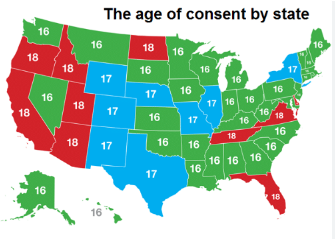
Sex between an adult and individuals in this age range is legal in most countries and all US states. The age of consent is 16 in 32 US states and most of Europe(it is legal for anyone 16 and up to have sex with anyone regardless of age gap in 32 states unless the older partner is in a position of trust or authority). This means the lower limit of ephebophilic sexual intercourse is allowed nearly everywhere.
 

a1b089a5ca16bc5b760efc6b96cec80f.png


Also considered "normophilia".[20]


Some experts have considered reclassifying ephebophilia as teleiophilia, combining them, or even declassifying it as a chronophilia due to the fact that many elements of ephebophilia do not match up with the definition of a paraphilia(atypical sexual interests). Ex: post-pubescents are as reproductively viable as middle-aged adults.


Some sexologists, experts, and MAPs question this category, sometimes arguing that the majority of ephebophilic men might be "normative"/teleiophilic. A major criticism that lends to this argument is the implausibility of a chronophilia category that orients itself roughly to the beginning of Tanner Stage 5, and ends in a developmental no man's land" at age 18-19. However in comparison, pedophilia and hebephilia can be seen as well-aligned with "developmental milestones".


Another criticism is the implausibility of a primarily preferential ephebophile ever existing at all, when adjacent labels describe attractions that are very similar in nature.[13][17][23]
_______________________________
TELEIOPHILIA:
_______________________________
Coined by Blanchard in 2000; usage of this term has been slowing in comparison to more recent ones.[16] One of the main adult-based chronophilias. A sexual preference for younger adults in their 20's or 30s. Most people are teliophilic.[1] Tanner stage 5. 
_______________________________
MESOPHILIA:
_______________________________
Preference for middle-aged adults aged 40 to 50.


The prevalence of mesophilia(term coined by Michael Seto) in society is hinted at by the relative popularity of the slang MILF (which stands for "Mom I would Like to *"), as well as the derived acronym DILF.  Results from an online survey about paraphilic sexual interests suggest that 34% of women and 48% of men have reported sexual fantasies about older partners.[1]
________________
Some personal thoughts:


While I haven't done any real experiments on the prevalence rates of the chronophilias myself, a simple and easy experiment one can do at home is to show any straight guy a picture of 5 females, some 18+ and some under those ages all in the same picture without revealing their the ages and asking if they find them attractive. Many females who are 18 or up don't look any different from ones who are less than 18, so a lot of guys, if honest, would probably say nearly all of them are.

 

9cd558429401d2f7c074fcc52eb75fca.png


Some other good indicators of these rates is the fact that it was legal for adults to have sex with 10-12 year old's literally everywhere for nearly all of history until the 1920s without any guy complaining about it and the sheer popularity of lolicon (sexual fictional media of young females) in Japan. While lolicon doesn't seem to be as popular in the west from the surface, I imagine that it could possibly be due to social and legal oppression to it.


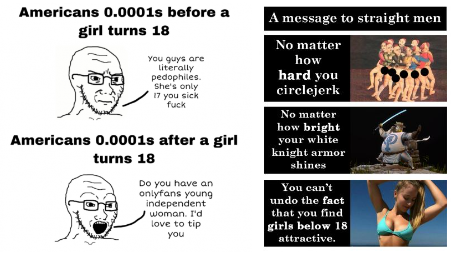
Another thing, guys seem repulsed by the idea of expressing interest in a 17 YO, but the very second she turns 18 they all appear to change their minds.
84541efa6418f4b84c499dd38c9fc6f8.png

So if the max age of consent(AOC) was 16 worldwide I imagine the same would apply. (Currently the AOC is 16 in 31 US states; anyone 16+ can have sex with someone 16+ regardless of age difference. It's 17 in 7 states and 18 in 12 states.) That is, they would not be interested in the 15 YO initially, but the very second she turns 16 they would be. Barely legal is one of the most popular porn categories right now, so if the 'barely legal' age was 15 one has to wonder if it would still be just as popular.


An observation I made that seems to be an indicator of the prevalence rates are an overwhelming number of sexual comments by guys with thousands of upvotes on a picture of two fully clothed twins both around the age of 13, one with long straight light-brown hair and another with a small short black braided ponytail in a Taekwondo school posing in a picture with their groins and feet against each other. I would compare it to a double banana split in the air. It is on a website named 9gag. For those interested, simply go to 9gag.com, do a search for twins. It should appear in one of the results.

 

d616eca829341b3b6b268c4abc1b5d00.png

_______________________________


Citations:

  1. Seto MC (January 2017). "The Puzzle of Male Chronophilias". Archives of S... 46 (1): 3–22. (www.justpaste.it/cscx4); Link between Mesophilia and the term MILF - final paragraph on page 14, for prevalence percentages see page 10, "labels do not relate to age itself but to preferences for human sexual maturity stages" - page 7, final paragraph on left column, For info on overlapping chronophilias, see page 16, third paragraph on the left column. "Nonexclusivity can encompass nonadjacent age categories, for example, some men are equally attracted to children as and adults, just as other men are equally attracted to males and females."

  2. Money, J. (1986). Lovemaps: clinical concepts of sexual/erotic health and... isbn 978-0-8290-1589-8, pages 70, 260 The term chronophilia was coined by John Money

  3. Money, J. (1990). Gay, Straight, and In-Between: The Sexology of Erotic Orientation. isbn 978-0-19-505407-1, pages 137, 183

  4. Schuster, Filip, (2014) Every fifth boy and man is pedophilic or hebephilic; a combination of studies (www.ipce.info/sites/ipce.info/files/biblio_attachments/every_fifth.pdf); see the results on page 7 for prevalence rates.

  5. Hall, G.C.N., Hirschman, R., Oliver, L.L. “Arousability to Stimuli in a Community Sample...” Behavior Ther., 26, no. 4 (March 2, 2006): page 681–694. (www.sciencedirect.com/science/article/abs/pii/S0005789405800395)

  6. Exact Copy of the DSM-5, American Psy. Association(APA); page 717 "The highest possible prevalence for pedophila in the male population is approximately 3%-5" (www.docdroid.net/qSmIApN/dsm20v-pdf#page=730); URL shows page 730, but redirects to page 717. See under prevalence.

  7. Rind, B, and Yuill, R (2012). "Hebephilia... A Historical, Cross-Cultural...review" Archives of Sexual Behavior, Jun 28 2012. (www.ipce.info/library/journal-article/rind-yuill-hebephilia); also for more see an analysis of normative Hebephilia: https://mapbiology.wordpress.com/adolescentophilia

  8. Stephenson, B. W. (2014, July 29). How many men are paedophiles? BBC News; 5% figure is mentioned in the fifth paragraph. (www.bbc.com/news/magazine-28526106)

  9. “Indeed, Howells (1981) maintains that “There is good reason to think that such persons [pedophiles] form a minority in the total population of people who become sexually involved with prepubescents” (p.76). Other researchers have come to a similar conclusion (Bromberg & Johnson, 2001; Mohr, Turner, & Jerry, 1964; Swanson, 1968).”(http://web.archive.org/web/20090106010254/http://www.attractedtochildren.org/2007/quotes-on-the-occurence-of-paedophilia-in-csos)

  10. Okami, P., & Goldberg, A. (1992). Personality Correlates of..." JoSR, 29(3), p. 297-328 “only a relatively small portion of the population of incarcerated against minors consists of persons for whom minors (particularly prepubescents) represent the exclusive or even primary object of sexual interest or source of arousal (http://web.archive.org/web/20090106010254/http://www.paedosexualitaet.de/lib/Okami1992.html)

  11. ~ Lautmann, Rüdiger (1994). “Attraction...” “In any case, as already mentioned," most sexual contact between older and younger people are by, "not pedophiles, but by non-pedophilic” people. (http://web.archive.org/web/20090106010254/http://www.attractedtochildren.org/2007/quotes-on-the-occurence-of-paedophilia-in-csos)

  12. Martijn, F.M., Babchishin K., Seto M. “Sexual Attraction and Falling in Love in Persons with Pedohebephilia” Arch Sex Behav., 49, no. 4 (Feb. 20, 2021): p. 1305–1318. (www.pubmed.ncbi.nlm.nih.gov/32086644/); full paper here: (www.justpaste.it/c84at)

  13. "The decreasing age of puberty". Texas A&M Health Science Center. 10 January 2018. (www.vitalrecord.tamhsc.edu/decreasing-age-puberty)

  14. Glueck Jr BC, 1955. Research project for the study and trea... New York State Dept. of Mental Hygiene

  15. Blanchard, Ray; Amy D.; Lykins; Wherrett, Diane; Kuban, Michael E.; Cantor, James M.; Blak, Thomas; Dickey, Robert; Klassen, Philip E. (2009). "Pedophilia, Hebephilia, and the DSM-V". Arch of Sex Behav. 38 (3): 335–350 (https://pubmed.ncbi.nlm.nih.gov/18686026)

  16. Blanchard R, Barbaree HE (2005). The strength of sexual arousal as a... SA, volume 17, issue 4, pages 441–460, pmid 16341604, doi 10.1177/107906320501700407, s2cid 220355347 (www.pubmed.ncbi.nlm.nih.gov/16341604), full paper here - (www.justpaste.it/ao5xh)

  17. Walker, A. (2019). “I’m Not Like That, So Am I Gay” The Use of Queer-Spectrum Identity Labels Among Minor-Attracted People. Journal of Homosexuality, 1–24. doi:10.1080/00918369.2019.1613856, full paper here(https://justpaste.it/da2js)

  18. CHARTS: Guys Like Women In Their Early 20s Regardless Of How Old They Get - Business Insider; charts from the book Dataclysm (www.businessinsider.com/dataclysm-shows-men-are-attracted-to-women-in-their-20s-2014-10)

  19. Lievesley R, Lapworth R. (February 2022). "We Do Exist": The Experiences of Women Living with... Arch of Sexual Behav., volume 51, issue 2, pages 879–896, doi 10.1007/s10508-021-02160-z, pmc 8888496, pmid 34791582 (www.link.springer.com/article/10.1007/s10508-021-02160-z)

  20. Hames, Raymond and Blanchard, Ray (2012). Anthropological Data Regarding the Adaptiveness of Hebephilia. Archives of Sexual Behavior, volume 41, issue 4, pages 745–747, doi 10.1007/s10508-012-9972-0, pmid 22644593, s2cid 254261711, issn 1573-2800 (www.digitalcommons.unl.edu/cgi/viewcontent.cgi?article=1050&context=anthropologyfacpub)

  21. Fagan, Peter J., and more (2002) "Pedophilia" JotAMA, 288, p. 2458-2465."Not all individuals who fulfill the diagnostic criteria for pedophilia actually" engage in contact with minors. (https://justpaste.it/brgyv); see the paragraph in the middle below the box on page 2459 in particular and the final paragraph.

  22. Seto, M. (2009). "Pedophilia," Annual Review of Clinical Psychology, 5, p. 391-407. They, "followed a sample of" underage pornography viewers, "for an average of 2.5 years. The majority of them, "were determined to be pedophiles". A small proportion (4%) engaged in sexual contact, "during this time period". Quotes regarding the pornography viewers are found on page 398, last paragraph on the left column. (www.justpaste.it/9me47)

  23. Lievesley et al (2022). Primary Health Professionals' Beliefs, Experiences, and... Arch of Sexual Behav, volume 51, issue 2, pages 923–945, doi 10.1007/s10508-021-02271-7, issn 1573-2800, pmid 35084616, pmc 8793822 (www.justpaste.it/b8m7i)

  24. Jahnke, Sara et al (2022). Minor-Attracted Person? Attitudes Toward Labels Among People Who are... Arch of Sexual Behav., volume 51, issue 8, pages 4125–4139, doi 10.1007/s10508-022-02331-6, issn 0004-0002, pmc 9663395, pmid 36175817 (www.justpaste.it/cj4rz)


Most pages of these publications have been posted on the following sites:


sites.google.com/view/chronophilias
 

archive.ph/5xhKO


2c209d45811b672ed6a88de4f1705128.png


I highly recommend everyone save this page as it may not be up forever. To do this right click anywhere and click "save as".


To immediately go to a particular essay or article:


1. Press CTRL+F. A search box will appear
2. Type the name of the essay or article.


The Truth Behind The Age Of Consent Laws
 
Since much scientific evidence has emerged to make it clear that younger people do not receive severe emotional damage following sexual contact with a significantly older adult if mutual consent was a factor, and no fully objective, scientifically validated evidence to the contrary has ever been gathered by any of the mainstream naysayers out there, what are the real reasons that contemporary society supports the continued existence of the AoC laws? Why does society generally feel equally dedicated to enforcing AoC laws in regards to adolescents in addition to children when it's empirically obvious that the former are actually young adults? What is the reason for all the negative stereotypes and assumptions directed at both adults who engage in relationships with much younger people as well as the young people who may reciprocate the interest? This essay will seek to answer those questions by explicating my thoughts and observations on this subject based upon my many years as a hebephilia(not to be confused with pedophilia) activist on the pro-choice side of the coin, and my many more years as a youth liberationist (the latter going back to my own early adolescence).
 
Please note that this particular essay will not describe the specific circumstances that led to the creation of the AoC laws as we know them today back during the 1880s in England. That will perhaps be the subject of a future essay, and the circumstances in question are well documented in a scholarly manner in Judith Walkowitz's excellent tome about sexual dangers and hysterias running rampant in late Victorian London, The City of Dreadful Delight. Instead, this essay will focus upon the modern rationale behind the continued enforcement of these laws and the societal attitudes that back up these laws in the minds of the great majority of the general public in the present era, while still keeping the historical perspectives in mind.
 
The first reason for the widespread modern societal support for these laws and accompanying attitudes is a very simple one: intergenerational sexual activity is currently offensive to the emotional sensibilities of many people raised under the present day cultural milieu, much as homosexual acts are considered aesthetically repulsive to many of a certain ideological stripe (e.g., fundamentalist Christians and other homophobes). The advantage that mainstream gay activists had over the youth community of today, however, is that the heart of the movement was composed of legal adults who had their full civil rights, whereas people under 18--during the heyday of the modern civil rights movement as well as now--do not. Those whom the government legally designate as "minors" today are essentially the glorified property of their parents and helpless to resist the "protection racket" mentality of the State.
 
Underage people in contemporary society also represent a strongly ingrained paradigm that people, influenced by the many lingering remnants of the Victorian mindset, consider to be sacred to them. This is the idea that enforced ignorance about the world (our culture uses the word "innocence" as a feel-good euphemism to sugarcoat this form of ignorance) is somehow blissful and beautiful, and that the supposedly carefree nature of childhood and early adolescence that comes along with this blissful and beautiful ignorance implies a degree of inner purity that adults are believed to lose once they learn about the world and all of the “horrible” and emotionally “complicated” things that exist within it outside of the confined safety of a child’s world. As such, our culture perceives such ignorance as immensely precious, regardless of how all of the younger people who are currently forced to conform to that paradigm may or may not feel about it.
 
Due to prevailing negative attitudes about sex, sexuality is therefore considered "dirty" and the introduction of it to minors is perceived as somehow tainting that blissful ignorance. Our culture therefore considers this perceived besmirching of "innocence" to be a heinous act (e.g., "stealing someone's childhood" or "violating their innocence"). Thus, the introduction of sexuality into a minor's life is viewed by most in our society to cause these kids to "grow up too fast," thus undermining that perceived wondrous state of bliss and purity of spirit that our culture believes childhood to personify in a material sense. Of course, in actuality, the presence of sexual knowledge and the full freedom to practice it in a mutually consensual manner is correctly recognized as a liberating experience for adults that is important to their emotional health, which one may think to cause many open-minded people to feel bemused over why we feel the exact opposite is true when it comes to sexual knowledge and experience being given to someone who has yet to reach the vaunted Magic Age. But the recognized liberating effects of sexual knowledge and experience is the very crux of the matter here, because the vast majority of people in our contemporary culture do not want kids to be liberated; they want them to remain legally, economically, and socially dependent on legal adults, and to stay within the parameters of the wonderful state of socially constructed "childhood"--and thus firmly under adult control--for as long as possible. Society rationalizes the artificial extension of childhood for teens under 18 as being beneficial to their spirit because of the ideological glorification of our present day paradigm of childhood. After all, the defenders of our society will say, childhood is so wonderful, blissful, and carefree, why wouldn’t someone want to be a child for as long as possible, and enjoy the beauty of this existence until society legally forces them to suddenly “grow up” once they reach their 18th birthday?
 
If an adult has consensual sex with someone who is underage (i.e., legally a child regardless of their individual level of biological or emotional development), he may not be harming a person in a demonstrable or objective sense but he is nevertheless harming a very sacrosanct idea in the eyes of modern Western culture, and thus demeaning what our society believes to be a idyllic and beautiful state of being that children (i.e., anyone who is legally a child, of course) represents to our ideological mindset. As such, people raised in this society take huge offense to such an act, with many actually finding this act to be literally worse than murdering a child.
 
Also thrown into the mix to rationalize such attitudes are the beliefs that young people under 18 are inherently incompetent and prone to bad decision-making. In other words, they are stereotyped, and their supposed lack of competency to make such "emotionally complex" decisions are assumed on the arbitrary basis of chronological age rather than judged according to individual merit. The justification to have this same attitude towards teens as towards actual children is bolstered by common societal myths that teens have inherent neurological malfunctions that render them very prone to making "bone-headed" decisions. An earlier biological myth described how teens were supposedly subject to hormonal swings that caused their behavior and decision-making abilities to be erratic, but more recently we have seen the development of the belief that the teen brain is inherently "defective," which therefore allegedly causes them to have a great propensity for making incompetent decisions. These all-too common discriminatory beliefs have been challenged quite well over the past decade in scientific studies conducted by clinical psychologist Dr. Robert Epstein in several of his articles, beginning with "The Myth of the Teen Brain" [available online] and in his excellent book, The Case Against Adolescence from 2007 and its 2010 update, Teen 2.0. As a result of this thinking, teens--like children--are seen to be in a perpetual state of "not knowing any better"...until they reach their 18th birthday, of course, where they officially become legal adults and are then assumed to be competent to make their own decisions regardless of individual merits. Legal adults have their full civil rights, so they must be given the benefit of the doubt and allowed to take emotional risks regardless of their perceived or actual individual merits, and this is the way it's supposed to be in a democracy. But people under 18 do not have these civil rights because they are not recognized as "adults" (according to current legal definitions), and thus the very important democratic right to take risks and grow as a person at their own pace--and to judge the rapidity of that pace for themselves--is not recognized.
 
Also add this to the mix: people in general are often reluctant to give up any power that they have over others. Why should either the majority of parents or the State willingly give up control over an entire class of people? Both see the civil liberation of individuals under 18 as a threat to their ability to mold young people to fit whatever paradigm our culture wants them to fit during their formative years, and many belonging to either of these two institutions therefore consider it to be very important to leave younger people in no legal or political position to resist such molding. That tactic is the basis for the famous maxim, "Give me a child until he is seven, and I will give you the man." Now imagine how much truer that saying is if you give both parents and the State near-full control over the child for the first 18 years of their lives. This is why youth liberationists continually stress that it's vitally important to grant people their full civil liberties during their formative years, and why it's ridiculous for opponents of youth liberation to claim that kids cannot be considered a true oppressed minority group simply because they will be automatically awarded their full citizenship once they reach their 18th birthday (well, almost; they still retain a few limits on their full rights until they reach their 21st birthday). The various powers-that-be in our society seem to feel that 18 years of pre-citizenship is a long enough time for the "molding" or indoctrination effect to have a maximum chance of "sticking" (and most often, it does).The various powers-that-be in our society seem to feel that 18 years of pre-citizenship is a long enough time for the "molding" or indoctrination effect to have a maximum chance of "sticking" (and most often, it does).
 
The reason many mainstream liberals (or, as some of my activist friends may prefer, "libruls") believe that it's okay for teens to have mutually consensual sex with each other but not with adults is because some people take a stab at being "open-minded" and "sex positive" in their own eyes by grudgingly accepting the fact that teens, including young teens, are sexual beings and that attempting to deny this completely is not only futile, but also counterproductive to their well-being (which is true, of course).
 
However, having been raised in the same culture as the rest of us, they will only allow their open-mindedness to go forward to a limited extent, i.e., to a level that is considered politically "safe" to hold among "reasonable" people on the Left of the political spectrum, who fear being called names by their opponents on the Right if they do otherwise. Hence, though they do not believe that consensual sexual activity between two teens of the same general age group is automatically going to have emotionally negative effects on the participants, they are still repulsed from an aesthetic standpoint by the idea of an adult engaging in sexual activity with someone that young regardless of the issue of consent. Simply put, such age disparate pairings are "icky" to them. So they justify this attitude by the stated belief that adults automatically have "too much worldly experience" for teens under the Magic Age, and this is believed to enable the adult in question to easily control the teen and manipulate them into doing something that these "libruls" do not want to believe any teen would willingly do unless they were manipulated into doing it, and therefore may have only thought they wanted to do it, or that they found it a positive and enjoyable experience.
 
Of course, this was the exact same rationale used by Southern white bigots in the late 19th and early 20th centuries to lynch black men who had sex with white women. Such men of color were always accused of "rape" regardless of whether or not the woman consented because the white men of this era and locale were so offended by the idea of interracial sex--bolstered by then still prevailing beliefs that women were easily led astray by "selfish" and logically superior men (an attitude that has since been aimed at people according to age rather than gender)--that they rationalized their lynchings with a firm belief that no self-respecting white woman could possibly have desired to have "icky" sex with a black man of her own volition. Because of their disdain for sex between black men and white women, these white bigots concluded that if the women weren't forced into sex with these black men then they must have been manipulated into it by the suave nature that reputedly gave all men an advantage over and above the inherent naivety and easily led astray female psyche. This enabled them to justify such harsh and unnecessary acts of retribution that were in actuality done solely out of hatred for blacks and revulsion over interracial relations between black men and white women, the latter of whom white men felt they were supposed to be "protective" of in the sense that these white women belonged to them alone (sound familiar?).


5782e40191c178c32b1a74cce5d3f1eb.png


This exact same dynamic is played out today, though not in regards to race but rather in regards to age. Blacks have since earned enough civil rights that it's no longer possible for the legal system--or for too many even mildly open-minded white people--to justify miscegenation laws. And women have earned much more respect in regards to their perceived level of competence during that same time as a result of their own movement for emancipation, so they are no longer automatically assumed to have been manipulated when they have a consensual relationship with a black man (they are simply said to have "jungle fever," and left at that). But the important thing to consider about teens under 18 is that, like children, and like blacks and women in the past, they currently lack the civil rights and legally recognized autonomy to escape from these stereotypes, and thus lack any substantial opportunities to prove their competence. They are also forcibly kept from obtaining certain "age inappropriate" information that would enhance their knowledge and ability to make competent decisions, which causes them to appear to "naturally" fit the stereotype of "ignorant" young people that is actually culturally imposed upon them--which is obviously a major case of political dirty pool played upon them by a combination of parents and the State. Those minors who obviously do not fit the stereotypes and rise above their legally and culturally imposed disadvantages are dismissed as "exceptions to the rule" or sometimes as prodigies, and not enough reasonable opportunities exist for sizable numbers of young people to prove their individual levels of competence at the present time. But people in our culture are indoctrinated into believing that this is the "natural" state of being for young people, while encouraged to ignore all of the historical and anthropological evidence that strongly suggests otherwise [recommended reading: Centuries of Childhood by Phillipe Aries, which traces the very gradual socio-cultural construction of the "child" as we know it today].
 
Another thing to consider is that teens, like children, are expected to conform to a certain cultural hierarchy. In our gerontocentric culture, older individuals are believed to be due respect by underage people simply by reaching the Magic Age and becoming a legal adult. This is seen to automatically confer legal adults with a level of authority over those who have not achieved the automatic esteem our culture feels one is due simply for reaching their 18th birthday. Thus, all adults are arbitrarily considered to be authority figures over people under 18, regardless of whether or not the adult in question has any real degree of power over the life of any given young person, such as that possessed by a parent, teacher, coach, etc. This authority is seen as inherent in the role one is expected to take on as an "adult," and as such, our society instantly perceives anyone who is granted full citizenship that comes with the legally recognized age of adulthood to have a power advantage over people under 18.
 
As a result of what I described above, intergenerational relationships are perceived as having an inherent power imbalance in favor of the legal adult regardless of any of the many other factors that could be present to effect that aspect of the relationship, and assuming how likely it is for any two people of any age group to form a relationship that is entirely equitable in every conceivable manner. As a result, according to our cultural mindset, if people see an intergenerational relationship--no matter how nice and egalitarian-minded the adult in the relationship may be--they nevertheless believe that they can never be "quite sure" that the girl doesn't actually want the relationship, but is merely acceding to her older lover's "authority" and doing everything he wants her to do simply because he commands it rather than because she wants to do it--so the law must intervene "just in case." No evidence needed or required, because the basis of the AoC laws are very arbitrary and are based on overriding assumptions that do not need to be backed up by evidence, a situation is supposed to the be the very antitheses of American law. The AoC laws are among the very few laws under American jurisprudence where assumptions without evidence are accepted in court, because it's believed that if there is even a remote chance that the adult in question is guilty of manipulating the girl into a relationship in which she doesn't consciously realize that she actually doesn't want to participate in, then no "good" and "responsible" court can possibly take the chance of granting him and the relationship clemency no matter how much the evidence may support doing so--and regardless of what the individual merits of the girl in question happen to be. This is because she is not yet a legal adult, and therefore not a full citizen whose right to take emotional risks, and whose competency is given the benefit of the doubt sans any compelling evidence to suggest otherwise, have to be taken into consideration.
 
While many people in our culture may still consider a relationship between a 45-year-old man and a 19-year-old woman to be "icky" and morally and ideologically objectionable due to all of the stereotypes and assumptions I mentioned above, a 19-year-old woman is nevertheless a full citizen legally, so her right to take such risks is grudgingly recognized despite all the stereotypical assumptions thrown at the two of them by polite society (e.g., he must be a control freak who is looking for a partner that is "easy" to manipulate, and she must see him as a surrogate "father figure" rather than as an actual relationship partner and has "issues" that she needs to work out, etc., et al.).
 
The same attitude persists today, albeit now directed towards people according to age rather than gender. If too many adults treated people under 18 as equals, it may grant a potentially high degree of empowerment to these
c1990946c15e0aa20d707c45360420f3.jpg
underagers, and our culture believes that young people should be kept in “their proper place." And if these youngsters were given too many opportunities to prove they are capable of much more than the common contemporary attitudes claim they are, this may gradually erode the justification for the law enforcing their disadvantaged status as "pre-citizens." In other words, mutually consensual intergenerational relationships pose an inherent threat not to young people, but to the existing power structure in society. The government considers itself to be a protector of the prevailing status quo first and foremost, and people are raised and indoctrinated with a belief that the present status quo is basically good for everyone, and that it's the job of every decent citizen to work to preserve it, thus further explaining the uncritical, widespread acceptance of so many draconian laws and negative cultural attitudes used to suppress such relationships, and youth rights in general.
 

MAAs are also stereotyped. The public often portrays them as emotionless animals who only want to 'seek' out younger people and pounce on them when an opportunity arises. But most MAAs aren't usually prone to 'acting on' their attractions in the same way most adult attracted adults(AAAs) aren’t. This is not just about sex as the media and so-called “experts” would have you believe. Most of these people are only wired to meaningfully connect with younger teens. They can't simply date a nice 30-year-old woman down the street who would most likely be less picky than the average 19-year-old. Hebephiles who are very young-minded, tend to mesh considerably better on an emotional and social level with much younger women, who are as close as they can legally get to being with their true preferred age group. Their preferences on all levels are not a choice; they would not mesh well socially with the 30-year-old, and they would have no inclination to be physically intimate with them. Were they to lie and lead her on just to placate societal expectations, they would truly be committing an unethical against her, because they would be fully aware from the get-go that they cannot give her a genuine romantic relationship, and she deserves to have that as much as they  do. Their hearts just don't resonate with older females. They just don’t click with them; it doesn’t feel right. It’s only ever when they are interacting with middle school aged teens that they feel a sense of belonging. They experience love just like anyone else. They just want to be with someone who wants to be with them. Their drives and motivations are different in nature to our own. It’s always talked about as ‘urges.’ or ‘impulses'. They have the exact same feelings of love and affection as AAAs, but they aren't allowed to have any positive qualities ascribed to them. They want a real relationship full of love, happiness, laughter, and joy but complete strangers who don’t know them are somehow entitled to decide for them what’s right and what’s wrong and dictate how they are allowed to live their personal lives, and people are allowed to lie, spread disinformation about, and demonize these people with impunity.


The general public still refuses to understand that these people are not typically sociopathic, and that their attraction base encompasses much more than a crude physical desire for sexual activity, has strong emotional and social components, and that adult attraction to youths is not simply lust-driven (when they want a younger person they want them to be happy and like them as a person in return, it's always claimed that they have ulterior motives). This is partly derived from our culture's gerontocentric bias against younger people, i.e., the belief that youths couldn't possibly have any personality traits, interests, or intelligence that an adult would find appealing in an emotionally or socially romantic way. At least, not any "normal" adults, as the bias goes. 


Few know the distinction between genuine GLers, child fetishists (CFs), and teen fetishists(TFs). GLers have an attraction for minors (either LGs or AGs, or both) that runs the full spectrum of attraction, and is not limited to sexual lust only. For instance, a true girl-attracted pedophile or hebephile will have an emotional, social, and aesthetic component to their attraction for females in their respective age group (or for both age groups, in the case of pedohebephiles) that is every bit as powerful, at least, as the sexual component of their attraction. They will have a strong proclivity towards being able to actually fall in love with girls, and they adore their characteristic personality traits and enjoy their company under general principles, and tend to treat them with a degree of respect for their feelings overall and reverence for their entire being that they rarely receive from AAAs. They also tend to enjoy making friends with females whom they do not have particularly notable degrees of sexual interest in, and they have a strong interest in the entire social world that girls have built for themselves; for example, a female-attracted pedophile would actually enjoy having a tea party with a girl whom he loved, or sitting and watching a movie with her that she picked out, and wouldn't just be going through the motions to placate her. 


In contrast, a CF or TF will tend to have a strictly sexual interest in females of a respective age group (or both); and will not have any greater degree of respect for them or liking of them as people in a general sense, or great interest in their social world, then the typical AAA will, including AAAs who have a general platonic love of youths. These individuals have a mere fetish, not a full attraction base for females, and are not the same thing as genuine GLers, and we can no longer deny that the prevalence of these males is widespread. We often hear that the popularity of virtual pornography depicting minors in Japan, particularly Lolicon is "even more disturbing" than the idea of admiring younger people "in that way." Today, barely legal pornography is one of the most popular categories. Could this possibly mean that such attractions are relatively common? Could this mean that hebephilia (and maybe even true pedophilia) are not as rare as enlightened individuals like to believe? Could it mean that adult attraction to younger people might be as ''normal'' as adult attraction to members of the same gender despite its social unpopularity amongst conservative factions in Western society? Could it mean that 5% of males are pedophiles, 1/5 of males are hebephiles, and a 1/3 or more are ephebophiles? Are such a vast number of adults in Japan truly so disproportionately depraved compared to us open-minded and enlightened folks in the West, or can it simply be that the large amount of legal, cultural, and social oppression of MAAs in America and its fellow Western nations causes the bulk of pedophiles and hebephiles native to the West to stay far inside the closet? I'm sure the thought that hebephilia and pedophilia could be as common in America as they are in Japan is just too unsettling a thought for many consider! It's much better to follow the party line of the American media than it is for people to do their own thinking or research on this subject.


Just taking into account hebephiles alone, 40 million men in the US alone are programmed to fall in love, form an emotional bond, and strike up a relationship with a pubescent female the exact same way as someone attracted to older females. This implies that if only hebephiles are considered 80 million parents in the US alone have a child whose sexuality, core fundamental and immutable design, is not only criminalized, but is openly hated at about the same level as Jews in Nazi Germany.  If we cut that 20% in half and say that half of them aren't seriously affected by modern consent laws, that still leaves 20 million men in the US alone. 40 million American parents have a son living anywhere between a subpar and unfulfilling life ranging anywhere from dissatisfaction to pure torment to a downright miserable existence; whose love has become demonized and unfairly cut off from the possibility of true love, and that is not right. Even the most cherished concept of freedom of speech is tossed out the window to silence the few brave enough to speak out and try to defend themselves. Something is SERIOUSLY wrong here. This is a tough pill for everyone to swallow, but we have all been deceived about this on an unimaginably massive scale. 
 
However, l should note that there are a few brave souls out there(Debbie Nathan, Dr. Bruce Rind, Dr. Robert Epstein, Susan Thompson, Susan Clancy), who are doing the right thing based on truth because to them this is much more important to them than doing the convenient thing based on strictly moralizing concerns that have no basis in scientific fact. History only moves forward and social progress only occurs thanks to the efforts of such individuals. Though it's still too early in the game to expect many aside from MAAs (including those within the youth liberation movement) to openly champion for MAA rights specifically, that situation is slowly changing, due in part to the reaching out methods of newly emerging offline support orgs such as the Maryland based B4U-ACT. The fact that there are a growing number of individuals who are openly fighting for youth rights and asking the questions that others failed to ask in their otherwise bold and courageous studies about the current cultural conceptions of young people should be seen as a welcome state of affairs for anyone who has any degree of respect for civil rights and liberties for everyone in society. These brave individuals are fighting for the rights of youths because it's the right thing to do, and thus do so without worrying about detractors lamenting, "If young people gain their rights, that means they might end up having sex with 'pedophiles!'" If we had more such pioneers living in any given time period, imagine how much faster social progress and justice for everyone in society would have occurred. These brave purveyors of the truth have courage beyond that of any anti who has ever walked the Earth, because unlike the latter hate-mongers these seekers of the truth have taken huge personal risks and sometimes made major personal sacrifices to disseminate research that contradicts a widely held belief. As it is now, taking a specific stance on AOC laws (or any other) topic is difficult simply because it's politically popular and deeply imbedded in the cultural fabric.
 
The aforementioned reason and all of the above factors combine to explain why people are so willing to swallow the many obvious contradictions related to the AoC laws, and support all of the silly rationalizations and stereotypes that we are indoctrinated into accepting as reasonable justification for them. They also explain why the government enforces and promotes these attitudes and beliefs while outright condemning any valid scientific study or empirical observations that disprove any of the rationales—a prime example of this occurred when the entire U.S. Congress voted unanimously to condemn the Rind Report after it was published in 1998 despite the fact that it was fully peer-reviewed and used perfectly credible methodology to exact its results, has never been successfully refuted anywhere else by any objective study (and proved fully replicable by another group of researchers in 2005). This made it quite clear that truth is far less important to the government than preserving custom and the belief systems that rationalize the defense and retention of the present status quo. The fact that this status quo, and the laws and cultural mores designed to preserve it, may be based on a series of lies isn’t important as long as these fallacies best enable the powers-that-be to maintain the present gerontocentric cultural hierarchy, civil rights be damned.


The Importance of Truth
 
Every so often, a particularly important and inspirational statement is made by someone in the public eye, be it courtesy of a writer, a politician, a lawyer, etc., that everyone in the world should take heed of and which should be preserved in perpetuity. Such a quote was made in an early 2010 article/interview:


of British journalist David Aaronovitch, who was discussing his new book detailing some of the greatest conspiracy theories of the 20th century to the first decade of the 21st, Voodoo Histories: The Role of the Conspiracy Theory in Shaping Modern History (the quote will be given down below in the summation paragraph of this essay, so be patient!). Though the book has nothing to do with the Minor Attracted Adult (MAA) community, it should be noted that it does have a lot of relevance to MAAs. This is because it can be argued that many of the lies aimed at the members of the MAA community, including the highly inaccurate image of them constructed by the media and since emblazoned into the mindset of popular culture, have been a litany of urban legends that could possibly be combined to include what future historians and journalists may consider a massive conspiracy theory of sorts (especially since the sex abuse hysteria includes the underage porn scare, aspects of which that are commonly reported in the media may constitute an urban legend of its own). That is pushing the definition of "conspiracy theory" a bit, of course, but consider some of the incorrect beliefs that have been part of the interconnected sex abuse hysteria and "pedophile panic" that have since been totally disproven, or at least received a major challenge in a mainstream book or research paper to the point of providing enormous evidence against these dubious credences. The following disproven or greatly challenged assumptions were once accepted parts of our society's conventional wisdom that weren't challenged for many years each (listed below in no particular order):
 
1) Children never lie when they say they have been sexually abused. That once very popular belief, which all but doomed almost every single adult who was ever accused of this crime regardless of the fact that there may have been zero evidence to back up any given accusation, was finally disproven beyond a shadow of a doubt with the tragic McMartin pre-school incident: http://en.wikipedia.org/wiki/McMartin_preschool_trial The above incident put the kibosh on this once thoroughly accepted assumption forever after a bunch of unscrupulous female social workers with a moralizing political agenda got caught on tape bullying kids into making up extremely grotesque and outrageous stories about many bizarre types of abuse that evidently happened to these kids at the McMartin day-care center...all of which turned out to be complete fabrications. Info on the aspect of the sexual abuse hysteria that claimed that such abuse of kids was occurring in epidemic proportions in American day-care centers, of which the McMartin incident was the culmination of, can be found here: http://en.wikipedia.org/wiki/Day_care_sex_abuse_hysteria
 
2) Every adult who commits genuine acts of sexual abuse against minors have and are primarily motivated by a sexual attraction to them. Some very good objective studies, many of which are quoted here:


with links to the full reports, have provided extremely compelling evidence that close to 90% of all cases of genuine, demonstrable sexual abuse against minors are not done by true pedophiles and hebephiles, but by what are often called situational abusers(SAs). Those who fit the latter definition are defined as adults (and sometimes teens) who SA youths for reasons that have nothing to do with sexual desire but most often due to an array of other factors, including alcoholism, power trips over these kids whom such adults have particularly heavy authority over, marital problems, heavy stress, and other personal issues that have nothing whatsoever to do with a sexual desire for underagers.
 
Below is a summary of some of the studies:
 
“. . . most data suggest that only a relatively small portion of the population of incarcerated against minors consists of persons for whom minors (particularly prepubescents) represent the exclusive or even primary object of sexual interest or source of arousal (Freund, Watson, & Dickey, 1991; Gebhard et al., 1965; Howells, 1981; Lang et al., 1988; Langevin, 1983; McCormack & Selvaggio, 1989; Marshall, Babaree, & Butt, 1988; Marshall & Eccles, 1991; Mohr et al., 1964; Quinsey, Chaplin, & Carrigan, 1979; Righton, 1981; Rowan, 1988; Schofield, 1965; Swanson, 1968).”
 
~Okami P., Goldberg A. (1992). “Personality Correlates of Pedophilia: Are They Reliable Indicators?,” Journal of Sex Research, 29 (3): 297-328 (1992).
 
“In some studies, 30% of those convicted tested did not show sufficient arousal [to children] to derive a usable score (Barbaree, Seto, Serin, Amos, and Preston, 1994; Freund and Blanchard, 1989).”
 
 
~Wogan, Michael (2002). Measuring Sexual Preferences Using Eye Movement Data. (The portion of preferential offenders isn’t mentioned.)
 
“This exhaustive and authoritative work is based on a three-tiered typology of" those who engage in sexual contact with prepubescents and adolescents, "[the first type being] the true pedophile [who] has a general interest in social contact with minors, including a sexual dimension. […] In this book I am concerned exclusively with the first type, which constitutes approximately 5% of all pedosexually active men.”
 
~ Lautmann, Rüdiger (1994). “Attraction to Children.”
“In any case, as already mentioned," most sexual contact between older and younger people are, "committed not by pedophiles, but by non-pedophilic” people.
  
~ Magnus Hirschfeld Archive for Sexology, “Prohibited Sexual Behavior and Sexual Violence.”
Of all cases of extrafamilial contact between adults and young adults, "from 1990-1995, only … 14.8% of the total … had been identified as suspected or actual pedophiles.”
 
~ Joint submission from the Northern Territory Government and Police, 9 March 1995, p. 4. Cited by the Parliamentary Joint Committee on the National Crime Authority.
 
“Indeed, Howells (1981) maintains that “There is good reason to think that such persons [pedophiles] form a minority in the total population of people who become sexually involved with children” (p.76). Other researchers have come to a similar conclusion (Bromberg & Johnson, 2001; Mohr, Turner, & Jerry, 1964; Swanson, 1968).”
 
~ Seto, M. C., Cantor, J. M., & Blanchard, R. (2006). “Underage pornography watchers are a valid diagnostic indicator of pedophilia,” Journal of Abnormal Psychology, 115, 610-615. However, according to the authors, the 35% figure may be inflated because study participants were referred due to clinical or legal concerns about their sexual interests or behavior, and the study included an inordinate number of people who had convictions for both underage pornography and sexual contact with minors.
 
Some have a persistent sexual preference for prepubescents beginning in adolescence, while others have a preference for adults but act with prepubescents due to situational factors (e.g., marital problems, loss of wife, abuse of alcohol, or stress). Most theories focus on the former type since the latter type are really not pedophiles. However, most clinical and criminal studies find the latter type to be the majority of those who offend.
 
~ Howells, K. (1981). “Adult sexual interest: Considerations relevant to theories of aetiology,” in Cook, M. & Howells, K. (eds.), Adult sexual interest in children, London: Academic Press, pp. 55-94; as summarized on MHAMic
 
The majority of reported acts of sexual contact by adults with young people, "are not committed by pedophiles,” but by guys in relationships with adult women and men, said John Money, of Johns Hopkins, a preeminent expert on sexual abnormalities.
 
~ Levine, J. (2002). Harmful to Minors, p.25-26


More important, sexual contact with a child does not a pedophile make. “The majority of reported acts of sexual abuse of children are not committed by pedophiles,” but by men in relationships with adult women and men, said John Money, of Johns Hopkins, a preeminent expert on sexual abnormalities.
 
~ Levine, J. (2002). Harmful to Minors, p.25-26
 
Also, the bulk of SAs operate within the home, boarding school, or other places where adults have the most stringent power and authority over minors. This strongly suggests that it's this element of power and not a mere erotic attraction to minors that most often acts as a catalyst for genuine non-consensual abuse of minors. FBI statistics that can be found with a modicum of research admit this (though the FBI, of course, does not distinguish between genuine non-consensual abuse and mutually consensual contact between minors and adults since all such contact is equally criminalized under the present day age of consent laws).
 
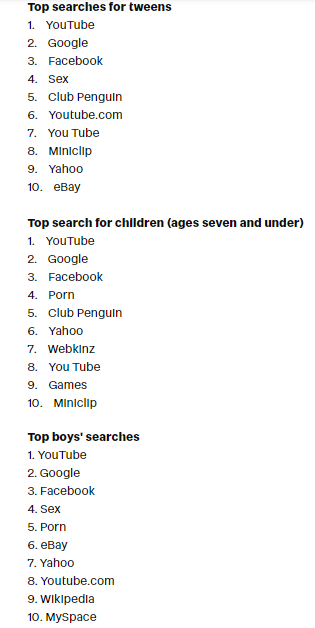
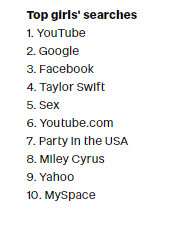
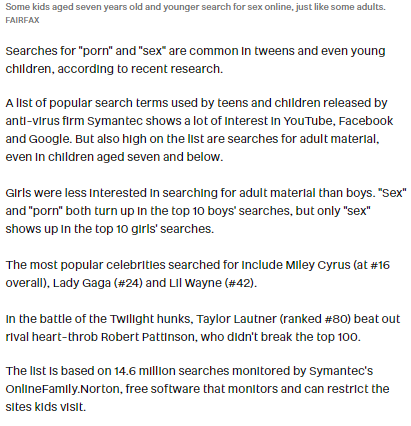
3) Kids have no real sexual desire. A recent collection of the Web surfing habits of youths--including pre-pubescents of both genders as young as seven years old--that was conducted by Symantec discovered that some of the most common topics searched for online by these underagers...well, let's just say that this data proved beyond a shadow of a doubt that the concept of "innocence" in regards to childhood is about as realistic as a big fat man in red clothing sliding down the chimney of every house in the world on Christmas Eve:


24e39edfdfdd101b7d89ac77732a8097.png
dd01fd16c8d4e1602ce92fd5e92548f5.png
6e3780c8ac726be8ea10087df0fb6e64.png
4) Kids were being sexually abused in truly horrific and often preposterous ways in the U.S.--and possibly across the world--by groups of mysterious and diabolical cultists who worshipped Satan and were abusing these kids in "honor" of the ultimate Lord of Evil. This particularly bizarre manifestation of the ongoing sex abuse hysteria that has been plaguing Western society for the past three decades was once accepted as absolute fact by the usual suspects who benefit from all permutations of this hysteria. These suspects include child "protectionist" groups, victim feminists, politicians of both major political parties seeking brownie points with the public and any excuse to increase police powers over all society, right-wing fundamentalist Christians, prosecutors without a conscience (including the later Waco, Texas mass murderess and good friend of Hillary Clinton, Janet Reno), and corrupt social workers and therapists with a less than savory agenda and an eye for a career boost at the expense of destroying the lives of innocent people.
 
Following a few totally unsubstantiated rumours that began early in the 1970s, the satanic ritual abuse hysteria began in earnest with the 1980 publication of the book Michelle Remembers by psychologist Dr. Lawrence Pazder and his patient (and later wife) Michelle Smith: www.en.wikipedia.org/wiki/Michelle_Remembers Thousands of innocent people, including numerous day-care center workers, were victims of this twisted tomfoolery, and as usual, people who were truly and wisely skeptical of this atrocity were too afraid to speak out for the risk of being called names that may have led to them losing their jobs as a result of questioning the hysteria.
 
This aspect of the hysteria was finally (and thankfully) totally disproven in the extremely important book Satan's Silence: Ritual Abuse and the Making of A Modern American Witchhunt:


or


by the uber-courageous journalist Debbie Nathan and the uber-honorable lawyer (yes, there are a few of those!) Michael Snedeker, both of whom should be hailed as heroes. A page of links leading to many important articles on this particular manifestation of the sex abuse panic can be found here.


www.web.archive.org/web/20111207012324/https://www.smwane.dk/content/section/5/30
 
5) Innumerable people who were sexually abused in their childhood were so traumatized by the alleged abuse that they repressed the memory deep into their subconscious, which could subsequently be retrieved at any point in their adulthood by deep hypnosis. The "repressed memory syndrome" was another major component of the sex abuse hysteria that was considered a scientifically valid concept despite no real evidence to support it when ignorant and outright unscrupulous therapists with (often questionable) talent in hypnosis claimed that individuals who showed any number of emotional problems in adulthood may have these symptoms as a result of experiencing extreme trauma in their childhood after being sexually abused, but which, according to this pseudo-scientific theory, these alleged victims would repress and thus no longer consciously remember the events.
 
The "repressed memory syndrome" also got its start in the infamous book Michelle Remembers (discussed above), which claimed that the horrific memories of an alleged victim of severe sexual abuse via her mom's non-existent satanic cult was repressed until retrieved by her therapist (and later husband) Dr. Lawrence Pazder by way of hypnotic regression. As one might expect, many other individuals with less than altruistic intentions soon exploited this newly recognized "syndrome" to further their own moral or political agenda. For instance, this phoney psychological condition got a further boost towards popular acceptance in the notorious book The Courage to Heal by agenda-ridden victim feminists Ellen Bass and Laura Davis. The latter two "victims' rights activists" jumped on the sex abuse bandwagon so popular with members of their specious ideology to spread the word to their many readers that just because they don't remember being sexually abused doesn't mean that it didn't happen. Bass and Davis not so sagely asserted that any number of personal issues that can be caused by any number of non-traumatic factors in the type of society that we live in today were often indicative of forgotten sexual abuse during their childhood.
 
Two particularly telling quotes from the book that are representative of the typical statements made within its pages make it quite clear how devoted to scientific validity and objective reason its authors weren't in the original edition of the book: "If you are unable to remember any specific instances like the ones mentioned above but still have a feeling that something abusive happened to you, it probably did" (p.21). And if that wasn't indicative enough of the type of chicanery which filled the pages of this book, behold this utterly anti-scientific gem that is also found within this charming little tome: "Demands for proof are unreasonable" (p. 137).
 
So according to the authors, it's more important to be "kind" and "considerate" to the feelings of the alleged victim of the alleged abuse than it is to call for an investigation or any type of inquiry into the truth if the evidence doesn't back up the allegations of this supposed victim. Obviously, the faux social science of "victimology" certainly doesn't fit well into a society that is supposed to be based on democratic principles, nor a legal system that purports to be based upon the notion of innocent until proven guilty. Just imagine if this ideology was allowed to infest our entire system of jurisprudence without challenge. Excuse me, but I would like to think that anyone who is devoted to the truth and the simple concept of social justice would gladly risk being "insensitive" to the feelings of the alleged victims by demanding evidence of their claims before taking the risk of prosecuting someone who may be entirely innocent.
 
A book review of The Courage To Heal that is courtesy of therapist Ralph Underwager can be found here:


Ignore some of Underwager's psychobabble in regards to various psychological theories he expresses in the review (including the rather unproven contention that psychopathic tendencies have a genetic basis according to one of the theories he seems to support), and you will find a cogent and not overly long critique of the type of "theories" that Bass and Davis push in their book to support their anti-male, anti-heterosexual, and anti-scientific agenda.
 
Perhaps it should be noted that the most recent edition of The Courage To Heal added a chapter that attempted to refute the statements made by the book's many detractors who dared to ask for scientifically verified evidence of the claims made therein. It's sad that this book is still considered a legitimate source of objective info for female sexual abuse victims to seek out as a means of healing. But for those particular women who espouse the concept of "victimology" and are therefore interested in revenge rather than actual healing, creating a whole social identity around their "victimhood" (i.e., becoming a Victim rather than simply a victim, if you know what I mean), and to consider themselves "damaged goods" for the rest of their lives 841f407d5b3ccf38d898f32c44b94120.pngsince truly healing and moving past their pain would deny them the perceived right to convey sociopathic behavior towards others who try to get close to them, especially men who may express an interest in them and family members who may offer their shoulder, and then calling all of the above individuals "insensitive to their pain" if they dare complain about such aberrant behavior being directed at them for no justifiable reason.
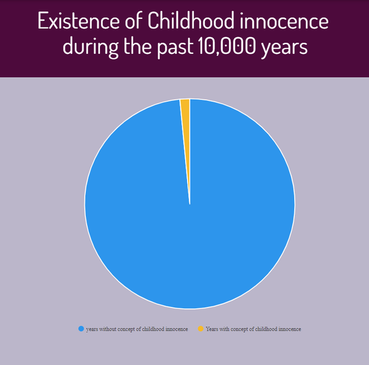

 

Thus was born a new psychological concept, which contended that when people suffer extreme trauma they will very likely repress it deeply in their subconscious and that hypnosis was supposedly a reliable method of retrieving these buried and forgotten memories. As a result, numerous therapists with even a minor degree of skill in hypnosis jumped on the bandwagon, and before you knew it, people were "remembering" previously repressed memories of sexual abuse in massive numbers, a number that included actress and comedian Roseanne Barr (a.k.a., Roseanne Arnold, a.k.a.,...isn't it just plain old Roseanne now or did she end up taking the last name of that bodyguard of hers that she married?). These allegations were taken extremely seriously by the courts and the media, as well as many in the mental health profession.
 
Of course, it's now known that people who suffer severe trauma very rarely, if ever, suppress such memories but instead suffer from empirically demonstrable conditions like post-traumatic stress syndrome, which often afflicts former soldiers who had truly horrific experiences in combat, victims of extreme forms of physical abuse by parents and/or their peers when younger, and victims of various violent crimes. This well documented condition made it clear what most often happens when someone undergoes a truly traumatic experience, which is the exact opposite of what the purveyors of the "repressed memory" nonsense claimed, i.e., that traumatic events in someone's life, which was believed to be a common reaction by children to sexual abuse until later studies (documented below) proved otherwise, would very often be forgotten as the result of an alleged natural self-defense mechanism of the psyche.
 
After thousands of innocent people, often parents and other relatives, were falsely accused of SA and dragged through legal hell over the course of a decade due to events that were allegedly forgotten by their supposed victims until retrieved by hypnosis, the "repressed memory syndrome" was finally exposed beyond a shadow of a doubt as the junk science that it was in the book The Myth Of Repressed Memory: False Memories And Allegations Of Sexual Abuse by psychologist and memory expert Dr. Elizabeth F. Loftus with the assistance of Katherine Ketcham.
 
Other books and articles have appeared in the mental health literature since then which cast further aspersions on the concept of "repressed memory," such as this excellent and extraordinary article on Loftus' book by Karen Adler:


 A page containing many links to other articles on this topic can be found here:


And let's not forget how the "repressed memory syndrome" and the irresponsible use of hypnosis combined with other factors to create the alien abduction phenomenon that was popularized by such books as artist Budd Hopkin's series of tomes on the subject starting with Missing Time near the end of the 1970s, on the eve of the beginning of the SA hysteria, and author/actor Whitley Strieber's equally popular series of books on this topic beginning with Communion in the 1980s. One cannot ignore the blatant sexual aspects and confabulation of fantasy and reality with "memories" retrieved via hypnosis that is highly evident in this phenomenon that became most popular during the days when "repressed memory syndrome" was at the peak of its societal acceptance. The alien abduction phenomenon was quite possibly influenced in certain ways by the sex abuse hysteria that was going on alongside it, which is evident when you analyze the reports closely enough and see how many youths were supposed to be involved in this phenomenon.
 
6) All cases of what is legally considered underage pornography are always produced by adults and never by the minors themselves. That simultaneously stereotypical and comforting idea to victim feminists and antis was blown out of the water completely once the sexting phenomenon came to light towards the end of the first decade of the 21st century:


or


This revelation shouldn't have taken the public by surprise, since it was revealed a few years earlier that teens were routinely taking and uploading nude pics of themselves on socnet sites like MySpace, as noted here:


or


This time, it wasn't possible for the media to blame adults for this increasingly popular method of underagers to express their sexuality, nor could the mental health industry and victimologists decree their famous mantra, "It's not the fault of the kids!"
 
The above examples of wishful thinking by our gerontocentric society were blown to hell once and for all with the revelation of Justin Berry's story. For those who are not familiar with the case, Justin Berry was a youth who started a lucrative business for himself by making and distributing pornographic videos of himself masturbating online, beginning when he was 13 on a website of his own creation. He built a large clientele for himself and was very financially healthy as a result. He eventually came to the attention of author and reporter Kurt Eichenwald, who wrote a much balleyhooed article on Justin Berry's story in The New York Times, which was filled with all the typical mainstream propaganda about how Berry was the victim in this situation, how his homosexual male clientele "exploited" him, how the advent of webcams and other new technology is a terrible thing for young people to have in their possession, how the Internet is allegedly filled to the brim with predators, etc. However, there were many things that Eichenwald didn't mention about Berry's story in his bias-filled article, including the fact that he directly insinuated himself into Berry's life by giving him money to allegedly try and help him "turn over a new leaf." Eichenwald was even found to have high-level access to one of Berry's illegal sites, and Eichenwald later convinced Berry to speak out on Internet predation in public by officially going along with Eichenwald's claims that he was a victim. Hence, once Berry turned 18 and was no longer sale material to his homosexual hebephile clientele, playing the "victim" card was probably seen as the wisest thing for him to do, since he had great potential to become a media darling as a result and to possibly make a killing by having Eichenwald's sanitized and 'socially acceptable' version of Berry's life story turned into a profitable movie. However, once the facts on the case came out, Eichenwald and Berry lost their movie potential, as well as the chance to turn Berry into a victim-turned-activist-media-sweetheart.
 
Journalist Debbie Nathan, who had previously debunked the satanic ritual abuse nonsense with her book Satan's Silence in 1995, composed a lengthy article for CounterPunch in 2007 that revealed the full truth behind Justin Berry's story and put all of Eichenwald's politically correct claims to question. That article can be found here:


Nathan's article makes it quite clear that Berry was hardly a saint, and his full story will make one question who exactly benefited from his situation the most and who was truly exploited.
 
Further, Eichenwald's breach of ethical conduct in regards to his behavior during the entire affair is likewise illustrated in the above linked article, and his claims about Berry's innocence and victim status, along with his assertions about Internet "predation" and underage porn for sale and profit being problems of epidemic proportions, are likewise debunked. Another good article detailing Eichenwald's handling of the Justin Berry story is John Farmer's 2006 essay that can be found here:
 
www.web.archive.org/web/20140204005827/http://massis.lcs.mit.edu/telecom-archives/TELECOM_Digest_Online2006-2/1358.html
 
or
 
https://archive.ph/V6Chw
 
Farmer does make some disparaging comments about younger people in this article (such as expressing his doubts that a 13-year-old possesses the intellectual and emotional wherewithal to think of creating the type of online business that Berry created without "encouragement" from adults) and he does seem to have no problem with parents incessantly invading the privacy of their kids, but he nevertheless asks many important questions about Eichenwald's portrayal of Justin Berry that need to be asked, and he should be commended for this.
 
7) The brains of adolescents are inherently faulty due to innate biological factors and thus they have an inherent tendency to make poor decisions that necessitate denying them most of their civil rights and keeping them under the control of their parents and other adults for their own good. This idea has been fashionable since the turn of the 19th/20th century when the early stages of the Industrial Revolution eliminated what was left of the rights that young people used to enjoy, and the mid-19th century Victorian concept of the "innocent child" was extended to include anyone under the age of 18. 6687b742382965f99e4e20ce5bc7ba97.png
 
As a result of this, the concept of a distinct phase of life that came to be called "adolescence" entered the official public consciousness in a major way, and this concept was mostly pioneered by the beginning of the 20th century courtesy of the social conservative psychologist and author G. Stanley Hall. Hall used aspects of what we today call Social Darwinism and misuse of evolutionary biology to claim that the life stage of adolescence was a natural biological reality rather than a social construct. He diligently opposed what he referred to as "precocity" in young people, which can easily be translated as, "Do not let young people do anything more than what society believes they should be doing at that current age, and society should insure that young people at this newly conceptualized stage of life universally adhere to the socio-cultural paradigm we have established for their age group."
 
As Hall biographer Nancy Lesko said in this article:


www.education.stateuniversity.com/pages/2026/Hall-G-Stanley-1844-1924.html, 


"The shapers of the modern, scientific adolescent made growing bodies and sexuality primary foci and the measures to prevent precocity enhanced youth's economic dependence" [emphasis mine]. Sociologists and psychologists who have studied the concept of adolescence later in the 20th century and up to the modern era (it's early February of 2010 as I write these words) have increasingly come to question Hall's biological conception of adolescence as being a distinct and natural phase in human development that marks a period between childhood and full adulthood that requires individuals in this intermediate stage to have the same degree of legal and social controls as it came to be believed that children should have since the Victorian era began. This new social construct resulted in young people under the age of 18 who fit into this new category to be given the same legal and social status that pre-pubescents ended up with during the Victorian period (indeed, Western culture tends to view adolescents under 18 as older children rather than young adults). Hall's increasing number of opponents in the social sciences over the course of time began to view his conclusions as outdated.
 
Major and notable challenges to Hall's theory on adolescence include French sociologist Philippe Aries' book Centuries of Childhood (published in the French speaking world in 1960 and first translated into English in 1962). This tome ended up having a major impact on the social sciences during the liberal era of the 1970s when progressives of that decade began to reassess society's attitude towards younger people that was largely established by Hall and his Victorian predecessors. These reconsiderations of the status of youth included questions regarding their subservient role in the present day social institutions (such as within the nuclear family unit and within the modern elementary and secondary school systems). This was a truly progressive idea that was sadly derailed when the onset of the sex abuse hysteria and the conservative takeover of government, beginning with Ronald Reagan's presidential election in 1980, rolled back the emerging youth liberation movement of the '70s (begun notably in Ann Arbor, Michigan). Further, the combination of the sex abuse hysteria and the conservative takeover of government (which complimented each other heavily) cowered most of the liberal elements of society who began considering the validity of youth competence (including their sexual rights) in the '70s into silence and outright capitulation to the demands of the newly empowered social conservatives. This, of course, was motivated by these progressives' fears of being called "pro-pedophile," "anti-family," "insensitive to victims of child abuse," and other highly unpleasant, potentially career-destroying epithets.
 
And so things remained until the Internet bloomed to the level we recognize it as today in the late 1990s when the youth liberation movement was reborn in a significant way with the establishment of ASFAR (Americans for a Society Free from Age Restrictions) and, later, the even bigger and more influential youth lib org NYRA (National Youth Rights Association; created by somewhat less radical individuals who had left ASFAR).
 
All of this led to the pioneering efforts of more scholars in the social sciences such as, perhaps most prominently today, clinical psychologist Dr. Robert Epstein:


Dr. Epstein began his work in this area with a highly important and much discussed article published in an issue of Scientific American Mind entitled "The Myth of the Teen Brain" (a digital version of the latter issue of Scientific American Mind containing Dr. Epstein's aforementioned article was purchasable online for $7.95 here in 2011):


https://web.archive.org/web/20110221085733/http://www.sciamdigital.com/index.cfmfa=Products.ViewIssuePreview&ARTICLEID_CHAR=9F1EBAA7-2B35-221B-6CBD51A39316C4D6
 
Here is a new link to a free copy:


https://drrobertepstein.com/pdf/Epstein-THE_MYTH_OF_THE_TEEN_BRAIN-Scientific_American_Mind-4-07.pdf
 
7e354f94ceb9bd35550c91341e155fb6.png


Epstein continued and expanded his studies into the reality of adolescent competency with an extremely groundbreaking book The Case Against Adolescence: Rediscovering the Adult in Every Teen in 2007, and quickly followed it up with an updated and expanded version in 2010, TEEN 2.0: Saving Our Children and Families from the Torment of Adolescence. A list of the various cultural myths our society has of adolescents that Dr. Epstein tackles in his book can be found here:


His Young Person's Bill of Rights, written in celebration of the first annual National Youth Rights Day on April 14th, 2010, can be accessed via a link found on the same page as the preview to Epstein's newest book at this writing.
 
Though I consider Newt Gingrich, the far right-wing former Speaker of the House of Representatives, to be a mortal political nemesis of mine, I have no choice but to commend him (along with his ideological cohort Rush Limbaugh for the same reason) for coming out in favor of this book and the principles for which it stands, something that I am sad to say is much more than most prominent media pundits of the mainstream Left have done thus far. To quote Gingrich:
 
"Adolescence is a social experiment that failed. Dr. Epstein's book traces the history of the problem, demonstrates with unrelenting perseverance that much of the turmoil of our teens is a creation of our culture, and offers a specific and detailed proposal for getting our young people back on track. If you are concerned about America's young, and about America's future, this is a must-read."
 
And as physician and author Deepak Chopra importantly noted about this book: We need to re-examine our basic assumptions about young people, and Epstein shows us how.
 
Another very important article about youth liberation by Dr. Epstein, this one specifically aimed at how the modern secondary education system that we call high school needs to be dispensed with to a great extent, and which also details the circumstances that led Dr. Epstein to question modern cultural attitudes towards young people and ultimately embracing youth liberation, is his 2007 essay published in an issue of Education Week entitled, "Let's Abolish High School":


www.drrobertepstein.com/downloads/Epstein-Lets_Abolish_High_School-Education_Week-4-4-07.pdf
 
1911660b83eabfb1c203ba956fdae999.png


A very important thing to note here is that in the latter article Dr. Epstein mentions the fact that he is a father of four children, which should further demolish the self-righteous claim of many of those who do not support youth liberation (both outside of and sometimes within the MAA community) that only people who are not parents could possibly support youth liberation, and that any youth liberationist who becomes a parent will quickly repudiate their support of youth lib, or that that youth liberation is inherently incompatible with and hostile to the institution of parenthood. In fact, Epstein describes in the opening paragraph of this essay that his status as a parent actually led him to embrace youth lib, not automatically reject it, as those who are hostile to or ambivalent about the youth lib platform will often claim.
 
As all of the above makes clear, there are now serious challenges to the societal assumptions that adolescents are inherently incompetent due to a "faulty" or "underdeveloped" brain, and these challenges are being increasingly supported by a growing number of individuals in the social sciences. These latter social scientists are now being joined by others who are familiar with the history of childhood and how different conceptions of "The Child" in the pre-Victorian era were in comparison to afterwards. And this as opposed to the conception that was adopted since that ideology's paradigm for children became the dominant one in our society, and later expanded to include young adults who are under the arbitrary age of 18.
 
8) Mutually consensual sexual contact between anyone today considered to be 'minors' and those who are adults is always traumatizing for the younger person and will likely cause lifelong psychological 'damage' to them, no matter how much the minor in question may have enjoyed and desired the experience. This powerfully imbedded and very widely held cultural assumption causes even many of the most outspoken and generally brave progressives and liberals to cower like an animal confronted with fire whenever this subject is brought up, and such individuals are more than quick to throw aside their ideology's devotion to open-mindedness and do nothing more than mindlessly agree with the mainstream view of this truly hot button topic. To show even the slightest deviation from the mainstream view, or even to ask for empirical evidence of its validity, runs the risk of being called a series of very unpleasant names and likely doom a planned political campaign or future job promotion.
 
The conservative conquest of our national mindset beginning with the Reagan victory in 1980, along with the onset of the ongoing sex abuse hysteria and the accompanying "pedophile panic," is one of the most potent weapons used to keep those we today call 'underagers' or 'minors' under the direct control of both their parents and the state despite the fact that the largest amount of real abuse directed against young people of all kinds--including sexual abuse and even murder--occurs by individuals living within the home and who possess the most direct and stringent power over these minors.
 
The tragic kidnapping and murder of eight-year-old Adam Walsh in his home town of Hollywood, Florida by a deranged serial killer (who is believed to have been a man named Otis Toole who died while in prison for an unrelated offense later in the 1980s and thus never brought to justice specifically for Adam's brutal murder) caused Adam's very understandably grief-stricken father John Walsh to declare war not on the small number of dangerous serial killers and other situational abusers who target youths per se (which would have been entirely justifiable), but on Minor Attracted Adults specifically. Picking up on the SA hysteria that was in its early stages when his son was killed, John Walsh spread what came to be called the highly disingenuous "stranger danger" phenomenon. He proved to be one of those individuals in this mess whose desire for vengeance over that of reasonable justice, along with his total disregard for truth on this subject, caused the sex abuse hysteria to reach the epidemic level that it remains at today, three decades after the tragic loss of his son. John Walsh largely accomplished this by exploiting his situation and the hysteria accompanying it to establish a major media career for himself that promulgated one of the greatest myths of this hysteria: that "pedophiles" (which Walsh, like most of the rest of the media, use as a blanket term for both genuine pedophiles and hebephiles) are responsible for effectively all of the sexual abuse inflicted upon minors in society. In his eyes, there is no such thing as a situational abuser, i.e., what even the FBI admits are adults, and on some occasions adolescents, who commit the bulk of all real non-consensual and coerced acts of sexual violence on minors and who usually do not have a strong or preferential attraction to them and are therefore not real pedophiles or hebephiles in the vast majority of cases.
 
Walsh also pushed the idea that the threat of strangers who kidnap and SA and murder minors constitute a menace of epidemic proportions, thus totally ignoring the facts. The facts are that most situational abusers who commit acts of genuine and demonstrable abuse against them operate within the home and sometimes within other institutions where adults have the most direct and strictest degree of power over them, such as boarding schools. The SAs who are strangers to youths, including the very rare breed of serial killer that targets them, are extremely rare.
 
Youth liberationists do not consider John Walsh to be an ally by any means, because his efforts have resulted in draconian laws that have imposed further and further restrictions on the rights of young people, not to mention an increase in the cultural attitude that they are inherently incompetent and always in extreme danger of being kidnapped and assaulted or even murdered by deadly trenchcoat wearing strangers. Therefore, according to the ideology of the "child advocates" that Walsh had a big hand in empowering, young people under the age of 18 are in dire need of this increased parental control "for their own good."
 
Youth liberationists are also angered by the manner in which Walsh has worked to further empower the institutions where minors suffer the greatest amount of actual abuse of all kinds, such as the hierarchal structure of the nuclear family unit, and deceived the public as towards the real reasons why the vast majority of the 100,000 minors reported as missing every year were not at home. And if any of our opponents (or any of the "moderate" elements from the MAA community, for that matter) doubts that the youth liberation movement could possibly have any beef with John Walsh and the many misleading bits of information spread about the threats to the safety of young people in America by the organization he founded, the National Center For Missing and Exploited Children, please take a gander at this article: www.youthrights.net/yt/v2n6.pdf from 2001 by youth liberationist Lisa Freeman that appeared in an issue of Youth Truth, ASFAR's official zine. And please note that Freeman has nothing whatsoever to do with the MAA community and there is absolutely no evidence whatsoever that she is an MAA herself. This is true of the great majority of the youth lib movement, in case our enemies (including Walsh himself) might attempt to claim that Freeman must be a "pedophile" for denouncing an esteemed organization like the NCFMEC.
 
Walsh was soon joined by another major player in his mindless and vindictive crusade against MAAs who also did more than her fair share of contributing to the growth of the SA hysteria and its accompanying industry. Oprah Winfrey came on the scene in the 1980s a few years after John Walsh began building his influential career in the media and ended up building an even bigger and more lucrative career than Walsh did. Winfrey is often credited with the invention of what came to be known as "trash TV," a method of doing a talk show that made the once respectable genre under the hands of serious seekers of the truth like Phil Donahue into something that ravenously sought superior ratings via the exploitation of serious topics by means of sensationalism rather than objective discussion and consideration which analyzed all sides of any issue. If one has any doubts about this, then simply look at the difference between the early talk shows of the '70s, heralded by Donahue, and what passes for them today, with the likes of Jerry Springer having such huge ratings and popularity.
 
Oprah's constantly growing influence and self-serving grab at big ratings effectively helped turn all talk shows against serious discussion of adult attraction to minors, and also helped further popularize the "victim mentality" (described above in my discussion of The Courage To Heal). However, Winfrey didn't simply push such a mentality on adult women, but also upon anyone who had any type of intimate relationship with an adult prior to turning 18 regardless of consent. Of course, she also pushed anti-male attitudes in general on her huge audience that consisted mostly of women, the latter attitudes being (according to a theory of mine) a major component behind the justification of the age of consent laws. When Oprah revealed that she was SA by an uncle when she was a child (the real details of which have never been fully investigated at this writing to determine things such as whether or not Oprah's uncle was a true pedophile, nor the authentic nature of the incidents she describes), she used this as a justification to officially declare open season on MAAs. She has done as much as John Walsh has to popularize the idea that young people under 18 can never be anything other than victims in relationships with adults. To this day she continues to spread an increasing number of sometimes truly bizarre and outright outlandish and nightmarish lies about MAAs. A good example of this is her recent outrageous claim that the "pedophile" community had posted an online instruction manual supposedly giving each other advice on how to sexually abuse kids, some as young as infants, in extremely graphic and disturbing ways, including the insertion of knives and other implements in their sexual organs. Predictably, no one in any of the many MAA boards I am familiar with has any idea what she was talking about or has ever even seen, let alone participated in the creation of, such a horrendous instruction manual. A few in the MAA community have conjectured that if this instruction manual actually exists anywhere on the Net (and that's a huge if) it's probably nothing more than a very sick joke composed by Internet trolls.
 
Considering how Winfrey continues to terrify the public with outrageously horrid claims like the one mentioned above, which no one outside the community ever bothers to substantiate or even question, is it any surprise that her many viewers hate and fear MAAs with such a passion? And then there was the 9000 penis's affair which at least served to embarrass her when it was revealed that it was a hoax from a troll at her website and not a true pedophile, but this incident still didn't humiliate her enough to tarnish her stellar reputation among her viewers, nor to expose her singular lack of concern for seeking the truth when it comes to this subject.
 
As a result of the SA hysteria being helped along by the likes of Walsh and Winfrey, both of them since its early days, the idea that youths under 18 are terribly and irreparably traumatized by any type of sexual contact with adults, regardless of the matter of consent, was considered an irrefutable fact that has rarely been questioned by any politician or researcher. But there were some dissenting views here and there which did have an impact, and the massive amount of courage it took these lone voices in the wilderness to go against conventional wisdom when it comes to this particular topic was immense and commendable in the extreme.
 
One of the first reports to come out that did a serious study of the issue of trauma during the SA hysteria was the Rind Report: www.eng.anarchopedia.org/Rind_Report a government funded study conducted by (taken from the above link) Bruce Rind, Department of Psychology Temple University, Philip Tromovitch, Graduate School of Education Temple University and Robert Bauserman, Department of Psychology, University of Michigan.
 a387846092a8cf09e13de106399c443b.jpg
The stated goal of the report was to do an objective study on the following common assumptions:


-"Child sexual abuse (CSA) causes psychological harm;


-this harm is pervasive;


-this harm is intense; and


-boys and girls experience CSA equivalently."
 
This meta-analysis ultimately concluded, "Self-reported reactions to and effects from CSA indicated that negative effects were neither pervasive nor typically intense, and that men reacted much less negatively than women. The college data were completely consistent with data from national samples. Basic beliefs about CSA in the general population were not supported" [emphasis mine].


e0ae81d5dbd4448fd44710d31e86efa1.png


4f991caf8c7c539c33295a52dbedbda0.png
 
Of course, there is no doubt that the Rind Report is flawed to some degree, because it seemed to be conducted under the premise that all such contact is to be considered "abuse" in an absolutist sense (though, as you will see, it did take the matter of consent into account), and the report's loaded statement that girls are much more likely to receive a negative experience from all forms of sexual contact with adults has been challenged and contradicted elsewhere (I will get to that soon), though virtually no other aspect of Rind's study has been successfully refuted anywhere else by any objective study.
 
As a result of the above mentioned flaw, a certain number of BLers who have no interest in promoting the rights of GLers and girls along with those of BLers and boys often justify this lack of consideration for the rights of adults and minors who do not fit their own gender preference by quoting the above conclusion of the Rind Report and deciding that girls are much more likely to perceive even mutually consensual contact with men (if not also with women) negatively than boys. This provides the rationale of these "old school" BLers for not working with GLers politically or supporting the emancipation of girls in equal degree to their support for the rights of boys, and thus exclusively arguing for the societal legitimization of man/boy love and the rights of boys while ignoring and occasionally even denouncing the equal legitimization of man/girl love (or even women/girl love) and the right for girls to choose whom they can love in addition to the rights of boys to do the same. Such BLers never seemed to bother asking the important question of who the girl participants in Rind's study happened to be, whether or not their sexual liaisons with adults were consensual or non-consensual, or (perhaps most importantly) whether or not these girls engaged in liaisons with adults that were found out, and if the girls who reported these negative experiences had therefore been subjected to the infamous intervention process by the police and agenda-driven social workers whose "interview" methods (perhaps more correctly referred to as interrogation methods) came to public attention during the previously mentioned McMartin day-care incident that occurred years earlier.
 
Thanks to my fellow GL activist SuiDream, I was notified that the Rind Report did indeed have a flaw in it that was recognized as such by the three psychologists who conducted the meta-analysis. So I did a thorough search of the Rind Report and found out that there is indeed a flaw in the original correlations made in the meta-analysis that claimed girls are much more likely to have a negative reaction to a sexual liaison with an adult than boys (which I will get to in a moment).
 
The Rind Report was not entirely flawed as the antis claim, however, because no alternate objective research on this subject that included boys and girls have found any evidence that boys react more negatively to sexual contact with adults than girls do, but this other research (including that conducted by Sharon Thompson, which didn't include boys at all) has found that girls in addition to boys generally do not react negatively to sexual relations with adults when such contact is mutually consensual and does not involve incestual advances by those with the most direct power over these youths.
 
When one does a thorough reading of the Rind Report, one will notice a certain passage which makes it abundantly clear that a likely reason why the girl participants expressed a much greater likelihood of having a negative reaction to their sexual liaisons with adults is because the samples of college students used included a disproportionately large number of those who were subject to incestual advances. Note the following passage from the Rind Report itself:
 
A chi-square test of the homogeneity of the sample-level effect sizes revealed that they were not homogeneous, X2(53) = 78, p < .01. In an attempt to achieve homogeneity, we examined the distribution of sample-level effect sizes to determine whether outliers existed. We defined outliers to be effect sizes that were at least 1.96 standard deviations away from the unweighted mean effect size (i.e., falling in the extreme 5% of the distribution). Three outliers were found (r = .36 in Jackson et al., 1990; r = .40 in Roland et al., 1989; r = -.25 in Silliman, 1993) with z scores of 2.71, 3.16, and -3.60, respectively. The Jackson et al. study included only incest cases in the CSA group, and the Roland et al. study included a large proportion of incest cases [emphasis mine]. Moreover, Neumann et al. (1996) also found the Roland et al. result to be an outlier. Measures used in these studies from which effect sizes were computed included: the SAS, BDI, RSE, and DSFI (Jackson et al., 1990); the MMPI form R (Roland et al., 1989); and the LOC and TSCS (Silliman, 1993). These measures were all used in other studies whose effect sizes were not outliers, implying that the outlying results were not a function of these measures. Removing these outliers resulted in homogeneity, *2(50) = 49.19, p > .50, based on k = 51 samples, with N = 15,635 subjects [emphasis mine]. The recalculated unbiased effect size estimate (/- = .09) and the 95% confidence interval (.08 to .11) were unchanged after rounding. The obtained small unbiased effect size estimate implies that, in the college population, the magnitude of the relationship between CSA and adjustment is small, which contradicts the assumption that CSA is associated with intense harm in the typical case [emphasis mine].
 
Initial meta-analyses yielded 8 homogeneous and 10 heterogeneous results. In an attempt to achieve homogeneity with heterogeneous sets, we examined the distribution of effect sizes within each of these sets to detect outliers, as defined previously. We removed all such deviant effect sizes and then recomputed the meta-analyses. If homogeneity was achieved in a particular set, then the search for outliers stopped for that set. Otherwise, the reduced set of effect sizes was examined for new outliers, and, if found, the outliers were removed and the meta-analysis was performed again. If the set of effect sizes was still heterogeneous and no additional outliers were found, the set was considered to be heterogeneous. This procedure resulted in achieving homogeneity in 7 of the 10 initially heterogeneous sets, yielding 15 out of 18 homogeneous sets [emphasis mine]. Effect sizes remained heterogeneous only for hostility, self-esteem, and sexual adjustment. Of the 9 effect sizes removed in the 7 sets that became homogeneous, the majority came from two of the studies that contributed to the heterogeneity of effect sizes in the sample-level metaanalysis 5 from Roland et al. (1989) and 1 from Jackson et al. (1990). These six effect sizes and one additional effect size from Bendixen et al.'s (1994) female sample were removed from the upper end of their distributions [emphasis mine]. Two effect sizes were removed from the lower end of their distribution (Fishman, 1991; Fromuth & Burkhart, 1989, Southwest sample). Measures on which removed effect sizes were based in Jackson et al.'s and Roland et al.'s studies were listed previously in the sample level meta-analysis section; Bendixen et al. and Fishman used investigator-authored items, whereas Fromuth and Burkhart used the SCL-90-R. Many studies with no outlying effect sizes used investigator-authored items and the SCL-90-R, implying that the outlying results were not a function of the measures used.
 
In Table 3, the original numbers (i.e., number of samples, number of participants in these samples, unbiased effect size estimate, and homogeneity statistic) associated with the heterogeneous results for the seven sets that became homogeneous are shown in parentheses, whereas the numbers associated with the reduced homogeneous sets appear directly under the column headings. Removing outliers showed itself to be productive in achieving homogeneity [emphasis mine]; further, this procedure had little effect on effect size estimates, indicating that the large majority of effect size estimates can be considered to be reliable estimates of true effect sizes in the college population. The unbiased effect size estimates for all 18 symptoms were small according to Cohen's (1988) guidelines [emphasis mine]. The effect size estimates ranged from ru = .04 to .13. Despite these small values, all effect size estimates, except for one (locus of control), were statistically significantly greater than zero, as is indicated by their 95% confidence intervals. These findings indicate that, for all symptoms but one, CSA participants as a group were slightly less well adjusted than control participants. The small magnitude of all effect size estimates implies that CSA effects or correlates in the college population are not intense for any of the 18 metaanalyzed symptoms [emphasis mine].
 
 
The overabundance of cases involving incest was very likely present in many more of the girl participants in the study than the boy participants, thus likely accounting for the discrepancy. And, as noted in the above excerpt (all taken from pp. 31-32 of the Rind Report), once the above outliers were adjusted and removed from the female samples, there was much less disharmony with the male samples. Hence, the Rind Report actually admitted that the above-mentioned flaw was indeed a discrepancy in the meta-analysis, and the final draft of the report recognized and corrected this. It's unfortunate that so many people seem to have failed to read this section of the Rind Report, and have used it as an excuse to imply that girls are less capable of handling their sexual rights than boys are. Or, within the MAA community, that BL is more legitimate from a moral standpoint than GL is. It seems rather clear from the above study that girls appear to be much more often subject to incestual advances by parents and other close relatives within the home than boys are. This fact would certainly account for the above noted discrepancy in the study results. But that should have little bearing on girls' typical reactions to sexual activity with adults who do not live within the home, do not have a direct degree of authority over them, are not related to them, and for which the relationship was entirely consensual.
 
There are further good reasons to ask the questions I just asked about the female participants in Rind et al.'s meta-analysis. This is because other researchers who have interviewed underage females that engaged in specifically mutually consensual sexual liaisons with men who had no direct authority over them and were not related to them, such as Sharon Thompson in her monumentally large study of teen girls' sexual lives that was recorded in this very important book Going All The Way: Teenage Girls' Tales of Sex, Romance, and Pregnancy:


,have reported things quite differently than the initial results of the Rind Report before the above mentioned discrepancy was accounted for. In this study she tackled the subject of these young girls' romantic relationships with adult men in Chapter 7 of that book, and she made the issue of consent quite clear in the questions she gave to her girl interviewees. She didn't make the mistake of lumping all sexual encounters together under one heading, without taking the important matter of consent into account.
 
As Peggy Ornstein said in her online review:


of Thompson's book, "Sharon Thompson's Going All the Way takes a brave approach to one of the most emotionally and politically charged issues of our times: sex and teen-age girls. Let me make this clear: this is not a book lamenting teen-age pregnancy rates. It is not a rant against promiscuity. Ms. Thompson is simply, without censure, reporting on how young women see their sexual selves." Hence, the objectivity--not to mention courage--of Thompson's study of this subject is made quite clear in Ornstein's review (and for anyone who reads the book), and to her credit Thompson was concerned more with establishing the truth than she was with promoting a certain popular moral agenda that ends up effectively stereotyping teen girls by showing them little if any respect.
 
Regarding what was said by the many interviewed girls regarding their mutually consensual liaisons with adult men, Ornstein reports, "And while the girls with adult male lovers generally reported enjoying sex [emphasis mine], they too operated on a barter system, often swapping erotic favors for surrogate fathering." It's quite possible that most of the females that Thompson interviewed with this particular set of questions were not gerontophiles, and thus weren't naturally oriented towards adult men sexually and emotionally. However, the "surrogate fathering" thing, another stereotype directed at teen girls every time they get involved romantically with adult men, may be translated as girls who seek out relationships with men for reasons that are not entirely honest to the men in question. Nevertheless, the fact that these females found surrogate "fathering" from their adult male lovers, and made it clear that they were not psychologically damaged or felt degraded by the sexual aspect of the relationship, it can be surmised as an educated guess that these girls' genuinely wanted the sex and may have had a strong sexual attraction to the men they had these relationships with even if they described themselves as "exchanging" sex for "fathering" in their interviews with Thompson.
 
There are plenty of reasons why such stereotypes should be questioned. For one thing, it's well known to anyone who is either a parent or has worked with kids, or to anyone who has ever been a kid, that very few young people, both pre-pubescents or adolescents, ever do anything that they truly do not want to do or are not compelled to do out of absolute necessity. The idea that sexual activity is the one thing in the world that underagers will engage in if they don't want to with adults, let alone those particular adults who do not live with them or have any particular degree of strict power over them, is quite baffling and entirely devoid of common sense, to say the least. Further, it's well known that there are many adult men that do not have a romantic preference for adolescent girls but who still have a measure of respect for these girls that would gladly play the role of surrogate father for them without expecting erotic "favors" in return. Why don't girls who are only seeking a platonic father surrogate--and nothing more--simply find men who are not hebephiles (and thus do not have a preference for teens) and make it clear to them from the get-go that they are looking for a platonic friend or "father figure" and nothing more? Furthermore, since the hebephile attraction base encompasses far more than a simple sexual attraction to teen girls, and includes (at least in most cases) a strong social component to it, why couldn't these girls approach a caring hebephile and make it clear from the get-go that they were simply looking for platonic friendship and support?
 
One is forced to suspect that many of these girls who were interviewed by Thompson found adult men whom they had a degree of physical attraction to, came onto them sexually, and convinced these men that they were in an actual romantic relationship with these girls when in actuality the girls hoped to keep these men around for their friendship and the feeling that they were a surrogate father figure of some sort who would perhaps take care of them in certain ways that they wouldn't have if the girls didn't feign a romantic interest in them. If so, this would constitute disingenuous and even manipulative behavior on the part of the girls, who may have felt that convincing these men they had a sexual/romantic interest in them would serve to wrap them around their fingers more, and to be more likely to keep them around in their lives. This, of course, contrasts heavily with the contention by many that these girls could never be anything other than a victim of these men, and that the adults in such cases are always without exception the ones in the wrong because unlike anyone who is under 18, adults are always believed to "know better." In other words, our society believes that it's impossible for an underage girl to manipulate an older man, and that only the reverse is possible because of the common ageist belief that older people always have superior wisdom and worldly experience than younger people do. Of course, if this was true, one wonders how the large number of young con artists working for fraudulent telemarketing companies have managed to so effectively bilk senior citizens out of their life savings.
 
Any man who has been actively dating for any length of time have met the type of young woman described above, and hebephiles are well aware that there are adolescent girls who do exactly the same thing as these women who are legally adults do and are just as competent and capable of pulling it off, which should be expected since adolescents are essentially young adults.
 
True gerontophiles, however, are not usually looking for a surrogate father figure when they enter into such relationships with adults, but have a genuine physical, emotional, and social orientation towards adult men (or women). Hence, their feelings for much older men (or much older women), and their reasons for seeking them out as lovers, are for reasons that are no different than why teleiophile women seek out adult men for romantic relationships.
 
The main point is, however, that these many females who had mutually consensual sex with much older adult men found the physical intimacy they shared with them generally enjoyable and did not later report psychological damage or overwhelming feelings of being used and abused as a result. Further, the many female gerontophiles who have visited the MAA community in the past have made it quite clear that they did not suffer any psychological damage or negative reaction to sexual relationships with adult men if the relationships were mutually consensual.
 
It should be noted that the remaining number of BLers who ignore the rights of girls and GLers, and who may not consider them as morally legitimate as the rights of boys and BLers to choose to have relationships with each other, have thankfully greatly diminished over the past decade now that there are several message boards, including Newgon, where BLers and GLers routinely interact with each other, learn about each other, support each other, and perhaps most importantly, where the BLers who participate in these joint boards have met as many female gerontophiles as they have their male counterparts and are thus quite aware that girls are not more likely than boys to receive a negative reaction from a mutually consensual relationship with a man (or a woman, for that matter). The ever diminishing number of BLers who still feel that man/boy love is morally superior to man/girl love, and who show signs that they may believe that girls are less capable of handling their rights as boys, prominently appears to include the author whose otherwise excellent work is archived on the SafeHaven Foundation Press website: www.shfri.net/shfp/shfp.cgi that he established to keep his work available to the public. This particular BLer author should know better given the several decades he has been doing research on this subject, yet he evidently still uses one of the few faults of the Rind Report to justify his total lack of interest in fighting to legitimize Girl Love as well as Boy Love. If he had bothered to interact with GLers as so many other BLers do nowadays rather than posting on boards exclusively inhabited by BLers, and if he met and talked to as many female gerontophiles as he has done with their male counterparts, he would indeed know this and not blindly follow the conclusion made by the Rind Report regarding the experiences of girls who had experiences with men being much more likely to be negative than that of boys who did the same when there is good reason to question that statement due to all of what I mentioned above.
 
Perhaps unsurprisingly, the Rind Report was "condemned and denounced" by Congress despite the fact that its findings and methodology was further peer reviewed by representatives of the APA, and psychologist Ray Fowler, representing that org and its review of the Rind Report, concluded: "Because the article has attracted so much attention, we have carefully reviewed the process by which it was approved for publication and the soundness of the methodology and analysis. This study passed the journal's rigorous peer review process and has, since the controversy, been reviewed again by an expert in statistical analysis who affirmed that it meets current standards and that the methodology, which is widely used by the National Institutes of Health (NIH) to develop guidelines, is sound." But Congress' denunciation of the Rind Report's conclusions by a unanimous vote of 355-0 [!], which made it clear that no politician of either major political party will dare to be open-minded about this subject right now, and that the government officials' unwillingness to put science and truth before deeply held cultural beliefs no matter how much evidence is presented to counter such beliefs, should encourage more people to question the "wisdom" of the government far more often than they do. Sadly, due to all the outside attacks on his studies in this area, Dr. Rind was scared away from pursuing this particular research any further and has since put his time and efforts into other, less controversial areas of study.
 
However, as noted in this very important article: www.archive.ph/Mqkqv by Dr. Frans Gieles that offers a detailed counter-argument to the detractors of the Rind Report, Dr. Rind and his fellow authors of the report made this statement when the issue of consent was brought up by the many detractors of their study, specifically in regards to the ability of adolescents to consent, which was readily and officially recognized by the APA in a 1989 statement to the Supreme Court, and also made a strong implication that the studies suggested that pre-pubescents may be able to give what was defined as 'simple consent' (if not the more commonly used 'informed consent'), which was still found to result in positive or at least neutral outcomes by children who have utilized it in non-coerced and non-incestual relationships with adults:
 
It should also be made clear that when Congress, the Leadership Council, the Family Research Council, or even the APA is talking about 'children' in the context of sexual relations with adults, they are not using biological definitions of childhood, but instead are referring to minors under the age of consent, which is generally from 16 to 18 in the U.S. Thus, they are talking not only about prepubescent children, but also adolescents. It is thus informative to review what the APA has had to say in the past about adolescents' ability to provide informed consent in a different context. In an October, 1989 amicus brief to the U.S. Supreme Court, the APA argued, based on a review of the developmental literature, that pregnant girls do not need parental consent to obtain abortions, because they are capable, in an informed consent sense, to decide for themselves. They wrote:
 
"Psychological theory and research about cognitive, social and moral development strongly supports the conclusion that most adolescents are competent to make informed decisions about important life situations [emphasis mine]. . . . In fact, by middle adolescence (age 14-15) young people develop abilities similar to adults in reasoning about moral dilemmas, understanding social rules and laws, and reasoning about interpersonal relationships and interpersonal problems. . . . By middle adolescence most young people develop an adult-like identity and understanding of self. . . . Thus, by age 14 most adolescents have developed adult-like intellectual and social capacities including specific abilities outlined in the law as necessary for understanding treatment alternatives, considering risks and benefits, and giving legally competent consent. . . .
[Additionally,] there are some 11-to-13-year-olds who possess adult-like capabilities in these areas.
 
"In view of these conclusions, which are based on the developmental literature, it seems inconsistent to reject even simple consent [emphasis mine] as a moderating variable in a rigorously peer-reviewed article, given that many of the CSA [child sexual abuse] episodes analyzed involved adolescents. In short, the scientific data demonstrate the utility of consent, in the sense of simple consent or willingness, as a moderating variable. Thus, simple consent is a valid scientific construct for predicting and understanding the outcomes associated with CSA experiences [emphasis mine]."
 
It should be noted that the above quoted amicus brief given to the Supreme Court by the APA in 1989 likewise backs up the research and assertions made by Robert Epstein that was mentioned in a previous section of this essay.
 
The Family Research Council said in response to the Rind Report: "Whatever the children's perceptions were, we know, "that they were not capable of legally, ethically, morally, mentally, or emotionally consenting to sex with anybody, much less an adult." Thus, what we are left with is a study that should never have seen the light of day, much less publication in a professional journal."
 
It's a typical ageist move for adults with a moral agenda to protect the integrity of the current institutions of society while masquerading as "protecting" the children to disregard just about anything that kids say unless it somehow fits their agenda to do so, such as when so many people insisted that believing everything the kids said in the McMartin pre-school incident despite the complete lack of evidence of what the kids were claiming, its utter outlandishness, and without considering what effect the bullying 'interview' methods of the social workers involved in the case may have had on the kids.
 
In regards to the issue of consent being impossible for minors, Dr. Gieles remarks:
 
Several authors before Rind et al. have accepted that their participants told them that their experiences were wanted in a certain percentage of the cases. A scientist has to accept this as a matter of fact [emphasis mine]. The fact is: "the participants told me"
 
As the authors [i.e., Rind and his collaborators in his report] said it: "In the research we reviewed on the effects of CSA, "consent" has meant the victim's own perception of his or her level of participation - from being forced to willingness - because this is known to affect a victim's reaction to the experience [emphasis mine]. Given that our study is a review of dozens of other studies, many of which explicitly examined how victim's own perceptions of their level of participation affect outcomes, it was appropriate for us to examine this factor as well." Thus, “consent” was not a premise, nor a central concept, but one of the factors that could vary the participant’s perception of the CSA event [emphasis mine].
 
If one rejects the possibility of willingness, one should reject every study that finds a difference between willing and unwilling experiences. But if consent to sex - informed or not - is impossible for children to give to adults, one has to then wonder why it makes such a dramatic difference in outcomes. Though a self-perceived level of consent may be of no interest to FRC [the Family Research Council], the meta-analysis demonstrates that the self-perceived level of consent makes a huge difference to actual children [emphasis mine].
 
The FRC statement cited above, "Whatever the children's perceptions were, we know that the children were not capable" is quite clear. What children say and feel is not important because FRC knows better.
 
I couldn't have said it better myself. And it now becomes clear why the FRC and other orgs like it sought to suppress the findings of the Rind Report so strongly...those findings went against the political and moral agenda of such orgs, and violated not children's safety but rather society's cultural norms.
 
Dr. Gieles concludes: "If the children say they were harmed, they must be believed. NAMBLA has to accept the facts. But if they say they were not, they must still be believed. FRC has to also accept the facts. Otherwise, the children are just being used."
 
I agree that children should be listened to if they say they were harmed by sexual contact with an adult. However, I think it's an entirely valid concern to sometimes question the verisimilitude of such statements if the youth in question had mutually consensual sexual activity with an adult and was subsequently found out and the youth in question was forced into what passes for "therapy" within the clinics of the sex abuse industry. Why didn't the members of the Rind commission take this into consideration? Come to think of it, why didn't Dr. Gieles do the same thing in his article? It's a very well known and extremely obvious fact to anyone who has ever spoken to someone who has been through this "therapy" that a huge dose of behavioral, conceptual, and moral modification is done to the young person if they say they weren't harmed by the contact with their adult lover and if they assert that the experiences were positive.
 
I have personally known a brave teen female gerontophile activist (she used to post on some of the MAA boards as Fayla) who spoke out in defense of mutually consensual relationships between adults and youths under 18, both on the boards and in a series of audio recordings she uploaded to Youtube. When her real identity was found out by the notorious anti-MAA hate group called Perverted Justice, and her parents, her school, and the police in her home city were notified of what she was doing by this organization, she was forced against her will into this "therapy." She described to me the entire ordeal of any underage person who dares openly disagree with the moralizing imperatives thrown at them by the police and the corrupt therapists who oversee such programs. They relentlessly insisted that she was emotionally ill as a result of her preference for adult men, that she was "abused" by her adult boyfriend and that he couldn't possibly have loved her but was only using her for his own selfish purposes, that it's not possible or "normal" for an adult to love a person under 18 (any MAA will tell you that this common belief is a total load of bull), and that she should feel resentful against him and do everything in her power to see to it that he is put in jail. She had previously had other adult boyfriends whom her therapists likewise told her couldn't possibly have had any genuine feelings for her and couldn't have done anything other than having used and manipulated her for entirely selfish reasons, that she should hate every single one of them for what they did "to" her, and that she should do her utmost to cooperate with her "rescuers" by giving them the identities of these men so that they can be arrested. If you resist this attempt at brainwashing (which is what it clearly is), she said, her therapists only grow more and more relentless with it and they will not let any youth out of this "therapy" unless they begin telling these individuals what they want to hear, which can easily be argued is a form of thought control that is very similar to what adult sex offenders--whether they are real MAAs or not--go through in the prison "sexual recovery" programs. It's far from uncommon for youths who are not activists, and thus not as strong-willed as those who are, to be successfully brainwashed after their initial attempts to resist and deny what these cops and "therapists" are trying to convince them of.
 
As an example, I remember that during my days posting on the now defunct Open Hands forum, we would periodically receive visits from adult women who had been intimate with an adult man when they were underage, who would make comments that were often a close variation of this:
 
"When I was 13, I had a sexual relationship with a man many years older than me. I enjoyed the experience, he was always there for me, we spent a lot of time together, he treated me kindly at all times, and he told me that he loved me. But if he really loved me, how could he have hurt me in that way?"
 
I think any moderately rational person would be entirely justified, after reading such a post, to respond with a loud, "Huh?!" This would automatically make at least the pro-choicers among the MAA posters on that board who read such a post to logically suspect that this woman and her older lover had their relationship "found out" and that she was consequently pushed through enforced "therapy" by the system. Thus, she was ultimately convinced that despite how much she admits she enjoyed the experiences she had with this man, she was nevertheless "hurt" by him. And sure enough, it usually turned out that women who made such posts had indeed been through "therapy" and thus coerced by those conducting her "treatment" via intense and utterly relentless repetition of psycho-propaganda into believing that her older lover had harmed her even though she continued to clearly recollect the pleasure and comfort she received from this relationship, and even recalled that the man always acted like he loved and cared about her.
 
Of course, our opponents would love to jump at claims by women posters on the MAA frequented boards like the one I just described above and shout, "See! See! This proves that kids are hurt by such experiences even if they enjoy them!" The problem is, the latter common statement greatly conflicts with the experiences reported by the multitude of adult gerontophiles of both genders that we in the MAA community have met in the past when they came to the boards looking for support and camaraderie, many of whom said they had had mutually consensual sexual experiences with adults when they were underage and who were never "found out" and thus never put through any of those "therapy" programs. These women (and men on the BL boards) always without fail told a markedly different story than those who had either had their relationships discovered and they were forced into "therapy" as a result, or, on a few occasions, those who were given an extremely hard time by peers and family members who found out about the relationship some time after it had ended and told her over and over again, very harshly and very maliciously, that her relationship with that man was absolutely shameful, that she is a disgrace for enjoying it, that there was no possible way he could have actually loved her or truly cared for her well being, that he couldn't have been motivated by anything other than a purely selfish desire to use her for his personal sexual gratification, that she suffered a stain on her soul for enjoying such experiences, that she was obviously mentally unbalanced for her positive perception of the relationship, and that she clearly only thought she enjoyed it but actually could not have (as if they were mind-readers). Some have even claimed that people who reported having mutually consensual relationships with adults when they were minors that had positive effects on their self-esteem must be suffering from Stockholm Syndrome! Those girls who told the wrong people about the relationship long after it happened ended up having those moralism-driven individuals impose a huge amount of guilt on them for feeling good about the relationship. This resulted in a heavy blow to their self-esteem along with great encouragement to blame the relationship they had with their adult lover for this shame and severe blow to her self-image and confidence and not the highly emotionalistic and totally irrational reaction that so many people she told about it had.
 
I think that the above point is extremely important to mention, and any researcher who conducts such a study needs to take this into consideration and ask their interviewees if they had been through the system or not, or if they had ever revealed their relationship to others and, if so, how these others reacted to it and what they said to her or him, because there can be no doubt that these factors are potentially going to tremendously influence their perception of the experience.
 
In response to some detractors of Rind's study claiming that his findings were "bad news" because now it would encourage MAAs to "molest" kids, Dr. Gieles said:
 
"The conclusion that there is less harm than has always been supposed and that children are more resilient than was thought, is a message of hope. The Rind study is nothing more than another confirmation that children are resilient [emphasis mine]. There are many studies showing that a percentage of children are able to endure horrific experiences in childhood and yet go on to lead normal healthy lives without apparent damage. People accept such a conclusion when the experiences concern things like deaths of parent or siblings, car accidents, fires, war, or natural disasters. They seem unwilling to accept the same result showing up in this particular circumstance."
 
The above points represent yet more substantive evidence that the agenda of the antis and other groups who are hateful towards intergenerational relationships are entirely based on moralism and an emotionalistic fear of a natural thing which more and more evidence is making clear that it's not likely to cause any demonstrable harm to young people who participate in it of their own free will. And this finding also blows a hole in the commonly held belief that children and adolescents are extremely fragile emotionally, when in actuality all the evidence suggests that kids are quite resilient emotionally and thus can handle the "complications" of a sexual life with whomever they may please, be they peer or adult, just fine.
 
Dr. Gieles next says: "If there is harm - and there is harm in some cases - than it's better to know which cases are the most harmful. Those are the cases in which the child suffers from a bad family environment, which has far more influence than the sexual experiences [emphasis mine; this is the closest anyone connected to the Rind Report came to actually questioning the totalitarian nature of the various social institutions that children and teens find themselves trapped within today, where it's well known that the lion's share of real abuse of all kinds, including sexual abuse, is inflicted upon minors]. Well, this is "bad news" for organizations that want to keep and protect "Family Values.'"
 
Could it be that most of the cases where there was harm are cases that included genuine force or coercion? And could it be that if kids have been proven capable of healing quite well from actual abuse contrary to the popular belief that there is absolutely nothing more horrible and traumatizing to a youth than sexual abuse, can it not also be concluded--or at least logically conjectured--that kids could handle mutually consensual relationships with adults much better still, and that even negative experiences in such a mutually consensual relationship (e.g., getting involved with a particular older lover they weren't compatible with) will still result in the young person coming out of it with their sanity and overall emotional health fully intact, as opposed to the popular belief that they will be "scarred for life" as a result of this relationship? It's simply logical and reasonable to conclude that if young people can indeed recover fully from genuinely abusive relationships (which should certainly result in the abuser being punished by the law; the MAA community does not condone genuine abuse; MAAs simply insist on the word "abuse" being limited to instances in which the younger person clearly did not want the contact they experienced), then they can deal with mutually consensual relationships with adults just fine. If this is indeed the case, then the only possible reason so many elements in society can be against mutually consensual intergenerational romantic/sexual relationships (as well as all civil rights for young people) is because they find such liaisons aesthetically repulsive.
 
Another important statement made by Rind in defense of his report that further demolishes the sacred belief in question of the various entities that spread and benefit from the sex abuse hysteria was:
 
"In fact, if adverse childhood events are found to be less psychologically harmful than previously thought, or in some cases not measurably harmful at all, researchers have an ethical duty to report this. In the case of CSA, this finding has some positive implications: victims do not have to believe that they are 'damaged goods' and will inevitably suffer personality disorders and other psychopathology [emphasis mine], and clinicians may have solid grounds for providing reassurance and hope to those who have had such experiences. Ignoring such data may bring harm to those who have had such experiences by perpetuating feelings of being "damaged.""
 
Well said, Dr. Rind. The constant insistence by unscrupulous therapists and social workers, not to mention vengeful media moguls like Oprah Winfrey and the authors of The Courage To Heal, who have embraced the "victim mentality" that enables these individuals to profit from the sex abuse hysteria in many ways, and to convince the public to further support the legal enforcement of the sexual suppression of young people (as well as all other forms of oppression imposed upon them), helps to further enable these mental health professionals who foster this mentality to further control their patients and to secure them as paying customers for life by assuring them that they are "damaged goods" forever. Of course, they will tell their hapless patients that they have the "pedophiles" to blame for their pain, even if the person who abused them was actually a situational offender, most likely a parent or other relative in the house who didn't possess the emotional and sexual preference for younger people that characterizes true pedophiles and hebephiles. And of course, if there is no evidence whatsoever that these women were actually sexually abused by anyone at all, they will be told that they repressed the memory due to the trauma of the event (thankfully, "repressed" memories that were supposedly uncovered by hypnotic regression with no evidence to back them up are no longer admissible in court).
 
Of course, Rind didn't question or in any way take into consideration the institutions of society where kids currently suffer from the greatest degree of real and demonstrable abuse of all kinds, including sexual assault and murder, which is within the home, and that was a very glaring omission that future researchers on this subject who truly purport to care about the welfare of kids over and above preserving the integrity of any single institution within our society, especially when the present version of said institutions may contribute heavily to the genuine abuse of youths. Such researchers need to address this matter if their research is to have a full degree of objectivity. Any seeker of particular truths which may be uncomfortable to the majority of people in society to come to terms with and accept need to expect to be called names and to acquire many enemies as a result, and should expect to suffer attempts by whatever org they work for to have them fired or even to receive anonymous death threats from various individuals. Rind and his crew should have anticipated this reaction and not been so taken aback when the hate-mongers came pouring in. A seeker of the truth who lacks courage and a very thick skin is not going to have a career in seeking these truths for very long. This is why the great majority of people who may have an inkling of the truth, or a genuine desire for learning it, do not pursue it or voice their opinions publicly, or they quickly cower into silence and complicity with the mainstream attitude after doing so once they have been attacked and insulted by protectors of the prevailing conventional wisdom. This creates the public illusion that "everyone" other than members of the MAA community themselves are supportive of the demonized status that pedophiles, hebephiles, and ephebophiles have to live with in society today.
 
A similar situation faces anyone who supports the principle of youth liberation, and such people are often similarly criticized for supporting youth rights by detractors who claim, "If kids are awarded their civil rights, 'pedophiles' will have sex with them!" This is why the largest youth lib org in America, NYRA, currently has no official position on the sexual rights of youth even though they fully acknowledge the importance and validity of such rights on their message boards when the discussion is broached there.
 
Backing off from supporting youth rights is not justified for this reason, because as icky and revolting as so many people currently feel intergenerational sexual activity to be, and as much as people generally dislike MAAs for the nature of their romantic desires, the fact remains that it's becoming increasingly clear that the vast majority of them are not dangerous or deranged in any way, and all the common myths about underage people being unable to give meaningful consent to sexual contact with adults or being traumatized for the rest of their lives as a result of such contact are false. It's also becoming quite clear that MAAs are fully capable of truly loving and caring about kids in our respective age of attraction (AoA), despite the common belief that they are only capable of self-serving sexual gratification when involved romantically with minors. If all the above evidence is taken into rational consideration, then one is ultimately forced to admit that the incessant dislike for MAAs even in the face of such evidence is based more or less entirely upon moralistic and aesthetic reasons, and not anything to do with protecting minors from demonstrable harm that can be verified or even suggested by empirically observable scientific study. Denying minors support for their civil rights when it becomes evident they are capable of handling them competently (as the APA explicitly noted in its 1989 amicus brief to the U.S. Supreme Court in regards to adolescents, and as Rind's study has suggested in regards to pre-pubescents being capable of what those in the mental health profession call 'simple consent') solely because one does not like pedophiles, hebephiles, and ephebophiles, and are personally offended by the thought of minors enjoying mutually consensual sexual relationships with adults is extremely unjust and an affront to the youth community.
 
I think Dr. Rind and his crew should be reminded of this because despite their strong attempts at scientific objectivity, they still fall victim to catering to the type of moralism-driven attitudes that was the motivation behind the detractors of the Rind Report (as will be seen a bit below).
 
Dr. Gieles then seems to leave his objectivity behind a bit when he says: "...in my personal opinion, the 'good news!' cry of NAMBLA may not be interpreted as a green light for sexual acts with children; there is less harm than we had thought, but still there is harm in some cases."
 
So minors shouldn't be allowed to take the emotional risks, despite the mounting evidence that it's highly unlikely that mutually consensual sexual contact between two people of different generations will harm them in any way? It's impossible to completely remove all degree of risk from the life of a child or teen. If the possibility of harm is not likely, then it makes no logical or ethical sense to deny them the right to make such decisions, especially when it's a well known fact that riding in cars and taking a swim in a pool is far more risky for minors than engaging in mutually consensual sexual activity with either peers or adults, yet we continue to allow them to do the former things because the general public does not consider riding in a car or swimming in a pool to be 'icky' or offensive to their personal sensibilities.
 
One of Rind's detractors was politician Joseph R. Pitts, who said: "The authors write that pedophilia is fine - as long [as] it is enjoyed." Um, if an intergenerational relationship was enjoyed by the younger person, how could it not be fine? Or is Mr. Pitts making nothing other than a moralizing argument here, which is exactly what I suspect? Unfortunately, loaded and moralism-based comments like the one spewed by Mr. Pitts up above serves to scare seekers of the truth into falling short of actually challenging the laws and social institutions that suppress the rights of youths even when those latter two things are found to be far more harmful on many occasions than any mutually consensual relationship with an adult could ever be.
 
Dr. Rind made it clear that he was only willing to be objective and courageous to a certain extent when he made the following statement to his detractors in response to their claim that the findings of his report "condoned" the abuse of youths:
 
"[...] critics have implied that [our] conclusions condone sexual abuse. In fact, in our article, we clearly state that our review of the research literature does not condone CSA, and changes nothing with regard to moral or legal views of abuse. We wrote that 'lack of harmfulness does not imply lack of wrongfulness,' that moral and legal codes of society need not be (and often are not) based on findings of psychological harmfulness, and that 'the findings of the current review do not imply that moral or legal definitions of or views on behavior, currently classified as CSA, should be abandoned or even altered.'"
 
Once again I feel forced to utter an audible "Huh?!" at the above statement, as I would like to think any person who was truly committed to rationality, logical reasoning, and objectivity would also do after reading it. So let's be clear on what Dr. Rind is trying to say in order to pacify his detractors and probably society in general. First of all, I think we can all agree that Rind and everyone else (including--and especially--the MAA community) should never condone genuine abuse and should always support the moral and legal prosecution of those who would force or otherwise coerce anyone of any age to commit some act against their will. However, Dr. Rind saying that his study should have no impact on how society, from both a moral and legal standpoint, defines the word "abuse" is completely absurd and forces one to ask themselves why the study was even conducted in the first place if it was never intended to have any effect on the law or society's perception of what constitutes abuse when minors have sexual interactions with adults, and what our social attitudes and legal policies should be in regards to it. Worst of all, Rind and his partners in the study actually used the tired old moralism-based statement, "lack of harmfulness does not imply lack of wrongfulness." How can anyone who purports to put science and reason above moralism and emotionalism possibly support such a dubious old saying? How can one suggest that the legal system of a supposedly democratic society could use such unbridled moralism to justify any type of law? Could any law based on such an ideology be anything other than draconian and have anything less than very serious negative implications for everyone living in the society that adopts them? Does the fact that a certain act or relationship may greatly offend the personal sensibilities of "polite society" justify keeping it illegal and doing nothing to question its moral basis if reliable, peer-reviewed scientific studies make it clear that such an act, as long as it's mutually consensual, is not likely to cause any real demonstrable harm to anyone participating in it? And Dr. Rind opines that society's current moral views and legal definitions of any type of behavior should "not be abandoned or even altered" even if objective scientific studies suggest very strongly that these attitudes and definitions should indeed be questioned and re-evaluated? Or, in other words, as long as such forms of behavior happen to offend society's aesthetic sensibilities and go against its "traditional values" (just as homosexuality used to do, and still does to social conservatives and Christian fundamentalists), then we shouldn't change our moral views and legal policies against such behavior even if reputable scientific evidence suggests that such mutually consensual acts are highly unlikely to cause any demonstrable harm to anyone? Are we living in the Dark Ages here, or at least in a theocracy?
 
And perhaps most important of all, no matter what someone may feel about MAAs and their "icky" romantic/sexual desires, if Rind can go so far as to quote an APA study that made it very clear that the mental health industry has great evidence to suggest that at least adolescents, including younger adolescents, are fully capable of giving informed consent to many things and clearly have intellectual and reasoning faculties on par with those who are legal adults, and if Rind's own findings suggest that pre-pubescents are at least capable of what he calls 'simple consent,' and that this basic form of consent also means that children who participate in activities that they consider enjoyable, pleasurable, and mutually desired are highly unlikely to suffer any psychological damage out of the blue, what exactly justifies Dr. Rind or most anyone else in the mental health profession who has done any degree of serious study into this topic to continue supporting the current moral attitudes and legal definitions towards the concept of youth rights in general and intergenerational sexual relationships in particular?
 
Dr. Rind is supposed to be a man of science, as are others in the mental health profession, and their job is to seek empirically demonstrable truths on a rational basis, and this objectivity and devotion to scientific truth is enormously compromised when they attempt to pander to the customs and attitudes of the current status quo when the latter two things conflict with scientific validity and are based entirely on moralism-derived precepts. This is no different than supporting laws based upon Biblical scripture, such as laws designed to save the souls of people rather than protecting them from actual harm that is demonstrably observable (such as murder, robbery, arson, assault and battery, genuine rape, etc.). And there is also the very serious issue of civil rights here, not simply those of MAAs, but also those of youths under 18, and the extremely important question of whether or not it's in any way justifiable to deny any group of people their civil rights simply because having those rights might result in those people engaging in some activities that, while causing no one any demonstrable harm, would offend the general public, or (in the case of the youth community), would conflict with "traditional values" that support the subservient, third class citizen status of people under 18 out of a desire to preserve the "traditional family" (i.e., the nuclear family unit) and its hierarchal structure. And this despite the fact that it's well known to the various law enforcement agencies that the current nature of the institution known as the nuclear family unit is where the great majority of demonstrably real abuse towards minors actually occurs.
 
Ignoring the latter situation, and trying to divert blame away from the institutions in question simply because they are in harmony with what we call our "traditional values" by passing laws that harass and oppress both MAAs (who all real evidence suggests are no more harmful to society as a group than are homosexuals) and youths under 18 (via denying them the vote, forcing them into a totalitarian educational system rather than seeking alternate methods of learning that are more in harmony with our society's supposed democratic tenets, passing restrictive curfew laws on them, denying them freedom of speech and association, invading their privacy with impunity, punishing them for any instance of expressing themselves sexually, etc.), is not justifiable from an ethical or democratic standpoint by any stretch of the imagination. Both the lawmakers and the mental health industry should know better than to do things like this, and I would have thought better of Dr. Rind and his collaborators after their initial bout of courage.
 
Dr. Gieles then goes on to say this in defense of the Rind Report: "If politicians with their power (supposedly without reading or understanding the study), decide to condemn and denounce the facts, found in careful scientific research, it's the end of science, but also the end of a correct discussion about morality."
 
Again, I couldn't agree more. Yet, it's allegedly okay, according to Dr. Rind and even Dr. Gieles, after stating a commitment to science over moralism and truth over assumptions, that it's more than okay to continue denying young people their full civil rights and continuing to denounce mutually consensual intergenerational sexual activity as being intrinsically "wrong," almost as if some absolute law of the universe decrees it to be so. This line of thinking has no more logical validity than someone who claims that gold has intrinsic value over and above the fact that our society says it does.
 
And of course, according to Dr. Rind, there is no reason for society to change either its moral attitude towards adult attraction to minors (and vice versa, of course) or to change its cultural conception of those we today label 'minors', despite all the evidence accumulated and mentioned above, both in Rind's own meta-analysis and the 1989 APA briefing to the Supreme Court. So much for Dr. Rind's loyalty to science and reason over that of moralism and cultural bias.
 
Finally, Dr. Gieles wraps up his article with this sage observation:
 
"Everybody has to accept the conclusions from careful scientific research, until further research gives other conclusions. The FRC wrote: 'If psychology finds no harm in something considered morally wrong, we believe they are not looking carefully enough' [emphasis in original]. This is the essence of what passes for respectful criticism of Rind et al. At least, it is not a personal attack. It is, however[,] an attack on the very idea of science [emphasis mine]. Think what this means: Social scientists would be sent back to the drawing board, until their facts agree with popular prejudices."
 
Very well said, Dr. Gieles. However, I must ask why you (yes, you, Dr. Gieles) didn't take Dr. Rind et al. to task for doing the very same thing as his detractors did when he said that scientific findings shouldn't have any effect on social policy, the law, or moral attitudes of society as long as the herd's beliefs about something are strong and emotionally charged enough, and this regardless of whether or not the beliefs that support it are proven wrong by sound scientific research. And even more, if such scientific findings may risk casting aspersions on some of society's most sacrosanct socio-cultural institutions, however justified it may be in doing so, that is also apparently a good enough reason to avoid questioning the moral attitudes and legal policies connected to any given type of behavior.
 
Moving away from the Rind Report and all that it entails, we now move onto the final point of this section of the essay, and a tome published in 2009 that may have cast the final nail in the coffin of one of the antis'--and general society's--most potent beliefs in favor of the denouncement of mutually consensual sexual activities between adults and underagers, albeit very inadvertently on the part of the author in question. That book is The Trauma Myth by Susan Clancy.
 
Clancy's research dovetails nicely with the findings of the Rind Report, and her research makes it clear that underagers do not usually experience trauma and lifelong devastation as previously believed simply for having a sexual experience with an adult. Although, predictably, Clancy has been viciously attacked by detractors who claim she is "promoting pedophilia" or taking a "pro-pedophile" stance in her book, she has clearly kept her open-mindedness to a greatly limited extent and has done no such thing. She vehemently condemns all adult sexual contact with anyone underage out of hand for all of the usual stereotypical reasons (such as youths being inherently incapable of consenting to sex with adults due to their lack of life experience and understanding of what sex actually is, blah blah blah...). But she was very courageous simply to challenge this deeply held assumption that has been propagated by the media for three decades now, and even suffered self-imposed exile to Nicaragua as a result of her colleagues turning on her as a result of her objectivity in these studies.
 
However, she doesn't go anywhere near being pro-youth or even display any basic consideration of the actual potential of younger people in her studies of this subject, as does previous authors who were likewise courageous enough to challenge society's deeply held notions about young people since the Victorian era and the Industrial Revolution, such as Judith Levine and Robert Epstein.
 
But what she did with this book was certainly iconoclastic enough, and one can hope that if she is capable of challenging deeply held societal myths like those concerning "repressed memory" (which she did in a previous book, Abducted, where she dealt with the claims of "repressed memory syndrome" and the hypnotic retrieval of allegedly buried memories as they pertain to the alien abduction phenomenon) and the widely held belief that trauma, repressed or otherwise, always happens when kids come into sexual contact with adults, she may eventually come to challenge other social myths endorsed and spread all over the globe by the sex abuse industry in their incessant attempts to keep the current hysteria going strong so that those who profit from it in the realms of the mental health industry, government office, the media, and entertainment can continue to keep the money flowing in. The book remains extremely important to both the MAA community and the youth community as both struggle for their basic civil rights despite the fact that Clancy clearly wrote this book and conducted the studies recorded therein to help neither emancipation movement, but simply for the expressed purpose of benefiting sexual abuse victims.
 
I already analyzed Clancy's interview that appeared on Salon.com in another essay, so I will not reiterate those points here. However, despite Clancy's demolition of one particular common assumption that is entirely false (one corroborated by other objective studies, such as the previously described Rind Report) and her previous demolition of another such myth in a different study, her book is full of other assumptions that she doesn't bother to challenge or do any research on. Instead, she continues to perpetuate these other myths and specious beliefs in regards to the subject of intergerational love with reckless abandon almost as much as Oprah Winfrey, John Walsh, and the rest of their ilk do.
 
Nevertheless, Clancy certainly has a commendably large degree of courage and integrity, along with a sincere desire for honesty against popular falsehoods that have become part of our society's conventional wisdom, and these are admirable character traits that are alien to the personas of Winfrey and Walsh. Also, I believe that Clancy is driven by a sincere desire to help sex abuse victims, rather than being driven by a combination of revenge and a desire to maintain popular appeal so as to preserve their lucrative media careers, as is the case with Walsh and Winfrey.
 
Still, there is much to nitpick about in Clancy's study seen in The Trauma Myth, including this statement by the unnamed book reviewer on the page I linked to up above:
 
"Because children don't understand sexual encounters in the same ways that adults do, they normally accommodate their perpetrators-- something they feel intensely ashamed about as adults." Of course, there can be no doubt that kids feeling the need to accommodate advances by parents or other adults who have direct power over them within the home (or sometimes within a boarding school) being a common result of their legal powerlessness and their lack of civil rights within these institutions...is a subject that Clancy didn't even bother to go near in her interview despite the extreme importance of doing so, an omission mirrored a decade earlier by Rind and his partners.
 
I haven't yet read Clancy's book at this writing, but her interview on Salon.com strongly suggests that she isn't likely to do much, if any, questioning of these institutions at all since she lumps all adults in the same boat when it comes to having power over kids, so she feels no need to cast any stones on the institutions where kids are abused most often in a genuine sense of the word. Thankfully, both Levine and Epstein did these very things, as have various youth liberationist authors in the past, such as John Taylor Gatto and John Holt. And since Clancy doesn't distinguish between parents and other older relatives living within the home and adults from outside the home that have no direct power over the youths in their respective AoA whom they may share a mutually desired relationship with, she does a great disservice to the topic--and to the truth. In fact, Clancy even trotted out the "lack of harmfulness does not imply lack of wrongfulness" line previously used by Rind in regards to the same subject. So I guess that statement in defense of moralism over empiricism is going to become the official catch phrase that researchers who compile data on this subject will use in the future to assure the public that regardless of the nature of their findings, they will not repudiate the moralizing assumptions that their research effectively refutes as not being based in scientific reality.
 
It may be fruitful for many in both the MAA community and the youth liberation movement to peruse this metafilter blog: https://www.metafilter.com/88964/The-Trauma-Myth-by-Susan-Clancy, which contains a large number of responses from various people outside of both the MAA community and the youth liberation movement, as it's interesting to see these individuals struggling to understand the subject that Clancy raises while pleasantly maintaining all of the typical biases and assumptions that each of these individuals have towards the topics of sexual abuse, the concept of childhood, adults who have a preferential attraction to minors (pedophiles, hebephiles, and ephebophiles, though these people only know the term "pedophile"), the general state of psychiatric knowledge of all of these topics, etc. The aforementioned responses range from people who are trying their hardest to be open-minded despite the cultural influences they have grown up with, to people who are perhaps hopelessly ignorant and incorrigible about this subject. And the comments even include a response by someone that claims to be a mental health professional herself (scroll down low on the page linked to just above to find this one), and who happens to possess every single stereotypical conception of underagers in the book. As one might expect from her, she outright denies the capability of minors to consent to sexual activity with an adult despite the fact that Rind and his partners recognized the concept of simple consent along with the better known category of informed consent, and concluded that even pre-pubescent children are capable of this basic form of consent because they are well aware of what activities are pleasurable and positive to experience, and they fully recognize this as consent upon retrospect after growing up. That is, of course, provided they aren't forced into "therapy" or otherwise told by dozens of people whom they may have mistakenly told of their experience who insisted that the kids in question should be ashamed of having enjoyed the contact and all the other connected stereotypes and assumptions. In other words, intergenerational sexual activity is always intrinsically wrong in an absolute sense no matter how much it may have been mutually consented to and enjoyed by the younger person.
 
The alleged mental health professional who made a comment on the metafilter I linked to up above didn't even seem to be aware of the concept of simple consent, but Rind et al's study made it clear that such a category of consent is indeed recognized in the psychiatric field (I highly doubt that Rind and his collaborators in the study made the definition up out of thin air, as they displayed great care in conducting their research on this very testy and controversial subject).
 
As can be seen by the various commenters on the metafilter linked above, these following assumptions in regards to the general subject Clancy raised seem to be all too common and not challenged nearly enough:
 
a) Youths have an inherent lack of ability to consent to sexual contact with adults because they do not understand what sex is. This despite the fact that it's been proven in many studies that pre-pubescents, let alone adolescents, are fully capable of experiencing sexual pleasure and enjoyment and are not traumatized by mutually desired contact of this nature with either peers or adults [I should note here that I am not promoting any type of sexual activity between adults and pre-pubescents that is developmentally inappropriate for pre-pubescent children, such as full penetrative intercourse, and the great majority of genuine pedophiles I have met have no interest in engaging in such activities with kids that have not yet reached puberty. What I am talking about here is what is often called "sex play" (and referred to by various euphemisms in the past, such as "playing doctor"), which pre-pubescent children often engage in with peers and sometimes initiate with adults.] Is it all that hard to understand that some things bring pleasure and other things do not?
 
b) Youths are "pre-sexual" (yes, one of the commenters actually uses the latter term). This fashionable assumption is flatly contradicted by any child who has ever engaged in "playing doctor" with each other, peeked in at their older sister or cousin when she was changing her clothes, pulled up the dress of a peer, was caught masturbating, secretly told each other "dirty" jokes, or who surfed the Web looking for porno sites (which was revealed by that study conducted by Symantec that I mentioned and linked to up above in one of my previous points in this essay). Children are well known to be sexually curious, and this sometimes manifests in the ways described above or even with full blown sexual experimentation (i.e., "sex play") initiated with a peer or a trusted adult. While it's certainly true that pre-pubescent children do not have the same type of sexual desires as adults do, and generally do not seek to engage in all of the activities that adults (and adolescents, who are young adults) do with each other, they are clearly not entirely asexual as is commonly believed, and are naturally curious about sexuality. It's amazing how many adults wilfully forget what it was like being a child and practice denial of this aspect of their childhood.
 
c) Even if children can receive pleasure from mutually consensual sexual contact with adults and are not magically traumatized by it, it's still always a form of abuse on the part of the adult because children and younger teens cannot understand the full ramifications or consequences of engaging in such activity. What type of consequences are likely to result from sexual activity as long as sufficient precautions are taken in regards to STDs, pregnancy (in regards to teen girls), etc? Should kids be denied the right to take risks when it's been established via good and objective scientific studies that such risks are not extreme or are not likely to result in any serious psychological problems? Is sexual activity really too "complicated" for children and even teens to understand? Again, is it all that "complicated" to understand what brings you pleasure and what doesn't?
 
d) Intergenerational sexual contact is always a form of abuse by the adult because of the inherent power differential between adults and minors. This power differential is an artificial one created by society, and youth liberationists are working hard to remedy it by establishing civil rights for young people under 18. Even in the absence of civil rights for youths, if we can trust adults to raise kids and to teach them without abusing them despite the very strict degree of power that such adults have over minors, why can't we likewise trust adults who may share a mutual desire to have romantic relationships with kids when these particular adults will most likely not have anywhere near the same degree of power over these kids as do parents and teachers? And should we ignore the fact that most of the real abuse of power directed at kids which harm them in very demonstrable ways occurs courtesy of those who live with them or otherwise have the most direct power over them? And if one attempts to define "power differential" as the physical power imbalance between adults and minors, I will have to remind them that such a physical power imbalance exists between men and women on most occasions yet we don't consider such relationships inherently abusive on the part of the man if the woman consents to the relationship and reports it as a positive experience.
 
Please allow me to also remind such people, before they say "Children and women are not comparable in this situation because women are adults who fully understand sex and children don't!" that it was also once believed that women were "innocent" of all sexual desire at one time, that men who initiated sexual activity with them outside of marriage were abusing or corrupting them, and that women didn't understand the ramifications of such relationships (sex between men and women was tolerated within the bounds of marriage only as a "necessary evil" that was grudgingly accepted due to the fact that such activity was essential for propagating the human species, but it was believed that women didn't actually enjoy sex).
 
In regards to the idea that all romantic relationships must have a complete "balance of power" in order to be considered legit and non-abusive, please note these words from psychologist Paul Okami, who has studied this topic in detail:
 
The problem with the "balance of power" argument is that dyadic power can be in constant flux within a relationship and, in any event, is always multidimensional. Who has the greater power in a relationship? A black man or his white wife? A smart, beautiful, well-heeled female medical student or her somewhat dim-witted, cab-driver boyfriend (who is built like Arnold Schwarzenegger)? A teacher who is desperately in love with her 15-year-old former student or the 15-year-old who doesn't much care one way or the other and could imprison the teacher for a hefty stretch with a few words? One simply cannot say which type of power is more significant socially or more important to the partners themselves - race versus sex, physical strength versus intelligence and wealth, age versus degree of "wanting" the relationship (being in love), social versus dyadic. ... Moreover, there is nothing logically intrinsic in power discrepancy that violates principles of justice or fairness in sexual relationships or that is necessarily harmful to the "less powerful" participant, unless one views sexual relationships as similar to hand-to-hand combat (e.g., heavyweight vs. flyweight contestant). The instability and multidimensionality of dyadic power and the fact that a "power-balanced" relationship is clearly mythological (in the sense that it can never be logically ascertained) lay to rest as useless the "power imbalance" argument. At best, this argument is a fine example of late twentieth century cultural-feminist silliness [Peer Commentaries on Green (2002) and Schmidt (2002) Archives of Sexual Behavior, Vol. 31, No. 6, December 2002, pp. 479-503].
 
In order to clarify Okami's words in regards to what he is saying about power imbalances in relationships, my fellow GLer activist who posts in the MAA community under the nick Hen-Wen had this to say: "I think the salient point is that power imbalances are unavoidable in relationships, and that what matters is how that power is used or not used. Power balance is something that you create in a relationship, not something ready-made to be sought out. In terms of so-called precociousness, I find it attractive not because it gives the girl more power, but because it demonstrates that the girl has achieved some mental and emotional maturity (which is something that is to some degree independent of age), and which allows me to have more meaningful interactions with her. While it's true that the power imbalance argument has its root in Christian ideas about sex, the specific power-imbalance argument has its roots in feminist criticisms of power imbalances inherent in heterosexual sex."
 
e) Sexual activity that occurs between adults and minors is always initiated by the adult because minors "don't do that stuff." This popular assumption is entirely untrue, and is easily refuted if one bothers to read the multitude of posts left on MAA boards over the entire history of the Internet by teen and legally adult gerontophiles of both genders who made it clear that they frequently sought out contact of all sorts, both romantic and social, with adults of the gender they were attracted to when they were underage (or at least desired and frequently fantasized about such contact even if they didn't actually experience it).
 
Of course, all of these posts made by gerontophiles of both genders were either ignored or assumed to be made by middle-aged MAAs pretending to be minors. And this despite the fact that some of the MAA community's worst enemies, most prominently hate groups like Perverted Justice and Absolute Zero United, are well aware that at least some of these underage gerontophiles are actual teens because a few of them have been outed and forced into "therapy" as a result of these orgs finding out these teens' real identities and reporting their online activities to their parents, school staff, and local police. If anyone reading this essay doubts what I just said, then I suggest that you go to Perverted Justice's infamous Wikisposure site and read the entry called "The Fayla Incident," as this event will also show the sad fate that can happen to any underage gerontophile who becomes an activist for their civil rights, particularly their sexual rights, if they are outed and their activities are reported to their parents, their schools, and the police.
 
Gerontophilia is a real and distinct form of attraction base experienced by a significant minority of young people, and as this community is arguing, it constitutes a genuine sexual orientation that deserves to be acknowledged and respected rather than either ignored altogether, or declared to be an emotional illness or solely as cases of young people exchanging erotic favors for platonic friendship or surrogate fatherhood/motherhood from adults that they are supposedly not actually attracted to in a romantic or sexual manner. Young people who seek out adults for the latter deceptive reasons do actually exist, of course, but that doesn't change the fact that many other young people do indeed have a natural orientation and preference for significantly older people that is clearly romantic, emotional, and sexual in nature. Genuine gerontophiles, as opposed to girls, and occasionally boys, who seek to "exchange" sexual favors for surrogate fathers or mothers, usually do not perceive the adults they seek these relationships out with as the equivalent of a substitute parent.
 
Many hebephiles are also attracted to adult women and actively seek out legal relationships with much younger women in the age range of 18-early 20s, and I have met numerous gerontophiles in that age group who have discussed how they routinely initiated sexual contact with adults when they were underage. This sometimes included the desire to engage in such activities--and frequent fantasizing about initiating them-- ever since they were pre-pubescents. I plan on making a point of bringing several of these gerontophiles who are now of legal age into this debate in the future, as they will make it very clear that not only are there many young people who have a natural sexual, emotional, social, and spiritual preference for significantly older people, but that most of them (like most MAAs) are entirely sane, were not traumatized or psychologically damaged in any way by these experiences (provided they were mutually consensual), that underagers can readily tell the difference between coercive and non-coercive relationships and react much differently to each, and that society's legal and moral definitions of "abuse" need to be differentiated (even if Dr. Rind doesn't think his scientific studies and conclusions necessitate this; common decency and a simple appeal to social justice suggests otherwise).
 
f) Pedophilia is a mental disorder. Though pedophilia is considered to be a mental disorder by many in the
mental health profession today and is listed as such in the current edition of the DSM (Diagnostics and Statistical 
f6df981ff614efa931421a0930c76a93.png
Manual, the "bible" of the mental health profession), there are a growing number of MHPs (mental health professionals) who are challenging this notion. These
b4fb08b196711db421056157292223b5.png
 open-minded MHPs are not making such challenges to "promote pedophilia" as their detractors will claim, but rather in the interest of advocating the truth. As such, these MHPs who have a dedication to truth and science over politics and moralism believe that putting pedophilia in the DSM has nothing to do with scientific validity and everything to do with making the DSM cater to cultural biases against any given form of desire or behavior that is not currently considered to be socially acceptable. The less than honest MHPs who cater to such cultural attitudes even when they do not coincide with the truth are often rightfully accused of politicizing science.
 
It should also be mentioned that hebephilia(prevalent in 18% or more of men), which is much more common than true pedophilia(5% of men) and which is often conflated with pedophilia by the media and the various anti groups out there, is not considered a mental illness in the current edition (nor any previous edition) of the DSM despite its degree of social unacceptability.
 
g) The word "trauma" can have many different meanings or conceptions, and Susan Clancy only uses one of them in her book. Hence, her research and the main premise of her book is faulty. This is a claim that Clancy should have expected to hear from her detractors, especially since almost any word in popular usage can be twisted to mean pretty much anything that someone wants it to mean. However, Clancy uses the official definition of "trauma" that is accepted and utilized by the mental health industry, a definition that appears to be the most commonly understood usage of the word by the general public and the media also. As such, I am not certain as to what pet definitions or variations of the word are used by her various detractors who make such claims.
 
Considering how some of the commenters in the above linked metafilter discussing Clancy's new book still believe implicitly in "repressed memory syndrome" despite its near-universal refutation by all credible MHPs based on real, objective study and available evidence, as well as their adherence to any number of myths regarding this topic that I mentioned in this sub-list, I wouldn't be the least bit surprised if some of these commenters are members of the Flat Earth Society, or who unquestionably believe any number of the conspiracy theories mentioned and debunked in David Aaronovitch's aforementioned new book. In truth, the claims of the people who make up the staff of the Repressed Memory Foundation (yes, such a foundation continues to exist to please the "victimology" advocates!) have about as much validity as those made by the members of the Flat Earth Society and those individuals who believe that the American government faked the 1969 mission to the moon.
 
The brave purveyors of the truth documented in the proceeding sections of this essay
95763e4edb8e279a090aed2554010d58.png
have courage beyond that of any anti who as ever walked the earth, because unlike the latter hate-mongers these seekers of the truth have taken huge personal risks and sometimes made major personal sacrifices to disseminate research that contradicts a widely held belief. How many people have ever been fired from a job for being an anti? They may claim they receive death threats from MAAs for their work, but even if that were true, how many more MAAs have received death threats from people in their community as a result of being outed by antis than the antis have from actual MAAs? And how many people ever get ostracized by their community for being antis? Considering the mental health of many antis, I would like to see them deal with the type of adversity that MAAs routinely deal with, not to mention the non-MAAs who seek out truths that society is not comfortable with hearing, and see how well they dealt with the situation if it were reversed.


History only moves forward and social progress only occurs thanks to the efforts of such individuals as described in this essay (e.g., Debbie Nathan, Dr. Robert Epstein, Dr. Bruce Rind, Susan Thompson, Susan Clancy, etc.). Though it's still too early in the game to expect anyone from outside the MAA community (including those within the youth liberation movement) to openly champion for their rights specifically, that situation is slowly changing, due in part to the reaching out methods of newly emerging offline support orgs such as the Maryland based B4U-ACT: www.b4uact.org This organization has, in just a few years of existence, provided for mutually respectful discussions between MAAs and MHPs who are open-minded seekers of the truth that are willing to take great risks, both personal and professional, to learn what is true and what isn't about adults who have a preferential attraction to minors of all age groups from an objective scientific standpoint. Taking a specific stance on this (or any other) topic simply because it's politically popular and deeply imbedded in the cultural fabric is not ethically justifiable to those individuals who have a genuine desire to learn the reality behind this complex social phenomenon.
 
As all activists remind those who grow impatient with the speed of progress in their chosen cause: one step at a time. The fact that there are a growing number of individuals who are openly fighting for youth rights and asking the questions that Dr. Bruce Rind and Susan Clancy failed to ask in their otherwise bold and courageous studies about the current cultural conceptions of young people should be seen as a welcome state of affairs for anyone who has any degree of respect for civil rights and liberties for everyone in society.e5ec81bc6c84964c298e1a4d2c0abb1f.jpg These brave individuals are fighting for the rights of youths because it's the right thing to do, and thus do so without worrying about detractors lamenting, "If young people gain their rights, that means they might end up having sex with 'pedophiles!'"  The Robert Epsteins of the world strongly believe in the rights of young people and consider what has been discovered about them using valid scientific research and a detailed objective look at history to be more than enough of a good reason to strive to change both the laws and the moral conceptions of young people without being concerned about the possibility of these emancipated youths engaging in activities that might offend the sensibilities of many in society or inspire moral outrage in them. To those who are more concerned with matters of social justice than they are with offending sensitive people clearly believe that capitulation to societal attitudes that are based entirely on moralism rather than scientific accuracy (as Dr. Rind had no problem with doing) would constitute a vast injustice to the young people who these youth liberationists rightfully view as oppressed.
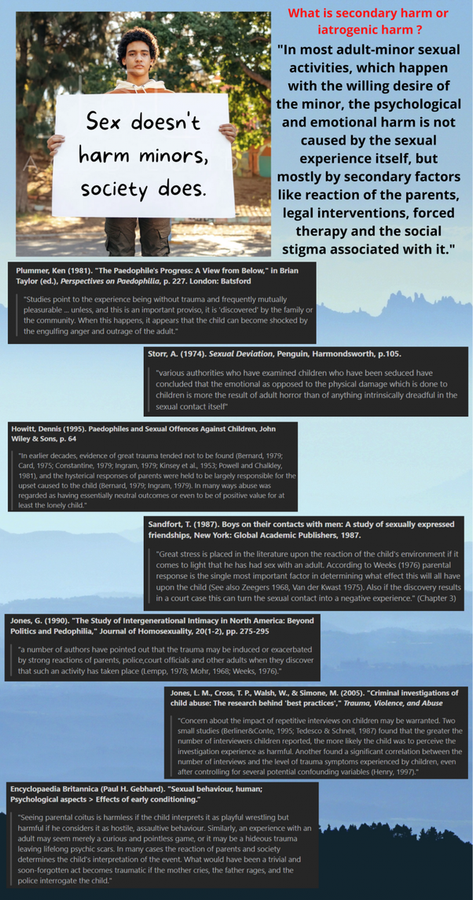
 
In other words, to a few brave souls out there, doing the right thing based on truth is much more important to them than doing the convenient thing based on strictly moralizing concerns that have no basis in scientific fact. If we had more such individuals living in any given time period, imagine how much faster social progress and justice for everyone in society would have occurred.
 
Going back to the subject of journalist David Aaronovitch's 2010 book on conspiracy theories that was mentioned in the opening paragraph of this essay, a book dedicated to the idea that learning the truth about any given subject is extremely important, Aaronovitch made the following statement in response to interviewer Thomas Rogers' query as to why it matters if people believe in things that are categorically untrue and whether or not people aren't entitled to believe whatever they want to believe:


"I do think it actually matters what is true. The search for the truth is an important search, and if it isn't, we're lost in all kinds of ways. We're lost in the fields of Holocaust denial. We're lost in being able to compare what is good and what is bad because we can't agree what actually happened. We're lost when it comes to guarding minorities against populist agitation [emphasis mine]. Nobody's going to die from saying Shakespeare wasn't Shakespeare, but in other areas, when the truth suffers, our decision making suffers. When there is no authority to the truth, prejudices thrive [emphasis mine]."
 
Though Aaronovitch certainly didn't make the above quote with either the MAA or the youth community in mind, it's nevertheless very applicable to the latter two groups as much as to anyone else, and should serve as one of the most inspirational quotes made in this decade. Aaronovitch's sage quote should also serve as a strong reminder to everyone who reads it that seeking the truth is extremely important to the world. Those who are courageous enough to seek the truth in opposition to some of the most deeply ingrained and even outright sacrosanct falsehoods in society should receive a huge amount of gratitude from everyone on this planet (particularly anyone who has ever been oppressed or harmed by false beliefs), because without these individuals social progress for the betterment of the entire world could never occur.
 
Addendum


The following bonus section of this essay features brief responses to the sub-list of social myths regarding young people and intergenerational attraction which I mentioned above by my fellow MAA activist Quoth.
 
1) Children never lie when they say they have been sexually abused.
 
Bullies in the legal system certainly do try to force kids to say what they want to hear, and will also try to twist whatever they do say to fit their agenda. A friend of my family's was in this position a few years ago, after drawing the ire of the local child "welfare" agency due to her "interference" with a teen girl. What she was actually doing was trying to help a teen girl, who was facing emotional abuse by her father, but the father had some influence and complained about it. Next thing she knew, social workers were trying to fabricate proof that she was abusing her foster kids, and they tried to bully the kids into saying that. Fortunately, their bullying tactics were unsuccessful (and unfortunately nothing was ever done about the girl's emotionally abusive father, as far as I know), but this is a typical example of how legal authorities can and do try to fabricate cases of child abuse for political reasons. Do a search for "child protective services make false allegations" on Google or Yahoo and you'll find plenty of stories like this.
 
2) Every adult who commits genuine acts of sexual abuse against kids have and are primarily motivated by a sexual attraction to them.
 
Of course, abuse of any form is about exerting power over someone else. It really shouldn't be a surprise that those who commit abusive acts are often in a position of power over their victim. On the other hand, attraction has nothing whatsoever to do with exerting power over someone else, and implies quite generally that someone views the person they are attracted to as an equal.
 
3) Youths have no real sexual desire.
 
I've always wondered how those that make this claim can do so with a straight face. Do they not remember anything at all before the Magic Age? And is their doublethink really good enough that they can deny that their own sons and daughters have sexual desires, especially when their spying software logs the kids searching for sex and porn, and notes that they are top ten search terms?
 
4) Kids were being sexually abused in truly horrific and often preposterous ways in the U.S.--and possibly across the world--by groups of mysterious and diabolical cultists who worshipped Satan and were abusing these kids in "honor" of the ultimate Lord of Evil.
 
Mass insanity at its finest.
 
5) Innumerable people who were sexually abused in their childhood were so traumatized by the alleged abuse that they repressed the memory deep into their subconscious, which could subsequently be retrieved at any point in their adulthood by deep hypnosis.
 
This idea was always so laughable that it should have been rejected by serious psychologists without consideration. I think "repressed memory syndrome" is just another symptom of a larger problem within the study of psychology, in that any "theory" is automatically true until proven false. It should be the other way around.
 
6) All cases of what is legally considered child pornography are always produced by adults and never by the minors themselves.
 
Kids were taking sexual pictures of themselves long before cell phones were invented. The sexting cases are simply the modern way of doing this.
 
7) The brains of adolescents are inherently faulty due to innate biological factors and thus they have an inherent tendency to make poor decisions that necessitate denying them most of their civil rights and keeping them under the control of their parents and other adults for their own good.
 
The proponents of this claim always like to use cases where teens "act out" to justify it. Of course, they never mention that this is almost universally in response to the unjust, broad denial of their civil liberties. And they never even attempt to justify their claim that a person can go from being incapable of making any decisions to being a fully capable human being in a single day.
 
8) Mutually consensual sexual contact between anyone today considered to be 'minors' and those who are adults is always traumatizing for the younger person and will likely cause lifelong psychological 'damage' to them, no matter how much the minor in question may have enjoyed and desired the experience.
 
The thing that people desperately need to realize is that the only valid definition of "wrong" is that which brings harm to someone.
 
Mutually consensual sexual contact itself cannot be traumatizing for the very simple fact that it is consensual. Trauma from the contact can only occur where there is some kind of force or manipulation used, but if it does, the contact is no longer consensual in any way.
 
The treatment that 'minors' get if they happened to be involved in a consensual relationship that is discovered is what is traumatizing. Moreover, hearing over and over again that any sexual contact between adult and child/teen is inherently harmful will have a severely negative impact on those who had some consensual contact that went undiscovered. And for the victims of genuine abuse, the way that they are treated by the legal system only traumatizes them further, in some instances far more than the actual abuse itself ever did.
 
I'd love to see someone who supports this ignorant claim struggle (and inevitably fail) to refute this: "The idea that sexual activity is the one thing in the world that underagers will engage in if they don't want to with adults, let alone those particular adults who do not live with them or have any particular degree of strict power over them, is quite baffling and entirely devoid of common sense, to say the least."
 
a) Children have an inherent lack of ability to consent to sexual contact with adults because they do not understand what sex is.
 
Knowing if something is pleasurable is not a difficult concept, at all. And moreover, it is awfully hard to say with a straight face that kids don't understand what sex is when they are frequently searching for sex and porn online, as noted by the Symantec study of kids' surfing habits.
 
b) They are "pre-sexual" (yes, one of the commenters actually uses the latter term).
 
A convenient term to begrudgingly acknowledge that kids, in fact, do have a sexual nature, while keeping it fully separated in their minds from "real" sexuality.
 
c) Even if children can receive pleasure from mutually consensual sexual contact with adults and are not magickally traumatized by it, it's still always a form of abuse on the part of the adult because children cannot understand the full ramifications or consequences of engaging in such activity.
 
How could something mutually consensual ever be considered abusive? Moreover, learning about the possible risks of sexual activity is not difficult, and those risks can also be largely negated by some simple precautions.
 
d) Intergenerational sexual contact is always a form of abuse by the adult because of the inherent power differential between adults and children (a situation that could include teens under the age of 18 also).
 
A power differential which exists solely because divisions based on age exist.
 
e) Sexual activity that occurs between adults and minors is always initiated by the adult because kids "don't do that stuff."
 
Wishful thinking doesn't make it so.
 
f) Pedophilia is a mental disorder.
 
A "mental disorder" which does not meet the DSM's definition of what constitutes a mental disorder.
 
g) The word "trauma" can have many different meanings or conceptions, and Susan Clancy only uses one of them in her book. Hence, her research and the main premise of her book is faulty.
 
Only if "trauma" is taken to mean something completely different than what any reasonable definition of the word would say. And in any event, playing a game of semantics with a word does not undermine what someone claims if one looks at what the person is actually trying to convey.
 
Sources
 
1. URL for David Aaronovitch's interview on Salon.com about his new book on famous conspiracy theories from the early 20th century to the first decade of the 21st century:


archive/alternative link in case the site goes down:


archive 2:
www.justpaste.it/akq0k
 
2. URL for the Wikipedia entry on the McMartin pre-school incident:


www.en.wikipedia.org/wiki/McMartin_preschool_trial
 
3. URL for the Wikipedia entry on the general day care sex abuse hysteria that once plagued America:


www.en.wikipedia.org/wiki/Day_care_sex_abuse_hysteria
 
4. URL for the section of the AttractedToChildren.org site describing some important facts about pedophilia:
archive 1(in case site goes down):


archive 2:


www.justpaste.it/ci3v0
 
5. URL to the article on Stuff.co.nz about the Symantec data collection project that proves pre-pubescents and underage adolescents routinely search for porn and sex sites online:


archive 1:


archive 2:


archive 3:


www.archive.ph/wip/VV1UU
 
6. URL to the Wikipedia entry on the book Michelle Remembers, the 1980 tome that was largely responsible for starting both the satanic ritual abuse hysteria and the "repressed memory syndrome" fiasco:


www.en.wikipedia.org/wiki/Michelle_Remembers
 
7. URL to the article about the book Satan's Silence, a tome which effectively debunked the satanic ritual abuse hysteria:


archive:


www.archive.ph/ogc5m
 
8. URL to page containing various important articles on the satanic ritual abuse hysteria:


archive:


www.justpaste.it/94p5o
 
9. URL for article about the book The Myth of Repressed Memory, a tome which effectively disproved the once popular but almost entirely fallacious "repressed memory syndrome" phenomenon:


archive:


www.web.archive.org/web/20190225013855/http://primal-page.com/myth.htm
 
10. URL to another very excellent article on the book The Myth of Repressed Memory:


archive:


www.web.archive.org/web/20170811073918/http://www.ishk.com/myth_of_repressed_memory.pdf
 
11. URL to a book review of The Courage To Heal:


archive:


www.web.archive.org/web/20220314055823/www.ipt-forensics.com/journal/volume4/j4_4_br1.htm
 
12. URL to a page containing links to many other articles on "repressed memory syndrome":


www.web.archive.org/web/20120331002330/http://www.smwane.dk/content/section/6/31
 
13. URL to a CBS News article describing the sexting phenomenon:


archive:


www.archive.ph/nVxP
 
14. URL to an article on the Sodahead.com website describing the reality of underage girls uploading nude pics of themselves on socnet sites:


archive 1:


archive 2:


https://archive.ph/hGKf8
 
15. URL to a biography of psychologist G. Stanley Hall, the creator of the modern day concept of "adolescence":


archive:


www.web.archive.org/web/20111105202840/www.education.stateuniversity.com/pages/2026/Hall-G-Stanley-1844-1924.html
 
16. URL to Dr. Robert Epstein's website:


archive/backup:


www.archive.ph/jMJaA
 
17. URL to the section of the Scientific American Mind website where you used to be able purchase (for $7.95) a digital copy of the issue containing the article, "The Myth of the Teen Brain":


New url here with a free digital copy:


https://drrobertepstein.com/pdf/Epstein-THE_MYTH_OF_THE_TEEN_BRAIN-Scientific_American_Mind-4-07.pdf
archive/backup: 


www.web.archive.org/web/20230521151641/https://drrobertepstein.com/pdf/Epstein-THE_MYTH_OF_THE_TEEN_BRAIN-Scientific_American_Mind-4-07.pdf
 
18. URL for a page containing links to a preview for the book TEEN 2.0: Freeing Our Children and Families From the Torment of Adolescence and the Young Person's Bill of Rights that was created by RE:


archive/backup link in case the site goes down:


www.web.archive.org/web/20230605182634/http://teen20.com
 
19. URL to the article "Let's Abolish High School":


archive 1:


archive 2:


www.justpaste.it/5gx1e
 
20. URL to the archived article from ASFAR's official zine Youth Truth explaining why the NCfMAEC is no friend of the youth liberation movement:


www.youthrights.net/yt/v2n6.pdf
 
21. URL for Anarchopedia entry on the Rind Report:


alternative links:


www.toptal.com/developers/paste-gd/Cxj7A8w5
 
22. URL for Google page containing info on the book Going All The Way, a seminal study of teen girls' sexual lives:


www.books.google.com/books?id=xfObOu5n99sC&printsec=frontcover&dq=Going+All+The+Way+by+Sharon+Thompson&source=bl&ots=CW3SetgFrl&sig=DXrM7T9vnmo_pi2vi-WDVvycL1g&hl=en&ei=tvttS8WnIZCRjAfG06D0BQ&sa=X&oi=book_result&ct=result&resnum=1&ved=0CAgQ6AEwAA#v=onepage&q=&f=false
 
23. URL for a New York Times review of the book Going All The Way:


alternative links:


www.web.archive.org/web/20220428114303/http://www.nytimes.com/1995/08/27/books/sex-and-the-teen-age-girl.html?pagewanted=1
www.archive.ph/OOIua
 
24. URL for the Safehaven Foundation Press:


https://web.archive.org/web/20170423063650/http://www.shfri.net/shfp/shfp.cgi
 
25. URL for a detailed article that counters the common claims of the Rind Report's detractors:


alternative links :


www.toptal.com/developers/paste-gd/uouzXu0T
 
26. URL for Debbie Nathan's CounterPunch article about the life of Justin Berry and Kurt Eichenwald's misrepresentation of it:


alternative:


27. URL for John Farmer's good article on Telecom-Digest Online about the Justin Berry story and Kurt Eichenwald's highly selective interpretation of it:


or


www.archive.ph/V6Chw
 
28. URL to a book description of The Trauma Myth, an important work of research that refutes the commonly held belief that sexual contact between underagers and adults is always highly traumatic for the younger person:


As of 2023 the link is down. Here is a new one:


www.psychotherapynetworker.org/article/trauma-myth
 
29. URL for metafilter blog featuring numerous comments by people (both those making a commendable effort to be open-minded and those who are extremely and blissfully ignorant about this topic) discussing The Trauma Myth and the implications of the research contained within:


alternative:


www.web.archive.org/web/20190923224313/http://www.metafilter.com/88964/The-Trauma-Myth-by-Susan-Clancy
 
30. URL for B4U-ACT, a Maryland based org that is the historical first ever offline support group for MAAs:


alternative:


www.web.archive.org/web/20230529061301/https://www.b4uact.org
_______________________________
All links in clickable format here. (Most of the articles and text have also been pasted, so it is not necessary to go to the links):


https://sites.google.com/view/atimeofuniversaldeceit
 
Alternative links:


www.justpaste.it/a5u4q
www.archive.ph/MfC8x
www.TIOTtext.blogspot.com
www.tiottext.wordpress.com
www.web.archive.org/web/20231016170357/www.justpaste.it/a5u4q
www.web.archive.org/web/20231016222205/https://sites.google.com/view/atimeofuniversaldeceit
 
Clickable links without the pasted articles and text:


www.archive.ph/lFzJQ
 
Alternative links:


www.writeurl.com/ErML0UgfPeG6N9Xk
www.sharetext.me/y7clp1fgkb
www.tiotlinks.blogspot.com
www.linkslist.app/PL1JMWe
 
I recommend anyone interested in learning more about all of this to read the books listed, in particular The Trauma Myth. 


I mean no harm by spreading this message; I’m just a good Samaritan speaking the truth during a time of universal deceit.


Most of these sites have been archived(permanentely saved). If any links are down, go to www.archive.org or www.archive.is, and search for the site. You may still be able to view a snapshot of it.


The Trauma Myth--My Analysis Of The Susan Clancy Interview
 
This essay concerns an article on the progressive news site Salon.com about the sex abuse industry, this time an interview: that columnist Thomas Rogers conducts with controversial author Susan Clancy regarding her extraordinary 2009 book, The Trauma Myth:


This book is perhaps as important to the cause of the pro-choice segment of the Minor Attracted Adult [MAA] community's movement, as well as the youth liberation movement, as any other book before it, because it dispels one of society's most fervent myths about adult interaction with youths--that such interactions are always traumatic for the young person, and will transform all such youth participants into emotionally "damaged goods" for the rest of their lives.
 
However, be advised that Clancy is no friend of the MAA community (very few would admit to be today), nor is she open-minded regarding youth sexuality, as are other controversial authors such as Judith Levine and Robert Epstein. She is actually quite adamant that youth/adult sexual interactions are always and intrinsically wrong and therefore should always be considered a crime, and I will respond to her statements along those lines in this analysis. However, just as Clancy made a major challenge to the once fashionable myth of "repressed memories" in a previous book, she now challenges the myth of mandatory/intrinsic trauma for "abuse" victims, and this nevertheless opens the door to a future where young people are allowed to enjoy sexual interactions with whomever they choose to be with.
 
Let's start by looking at some excerpts from the article and break them down:
 
"In a 2003 New York Times magazine profile about her, well-known trauma therapist Daniel Brown lashed out at Clancy's 'political agenda,' and Clancy's hate mail has included accusations of cheering on adults who engage in sexual contact with youths and even engaging in sexual contact with them herself."
 
Whenever someone challenges the established orthodoxy of the sex abuse industry that allows for lucrative careers for people like Daniel Brown--even though their careers are based on treating nothing but a myth, and therefore perpetuating it--you must be a defender of "abuse" in their eyes. Despite Clancy's hysterical attitudes and even a degree of anti-male sentiment (yes, she is that type of "feminist") towards the subject, she is nevertheless a seeker of truth who may one day change her tune on other aspects of this SA industry in the future, and her willingness to challenge the industry even to this limited but important extent deserves commending.
 
Clancy: "The title [The Trauma Myth] refers to the fact that although sexual acts by adults with minors are usually portrayed by professionals and the media as a traumatic experience for them when it happens — meaning frightening, overwhelming, painful — it rarely is. Most of them do not understand they are being victimized, because they are too young to understand sex, the perpetrators are almost always people they know and trust, and violence or penetration rarely occurs. 'Confusion' is the most frequently reported word when victims are asked to describe what the experience was like. Confusion is a far cry from trauma."
 
It's thoughtful of Clancy to point this out, but what she sails over, of course, is exactly why a youth is "victimized" if they are not traumatized by the incident. Is it possible that the "confusion" may be the result of the fact that they enjoyed a mutually consensual experience while always hearing from others that such interaction constitutes "abuse"? One can indeed argue that sexual interaction with older family members can be considered abuse, since young people are in no position to say 'no' to such authority figures (but this may be a complex issue in and of itself that is not entirely black and white, and I will perhaps tackle it in a future essay). What I am talking about here is non-familial adults who do not live in the home, and therefore do not have such direct and extreme authority over the young people whom they may have mutually consensual interactions with.
 
Clancy: "You get all these people who are keeping it a secret because they're ashamed — because what happened to them is not what is portrayed in the media or psychological and medical circles."
 
Hmmmm...is this perhaps more indication that people are ashamed of mutually consensual experiences in their youth because this is how the various institutions of society tell them they should feel? And are they actually made to feel guilty because they were not traumatized by the experience? Once again, I am not talking about definitively non-consensual and unwanted sexual experiences with older people that occur within the home; I am talking about those that occur with adults whom they trust, and who do not have direct authority over them--and especially those whom the younger person may even initiate such contact with (though I strongly recommend that both minors and adults avoid breaking these laws due to the possible consequences for both people if they are "found out"...I am fully law-abiding myself and I would never advocate breaking the law).


450206c27e2d1621e56a5658da8ac214.png
 
Clancy: "For 30 years we've been working on preventing sexual abuse. But we've skirted around what sexual abuse really is. The kids don't know what's going on, and they often enjoy it. They're not going to resist [emphasis mine]."
 
Of course, the fact that someone enjoys something and receives pleasure from it, and the fact that they don't resist as a result, isn't cause for Clancy (or too many other people, for that matter) to question whether we should continue to categorize something as "abuse." Instead, it's assumed that the youth in question "doesn't know what's going on," because if they did, according to the logic being presented here, they would resist. This is a case of stereotyping younger people as much as it is their "abusers."
 
Clancy: "In the 1950s and 1960s, psychiatrists were very open and honest about sexual abuse, but there was also that tendency to think it was the child's fault. Feminists were naturally infuriated, because it's not the children's fault! But the way they got attention to it was to portray the sexual abuse in a way that would shock people. They did that by comparing it to a rape. Before that, the reaction from the medical and psych communities was, 'This is not something we really care about.' It wasn't until feminists and child-protection advocates misportrayed it that we were able to arouse massive medical and scientific attention to the topic."
 
No one from the MAA community has ever suggested that intergenerational sexual interactions are "the child's fault." What Clancy and the establishment cannot conceive of is the concept that it's actually possible for the youth to initiate such contact, or that it's actually possible for a younger person to desire an older person, because the prevailing "wisdom" on this subject is that minors (even those as old as 16) do not understand their sexual desires and therefore have no conception of sexual pleasure unless such contact is foisted upon them. Further, it's an established belief on this topic that blame has to be assigned to either party when two people of disparate age groups act on a mutual desire, and the blame is always on the older person since adults are always expected to "know better." Once again, this is a case of stereotyping in both directions. Also, Clancy seems to suggest that the attempt by certain elements of society (which she identifies as "feminists" and "child-protection advocates") to bring attention to the problem of adult-minor sex by “misportraying” it in a way that would "shock" the public was ultimately a good thing, a case of the ends justifying the means, despite this attitude being responsible for creating a huge mess that Clancy is working to clear up.
 
Clancy: "Ninety-five percent of victims never seek treatment because of what they falsely assume and fear about sexual abuse. Many of them do not even think they were abused [emphasis mine]. This is a huge problem."
 
Could it be that such cases are a "huge problem" because society cannot accept the idea of young people finding pleasure in sexual interactions with others, particularly older people? Now don't get me wrong...if force or coercion was used, I would expect the event to be an extremely negative one for the youth in question, and such youths would indeed be victims in a true and accurate sense of the word. And, of course, adults who are responsible for such coercion should be considered to be guilty of a crime and treated accordingly by the law. I am not saying that youths cannot be victims, because they most certainly can; anyone of any age can. I doubt a young person, or someone of any age, would experience pleasure and "feel good about" a forcible rape or a sexual interaction they capitulated to as a result of blackmail. But how the young person felt about the interaction, and the important question of whether or not it's always the adult who initiates such interactions, are important things to consider that Clancy completely shunts aside because she cannot conceive of the validity or possibility of either. And it's very telling that Clancy never goes so far as to question the fact that the bulk of real sexual abuse goes on within the home, often by parents, stepparents, grandparents, etc., even though this "open secret" and shameful condemnation of the hierarchal nature of the prevailing family unit is readily available via FBI statistics. She never seems to consider that the legal and civil empowerment of youths--and society taking their potential, intelligence, and desires seriously--may be a good antidote to the problem. But since Clancy doesn't consider young people and their desires any more worthy of consideration than the establishment she opposes on various issues, she never reaches these conclusions (at least, not at this point in her career; I am giving her a chance).
 
Clancy: "You have people who call me and say, 'My uncle attempted sexual penetration when I was a child, but I'm not sure if I qualify as a SA victim.' I say, 'How in God's name do you not think you're a SA victim?' It's because in most cases of SA, it was not traumatic when it happened [emphasis mine]."
 
As everyone in the MAA community who knows me is aware of, I am not a fan of adults engaging in full sexual penetration of pre-pubescents, even if the young person requests it, because I do not think it's a responsible thing to do for reasons of physical safety (but I am not against the mutually consensual practice of outercourse, i.e., mere "sex play," between adults and willing pre-pubescents who may initiate the contact with both peers and adults whom they like and trust). I do not believe that pre-pubescents are miniature adults, and I do believe that the type of sexual interaction they desire with others (peers or otherwise) are quite different in many ways from those that adolescents and adults desire to engage in, and this needs to be considered. Also, I am not someone who encourages or supports incest for a variety of reasons (which I will get into in a future essay; however, for the record, I do not believe that mutually consensual incestuous activities should result in prison for any of the participants). Nevertheless, I need to point out that Clancy doesn't distinguish the age of the person she is discussing when they say they were penetrated as a "child," and some of her other statements make it clear she is one of those willfully blind people who considers adolescents under 18 to be "children" simply because they share a legal status with pre-pubescents; hence, her conception of adolescents appears to be no different than her conception of pre-pubescents.
 
Also, Clancy makes it clear once again with her above statement that she considers all sexual interactions between adults and youths under 18 to be "abuse" regardless of the fact that the younger person wasn't traumatized or emotionally "damaged" by it in any sense. She will justify this by uttering the popular attitude, "They can't consent." This is a cultural belief and a stereotypical attitude towards younger people that grew out of the Victorian era mindset that children are essentially asexual beings who are "tainted" by sexual experiences, and that only adults would initiate sexual activity with them, but never the other way around. And in case someone accuses me of "blaming the victim," I am not assigning any blame at all on either participant, regardless of who initiated it, as long as the sexual encounter was willing and pleasurable to both people who participated in it. It takes two people to tango, not just one. If someone can concede that sexual activity between people of disparate age groups where no force or coercion was involved is not only non-traumatic, but even pleasurable to the younger person as well as the older person, why is it still considered "abuse"? Is it an abuse of a person or in actuality an abuse of a cherished societal paradigm? Why can’t the many detractors of the phenomenon simply call a spade a spade and be honest about this?
 
Rogers then makes the following observation: "It's a very fine line between what you're saying and saying that they aren't hurt by SA."
 
Eager not to allow him to go further in that direction, Clancy forcefully responds with: "I will never say that. I could not be more clear. This is an atrocious, disgusting crime. People have a tendency to assume I'm saying it's not a big deal or it's the minor's fault."
 
Okay, let me try to understand Clancy's logic here. She concedes based on objective study of her own (regardless of how uncomfy the conclusions of such studies make so many people) that "most" youths (meaning, perhaps, those who weren't forced or coerced into sexual interactions with adults?) who have non-coerced sexual interactions with adults are not traumatized by it, and often actually report deriving pleasure from it, but it still hurts them nevertheless because, as conventional wisdom tells us, they are incapable of understanding sexuality. Hence, according to this logic, even if they aren't harmed by mutually desired contact of this nature, we must always cry foul when it happens.
 
As for Clancy's concern that taking a morally neutral stance on non-forced and non-coerced sexual interactions between youths and adults will result in her being accused of "blaming the youth," I again respond to such a ridiculous and loaded assertion by asking: why must blame be assigned to anyone in a situation where both participants found it pleasurable, and where both were fully willing?
 
Clancy continues: "Most people don't want to think too hard or thoroughly about these things."
 
Good observation, Susan. Now why don't you ponder that statement further and take your own advice?
 
Rogers then further cautions Clancy: "One could argue that your claims could encourage abusers — or convince them that what they're doing isn't wrong. How do you respond to that?"
 
Clancy replies: " Forcefully! As I hope to have made clear in the book, SA is never OK. No matter what the circumstances are, or how it impacts the victims, SA is an atrocious, despicable crime. Just because it rarely physically or psychologically damages the child does not mean it is OK."
 
So in other words, according to Clancy (and our esteemed conventional wisdom that she iconoclastically opposes, albeit only to a certain extent), despite the fact that sexual interactions between adults and minors under 18 are rarely physically or psychologically damaging to youths (with those "rare" occasions perhaps being the occasions when force or coercion of some sort is used), no matter what the circumstances are (e.g., even if the youth initiates it themselves), or how it may impact the "victim" (e.g., even if the youth finds it entirely positive, pleasurable, and conducive to the enhancement of their life experience) it's always "atrocious" and "despicable," it should always be considered a crime, and it always constitutes "abuse." Is Clancy, and those who make similar declarations, in any way conscious of how much they sound like they are engaging in nothing more than petty moralizing here? And not to mention how they sound as if they are condemning something that she admits causes no discernable or demonstrable damage to those who participate in it willingly simply because it offends their personal sensibilities and the cultural conception of younger people that they have been indoctrinated with all of their lives? However, since Clancy is still a highly courageous woman, I am not going to go so far as to say she is taking this stance simply because she hopes that by doing so it will lessen the condemnation she is receiving from society for making the observations that she has in her book.
 
Clancy further ruminates: "Harmfulness is not the same thing as wrongfulness."
 
So, just because something doesn't cause any harm and may even be positive and pleasurable to experience that doesn't mean that it isn't wrong in some intrinsic sense. Hasn't the same things been said in the past about women enjoying sex, homosexual sex, masturbation, recreational sex in general, and the "doggie style" sexual position? I am hoping that Clancy does more thinking in the future since she has shown that she is indeed capable of it.
 
Clancy then goes for the gold: "And why is it wrong? Because children are incapable of consent."
 
Leaving aside the too commonly accepted stereotype Clancy uttered above to justify her moralizing about this topic (there is no proof that they are cognitively incapable of consent, especially not if they receive objective and comprehensive sex education early in their lives), does the fact that young people are capable of experiencing pleasure and reporting positive experiences with mutually consensual sexual interactions with adults mean absolutely nothing? Does that not make it clear that they are fully capable of understanding sexual activity? The Rind Report made it clear in the past that even pre-pubescents are capable of something that Dr. Rind et al. referred to as simple consent, and that those who experienced interactions of this sort with both peers and adults felt, upon becoming adults, that they were capable of consenting to activity that clearly felt pleasurable to them. Once again, I am not condoning aggressive incestuous advances by family members or other adults who have such a heavy degree of authority over youths in question; I am talking about adults they trust who they may share an interest in interacting with in such a way, and who do not have such a high and direct degree of power and authority over them.
 
Clancy then goes further still to distance herself from taking the next logical step in understanding the intricacies of sexual interactions between underagers and adults: "They do not understand the meaning or significance of sexual behavior. Adults know this, and thus they are taking advantage of innocent children — using their knowledge to manipulate them into providing sexual pleasure. Sick."
 
Can Clancy possibly be any less overt with her spewing of pure emotionalistic rhetoric rather than reasoned analysis of the subject? The term "sick" is often used to denote something that offends someone's sensibilities regardless of whether or not it's actually harmful in any demonstrative sense. Yet Clancy engages in it without a second thought when it comes to such a topic. According to Clancy, children (again, without even specifying her exact definition of the word) are "incapable of understanding the meaning or significance of sexual behavior." What is the meaning and significance of sexual behavior? Progressives seem to agree that sexual behavior is often done for the mutual giving and receiving of pleasure; because it's fun to engage in; and because it can further a strong emotional bond and affection between two people or perhaps work to establish one that didn't already exist. Is its significance not the fact that when done with mutual respect between two people who seek to exchange pleasure with each other it can be a positive experience on one's self-esteem and personal growth? Is sexual activity not an important learning experience in life? With those observations in mind, and with Clancy's concession that sexual activity is often reported to be positive and pleasurable by young people under 18 who have engaged in it in a mutually consensual manner either with peers or with adults, is this not a strong indication that young people are every bit as capable of "getting" and understanding the meaning and significance of sexual behavior as well as anyone who is X number of years older?
 
Of course, according to Clancy, children are always "innocent" (she actually used the word in her above statement), which by our societal definition means inherently asexual. Therefore, their conceptual image and what they represent to society is "tainted" if they experience something as "dirty" and "impure" as sexual behavior. And Clancy never seems to recognize the cultural significance of such attitudes, nor does she, as a self-professed feminist, even seem to realize that such an attitude was once applied to women to deny the validity of their sexual nature and desires.
 
But adults, according to Clancy, always know the meaning and significance of sexual behavior which, as I mentioned up above, is about the mutual exchange of pleasure and emotional bonding between two human beings. Thus, they are always being "manipulative" when they engage in a mutually pleasurable activity with younger people (perhaps because they "taint" the spiritually pure cultural image of these young people), because adults who either respond to young people's advances (something Clancy seems to deny the possibility of), or initiates the advances themselves, are "manipulating young people into providing sexual pleasure," something that they should never be engaging in--because of the "damage" this does to their cultural image, even though it does no damage in a purely physical, demonstrable sense--and the assumption being that the adult only cares about their own sexual pleasure and couldn't possibly care about the youth they are interacting with in any possible way. The latter attitude constitutes nothing more than making a huge and totally unsubstantiated assumption based upon nothing more than a stereotype.
 
Also, I think in the future Clancy needs to talk to some gerontophiles [younger people with a preferential attraction to significantly older individuals who are not necessarily elderly] who have passed the Magic Age, as they will make it clear to her that some people under 18 are not only sexually aware--sometimes at a surprisingly early point in their lives--but have a sexual and emotional preference for significantly older people and often make the advances themselves. One thing the MAA community needs to do in the future is to gather together all of those gerontophiles we have met in the past to speak on behalf of both themselves (i.e., youth sexual rights and youth rights in general) and our community in the future. Clancy and other researchers need to hear their stories and acknowledge the reality of their existence, along with what it implies about the validity of the conception of youthful "innocence" that our society is so fond of preserving and perpetuating.
 
When Thomas asks Clancy why she is so opposed to the "repressed memory" concept, she responds: "Because it doesn't exist. There is not one single research study showing that people exposed to horrifying, overwhelming, painful events 'repress them' and recover them later on. Rather, people exposed to horrifying events report that they often remember them all too well [emphasis mine]. Ask any child exposed to the recent earthquake in Haiti if they 'repressed it.' None will. True trauma will always be remembered. Richard J. McNally's Remembering Trauma is a comprehensive critique of repression. Repression is a psychiatric myth [emphasis mine]."
 
In this good statement, Clancy helps rebuke one of the most glaring examples of junk science and (as she calls it) "psychiatric mythology" used to justify and perpetuate the SA hysteria of the past 30 years, one which began with the publication of the utterly debunked but socially influential and destructive book Michelle Remembers (which also started the equally infamous and socially destructive "satanic ritual abuse" hysteria, now likewise debunked). She has now moved on to tackle and debunk another myth perpetuated by the sexual abuse hysteria: the belief and assumption that young people under 18 are always traumatized by sexual interactions with adults (in particular, at least).
 
However, despite her doing something that takes a good degree of courage and open-minded critical thinking, which is commendable, Clancy (at least at this point in her career) refuses to take this critical thinking to the next level so as to repudiate the SA hysteria itself, even as she has denounced two of its most sacred though terribly incorrect tenets. The next logical leap, of course, would be to actually do what she is already accused of doing by her detractors: to consider that if it's not true that minors are traumatized by sexual interactions with adults as long as such interaction is not the result of force or coercion of some sort, then maybe their ability to experience pleasure from it is an indication that they do indeed have a sexual aspect to their nature that is every bit as legitimate for them to explore and experience as that of adults--and that it can potentially have the same benefits for them as it does for adults. Perhaps society's prevailing image of kids is wrong; perhaps they aren't inherently "innocent." Perhaps they can sometimes initiate sexual contact with adults and it's not always adults who foist their advances on them. And perhaps adults who have a sexual attraction to them may have more than a selfish desire for their own personal sexual satisfaction, and they may have at least as great an interest in the pleasure and emotional comfort of the younger person as they do their own. Maybe it's possible for an adult to actually love a youth in a true romantic sense, and vice versa. Maybe "manipulation" can work both ways in some isolated cases, not just on a one-sided adult-to-youth manner. And maybe, just maybe, kids have the potential to make their own decisions in other matters not related to sexuality (thus resulting in a comprehensive pro-youth stance by Clancy and feminists like her in the future). If such is the case, should we perhaps stop defining the term "abuse" so broadly, and in such an absolutist fashion? And maybe, just maybe, should we consider that perhaps other factors in society, such as poverty, warfare, and (just perhaps) the oppressive third class citizen status of kids are far, far more harmful to them than mutually desired sexual experiences between these youngsters and anyone they may choose to share such intimacy with?
 
In fact, Judith Levine (further to her credit and pro-youth credentials) devotes a whole chapter in her book Harmful To Minors to poverty and how it negatively affects minors in many more ways than the expression of their sexuality ever could, even going so far as to make the bold declaration that poverty doesn't simply cause abuse, but poverty is a form of abuse. And, of course, Levine challenged the validity of the "pedophile panic" in another chapter of her aforementioned book. Can it be, as Levine suggests, that the priorities of the "child advocates" are totally mixed up and single-mindedly focused on things that aren't the worst problems that our young have to face in modern society? And if so, wouldn’t our society and its child protective industry be guilty of placing priority on issues of moralism as opposed to material issues with an actual tangible effect on the lives of minors?
 
But Clancy has yet to take these steps and currently seems to define her conception of "child safety" and "child advocacy" almost solely on the basis of protecting minors not simply from SA (which is an admirable goal that those in the MAA community fully support), but from protecting them from their own sexual desires. That is a case of suppression masquerading as "protection."
 
Continuing on this subject, Clancy then makes this telling observation: "The idea of repression ultimately hurts victims. It reinforces the notion that SA is and should be a traumatic experience when it happens — something done against the will of the victims. Since for most victims this is not the case, they end up feeling 'alone,' 'isolated' and 'ashamed.'"
 
Once again, though Clancy concedes that sexual activity between older and younger people (which she always labels "abuse") is not normally traumatic and not even against the will of the younger people it is nevertheless always wrong and harmful. The question I raised before remains: is such mutually consensual activity harmful to them, or harmful to society's conception of them, and therefore to perhaps the continued justification for the civil oppression of people under 18?
 
And is it possible that the reason so many of them feel "ashamed" when they think back to their sexual interaction with adults is because of the attitudes society has against younger people's expression of their sexuality--i.e., that sexual behavior is a "dirty" thing to engage in--and not because sexual activity has an inherently "shaming" affect on younger people?
 
When Rogers asks Clancy about how she was treated back at Harvard when she first proposed her controversial work on the myths of the sex abuse industry, she said: "It's bad enough I moved to Nicaragua. When I was at Harvard — the peak of my career, at the university you want to be, surrounded by all the people who were the titans in the field — there was just so much bullshit going on. People focused on a type of abuse that affects maybe 2 percent of the population, millions of dollars for funding that doesn't apply to most victims, best selling books written by therapists misportraying SA. I would try to tell the truth. I would be attacked. Grad students wouldn't talk to me.
 
"Professors would tell me to leave for other fields. I just felt disillusioned. I got this opportunity from the World Bank to do cross-cultural research on how SA is understood in Latin America. I came down to Central America, and I've stayed."
 
So, Clancy had to move to another nation on another continent to escape the chastisement of her peers in the academic and intellectual field for daring to make even a moderately controversial challenge to the accepted orthodoxy of our culture even though she remains firmly entrenched in society's overall belief system and cultural conception of younger people as inherently "innocent," asexual, and incompetent. Isn't that interesting considering how many people in the MAA community have either done the same thing (i.e., self-imposed exile from their native land) or strongly contemplated doing the same thing for the exact same reasons as Clancy did? I guess maybe in the future Clancy will be able to understand exactly how people from this community feel for having desires and/or views that challenge society's most sacrosanct beliefs. And it should be noted that Clancy is all too aware that some of the greatest intellectual minds in academia, who are present at Harvard, are less capable--or perhaps less willing--to make even a relatively modest challenge to the existing orthodoxy regarding youth sexuality and the intrinsic nature of those we today label 'minors' than many people who are not college educated but do so on the basis of their personal experiences (like the bulk of gerontophiles who have described positive and both physically and emotionally fulfilling sexual interactions with adults even prior to reaching the vaunted Magic Age).
 
I am sorry that Clancy felt forced into self-imposed exile from her native country in order to continue her work, but I think this should be all the more reason for her to consider questioning the Western cultural attitudes and assumptions even further than she has already to see what other firmly held beliefs and policies may be based entirely on social or psychiatric mythology. And it's probably a good thing that Clancy is now living in Latin America, because not only does that section of the world have a much more open-minded view on the nature of "abuse" than does the Western nations, but there is even an emerging tendency there to be more respectful of the sexual desires of younger people and of the damage that legally enforced repression of their sexual expression can cause, a state of affairs made clear when one Latin American nation--Peru--recently lowered its age of consent from 17 to 14.
 
When Clancy is asked to address how depictions of sexual abuse of youths in movies that are based on the type of psychiatric and cultural assumptions that she has worked to refute, she says:
 
"I think it does a disservice to victims. There were a number of movies in the last few years where people were so traumatized by SA that they needed hypnosis to bring back the memory. In 5 percent of cases it is awful, and medical attention is required. For 95 percent of victims, that's not what happens [emphasis mine]."
 
Can it be that the 5 percent of the cases (and probably a bit more) that Clancy mentions above which are "awful" may perhaps be cases where actual force was used, and actual beating of the youth occurred, and thus physical and emotional damage did indeed result? In such a case, no sane or compassionate person would argue that the youth was anything other than a true victim of genuine abuse. Of course, I am not saying that physical damage needs to occur in order for a case to be genuine abuse. Coercion can take other forms, such as blackmail or threats where the violence wasn't actually carried out due to the youth's unwilling compliance as a result of the threats. In such cases, the youth is also a genuine victim, and I have little doubt that a youth (or someone of any age) that experienced such a thing would feel extremely hurt and emotionally devastated as a result, but such cases are extremely rare outside the home. And as Clancy's research (which matches with FBI statistics) seems to indicate, the great majority of youths who experience sexual interactions with adults do so in a manner that is fully consensual and thus non-traumatizing without any type of psychological damage, save a possible degree of shame and guilt that is not an inherent result of the experience itself but rather is based on society's reaction to the interaction, or how society conditions the youth to perceive the experience (i.e., an entirely sociogenic effect). That latter condition can be remedied by a combination of sex positive education for minors at an early age and a strong challenge to the attitudes of a society which insists--against all available evidence--that sexual activity is always negative for people under 18 no matter how positive it generally is on many levels for people who were past the Magic Age.
 
Clancy gives an example of the above:
 
"Look at Mystic River. In that movie child SA involves a faceless priest. The child is destroyed for life. There's a sadistic aspect to it that has nothing to do with what happens to most kids."
 
Well said. Yet, Clancy will then turn around and argue that even if an intergenerational sexual interaction is totally bereft of any sadistic aspects and the youth is not "destroyed for life," it is still always wrong because a lack of "harmfulness" is not always commensurate with a lack of "wrongfulness."
 
When Thomas asks Clancy if she is aware of any movie or TV show which depicts a sexual interaction between an adult and a minor in an accurate way, she says:
 
"There's a moment on HBO's True Blood in the first season, where Sookie Stackhouse is talking to Bill, her vampire lover, about what happened between her and her uncle, and I thought that was a very good depiction. She said it didn't ruin her life, but it's sad that something like that has to color her feelings about sex and intimacy as an adult."
 
Um, if the sexual interaction wasn't traumatizing and didn't ruin her life, and if the interaction was mutually consensual, then how would it "color" her feelings about sex and intimacy as an adult? Is it even remotely conceivable that an experience looked upon as positive by a youth may enhance her ability to achieve successful intimacy with another person later in life? Clancy won't go there, of course.
 
In regards to the matter of accurate depiction of an attraction between an adult and a youth on TV, I would like to refer her to an incredibly daring storyline from the defunct but greatly missed TV series Once And Again, where high school student and regular character Grace Manning (played by Julia Whelan) fell in love with her drama and creative writing teacher August Dimitri (played by Eric Stoltz), and he ended up reciprocating the feelings. It should be noted that Grace pursued August, not the other way around. This was a rare acknowledgement in our popular culture that sometimes the younger person can be the initiator, not only the adult. It should be noted here that their physical intimacy never went beyond a single kiss--Grace moved in and kissed August (not the other way around)--and he neither moved away nor responded in kind despite his desire to do the latter. Fearful for the consequences that both would face if he allowed things to progress any further, he immediately suggested that they proceed to the play that both of them had plans to attend, with Grace incorrectly upset over feeling that the reason he didn’t return her affection was because she was unappealing.
 
The storyline came to an explosive head when Grace's stepmom Karen Sammler discovers a semi-romantic poem that August wrote for Grace and all hell broke loose after that. Grace is terribly upset that due to society's conventions she is unable to have a relationship with her teacher, someone she loves, respects, and trusts--and would therefore greatly enjoy sharing her first intimate sexual experience with--and when her mom sees how the ensuing investigation by the school board that Karen initiated against August due to a relationship that she pursued first is causing her daughter such emotional turmoil, she does something extremely selfless that is nearly unthinkable for a "concerned" parent in our current society: she considers her daughter's feelings for her teacher and what the investigation by the school board will likely result in for August, and she drops the charges and even allows her daughter to say goodbye to August as he packs up and leaves the school—and Grace’s life--for good. August tells Grace that the whole thing was his fault, not hers, but she declined agreeing with him, likely because it was something that she wanted as much as he did [does this perhaps suggest that there is absolutely no need to assign blame to either participant?].
 
This didn't mean that Grace's mom was as forgiving of him, however; as August was leaving he ran into Karen Sammler, and when he attempted to talk to her to explain his side of things to her, she simply closed her eyes and firmly said, "I don't want to hear it." Despite her continuing disdain for August, however, at least Karen Sammler ultimately respected the feelings of her stepdaughter and came to reluctantly accept the fact that, in words passionately spoken earlier by Grace, "I don't need to be protected from this person!"
 
That particular storyline of a great drama series that left the air after a mere three seasons was the only open-minded depiction of intergenerational love on a TV series to my knowledge where the adult was not condemned as an utterly deplorable human beings for his feelings, and where the feelings (if not the competence) of a girl under 18 was honored in the end (though I do recall an episode from the truly awesome first three seasons of the radical 1990s TV series Picket Fences where the age of consent laws were duly questioned, but it that case it was a situation involving a 16-year-old girl having consensual sex with an 18-year-old boy, so the American audience may have been somewhat more sympathetic for that situation than the one depicted in Once And Again). Maybe Clancy should have watched the episodes of this series containing that storyline, and think hard and critically about the themes presented therein.
 
Interestingly, at least in the past few years, reruns of the show were aired on the Lifetime channel, a station that is notorious for producing telefilms that are not just poor in quality, but which espouse strong anti-male and anti-youth rights themes, including propping up the main tropes of the SA industry whenever possible, and you would think Clancy would have an interest in whatever airs on that network for these reasons. The refuns of Once And Again must have stood out as a shining gem compared to the usual dreck seen on that channel when you consider the themes seen on many of its self-produced telefilms, especially that one particular storyline involving the romantic feelings between Grace Manning and August Dimitri; that must have stood out on the Lifetime channel like an X-rated film airing on the Disney Channel. But even if Clancy cannot watch the reruns on Lifetime anymore (either because the network isn't available on any Nicaraguan stations or because the series is no longer rerun on that channel) the entire series is now available on DVD. I would urge Clancy and other "feminists" of her particular stripe to purchase the series and watch it with an open mind and heart.
 
Clancy concludes her thoughts about the above fictional example of the accurate reminiscence of an intergenerational sexual experience on True Blood with this:
 
"It wasn't out of control. They didn't make it sensational."
 
Imagine that! But isn't the continuation of the current attitudes towards youths and adults interacting with each other sexually even with the acknowledgement that non-coercive experiences of that nature do not automatically traumatize and damage the youth for life, as well as society's attitude towards youth sexuality and any expression of it thereof (not to mention the broader issue of youth competence in general), going to prolong the existence of the hysteria for much longer than it has to even as we incrementally undercut all the popular myths associated with it? And won’t this prove that the main beliefs used to justify it in the first place are nothing more than myths? Shouldn't that encourage us to conduct a comprehensive analysis of the entire gamut of beliefs and assumptions regarding youth sexuality and even youth competence in general? And, perhaps most importantly, shouldn't we perhaps listen to what the youths themselves have to say about this, and how they feel about non-coerced interactions and relationships with both peers and adults, without telling them how we think they should view such interactions?
 
This is what Clancy had to say about the legal use of the term 'statutory rape':
 
"It's outside my bailiwick to comment on legal terms, but in an ideal world I don't think that's the term we should use. I think there should be clear legal terms to differentiate SA that involves touching and no force, and SA that's penetrative, and SA that involves force and violence. You have to make it clear that in all cases it is a crime, but clumping all of them under one title — when they range from genital stroking to anal penetration — is a bad thing."
 
That's an interesting and not overly bad idea, leaving aside the fact that Clancy insists that all instances of youth and adult sexual interactions, even when no force or coercion is involved, should be considered a crime and be labeled "abuse."
 
Now, here is what Clancy had to say when asked about whether or not Roman Polanski should be put in jail:
 
"The Roman Polanski case is a clear case for SA. It's infuriating that people are losing the main point. He's a guy who had sex with a child. If she had been beaten or if she had been rushed to the hospital, it would have been an entirely different situation, but because she wasn't physically traumatized nobody cares. She was drugged, the poor thing. If he had slapped her around, if he had pushed her up against the wall, he would have been locked up. Ninety-five percent of children don't fight it because they don't understand what's happening and because when they tell the truth nobody cares."
 
Okay, let's look at the various portions of Clancy's totally predictable response and do some analytical nitpicking:
 
"He's a guy who had sex with a child..."
 
Why doesn't it surprise me that a supposed progressive like Clancy views an adolescent girl--even a younger adolescent--as a "child"? Obviously, she cannot see beyond the legal definition of "child" and willfully confuses someone who is subject to that legal terminology with empirically evident reality.
 
"If she had been beaten or if she had been rushed to the hospital, it would have been an entirely different situation..."
 
Yes, it certainly would have, and that is one of the main points of my essay.
 
"…but because she wasn't physically traumatized nobody cares..."
 
Nobody? I see plenty of people out to hang Polanski by a noose simply because he had sex with a girl under the age of 18, with none of the other factors usually being relevant in the least. I believe it's entirely possible for a youth to be a victim of genuine abuse even if no actual physical violence had occurred, of course, but there are too many questions and holes involved in the Polanski situation, especially when you consider that Polanski was not known for being either violent, or for coercing any lady of any age into sexual situations with him, and he has been friends with many young women in his life due to his predilections as a hebephile (please see my essay The Roman Polanski Circus for my detailed analysis of the Polanski situation).
 
"She was drugged, the poor thing..."
 
Yes, there is good evidence that Polanski gave Samantha Geimer a qualuude prior to having sex with her. But though she implied that she was "out of it" in her famous grand jury testimony and told Polanski "no" and that she wanted to go home repeatedly, it was revealed by the judge who tried the initial case that Geimer had taken qualuudes before and was familiar with how they would affect her, especially if washed down with alcohol. But she took the pill anyway, and considering how the drug scene was in the '70s when this incident took place, it can be argued that Polanski gave her the pill to relax her, not to dope her up to the extent that she couldn't resist his advances [please permit me to point out that this is something I do not personally agree with; I would never give any hypothetical teen girl I was about to be intimate with a recreational drug or alcohol of any sort to relax her or to "get her in the mood," no matter how familiar she was with its effects on her or even if she requested these things herself...I would simply put on some sweet music, and if that didn't work, I would simply have lunch or dinner with her and that's it].
 
But I don't get the impression that Geimer was totally zonked out of her mind when she and Polanski had sex. If Clancy was reading this, she would likely berate me with a variation of the following: "How could you be so insensitive? You're simply defending Polanski because he is a hebephile like you, and you would probably defend him even if he did beat her to a bloody pulp before having sex with her!" Not true, and a very poor assessment of my character such a statement would be. As I wrote in my previous essay on the Roman Polanski situation (noted above), there is something fishy about that grand jury testimony that Geimer disseminated when you consider that she has never made any disparaging comments about Polanski at any point in her life following the incident, not even 30 years later, and she has recently said she wants no part of the sensational media circus surrounding Polanski's arrest in Sweden, except to say that she holds no ill will towards him and that she thinks the case against him should be dropped.
 
But there is something even more important to take into consideration when analyzing the veracity of that grand jury testimony. Clancy should be well aware of the fact that police and social workers often do a bit of coercing themselves, especially when it comes to their highly suspect method of interrogating minors whom they are trying to get them to help the cops make a case against an adult (or even another minor in some instances) who is accused of SAing them. Clancy must also be aware of how this situation was exposed beyond a shadow of a doubt with the infamous McMartin pre-school incident.
 
Of course, Clancy, like many other authors who recently appeared on Salon and elsewhere, would likely respond to Geimer's request that the charges be dropped by saying that how she felt about the situation--even from the perspective of her current adult mind (which Clancy would presumably have more respect for than the judgment capabilities of a 13-year-old)--was totally irrelevant, that what Polanski did should still be a crime, and the situation should be considered a clear case of "abuse" no matter what Geimer's emotional reaction to it was, either then or now. Sexual activity between adults and people under 18, no matter how mutually consensual, no matter how pleasurable it was to the younger person, no matter who initiated the contact, no matter how much love and affection may have been shared between the two as part of the experience, and no matter how evident it was that no trauma or emotional damage of any sort had occurred to the younger person, is always wrong in some intrinsic absolute moral sense because minors can't understand sex, and as a result of that, they just don't "get" the fact that it was wrong.
 
"Ninety-five percent of minors don't fight it because they don't understand what's happening and because when they tell the truth nobody cares..."
 
Wrong on both counts. I think minors, particularly adolescents (though Clancy doesn't make the distinction anyway), are fully capable of understanding sexual intimacy and are well aware of the difference between something that gives them pleasure and something that hurts them, and there is no evidence to suggest otherwise. If a parent, stepparent, or grandparent does push them into the situation, yes, it can be confusing to the minors in question, which is why it's important to question the power imbalance that exists within the hierarchal family unit of the present in a society where minors under 18 are effectively without most of their civil rights, and are therefore little more than the legal property of their parents in one sense and wards of the state in another sense (if the prevailing family unit was democratic in structure, as it would be in a youth liberated society, however, things may well be different; again, I will try to tackle this issue in a future essay). Clancy has yet to do this, of course, so she has yet to go to the root of the problem where a good 85% of all genuine abuse directed towards minors by adults occurs. A situation with an adult that did not have direct power over them would be much different, especially if the youth initiated it. Even pre-pubescents often engage in sex play with each other and they fully understand that this type of experimentation is fun when conducted between two willing individuals. Why would it be any different with an adult that does not live in their house and does not have direct power over them? I think it’s likely that Clancy would respond to my latter question with a variation of this: “That’s different, because adults ‘know better’ and minors do not!” What, exactly, do adults “know better” than them when it comes to understanding that mutually desired sexual contact can be pleasurable and fulfilling? I guess what that statement really means is that it’s commonly believed that adults are mentally sophisticated enough to understand that even mutually consensual sexual interaction between themselves and younger people who are legally designated as “minors” is supposed to be intrinsically “wrong” in some absolutist, cosmic sense—or, perhaps more accurately, are better able to understand that offending the moral sensibilities of the majority and those who run the state apparatus is very unwise.
 
And Clancy says that nobody cares when minors tell the truth? At the risk of coming off as impolite, I think Clancy has a lot of nerve to complain about people not listening to minors, since she only considers listening to them if they tell her something in harmony with her worldview regarding youth sexuality, and though she will believe them if they insist they weren't traumatized or damaged by the experience since that goes along with the conclusions of her research, she will argue with them until she is blue in the face if they should also insist that what they did wasn't intrinsically wrong regardless of how they themselves felt about it.
 
When asked how SA victims should be treated by the system, she says:
 
"I think practically, SA victims need to hear loud and clear that what happened to you is what happens to most people. It was wrong and not your fault, and you should report the crime, and the perpetrator should be punished. I don't think that they in most cases need years of therapy to get over the betrayal. What they need first and foremost is the straightforward truth: You are not alone, you have nothing to be ashamed of, it's his fault, and this is a crime."
 
What if the young person insists it was not abuse? What if they question the absolutist edict that their experience was "wrong" if they felt it was a positive experience? Yes, it's a crime in the sense that it is against the law, but shouldn't what we have learned thus far open the door to questioning the wisdom of these laws? And once again, as for telling them it wasn't their fault even if they initiated it or pursued the adult--because unlike them adults always "know better"—then why must any blame be assigned to either participant in the first place? And if you keep telling them that what they did with an adult that may have made them feel loved and gave them pleasure was inherently wrong, isn't that all the more likely to make them feel ashamed about what happened if they see things differently than you do?
 
With her next statement, Clancy goes a bit off the deep end and displays how much of her attitudes are based on raw emotion rather than reason when she makes it clear how much of her attitude is based on her interpretation of "feminism":
 
"There's something I would like to add. Despite all of this media and research attention on adult-minor sex for the last 30 years, I still don't hear the answer to one question: What the fuck is wrong with all of these men?"
 
Um, considering all the media and research attention on adult-minor sex for the past 30 years, this is the one question that Clancy wants the answer to? As if none of the other questions I raised above in this essay should even be considered?
 
"Sexual abuse is not women; it's men [emphasis mine]. Every once in a while a woman will SA, but in 95 percent of cases it's a man that is known to the child — a teacher, a friend, a family member."
 
It was very revealing of you to point out this bias of yours, Dr. Clancy, which adds more credence to my theory that age of consent laws are largely based on negative stereotypes our society has on men. But is it true that a whopping 95% of all those who engage in actual sexual contact with minors are men? Could it be that reports of women engaging in sexual contact are simply underreported to a huge extent because if the reality was made crystal clear via the media, it would besmirch the warm and cuddly image society has of women being inherently nurturing and loving of kids? This would be in contrast to the cultural conception of men being inherently predatory and possessing a disproportionately voracious sexual appetite in comparison to women. Hence, would this serve to encourage society to ask uncomfortable questions about various institutions--including that of raising kids--that favor women? More on that in a bit.
 
Clancy elaborates further:
 
"These are high-functioning people in society who are choosing to engage in sexual contact with children. All this focus on the psychology of the victim is a way to sidestep this central question: What is going on in society that so many men are choosing to get off on small children? I can find almost no studies on the subject. People will go into jails and interview a perpetrator, but most of these people don't go to jail, and most of them aren't caught."
 
Now she says "small children," which implies very young kids as opposed to adolescents even though she has previously made it clear that she doesn't make a distinction, so I will continue to go with that; perhaps Clancy believes that by saying "small children" this will pack a greater emotional punch to her readers by emphasizing what she considers to be the inherent helplessness of kids.
 
Now, as for what is going on in society that makes so many men "get off" on kids...that depends on whether you are talking about MAAs, child fetishists, or situational molesters. Of course, Clancy will not make the distinction at this point in time, and will likely rank all of the above three categories under the blanket term "pedophile" just as much of the media does. That is highly inaccurate, as members of the MAA community are well aware, but I will get to that after answering Clancy's main question raised up above.
 
First of all, sexual/romantic attraction and admiration of those who are today labeled as “minors” is not truly rare, nor is it a trend that suddenly appeared in society out of the blue 30 years ago.(I'm sure if it was rare most adults would have tried to criminalize adult-child sexual relationships long ago). This is especially true in regards to adult attraction to adolescents, who are basically young adults themselves. The four sub-categories of MAA [Minor Attracted Adult]--pedophiles(5%), hebephiles(18%), ephebophiles(30%+), and nepiophiles(1%)--have existed throughout human history in equal numbers to what each of these groups exist today. The beauty of youth among all age groups has been recognized by many artists and writers throughout history, and it was only during the Victorian era of the mid-19th century that the concept of everyone labeled under the term "child" (a term that has since been expanded to include adolescents under 18 by the beginning of the 20th century) were considered to be pure and asexual, and this was due to a general disdain for sexuality and sexual expression itself that was the hallmark of this era.  Since adult women were gaining more rights and gradually making it clear that they were capable of feeling sexual desire and having a positive reaction to sexual experiences, Victorian society took advantage of the gradually decreasing rights of younger people that were occurring at the same time to treat them as a political and cultural "consolation prize," and to use them to take women's place as society’s treasured paragons of asexual purity.
 
At this time, it was also “minors” that took the place of women as being the individuals in society who were considered to have an inability to make competent decisions outside the realm of some other group's authority (men in the case of women in the days before their suffrage, adults 18 and over in the case of those we today label “minors”). The culmination of the Industrial Revolution that happened shortly after the Victorian mentality gained a foothold in Western society delivered the final blow to what was left of youth rights, along with the expansion of the definition of both the term and the cultural conception of the "child," including the creation of an intermediary phase of youth between childhood and adulthood, which came to be called adolescence. All but the oldest people under the latter intermediary stage of human development were relegated to the legal status of "child" and were no longer treated as young adults but rather as older children.
 
As a result of the above, society began to see adult attraction to people under the arbitrary age of legal adulthood as unnatural and pathological, and utterly ignored the existence of art and literature from the classical and medieval world that made it clear how common adult attraction to both pre-pubescents and (especially) adolescents have always been throughout history, and did its best to legally and culturally suppress all newly produced works of art carrying this theme by condemning them as "obscene." Youths under a legally designated arbitrary age, now bereft of most of the rights that young boys at least once enjoyed, and firmly entrenched at the bottom rung of the hierarchal nuclear family unit, were harshly disciplined for expressing their sexual nature in any way, a situation that occurs to this day when tweens and teens under 18 are actually brought to court and put on offender registries for expressing their sexual side by doing things such as taking nude or otherwise provocative pics of themselves and posting them on socnet sites like MySpace and Facebook,c24568ce8ebd390266690a07a91d67f2.jpg or sending them to other people via their cell phones (i.e., the sexting phenomenon), or even when pre-pubescents are caught "playing doctor" with each other. This recent state of affairs forced almost all expressions of adult attraction to minors into the closet as it now became an "issue" in society.
 
But the issue didn't truly explode until the beginning of the SA industry that coincided with the conservative takeover of the government that started with the Reagan years, where liberals were beaten back and felt compelled to repudiate their previous development of an open-minded stance on certain "hot button" issues, including this one, which led to the type of progressive we most often see today that is epitomized by Clancy and the other Salon writers I mentioned in my essay "The Roman Polanski Circus." This is in marked contrast to the progressives who existed during the truly liberal era of the early 1970s that applauded books like Show Me for their educational and scientific value to minors without worrying about whether a "pedophile" might become aroused after viewing the pics in that book. Imagine how Clancy and most other modern progressives would react to that book if it was published today? Judith Levine and possibly Robert Epstein would likely be among the relatively few lone voices even in the progressive world who would be arguing on its possible merits rather than falling all over themselves to come up with stronger words of condemnation for the book. Progressives of today are reluctant to even fight for sex education of young adolescents that doesn't place a high moral emphasis on abstinence.
 
That is what created the illusion in the minds of Clancy and others who think as she does that adults (erm, okay...men) with a sexual attraction to minors is some deviant aberration that sprang up out of the dark depths of decadent 20th century society. This only seemed to occur when the idea of adult attraction to those the legal system today designates as “minors” became a major "issue."
 
Needless to say, the great majority of MAAs probably do not get involved in sexual relationships with youths in their respective age of attraction, and even less initiate such mutually consensual experiences that do still occur. Instead, the bulk of modern MAAs who enjoy having youngsters in their lives seek to interact with them in legal and socially acceptable ways, and there are many (like myself) who steer clear of having them in their lives altogether because they fear being accused of something even if they didn't actually do anything illegal, and/or because they find it emotionally troubling to always have to stifle their true feelings for minors they interact with should a greater than platonic interest develop on either end, or because they may be activists who are "out" as MAAs in real life and therefore do not find it wise to interact with them even in a legal and socially acceptable manner due to the risk of being accused of something by a panicky bigot (this author belongs to the latter category; as a heterosexual hebephile who is not in the toybox at all, I stay as far away from adolescent females as possible in almost all cases out of fear that I might get accused of something illegal despite the fact that I am entirely law-abiding). Regardless, the popular belief that it's MAAs of any of the three aforementioned sub-categories that are involved with the bulk of intergenerational sexual interaction that does occur in this society in spite of the laws is another major myth that needs to be addressed much more often than it has been thus far.
 
Secondly, there are individuals that may best be called child or teen fetishists(CFs). There are probably a lot of these individuals in society today, and they have likely been around for as long as human history has been around too. What distinguishes them from bona fide pedos, hebes, ephebos, and nepis (i.e., those who together make up the broad political categorization of Minor Attracted Adults, or MAAs) is that their interest in minors is strictly sexual, and can even harbor violent fantasies to a much more prevalent degree than that which occurs amongst bona fide MAAs. This is in contrast to those better defined as MAAs, who tend to possess an attraction for minors that is as much emotional, social, and aesthetic as it is physical. However, CFs rarely act out their fantasies and most of them are quite harmless from a demonstrable point of view. Most of the relatively small number of them I have met personally when they gravitate to the MAA community display varying but often high degrees of guilt over their strictly sexual attraction to minors as a result of the societal condemnation of it, and do not believe it should ever be acted out, though many of them believe that viewing and possessing underage pornography should be legal. The only thing CFs are routinely found guilty of is downloading and viewing underage pornography. Hence, I think few CFs (save for the small number of them that may lack good self-control) are involved in the genuine harm of youths discussed in this article. It should come to no surprise to Clancy that large numbers of these fetishists exist, because human beings can have almost anything you can possibly imagine as a sexual fetish. If there can be small but notable groups of people with sexual fetishes for depictions of animals having sex, plushies, dolls, and even shoes it should come as no surprise to anyone that children and teens could be the subject of many adult's personal fetish too.
 
Next, we come to the situational molesters(SMs), and it is from individuals like these that most genuine abuse of minors occurs, including outright force if not by various types of coercion. To Clancy's credit, she does not push the "stranger danger" myth, and she recognizes that most people who initiate sexual acts on minors are those who live with them or who they otherwise know (though this can be a rather broad definition, since minors could obviously be said to know any adult whom they developed an interest in). As has been noted in FBI statistics and many other sources but not at all acknowledged by Clancy is that the great majority of SMs do not have a sexual preference for minors, but initiate sexual acts with them for a variety of other reasons(most adults who perform sex acts with minors are not pedophiles or hebephiles and aren't attracted mainly to them), including severe emotional stress resulting from things like marital problems, the detrimental effects on behavior and judgment that can result from alcoholics who do not get any help and frequently consume alcohol, or simply from particularly severe power trips that are the natural consequence of the hierarchal nuclear family unit that is the socially dominant model of today. Such adults initiate non-consensual sexual contact with minors for much the same reason that heterosexual prisoners rape fellow inmates of the same gender, i.e., not because of a simple sexual desire alone but rather as a way of exercising power in an utterly corrupt way and establishing dominance and inflicting humiliation on an easy victim. The power that parents and other adults in certain positions in society have over children and adolescents under 18 make these individuals very easy victims in many cases, and this is something that our current heavily gerontocentric society doesn’t want to acknowledge, let alone deal with in any realistic manner.
 
There are a minority of situational molesters who do not operate in the home, of course, and this small number of individuals simply see minors as easy victims due to their small size and are malevolent opportunists. It's these people who are responsible for the tiny number of kidnappings and murders of minors that the press often make sensationalistic stories about, and use as the impetus to rationalize a new wave of heavily draconian laws that hurt far more innocent people than they protect, further increase police powers over society, further encroach upon what few positive rights youths under 18 currently have, and further perpetuating the already pervasive sex abuse hysteria. However, it should be noted that the very tiny number of SMs who are strangers to the minors they kidnap or even murder pales enormously in comparison to the number of minors who are SAed or physically abused in many other ways, including murder, by parents every year. Clancy has so far refused to ask the very difficult questions about the nature of kids' politically disempowered status in society and the hierarchal structure of the present day family unit and school system that are together the cause of by far the greatest amount of real demonstrable harm inflicted upon kids every year. Judith Levine took a halting step towards identifying these things as major problems for kids in Harmful To Minors, but she didn't go into it in detail, possibly so as to avoid offending a major target audience of her book any more than she had to.
 
Hence, SMs, who are the cause of the vast majority of actual sexual interactions with minors (and neither MAAs nor typical child and teen fetishists), including most instances that are truly abusive and non-consensual in nature, tend to "get off" on power and dominance more than they do on simple sexual interaction with minors, and to them they are simply targets of convenience due to both their present disempowered status in society (including within the schools) and their current servile role within the dominant family unit.
 
Okay, with that out of the way, let's turn to Clancy's contention, a popular one in society, that it's "not women, but men" who sexually engage with minors and see if it holds up to scrutiny or is nothing more than a myth perpetrated by "victim" feminists. This is going to be lengthy, because I want to gather as much evidence to back up my contention as possible, and any or all of this info may be highly valuable to future researchers on this or related topics.
 
First, note this section: www.canadiancrc.com/Female_Sex_Offenders-Female_Sexual_Predators_awareness.aspx of the Canadian Children's Rights Council, which is not a youth liberationist org but rather one of those "child advocacy" orgs that Clancy seems to be so fond of, but it devotes a whole section of the site to the phenomenon of female SOs across North America. The site proves its "CA" credentials with its attitude towards all sexual activity between minors under 18 and adults, and it ignorantly combines articles from various places where the sexual relations between adult women and minors were clearly consensual with articles that are clearly describing acts of true abuse and outright sadism perpetrated by women against minors (such as the Melissa Huckabee incident), a shameful practice that perpetuates the idea that all sexual activity between adults and minors constitutes "abuse."
 
However, despite the wrongful equation of mutually consensual acts between women and minors with true acts of violent sadism committed by women against minors, the articles and statistics on that site make two things clear that will make "feminists" like Clancy quite uncomfortable: 1) It's not all that uncommon for women--be they MAAs or those without a sexual preference for minors who simply happen to unexpectedly fall for a minor--to have mutually consensual sexual relations with minors; and 2) a large degree of actual violent abuse committed against them by adult women, including mothers, is a problem that is much more widespread than society is willing to face up to for a variety of reasons. Let's look at some of the highlights from the above site:
 
"Female sexual predators(SPs) go unreported because of a lack of awareness by the public."
 
"75% of female SPs are male and 25% are female."
 
Though the majority of sex offenders in North America are indeed male, the number of women who engage in illegal sexual acts with minors are much greater than the mere 5% Clancy imagined, according to this report.
 
"86% of the victims of female SPs aren't believed, so the crimes go unreported and don't get prosecuted."
 
This is in contrast to the situation faced by men, where almost all accusations against them are believed no matter how unfounded the accusations may be in many instances, and which greatly discourage men from taking jobs where they will be working closely with minors, such as teachers or babysitters. This is due to the very different cultural perceptions of men and women that I mentioned up above. Hence, these statistics suggest that contrary to Susan Clancy's claim that few women commit such crimes, in actuality it may simply seem this way due to the fact that women are rarely arrested for them. But "feminists" like Clancy do not, of course, consider this, since if they did it would conflict uncomfortably with their worldview about men being more prone to violence and/or sexually voracious than women.
 
Now, check out this section: http://www.canadiancrc.com/Newspaper_Articles/MovingF_Female_perpetrators_Child_sexual_abuse_JUL94.aspx of the site, which features a detailed analysis of female offenders by author Lisa Lipshires, which, of course, includes both mutually consensual experiences between women and minors and those who suffered genuine abuse at the hands of female situational molesters, though both are labeled as "abuse" here. Some highlights I would like to point out and maybe comment on:
 
"Betsy K. and Marcia Turner are part of a small, growing number of people confronting the issue of female-perpetrated child sexual abuse. Many feel they are fighting an uphill battle against societal denial and cultural stereotypes of women and men [emphasis mine]."
 
"In her 1993 doctoral dissertation, 'Female Sex Offenders: Societal Avoidance of Comprehending the Phenomenon of Women Who Sexually Abuse Children' (University Microfilms, Ann Arbor, MI), Boston psychologist Laurie Goldman analyzed the ways society minimizes the scope and impact of adult-minor sexual contact by women."
 
So it would appear that some women academics who are not blinded by "feminist" stereotypes not only acknowledge the existence of women who have sex with minors, as well as women who commit actual acts of violence against them (I will distinguish between the two though the article and Clancy herself does not), but actual studies have been conducted on it. Hasn't Clancy ever read any of these studies? Let's take a look at what Dr. Goldman has to say about this phenomenon:
 
"Unable to obtain subjects for her study, Goldman decided to focus on the societal denial that makes female perpetrators such an elusive population [emphasis mine]."
 
This should be interesting...
 
"Goldman discovered that denial of female perpetration is woven into the very systems meant to protect children."
 
Translation: the very system that pushes the SA hysteria in the interests of "protecting" minors from their own sexual desires works to suppress not only the culturally unacceptable idea that they can be sexual beings, but also the almost equally culturally unacceptable idea that women can possibly be anything other than nurturing in a strictly maternal way towards minors.
 
"In the State of Washington, for example, one human services professional reported that when an accused female offender was brought before a judge, the judge declared, 'women don't do things like this,' and dismissed the case. In another case, a New England prison warden told Goldman that she had only one woman in her system who had been convicted of CSA because 'public sentiment did not allow for such charges to be brought to trial in her conservative state.'"
 
Imagine that! I see that our esteemed Harvard scholar and expert on CSA—that’s you, Dr. Clancy--needs to do more research, and just as she commendably works hard to dispel certain myths perpetrated by the sex abuse hysteria, there are certain myths she needs to work to dispel from her own psyche first.
 
"This comes as no surprise to Gail Ryan, facilitator of the Kemp Center's Perpetrator Prevention Project in Denver. She has found that female adolescent sex offenders 'are much less likely than male adolescent offenders to be caught or charged.'"
 
In other words, adolescent female "offenders" who have sexual contact with pre-pubescent kids are much less likely to be charged than their male counterparts who engage in the same activities for the reasons mentioned above by Goldberg, and they are also much less likely to be caught because people no doubt keep less of an eye on them around minors than they do with adolescent boys. This is very similar to how black shoplifters are much more likely to be caught while committing the act of theft than white shoplifters, not necessarily because whites shoplift less but simply because store employees and security guards tend to watch black shoppers much more closely than they do white shoppers due to common stereotypes of blacks as being more prone to commit crimes than whites.
 
"Iowa State University sociologist Craig Allen, who conducted a study Of 75 men and 65 women who had been convicted of SAing a minor, refers to this process as a form of societal 'gate keeping.' By the time female offenders could be referred to a therapist for treatment, he writes in Women and Men Who Sexually Abuse Children: A Comparative Analysis (Brandon, VT: Safer Society Press, 1991), 'only those women would be left whose behaviors were so deviant' that their abusiveness could not be denied 'at any of the preceding 'gates' in the system.' Allen's gate keeping hypothesis could account for why female perpetrators appear so rarely in therapists' case studies and why, when they do, they are generally described as psychotic or otherwise severely disturbed."
 
The above observation by Allen is easy to interpret. Basically, in his case studies conducted on female sex offenders, it was clear that the only female perps who received state enforced therapy were those who were likely to have truly abused minors in a real sense, including the use of violence. Those who engaged in what was most likely mutually consensual relationships with minors were let go. This is certainly fair in my opinion, but the point of the above is that men are hardly ever given this type of deal, and they tend to be sent to therapy regardless of whether their sexual interactions with a minor was clearly mutually consensual or actually abusive. This can largely account for why there are so many more male offenders in prison and therapy than females.
 
"Ruth Matthews, a St. Paul psychologist who has worked with 50 adolescent and 70 adult female sex offenders, says another major reason why adult female perpetrators are rarely seen in treatment is that many are mothers. In such cases, she says, dependent children are generally reluctant to turn in their mothers."
 
Hmmmm...imagine that. This is an uncomfortable fact for our gerontocentric society that youth liberationists have been trying to get across to the public for many years now. Most of the cases alluded to in the above excerpt probably did constitute actual abuse and coercion, since the bulk of all real abuse of underagers--sexual, physical, and (rarely considered to be a problem) emotional--are committed by parents or any other adult who lives within the home and therefore wields great power over them. I have no doubt that minors are much less likely to report a mother than a father, and even if they do, a guilty mother is much less likely to be investigated, let alone convicted, than a guilty father, as the above evidence makes clear. And the above study displays (however inadvertently) the fact that our young are forced into dependence on their parents much longer than is necessary, and because there is no community overview of younger people who could not be on their own even in a youth liberated society, are major reasons why they would be much more reluctant to turn in a parent than they would a total stranger, or a person who lived down the street that may have genuinely abused them. And since mothers are usually awarded custody of their kids when a divorce occurs via one of the most blatant examples of favoritism given towards them due to the cultural belief that women are inherently more nurturing and thus make better parents in most cases than men do, it stands to reason that much parental abuse inflicted on their young results from mothers.
 
"If children -- whose disclosures still provide the primary means of reporting offenders -- are being abused by mothers who are single parents or who carry out the abuse with male partners, disclosure would cause them to be removed from their homes and placed in foster care. By contrast, when there is an offending father and a non-offending mother, a child's disclosure would not mean 'as much of a loss,' says Matthews. 'They still will have their home, they still will have a parent, and their family will stay intact.'"
 
Very good observation on Matthews' part. And one Clancy and her fellow "feminists" need to pay attention to.
 
"If minors seldom disclose, and if female abusers are often winnowed out of investigations and court proceedings, how much female perpetration is actually going on? Because of the hidden nature of CSA[at least within the home] and because of problems with the way in which CSA data are collected, nobody can provide a definitive answer to this question."
 
The above is a point that makes it all the more clear that Clancy's claim of 5% for female perps of SA--and most importantly, real abuse that actually harms minors--was simply pulled out of her...well, you know where. In other words, it was a total assumption on her part based on "feminist" ideology and nothing more.
 
"In a 1981 study, 60 percent of 412 male and 10 percent of 540 female undergraduate psychology students at the University of Washington who recalled sexual contact with a post-pubescent person at least five years older than themselves when they were minors said the adult who made contact with them were female. (Fritz, G., Stoll, K., and Wagner, N. 'A Comparison of Males and Females Who Were...,' Journal of Sex and Marital Therapy, 1981, vol. 7,54-59.)"
 
Despite the biased comment in the above quote that refers to all the instances of sexual interaction between kids of both genders and females who were at least five years older than themselves as being "abuse" without even taking the issue of consent into consideration, the aforementioned study nevertheless makes it clear that older kids who are female engage in sexual contact in a general sense with other kids several years younger much more often than is commonly believed.
 
"Researchers do not know why some studies uncover a higher rate of female perpetration than others, but The National Resource Center on CSA(NRCCSA) asserts that because of a lack of standardization in reporting and inconsistencies in research methods and definitions of SA [emphasis mine], 'the firm statistics everyone desires' on the prevalence of abuse 'simply are not available.' (NRCCSA News, May-June 1992, vol. 1, no. 1.)"
 
This excerpt makes it clear that one of the problems with getting consistent statistics of illegal sexual activity involving adults of either gender with minors is often because the definition of "sexual abuse" tends to be inconsistent from one study or another, and all based upon often loaded and culturally biased definitions of what constitutes "abuse."
 
"The abuse that females perpetrate can range from subtle, non-contact forms such as exhibitionism and voyeurism to overt sexual touching and/or penetration."
 
"Other therapists, including those specializing in younger males who have engaged in sexual contact with older females, have noticed an apparent pattern in clients' reports of female-perpetrated abuse. Minneapolis psychologist Peter Dimock has counseled 400 to 500 male survivors of SA since 1980. He found that, for the 25 percent who recall being abused by a female, most experienced the abuse as subtle or seductive. Very often, Dimock says, if the female abuser is in a parental or caretaking role, she will perpetrate the abuse 'under the guise of caretaking, where it has involved putting medication on the minor's genitals, inserting suppositories or enemas,' or she will make an excuse to expose her body to the boy, 'clearly with an intent to arouse, but, again, under the guise of normalized behavior.'"
 
Imagine that!
 
"Nic Hunter, a psychologist from St. Paul, author of Abused Boys: The Neglected Victim of Sexual Abuse, and editor of The Sexually Abused Male, Volumes I and II (all from Lexington, MA: Lexington Books, 1990), has also found in his work with hundreds of males that approximately 25 percent were SAed by females and that in general, the abuse was 'very covert in that it was disguised as something other than a sexual contact.' Dimock adds that female abusers frequently treat the younger person like romantic partners, taking them on 'date-like outings.'"
 
Okay, the above excerpt contains the conceit that an adult and a youth cannot actually be romantic partners, and that the adult taking their younger partners on "date-like outings" (maybe to the movies, the park, out to dinner, etc.?) is a form of "abuse." It would appear that any type of interaction between minors and adults that remotely contains romantic connotations can be labeled as "abuse" these days. These were most likely instances of mutually consensual relationships that were "found out," and the boys were then "convinced" it was abusive and that they were "victims" after being forced into "therapy" (just a theory of mine, but quite likely to be accurate since I'm sure not only girls are forced into therapy when mutually consensual relationships with adults are discovered; such "therapy" sessions are a routine part of the state intervention process). But again, such statements would make it clear to Clancy that many more women engage in romantic relationships with minors that she is willing to believe.
 
"Not all survivors or victims report that SA by females was subtle or covert. Of the 93 women who perpetrated in Michigan therapist Bobbie Rosencrans' recent four-year study of survivors of maternal incest, 65 percent reported that their abuse had been violent. Karen K., a survivor of maternal incest from Washington State who edits the newsletter S.O.F.I.E.(Survivors of Female Incest Emerge!), has read nearly 500 letters from survivors in the past 18 months. She feels that women are more creative and more brutal in their abuse [emphasis mine]."
 
Since the above analysis was based on studies of maternal incest, it's far more likely that these incidents constituted actual abuse by women who were SMs rather than MAAs. And to think that it's been said by some survivors of maternal abuse that women are more creative in their abuse than men, and also more brutal. This proves that women can be as violent as men when it comes to abusing the power that society grants them over their biological kids in the currently dominant family unit.
 
"One of the most common reactions to female-perpetrated abuse is shame about gender identity. Phyllis E, who was SAed by both her mother and her father, remembers feeling a deep disgust for her mother's body -- a disgust that carried over into a hatred of her own female self. 'I couldn't stand my own body for years,' she says. 'I couldn't understand how men could stand women's bodies.'"
 
Very interesting. "Feminists," take heed!
 
"Tom, a therapist and who was abused by three females, including his mother, has also felt a deep confusion about his gender identity. Along with subjecting Tom to unnecessary enemas, masturbating him in the bathtub, and making him sleep in her bed and watch her dress, his mother perpetrated against him a type of behavior that Indiana therapist Christine Lawson refers to as 'perversive abuse.' Perversive abuse, Lawson writes in 'Mother-Son SA: Rare or Underreported? A Critique of the Research' (CA & Neglect, vol. 17, no. 2) is abuse of a minor's sexuality and 'may include behavior such as forcing the boy to wear female clothing ... and generally discouraging the minor's identification with males.' Tom says that 'until I was five, I hadn't the foggiest notion that I wasn't a girl.'"
 
It would appear that the above report constitutes a case of actual abuse conducted by a female situational offender with many psychological issues that she took out on her son, and it serves as a chilling reminder to the depth that mothers can sink to when they turn abusive on their young. In fact, though I have no idea if it has happened or not, I have yet to hear of a father or other male authority figure who forced minors under their care to undergo enemas, which are highly unpleasant to endure even if necessary and done by yourself or a medical professional.
 
"A widespread societal belief that female-perpetrated sexual contact is improbable -- particularly if the one making contact was one's mother -- has made it especially difficult for survivors of female abusers to disclose their experiences and has left them with perhaps an even deeper sense of isolation."
 
"Karen K. remembers believing for years that she was the only survivor of mother-daughter incest. 'I felt completely isolated and alone with who my perpetrator was,' Karen says. In response to Rosencrans' study (Safer Society Press, 1994), one woman wrote, 'I've never met anyone who was sexually abused by their mother. I didn't know that 93 other people existed.'"
 
Yet another allegation that suggests the real number of female situational molesters who assault their own kids is not as rare as many seem to think, but simply swept under the rug.
 
Now, to further refute Clancy's specious and arguably sexist claim, let's take a look at this article: www.web.archive.org/web/20100711170820/http://sexual-abuse.suite101.com/article.cfm/sexually_abusive_mothersby Karen Richardson, which is specifically devoted to sexually abusive mothers. This means that it's likely that real abuse was occurring in all of the true accounts by female SMs who were operating within the favorite and safest place for all SMs who are parents to operate--within the loving home. In almost every single one of these cases, I would agree with Clancy that they constitute a real problem, though I am not quite sure our respective suggestions at solutions would coincide.
 
"SA perpetrated by mothers is an uncomfortable subject for many people. A mother committing sexual acts on their child in unthinkable – yet it happens. It defies everything we want to believe about mothers. Yet statistics validate that sexually abusive mothers do exist."
 
"ChildLine is a helpline operated by the National Society for the Prevention of Cruelty to Minors (NSPCC). According to their 2008/09 statistics, 2,142 minors who called about SA reported that the perpetrators were women. Out of these callers, 1,311, or 11% of all calls cited their mother as the abuser [emphasis mine]."
 
"Other female perpetrators reported by minors who called CL were a female acquaintance, aunts, sisters, stepmothers and grandmothers."
 
Wow. What a humbling stat for "feminists" like Susan Clancy to digest.
 
"Dr. Christine Hatchard has a Masters degree in Counseling Psychology and Human Services and a doctorate in Clinical Psychology, with a specialization in Psychological Assessment. She founded Making Daughters Safe Again in 1999 and has worked with hundreds of survivors of mother-daughter sexual abuse."
 
Imagine that. This is the second organization I came across in the course of this research that is exclusively devoted to abuse survivors who were victims in the home by mothers, and not fathers. Are the "feminists" of Clancy's stripe absolutely certain that her immortal declaration--"Sexual abuse is not women; it's men"--are based in reality?
 
"According to Dr. Hatchard, the vast majority of female SAers are married and heterosexual. The mother may be a survivor of abuse and act out her experiences on her daughter or son. She writes on her website, 'The mother may find it unbearable to see any part of herself in her daughter, and displace her own anger and shame over her sexuality onto her daughter. The mother often wishes to dominate and control her daughter [emphasis mine], while also seeking emotional support from her, sometimes resulting in a reversal of roles.'”
 
Though I think the claim that someone who was SAed by parents will likely grow up to become abusers of their own children in turn is a highly dubious one, I think the crux of the above excerpt is the commonly reported observation that genuine SA of minors is often the result of the power that parents currently have over them, something that few if anyone outside the youth liberationist movement are seriously challenging for obvious political reasons. This is because such power all too often results in a desire to dominate and control those who are in a subservient position to themselves, and the above is a disturbing reminder that women are just as capable of taking advantage of this power they wield and resorting to abuse as men. This is also evident in how many female politicians tend to be every bit as warmongering and inimical to the civil rights of those under their rule as any male politician (e.g., Indira Ghandi, Margaret Thatcher, Hillary Clinton, the female perpetrators of prisoner abuse in the Abu Ghraib scandal), but that is a whole other subject that I will not go into now; I just mentioned it here quickly since that is a further bit of evidence to refute the common societal belief that women are inherently nurturing and more peaceful than men when in positions of power and authority.
 
"There is agreement that this is a highly under-reported crime. An NSPCC report on female sex offenders in 2005 suggests that determining a precise prevalence rate is difficult because sometimes even professionals do not acknowledge that a woman is capable of committing such a heinous crime against her own child [emphasis mine].
 
"Less than 1% of members at Dr. Hatchard’s 'Making Daughters Safe Again' report that they had intervention as a child. Dr. Hatchard states that some of the reasons this is highly under-reported include:
 
⦁ "Therapists, doctors, social workers and other professionals know very little about this form of abuse or they simply do not consider it a possibility [emphasis mine].
⦁ "Perpetrators overwhelmingly appear like a caring mother.
⦁ "Low physical evidence that can’t be detected upon a routine physical exam.
⦁ "Lack of protection by physically or emotionally absent fathers or abusive fathers.
⦁ "Abuse is hidden under the guise of normal medical care or hygiene routines."
 
So societal biases against men and in favor of women cause abusive mothers to get away with their bullshit far more often than abusive fathers do. Nice. Also, it amazes me that "feminists" like Clancy and others who look the other way in regards to the prevalence of maternal abuse of minors due to a belief that abuse against them (as well as spouses) is a thing that almost only men do never seem to consider the fact that since women do not produce semen and men do, it can be much more difficult to use laboratory testing to prove (or disprove, admittedly) that a woman committed an act of sexual violence than men.
 
"For the sake of the children whose mothers have sexually violated them, it’s time society acknowledges that women can and do commit SA[emphasis mine]."
 
Granted, men may indeed commit acts of abuse against their kids much more often than women do, and there is undoubtedly many more male situational molesters than there are female in a general sense, but ignoring the sizable number of cases that women are responsible for is totally unjustifiable and yet another result of cultural beliefs being confused with facts. And the number of female perps is clearly well above a mere 5%.
 
Here is the link to Making Our Daughters Safe Again: www.web.archive.org/web/20110831135728/http://mdsasupport.homestead.com/home.html, the site mentioned above that is devoted to the cause of raising society's awareness that many minors (specifically girls in this case) are abused by their mothers, much more so than is commonly believed. Didn't Clancy ever happen upon the site of this org before? Or did she do so and just willfully block it out of her mind? I will give her the benefit of the doubt and presume the former, which shows that she needs to do more research before spouting her “feminist” rhetoric. I have no doubt she is fully capable of getting past these biases of hers, as she has proven to be willing to sacrifice everything in pursuit of the truth.
 
Next we find this article: www.independent.co.uk/life-style/love-sex/taboo-tolerance/female-sexual-abuse-the-untold-story-of-societys-last-taboo-1767688.html by Charlotte Philby. Though, as we might expect, this article contains a certain number of ignorant assertions (that I will nitpick a bit), such as the claim that CSA is a result of "pedophilia" in general--which is not accurate, as the bulk of real SA occurs in the home by SMs who do not have a sexual preference for minors--pedophilia (as well as hebephilia) is a set of feelings and a state of being, and does not denote or imply any type of action. The article also fails to differentiate between mutually consensual sex between women and minors and the type of genuine abuse all too often inflicted by those adults who have direct power over them. And of course, the article refuses to take the next logical step of some of its findings and suggest that perhaps the civil disempowerment of minors and their forced role as "lowest person on the totem pole" within the confines of the present family unit may be the biggest source of these problems. But it does at least provide a lot of good info that further refutes Clancy's claim.
 
"The story that Sharon, who is now 40, has been unable to tell before today is one that few would wish to hear: from as far back as she can remember until the day she left home at the age of 16, Sharon, an only child, was SAed by her mother. The particulars of her abuse are too horrific to bear repeating in detail; this was sustained sexual violence, which she suffered silently at the hands of the one person who was supposed to love and protect her above all others [emphasis mine]."
 
Do parents in general, including mothers, really do such a stand up job of protecting their kids from harm when statistics show that it's most often parents who commit acts of violence, including murder, on their kids than either peers or strangers every year?
 
Granted, many parents are decent and caring human beings, but that doesn't make their current level of power over their kids any less justifiable (as the saying goes, a benevolent dictator is still a dictator). Let me make it clear that I do not believe it's the institution of parenthood itself that is the problem, but rather the type of near-absolute power they currently have over their kids. Parents are not the enemy of kids, and are in fact potentially the greatest resource they have in their lives, but the type of hierarchal power that they and other adults currently have over youths under 18 may very well constitute an "enemy" to these minors. In other words, it’s power and not any group of people that is the enemy, because too much power tends to corrupt people, even ordinarily good people. This holds true regardless of the person’s gender.
 
"It was at the age of 30, when she became pregnant with her own daughter, that Sharon finally summoned the courage to speak to her GP for the first time about what had happened to her. Her fear was that if she didn't seek help to overcome her issues, they could in turn have a damaging effect on her unborn child. But her doctor's response was: 'Don't be silly, mothers don't SA children. You're understandably worried about becoming a parent yourself, but don't let your imagination run away with you.'
 
"And it seems this reaction is all too common."
 
Is it really that hard to believe that a mother, who wields the same type of power over her young as their father does, is any less capable of abusing that power?
 
"While researching this piece, I spoke to a number of adults – men and women – who as minors endured horrific SA at the hands of their mothers, aunts, grandmothers and female [care providers] [emphasis mine]. Very few of them had ever had a chance to tell their story before, and the effect of keeping their experiences to themselves for so long has had a disastrous effect on their mental state."
 
Though I think there is a good amount of evidence that even minors who suffer genuine abuse are not destined to be "damaged goods" for life because of it, and should be able to heal fully with sufficient support and some competent therapy, I can understand that the perceived need to hide abuse committed by a close family member, particularly a mother, can cause extreme anxiety and depression.
 
"The systemic denial of female SA is one of the scandals of our times. While in recent years the issue of male paedophilia has been placed firmly at the forefront of public debate in Britain, with endless high-profile media and Government campaigns bringing this formerly underground issue into the public spotlight, it seems that the involvement of women in cases of CSA is an enduring taboo, and in order to break that wall of silence we must start by addressing a series of serious shortfalls that run throughout the protection services in this country."
 
For starters, as I said above, the issue of genuine SA of minors has nothing to do with the topic of "pedophilia" per se. And the existence of MAAs has never been an "underground" issue; they have existed as long as human history has existed. It simply wasn't an issue at all until relatively recently in history because it's only in recent history that youth sexuality, along with their general potential and competence, has been denounced and suppressed to the extent that they are today. It can be argued, though, that the SA that all too often occurs within the home by mostly situational molesters has been an "underground" issue for obvious reasons.
 
As for the shortfalls that "run throughout the child protection services" in any Western country, these governments do not dare address that issue directly, because it would risk undercutting the current structure of one of modern society's most revered institutions, as well as bringing up the matter of youth rights. So instead, it's much safer to blame the existence of MAAs for this problem, and attributing all the cases that involve arresting adult perps who live in the home to the problem of "pedophilia" rather than parental power and the civil disempowerment of youth.
 
"Yet, while such figures have forced us to face the reality of male CSA in the UK, there are enduring myths that surround our ideas of paedophilia – including ideas about the type of people who abuse."
 
It's nice of the author to recognize the above, but it's a shame that she won't consider the idea that there may be other myths regarding adult attraction to minors also.
 
"As well as founding Kidscape, Elliott is also a child psychologist with 40 years' experience and the author of Female Sexual Abuse of Children: The Ultimate Taboo. She understands all too well that predators come in all shapes and sizes, male and female. In the early Nineties,while researching her book on female sex abuse, Elliott was a guest on the Richard and Judy breakfast show. During her brief television appearance, she invited viewers with personal experiences of female SA to phone in and share their stories. Immediately, she says, the lines started buzzing. There was barely enough time on air to answer a fraction of the calls she received from men and women of all ages, from across the country, getting in touch to share their stories."
 
Though I would question the definition that Elliot uses for "predator," I think it's quite telling that there has been enough hoopla about females who abuse minors--or at least those who have mutually consensual sex with them--that a book has actually been written about it. I guess Clancy and other "feminists" of her particular stripe didn't see that, either.
 
"Since then, Elliott has been contacted by some 800 victims, 780 of them in the UK, each desperate just to talk. In a large percentage of these cases, the abuse took place within the family home, which is one of the reasons why cases of female sexual abuse are so incredibly hard to spot [emphasis mine]. Yet, sadly, this doesn't mean that the abuse isn't happening. As Elliott points out: 'Considering that I am just one woman working for one relatively small charity, and this many people have managed to get in touch with me, I dread to think of the true scale of the problem.'"
 
Please note what the author said up above (which I italicized), because it's a very important acknowledgement and it is something that the welfare agencies purporting to "protect" minors need to open their eyes to and start criticizing the real reasons why so many of them get physically and SAed so often in the Western nations. And I wish Clancy would see that too.
 
"Extraordinarily, in the vast majority of cases involving female SA (of both boys and girls), the child's mother turns out to be involved in that abuse, whether offending alone or with another woman or a man [emphasis mine]."
 
Are you getting all of this, Dr. Clancy?
 
"Very few have ever before felt able to talk about the abuse because they feared they would not be believed – and those who have already come forward, to a doctor or therapist, have usually had their worst fears realized. One man, now 60 years old, recalls: 'When I tried to tell my therapist of my abuse when I was 35, I was told: 'You are having fantasies about your mother and you need more therapy to deal with that.' In reality, my mother had been physically and SAing me for as long as I can remember. The abuse was horrific, including beatings and sadomasochistic sex.'"
 
Are you this too, Dr. Clancy?
 
"And this view is one corroborated by a number of frustrated officials currently working in child welfare organizations and different parts of the British justice system, who wish to remain anonymous. These individuals say they just aren't being given the tools they need to address this issue, or even being made aware that it is an issue at all. This is perhaps not surprising when you learn that there is hardly any official information available pertaining specifically to the area of women who SA children, and barely any research being carried out, either [emphasis mine]. There have been a couple of Government-led initiatives to educate officials in welfare agencies about the issue – including a conference held in Manchester last April entitled 'Child Abuse: The Female Offender'. But still nowhere near enough is being done."
 
I guess Clancy never heard of that conference in Manchester. Maybe the communications were down in her area of Nicaragua at the time.
 
"All things considered, we might do better to look somewhere other than the Government data for an idea of the prevalence of cases of child abuse involving female offenders in the UK – and the most widely respected sources for this are the independent studies from CL  and the NSftPoCtC, which are believed to provide a much more accurate picture. Suddenly, the issue of female SA doesn't look quite as uncommon as we might otherwise have believed [emphasis mine]."
 
Imagine that.


"...as Zoe Hilton, the [NSftPoCtC] policy advisor for child protection, suggests: 'The true extent of female SA is still a hidden picture.' Furthermore, it is not a picture that many seem in any hurry to clarify [emphasis mine]."
 
"One of the biggest problems, of course, is that the idea that women can and do SA minors [or at least be sexual with them in a mutually consensual manner--D] is highly provocative in itself [emphasis mine]."
 
Doesn't Clancy know that!
 
"'Women are perceived as the nurturers, those who are there to look after our young people," explains a spokeswoman for the online child protection act in Britain, adding that female sexual abuse is often even more threatening than male SA as it undermines what we understand about the way women relate to children [emphasis mine]. In order for us to recognize it, the spokeswoman continues, we have to set our preconceptions aside. Otherwise, children will continue to suffer in silence: 'How can a child be expected to understand they are being abused and that what they are enduring is wrong if we as a society cannot recognize women as abusers?' she asks."
 
It's relatively easy for a kid to tell if something that is done to their body by another person is right or wrong: if it gives them pleasure, if it doesn't cause any physical or psychological damage, and if they desire the activity in question, then it shouldn't be considered "wrong." Most often (at least in our culture) they do not grow up thinking of their parents in such a way (the Freudian concepts of the Oedipus and Electra Complexes notwithstanding), which is why such activity often bothers them when initiated by a parent. Also, with the very direct power that parents have over their young, the latter are in no position to say "no" to such sexual advances (which are why I have reservations about supporting in-the-home incest, at least during a time period when youths do not have most of their civil rights recognized by the law). As for the particular sentence I italicized up above, that one is on target.
 
"Understandably, this is a sensitive and highly emotive subject, the fallout from which Michele Elliott of Kidscape has witnessed at first hand. In 1992, she held a conference in London while compiling her book on the subject of female sexual abuse. She recalls how 30 women turned up to disrupt her address: 'They stood up and started yelling about how terrible it was that I was detracting from the fact that male power was to blame [emphasis mine]. It is very disappointing when you encounter such extreme and closed-minded reactions [bwah-hah-hah! The pot calling the kettle black here? Sorry, I couldn't resist--D]. I was simply responding to what victims had told me."
 
Instead of blaming the abuse of minors on specifically male power, why not the dangers of female power also? Since when do women act any kinder than men when in positions of power? Has any of these people ever studied the policies and positions of female politicians, or had a female boss at a job in the past? And isn't parental power, which women share with men, one of the most prominent examples of power granted to women in society? I think parental power in general needs to be blamed here. And yes, I agree with Elliot that close-mindedness, particularly in its extreme forms, is truly a negative force in society. People in both this community and the youth community know that all too well. Which is why I couldn't help laughing when I saw that comment Elliot made in the above excerpt.
 
"And such closed-mindedness is rife in the criminal-justice system too, Hilary Aldridge confirms: 'There is a tendency in the courts to see the woman as a victim of a male counterpart.' But this isn't always the case by any means. Even when there is a male co-offender, this doesn't automatically mean that the female partner is an unwilling accomplice."
 
The above point made by Aldridge is extremely important, because the courts in all the Western nations, not just Britain, all too often make the exact same stereotypical assumptions, i.e., that all women who commit horrendous acts of abuse on minors, even murder, are most likely a dupe of some monstrous man. A very glaring example of such a thing was the case: www.web.archive.org/web/20120419204251/http://www.trutv.com/library/crime/serial_killers/notorious/bernardo/index_1.html  involving the horrific Canadian serial killer Paul Bernardo and his very willing accomplice--his wife Karla Homolka.
 
Bernardo is especially loathed by hebephiles like myself (as well as the entire MAA community, of course) because he was one of those rare serial killers who targeted teen girls. His first kill was the most shocking one of all, as it was Karla's own younger teen sister Tammy (even though he only intended to rape the girl after drugging her, which was abominable on its own), but the most horrible part of the entire incident was that Karla helped him drug and rape her own little sister at his request. Since Karla worked at a veterinary clinic, she stole some halothane, a chemical used to anesthetize animals before surgery, and Bernardo used it to keep Karla's sister unconscious after knocking her out by slipping a halcion pill in a drink he made for her without the girl's knowledge. In fact, while the rape was going on, Paul requested that Karla join in on the sexual assault, and she complied. Think about this for a minute...she did this to her own sister. Unfortunately, an already horrific situation got far worse when Tammy choked to death on her own vomit. As per another of Bernardo's requests, Karla helped him hide the drugs and the camera they used to film the rape-turned-deadly, and to cover up the fact that they were responsible for Tammy's death, thereby convincing her grieving parents that she and her husband had nothing to do with the fact that the girl choked to death. After all, how could the Homolka's possibly suspect that their daughter was remotely capable of doing such a thing to her own little sister? Since Karla was home that night, they couldn't imagine that she would let her husband do anything to her sister without fighting like mad to protect her.
 
After this, the horrid activities of Bernardo continued as he targeted two other teen girls before he was found out and arrested, but he couldn't have successfully kidnapped either of those girls without Karla's help. Bernardo’s and Karla's modus operandi for kidnapping these girls would be for Karla to drive up to the curb near where the girls were walking without her husband in the car and call the girl over to her vehicle to ask for directions. Both girls did so in succession because, as Bernardo had anticipated, they would be much more likely to trust approaching a strange woman than they would a man. When the girls were talking to Karla, Bernardo, who was hiding nearby, would sneak up behind them and force them into the car at knifepoint. What followed for both of his following victims were days of torture and sexual abuse, all of which Bernardo caught on camera--and all of which Karla directly participated in, which included her sexually assaulting the girls in various ways at Bernardo's direction. Bernardo then killed both of his victims, deliberately this time, and disposed of their bodies, and Karla helped with that, too.
 
Luckily, Bernardo's obsessive and perverse need to get the sexual abuse on film proved to work against him when he finally went to court, since the films provided proof of what he did. What the confiscated films also showed the jury during their trial was Karla's direct involvement, and though her attorney pleaded with the jury to accept his claim that Karla only did this because she was forced to do so under threat of death by her husband, the jurors noted that she participated in the sexual assaults of the girls with a lot of evident enthusiasm, and she seemed to be very aroused while doing so. Could she fake that and put on such a good performance under duress? And even if she was threatened by her husband to help him drug and rape her little sister, wouldn't anyone expect her to defy her husband and fight to protect her sister even if it may have meant her own death? Couldn't she have told her husband she would go along with it and then shove a knife in his back when he wasn't looking, before they actually went through with it? Needless to say, the jury had trouble believing the claims of Karla's attorney and found her as guilty of the horrible crimes as her husband was (as noted before, not only did she directly participate in all of them, but Bernardo couldn't have gotten his hands on those girls--including Tammy Homolka--nearly as easily without Karla's help). Despite the verdict by the jury, the judge decided to go soft on Karla with the sentencing, so she only got a mere seven years in prison while her husband (thank the gods!) got life imprisonment. Why didn't Karla get put away for life also? This partial travesty of justice wouldn't likely have occurred if Bernardo's loyal accomplice had been male.
 
Next up, there was an article that appeared on Salon.com on the very same day and under the very same category (Sexual Abuse) as Clancy's interview that further blows holes in Clancy's rather sexist assumption.
 
The following article: www.salon.com/news/opinion/feature/2009/08/17/nuns on Salon.com by feminist progressive author Frances Kissling and you will see yet another set of allegations of SA towards minors in the Catholic hierarchy, only this time not perpetrated by priests but by nuns. I am not making any judgments on how true all of these allegations are since I have not yet conducted a detailed study of these claims against the Catholic clergy, but since priests and nuns are authority figures and Catholic boarding schools are extremely authoritarian in nature, with minors being oppressed there to a heavy degree, it doesn't surprise me too much if SMs would flourish in such places. This is because most SMs operate within the home, boarding schools, or other places where adult religious authority figures have such a huge degree of power over minors, and where the environment takes the place of the home for students residing there. So it's not surprising that the same type of abuse that all too often goes on in homes would go on there too. 
 
And since several Catholic priests and nuns may have serious personal issues as a result of forcing celibacy and general sex negative attitudes upon themselves, this may indeed be the reason why some of them segue their natural authoritarian attitudes into particularly corrupt power trips that involve abuse of a sexual nature. Such power trips may cause them to "act out" their deeply sublimated sexual frustrations on those who currently are compelled to be under their authority. And since (contrary to Clancy's attitude) nuns in these authoritarian institutions often have the same degree of power over kids that the priests do, should it be surprising to anyone that they will often take advantage of their power and authority in ways similar to their male counterparts in the hierarchy? This is an especially good question when you consider how nuns are at least as notorious as any male members of the clergy for dispensing cruel abuses of their authority, sometimes including outright physical abuse, against minors under their charge in such places. Please look at this one single excerpt from Kissling's article:
 
"Instances like this [i.e., numerous reports of physical abuse by nuns] were child's play compared with some of the stories told by boys and girls abused by U.S. sisters at the same time as lucky girls like me were flourishing in Catholic girls' schools. Pamela Miller, a reporter for the Minneapolis Star Tribune, reported on a press conference of survivors of nun abuse held in June 2006. Five women who were among a dozen Minnesotans and an 'estimated 400 men and women who have recently come forward to talk about being sexually abused by nuns' [emphasis mine] told their stories."
 
Please keep in mind again that the above article was composed by a fellow female feminist of Clancy, and it may be surmised that Kissling is a member of a class of feminism that is closer to the true essence of a noble movement dedicated to achieving female empowerment and equality of opportunity in society, which includes being harsh on members of the female gender when necessary, rather than the man-hating spin-off of the movement that wrongly uses the same moniker ("feminism"), the latter of which can see women and girls as being nothing other than victims or innocents, and rarely if ever perpetrators of abuse when in positions of power themselves.
 
No analysis of this subject can be complete without reminding Clancy (and other "feminists" of her stripe) of the truly horrifying murder of a teen girl that was taken under the wing of Gertrude Baniszewski: www.en.wikipedia.org/wiki/Gertrude_Baniszewski. In 1965, Baniszewski, who was a single mom that adopted several kids, viciously and brutally tortured Sylvia Likens, one of the teen girls she had adopted whom she grew to despise. This torture continued over a prolonged period of time and left the girl in extreme agony for far too long before the mercy of death finally released her. Not only that, but Baniszewski had her own adopted kids join in on the brutality inflicted upon the hapless girl, and also invited young boys from the neighborhood to likewise join in. The horrors inflicted upon Likens ran the entire gamut of psychological and physical brutality of the highest extreme, and this included SA such as frequently raping the her with a Coke bottle to the extent that Likens' vagina was almost swollen shut by the time her body was discovered and an autopsy was performed to determine the extent of the damage (as horrible as the actions of serial killer Jefferey Dahmer were, at least he typically drugged his male victims into unconsciousness before dismembering them). The sexual abuse inflicted upon Likens by Baniszewski was so extreme that Likens became incontinent as a result, and because of this Baniszewski kept her chained in the basement, often naked and with a minimum of food, from that time onwards.
 
The full extent of the unspeakable brutality that this teen girl suffered under the hands of Baniszewski and her young accomplices is described in detail in the link provided above, and a warning is in order: that particular entry on Wikipedia is not for the weak of stomach, and because of that I will not repeat any more of it in this essay (and what I did report here was, sadly, merely the tip of the iceberg). Needless to say, what happened to Sylvia Likens as a result of Baniszewski's extraordinary cruelty was labeled "the single worst crime perpetrated against an individual in Indiana's history" by one of the people involved in her court case when the woman was tried for first-degree murder. Ultimately, Baniszewski was sentenced to 18 years in prison following an appeal, and despite the intense protests by groups such as Protect the Innocent and SALM, as well as an equal degree of protests all over the media by Sylvia Likens' family, Baniszewski was paroled and released from prison due to almost two decades of good behavior behind bars (mm-hmmm). If Baniszewski was a man, it can be readily assumed that her appeal would have been denied and she would have gotten life imprisonment without the possibility of parole (Baniszewski died in 1990 of lung cancer). Baniszewski should never have been released from prison, and had her parole occurred in more recent years, you can rest assured that the MAA community would have been foremost in protesting her release.
 
The Baniszewski incident was chronicled in the recent film An American Crime starring Catherine Keener as Gertrude Baniszewski and Ellen Page as Sylvia Likens, and it was released on Showtime in 2008. It's now available on DVD, and I urge those with reasonably strong stomachs to watch this film and think upon its implications. I further urge anyone who may have doubts as to the capability of women committing such horrible crimes against minors under their charge to watch this film regardless of their gastro-intestinal constitution because they need to experience the shock out of their current mode of thinking that this film of a true story will help provide.
 
Of course, Clancy and other "feminists" of her camp would insist that cases like Baniszewski's are incredibly rare, but based on the rest of the info on this subject which I have presented in the latter portion of this essay, such horrible abuse inflicted upon minors by women within the home or other institutions where adults have such near-total control under them in their care (such as the Catholic boarding schools mentioned above) is much more common than "feminists" such as Clancy--and our entire society in general--are willing to admit.
 
Yes, women can be very nurturing and caring to kids under their care, and in the majority of cases, they are. So can men, however. There are any number of single fathers out there who treat their young quite well under the circumstances. And yes, men do commit acts of violence against youths under their care much more often than women do. But the fact remains, however unpleasant it may be for certain elements of society to admit, that women who are in positions of extreme authority over minors commit acts of often horrifying abuse against them under their care much more often than is frequently believed. And as the above reports suggest, such women often commit acts that are of even greater savagery and brutality than their male counterparts do, which includes severe cases of SA and murder. Further, the above info makes it quite clear that many decent, non-abusive women will engage in illegal but mutually consensual relationships with minors of both genders, and that female MAAs are certainly far more common than our society will admit.
 
As I have often said in my various writings within the MAA community, the problem is neither men or women, but rather the degree of power that adults are given over our young in the modern nuclear family unit and in most of its educational institutions. You will note, for example, that I have never heard of a single case of abuse inflicted upon minors by either the men or women who are part of the staff of the democratic schools based upon the Sudbury model, and this speaks volumes as to the future solution of the problem of CA once society gets over its love affair and consequent blind eye turned towards the current gerontocentric, hierarchal institutions in society that are run like totalitarian governments. Since Clancy is a woman dedicated to uncovering truth no matter how uncomfortable society is with hearing it, I think there is a good possibility that she is capable of eventually embracing the tenets of youth liberation in the future. Time will tell, but lets all give Dr. Clancy a chance.
 
Finally, here is a link to another book (again written by a woman!) that Dr. Clancy seems to have missed: Sexual Abuse of Children by Women by Michelle Elliott: http://books.google.com/books?id=KKTr_bJbcXwC&dq=Sexual+Abuse+of+Children+By+Women&printsec=frontcover&source=in&hl=en&ei=eGJXS-vbNcuTkAXtnLHjBA&sa=X&oi=book_result&ct=result&resnum=11&ved=0CC0Q6AEwCg#v=onepage&q=Sexual%20Abuse%20of%20Children%20By%20Women&f=false
 
I trust I have made my case on the above point. If Dr. Clancy believes that either mutually consensual sex between adult women and minors, or genuine SA of minors by mothers or other female relatives and those who are in positions of heavy authority over kids (and yes, I will make that distinction, unlike her, because like it or not it's a major distinction), she needs to put her "feminist" biases aside and do a lot more research. If I could do it, then so could she.
 
If Dr. Clancy ever reads this essay, I hope she will one day forgive me for coming off as harsh on her, but I would like to think she can understand the strong degree of passion that an activist of any particular cause can have. And I am sure that she can fully understand the strong desire for anyone to make the truth about a certain controversial subject known, regardless of how uncomfortable society may be in confronting and acclimating to that truth.
 
Okay, in overview of all the above in this essay:
 
The Trauma Myth is probably going to become one of the most important books written in terms of its impact on both the MAA community and the youth community for the first decade of the 21st century since Judith Levine's Harmful To Minors and Robert Epstein's The Case Against Adolescence and its more recent update, Teen 2.0. It contains a highly controversial--but very necessary--refutation of one of the most powerful myths used to propagate the SA hysteria that causes both the media and the government to mercilessly persecute MMAs, as well as wage a war on youth sexuality and any possible expression of it. This includes the passing of more and more Orwellian laws that not only increase the already prodigious chains around the freedom of youths under 18, but also attacks the civil liberties of everyone in this country under the auspices of "protecting minors." The main objective of such laws and the hysteria that bolsters support for them is to keep youths under 18 in their current place, and a major part of that is to suppress their sexual nature. MAAs are simply the equivalent of "collateral damage" in the hysteria and accompanying witch-hunting by the government (to borrow a very apt usage of military vernacular from a fellow activist, qtns2di4).
 
After the publication of this book, Clancy has made it very explicit ("forcefully," as she puts it in her Salon interview) that she has not written this book to advance the rights of MAAs (who she seems to loathe as much as anyone else), nor has she written this book to advance youth rights or legitimize their sexual nature (as has Judith Levine in the latter case, another fellow feminist progressive writer, albeit one who takes her status as a progressive much more seriously). She simply has the stated goal of helping victims of SA (both real and culturally constructed), and she feels that the continuation of any type of sociological, psychological, or cultural myths that may hinder the understanding of what SA victims go through is wrong and must be opposed no matter how controversial and politically unpopular pointing out these truths may be, and no matter what the personal costs to herself may be. For this, as I said before, Susan Clancy is to be commended and admired. She deserves a lot of props, and despite the ignorance of many of her claims against MAAs and men in general, she is nevertheless a supremely courageous woman, and I am going to give her the accolades she deserves.
 
I will also remind everyone in the MAA community and youth communities, as well as all of those in the ever-growing youth liberation movement, that the publication of this book is no small thing. What Susan Clancy calls the "trauma myth" was perhaps the most powerful of the several socio-cultural myths disguised and mistaken for some sort of objective truth used to justify societal condemnation of intergenerational relationships. It has made crystal clear what pro-choice members of the MAA community, a sentiment echoed by many gerontophiles who have had positive relationships with adults while legally underage, have been saying for as long as I have been an active participant in this community, and also much longer. It is a validation that mutually consensual and mutually desired romantic/sexual relationships between younger and older people do not automatically and magickally cause trauma or lifelong emotional damage to the younger person involved in the relationship. This book proves the contention of the activists in both the MAA and youth communities that progress towards change is indeed occurring incrementally, and that there is hope for the future. Once again, Clancy did not intend the book to serve this latter purpose and she makes it very clear in her interview that she is not "pro-pedophile" in any way, shape, or form. Nevertheless, the book still serves to dispel one of society's greatest myths in the SA hysteria, one used as an extremely potent weapon to justify all the draconian legislation designed to prevent youths under 18 from any type of sexual interactions with legal adults--or oftentimes even with peers—not to mention pretty much any type of youth sexual expression--no matter how much it may erode our democracy (or pretenses to it, at least).
 
Please note that I am not saying that we don't still have a long way to go before making the case for the legitimization of this orientation, as well as the achievement of respect for youth competence that will lead to the establishment of all of their civil rights. There are many important questions that Clancy does not bother to tackle in her book, such as the manner in which the legally disempowered status of youths and their forced dependence on adults for the first 18 years of their lives may play in the rampant amount of abuse of all kinds (including but not limited to the sexual) that is perpetrated against them; the role that the authoritarian and hierarchal nature of the currently dominant family unit--the nuclear family unit, where the majority of actual abuse of all kinds, including the greatest number of non-accidental deaths, inflicted upon minors occurs-- plays in this situation; the way the "pedophile panic" is inexorably transforming the Western nations into borderline police states; the manner in which the war on youth sexuality is causing many young teens who express themselves sexually to be arrested and placed on sex offender registries (e.g., the “sexting” phenomenon); and the questioning of why she still considers it intrinsically "wrong" for adults and youths under 18 to enjoy mutually consensual romantic/sexual relationships with each other if the evidence she has compiled for this book--which has been stated in similar objective studies in the past, including the Congressionally condemned Rind Report-- establishes once and for all that no trauma or emotional damage automatically occurs as if by some mystical force when two people of disparate age groups share a mutual desire for intimacy with each other. These are all questions that need to be confronted and addressed in the future, and though Clancy is not going to be the one to do this (at least not at this point in her career), what she has done in this book is still exceedingly important and groundbreaking. Though the antis and much of academia will do their best to either denounce it or ignore it, it's not going to go away, and its implications on the validity of the war on youth sexuality, and its expression and legitimacy thereof, cannot be denied.
 
As a short addendum to this essay, my fellow activist on GC, Baldur, had this to say:
 
"Just noticed this from the Clancy interview:
 
"'In the 1950s and 1960s, psychiatrists were very open and honest about SA, but there was also that tendency to think it was the youth's fault. Feminists were naturally infuriated, because it's not their fault! But the way they got attention to it was to portray the abuse in a way that would shock people. They did that by comparing it to a rape. Before that, the reaction from the medical and psych communities was, 'This is not something we really care about.' It wasn't until feminists and child-protection advocates misportrayed it that we were able to arouse massive medical and scientific attention to the topic.'
 
"In essence, Clancy is saying that when the Feminists realized that their arguments were ineffectual, they decided to lie to get what they wanted.
 
"It is something that this variety of Feminists are still doing. They can't get their way by honest means, so they lie. They commit fraud. And they're proud of it.
 
"We heard about it lately with regards to the fight against sex trafficking: the activists lie because the truth doesn't bother people."


Why Most Teens Will Not Support The Age Of Consent Laws If Given The Choice

I would like to thank some of my fellow pro-choice activists for their contributions and editorial assistance with this essay, including Summerdays, Baldur, qtns2di4, and Bella.

One of the biggest questions I ever receive from those--both within and outside of the MAA [Minor Attracted Adult] community--who supports the continuation of the age of consent [AoC] laws as we know them today is a variation of the following:

"I don't think the elimination of the AoC laws as they now stand is in any way a legitimate part of youth liberation politics, because I don't think that most underage girls [or boys, as the case may be] have any interest whatsoever in having sexual relations with adults. So, I think it's just pure selfishness on the part of MAAs for trying to alter these laws, as well as pure wishful thinking on their part that a youth liberated society would be some sort of 'pedo paradise.'"

Individuals who frequently make variations of the above statement clearly fail to realize that even if it did happen to be true, it is nevertheless totally and completely beside the point of the very foundation of liberation, including youth liberation. They also make the error of assuming that pro-choice MAA activists are in turn assuming that there would, for some reason, be lines of youths in our preferred gender and/or age group standing outside of our homes and begging for the sexual and romantic contact with us that they were denied for the duration of time that these laws were heavily enforced.

The point of liberation—the main point, in fact--is not to give people the right to do only the things that the vast majority of the population want to do, but rather to give them the choice to do what they want even if some of their decisions may be uncomfortable to the majority of both the people who comprise their particular group, and the majority of people in the greater society around them. The key word here is choice. That is the crux of liberation, it's the crux of the pro-choice stance amongst MAA activists, and it should be the crux behind the platform of youth liberation, as well. This stance doesn't advocate any type of activity, nor does it say that everyone who belongs to a certain group should or should not engage in a certain type of activity, nor does it make any type of moral judgments on those who either do or do not engage in any particular type of activity. What it does advocate, plain and simply, is the importance of choice, which is why the stance is referred to as pro-choice rather than something less accurate and more loaded in context, like "pro-sex."

Making the above statement and supporting the continuation of the AoC laws more or less as they are today due to the strong belief that the above statement is true, is no more logical or ethical than the great heterosexual majority refusing to support the granting of rights to the homosexual minority simply because the majority of people have no desire to engage in homosexual relationships or marry someone of the same gender themselves; or, for that matter, because we don't personally know anyone who supports these rights. Of course, the latter of which, if true, is more likely due to the case of us happening to live in an area of the nation, or under a specific political climate in any given era of history, where most people with non-normative desires are firmly in the closet, and thus firmly silent about these desires. For instance, how many heterosexual people who lived during the 1940s were aware of anyone they knew being a homosexual? And how many homosexuals who lived during that era were open and honest with every one of their heterosexual friends about their preferences? Obviously, AAMs [Adult Attracted Minors, a term for gerontophiles who are legally underage] are mostly in the closet these days just as firmly as MAAs, and for very good and obvious reasons. Hence, I certainly don't understand why anyone would expect large numbers of them to be talking openly about their desire to date and socialize with significantly older people even with some of their closest friends, who in the current climate may very well panic upon hearing this and relay the news to their friend's parents and/or teachers.

I do not personally believe that the great majority of young adolescent girls [AGs] would actually desire to have a more than platonic relationship with MAAs even if we lived in a youth liberated society, and I do not believe that the great majority of MAAs believe this in regards to themselves either; but I do think that it's totally ridiculous to assert that very few, if any, would harbor such a desire, or that there wouldn't be a possibly significant minority of them who would do so, either as a result of their natural preferences or due to simple curiosity as to how well a relationship with an older man (or woman) may work for them, if the choice was allowed. Individuals who claim otherwise are not only ignoring the very real existence of gerontophilia [a sexual, emotional, social, and aesthetic preference for significantly older though not necessarily elderly individuals]--which may exist to varying degrees amongst the youth population as often as hebephilia occurs amongst legal adults today--but they are also ignoring the full range of diversity of desire and curiosity in regards to sexual preferences and proclivities that exists amongst the human species overall. Those that do deny such things may actually be the one's who are engaging in wishful thinking here, not those amongst the pro-choice segment of the MAA community.

As my fellow activist qtns2di4 noted:

"The argument that it's 'a very tiny minority' is well debunked, but the gay example isn't even the best example you can think of. 'How many slaves wanted to be free?' 'How many women wanted to go to university, work, and vote?' If you are willing to dive into more dangerous waters, 'how many people support some form of drug legalization yet have never taken drugs and don't plan to do it once it's legal?' 'How many people support abortion that have never had one and don't plan to have any?' Liberal audiences should be even more receptive to the argument, given the subsidies to opportunity that which liberals usually promote: those are usually for a tiny minority, at least when they begin."


As noted by my fellow activist Summderdays:

"Freedom is not an issue of, 'if we give these people this freedom, will it benefit us or not benefit us, overall?' Freedom is simply freedom. People deserve to be free - free to make choices, even when those choices are ones we don't like. Anything else is like saying, 'okay, you're free to choose, but only if you make a decision I'm happy with.' It would be less offensive if these people actually admitted that they don't support freedom, but what really bugs me is they act like they do support freedom at the same time that they deny it of people."

Hence, a youth liberated society would not be a "pedo paradise," of course (regardless of how someone may define such a place), but it would be a much more liberated and ultimately more enlightened society where the range of--and respect for--the right of choice would be considerably greater than it is today. Such a society would benefit younger people every bit as much as it would older people with a preference for much younger individuals, and such a system of tolerance of all activities that respected consent and didn't cause demonstrable harm to another human being would ultimately be beneficial for society itself. For a truly free, democratic, and liberated society to exist, people have to try to empathize with the perspectives of those who exist outside their own, and not to limit their respect only for the type of mutually consensual activities that they believe are either common or which do not have an “ickiness” factor according to their personal sensibilities.

As such--and getting back to the comparison to gay rights--I will always support the right for individuals to engage in homosexual relations as their individual tastes and emotional needs decree despite the fact that it may appear on the surface that the criminalization of such relations wouldn't impact upon me personally, nor the heterosexual majority I belong to. Further, the large number of bisexuals in this country would continue to have a greater range of choices regarding who they may or may not date or have sexual relations with if the matter of choice in regards to this is allowed and respected.

However, I would argue that if I supported the criminalization of any activity that was outside my personal tastes, as well as the personal tastes of the majority of society, then that would constitute selfishness on my part, not selfishness on the part of the minority of people who would desire homosexual relations to have this choice open to them. I would also be aware that the ramifications on our democracy over such an Orwellian decision would certainly be extreme, and if I agreed to allow one particular type of choice to be denied to others simply because I didn't think the taste was common, or because it wasn't a taste that I personally shared, then this would make it easier for the government to rationalize further restrictions on such choices in the future. Because of the tendency for such draconian legislation to be cumulative in effect, eventually I could expect one of my personal tastes to be criminalized, as would likely be the case for all of my fellow heterosexuals, be they teleiophiles or not [a teleiophile is an individual with a sexual, emotional, and social preference for individuals in the same general age group, regardless of gender or race, and are presently the ‘norm’ in Western society]. As I always say, when discussing civil rights and the criminalization of any type of choice--as long as it honors mutual consent and does not lead to the demonstrable harm of anyone else--the big picture always needs to be considered. An emphasis placed upon the much smaller picture that only relates to what our own personal desires happen to be, or what we perceive to be common amongst the general population, is highly counter-productive to the notion of freedom and the right to the pursuit of happiness in the long run. Minority desires and lifestyle choices always need to be respected as much as the "normative" choices made by the majority in a democratic society.

It should also be considered that most people who lived during the decades prior to the 1970s would swear that no one they knew had any desire to engage in homosexual relations, because most mainstream gays back then were firmly in the closet. This is something that someone living in today's era should consider when they insist that they are totally (or almost totally) unaware of any underager who actually has gerontophiliac desires, regardless of whether or not they themselves are underagers and thus have a large group of peers and friends who are also tweens or teens.
Now, as for the question as to whether most young people would have no interest in having the AoC laws lowered or abolished simply because the great majority of them had no interest in having sexual/romantic relations with adults. Is this really the crux of the matter in regards to this one particular aspect of youth liberation? I would like to say there is some good evidence that the answer to the above question is a resounding no.

Back in 2000, there was an article by Nicole Martin posted on the online version of the British newspaper known as The Telegraph (still available today) that discusses what many adolescent girls in Britain consider to be the highly inadequate and hugely unrealistic sex education courses available to them in middle school and high school, which among other things was, "out-dated, uninformative and taught too late." A poll was taken amongst numerous schoolgirls in Britain between the age range of 12-16 by wickedcolors.com which yielded some results that make it quite clear that the majority of AGs in the West may have attitudes about sexuality that contradict the moralizing values of the West's heavily gerontocentric culture:

Not only did 9 out of 10 of these girls polled say that it's unrealistic to expect young people to wait until they are married to have sex, but 87% of the adolescent girl respondents on that poll said that they wanted the AoC in Britain to be lowered from its current status at 16. In that article, Martin said, "Lucy Laverack, a founder of wickedcolors.com, which conducted the survey, said the poll showed how frustrated young girls were with the Government's inability to understand what they wanted. She said: 'Girls today are head-strong, opinionated and intelligent. They are career driven and politically and economically very aware.'"

That sounds like something that youth liberationists have been arguing about for years now, and this makes it clear that the question of sexual rights is far from irrelevant to the entirety of youth liberation, even though it’s hardly the only important right that younger people need to win, with voting rights, labor rights, free speech rights, educational rights, and rights of association and movement also very important (and with voting rights probably the most important of all the rights the “underage” youth community needs to win).

As noted by Summerdays regarding that poll (in bold face):
There's a novel idea - ask the girls themselves who are underage rather than extrapolate from what adults retroactively believe (or have convinced themselves to believe) they would have wanted, or worse yet, what they want kids to want, regardless of reality.

It's not about giving adults the right to be intimate with kids. It's not that at all. It's about giving the kids the right to choose for themselves what they want to do with their bodies. Whether that involves adults or not.

Funny how anyone could get the idea that a position that promotes choice would be anything but disdainful of non-consent. The idea that people want to give kids a “choice,” just so that they can then go and force them to do things they wouldn't want to do. How ridiculous is that? If I want kids to have a choice, that means I intend to respect that choice.

A link to that article can be found here:


http://www.telegraph.co.uk/news/uknews/1376140/Girls-say-teenage-sex-campaign-is-out-of-touch.html Many thanks to my friend and fellow activist Bella (no, not actress Bella Thorne!) for providing me with a link to that article.

So, should any of the naysayers be surprised about the above results from that poll? And do those results indicate that the great majority of adolescent girls between the ages of 12 and 16 want to have sexual relations with much older adults? The answer to both questions is certainly no. That is not what the above poll results indicate, and again that is entirely beside the point of the AoC question when it comes to youth liberation. What I believe those above poll results do indicate is that AGs support the simple freedom of choice to carry out their personal dating and sex lives as they see fit--in concert with whatever their personal desires and tastes may happen to be--and that they wish that sex education classes would prepare them for making whatever decisions they might want to make for themselves from an early point in their lives--nothing more, and nothing less than that. No “pedo paradise” (or “hebe paradise,” for that matter), but simply a society that honored freedom of choice, a situation that would benefit everyone whatever their age, race, gender, or personal tastes happened to be.

As Summerdays further lamented on this point:

"I will never be able to understand how sex could be an exception to a person's freedoms. If sex is not included, then a person is not completely free. If it were true that kids aren't interested in sex, then what difference does giving them the freedom make? As long as we continue to honor choice, none of the kids will be having sex. And if it so happens that some of them are interested in sex, then not giving them that choice is a restriction of freedom. Seems pretty simple to me."

Thus, the question of the AoC laws most definitely is a valid aspect of youth liberation, even if some youth lib orgs are afraid to touch the issue due to the fact that it's such a highly emotionally charged topic. Nevertheless, this issue is every bit as important as other major components of the youth lib platform such as the other rights mentioned above, and may be surpassed in importance only by (in this order) voting rights, free speech rights, and educational rights.

In another essay, I tackle the question of what our culture all-too-often refers to as "child pornography" as it relates to the overall issue of youth liberation.
 

The Ultimate Pandora Box: The Phillip Greaves Case And The First Amendment
 
The State must declare the child to be the most precious treasure of the people. As long as government is perceived as working for the benefit of children, the people happily will endure almost any curtailment of liberty.
- Rabbi Daniel Lapin
 
The December 20th, 2010 arrest of Phillip R. Greaves, author of the uber-controversial self-published e-book The Pedophile's Guide to Love and Pleasure: a Child-lover's Code of Conduct, on obscenity charges filed against him from a Florida court (despite the fact that the author resides in Colorado) makes a very important point very clear in our society: the current anti-pedo hysteria may not be compatible with the Bill of Rights, particularly the First Amendment. The whole story can be read about here: www.cbsnews.com/news/the-pedophiles-guide-author-philip-ray-greaves-ii-arrested
 
The words of the Polk County Sheriff who had Greaves arrested, Grady Judd, goes a long way towards revealing the real reason why the powers-that-be in our society argue for the power to single out certain ideas that it considers particularly offensive to warrant an arrest for those expressing such "forbidden" thoughts through the written word despite our pretenses towards a constitutional democracy that is supposed to protect unpopular speech as readily as our most popular and cherished opinions. That is basically what the crime of "obscenity" is designed to do. Its parameters are usually vague enough that you can arrest people for almost any type of speech or imagery that offends the sensibilities of a large number of people in either any given community--or the entire nation--if you can't build up charges for anything more substantive, such as evidence for some type of demonstrable harm suffered by a human being (as opposed to a cherished idea or paradigm). And it's also quite telling how powerful the "obscenity" laws of a single small county within a state can be when the author of the offending words lives in another state located far from the prosecuting court or the jurisdiction of the LEOs [law enforcement officers] who ordered the arrest.
 
Let's note a few of Sheriff Judd's ever-so-enlightened words for bringing Greaves to what he considers to be "justice" [as excerpted from the above linked article on CBS News]:
 
"I was outraged by the content," Judd told The Associated Press. "It was clearly a manifesto on how to sexually batter children ... You just can't believe how absolutely disgusting it was."
 
Sexually battered children? Since Greaves said he in no way promoted any illegal activity in his book, it's quite clear that the powers-that-be--like the vigilantes who run notorious hate groups like Absolute Zero United [AZU]--enjoy twisting words and meanings so that advocating an open-minded or neutral attitude towards intergenerational love and sexuality is automatically encouraging "rape" and "molestation"--or in this case, "sexual battery." This is a classic "trap" situation that these pundits of purity and ideological orthodoxy place before authors who dare to tackle this subject in any way other than total condemnation, because this attitude allows the vigilantes and LEOs to label fully consensual sexual contact as "rape," "molestation," "sexual battery," etc., simply because the law says that is the case solely due to the age of one of the two participants regardless of whether or not the matter of consent was present and how the younger participant may have felt about the experience. This enables the pundits of the law and arbiters of anti-youth sexuality to bring an extremely loaded context to the entire discussion or purpose of the author in question, and to define actions according to what the law refers to them as, rather than what the actual definition of the word entails. If merely arguing that intergenerational sexual contact should be legal if consent from both parties is duly respected constitutes the advocating of "rape" or "molestation" in the eyes of the law, then what does this mean in regards to the First Amendment right of people to peacefully challenge laws which they do not agree with via the written word? Isn't this a massive case of political and intellectual dirty pool being leveled against those who may wish to oppose a certain topic that the current national mindset considers unpopular to challenge? Attorneys who are truly loyal to constitutional rights need to directly confront this issue in the near future, and I can only hope that Greaves' legal team does so.
 
Another matter brought up by Judd is a classic reason for leveling charges of "obscenity" against someone: that the topic they are discussing, and the stance they take in regards to that topic--and possibly some of the scenarios they use to illustrate their points--come off as "disgusting" (i.e., a visceral, knee-jerk negative emotional reaction) to those who read it. Sheriff Judd actually used that adjective, so I can hardly be accused of putting words in his mouth or distorting the meaning of what he tried to say. So, in other words, if certain types of speech and certain means of conveying points, such as through hypothetical scenarios, happen to offend the personal sensibilities of people badly enough, then the vice police should have the legal power to arrest and indict that person. Is this what you are saying, Sheriff Judd? If so, then you need to take a crash course on constitutional law, and learn what the meaning of the First Amendment is, so that you can understand that a true constitutional democracy doesn't limit its protection of ideas to only those which are popular and do not offend anyone. If such was the case, then we shouldn’t pretend we have a democracy—even a nominal one—in the first place.
 
I would like to say here that I have spoken with a MAA [Minor Attracted Adult] who reviewed Greaves' e-book, and he said the tome is certainly deserving of a certain degree of criticism. For instance, his hypothetical scenarios of sexual contact spoken from a faux child's point of view may arguably be considered unwise in the present climate, and the inclusion of these scenarios were bound to make the case for an "obscenity" charge somewhere in the nation. This is not to say, however, that I think the charge was justified, because those scenarios he described in his book were not actual events, and it shouldn't matter whether or not the ideas expressed by those scenarios offended a large number of people or not. Change and social evolution cannot occur without a large amount of outrage as the old ideas are challenged and new ones suggested in their place, and the normative ideas of one century are very often the highly controversial or radical ideas of a previous century. Greaves' e-tome and other publications like it are putting our purported commitment to democracy and freedom of speech to a major test, and it's a shame that individuals like Sheriff Judd are determined to make our nation fail that test. What will it mean to future generations if the nation ends up miserably failing that all-important test on a wide scale? This question is especially important when you consider how the U.S. often seems determined to drag the rest of the world down whatever abyss it chooses to plunge into itself by way of its presently unrivaled economic and military power (though China and Russia are both rising powers in the global arena, as if we really needed more "super power" nations in the world; but that is a whole other topic).
 
Let's take a look at another excerpt from the above linked article, which includes more of Judd's spurious comments:
 
"‘What's wrong with a society that has gotten to the point that we can't arrest child pornographers and child molesters who write a book about how to rape a child?’ said Judd, who keeps a Bible on his desk and is known throughout Florida as a crusader against child predators.
 
“Florida'[s] obscenity law - a third-degree felony - prohibits the ‘distribution of obscene material depicting minors engaged in conduct harmful to minors.’"
 
It's rather interesting how Judd considers Greaves to be a "child pornographer" and a "child molester" despite the fact that he took no illegal pictures of nude minors or of minors engaged in sexual situations, nor has he ever been accused of illegal sexual contact with a minor. Yet, because of his mere ideas, and the first person narrative style he used to explicate fictitious scenarios to illustrate a specific idea to his readers, he has actually been referred to by these shameful monikers from an officer of the law, an obvious attempt to garner a specific emotional reaction of outrage towards Greaves despite the fact that his actions in no way fit the true definition of such terms. Does this not make it clear that these terms are becoming more and more broad, and pretty much slowly evolving in the popular and even legal lexicon to mean nearly anything the person using those terms wants them to mean? Does this mean that pro-choice MAAs who are fully law-abiding are now considered "child molesters" simply because of their views, regardless of having had no actual sexual contact with a minor? Does the exercise of free speech in defense of fully consensual intergenerational romantic/sexual relationships now constitute an act of "child pornography?" I am not currently sure how graphic Greaves' first person fictional narratives were, but I will say that the mere written word is not currently against the law in America, though authors have been arrested on "obscenity" charges for such written material in the past. That is the joy of the "obscenity" charge for prosecutors--the charge can be applied to nearly anything that happens to offend them or others badly enough.
 
Also, is it any wonder that Sheriff Judd keeps a Bible on his desk? Not to disparage the Bible for whatever truths or insights it can provide to those who read it, but that tome has been infamous for the number of fundamentalists who have used various scriptures within it to justify any number of totalitarian policies or bigoted attitudes. Never mind the fact that there is clearly nothing in the Bible that speaks out against mutually consensual intergenerational relationships, as the "pedophile problem" was a non-issue in the long ago era when the Bible was written since younger people were not conceptualized in the same way then that they are today, i.e., as helpless, naive innocents who are always harmed by participation in even mutually consensual sexual activity. Then again, Bible-thumpers of any given era have always felt free to interpret and twist any given scripture to mean pretty much anything they want it to mean, and to help them rationalize any given moralizing crusade they may have up their sleeves in any given decade or century.
 
Further, Sheriff Judd is known throughout Florida as a crusader against "child predators," yet another term that appears to be used more and more broadly as time goes on. So Greaves is now a "child predator" because of his ideas and opinions? What does that make anyone who dares to speak in an open-minded fashion about mutually consensual intergenerational sexual contact? Is it any wonder that the mainstream progressives and liberals--a political tendency whose adherents have not been known for their courage over the past three decades since the conservative mindset took over the nation with Reagan's election back in 1980—usually tend to speak out as mindlessly ignorant about this subject as any conservative whenever they care to discuss it publicly? By broadening these terms to apply to individuals with no criminal records who simply have unpopular ideas, this is a clear attempt at intimidating people into not speaking out against the hysteria, to not look at the general subject of youth sexuality in a remotely progressive fashion (at least not publicly), and to not in any way challenge the feeding of people who benefit and acquire power via the ongoing "child predator" and sex abuse hysteria like Judd out of fear of being called all the usual names. It takes real courage to challenge the extreme damage that people like Judd are doing to the foundation of our democracy, and this courage is in short supply today as anyone who merely challenges the popular reigning conception of youth sexuality, or our present day paradigm of the "child" in general, can be labeled a "child predator" or a "child molester."
 
Of course, Judd made sure to justify his "obscenity" charge against Greaves by saying that it's unlawful in his Florida county to distribute "obscene material depicting minors engaged in conduct harmful to minors." Never mind the fact that all of the available objective and peer-reviewed science has found no evidence that intergenerational sexual activity is harmful to minors if the matter of consent was honored and respected by the older participant (see Rind, 1998; Green, 2010; and Bailey, 2011). How long are we going to ignore science and continue to allow the law to create policies that are based on a social myth? Isn't this problem especially grave now that freedom of speech and the free expression of unpopular ideas that a lot of people consider to be "disgusting" are at risk of being stifled by the power of the state? If this precedent is allowed to continue, how far will it go? Where will it end? What type of society will be the ultimate result of this tendency taken to its logical conclusion?
 
Thankfully, this major threat to democracy in general and the First Amendment in particular has not gone entirely unnoticed by those who have worked within the legal system. Note this other excerpt from the above linked article:
 
“Legal experts questioned whether Greaves' right to free speech would come into play if there's a trial. If prosecutors can charge Greaves for shipping his book, they ask, what would prevent booksellers from facing prosecution for selling Vladimir Nabokov's Lolita, a novel about a pedophile [sic]?
 
"‘As bad as this book may be, the charge opens a very big Pandora's box,’ said Dennis J. Kenney, a former police officer in Polk County and a professor at John Jay College of Criminal Justice in New York. ‘The charge sounds to me like a significant overreach.’"
 
It's nice to see that some people like Prof. Kenney can put aside the emotional effect that this book has on him long enough to realize what is actually at stake when it comes to the type of legal actions taken by Sheriff Judd and his many ideological partners-in-crime. Hence, there is hope on the horizon, but will we end up in a Second Dark Age before this hysteria and those who benefit from it are exposed for what they really are, and for what the implications they represent on our core freedoms really entail? That is the major question we should all be concerned with.
 
Finally, Sheriff Judd made a comment in the above linked article that is all too common from any pundit looking for an irreproachable excuse to circumvent democracy and arrest people for promulgating "offensive" or "dangerous" ideas:
 
"‘If we can get jurisdiction ... we're coming after you,’ Judd said. ‘There's nothing in the world more important than our children.’"
 
As long as that intellectually dishonest excuse is made, virtually any curtailment of our essential freedoms and liberties can be rationalized, and those who do cherish democracy are often afraid to challenge anyone making such statements for fear of being accused of being a "child predator," "child molester," "soft on child abuse," etc., regardless of the fact that it's quite obvious that what Judd is actually concerned about is not the safety of children, but rather an attempt to make it a case of political suicide to challenge the sacrosanct idea of what the conceptual image of the "child" is supposed to represent in our society.
 
As one of my fellow MAAs who reviewed this e-book said to me about this situation via e-mail:
 
"He was arrested for 'distributing obscene material depicting minors engaged in conduct harmful to minors.' Obviously, Amazon is at least as guilty. They, not Greaves, sent it to me. Should I report them to the police?
 
"Seriously, if Greaves is going to be arrested over this, we should all push for Amazon, Jeff Bezos, and all his minions under him to be arrested. What better way to make people realize the absurdity of all this?"
 
To further underscore the seriousness of this situation, how much of a threat this hysteria poses to our democracy, and exactly what happens when mob rule takes over and people allow their emotions to cloud their reasoning faculties, my fellow MAA activist Scotty made this observation about the Greaves arrest:
 
"He did not send the material to a minor; he sent it to an adult police officer. He violated Polk County law, not state law.
 
"Then the sheriff asks Colorado to arrest the man and extradite him to Florida, and they do it? He WAS NOT arrested by Polk County deputies in Colorado where they have no jurisdiction; Colorado authorities did it.
 
"Now, a red-neck county in Florida seeks to impose its will upon the rest of the United States.
 
"I went to AC360 to comment, and I could not believe the things that were posted there. The vast majority agreed with the sheriff AND said that if the author cannot be prosecuted under the Constitution of the United States as it is presently written, then we should change it to allow that!
 
"Do you see where this is heading? If such a constitutional referendum came before the people now it would probably pass.
 
"The powers-that-be are using pedophilia to take away our freedoms! The posters also wanted the people who purchased the book to be jailed, and Amazon to be prosecuted for selling it!
 
"Playboy magazine interviewed noted international security consultant Philippe Bacard and asked him if it were possible to turn America into a police state. His reply:
 
"'Easy. First, keep a dossier of every schoolchild from the beginning, so that every future American will grow up knowing that the government is keeping a record of his activities.
 
"'Second, scare the people into surrendering their freedoms by filling the news with stories of drug dealers, pedophiles, and terrorists.
 
"'In fact, it is happening now!'"
 
As of December 22nd, 2010, Greaves has declared that he will continue his habit of courage by fighting the charges against him, as reported here: 
www.abcnews.go.com/Technology/author-pedophiles-guide-arrested-obscenity-charges/story?id=12440853
 
An excerpt from the above linked article notes:
 
“Greaves said he plans to fight the obscenity charge, and he expects to win.
 
“One lawyer says Greaves will walk out of jail a free man.
 
“ ‘I don’t think that this case has a chance of being successful for Grady Judd and Polk County authorities,’ said defense attorney and First Amendment expert Lawrence Walters.”
 
Though many people will balk at the fact that a "pedophile" will likely be granted the freedom of speech to express his opinions openly, this predicted resolution will actually be a victory for everyone in America, because ultimately the Constitution and the principles we defend under American law will prevail over knee-jerk emotional reactionary attitudes, and one less book will be censored as a result.
 
My thanks to fellow MAA activist LOD for providing me and the rest of the community with the information from the above linked article.
 
ADDENDUM
The early drafts of this essay generated a good degree of further discourse amongst MAA activists on the GC forum, and their words deserve to be included in the last section of this essay.
 
My fellow activist qtns2di4 had this to say while quickly evaluating my first draft:
 
"Obscenity statutes have so far been upheld as valid 1A exceptions.
 
"I wouldn't fight it, because of this, as a 1A issue.
 
"I am much, much, much more convinced that it is a violation of the Federation arrangement through the Commerce Clause. This is very clearly Interstate Commerce. Federal jurisdiction. The states have no authority over that. The police officers have to be arrested for possession, but there is no fault either from the Colorado guy [Greaves] or from Amazon because they are in other states, so they are regulated by the Federal in this interaction."
 
Lateralus responded to the above with the following anecdote:
 
"It doesn't matter on what grounds you fight this; it will stand at the local level, though it might be overturned at the state/federal level. The reason is simple: if you have a jury trying this case, the jury will uphold anything having to do with pedophilia, because most people are ignorant and high-strung when it comes to this issue.a10a70a8abbde3117edd35d24816594f.jpg I believe juries should be outlawed in the U.S. at this point. They used to be fairly reliable. You could count on the average person to exercise fairness with regard to their peers and be pretty well up on the laws. That time is no more. Juries were invented to counter the biases inherent to the class system, but they are no longer very useful because average people are idiots who make decisions based on emotional gut reactions, not on facts or higher principles."
 

Though Lateralus' words towards his fellow 'common' citizens were rather harsh and arguably ad hominem territory, it cannot be denied that the essence of his statement was true: too many people think with their emotions when it comes to this issue, and anti-democratic, agenda-pushing pundits like Sheriff Judd count on this. If Judd didn't think that he could count on this type of emotionalistic attitude from his fellow citizens, he never would have wasted the time to push such an unconstitutional case in the first place. He knew Greaves' opinions were unpopular enough that many people in a possible jury--along with many in the press on any side of the political spectrum--wouldn't care about the important foundations of American jurisprudence as long as a "disgusting" pedophile was arrested and his book censored.
 
In response to the above response by Lateralus, qtns2di4 stated:
 
"In most states (and for most felonies) the defendant can freely choose whether to go jury or bench trial.
 
"In this particular case, the Commerce Clause argument would be about admissibility in the court, so it would have to be argued pre-trial, and would always be bench, not jury, because it is a Technicality.
 
"The First argument is about the merits of the case. Here is where it might be jury (don't know the specifics, there might be choice or there might be a statute determining it is one or the other). Evidently, for the same reasons you point out, I would choose bench. But still, if the presiding judge is only county level, not state level, then it might still stick - at least until it made it to the state level. Any state level judge should know better than that (should is, of course, no guarantee that they do).
 
"Notice that the book need not be declared legal in Polk County for Greaves to be acquitted; all the defense needs to prove is that it was a legal material to sell or possess in his own jurisdiction and that there was no way he could prevent its sale to pockets within the USA where it is not legal. Much like, e.g., small wineries, breweries, and distilleries that only sell online cannot realistically know when they are selling to a dry county - yet I am sure if any such case was tested the cops are the only ones that would be jailed - and at least they would be very publicly embarrassed. (Now of course, if the verdict makes the book legal, that is welcome! I just wanted to remind [here] that it doesn't have to go that far to acquit Greaves)."
 
My fellow MAA activist Summerdays then had these important words and observations to add to this discussion:
 
"Our 1st Amendment 'rights' have been watered down to the point that 'freedom of speech' hardly means anything anymore. That is the insidious way to do it. Most people will say, 'well, we still have freedom of speech, there are just certain kinds of speech that don't deserve protection, that's all.' This is how people are tricked into believing they have freedom of speech when they don't. Into believing that censorship in some way serves our rights - by providing us protection at the expense of liberty. Unfortunately, most people these days seem far more concerned with protection than liberty, they'd gladly sacrifice the latter for the former, and it's apparently beyond them to consider why that's a bad thing. I'd rather take the risk of being free, than the protection of living in a cage.
 
"And people will still argue, 'the ones in power are sensible, they'll only censor things that really ought to be censored to begin with.' Slippery slope arguments don't seem to faze these people. Most of them are lucky enough to have thoughts and opinions that go along with the status quo, or are otherwise too susceptible to suggestion. If it's censored, then it ought to have been censored. People argue that the topic of pedophilia is rightly censored because what kind of civilized society would allow the spreading of speech that depicts the 'rape' of children? But the reality of it is, I could have an extremely positive romantic fantasy about having an intimate moment with another human being, but if that human being is a minor, and I choose to share that fantasy with the wrong person, I could be subjecting myself to a world of hurt (if not at the hands of the law, then at the hands of my peers at least). There's nothing sensible about censoring the topic of pedophilia. There's nothing civilized about it either." 


f158f41cabd71bd84e1ac24196d31000.png
 
Summerdays continued with a few responses to various points I made in the above essay (which will be repeated in bold face to make it clear which points Summerdays is referring to, while Summerdays' responses will be in standard text in quotation marks):
 
"I was outraged by the content," Judd told The Associated Press. "It was clearly a manifesto on how to sexually batter children ... You just can't believe how absolutely disgusting it was."
 
"This cop is going up against a phantom. A 'sexual predator' who wrote a book about committing heinous crimes. Except the predator, and the book, exist only within his mind, and the minds of those who believe his lies. Unfortunately, though, that phantom has been projected onto a real person who wrote a real book, and he's being punished for this cop's tortured fantasies. I can't believe the system encourages this gross abuse of 'justice.'
 
"Obscenity law is unconstitutional."
 
Here I must say that I totally agree with Summerdays on that assessment, because the notion of "obscenity" doesn't stand well as a legal concept in a constitutional democracy, since the term is very subjective, what it covers changes not only from decade to decade but also according to the personal opinions and sensibilities of any given judge depending upon what type of community he/she happened to have been brought up in or happened to be adjudicating within. It's not a concept that can have a specific definition that holds up to the test of time or all sensibilities, and as such it results in judges and LEOs using their own discretion upon which material to judge "obscene" or not. Also, and most importantly, what the "obscenity" laws basically legalize is the power of the courts and LEAs [law enforcement agencies] to criminalize any type of text or image that they find personally offensive, or which a majority of people in the nation (or certain areas within the country) may find offensive, and that is not conducive with democratic principles. This is also why hate speech and anti-war speech must be allowed in a true constitutional democracy despite the highly offensive nature of such words or images.
 
So Greaves is now a "child predator" because of his ideas and opinions?
 
"Judd laid a trap for Greaves. I think it's obvious which one of the two is the predator."
 
It takes real courage to challenge the extreme damage that people like Judd are doing to the foundation of our democracy[...]
 
"The people who stand up for democracy are labeled criminals and thrown in jail. The people who continue to erode our democracy are awarded positions like 'sheriff,' 'judge,' 'mayor.' It's disgusting."
 
I would opine here that all too often people in positions of power attempt to protect the sanctity of certain ideas while masquerading as an attempt to protect actual people. However noble this may sound to too many people in essence, it's not harmonious with the principles of a true constitutional democracy. And before any detractor of ours chimes in here with the following oft-used statement to attempt to defend anti-democratic actions, "the U.S. actually isn't a democracy, it's a republic," let me remind you that the only 'differences' between a democracy and a republic are purely semantic.
 
Of course, Judd made sure to justify his "obscenity" charge against Greaves by saying that it's unlawful in his Florida county to distribute "obscene material depicting minors engaged in conduct harmful to minors."
 
"Personally, I think Judd should be held responsible for requesting material that he knew was illegal in his county. I don't give a damn that he's a cop, that doesn't give him the right to break the law with impunity, especially for the purpose of luring others into legal traps. And it doesn't make a difference to me whether this constitutes legal 'entrapment'; I think the cop should be punished regardless, for his blatant disregard for the law, as well as his petty victimizing (not to mention the lies - no, cops should not be allowed to lie to anyone).
 
"What a world we live in."
 
After this, qtns2di4 then weighed in with the following responses to Summerdays' above points [the former of which are in standard text within quotation marks, the latter of which are again in bold face]:
 
Most people will say, "well, we still have freedom of speech, there are just certain kinds of speech that don't deserve protection, that's all."
 
"'Freedom of speech is there to protect the ideas which are uncomfortable to us. The ideas everyone agrees upon need no legal protection.' (Miloš Forman)"
 
Into believing that censorship in some way serves our rights - by providing us protection at the expense of liberty. Unfortunately, most people these days seem far more concerned with protection than liberty, they'd gladly sacrifice the latter for the former, and it's apparently beyond them to consider why that's a bad thing.
 
"Larry Niven's Equation: F * S = k "(The product of Freedom and Security is a constant. Any increase in either comes at the expense of the other)."
 
And people will still argue, "the ones in power are sensible, they'll only censor things that really ought to be censored to begin with."
 
"Politicians are not suddenly more sensible or ethical because you happen to agree with their current position. They are the same politicians you hate every other day of the calendar, when they are not busy screwing up pedophiles, but screwing up someone else."
 
Personally, I think Judd should be held responsible for requesting material that he knew was illegal in his county. I don't give a damn that he's a cop, that doesn't give him the right to break the law with impunity, especially for the purpose of luring others into legal traps. And it doesn't make a difference to me whether this constitutes legal "entrapment," I think the cop should be punished regardless, for his blatant disregard for the law, as well as his petty victimizing (not to mention the lies - no, cops should not be allowed to lie to anyone).
 
"If he had requested a product from a country under U.S. embargo, he'd already be in federal jail, no matter what his title is - and independently of whether anyone else would also get charged with distribution (likely yes)."
 
Thus, it would appear that LEOs are liable for violating some laws when seeking arrests, but not any that happen to more blatantly inconvenience the federal government as opposed to the rights of common citizens.
 
A single statement/request by Tester is worth mentioning here:
 
"Anderson Cooper, Bill O'Reilly, and other TV news anchors all said on National TV that they purchased this book. I want these TV news anchors arrested for possession of [obscene material]."
 
 
The source for the above can be seen here: http://www.youtube.com/watch?v=jOxI52FRVO4&playnext=1&list=PL01FE48A945663615&index=83
 
 
If these news anchors are not prosecuted as Tester has requested, then it would appear we are sent the message that what type of material you may have in your possession doesn't matter so much as why you have possession of it. If this is the case, then why do the LEAs continue to prohibit respected journalists from viewing the content of their child pornography files for the purpose of verifying all of the often outrageous claims made by the LEOs in regards to what type of imagery exists in those files? (And yes, you're damn right I'm going to bring this subject up again, even if only briefly!) Once again, it would appear that certain laws are honored or ignored by the courts depending upon whom they may or may not happen to inconvenience.
 
Courtesy of my fellow GChatter LOD, as of April 6, 2011, it was reported in this article: http://www.miamiherald.com/2011/04/06/2154135/author-of-pedophilia-book-gets.html#ixzz1ImTQnWAf that Phillip Greaves has decided to plead "no contest" to the charges against him.
 
An excerpt from the above linked article (in bold face):
 
LAKELAND, Fla. -- A Colorado man who wrote The Pedophile's Guide to Love and Pleasure has been sentenced to two years probation in Florida.
 
As part of a deal with Polk County prosecutors, 48-year-old Phillip R. Greaves II pleaded no contest Wednesday to distributing obscene material depicting minors engaged in conduct harmful to minors. He will serve his probation in Colorado. He will not have to register as a sex offender.
 
In response to that on the GC board, qtns2di4 said:
 
"No contest ≠ Guilty plea.
 
"It doesn't set a precedent (good for us), and doesn't necessarily prevent double jeopardy (bad for him).
 
"I would still have fought it purely by Commerce Clause, trying to create a constitutional crisis."
 
In response to the above, LOD said:
 
"I know there are superficial differences but it basically means guilty, otherwise there would be no punishment."
 
A response from yours truly to the above was:
 
...it should be noted that his punishment--such as it is--was extremely light, especially when you consider there was no SOR [sex offender registration] requirements. So it may not be the equivalent of a full admission of guilt, and the very light probation may have been added just to make it clear that the court did "something" in exchange for his plea.
 
Nevertheless, I do wish he had chosen to fight this, and maybe even bring it all the way to the Supreme Court, out of principle rather than simply pleading "no contest" to something he clearly didn't do, when you consider what nebulous and subjective legal terms "obscenity" or "material depicting acts harmful to minors" can be. I suspect that his lawyer talked him into taking the easy way out of this one, probably saying something to him like, "With an accusation like this, you are all but guaranteed to lose in a trial by jury, so I strongly suggest you let me work out a plea bargain deal with the judge, because you don't want this going to a jury trial, and such a plea should be easy and light since the whole thing is simply over words in a book and you have no prior criminal record."
 
In response to the above comment of mine, Taf-kat weighed in with:
 
"Diss, I know it smacks of a sell-out, but when you have been given the option of a plea-bargain, like I have, it takes a man braver than me to decline it - despite pleading guilty with tears running down my cheeks it's something I would do again; sometimes you have to lose a battle and hope you win the war at a later date."
 
My reply to the above was:
 
Understood, and I'm sure I would have strongly considered taking the plea bargain too, especially such a light one, rather than face a jury trial against accusations of that nature. I have heard how difficult and trying such a situation can be, so I am not unsympathetic.
 
Nevertheless, I wish he had gone the distance because his case is so important to the issue of civil rights and free speech in general; it was over something as important as unpopular ideas expressed in a book rather than his being caught with illegal pics or engaging in illegal sexual activity; and it was based on an accusation that is very vague and subjective, i.e., the "obscenity" nonsense and the "material that is harmful to minors" claptrap. Your situation was different from his in a major sense, in my opinion. I wish he had found a more courageous and heavily principled defense attorney in the field of constitutional law.


An Analysis of Attacks on Intergenerational Attraction on Cracked.com


Everybody hates pedophiles (and hebephiles, of course, but too few people these days have the slightest interest in making the distinction anyway, so you know what I mean). Hating and attacking pedophilia in a mindless, knee-jerk manner is a bona fide trend. It's a trend that is equally popular among conservatives and liberals alike, which is saying something! If you want to cast any literary character in a bad light, make him (or her) into a pedophile [i.e., a Minor Attracted Adult, or MAA, a political blanket term covering pedophiles, hebephiles, and ephebophiles]. Just don't expect anyone to accept that such a character can possibly have any shades of gray in his persona, or any degree of complexity of character at all. If he is written as a pedophile, he is evil. He is psychotic. His mind is more depraved than that of a serial killer, because let's face it, everyone knows that actually murdering and cutting people to pieces is by far the lesser evil than some grown man who simply thinks about how sexy a girl under 18 is, regardless of whether or not he actually does something as gut-wrenchingly horrifying as sharing a mutually desired kiss on the lips with her. After all, serial killers merely take the lives of adult women in usually incredibly painful and sadistic ways--they do not do the far more horrible thing that MAAs do: they do not steal the indescribably beautiful "innocence" of young girls by engaging in mutually consensual sexual activity that may bring the girl so much pleasure that the poor naive and idiotic child may actually have no idea whatsoever that she actually hated it, and had something so incredibly precious stolen from her! So it's easy to see why MAAs are hated by everyone, and considered to have no gray in their character whatsoever, while even a serial killer can be depicted as an emotionally complex character with arguably commendable traits in a popular TV series on Showtime. Just imagine an MAA character being depicted as anything less than a total bag of filth in human form, and being shown to display even an ounce of humanity in an ongoing TV series aired during today's climate.
 
Far be it from the usually prescient people who bring us the uberly-hilarious and usually insightful online zine Cracked.com to risk bucking such a popular trend by attempting to be any more open-minded or informed about this hot button topic than anyone else. Which brings us to this article by Connor Thorpe describing the "5 Greatest Books With Psychotic Fan Bases," a list that includes (at number one, no less!) the classic novel Lolita. Take a wild guess who Nabakov's infamous tome has as a "psychotic" fan base? I'll give you a small hint if you can't figure it out on your own--it isn't Trekkies, in case that was your first guess.
 
As you can see from reading the article, author Thorpe's problem isn't so much the "pedophiles" in America, who are rightfully ostracized and denied even the meager right to look at computer generated images of fully-clothed minors if there is any possibility they might become aroused by viewing the fictitious simulation of a girl, but rather the the "pedophiles" of Japan, since they actually have legalized lolicon! Okay, though Lolita was actually about a hebephile, not a pedophile, and the largest amount of lolicon features young teen girls rather than little girls, why squabble over a simple term when the one being used invokes the strongest mental reaction in people than another more accurate term that would pack far less of an emotional punch in the gut, right? I mean, since accuracy is rarely the forte of any article that purports to discuss pedophilia and/or hebephilia, why expect any one single detail to be accurate, no matter how obvious the detail (i.e., the obvious physical differences between children and adolescents), right?
 
Let's look at some of the highlights of the section of Thorpe's article that presents such a humorous (read: laughable) condemnation of Lolita's contemptible fan base of evil "pedophiles" and my response to each of them:
 
"Vladimir Nabokov's Lolita is the story of the unfortunately named Humbert Humbert, a middle-aged professor who's also basically a deranged pedophile. Humbert kidnaps a young girl, Lolita, and travels the country with her, until she runs off with another middle-aged man [Quilty]."
 
Um, Humbert is deranged? Granted, he isn't depicted as a saint in the book, and he certainly isn't a role model for any hebephile (or actual pedophile) to follow, of course, but he's hardly Hannibal Lecter or Michael Myers--then again, the latter two characters merely brutally murdered numerous people in hideously grotesque ways, and the unfortunately named Humbert has a romantic/physical preference for young adolescent girls--I would hate to further besmirch the character of Lecter or Myers by comparing them to the likes of Humbert!
 
And Humbert kidnapped Lolita? From what I recall from reading the book, he simply took legal custody of her when his wife Charlotte, who was Lolita's mom, died after being struck by a car, and Lolita didn't resist going with him in any way because she shared the attraction to Humbert. Of course, I wouldn't expect Thorpe to mention an insignificant little detail like that because it might make Humbert look ever so slightly less vile, and I can understand him not wanting to take that chance. So it's better to use the word "kidnapping," because every ignorant, er, smart person knows that under no conceivable circumstance would any girl on the planet, regardless of her personal preferences or individual level of experience, willingly go anywhere with a filthy "pedophile" like Humbert.
 
"The term lolicon specifically refers to animated pornography that depicts children [specifically girls] in an erotic context. Even more disturbing? The sheer volume: almost half of the animated porn released in Japan every year (which is, like, all of it; they seriously love to hump cartoons in the Land of the Rising Sun) fits comfortably into the lolicon genre."
 
Hmmm, yea, the depiction of underage girls in an erotic context, and acknowledging their physical attraction in any way, shape, or form, is indeed disturbing. Much more so, in fact, than any depiction of extraordinarily graphic violence and torture that routinely appears in Japanese film like their infamous Guinea Pig movie series, or their "pink" films (and no, I am not suggesting here that the uber-violent films should be banned simply because they upset the sensibilities of many people any more than lolicon should). When it comes to the erotic admiration of girls' (or boys') youthful beauty, that is waaaayyy over the line of decency that no enlightened society should ever tolerate. Bring on the violence and butchery any day, but leave the "innocence" of underagers alone, damn it!
 
Author Thorpe also points out that the large prevalence of lolicon production in Japan is "even more disturbing" than the idea of admiring younger people "in that way." Hmmmm, could this possibly mean that such an attraction is relatively common? Could this mean that hebephilia (and maybe even true pedophilia) is not as rare as enlightened Americans like Thorpe would like to believe? Could it mean that adult attraction to younger people might be as "normal" as adult attraction to members of the same gender despite its social unpopularity amongst conservative factions in Western society? Could it mean that 5% of males are pedophiles, 18% of males are hebephiles, and a third or more of them are ephebophiles? https://www.newgon.net/wiki/Research:_Prevalence
 
Are such a vast amount of adults in Japan truly so disproportionately depraved compared to us open-minded and enlightened folks in the West, or can it simply be that the huge amount of legal, cultural, and social oppression of MAAs in America and its fellow Western nations causes the bulk of pedophiles and hebephiles native to the West to stay far inside the closet? I'm sure the thought that hebephilia and pedophilia could be as common in America as they are in Japan is just too unsettling a thought for Mr. Thorpe to consider! It's much better to follow the party line of the American media than it is to do your own thinking or research on this subject.
 
Here is the kicker from this section of Thorpe's article: "Though the studies aren't exactly concrete, many do suggest that the prevalence of lolicon in Japan has reportedly led to significantly increased sex crime rates against children and teens."
 
Um, Mr. Thorpe needs to get his facts straight, if that isn't too much to ask of someone when they are doing something as innocuous and socially acceptable as bashing pedophiles and hebephiles.
 
One need look to the Research section of Newgon on https://www.newgon.net/wiki/Child_Pornography to find cited quotations from numerous studies, most of which were not conducted by MAAs, and one of which even dealt directly with the prevalence of sex crimes against minors in Japan, that make it quite clear that contrary to Thorpe's statement there is no convincing confirmation whatsoever that viewing erotic material featuring minors is any more likely to increase an adult's chances of committing a sex crime against a child or teen than viewing adult pornography is likely to cause an adult man to sexually assault a woman. I will directly quote the report specifically dealing with sex crimes against minors in Japan, since the Japanese acceptance of adult attraction to young adolescents was the prime "offender" in Thorpe's article:
 
"Diamond, Milton, and Uchiyama, Ayako (1999). 'Pornography, rape, and sex crimes in Japan,' International Journal of Law and Psychiatry, 22, 1-22.
 
"However, there are no specific child pornography laws in Japan and SEM depicting minors are readily available and widely consumed. [...] The most dramatic decrease in sex crimes was seen when attention was focused on the number and age of rapists and victims among younger groups (Table 2). We hypothesized that the increase in pornography [in general], without age restriction and in comics, if it had any detrimental effect, would most negatively influence younger individuals. Just the opposite occurred. The number of juvenile offenders dramatically dropped every period reviewed from 1,803 perpetrators in 1972 to a low of 264 in 1995; a drop of some 85% (Table 1). The number of victims also decreased particularly among the females younger than 13 (Table 2). In 1972, 8.3% of the victims were younger than 13. In 1995 the percentage of victims younger than 13 years of age dropped to 4.0%."
 
Note to Mr. Thorpe: I understand that bashing pedophilia and hebephilia, and denouncing these poorly understood and poorly researched attraction bases is the "in" thing for almost everyone to do these days, and I also understand how important it is for Americans and other Westerners to pass judgement on cultural differences in nations that exist outside of the West that our own customs do not personally agree with--along with confusing our "normative" tastes with laws of nature--but please at least show us the courtesy to do your research effectively and provide citations to back up such claims, even if such claims are widely accepted and most of your readers do not care if you say inaccurate things about a certain social phenomenon as long as the targeted group is unpopular enough. Cracked.com is an awesome site, and it would be even more so if you guys showed equal care for accuracy regardless of what topic you are covering. Further, the site would be a truly refreshing face in a sea of mindless and ignorant condemnation if you actually made fun of the hysteria itself rather than mindlessly joining in on it.
 
"The message of Lolita is hardly 'pedophiles are awesome!'"
 
I don't think any MAA, be they a pedophile or hebephile, has ever interpreted that as the message behind Nabokov's book. We simply perceive it as a character study of a hebephile, and Humbert is hardly considered a role model for hebephiles and pedophiles to follow, but he was depicted as a complex character who wasn't unequivocally evil, but had issues that were largely related to the way his attraction base was treated by society. That didn't make much of his behavior in the book ethically right, of course, but it did put it into important context.
 
"In fact, it's pretty much the exact fucking opposite. Remember how everybody dies and all? We don't know how the translation was handled, but we're pretty sure the Japanese version didn't end with all the characters laughing and leaping into the air for an '80s sitcom style freeze-frame."
 
I guess the Japanese do an injustice to what happened at the end of Nabokov's novel every time they do a story involving a hebephiliac relationship that doesn't end in horrible tragedy for all concerned, right, Mr. Thorpe? Oh, and by the way, not every story touching on this theme in Japanese manga or cinema is patterned after Nabokov's book. The tradition of society-wide admiration for the beauty of young girls in the Land of the Rising Sun goes back long before Nabokov's novel saw the light of publication. The Japanese have never needed Nabokov's "encouragement" to feel that it's not the epitome of vileness or evil to admire the erotic aspects of young girl beauty.
 
"Most of the interpretations of Nabokov's famous novel point to Humbert being a gigantic collection of dick-shaped blobs--a completely and utterly reprehensible human being that should by no means be emulated. Nabokov himself even hated the character, as evidenced by the fact that he wrote him as a goddamn pedophile [emphasis in original]."
 
First of all, where does Mr. Thorpe get the impression that any hebephiles (or pedophiles) anywhere in the world are trying to emulate Humbert when they openly express their admiration for young girl attractiveness? I have yet to meet a fellow MAA who finds Humbert worthy of emulation. And newsflash, Mr. Thorpe: the great majority of MAAs are decent people who do not act like Humbert or Quilty in their personal dealings with people of any age simply because they have an unpopular attraction base that disgusts you and much of the rest of "polite society." They are as multi-faceted and diverse in character traits and range of interests as any human being with a socially acceptable attraction base.
 
As for your contention that Nabokov "obviously" hated Humbert simply because he wrote him as a "pedophile," well that is certainly on target since no individual or character so obviously deserves condemnation and hatred more than a pedophile or hebephile, and there is no way in hell that anyone can possibly like an MAA since it's quite "obvious" that all of them are psychos and monsters who cannot possibly have a single positive quality to our character considering our icky attraction base, correct? And also by the way, Mr. Thorpe, are you aware that sexual crimes against children and teens are extremely rare outside of the home and other institutions (such as boarding schools) where adults have the greatest degree of power and control over minors, and that most adults who engage in sexual contact with minors do not have a preferential attraction towards them? If real MAAs were as universally evil and depraved as you seem to think, crimes against children and teens by adults who did not live in the same home with them would be astronomical in number, as opposed to the rare crime that it actually is.
 
Should I have expected better from one of Cracked.com's authors when tackling this issue? I suppose not, because some trends are just too popular to risk going against via a modicum of open-mindedness and attempts at accurate research. I certainly hope that none of Mr. Thorpe's family or close friends--especially not one of his children--turns out to be an MAA(considering how there's a 50% or more that one of them have one of the chronophilias), or they will be quite reluctant to ever be honest with him about these feelings--despite the fact that they didn't choose this attraction base any more than a mainstream homosexual chose to be gay, nor will his articles contribute to their sense of self-worth as human beings above and beyond their attraction base.
 
Addendum:
An observation in regards to how Japanese stories tend to conclude:
 
"[Mr. Thorpe] writes:
 
"'In fact, it's pretty much the exact fucking opposite. Remember how everybody dies and all? We don't know how the translation was handled, but we're pretty sure the Japanese version didn't end with all the characters laughing and leaping into the air for an '80s sitcom style freeze-frame.'
 
"The author doesn't seem to understand Japanese literature. A novel in which all the most important characters die at the end...is typical, and has nothing to do with whether those characters are considered noble or ignoble."


A Response To A Person Who Expressed Concern Over Intergenerational Attraction


The following is a grammatically corrected and slightly edited copy of a response I made to a woman who had two bad experiences with adult men when she was underage, and then asked questions to the MAA [Minor Attracted Adult] community. The questions from the woman are in bold face, with my comments and responses made in standard text. It begins with my response to her initial respectful but guarded query to the forum.
 
Welcome, and thank you for your questions. Strictly speaking, I'm not a pedophile, but a nonexclusive hebephile...that is, an adult with a primary romantic preference for adolescent girls aged 11-14(considering how at least 18% of guys are preferential hebephiles odds are very likely that any males reading this could be one too. There is also no doubt that at least 50% of men reading this are ephebophiles, that is they are attracted to post-pubescents from 14-19. If this is hard to believe consider how lolicon constitutes almost half of the animated porn released in Japan every year and it was legal for adults to have sex with 12 year olds everywhere until the 1900's and none of the adults have ever made a fuss about it for so long. Thus there is no shame for any guy to admit that they have one of these attractions.) although I am also equally attracted to females from 14-30 as well. For academic research on prevalence see: https://www.newgon.net/wiki/Research:_Prevalence Since this includes some girls who are 12, and you had a bad experience at that age, I will step in here and give you some answers in addition to all of the great responses you have received here from genuine pedophiles.
 
When I was about eight, an unknown man tried to make me go into his car so he could "take me to the beach" *I was on my way to the public pool* and insisted about it until I run away in tears and scared out of my mind. I never talked to a stranger again during the rest of my childhood and my early teenage years. Then another man, this one known by my family, tried to touch me *and I'm not talking about my arm* and even offered me money to go with him, saying that he was being generous because I was "fresh" and that he could find a hooker for way less but he liked me better. I was twelve then and could confront him. He left me alone when I threatened him to call the police if he ever dared to even look at me or any of my friends again.
 
This man doesn't sound like a typical pedophile to me. He sounds more like some creep with a purely sexual fetish for underage females. Most pedophiles are not like this. It's possible the man was a pedophile, but 90% of all adults who commit these crimes are not real pedos. Pedos CAN be bad people, just like people from any group can be bad, but MOST of them are decent people, just like most blacks, most Jews, and most homosexuals are decent people. To be honest, I had a bad experience with a homosexual man when I was a few months shy of my 18th birthday, and this occurred soon before I graduated high school; he unsuccessfully tried to pick me up in his car as I walked home from school on two separate occasions. As a result, I had negative opinions of gay men for a while, but that changed in time because I came to realize that not all gay men are like that. Many people who are attracted to little girls [LGs] or adolescent girls [AGs] are good people who would not try to force themselves upon a girl or impose unwanted attention upon one. In fact, if you read the posts here carefully, you will see that most pedos and hebes believe in letting the girl initiate the contact first, if it was legal to do so. But since it's not legal, and since responding to such advances would put us in jail and have the girls forced into brainwashing “therapy” if the incident was found out, we refrain from engaging in such illegal sexual activities.
 
There is a huge difference between someone forcing their attentions on a girl and mutually consensual sexual activity between two people. Most girls who engage in mutually consensual sexual behavior with adults have reported much different experiences than girls who were forced into having sexual contact with someone against her will (that is, until the girl is forced into “therapy” and brainwashed into hating her former lover, along with all adults who have his attraction base, and the very idea of this particular attraction base in general). Too many people have had negative experiences with non-consensual contact and then turn against intergenerational contact in general, ultimately developing a deep hatred for love and sexual contact between the generations—and all based on an experience (or two) with non-consensual contact. As a related example, some men who were raped in prison by other men who were likely not even genuinely homosexual sometimes developed a deep hatred for all homosexual contact, all the while not considering that there is a big difference between how people experience non-consensual as opposed to mutually consensual sexual activity of any sort. Sexual activity between the generational gap can be quite harmful if the younger person was unwilling (as you well know), but it can also be very beautiful and life-affirming if both people were willing and shared a mutually strong desire for the contact (which you do not seem to be aware of, due to a combination of your negative personal experiences and what you have read and watched in the media).
 
Of course, with the law being the way it is today, all such contact is demonized as being "abusive," and when people read about this in the media it creates a heavily distorted picture of intergenerational love and sexual contact.
 
These two episodes have been in my mind since then and I still can't understand why someone can be sexually attracted to a little girl.
 
Personally, I don't understand how a male could be attracted to another male. But I understand that it exists and I accept it as a valid form of love and sexual pleasure between two people who both have this as a natural orientation. Pedophilia is a natural orientation, also; it in no way fits the criteria for a mental illness despite being included in the DSM [Diagnostic and Statistical Manuel, the “bible” for mental health professionals in North America and even abroad] for purely political reasons. I'm not attracted to pre-pubescent girls myself, but I accept it as a natural orientation just as I accept homosexuality despite not “swinging” in that direction either.
 
When I see one of them, I just think of princesses and cardboard castles, tea parties, playing with mom's make-up and things like that. I thought about it a thousand times but I still can't understand why anybody would be aroused by them, they're so tiny and fragile, an adult would hurt them if s/he tried anything sexual with them.
 
As I understand pedophilia from my years of participating in this community, most pedos actually have sexual desires on the level of a child. This means that they most often do not want to have sexual relations on the same level as two adults would have it, i.e., via sexual intercourse. I agree that many, if not most, LGs are too physically fragile for sexual intercourse with an adult, and most pedos I know do not desire adult-level sexual interaction with a LG. They prefer mutual cuddling and kissing more than anything else, and would probably not be averse to mutual touching, but generally desist from touching any "private" areas to avoid breaking the law. Low-level 'outercourse' like this would not "break" a LG, and most pedos would probably be happy with simple cuddling, kissing, and hand holding. As for those social aspects of a LGs' lives that you mentioned (e.g., tea parties, playing with mom’s make-up, etc.), most genuine pedos have a strong interest in a LG’s social life and find this appealing, albeit in a different way than you. I'm not sure myself how this translates into an overall romantic interest in LGs, but some people feel that I'm "out of line" for finding the various social aspects of an AG's life to be appealing in the same sense. I'm not sure if you are attracted to men or women (or both), but if you are attracted to men, I'm sure that you find many aspects of their typical social life (e.g., watching sports on TV, their frequent fascination with cars) to be appealing in ways that I and other heterosexuals wouldn't understand.
 
Also, trying on make-up can be interpreted as a LG's way of trying to act more "grown up."
 
They don't even understand sex yet! *please, don't try to prove me wrong on this point, I have a niece who's 6 and I know for a fact she doesn't understand what it is*
 
Let me ask you an honest question: has your niece been sheltered in any way? Has she been educated about her body properly in school? Or is she forced to learn everything from peers? I think whether or not a six-year-old girl would know anything about sex depends on a lot of factors; e.g., what type of family they were raised in, what type of school they went to (i.e., what the curricula consisted of), the knowledge base and experiences of the peers they hang out with, what they watch on TV, etc. I have known girls that young who surprised me with their knowledge of sexual matters by saying things that astounded even me and caused my jaw to drop to the ground.
 
Also, have you ever considered that your niece may possibly be afraid to let you know what she knows about that subject, because she is well aware that you would disapprove of it if you did know, and perhaps she fears you would love her less or shatter the “perfect” image you have of her if she let you know how much she really knew? Kids will often say or avoid saying things depending upon how they suspect the adults in their lives would react. Maybe she is aware that she is not "supposed" to know about anything sexual. I'm not saying that she has thoughts about adult-level sexual activities, but she may be aware of simple means of seeking pleasure. When I was six years old my friends and I made a pastime out of telling "dirty" jokes to each other in private, and of discussing things we weren't "supposed" to know out of earshot of all adults. So it's possible that your niece is not as totally in the dark as you think (or would prefer to believe, as the case may be).
 
Reading this board, I have to say I'm scared of letting her go out of my sister's house anymore. I'm sorry but things like "OMG! That 8-year-old girl is HOT!" or "I saw a LG wearing a dress and she was wearing white cotton panties, nice view!" scare me. A LOT. With this I'm not saying you should go to jail or anything like that, in case you're just talking about it or thinking about it. But I can't help to be scared of it. I hope knowing the answer to my questions can take the fears away or, at least, make them smaller.
 
I have often told the posters on this board to please be careful of how they express the sexual side of their interest in girls, and I also frequently remind them that this forum is a public board that is read by many, many people who may well be scared or "creeped out" by any sleazy or seemingly disrespectful comments towards underage girls that they read. When I say this, I will receive much agreement but I also usually get a response from someone who tells me that it doesn't matter what we say or do on these boards because we're going to be hated no matter what, so we might as well make all the sleazy and crude comments about girls that we want. In other words, they argue that the quality of our behavior ultimately makes no difference at all to the general public’s perception of us. You're living proof that it does matter very much what we say and do on these public boards, and that how we express ourselves in public can make the difference between terrifying a Non-MAA [Minor Attracted Adult, our community’s political blanket term for both pedophiles, hebephiles, ephebophiles, and nepiophiles] who may be "on the fence" on this issue and possibly turning them completely against us, or having them gain a more sympathetic view of an attraction base they are not familiar with by seeing the very real human side most of us have that includes a huge degree of respect and admiration for all aspects of a girl’s being, not just those relating to their physical attractiveness. Hence, being respectful in what we say in public can help make a fence-sitter or someone seeking objective information about us feel more comfortable with us as a community and developing a more positive view of both the sexual component of our attraction base, along with youth sexuality in general.
 
Also, some MAAs are so angry with the general public over the way they  are treated and perceived that they have developed as little respect for the public as the public has of them, and are therefore appalled at the thought of utilizing self-control in regards to what they say or do on this board, and do not care in the least if they offend the general public with what they say. I'm sorry that some of the less respectful people here got you scared...I can assure you that the vast majority of them in this community are very respectful of girls and take great care in how we present ourselves publicly, and particularly how they would present themselves with girls privately if such was legal. If you read enough posts on this board you will see the immense level of respect that typical MAAs of every stripe have of girls in their respective age of attraction [AoA]. You will also see that many of them support more civil rights for young people, not simply so they can have unfettered sexual access to youths (though many of them do want the right to have mutually consensual relationships with youths in our respective AoA, and this is a normal human desire that all human beings share), but it's more about wanting to see the people we love be allowed to reach their full potential and be considered full citizens of their respective nation rather than treated like emotionally fragile china dolls and denied full citizenship based upon the arbitrary factor of their chronological age regardless of their individual merits or general level of competence.
 
You have no reason to be scared of letting your niece outside, as most real pedos would be disgusted at the treatment you received by those two men you mentioned in your past, and would have come to your defense had they been there. Most pedos who were attracted to your niece would truly care about her well-being, just as you do.
 
Why do you think you're attracted to LGs? Please, don't answer that with "Just because" or "Why are you attracted to men/women?" because I can answer that. I really want a truthful answer to this one.
 
To explain why I am attracted to AGs: for me, hebephilia is a natural orientation(again it's important to understand that 18% or more of guys are hebephiles, so there's no shame in any of them admitting an attraction to AGs also!), or perhaps just a preference within the general framework of the typical heterosexual attraction base (in my case, as there are homosexual and bisexual hebephiles too, of course). I think AGs are the most wonderful, creative, and appealing human beings on this planet on all conceivable levels, and I think they are much more attractive on a physical, emotional, social, and spiritual level than most adult women. I would opine that pedophiles feel this way about LGs, just as mainstream gay men feel this way about other men and mainstream adult lesbians feel this way about other women, even those of different orientations cannot quite understand it from their own perspectives.
 
If a pedophile tries to have sex/takes nude pics of a LG *I'm not talking about a teen here, I'm talking about a child*, do you think that is a correct behaviour?
 
When you use the term "molests" I am presuming that you mean non-consensual sexual contact. I believe that non-consensual contact obtained via force or coercion (or a combination of both) is always wrong and should be punished by an arrest and a jail sentence. As I noted above, I do not think that mutually desired contact that is on the level of a child is inherently wrong, though I encourage all pedos to refrain from such activity in today’s world because of the way the current system treats such contact, and virtually all pedos, hebes, ephebos, and nepis I have known in the community are fully law-abiding.
 
As for nude photos, I believe that it is a legitimate form of art that should not be criminalized or discarded simply because an MAA may fantasize about the girl (or boy) in the pic. Recently, there was a story from Australia where an 11-year-old girl defended the artistic nude photos her professional photographer mom took of her when she was six years old (the same age as your niece). The prohibition line should, in my opinion, be limited to non-consensual behavior or any type of behavior that could physically injure a LG, or to place any LG (or AG) in a situation that they do not personally want to be in.
 
Are you sexually attracted to other people/things/whatever or just LGs? If the answer is yes, do those interests have anything in common with the one discussed here? Why?
 
Like many hebephiles, I am also attracted to legally adult women from ages 18-early 30s (though rarely above that, unless they look and act particularly young for their age), but the attraction level decreases exponentially as the age of the woman increases. Since I am not normally attracted to LGs (as opposed to young AGs), I would presume that it's much easier for you to understand how I could be attracted to AGs, since they are basically young adults with the same general physical and emotional features.
 
Thank you for asking us questions and taking the time to get to know us. Some of us may respond with angry posts, but this is to be expected when you consider the degree of misunderstanding and persecution that is directed at us on a regular basis(It's actually shocking how the anger outside of the community isn't greater in general considering how nearly 50% of guys are MAAs!). And I know that you were primarily interested in hearing from pedophiles, but I figured that you would like to hear the perspective of a hebephile who supports the fair and objective treatment of pedophilia, ephebophilia, (and nepiophilia) too.
 
Note: The above woman (or poster who claimed to be a concerned woman, though there was no major reason to doubt this) responded to the offer to register on GC in order to continue posting there and join our discussions, and did so under the nick MeMyselfandI. However, she rarely posted afterwards under that nick, and at this writing has not participated in discussions on GC for a very long time.


Why The Legality of Child Pornography is Relevant to The Youth Liberation Movement


"Whenever any government, or any church, or anyone else for that matter, undertakes to say to its subjects: 'This book you may not read, this film you may not watch, this image you may not see, this knowledge you may not have,' then the end result is tyranny and oppression, no matter how holy the motives." - Robert A. Heinlein, "If This Goes On..."


Recently I composed an essay designed to answer a question I often hear from individuals as to why the age of consent [AoC] laws are of any importance to the youth liberation movement, and if perhaps the pro-choice faction of the MAA [Minor Attracted Adult] community is simply being "selfish" for arguing that it is. Today, I move on to what may be considered the second part of that essay, which brings the same question to the fore regarding the many types of imagery and writing that may be classified as CP [child pornography] by the government of any given country. In other words, in this essay I will give a response to the many variations of the following question and an accompanying comment that I often hear in concert with it: "What does CP have to do with youth liberation? I don't think any youth under the age of 18 would ever have the slightest interest in appearing in erotic photography or videos, so I think it's foolish, selfish, and counter-productive for the pro-choice faction of the MAA community to support its legalization even in a future youth liberated society." That is quite a bold question and follow-up statement, but does it actually hold up to close scrutiny and logical analysis?


To begin with, one who has the above contention would have to answer the question as to why so many young people over the age of 18 so obviously have a desire to appear in films and photoshoots of an erotic nature, yet be simultaneously certain that absolutely no young person under the age of 18--even just a few years younger--would have a similar desire to do so. Does it make logical sense for youth liberationists to argue that those we today designate 'underagers'--particularly those in adolescence--have many of the same capabilities or desires as older people with the sole exception of the desire to publicly express their sexuality?


First of all, what does the heavy proliferation of the sexting phenomenon amongst underagers who own cell phones say about this? Please note the following online news reports--here(http://www.cbsnews.com/stories/2009/01/15/national/main4723161.shtml), here(http://www.msnbc.msn.com/id/34422197/ns/technology_and_science-tech_and_gadgets), and here(http://abcnews.go.com/Technology/WorldNews/sexting-teens/story?id=6456834).


The above linked articles provide just a few examples that one can find with a simple Google search. Although one can and will argue that sexted pics are designed entirely for the eyes of significant others and not for public consumption, one has to consider a few things: 1) it's illegal for underagers to post nude or overly provocative pics of themselves on public venues, and 2) many do so anyway on their socnet pages on MySpace and Facebook, and not all who do this keep those pages--and therefore access to their photo sections--private.
 
One then has to consider the proliferation over the past two decades of the online youth modeling sites, many of which remain legal despite strong attempts by the American government to criminalize the entire industry. These modeling sites often feature girls (and sometimes boys) in highly revealing clothing and sometimes even arguably provocative poses. When one of the biggest and most well known companies producing material for youth models, Webe Web, was eradicated from existence after its three owners were brought up on CP charges (some say spuriously), the hope of the government that the entire industry based in the U.S. would be destroyed along with Webe Web was ultimately quashed. This is because several of the young models previously hosted by Webe Web subsequently went off on their own following Webe's demise and continued working in the industry, many of them under new websites run by their parents. When the legal European youth modeling company known as the Gegg Agency fell for similar reasons, several of the girl models who were hosted by that site have likewise reappeared on other sites, also often under the auspices of their parents, who have interestingly refused to cooperate with LEAs [law enforcement agencies] in many cases; very few of these parents actually made a fuzz in the media about alleged "abuse" going on at the Gegg Agency, thus suggesting that the closing of the agency was more the result of pressure coming from the U.S. and Britain than anything more substantial. Pressure from the U.S. with likely help from Britain was known to have a large effect on the closure and indictment of youth modeling agencies situated in the Ukraine, who produced images--sometimes including nudity--that were not legal in the U.S. and certain other jurisdictions, but as my fellow activist qtns2di4 said, "it's not clear that they broke local laws." As he also noted, "As with Webe and C&G, girls and parents reappeared [on other youth modeling sites] and did not collaborate with police." Clearly, the government and parents are often at odds when it comes to the subject of youth modeling, and what does or does not constitute "appropriate" images, including the matter of simple nudity.


There are some in the MAA community who totally enjoy these still legal modeling sites but seem to be totally against young models and actresses appearing in more obviously erotic films regardless of what the youths themselves may feel about appearing in such videos. These dissenting voices strongly deny that any of the youths who appear in today's legal but controversial modeling sites would ever have the slightest desire to appear in actual erotica even in a youth liberated society. Because of this belief, they argue, the CP question is entirely irrelevant to the general youth liberation platform, and pro-choice MAAs--along with youth liberationists in general, of course--need to leave this topic alone for the "good" of the movement. Apparently, some people seem to believe that adolescent youth activists themselves do not want people in their age group to have certain choices that they have no problem with people over the age of 18 to possess. And the reason for this appears to be that they personally consider some of these possible choices to be so "icky" that the right to choose should be forfeit in these cases. In other words, if certain choices would offend society's sensibilities enough, and if it's strongly believed that very few, if any, people in a certain group would even want to make these choices in the first place, then it's okay to legally deny freedom of choice for such people in these particular cases.


As my fellow activist Summerdays noted, "Freedom [includes] the freedom to let others do things we don't like (as long as it doesn't hurt us or anyone else non-consensually, and in a real way)." He further notes, "If youths are to be free, they must be allowed the freedom to pursue avenues that are morally offensive to some, if they so choose.


"It's the same argument made against adult performers in the field of erotic entertainment - but again, with adults, we allow them the freedom to pursue their own vision of happiness, even if that vision disgusts and offends us. Minors, however, are not given such freedom. They may only pursue their vision of happiness if it falls within accepted boundaries as defined by certain adults."


The problem is that the above examples of sexting, uploading nude and provocative pics of themselves to socnet sites, and the proliferation of the youth modeling industry would seem to indicate, quite logically, that in a youth liberated society there may be some youths--perhaps a sizable amount—who would not only be happily willing to make films where they do nude scenes and even appear in outright erotic scenarios, but some may even be willing to appear in films or photoshoots that specialize in erotic content. Why is one to assume that exhibitionist tendencies would be entirely unique to people 18 years of age and older? Does the empirical evidence really suggest this to be the case?


While some assert that arguing for the legalization of much of what we today call "CP" in a youth liberated society--or even in today's society--is counter-productive and is not in the best interests of the young people we are fighting on behalf of, there are actually much better reasons to argue that the exact opposite may be the case.


For one thing, what type of message does the condemnation of all forms of youth erotica give to society when uttered by youth libbers? Such a message would appear to be that youths engaged in erotic activity on film, or in any way publicly expressing their sexual desires, is somehow inherently "disgusting" and "improper" despite the fact that youths are well known to have such desires. Yet, at the same time, it's believed by most of these same people that such activities are perfectly okay and proper for someone who is of the arbitrary age of 18 or over to do to any degree that they please, as if young people under this arbitrary age doing the same thing has some type of innate "ickiness" factor attached to it.


What, exactly, is inherently ugly about the nude body of youths under a certain arbitrary age? Or, perhaps more specifically, what is particularly ugly for young girls under 18 displaying their breasts and genital region on camera that is not similarly inherently ugly, demeaning, or exploitative for young women 18 and over who choose to do the same thing? What is it about youths willingly engaging in the mutual exchange of a pleasurable display like sexual activity on camera somehow disgusting or "wrong" in an inherent sense? Conversely, why is it perfectly okay and non-exploitative for young people of the arbitrary age of 18 and over to do the exact same thing? Why is the right to sexual expression liberating for people over one specific arbitrary age demarcation, yet somehow demeaning and exploitative for any person with the same desires who may fall anywhere beneath that same arbitrary chronological demarcation? What is it about sexual expression in particular that is so inherently anti-youth that no one under a certain arbitrary age would ever want to do it? What is so inherently anti-youth about sexual expression that even some purported youth libbers appear to insist that we must continue to legally prohibit anyone under the age of 18 from having the opportunity to make this choice? What is so inherently pivotal about the specific chronological age of 18 that suddenly allows everything of this nature to become “ok” in the eyes of our culture? Why does this specific age carry so much divine weight in our society’s collective mind, as if its great legal importance was somehow akin to a law of cosmic significance? And again, perhaps most importantly, what type of message does this send to the public when it comes from a political platform that is supposed to be based upon liberation rather than some type of moralizing form of protectionism? In what way would the continued criminalization of such erotica benefit the general principle of liberation amongst any group of people? When, exactly, has censorship of any sort and the concept of liberation ever walked hand-in-hand with each other and comfortably shared a proverbial bed?


Some of these individuals will argue that the legalization of CP would hurt young people under 18 even in a youth liberated society, and is therefore against their best interests. Let us take a look at this claim by using a few excerpts from one of the above linked online articles (specifically, the third) about what the current CP and "obscenity" laws have done to some underagers who were caught sexting [excerpt in bold face]:


News reports are increasingly documenting legal repercussions after indecent photos appear online. And attorneys say there are many unanswered questions about whether young people who send their own photos could face prosecution for obscenity or child pornography.
 
This year in Wisconsin, a 17-year-old was charged with possessing child pornography after he posted naked pictures of his 16-year-old ex-girlfriend online.
 
In Alabama, authorities arrested four middle-school students for exchanging nude photos of themselves. In Rochester, N.Y., a 16-year-old boy is now facing up to seven years in prison for forwarding a nude photo of a 15-year-old girlfriend to his friends.
 
"I don't think that's what was contemplated when the laws were written," says the Rochester teen's attorney, Tom Splain, who has worked on several similar cases this year. "I think it was more for the older pedophile [sic] collecting pictures of young children; we're now running into high school students getting swept up in these charges."
 
So it would appear that these pundits of protectionism now claim that laws originally intended to prevent "older pedophiles" (actually, hebephiles) from obtaining pics of underage teens that they may end up (god forbid!) fantasizing about in the privacy of their own mind had unforeseen negative consequences on another segment of the greater population: the very segment of the population that such laws were intended to "protect" in the first place. Many activists, however, believe that it's entirely hypocritical for these pundits to act as if they are shocked that underagers themselves ended up being prosecuted under these laws instead of just the older "perverts" that these laws were allegedly created to "protect" them from. These pundits are clearly playing dumb here, since it's well known amongst any politician with an I.Q. over 40 that any type of draconian law will inevitably have such "unforeseen" consequences on every segment of society, including those whom these laws were supposedly intended to "protect" from the horrible crime of having an older person fantasize to their image in the privacy of his or her own thoughts.


One now feels obliged to ask some very important questions whose answers may be disturbing to contemplate. What will happen in the future once these laws continue to expand so that underage teen girls get into legal trouble for sending pics of themselves in their strapless or otherwise “sexy” homecoming or prom dresses to a friend? Moreover, what will happen to parents in the future if they should send such a pic to one of their adult friends simply to show off how beautiful their daughter looked on that special evening? What would happen, for example, if the law suspected that one of the adults these parents sent the pic to may be likely to get aroused by viewing it? If you think I am being comically facetious here, then please consider how nebulous and broad all of the various things that fit under the general umbrella of CP are becoming. Consider, for instance, the many occurrences since the beginning of the sex abuse hysteria at the close of the 1970s and its resulting draconian laws of parents being arrested for taking nude pics of their babies and young children while the latter were in the bathtub or happily frolicking on the beach. This has been a common thing done by families since the invention of the camera that was intended to be entirely innocent, yet the very laws that most parents initially applauded have--predictably--come back to bite even them on the proverbial ass in many cases. No segment of society--not even the very architects of these laws themselves in some instances (*waves to former Senator Mark Foley*)--are spared the consequences of these draconian legislative measures.


If you look back to my previous essay where I dealt with the AoC laws and their relevance to youth liberation in general, you will remember that I noted how even the passage and toleration of a single draconian law in a purportedly democratic society will almost certainly have a cumulative effect on future legislation in this area. The result will invariably be further and further rationalizations for greater and increasingly insidious and far-reaching draconian laws. Predictably, as the years roll on large segments of the population are being convicted for things that they never would have realized were covered under the aegis of these laws when they were first instituted under totally noble pretenses. The ultimate result is an inexorable dive towards a borderline police and surveillance state where privacy is an alien concept, and anxiety over inadvertently breaking some pernicious law is a common fact of life. How is this supposed to benefit or protect younger people from harm? What about the serious implications upon the general adult population and the civil rights that they, unlike people under 18, currently enjoy? And how could it be argued that most teen activists who support youth liberation would actually agree with continued restrictions on their choices in just this one particular area? (The only other area in the realm of youth liberation that even approaches sexual rights in terms of the level of emotional contention is respect for youths' Second Amendment rights, but that is a whole other topic.)


Of course, one will then argue that the act of sexting can have many unforeseen consequences of its own [see endnote 1 for example]. Such concerns are certainly valid, but is the outright criminalization of something that people over the age of majority are allowed to do despite the same attendant risk factors constitute the correct solution to this problem?


The above question needs to be asked, because freedom of choice is extremely important to any platform dedicated to liberation, and this prominently includes the right to take risks. There are any number of ways in which girls (and boys) can be cautioned about indiscriminately sending nude pics of themselves to significant others or friends over their cell phones that belie the need for protectionist prohibitions on freedom of choice [see endnote 2 for some examples of these fully democratic alternatives].


The question of how many youths under a certain arbitrary age would or would not want to appear in erotic films or photoshoots is totally irrelevant to the importance of freedom of choice [see endnote 3]. Freedom of choice is perhaps the most important aspect to any program or platform that purports to be based upon liberation, and this includes choices that the activists involved may not be totally comfortable with, or which they personally deem "inappropriate" for someone to make for whatever reason [see endnote 4].


Another question the naysayers have to consider is how the full range of these CP laws as we know them today hurt the very foundation of a democratic society in a general sense. This includes the well-being of everyone in society, regardless of what their personal tastes in erotica--or the lack of same--may happen to be. How could such a thing be the case, you may ask? The answer is very simple and very logical, and would be much more clear to everyone if they simply compelled themselves to put logic and reason before emotion when confronting any given subject.


As I have said numerous times before, any society that purports to be based on democratic principles suffers immensely with the introduction of even a single draconian law into the penal framework, no matter how genuinely noble or good the intentions of those who pass or support such a law may be. History has shown, over and over again, that draconian laws passed within the context of a democratic society are clearly cumulative in nature and ultimately destructive to such a society's most cherished principles. In other words, the passage and toleration of even one such law within a democratic system tends to gradually lead to further and further justifications of more draconian laws of increasing severity and scope as time marches on. This is because the rationalization of the "need" for one such law can easily lead to further rationalizations for other such laws as time progresses, especially when a certain type of hysteria rears its hideous metaphorical head.


This is why placing laws pertaining to the possession and viewing of CP in a "special" class of image (and sometimes text) that is immune to First Amendment protections has gradually escalated into further and increasingly irrational prohibitions that have begun encroaching upon imagery where no actual minors are involved and erotic material that consists entirely of actors who are legal adults [see endnote 5 for specific examples]. This makes it clear that such legislation inevitably ends up targeting ideas rather than imagery of material beings or objects, a very dangerous prospect for a democratic system to engage in.


The above factors make it abundantly clear why it's so highly detrimental for a purportedly democratic society to allow any type of draconian law, or any type of censorship regarding what type of imagery or text that people can or cannot view or possess--or any type of idea that they may advocate, either in a subtle or overt fashion, or access information about (be it written or visual). This is regardless of whatever good intentions one may offer to justify banning such imagery or text--and the "dangerous" ideas one feels to be implicit in each--and regardless of how much you may be offended or upset by the imagery or text in question. And this, of course, goes equally for the politically motivated rationales for censoring footage or reports of war atrocities, but that is a whole other topic despite its equal level of importance to the realm of censorship law and its implications on a supposedly free society [again, see endnote 5 for more examples of imagery and footage that are banned by various Western governments under similar justifications].


Now, just so I am clear on this and no misinterpretation can be made, I do not, of course, support the production of CP that features children or teens literally being forced into sexual activity against their will and/or actually tortured in brutal ways on camera, or allowing these heinous producers to sell such imagery on the open market for profit, any more than I would support the existence of adult "snuff" porn if a burgeoning international market for such a product was actually true as per the claims once made by our esteemed bastions of the truth, i.e., the law enforcement agencies [LEAs] and their frequent enablers in deception, the corporate-controlled media. Unfortunately, when one thinks of the term "CP," such imagery is precisely the first thing to come to mind thanks to the constant popular image promulgated endlessly by the mass media, much as (with equal relevance to youth liberation) people automatically thinking of horrid sweatshop conditions whenever the term "child labor" is mentioned, as if it was totally impossible for younger people to desire employment, or to find such employment under perfectly humane and reasonable conditions in an advanced society like our own (though again, this is a whole other subject for another essay).


The fact of the matter remains, the various LEAs have never bothered to provide the public with proof of the frequent and often totally outrageous claims of what the CP they have in their vaulted collection consists of. Further, their utter refusal to allow even a few objective and well-respected journalists to view such material for the purpose of confirming the veracity of these often incredible claims is very telling [see endnote 6 for more examples of such chicanery perpetrated by the LEAs with a lot of help from the media in the not too distant past]. Hence, it's utterly absurd for even those who hate the very thought of CP to claim that it's in no way fishy or suspicious that the LEAs in question will not allow the viewing of these pics and vids even to a few well-respected journalists so they can confirm the veracity of the former statements about what the imagery in those pics and vids largely consist of. This is especially pertinent given the long record of dishonesty amongst the world of law enforcement and the frequently bizarre nature of the claims being made by them about different things they target. It's been said that extraordinary claims demand extraordinary proof (or at least some evidence), but people seem all too willing to make exceptions in the case of anything that they want to believe for purely emotional reasons, no matter how much these comforting beliefs may defy common sense (note the popular but highly incorrect belief in the "stranger danger" epidemic, but more on that below).


But what reason would the LEAs have for so massively deceiving the public about this subject, as they have with other subjects in the past? [Again, see endnote 6 for three major examples] This is actually a silly question for anyone with even a modicum of knowledge about law enforcement and politics--and how each of them works--to ask, but I will explicate the three major reasons for such deception here anyway:


1. The hefty paychecks enjoyed by the officers who comprise the various task forces of the LEAs that are dedicated to combating what the system refers to as crimes of "vice" depend upon the continuation of public hysteria and exaggerated moral "concern" about certain activities going on in our society. Hence, the LEAs have to convince the public and the media that the "problem" they are paid so handsomely to combat is one of such extremely high magnitude to the safety of our children and society in general that the common rules of democracy must be dispensed with to deal with them effectively. In other words, the highly lucrative career opportunities for LEOs [law enforcement officers] that can potentially arise via the generous flow of government funds are seen as extremely important by LEAs to maintain. These heavily valued career opportunities include the creation of future task forces and promotions within them, and they require a steady stream of arrests to build the reputations of the officers involved, and to justify the steep government (read: taxpayer) expenditures required to keep the cash flowing from Congress. This is why the officers who comprise these particular LEAs try to assure a constant supply of arrests by going after the easiest targets, such as those who download, possess, or simply view the banned imagery online rather than conducting the more sensible and less draconian action of tracking down and arresting the alleged plethora of people producing this new CP, and rescuing the supposed legion of kidnapped and horribly abused kids whom these officers claim are forced into making this product by the producers for profit.


2. In order for the public and the media to continue supporting the vast amount of government funding--read: taxpayer support--of such expensive and ultimately futile programs for combating the appearance and expression of every instance of youth sexuality on camera they can find necessitates the claims of the various LEAs that the perceived problem is one of extreme magnitude. Therefore, the LEAs frequently claim that as many as several million children worldwide are being victimized by this allegedly underground but powerful industry, and that the purveyors of these atrocities are so powerful, well-connected, and crafty--and that the demand for such product is so incredibly high across the globe--that they always remain one step ahead of the best and most well-funded of these LEAs' efforts. This enables the LEAs to demand a continuously larger amount of taxpayer-acquired funds every several months to a year, along with further encroachments on our democratic liberties every year, in order to combat this "menace." Of course, any demand for proof of the validity of these claims that are used to justify the perceived need for the Orwellian legislation and the excessive pilfering of taxpayer monies to fund the task forces to carry out its directives are never provided. Instead, we are expected to simply trust our government-funded "protectors" and take absolutely everything they say at face value, despite the fact that their record for honesty when it comes to matters of this nature is alarmingly poor [once again, see endnote 6 for a little sojourn down memory lane in regards to the honesty of law enforcement officers]. Worse, those of us who are disgusted with the very idea of CP on an emotional level truly want to believe the claims of these LEAs. This results in such citizens forming strong attempts to rationalize away the LEAs' refusal to grant freedom of the press to journalists who want to confirm the validity of their claims despite the fact that such people may be well aware of their duplicity in other aspects of the ongoing sex abuse hysteria over the past three decades [ibid]. Note the similar lamentations given to the notorious War On Drugs, though again that is a whole other if equally important topic.


3. Not only does the ongoing panic and disgust with any possible depiction of youth sexuality on camera throughout our culture enable the aforementioned lucrative careers for those officers who work in this particular area of law enforcement, they also serve to increase the rationale of these organizations to continuously demand increased police powers over society in a general sense [see endnote 7]. This is another reason why the successful passage of even one draconian law within a democratic framework can result in the latter framework being gradually eradicated as more and more draconian legislation is rationalized as different aspects of the hysteria or differing simultaneous hysterias (more than one often occur at once) combine to constantly create new aspects of the panic from which the government and its enablers in the media claim we need to be "protected" from.


In other words, those who work within law enforcement and other areas of government have a lot to gain from these hysterias, even as we, the common citizens, and anyone who may--now or in the future--dissent in any way from the imposition of any established norm, will end up paying a huge penalty in the long run. But terrified and intolerant people all too often do not think with their reasoning faculties, and instead let their emotions take over during such manufactured crises.


This is why I believe that it's entirely justified to accuse the various LEAs of yet another horrendous act of duplicity due to their adamant refusal to allow their highly outrageous claims to be validated by a few objective and well-respected journalists in the name of freedom of the press and freedom of information. There is no reason whatsoever to believe that the bulk of CP consists of children or teens being forced into sexual acts against their will and brutally tortured on camera, let alone the existence of a multi-billion dollar international industry that deals in the widespread production and sale of such horrific material. Such pics of genuine abuse do exist, of course, but there is no evidence to suggest that they make up a sizable proportion of the overall rubric of what is broadly defined as CP. Further, there are no known outlets for such product to be distributed profitably just as there was never a large-scale profitable business for adult "snuff" films as the LEAs once claimed. There are many truly depraved human beings in the world, granted, but there is no evidence that there are organized bastions of depravity of such a huge scale who possess such a vast amount of capital and exceptional technical skill amongst their number that an international demand of such a degree for this type of product is being successfully produced and sold for such a huge amount of profit. Arguing otherwise is to argue that MAAs with "extreme" tastes are so disproportionately vile and nasty compared to teleiophiles [people who have a preference for members of the same general age group] with similar "extreme" tastes that simulations of such activity featuring actors who aren't being tortured in actuality will not suffice in place of the real thing for these particular MAAs or child and teen fetishists.


Yet there is no evidence that an adult with a preferential attraction to minors, or even one who has a mere sexual fetish for minors, is in any way more likely than a teleiophile to be of such an aberrant or violent nature that they will absolutely demand the real thing over acted simulations on a large scale. To say otherwise is, whether intentionally or not, admitting that you buy into the worst form of stereotype towards MAAs imaginable sans a single shred of evidence that this stereotype is in any way a part of reality. We need to let common sense and simple logic prevail before we adopt such extremist beliefs about any single group of people. Let's not forget what happened to the Jews and other ethnic and sexual minorities living in Germany during the Holocaust when similar hysterical claims became widespread beliefs amongst the general populace of a particular nation, with government policies reacting accordingly.


As fellow activist Summerdays noted: "...I think this idea is fueled by the (erroneous) belief that the sexual attraction to minors is itself a vile and nasty perversion of normal adult attraction. Thus, anyone who could be so twisted as to be attracted to children [or adolescents] must undoubtedly harbor such disturbing tastes that would lead them to desire things - and to pursue those things - that not even the most perverted teleiophile would consider. But this is quite ridiculous. It's a bogeyman. It's not reality."


Also, such naysayers appear to buy into the common belief that the bulk of what is legally considered CP involves pre-pubescents as young as five years of age. The few individuals who have reported seeing such material--both within and outside of the law enforcement vocation--have stated that the majority of such images consists of adolescents, not pre-pubescents; that the vast majority of these images are old and were produced prior to the criminalization of CP beginning in the early 1980s; and those that feature explicit sexual acts are far fewer than those that feature 'simple' nudity which may or may not highlight the breasts (of teen girls) or genitalia. The type of pics that seem to be actual depictions of real acts of violence and torture appear to encompass by far the smallest amounts of this material in existence. Further, it's very difficult to tell which of the small amount of pics depicting torture and bondage themes are simulated and which are actual footage of real non-consensual abuse.


One must also consider the following logical questions: if such a vast amount of underagers across the globe were literally being kidnapped and forced into sexual activity against their will before a camera, and this material is being distributed to a huge corrupt clientele with deep pockets, then why has there been virtually no instance of such girls appearing in public after they had reached adulthood to make a plea before the world media to end such a horrific global industry? Where are the supposed multitude of adults who one would expect to have a body full of cigarette burns, savage wounds made by blades, or lacerations made by a whip appearing before the media to show these horrific wounds to the public in attempts to get this alleged powerful and heavily profitable industry eradicated once and for all? Moreover, where are the parents of all of these allegedly millions of kidnapped kids who one would expect to appear in the media daily making similar pleas on behalf of their missing children, especially since such parental public pleas and media noise is well known to be very common whenever one of the very small cases of stranger abduction occurs every year? Are we to believe that almost every single one of these multitudes of children supposedly being kidnapped and enslaved for the CP industry are killed and effectively disposed of after the films are made? And even if such was actually the case, what about the multitude of parents and other family members that we should expect to hear the impassioned pleas from on the public airwaves?


In other words, how do the LEAs--along with those who believe these claims--rationalize what may be called The Great Silence regarding an issue such as this? The only voices we ever usually hear are those of the LEAs and a certain number of CAs ["child advocates," who should never be confused with youth liberationists] and a smidgeon of miscellaneous Web surfers (including a few within the MAA community, it must be noted) who claim to have come across whole websites that are allegedly full of pics depicting such horrendous material. No proof or even any good evidence is ever offered that such a thing is occurring on anywhere near the scale that the LEAs and CAs often claim, yet the belief continues to proliferate via the sheer force of emotion that such propaganda stirs up amongst the masses. Hitler and Stalin would truly be proud of the contemporary American media if they were still alive to see the current sex abuse hysteria and its attendant "pedophile panic," along with the widespread irrational beliefs and draconian laws spawned by them.


Of course, I have no doubt that such abusive films have been made, and continue to be made, from time to time, but in such cases, it often turns out that the perpetrators of these non-consensual films and even on camera torture are usually not some stranger who abducted the kids in question for the purpose of selling videos of the abuse and torture on some nefarious underground market, but rather the parents or stepparents of these abused kids. This is very likely to be true because it would certainly explain why the great parental silence on this subject is so ubiquitous across the media, and why the media would be highly reluctant to report these facts due to what they may say about what happens to the supposedly sacrosanct institution of parenthood due to the reality of the present hierarchal nature of the much-beloved nuclear family unit in our modern non-youth-liberated society that the current status quo loves to promote so devotedly--and attempt to preserve at all costs--as inherently good. The latter statement is not intended by this author to disparage the institution of parenthood and the close bond shared between members of the family; rather, it's to make clear that the very concerns this essay was written to address most often occurs--when it actually does occur--as the result of the same laws that legally and civilly disempower younger people, and leave them as little more than the property of their parents. This situation leaves children and teens all the more vulnerable to the very thing that the platform of youth liberation in general is hoping to rectify. Hence, the eventual success of this movement will decrease the likelihood of the more unscrupulous parents out there from successfully forcing their kids into sexual servitude, or genuine abuse of any sort for that matter.


As Summerdays noted on this topic:


"I could imagine a completely alternate reality where pedophiles [and hebephiles] worked in tandem with peace officers to prevent the abuse (actual abuse) of children. By allowing the [MAAs] their trade - most of whom, as human beings, would be concerned about the treatment of the children in the pictures - they could bring to the attention of peace officers any pictures that looked suspect, which could then be followed by an investigation. If abuse is proved, then score one for the good guys. Otherwise, if the material has not been produced through abuse (and of course, the child's opinion will be paramount in this determination), then let it flow."


As such, I--and the entire pro-choice segment of the MAA community that I am aware of who supports the general legality of youth erotica--only support the production of such erotica that was made with the willing consent of the young people in question. This is particularly true concerning such material that is created by young people themselves; the idea that it's mostly or entirely adults who produce youth erotica is yet another falsehood that the twin phenomena of sexting and uploading of nude pics to socnet sites clearly debunk in no uncertain terms.


Moreover, I do not support any type of "hardcore" production of erotica for pre-pubescents, or anything that would be developmentally injurious to their age group (such as full onscreen sexual penetration of either their vaginas or anuses), so my support of the legalization of youth erotica is entirely geared towards mutually consensually produced products that are within reason, and I do not by any means take an "absolutely anything goes" type of attitude towards youth erotica, especially not when applied to pre-pubescents. Of course, I would never have a problem with any depiction of simple nudity, especially not within the context of a mainstream film that is designed to explore the intimate lives of youths in every detail to a realistic extent [see endnote 8].


One thing we should all keep in mind is that since what is often considered CP has such a great and ever-increasing broadness to it, one must first define what they consider to be CP rather than attacking "CP" in a general sense, since anything that is today legal can be declared CP by a single legislative decision tomorrow. Thus, many personally believe that the legal youth modeling sites of today should be considered CP, and are actively petitioning the Western governments to officially declare them illegal on those grounds. Hence, what does or does not constitute CP can be a personal as well as a legal definition, and the two are often incorrectly and irresponsibly conflated with each other by anyone discussing the subject.


Now, onto the final very important question as to why any type of imagery should be legal to possess or at least to view, even if not to produce or distribute for financial gain.


The idea that even the most deplorable images of CP should be criminalized to view or download because they depict a crime scene and will cause great emotional distress to the victims and family of such crimes must consider the following questions to prove that imagery specifically depicting the sexual exploitation of younger people must be considered part of a very special category of 'crime scene.' For starters, why isn't it illegal to download or view images or vids of actual war carnage, including that involving children getting or having had their limbs blown off as a result of accidentally getting caught in the crossfire of two opposing military forces (i.e., what our government and media loves to call "collateral damage")?


Why aren't pics and vids of actual murders and the horrible torture and execution of reporters and other non-military personnel by terrorists and foreign armies illegal to possess or view? What about the many actual pics of the horrifying carnage wreaked by real serial killers upon their victims that are fully legal to print in any number of serious books about the nature of serial killers? Perhaps very importantly, why isn't it illegal for anyone to possess or view pics of the extreme and very non-consensual sexual humiliation inflicted upon many Middle Eastern male prisoners by American security guards (some of them women) that occurred at the Abu Ghraib prison in Iraq a few years ago, which resulted in one of several major scandals to erupt from this duplicitous war? The latter case is especially true when you consider the deep level of humiliation that a man raised under a conservative Islamic culture will experience as a result of being forced to engage in simulated homoerotic contact with several other males while being photographed in the act for the amusement of their captors. And please note that many of these men were never even accused, let alone convicted, of a crime--in case some of you attempt to say that these men deserved this atrocious humiliation for allegedly being terrorists, or for being nationalist insurgents who dared to oppose the invasion and lengthy occupation of their nation by a foreign military that too many Americans wrongly identify with their own interests simply due to their citizenship. I am sure it can be cogently argued that these men and their families will be heavily emotionally distressed to realize that people across the world have possession of, and unencumbered access to, these pics.


Further, I am sure that there are many homosexual male and probably even some female bondage fetishists out there--that are otherwise very good and decent people in their dealings with anyone they know in real life--who are actually sexually aroused by viewing such pics and fantasizing about either being in the place of those guards, or of the men who were sexually victimized by them (since many people harbor fantasies of actually being raped). The Islamic male victims in question would certainly be highly emotionally distressed to receive confirmation of those pics being used for such a purpose. Yet I have seen all of the aforedescribed type of pics legally distributed all over the Web and in print, and all ostensibly for informative and/or political purposes. Why isn't anyone arrested for the possession or even simple viewing of such pics, especially when we do not have the slightest idea what happens to be going through the minds of anyone who may be viewing them? Can we possibly take the chance that some of these viewers may have such filthy and depraved thoughts while viewing these pics of what to many constitutes actual footage of a war crime? Is this, perhaps, because we do not favor any type of thought control, no matter how deplorable or vile we may consider such thoughts to be? Should any type of fantasy be criminalized, no matter how awful it may be to our collective sensibilities, as long as it stays entirely within the realm of fantasy? Is there any proof that anyone who has truly awful fantasies are likely to eventually "act out" these fantasies on a real victim? Have we seen even a single Abu Ghraib "copycat" crime perpetrated in the few years these pics have been legally available all over the Web?


As my fellow MAA activist who posts under the nick LGL noted in regards to the Abu Ghraib debacle:


"The thing you hear the anti-CP crowd holler is that children cannot consent, so this is another reason why CP should be illegal. But what of the men who had their pictures taken in Abu Ghraib? These men did not consent to these videos and pictures. They were humiliated. It's even legal to possess these pictures and upload them, but it's illegal to have LS model type pictures even though the girls were paid for posing. They are about the same as Playboy or Penthouse."


LGL further laments:


"And what of the victims of the Holocaust? You can buy books in many bookstores with pictures of women and children stripped naked [and] heading off to be slaughtered. This was humiliating and terrifying for all these people involved. They did not consent, yet these pictures are [publicly accessible and legal to view and possess]. I'm sure that the survivors feel traumatized by such an experience, yet this crime is viewed by millions of people over time."


"All these pictures, including CP and child erotica, should be legal to possess and view. There's a lot of pictures and videos I do not care to look at or own but I will fight for the right to be able to look, read, view, own, and distribute any source of media available."


Let us also keep in mind the famous pic of a Vietnam War atrocity where an 11-year-old girl was photographed running through her village streets in extraordinary agony after napalm was dropped on her by American military forces (it should perhaps be noted that the girl is entirely nude in the pic, and her secondary sexual characteristics are clearly visible). The girl is known to have survived this horrific incident despite incurring a great amount of permanent scars, both physical and emotional, as a result. Yet this pic is widely and legally available to view and possess in many print and online resources that cover war atrocities. Can it not be argued that the now adult woman and her surviving family may be extremely emotionally distressed as a result of coming across this pic in so many sources? Do we know beyond a shadow of a doubt what purpose absolutely everyone who takes possession of this pic may use it for, or what thoughts everyone who views this pic may possibly have while viewing it? Do we ever make such assumptions in regards to this pic? Or is the simple fact that it doesn't have a sexual context to it automatically cause us to accept the fact that it has the possibility of being viewed or possessed for non-puerile or non-insidious reasons?


What exactly justifies the legality of this pic to view or possess, but not anything considered CP by the various governments? Does anyone accuse people who possess the above-mentioned pic for whatever conceivable reason, and for supporting the continued legality of possessing it, to be supportive of war atrocities? What if some bigot or American with a twisted sense of patriotism (and there are many of those, unfortunately) uploaded that pic to a website with a horrible statement saying something like, "Burn the Gooks!"? Isn't there a possibility of that happening if this pic remains legal to view, possess, download, and upload wherever and for whatever purposes one pleases? If someone insists that this matter is "different" than CP, and that these questions should not apply to pics of atrocities inflicted upon a minor that does not have an obvious sexual context to it no matter how much emotional distress the public distribution of such pics may have on the victim and her family, then can they explain exactly why the presence or absence of an overt or suggested sexual context should make or break the legality of any type of imagery? What is it about sexuality that Western society is so hysterical about? Why does that subject elicit such a disproportionate degree of irrationality in our culture?


In regards to the oft-made assertion that the simple distribution of such pics or vids without the expectation of monetary gain will automatically create a huge swelling of demand that will result in a huge surfeit of such material being produced in the future is totally without proof, especially if the demand in question is of material that is illegal. Without the hope of a vast amount of financial remuneration being present to make the production of such dangerously illegal material on a large scale worth the effort for any number of insidious individuals who would comprise such an industry--which would include the high degree of logistical difficulties in doing so [see endnote 9]--then why would they do it? This is why such incidents are extremely low, why there is no logical way possible that such material could constitute a sizable degree of what is considered CP by the law, and it explains exactly why The Great Silence described above exists [see endnote 10 for a logical but highly disturbing reason as to why both the LEAs and the media may be highly reluctant to explain the truth behind the tiny amount of genuinely abusive CP, though this matter was already strongly hinted at above].


These are all of the reasons why CP should be entirely legal to possess and view in a democratic society, why all forms of censorship and draconian laws should never be tolerated or resorted to in a democratic system (or one that purports to be) in order to combat any perceived problem or threat, and why the issue of CP most certainly does pertain to the platform of youth liberation.


Endnotes


1. One such example is the possibility of a girl who sends nude pics of herself to her boyfriend being double-crossed as he shares the pic with several of his friends without her permission, or which he may even post online.


A cogent statement made by my friend and fellow activist CatcherintheRye on this point is the following:


"One thing that frustrates me about cases of sexting is how people hardly ever confront the people that bully young girls who have sexted and tell them how wrong their behavior is. Instead, they seem to instill guilt in the girls themselves. Sure, it is risky to sext with the laws the way they are, so I guess there's nothing wrong with informing young people about that, but I just find that they are really placing a sense of guilt and shame onto the wrong people."


Several months later, in regards to a case of the U.S. practice of bullying people under 18 who sext each other that was being discussed on GC, another friend and fellow activist of mine, Summerdays, made this valuable anecdote:


"The moral of this story is: if you sext, we will make your life hell. So don't sext."


"Notice how the bullies protect themselves by emphasizing the dangers of sexting, placing the blame on kids who make the 'poor decision' to sext, and not those who make sexting dangerous (i.e., the bullies themselves, be they peers, or school administrators, or prosecutors, or what have you)."


"You know, because bullying kids to the point of suicide is a whole lot better than telling them it's okay to take sexy pictures and share them with friends."


2. Democratic solutions to the risk factors involved with sexting includes such eminently common sense options as parents offering cautionary advice to their kids the first time the youths in question purchase a cell phone and start an account. In a youth liberated society, parents will accept the fact that their kids may utilize the technology for this purpose, and will not have to feel hesitant to offer this advice to them.


Further, sex education courses can offer similar advice during the teaching of the section that includes risks that young people should be aware of in regards to any type of sexual-oriented activity. This cautionary, value neutral advice doesn't have to be limited to discussions of the possible physical consequences of sexual intercourse amongst adolescents, such as STDs and unwanted pregnancies. The advice given in these courses can also include risk factors amongst the various social choices that young people may make in the course of a relationship, including those related to the use of technology such as cell phone cameras and that pertaining to the online world. Every problem a democratic society will ever face, either perceived or totally legitimate, can always be dealt with effectively via a democratic solution, and a draconian response that denies freedom of choice should never be the preferred solution in such a society, no matter how "serious" the problem is considered to be, or how good or noble the intentions behind it are believed to be (as noted above in the main text).


As my fellow activist Summerdays opined in regards to including objective and value neutral discussions about the risk factors associated with sexting in sex education courses:


"It's the same problem I see often with sex education in general. Assuming kids will practice abstinence (in this case, from taking sexy pictures and sharing them), and gearing the education toward that assumption, results in kids being kept from some very important safety information they should know. And the ones who don't abstain - and they will always exist - suffer because of it. Whether we want kids to sext or not, we ought to recognize that it's going to happen anyway, and we ought to have the responsibility to inform them about what the risks are, and the best ways to do it safely if that's what they end up choosing to do. No moral judgments, no behavioral prescriptions (or proscriptions) - just honest, accurate information."


3. Such possible sources of youth erotica that may exist in a future youth liberated society may include print and/or online publications similar to Playboy, but which are instead dedicated exclusively to displaying and celebrating the great beauty of youth.


4. Any alleged platform of liberation that denies or prohibits freedom of choice in its itinerary of goals, or which defines freedom in the context of "freedom from..." rather than "freedom to..." (as explicated in the classic book The Handmaiden's Tale), is in actuality a protectionist racket masquerading as "liberation." Do not be fooled by tyrants dressed in a liberator's clothing, or enticed by the proposition of safety in the arms of a "benevolent" dictator. Any platform of solutions to any perceived problems in society must offer much more than simply good intentions; their proposed solutions must be in harmony with the principles of a free society regardless of the genuine nature of their intentions.


5. Specifically, the aforementioned escalation that has arisen following the passing of the initial CP laws has exponentially increased from the simple viewing or possession of pics featuring minors engaged in explicitly sexual acts to the...


criminalization of pics or vids featuring simple nudity of minors without any blatant signs of sexuality;
 
-criminalization of pics or vids featuring legal adults pretending to be minors engaged in sexual activity or appearing nude;
 
-criminalization of cartoon representations and drawings or CGI [computer generated imagery] of sexually active or nude minors;
 
-criminalization of any serious attempt at artwork which may depict nude or "provocative" imagery of minors;
 
-criminalization of minors wearing scanty clothing (since such imagery might arouse a "pedophile");
 
-criminalization of fully clothed minors who may be posing in a "provocative" manner or having an "enticing" expression on their faces, for the same reason as above;
 
-utterly absurd and mind-blowing serious proposal amongst the Australian parliament to criminalize adult pornography featuring adult women of legal age with small breasts. In case anyone thinks I'm actually making this last one up, check out the following excerpt that can be found by scrolling down a bit on this blog:


The blog states (quotes in bold face):


Australian Classification Board (ACB) is now banning depictions of small-breasted women in adult publications and films. They banned mainstream pornography from showing women with A-cup breasts, apparently on the grounds that they encourage paedophilia, and in spite of the fact this is a normal breast size for many adult women. Presumably small breasted women taking photographs of themselves will now be guilty of creating simulated child pornography, to say nothing of the message this sends to women with modestly sized chests or those who favour them. Australia has also banned pornographic depictions of female ejaculation, a normal orgasmic sexual response in many women, with censors branding it as "abhorrent."
 
The Board has also started to ban depictions of small-breasted women in adult publications and films. This is in response to a campaign led by Kids Free 2 B Kids and promoted by Barnaby Joyce and Guy Barnett in Senate Estimates late last year. Mainstream companies such as Larry Flint's Hustler produce some of the publications that have been banned. These companies are regulated by the FBI to ensure that only adult performers are featured in their publications. "We are starting to see depictions of women in their late 20s being banned because they have an A cup size", she said. "It may be an unintended consequence of the Senator's actions but they are largely responsible for the sharp increase in breast size in Australian adult magazines of late.”


For further clarification of what the toleration of any type of draconian law or justification for censorship of any sort eventually leads--and so you do not think the above excerpt was posted on that blog by yours truly and thus has no actual validity--check out this link: http://www.smh.com.au/opinion/society-and-culture/weird-politics-of-small-boobs-and-bodily-fluids-20100129-n278.html?comments=27 (as columnist Bella Counihan said of this topic: "You can't make this stuff up").


And be sure to check out the coverage of this topic on the following parody site http://encyclopediadramatica.com/Operation_Titstorm -- parody often does a very good job of pointing out the sheer idiocy of very serious political matters, something seen regularly in the pages of MAD magazine, TV shows like Saturday Night Live, and the work of many excellent stand-up comedians such as Bill Maher and the late, great George Carlin.


Is it a coincidence that the move by Australian parliament to ban the appearance of small-breasted women in erotic films and mags occurred in the same legislation that is also trying to ban filmed or photographed depictions of female ejaculation? Is it so important that our society goes out of its way to such an extent to ban anything that may be remotely believed to "encourage 'pedophilia'" (or hebephilia, as the case may be) that certain rights of how legal adults may be depicted on camera should now be curtailed? Is it just a coincidence that encroachments on what legal adults can and cannot do on camera appear to be the result of legislators with a moralizing agenda starting out with censoring "easy" targets like CP before moving on to more "difficult" targets like adult porn? The answer to all three of these interrelated questions would appear to be a resounding no.


Since it's becoming increasingly evident, as noted in the main text of this essay, that these laws are intended to target a specific idea rather than to actually "protect" minors from appearing on camera while engaged in sexual activities, the common argument in defense of the continuation of this Orwellian legislation is that the proliferation of such imagery may encourage MAAs to "act out" on their urges with real minors. The problem comes when these individuals are asked to provide actual scientific evidence that this is actually the case, and not simply to make assumptions in the absence of such evidence. A far bigger problem arises, with far-reaching negative implications for the survival of what is left of our democracy, when those individuals who actually bother to respond to the above concern do so with a variation of, "We shouldn't have to ask for evidence! If there is even the slightest chance something like that may happen, and even one child per year may be 'abused' as a result, then that possibility makes these laws more than justified! And I don't care how draconian these laws may be when the 'safety' of children is at stake!"


My fellow MAA activist and youth liberationist, qtns2di4, made the following very important statement regarding the above argument being used to justify the criminalization of the viewing and possession of any type of image or text, by making a comparison to the only other two types of imagery or text that are routinely legally banned by governments in the Western world (both outside of America):


"Regarding bans on imagery that are rationalized as helping prevent copycats, there are two non-CP, non-blasphemy-laws, categories that have been made illegal or of controlled access in many countries. One is animal cruelty, and pics or vids featuring it have been banned in some countries. While the argument is [to prevent] an inspiration for others to do the same, a) as you argue, devoting resources to the banning of the images distracts them from prosecuting the culprits of the acts, and b) the [public accessibility of the] images themselves act as prevention and as awareness-building. The second category I am thinking of is Nazi and Nazi camp imagery. Apart from the above objections, which still apply, it is hard to see how [the public accessibility of] Nazi camp imagery helps create another Holocaust. That needs thousands, maybe millions, of collaborators, and they have to be in the broad daylight. A random Neo-Nazi, on the other hand, will not need a camp image to get inspired to commit any atrocity themselves, but will still be limited to what a single person can do. Though these cases are not identical, they are both cases of censorship allegedly as prevention of the commission of the action, akin to that of CP laws."


6. The concern with the validity of the often sensational claims made about the content of much of the CP collected by law enforcement task forces since the first laws were instituted is especially crucial in light of the fact that the LEAs and their hangers-on in the media once thoroughly promoted the reality of the "snuff" film market, the prevalence of rampant satanic ritual abuse of children occurring within day care centers across the entire breadth of North America, and their promotion and widespread acceptance of the "repressed memory" phenomenon that had (and still has, in some cases) a major effect on the mental health industry in the Western world--all of which has since been proven to be total bunk [the satanic ritual abuse and "repressed memory syndrome" phenomena were tackled in detail in my previous essay, The Importance of Truth, which includes a large amount of links and citations to relevant sources; info on the once widely circulated and non-existent "snuff" film industry can be obtained via a simple Google search.


7. All of the justified admonitions by civil rights advocates against the government's increasing rationalizations for increased police powers over society, which includes: 1) greater surveillance on the general public; 2) increased intrusions in our privacy, such as monitoring our phone calls and e-mail transmissions; 3) increasing the creation of the number of "special" categories of crimes and groups of people that are exempt from common constitutional protections (note what is occurring in the simultaneously ongoing "War On Terror"); 4) and the increased justifications for various forms of censorship that such hysteria's and "moral panics" cause, are thrown by the wayside by a terrified public and cowardly politicians who are too afraid to argue against these continued Orwellian encroachments on our basic civil liberties due to the perceived magnitude of the "threat."


8. These include the many examples of cinema that were produced in foreign countries like France and Denmark for the "coming of age" genre that featured pre-pubescent nudity, any type of artistic production designed to celebrate the beauty of the youthful form of children or adolescents, or any type of film that is intended to be of an educational nature. This would include the re-legalization of once renowned and heavily lauded educational books such as Show Me, as well as all artistic photojournals produced by artists like Sally Mann, Tierney Gearon, Violeta Gómez, and Bill Henson, which feature the celebration of the nude youthful form that has been a major subject of art throughout human history.


9. The logistical nightmares would include the obtainment of a continued supply of victims and what to do with those victims once the films are made and sent to the hypothetical buyers without gaining the attention of the young person's family, friends, or the local police in the process, totally belies common sense and credulity. This is why it's far more likely that in the instances in which genuinely abusive CP is actually produced, it is most often done by parents or stepparents who have continual closeted access to the child victims in question, rather than an organized network of strangers who are motivated entirely by profit on a large scale. This is also why such highly rare products are most often not intended for public consumption but rather for the small number of utterly corrupt fetishists who may share such a horrid interest.


Note the following excerpt of a quote taken from German defense attorney Udo Vetter from this article: http://archiv.sueddeutsche.de/25F38V/2996588/Simple-Loesungen-fuer-ein-komplexes-Problem.html  that appeared on the Süddeutsche Zeitung news site (translated into English courtesy of GirlChat's webmaster NFiH, who is fluent in German, and which can be confirmed via a translation from Google's software):


You cannot physically abuse children on the Internet. But you can look at pictures or movies of child abuse and trade them. "Of course paedophiles use the Internet to trade child porn," says lawyer Udo Vetter, who has acted as a defense lawyer in hundreds of child porn cases. "But there is no such thing as a commercial market."


...There is no effective system of money transfer for the distribution of illegal pictures and movies. According to Vetter, "you simply can't receive millions of dollars online anonymously." Money flow is monitored by the authorities of many states, including the USA.


...According to Vetter, none of his clients ever paid for pictures or movies[;] 80 to 90 percent of the files found by the police are identical. "Some of these pictures are 30 to 40 years old." In contrast to the claims made to justify Net censorship[,] the amount of child porn available on the Internet is rising extremely slowly. None of these pictures and movies have been produced professionally (the only exceptions being movies with teenage victims which may have been legal when they were produced) [emphasis mine].


If you remove the value judgment terms "abuse" and "victim" from the above excerpt--which were likely made to appease the readers of this article by using the type of language that they are used to seeing in the media when it comes to this subject--the entire article pretty much says it all about the silliness of the widespread claims by LEAs and their status quo-defending allies in the press that CP production is a huge multi-billion dollar international business.


See also this article: http://lapsiporno.info/landslide.html  about the infamous Texas case involving Landslide Productions, where its webmaster Paul Reeve was arrested for what amounted to a witch hunt. This article also shows the length that LEAs will go to get someone indicted even when the evidence collected doesn't warrant it.


My thanks to NFiH and qtns2di4 for the above tidbits of info.


10. An examination of the two most prominent of the very few victims of what they described as truly non-consensual CP while in their childhood to come forward via the media would appear to reveal the reality behind the tiny amount of genuinely coercive examples of underagers participating in CP production. This reality clearly doesn't lead towards the common, conspiratorial conception of CP being largely the product of an organized, well-funded group of criminal strangers kidnapping kids across the globe and forcing them to participate in sexual activity with adults on camera for the purpose of selling the footage for a sizable profit.


Two of the very few girls to loudly come out in the media for such a reason after reaching adulthood are Masha Allen, who participated in a relatively lengthy series of sexually explicit videos in her childhood--she was given the nickname "Disney Girl" in the media due to the fact that some of the pics of her were taken next to Disney World--and Kylie Freeman, who participated in a similar series of videos during her childhood under the nickname of "Vicky." These two girls, now adults, are perhaps the only two prominent victims of what were said to be coerced participants in the production of new CP that occurred during the age of the Internet, and Masha in particular has become something of a poster girl for LEAs as they engage in their never-ending battle to combat the dissemination of CP. There is a good degree of info on Masha: http://www.inquisition21.com/index.php?module=pagemaster&PAGE_user_op=view_page&PAGE_id=150 here on the Inquisition 21 website, and I thank my fellow activist Baldur for bringing this to my attention, and FreeThinkerGL for finding me the specific link.


However, as noted above, neither of these girls were the victims of an organized group of criminal strangers who kidnapped them and forced them to appear in such films for intended sale to a corrupt, international clientele of buyers who demanded such product. According to Masha, she was coerced into participation in such films by her adopted father, and Kylie was forced into doing the same thing by her biological father. Neither series of CP videos were produced with the intention of selling them for profit to some corrupt underground market, but were the result of fetishistic parents who made them for free distribution on P2P [peer to peer] video sharing networks that were available to a small circle of private acquaintances during the earlier days of public access to the Internet. There have been subsequent claims by those in the know that the very small amount of truly coercive CP produced for free consumption in the P2P online file sharing networks have all been the product of parents who have this sort of fetishistic "hobby," and not by organized criminal cartels controlled by strangers who kidnap kids for the purpose of producing CP for sale to a large international group of clients (see below for a highly important shared anecdote about the prevalence of CP distribution on P2P networks, now and in the past).


The above evidence and claims are actually entirely logical, because it's well known to both the FBI and youth liberationist orgs alike that the greatest amount of genuine abuse of all kinds perpetrated on minors by adults--including physical and emotional abuse in addition to that of a sexual nature, and even including murder--occurs at the hands of parents and stepparents, but not strangers. This unsettling fact is obviously very uncomfortable for the present day status quo to accept, and since the political overseers of modern society are dedicated to preserving the currently hierarchical version of the nuclear family unit at any cost, it's fully understandable as to why it's far preferable for the media to promote the concept of "stranger danger" and to portray the home as the safest place for children and young teens to be despite all the readily available evidence to the contrary.


Again, this reality is not mentioned here as an attempt to disparage the institution of parenthood or the sanctity of the family, but simply to make it clear that the current state of affairs with young people lacking most of their civil rights and the parents having such a near-total control over every aspect of their children's lives, as well as a near-monopoly on adult interaction with their kids--save for a few "authorized" non-familial adults, such as teachers and coaches, who are currently discouraged from actually befriending the kids under their charge for obvious reasons related to the ongoing sex abuse hysteria--is the very crux of the greatest and usually the most severe cases of genuine child abuse that occurs in society today. Love shared by family members is a very good thing, but the introduction of such a high degree of power into the equation predictably corrupts this love in too many cases and results in abuse, with some of the less scrupulous parents all too often taking this abuse into some truly horrific directions. The solution that youth libbers promote is not to break up the family unit or destroy the bond between parents and children, but simply to legally empower kids so that they can much more easily resist or escape being subject to any type of abuse or harm by others in their lives, whether it originates from the hands of strangers, teachers, co-workers, peers, or parents.


This is also why, despite the impassioned declarations of Masha and Kylie themselves, arresting people who simply download and view their pics--including the many who likely have no idea that they were supposedly taken under coerced circumstances, and also considering the only place these pics remain readily accessible to the public is on entrapment sites set up by the FBI in sting operations of highly questionable ethical and constitutional acceptability--is not conducive to democratic principles. The only solution that works within a democratic framework is to empower children and teens in a legal and civil manner so as to greatly increase their ability to willingly escape from truly abusive situations of any sort, and to prosecute the producers of any non-consensual material of this nature. Ironically, it should be noted that Masha Allen is now suing the state as a result of their 'post-rescue' operations, including the use of imagery she says were made under coerced circumstances for use in federal entrapment schemes, such as phony sting websites.


Doesn't the fact that upon 'rescuing' Masha from the reportedly abusive clutches of her adoptive father, she was placed under the foster care of a woman who claims to be a victim of sexual abuse who not only lost a case in court where she apparently frivolously accused her pastor of sexually abusing her, but also accused her parents of being part of a satanic cult who forced her to take part in human sacrifice (remember my discussions of the now thoroughly debunked satanic ritual abuse hysteria in my previous essay, “The Importance of Truth"?), mean that such foster care parents were bound to have a distorting effect on Masha's ideology, fueling her with feelings of revenge rather than healing, and into becoming an advocate of vengeful draconian rather than productive empowering solutions for other kids who may find their way into situations similar to hers as the result of abusive parents? Can this be the reason why Masha is so stringent upon penalizing people for looking at pics of her alleged abuse rather than focusing upon the notion of parental power that prevented her from leaving the abusive situation she found herself in? It should also be noted that the U.S. attorney who handled Masha's case following her 'rescue,' Mary Beth Buchanan, was fully aware of the past of Masha's foster mothers whose custody she was placed in. This forces us to wonder if Buchanan did so purposely, so as to increase the chance that victims like Masha would be subject to the type of irrational, vengeance-driven rhetoric from her foster parent so as to better ensure that the girl would develop a mindset conducive to furthering any political agenda that Buchanan and other LEOs like her may have. For the source of this info, go here.


Nevertheless, despite the very few lone voices in the wilderness like Masha and Kylie, the Great Silence continues, and these few voices of protest that do arise are from girls who were forced into abusive sexual situations on camera by parents, not by an organized, multi-national cabal of strangers, and their resulting pics and vids were produced for consumption by a small group of like-minded fetishists via a P2P online network with no money passing any hands, and not for profit to a huge underground international market of vile MAAs. The cases of these two girls should speak volumes about the reality of CP, a reality that bears no resemblance to the urban legends created by the LEAs and their allies in the mass media.


Also courtesy of my fellow activist FreeThinkerGL is this link to another essay on Inquisition21 that explains exactly how the American police often create crimes: Two Little Girls in a Doorway(http://www.inquisition21.com/index.php?module=pagemaster&PAGE_user_op=view_page&PAGE_id=146). As FreeThinkerGL mentioned to me about the latter article, "This was written before the Masha story above, but Masha's story gives it new significance." Many thanks and appreciation to FreeThinkerGL for the link to this article.


On the subject of P2P file sharing networks and their relation to CP distribution and all the myths that have sprung out of that, my fellow activist qtns2di4 makes the following important observations [in bold face]:


A few words about P2P.


P2P requires every user to identify themselves, therefore IP addresses are always visible to others, either by default or with little technical expertise needed to uncover them. This makes it an extremely vulnerable platform for sharing, and esp. for sharing illegal content. Any step taken to protect IP address information also makes the use of P2P less efficient to the user, so users will normally try to avoid doing it. That is not even to mention the dangers of malware transmitting through P2P, which are independent from the risks of giving IP address information publicly.


P2P reached its peak of use during the music sharing days. It was very adaptive to the technology of the time. It declined [in popular usage] as copyright lobbies and LEAs infiltrated it in order to combat music piracy. Obviously, while this use is also illegal, it doesn't have the emotional load, the harsh legal penalties, and the niche market characteristics that CP has, so it is not surprising that traffic involving music piracy, at any time, accounted for far more P2P traffic than CP ever could. I don't know if there is any analysis about the use of P2P that relates it directly to the sharing of CP. However, simple intuition would dictate that as P2P declined in use with the combat of music piracy and greater infiltration by LEAs, so did sharing of CP through it. Notice that, because of its structure, it is impossible to establish a payment system that works in assigning you rights of downloading in P2P sharing. That is why music pirates can use it but recording companies cannot. It also means that any CP that arrived into a P2P network became pirate, and therefore impossible to earn money from.


Traditional P2P networks today still exist, but, because of (otherwise legal) music and video piracy, they are completely full of LEOs [law enforcement officers], thereby making it ever less safe for sharing of any content, and CP will always be much less safe than any pirated music album. Their obvious successors are torrent networks, which work under some of the same basic assumptions of P2P, but which are more stable in themselves, less vulnerable (though not 100% safe) to malware, better adapted to larger file sizes, where it is possible to establish some form of payments system, and it is easier to hide IP addresses without obvious efficiency losses. However, the structure of sharing in torrents would also make it harder to share CP openly.


In short:


- P2P overall use coincided with the curve of (pirated) music sharing.


- There are no reasons to suspect CP was ever a large part of P2P traffic.


- P2P sharing has declined the more that LEOs and copyright lobbies have infiltrated it in their anti-piracy operations, but there is no reason to suppose that this doesn't spill over to CP, as it is also illegal content.


- Since the P2P structure doesn't allow for payments to be used, any CP diffused through this means was diffused for free (whether or not it was originally produced for profit)


- same as music [in the form of mp3 files] always was.


- Because of the changes undergone since then, it currently should be far more difficult to diffuse CP, new or not, via publicly accessible channels than it was during the golden age of P2P.


My thanks and appreciation to qtns2di4 for sharing this important info with me and thereby enhancing the informational basis of this essay.


A few important anecdotes have also been offered by my fellow GL in the MAA community who hails from the Netherlands and posts under the name Sancho Panza [in bold face]:


The view on what CP really is has changed dramatically over the years; I remember our Lolita magazine in the '70s of the last century. Freely available back then, but probably good for a couple of months on water and bread these days.


The Ukrainian child pornography raids are also interesting; the LS material I saw didn't look like CP by any standard to me, yet American influences managed to shut down the whole thing.


[P2P networks] like [LimeWire] will be history soon, not because of the availability of CP, but because of copyright infringements (as confirmed by the following excerpt from the LimeWire home page): http://www.limewire.com/nl


LimeWire is under a court order dated October 26, 2010 to stop distributing the LimeWire software. A copy of the injunction can be found here. LimeWire LLC, its directors and officers, are taking all steps to comply with the injunction. We have very recently become aware of unauthorized applications on the internet purporting to use the LimeWire name. We demand that all persons using the LimeWire software, name, or trademark in order to upload or download copyrighted works in any manner cease and desist from doing so. We further remind you that the unauthorized uploading and downloading of copyrighted works is illegal.


It's all about money; few people are really concerned with the well being of children, I'm afraid.


Sancho's latter statement is quite interesting when you think about it. Despite the fact that P2P networks have allegedly been a bastion of CP trading over the past decade, the biggest creators of such software were never shut down by any of the LEAs for that reason as long as they cooperated with the police. But now they are rapidly getting shut down by LEAs for entirely financial reasons related to the money allegedly being lost by the big record companies due to the well known proliferation of mp3 file sharing through these networks. The fact that money trumps proclaimed morality shouldn't come as a surprise to anyone in our capitalistic society, since that's pretty much business as usual. It also makes you wonder if the U.S. government and the many large corporations that control it wouldn't be covertly financing the production and sale of CP if their ridiculous claims that it was actually an international multi-billion dollar a year industry were actually true.


Why Child Pornography Should Be Legal

"Of all tyrannies, a tyranny exercised for the good of its victims may be the most oppressive. It may be better to live under robber barons than under omnipotent moral busybodies. The robber baron's cruelty may sometimes sleep, his cupidity may at some point be satiated. But those who torment us for our own good will torment us without end, for they do so with the approval of their consciences." - C.S. Lewis

"I do not believe that it can be too often repeated that the freedoms of speech, press, petition and assembly guaranteed by the First Amendment must be accorded to the ideas we hate or sooner or later they will be denied to the ideas we cherish. The first banning of an association because it advocates hated ideas -- whether that association be called a political party or not -- marks a fateful moment in the history of a free country..." - Justice Black

"It is always unconscionable for the government to punish people for expressing an idea merely because government officials -- or the majority of citizens -- decide that those ideas are 'dangerous' or 'wrong.' That is a power nobody ought to possess." - Glenn Greenwald

"He that would make his own liberty secure must guard even his enemy from oppression; for if he violates this duty he establishes a precedent that will reach to himself." - Thomas Paine

"The history of liberty is a history of resistance. The history of liberty is a history of limitations of governmental power, not the increase of it." - Woodrow Wilson


I would like to thank the crew of GC for giving me invaluable editorial input on my earlier drafts of this essay, with particular thanks going to my fellow activists Summerdays, Baldur, LGL (all three of whom have their contributions referenced below), along with some invaluable corrections from FreeThinkerGL and Misha.


Previously, I composed an essay discussing the question of legality about the very emotionally-charged subject of CP [what our culture and penal system commonly calls 'child pornography'] and its relevance to the youth liberation movement. But there are many broader implications regarding why CP should be legal outside of the various points I made in that previous essay. Before I get into them, however, I would like to say a few things about CP to make my stance, as well as that of the broader pro-choice segment of the MAA [Minor Attracted Adult] community, crystal clear to all who read this.

Most of us (including myself) do not support an "absolutely anything goes" attitude regarding the production of CP, especially when it comes to pre-pubescent children rather than adolescents. I fully believe that pre-pubescents should never appear in what we call "hardcore" pornography that would include large amounts of sexual activity--either with peers or adults--that would likely prove physically injurious to them--such as full penetrative intercourse--and which they would not likely seek out in real life. Accordingly, there is a big difference between "child pornography" and what may best be labeled child erotica. I would see no problem with pre-pubescents who possess an exhibitionist streak in them (and our society is well aware that such children do exist, despite our strong attempts to deny it) to appear in mildly erotic films where they engage in what we often call 'sex play' with people of various ages--depending upon what the child in question would agree to as per their individual tastes--which pre-pubescents of a slightly older age (say, six years old and up) at least semi-regularly do with peers and sometimes with adults whom they trust and have bonded with in a certain way.

I also have no problem with pre-pubescents appearing nude in films, including mainstream films, as long as they have no objections, since--as I explained in my aforementioned previous essay--I do not think it's logical or healthy for our culture to promulgate the idea that there is something inherently ugly or "obscene" about the nude youthful form, or even about normal youth sexual activity. Pre-pubescents have appeared nude and even sometimes engaging in lightly erotic scenes (i.e., those involving kissing and notable sensuality) in many foreign films over the past few decades, and people from those cultures do not have the conception that there is something inherently "wrong" with this--though this positive attitude about youth sexuality has been diminishing in these foreign Western nations due to constant aggressive American and British influence over the past two decades. In fact, it's largely American and British culture who has this irrational fear and loathing of anything remotely to do with youthful nudity and sexual activity despite their reality throughout human history, and it's the governments of these two nations who put so much pressure on artists of all stripes in nations both within and outside of the West to stifle all such attempts. As such, foreign films depicting a "coming of age" theme have regularly become noticeably less "bold" (read: realistic) in their portrayal of these normal aspects of the lives of youths over the past decade, the first of the 21st century. I'm sure if the current American mindset had its way, all "coming of age" films would be produced for suitability to air on the Disney Channel.

As for adolescents, since it's physically safe for them to engage in full intercourse with proper precautions, and some of them do have an interest in it (though not all, of course), then they should be allowed to participate in whatever type of on camera erotica that they please. I would never encourage or ask for them to participate in the equivalent of XXX-rated films where sex is the only point, but I believe that what we call "softcore" erotica should be no problem for those adolescents who may want to participate in it. Saying that absolutely no adolescents under the age of 18 would ever have the slightest interest in doing this is quite ridiculous and illogical for reasons I explicated in a previous essay on whether or not teens would support the age of consent [AoC] laws, as well as my previous essay on the relevance of the legalization of CP to the youth liberation movement. To make this point further, there are a few instances of underage actresses who lied about their age and appeared in several adult pornographic films, the best example of this perhaps being Traci Lords. Further, actresses such as Brooke Shields and Jodie Foster appeared in popular mainstream American films with highly erotic themes involving consensual youth prostitution during the 1970s when both were 12 years of age--Pretty Baby and Taxi Driver, respectively--and neither of them were emotionally "damaged" as a result; to the contrary, both went on to prosperous careers in mainstream cinema. Shields subsequently appeared in a few other mainstream films with highly erotic themes to them shortly after her first, including The Blue Lagoon and Endless Love, both of which included sex scenes (though she used a body double to depict her nude scenes in both of these films, something she curiously didn't do when she was a few years younger in Pretty Baby). And of course, Foster continued to do the same in films such as The Little Girl Who Lives Down the Lane at age 14, where she removed her shirt on camera (though viewers only saw her from the back and briefly from the side after she did so) and got into bed with an older teenage boy whom she had fallen in love with. Sadly, the latter film also gave us a typical stereotyped version of an Evil Pedo [or 'Evil Hebe,' to be technical in this case], who was played in this instance by Martin Sheen as the titular character's main antagonist. But as we all know, the bygone era of the 1970s and early '80s is long behind us now, and the sex abuse hysteria has continued to progress into the present, thus making films like those mentioned above much more difficult to produce today.


Nevertheless, some film producers continue to defy these modern conventions, such as then-12-year-old actress Isabelle Fuhurman taking on a racy role--including a sexy seduction scene where she attempted to seduce an adult man--in the 2009 horror/suspense film The Orphan. And prior to that, we had the then-adolescent Drew Barrymore explore sexual themes during the 1990s in films such as Far From Home (which she did at age 14) and the much sexier Poison Ivy (which she did at age 17), where she successfully seduced a much older man played by Tom Skerritt in a daringly erotic sex scene. And let's not forget Barrymore's sex-charged role, also at age 17, which she played the same year in the short-lived TV series 2000 Malibu Road. It's hardly a wonder that a year later she did a very sexual portrayal of real life "lethal lolita" Amy Fisher in The Amy Fisher Story, a well-received telefilm that hit the airwaves in 1993; Barrymore was barely 18 at the time, but the character she portrayed was a few years younger than that, and this true story made it clear once and for all that young adolescent girls can indeed pursue adult men and be dangerously conniving at the same time. Unfortunately, such relationships only make the headlines when they have an element of tragedy attached to them, or some other type of sensationalism (such as when a girl runs away with an older lover), thus promoting the biased attitude that intergenerational attraction always results in something bad, the same type of attitude promoted by the notorious lesbian novels published during the 1950s in regards to same gender attraction amongst women.

Let us not forget the popular French/American film collaboration The Professional (the longer version seen by French audiences was titled Leon the Professional), which starred then-12-year-old Natalie Portman in a very big role where she developed a heavy romantic attraction to a hit man named Leon (played by French actor Jean Reno) and wanted to have him be her first sexual experience, an offer the hit man gracefully declined despite obviously reciprocating her romantic love and even sharing a bed with her--the scene where Portman's character Mathilda asked Leon to be her first was excised from the American version to avoid rousing the ire of American audiences any further than it already did, but the scene where Mathilda told Leon that she was in love with him in no uncertain terms was retained. A year later, Portman appeared in another film where she portrayed a young adolescent girl who fell in love with an older adult man (and he with her) in the big screen opus Beautiful Girls. With these two films in her oeuvre, it appeared quite strange when Portman publicly announced shortly after the release of Beautiful Girls that she and her parents agreed to turn down the offer for her to portray the famed titular character in Adrian Lyne's 1990s film version of Lolita, since they believed it was "inappropriate" for her to star in a film where a young adolescent girl was romantically involved with a much older adult man (I guess they were hoping that the public had forgotten Portman's previous two film roles mentioned above). Needless to say, Lyne's film ended up languishing in production hell for a few years due to the expected controversy of producing it during the height of the sex abuse hysteria until finally being completed and released in 1997 with 17-year-old Dominique Swain in the title role. The latter version certainly had bolder scenes than the 1962 version of the movie (with 15-year-old Sue Lyons in the role of Dolores Haze, a.k.a., Lolita), but as one would expect, body doubles and scene deletions galore ensued in order for the finished product to reach the American silver screen--though it did include the rather bold scene of Swain locking lips with co-star Jeremy Irons in his role of the notorious literary hebephile(individuals attracted to pubescents from 11-14) Humbert Humbert.

As my fellow MAA activist LGL reminded me, the 1990s also saw then-tween actress Kirsten Dunst take the role of the vampire Claudia, an ancient adult woman forever trapped in the body of a ten-year-old girl (since she was turned into a vampire when she was ten, and vampires do not age beyond the point when they are first turned), in the film version of Anne Rice’s novel The Interview With the Vampire. In that movie, the character of Claudia was in love with, and almost locked lips with, adult actor Brad Pitt in his role as Rice's famed vampire, Louis [thank you to fellow GLer db1 for giving me the correct version of this interesting fun fact]. This was a highly ironic role for Dunst to take, considering how outspoken the beautiful actress was in her early adult years about how disgusting and immoral she thinks it is for a younger woman (let alone a young girl) to have a romantic liaison with an older man--and how she likewise believed she was "too young" to do a nude scene in a movie at the tender age of 19.

Finally, let's not forget how actress Claire Danes surprised audiences in 1996 when, at the "mere" age of 16, she won the much coveted role of Juliet in director Buz Luhrmann's updated cinematic version of Shakespeare's classic play of doomed young love Romeo and Juliet, which included a bedroom scene with her equally famous lover Romeo (sans any actual nudity, but Claire was topless at the time, but was only seen from the back when she removed her top). However, actress Olivia Hussey played the much coveted role of Juliet in director Franco Zeffirelli’s 1968 version of the film, which began filming two months after her 16th birthday, and she didn’t shy away from doing a nude scene (in fact, Hussey had played a fairly sultry role at age 12 in the English film version of Rumer Godden’s novel The Battle of the Villa Fiorita). And even more recently, let's not forget a few of the films that the truly amazing actress Dakota Fanning has participated in. These include Man On Fire, which she did at age ten, and which was a remake of a foreign action/adventure film from the late ‘80s that retained some of the latter movie's "lolita" themes, albeit more subtle to spare the sensibilities of American audiences. Nevertheless, it was very clear to all viewers that Fanning's tweenage character and her adult bodyguard/teacher, played to perfection by Denzel Washington, had developed actual deep romantic feelings for each other. Then there was Fanning's critically acclaimed and controversial indie film Hounddog, which she did at the "tender" age of 12, and which featured a rather heavy degree of "coming of age" sexuality--as well as the famed actress frolicking about in her underwear throughout much of this period film--but which also included an awful scene where she was raped by an older boy. Then, at 15 going on 16, Fanning had perhaps her best racy role yet, as she accurately portrayed the real life adolescent singer and unabashed sex symbol Cherie Currie in the 2010 film The Runaways, a biopic of the famous but short-lived girl band from the free-wheeling 1970s decade based on Currie's autobiography Neon Angel. In the latter movie, Fanning famously and somewhat daringly shared a lesbian kiss onscreen with her co-star Kristen Stewart.

Also worth mentioning are two other films with intergenerational romance as their central focus that are still legal to view today. The more or less obscure 1979 film A Circle of Two was a truly beautiful and open-minded film about a 16-year-old girl--played with stellar and witty alacrity by then underage Tatum O'Neill--who fell deeply in mutually shared love with an intense but kind-hearted 60-year-old artist--also played to perfection by Richard Burton. Interestingly, this movie featured the only nude scene that Tatum ever did. The other is the 1992 movie For A Lost Soldier, which was a true story based on the memoirs of Dutch artist Jeroen Boman, where he recalled a romantic relationship he had during World War II in his early adolescence with an adult Canadian soldier who had previously saved his life.

None of the above films are currently considered CP by the American penal code (save for those which actress Traci Lords appeared in from the age of 15 to 17), but all of them are examples of erotically charged films featuring young adolescents--and in some cases (such as Man On Fire), girls who are "merely" tweens. And since the definition of what legally constitutes CP in America continues to broaden every single year, it cannot be certain that even these films will not someday fall under the rubric of CP as defined by the increasingly draconian American penal code as the government continues to wage a vicious war against youth sexuality, and all possible depictions and expressions of it thereof. After all, the government will poignantly argue, if these films continue to be legal to possess and produce, a "pedophile" may end up seeing them and become aroused by them, and no society that cares about the sacrosanct Victorian image of kids could ever tolerate the possibility of such a horrible thing occurring, correct? Even worse, the government will tell us, such films may convey the "dangerous" idea that youth sexuality is normal, and we can't have that either, right?

The above examples also make it clear that in a youth liberated society, there would not likely be a shortage of youthful models and actresses who would enjoy appearing in erotic films, and at this point in time it's impossible to know beyond a shadow of a doubt that this wouldn't include a smaller but perhaps sizable amount of pre-pubescent girls as well.

Once again, I would like to stress that I am not in any way suggesting that--even in a youth liberated society--the MAA community, parents, or anyone else should actually blatantly advocate youth sexuality or the production of youth erotica, or in any way imply that all or even most young girls (or boys) should participate in the production of it, as eroticism is very clearly not a genre of filmography or photography that all youths are suited for, and this should be respected. We simply advocate the matter of choice, and there can be no doubt that there would be some youths of such a sensibility that they would enjoy participating in such films, including those which they produced and marketed themselves; the surfeit of "racy" YouTube videos out there featuring young girls (both tween and teen, and even some pre-pubescent) dancing provocatively and frolicking in bikinis and other revealing clothing that was produced and uploaded by the girls themselves make it very clear that there is a sizable number of young girls (and boys) who enjoy "showing off" in such a way on camera. Moreover, these youths clearly do not particularly care about the age group of people who have access to their videos and pictorials. Thus, youth sexuality and exhibitionism is a reality in our world, and even though I am not saying it should ever be advocated, it should nevertheless not be demonized or suppressed either. Toleration or acceptance of a certain phenomenon or genre of film or prose is not the same thing as advocating it.

Now, here is a fast and loose set of reasons why CP (or simple youth eroticism) should be legal in any society that purports to be a democracy:

1) The criminalization of CP is a form of censorship, plain and simple. Censorship in any form should not be tolerated in a democratic society, no matter how offensive or upsetting many people may consider the imagery or information in question. If our legal system places any type of material in a "special" category that is not protected by the First Amendment to view and access by the public, then we start a very nasty precedent that can easily lead to the rationalization of any type of "dangerous" idea or image being denied public access by our esteemed protectors in the future.

2) The argument that CP should be criminalized because people who possess or even simply view the images are viewing a "crime scene" doesn't hold up to scrutiny. There are many types of crime scene images that are perfectly legal for people to view or possess. For example, vids and pics of often innocent people--such as reporters and journalists--being executed by agents of repressive governments worldwide, and the carnage wrought on innocent victims in many books detailing the history of real life serial killers are filled with extremely graphic pics of people who were murdered in very gruesome ways. Why aren't they illegal to view or possess also? Perhaps, because, they do not specifically feature children? Then again, there are numerous examples of horrifying real images of children who have been subject to war atrocities that are perfectly legal to view and possess. These include numerous pics of children with limbs blown off as a result of accidentally stepping on land mines, and a famous pic from the Vietnam War featuring a tween girl running through the streets after napalm was dropped on her--and very obviously in extreme agony as her flesh was set afire (I recounted these things in a bit more detail on my previous essay about CP).

Yet, because these pics do not specifically feature anything to do with sexual activity (the above example of the girl who had napalm dropped on her was actually fully nude as she ran through the streets with her flesh burning, it should perhaps be noted), our culture and penal system mysteriously sees no problem with the public being allowed to view them. Also, despite the fact that many people are highly unsettled or offended by pics showing aborted fetuses, it is still fully legal to possess them and to post them anywhere, which many anti-choice advocates on the abortion issue often do for political purposes. How would such activists feel if access to such pics was illegal even for them to possess or distribute because of the fact that so many people were bothered or offended by them? Despite the fact that I am greatly sickened and horrified by pics of aborted fetuses, and despite the fact that I am pro-choice on the abortion argument, I fully support the right of these anti-choice advocates to collect and distribute such pics for whatever reason they may choose. Why? Because the tenets of democracy--which I support and take seriously--make me realize that I have to accept the public accessibility of ideas and images that I find personally offensive and abhorrent.

3) A point needs to be made about the tiny amount of CP that features actual footage of minors who were coerced into participating in the production of such films or pics, and even sometimes horribly tortured on camera (the rarity of such vids and pics, and the role of parents and stepparents behind the production of virtually all non-consensual CP, was discussed in detail in my previous essay on CP's relevance to the youth liberation movement). It's been argued that due to the nature of such imagery, it should be illegal to possess or view because some pervert might become aroused by the imagery, and thus, in effect, receive pleasure off of a child's misery. The problem with this justification to censor and criminalize such imagery leads to this question: is it ever justified in a democracy to penalize people for anything that may be going on within the privacy of their own thoughts regardless of how deplorable polite society may consider those thoughts, rightfully or otherwise? What type of precedent does this create for our society when we support the concept of thought control?

There are other things to consider here, too. As I mentioned in my aforementioned previous essay, the total criminalization of this type of imagery prevents their access not only to would-be-perverts who may become aroused by viewing it, but also to serious journalists who may want to view the imagery for the purpose of research and future articles based on that research. The argument that they do not need access to this imagery in order to write about it is entirely bogus, because without being able to prove beyond a shadow of a doubt that what the LEOs [law enforcement officers] are saying is in those images are actually true, they cannot compose an article or expose' on the topic with a full degree of accuracy. It's foolish and downright Orwellian for the law--or anyone else--to make assumptions as to why someone may want to access such imagery when mind-reading technology is not yet available, and to therefore conclude that the only possible reason for someone to access and view such imagery is because they want to be aroused by the images of abused children.

A further point that must be made about the argument that such coerced imagery is so horrible that we need to punish anyone who may be aroused by it is illustrated by the following example. A few years ago, a major scandal erupted in Iraq's Abu Ghraib prison when some of the American guards there--at least two of whom were women--forced many of the male Iraqi POWs imprisoned there (many of whom were never actually charged with a crime) to strip fully naked and engage in close physical contact activities with their fellow male prisoners, including standing on top of each other while all were nude so as to form a human pyramid-like structure. This was obviously done very much against these men’s will, and the guards took photographs for their personal amusement and to further debase these men in the future. These pics were subsequently discovered and disseminated across many political websites and blogs all over cyberspace, for the purpose of the columnists to protest this outrage and breach of American principles. As anyone who is familiar with the culture of these Islamic societies in the Middle East are well aware, such an action was far more humiliating and emotionally distressing for men who grew up in these cultures than it would have been for heterosexual men who grew up in a Western culture, where homoeroticism is currently more or less accepted and not considered a form of deviant behavior (save by some of the most conservative elements in Western society). There can be no doubt that all of these men forced to participate in this activity by their captors was humiliating beyond description and likely even emotionally traumatic to experience--yet no civilian reporters, journalists, or bloggers were arrested for posting these pics all over the Net. Can it not be cogently argued that these men and their families would receive a great degree of severe emotional distress, and likely even trauma, as a result of the appearance of these pics all over the Net, even on sites whose columnists were using them to rightfully protest what was done to these men, and even on sites where their faces were blurred out of focus to protect the anonymity of the victims? I would say yes, yet this rationalization was never used to arrest any of these well-intentioned bloggers (nor should it have been, for all of the reasons expressed both above and below).

Moreover, there is something further that must be considered about the Abu Grahib debacle. Are we to assume that everyone who viewed and downloaded these pics did so for the same reason as the above politically-motivated bloggers? It needs to be said that contrary to what appears to be popular belief, it's not simply a small number of adults with an attraction to children and teens who have "extreme" interests, and there are most certainly members of the mainstream homosexual community who can likewise have some rather "extreme" interests, as well as people from all groups with a teleiophilic attraction base [a teleiophile is someone who has a preference for members of the same general age group, regardless of gender or race]. Thus, it can readily be presumed with a high degree of likelihood that some adults viewed and downloaded the pics of those abused POWs in Abu Ghraib for the purpose of becoming aroused by having fantasies of being in place of the guards, and even of committing further forms of abuse with these men than are actually known to have occurred. Not only that, but it's also likely that several adults viewed or downloaded those pics and fantasized about being in the place of those abused men; fantasies of being raped as opposed to perpetrating such acts are far from unheard of, and many women--and some men--have admitted to having them, including many women who belong to the BDSM community (though certainly not all). Yet, this great likelihood was never mentioned anywhere that I am aware of, let alone any suggestion that possession or viewing of such pics should be legally prohibited from anyone outside of authorized court officials due to the corrupt thoughts they may have inspired in people with a certain type of predilection.

The exact same complaint can be made about pics of actual carnage wrought on victims by serial killers, since it's well known that some teleiophiles have the type of "extreme" tastes where they become aroused by depictions of violence, including those that had a sexual context to them. The realization of this would doubtlessly cause much emotional distress to the families of these victims, as well as anyone who managed to survive such an attack, to know that some people were collecting these pics for that particular reason. Should necrophiliacs be arrested for collecting pics of people who were murdered by serial killers for the purpose of "getting off" on the pics entirely within the privacy of their own mind? Sure, such thoughts may be considered "disgusting" by the great majority of society, and one may argue that some type of injustice is committed against the victims, but this is no reason to criminalize possession or viewing of crime scene pics where people were hurt or killed in horrible ways, and it's entirely unjust for any courts under the ethos of American jurisprudence to assume any reason why any particular person may wish to obtain such pics.

Yet, the complaints about these adult victims, and what they and/or their families may suffer as a result of these horrid pics being available for public access by people who likely have a wide assortment of reasons for wanting to view them (some well-intentioned, and others entirely puerile and salacious), are almost always non-existent. Nor do we ever hear any of the families of these victims, or of any victims who may have survived the attempt on their lives, of taking anyone who simply viewed or possessed the pics of the carnage for whatever reason to civil court so as to sue them for possibly "getting off" on the misery of these victims. When these points are made to people who want these coercive pics to continue to be criminalized, the response is usually a variation of, "That's different! The victims in those pics and videos weren't children!" This response is very telling and informative, and it cuts to the crux of the problem. It also makes it clear why such people support the criminalization of even on camera depictions of the majority of youth erotica that is known to have been produced with the full consent and enjoyment of the young participants, or where no evidence exists to suggest otherwise since no investigation was ever conducted to collect any evidence to suggest that coercion was involved. These statements are even echoed by people connected to the MAA community who enjoy and support the continued legalization of the youth modeling sites that feature girls in scanty clothing and sometimes arguably "enticing" poses. Once nudity enters the equation, however, such individuals immediately cry "foul" and claim that such pics or vids have "crossed the line." They further attempt to categorize any pics and vids featuring nudity as if they were examples of coercion, without bothering to ask for proof or even the slightest bit of evidence. And they never seem to realize that as long as what constitutes CP continues to be broadened, their beloved non-nude-but-sometimes-racy youth modeling sites will likewise get banned in the future, too. It's not like several members of the U.S. Congress aren't actually trying to do so, and this includes the attempts of uber-hypocrites like the rightfully disgraced Senator Mark Foley (and which proves that MAAs can be hypocrites who work against the interests of youth rights, their own community, and civil rights in general as much as homosexuals in positions of political power—such as J. Edgar Hoover—have done in the past).

So, in other words, if such imagery involves children, or anyone who happens to be "underage," it suddenly becomes a whole different story than any similar imagery involving adults, as far as most people are concerned.

Of course, the pundits of protectionism have a common excuse used to justify the consensual agreement of underagers being denied when it comes to taking nude or provocative pics of themselves, or participating in films of that nature. When the consensual participation of the underager in question is made clear, the latter pundits will say that these youths might later come to regret these on camera depictions of themselves, so we have to consider them being distressed in an entirely pre-emptive and hypothetical context. And this despite the fact that Brooke Shields and Jodie Foster never seemed to suffer after becoming adults for some of the erotic roles they played back at the "vulnerable" age of 12, as both have enjoyed very good careers and personal lives that were hardly scandalous or full of strife when compared to many of their fellow Hollywood celebrities. Further, Traci Lords herself broke into mainstream films and never suffered for her participation in blatantly pornographic films beginning when she was 15; Lords did later allegedly develop a serious drug problem, but the same thing is the case with many starlets of mainstream cinema, including those who limited their childhood roles to family-friendly fare like the late Anissa Jones of the popular late 1960s TV series Family Affair. A few youth models have likewise achieved their dreams, including Tierra Lee Abbott breaking into mainstream acting (including a recurring role on Nickelodeon's TV series Unfabulous) and the youth model who used the name Marie, who achieved her long-time dream of posing for Playboy shortly following her 18th birthday. It's quite clear that print versions of Playboy catering to the celebration and admiration of the beauty of youths would exist in a youth liberated society without people worrying about whether or not a "pedophile" became aroused by the pictorials included therein. Imagine how many opportunities for personal growth and advancement would be curtailed if we allowed the powers-that-be to follow the Nanny State mentality and forcibly prevent us from making certain decisions simply because we might end up regretting them later, no matter how much these pundits of protectionism may argue the likelihood of this happening, or that youths are "more likely" to later come to regret this or that decision than an adult will (as if this can actually be deduced effectively); one of the things we need to remember is that one of the most important civil rights people of any age can possess is the right to take emotional risks, because without this right we lose too many opportunities to grow and learn, and we end up at the mercy of the possible bad decisions of those who have the power to decide for us, rather than to learn and grow from the possible bad decisions of our own.

We should also keep in mind that our gossip-loving yet moralizing society loves to uncover “scandals” regarding underage celebrities, such as when the American press pilloried actress/singer Miley Cyrus for being caught in the act on more than one occasion of behaving like a normal adolescent girl does, which unfortunately contradicts the crystal pure image of the character Hanna Montana that she popularly but unrealistically portrays for the benefit of her employers at Disney—or for daring to participate in the taking of pictorials for various fashion mags that “inappropriately” show off her youthful beauty—such as exposing the skin on her back; yes, her back, not her breasts! Yet the moralizers in the press and outside of it had a field day with that, and Miley was ultimately being pressured—some might say bullied—into making an apology that the public wasn’t owed. In other words, Disney expects Miley to be Hannah Montana 24/7 in her real life, not only when she is in front of the cameras at their studios, and it doesn't matter to them how far removed Hannah may be from real adolescent girls--Miley appears to have sworn to uphold an idealized and highly sanitized version of a developing young woman when she signed that contract (*ahem*--I mean when her parents signed the contract, as any youth under the age of 18 are not permitted to sign their own contracts), and she and her parents are called names in the media and pushed into apologizing when she doesn't live up to a standard that no real adolescent girl should be expected to live up to.

Let's also not forget that the highly disturbing autopsy photos of child murder victim Jon-Bonet Ramsey are legally available online, and these include close-up photos of her vagina. But because the purpose of these pics are for the clinical study of a crime victim and not for the purpose of titillation, these pics are fully legal to view and presumably to download and possess. If the parents are indeed innocent of the crime, then aren't we causing them emotional distress by making these horrific crime photos publicly available? I am not arguing that disturbing crime photos should be illegal to view or possess, but I am using this as a point to make it clear that it seems really ludicrous that we can allow pics of this nature to be legal, yet pics and vids of youths posing nude or engaging in willing sexual situations that they may enjoy participating in is totally off-limits legally, and actually worthy of being placed in a "special" class of imagery that is not protected by the First Amendment. Again, this is what happens when emotion trumps logic; it results in one of the most important aspects of democracy being abandoned with too little complaints attached to it, and the government becoming involved in what clearly constitutes full fledged exercises in thought control.

The semi-naysayers often like to justify their above statements by making the famous declaration, "We have to draw the line somewhere!" I agree, which is why I believe the line should be drawn when the important factor of consent is no longer present. Claims that consent wasn't present when the young people who participated insist that it was need to be proven via a thorough but ethical investigation of all involved with the production, and not simply assumed for the purpose of "erring on the side of caution" or following the “better to be safe than sorry” ethos to the extreme.

So back to the main point: we only make sometimes irrational, and oftentimes outright draconian, exceptions to the above described rules when the people involved are underage, and this counts even after the girls or boys in question have become adults, as there is a new crop of lawyers who have taken advantage of the present climate of hysteria by encouraging some of these women to sue people who are discovered to have possession of some of the erotic pics taken of them when they were underage. I would say this creates a strong monetary incentive for such women to claim they suddenly woke up one morning to discover that they were “emotionally damaged” by the memory of those pics or vids being made—and hell hath no fury like a woman and her lawyer out to grab public sympathy via playing on people’s emotions in order to make a killing for themselves.

This all strongly suggests that our society has a deep and abiding fear and loathing of youth sexuality that is so pervasive that even some people who admit an attraction to younger people are caught up in the hysteria, and thus tend to view depictions of youth sexuality with great suspicion even when there is no reason to have such suspicions. The latter appears to be partly true because some MAAs appear to project their own personal tastes on underage models, and seem to assume outright that because they wouldn't have wanted to participate in such videos or pictorials when they were underage, they consider it inconceivable that any sizable number of girls (or boys) could possibly have different tastes and sensibilities from themselves, all the evidence that youths are no exception to the rule of diversity amongst the human species notwithstanding. Hence, they justify the criminalization of possessing or viewing any of the tiny amount of coercive films involving underage people while continuing to (usually) support the legal access to similar or worse pics and vids depicting adult victims. Predictably, the government jumps on this, realizing that they can start with the criminalization of possession and viewing of the small amount of non-consensual CP, and from there move on to rationalizing the criminalization of viewing consensual erotic material involving youths, and then moving on from there to criminalizing the possession and viewing of simple artistic nudes, and from there pics and vids of youths wearing revealing clothing, and from there...well, use your imagination, you are not likely to be far off base by doing so. This is because, as I have mentioned numerous times, the passing of a single draconian law of censorship creates a domino effect of sorts, resulting in the easier rationalization of increasingly severe and prohibitive Orwellian measures passed under the pretext of “protecting” children (i.e., anyone who is legally underage and thus bereft of sufficient civil rights to make their own decisions in almost any matter). This is something that the semi-naysayers do not seem willing to accept any more than the total naysayers are.

To complete this point, I want to make one thing very clear. Nobody in the pro-choice segment of the MAA community supports the legalization of producing any type of youth erotica where the participants were forced or somehow coerced into making the films or photo-shoots. To suggest that any of us would literally support the production of such material is silly, insulting, and totally outrageous. Trying to claim that those who support the legality of simply viewing even coerced imagery that they had nothing to do with the production of as being tantamount to supporting actual rape and torture, or the production and sale of films depicting such atrocities, is beneath contempt and a total corruption of the point we are trying to make. And arguing that the simple viewing of films depicting actual rape and torture somehow creates a demand for the production of more material even though no money is passing any hands is beyond ridiculous, and a classic example of the sordid tactic of grasping at straws to justify a certain form of censorship. This is like saying that those who view pics of actual victims of serial killers, or own a book containing such pics (which are readily available via Amazon.com or the true crime section of your local Barnes and Noble), actually support the legalization of serial murder, and that a demand exists for serial killers to continue committing acts of murder even though none of them make any money as a result of it. Such arguments would be totally and rightfully laughed at if not for the powerful emotional resonance that they bring with them due to the fact that people under 18 and sexuality are both involved. I and the rest of my community fully support the arrest and prosecution of anyone of any age who is involved with the production of any type of film or images of people of any age who are participating on camera in sexual activities that they did not consent to, or are being genuinely tortured and harmed on camera against their will. Very very few, if any, people in our community would ever remotely support the production of such films any more than the tiniest percentage of the various teleiophile communities would support a market for actual "snuff" films featuring real adult victims. The naysayers need to keep in mind that MAAs are, first and foremost, human beings, and as such we are fully capable of empathizing with human pain and suffering to the same extent that any teleiophile can.

4) As my fellow activist Baldur pointed out to me before, the continued criminalization of such imagery and/or text can be used to blackmail or frame individuals by having such evidence planted on their computer hard drives without the knowledge of the owner. This can be done by any individual with a sufficient degree of hacking skills, including a jealous co-worker or even a LEO who wants to see to the arrest and personal destruction of a certain individual for purely political reasons. And of course, there have been a growing number of claims that certain types of malware may automatically download CP to people's hard drives that they had no intention of even viewing, let alone permanently possessing. These claims are far from outrageous, because it's a well known fact that malware can and often does automatically download adult pornography to people's hard drives against their intentions, so it's quite likely that any type of online material can be unknowingly downloaded onto someone's computer hard drive without their knowledge or intention.

Addendum

The following are a few very important anecdotes in response to certain of my points, provided by my fellow pro-choice MAA activist Summerdays, to whom I extend much thanks and appreciation for them. My previously mentioned points are in bold face, and Summerdays' responses are in standard text.

Accordingly, there is a big difference between 'child pornography' and what may best be labeled child erotica.

I'm sure there's a term for the argumentative fallacy where the opponent exaggerates your point to the most extreme and indefensible end of the spectrum, in order to more easily refute it. And the black and white thinking ("all CP is the worst kind") certainly doesn't contribute to an atmosphere of reasoned discussion. There is a middle ground that is being trampled, and I find this to be very unfortunate, because that middle ground occupies a place where the erotic beauty of youth and adolescence can be celebrated in a very positive way. But if you dare try to defend the middle ground, the antis write you off as trying to defend the "worst kind" of CP, since to them it's all the same.

I would see no problem with pre-pubescents who possess an exhibitionist streak in them (and our society is well aware that such children do exist, despite our strong attempts to deny it) to appear in mildly erotic films...

I have no problem with this either, but I can see a potential problem with it - sociogenic in nature. It kind of parallels the issue of mutually consensual sexual contact between [youths] and adults - if the contact itself is not harmful, there is still the stigma that is imposed from outside forces that can result in harm. In this case, the stigma has to do with the sexual shame that is imposed on exhibitionism of this form. In other words, the idea that if somebody sees a "naughty" picture (or video) of you, your reputation could be ruined.

This is a general problem I see that needs to be addressed, but becomes something of a thorn in our side when the issue of youth erotica is involved. This is because of the "child protection" argument that considers children [and younger adolescents] unable to comprehend the repercussions of posing for sexy pictures (or videos) at their age - and the fact that they may regret it later (after it's too late, given the "immortality" of digital media in this age). You certainly see this argument when the topic of "sexting" comes up.

Some people would (and obviously do) argue that the solution is to eliminate any and all material of this nature - and to prevent kids from taking that "risk" to their reputation. I would argue that the freedom to engage in that kind of activity is important enough not to squander it for the sake of this risk, and also that I'm certain there are some (if certainly not all) children [and adolescents] who are capable both of understanding the risk (of potential stigma), and also possess the strength of character not to be significantly affected by it. Indeed, there may be cases where a [youth's] need to express him/herself overcomes the fear of "what people may think/do/say" - and I would argue that that's a healthy attitude to foster, rather than teaching kids to be afraid to express themselves for fear of how others may judge them.

Pre-pubescents have appeared nude and even sometimes engaging in lightly erotic scenes (i.e., those involving kissing and notable sensuality) in many foreign films over the past few decades, and people from those cultures do not have the conception that there is something inherently "wrong" with this.

Indeed, I do not believe we should indulge our culture's sickness. The exploration of sexuality is a natural curiosity, and it should be indulged, not repressed. I don't believe we should refrain from certain behaviors only because society frowns upon them. Where there are explicit laws against certain behaviors, that is another matter, but in terms of cultural norms, I think it's our duty to push the boundaries and keep an open discussion, and not be afraid to turn a few heads in our pursuit of a better way, as long as we are doing it with an understanding of the backlash we are likely to receive.

Ideally, the goal would be a more tolerant society where people are not shamed and stigmatized for being involved in the erotic arts, thus significantly reducing the risks of participation.

And since the definition of what legally constitutes CP in America continues to broaden every single year, it cannot be certain that even these films will not someday fall under the rubric of CP as defined by the increasingly draconian American penal code as the government continues to wage a vicious war against youth sexuality, and all possible depictions and expressions of it thereof.

Granted, I think Congress and/or whoever makes those decisions is concerned about laws that are so strict as to render that which is unambiguously "artistic" illegal - particularly works of art that are historically renowned. On the other hand, our tolerance for this type of material - youth sexuality - is gradually eroding, and the limitations on what can and cannot be represented artistically are increasing. I think we ought to be more concerned about what hasn't been created yet than what has. The movies you mentioned may not fall under the legal classification for "child pornography" any time soon (although it's still important for us to make certain they don't), but as time passes, and the laws tighten, and the penalties grow, fewer people are going to want to tackle such a controversial issue, and they'll be able to get away with much less with confidence. And if one such person dares to push the boundaries, he/she is bound to be demonized, and used as an example for even tighter laws, and harsher penalties. (The furor over Bill Henson comes to mind, and his work, from what I've seen, neither involves children, nor can it rightly be classified as "pornographic." If his work pushes people's buttons, then what sort of ban will they call for next?)

How long will it be before no one has the guts to even bring up the topic of youth sexuality anymore? There are already people saying this topic shouldn't even be addressed. Youths are sexual - not talking about it doesn't help anyone. And if youths were to somehow become completely asexual as a result - a result that the anti mindset would seem to favor - what kind of an impact would that have on us as a society and as a species? Think about how authoritarian a government would have to be to have the power to regulate all sexual expression involving minors (whether as the subject of the expression, or merely the subject of discussion). And worse yet, to actually regulate the way minors feel (by excising their natural sexual impulses through some kind of social conditioning). Do you really want to be controlled by a government with that much power? And surely you can't believe that they would limit their exercising of that power to minors. Anyway, the minors will one day become adults, and the adults will eventually die off, and what we've got then is a completely brainwashed populace. Children are the future of us all. Do we really want them growing up ashamed and with unhealthy attitudes about their sexuality? The minute we place sexuality into the governing hands of our so-called "protectors," we are giving up our own power over the continuation of our very existence.

After all, the government will poignantly argue, if these films continue to be legal to possess and produce, a "pedophile" may end up seeing them and become aroused by the imagery, and no society that cares about the sacrosanct Victorian image of kids could ever tolerate the possibility of such a horrible thing occurring, correct?

This is a ridiculous argument, because you simply cannot prevent pedophiles(5% of men) [or hebephiles(15-20% of men)] from being aroused by pedophilic stimuli. You would need to completely separate children from adults to start - and though that seems to be the direction we're heading, there are any number of reasons why I think that would be a terrible idea - and even then, pedophiles still have their imagination. As much as society hates pedophiles, you can't punish children for them - and that means allowing children to remain visible to the public eye. I won't accept "pedophiles may get turned on" as an argument unless it's backed up by a realistic plan to prevent pedophiles from ever getting turned on - and in that case, I would be vehemently against such an inhumane plan.

I would like to stress that I am not in any way suggesting that, even in a youth liberated society, the MAA community, parents, or anyone else should actually blatantly advocate youth sexuality or the production of youth erotica, or in any way imply that all or even most young girls (or boys) should participate in the production of it, as eroticism is very clearly not a genre of filmography or photography that all youths are suited for, and this should be respected.

Arguing that "youth erotica" should be legal in no way presumes that most children ought to be involved with it, and certainly not that any youths should be forced into it. Even were it true that most youths wouldn't have the slightest interest (and I'm not so sure that's the case), the fact that a few of them would is reason enough to allow them that opportunity. That's what choice is about.

Despite the fact that I am greatly sickened and horrified by pics of aborted fetuses, and despite the fact that I am pro-choice on the abortion argument, I fully support the right of these anti-choice advocates to collect and distribute such pics for whatever reason they may choose.

What is it about a naked [youth] posing in a suggestive manner that is considerably worse than an image of an aborted fetus, that we have to censor the former yet not the latter?
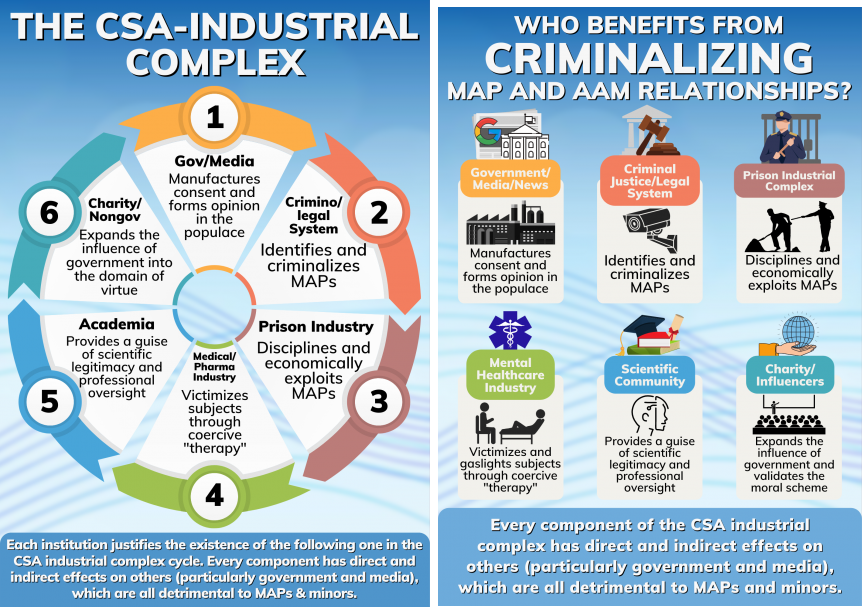
 

The Greatest Horror Of Them All--Being Labeled A Sexual Predator
 
Is there no place or hobby left untouched by the ongoing sex abuse hysteria? Is there nowhere, and no hobby, where we entities known as “legal adults” can interact with those who are legally considered "children" (even if very much adult in appearance and attitude) sans extreme fear of being labeled "child predators"? It would appear that no place and no hobby is safe from the hysteria, case in point...
 
This may come as a surprise to both the antis and the mass media (there is a difference, right?), but most in the MAA [Minor Attracted Adult] community are very multi-faceted individuals with a variety of interests and hobbies completely outside of their admiration for underagers in their respective age of attraction [AoA], or even with any political movement connected to advancing the rights of MAAs and/or youths. In other words, they are human beings, not the single-minded monsters of Western cultural mythology and the Walshian aspects of the media. And I am greatly sympathetic of the many non-MAAs in this society who sometimes have to live with almost as much fear as they do because of the people in this world who profit off of the current sex abuse hysteria, and therefore cause most adults to back off from associating in even the most indirect way with underagers, as if the latter carry a highly contagious form of leprosy that can be contracted even across the breadth of cyberspace.
 
Which brings me to the specific point of this essay. One of my many hobbies entirely outside of the MAA community—and mostly outside of politics and activism altogether--is my enjoyment of the sci-fi and horror genres in books, cinema, TV shows, video games, RPGs [role playing games], etc. I find much value in these genres since they are both inherently subversive, and they can therefore deal with subjects and themes that are difficult to express in non-genre fiction due to the sometimes taboo or sensitive nature of certain topics. As such, I believe the sci-fi and horror genres are extremely important to popular fiction, and this is especially the case when we are in the midst of a particular threat to our democratic principles (or more than one), and the ongoing sex abuse hysteria and accompanying "pedophile panic" certainly constitutes such a threat, as this essay will make abundantly clear.
 
This brings me to the most recent issue of Scary Monsters Magazine (issue #75) at the time this essay was written (circa September, 2010). Scary Monsters Magazine, edited by Dennis Drukentis, is one of the best print mags on the shelves today that covers horror and sci-fi fiction, and among its many popular features is a terrific column that appears in most issues of the mag, Scare-News by writer and fantasy fiction fan extraordinaire Johnny Scareshock. In fact, Scare-News is probably one of the best columns in any modern mag dedicated to horror and sci-fi fiction. On page 109 of Scary Monsters Magazine #75, Johnny was talking about the usual stuff for his column, when suddenly he segued into an unsettling experience he recently had on Facebook. Here is what had shaken Johnny so much in his own words (copied verbatim in bold face):
 
Facebook is a dangerous place. When people ask to be a friend the normal tendency is to allow it to happen. Well, when one of these friends asked me to join his fan club I had a sobering moment. I did not know who this "friend" was so I wondered why he would have a fan club in his name. I checked the fan club to find him using it to talk about his sexual fantasies. I saw that a number of his "fans" were young girls. I then checked this "friend's" profile to learn that he was only sixteen years old. Do you see what I am getting at here? I'm an adult, and if I were to join this child's fan club to read about his sexual fantasies that makes me a sexual predator. I quickly removed him as a friend. I then checked all of my other "friends" to make sure they were all over 18 and removed those who weren't. That incident was one example of how you can get into trouble simply by doing nothing.
 
The first thing I thought to myself after reading this while relaxing was, "Geez, can't I ever get away from this bullshit? Even we activists like a break from the nonsense we battle sometimes!" Let's think about this for a moment, people. Johnny Scareshock, who has nothing to do with anything remotely controversial that I am aware of, and certainly not the slightest involvement with the MAA community, is likewise feeling the fear that one would think should be limited to MAAs alone. He believes he will automatically be considered a "sexual predator" (his words!) simply for reading certain words on a certain socnet page/fan club. Just for reading words!
 
Obviously, he fears that if any legal adult dared to get *gasp choke scream!* aroused by reading about the sexual fantasies of a 16-year-old boy, then he is a most heinous criminal, far worse than the mad scientists who plot world domination by infecting people with zombie viruses or creating artificial monsters out of cadaver parts to kill on command in the movies and books he makes a hobby out of watching or reading! Not that Johnny himself would get aroused by this (I am not certain where his proclivities lie, as I don't know the man personally, though he is married to a woman in his age group and I have no reason to believe that they lie anywhere outside of the "norm"), but he seems to fear that even if he didn't get aroused from reading such fantasies that people would nevertheless assume he did if he was seen listed as a friend on this boy's Facebook fan club. And that would be so indescribably horrible, right? Worse than anything Johnny saw Michael Myers or Hannibal Lecter do in any of their movies, correct? Johnny seems to feel that the rest of society would think so.
 
Here is where the problem truly gets bad. The fact that legal adults are so quick to avoid interacting socially with underagers and avoiding them like a human-devouring zombie plague is only adding to the heavily enforced age segregation in this society. If you're not a parent, you need to treat all underagers as if they carry the zombie plague that Scareshock reads about in the course of his hobby. Even if you’re a teacher or a coach and regularly work with underagers, you are strongly encouraged to keep your distance from them and to treat them as nothing more than students, and never as friends.
 
In fact, the definition of "sexual predator" is becoming increasingly broad, to the point that people like Johnny believe they will be considered one simply for reading words on an online page--or being associated in any way with a "child" (read: anyone below the Magic Age of 18) who is not one of your own kids. And if the "child" in question is doing something as horribly inappropriate as describing their sexual fantasies--something that young people under 18 are either not supposed to be thinking about (after all, they should be concentrating solely on their academic studies, right?), or at least not supposed to be talking about, especially not in a venue like cyberspace, where anyone--including "old perverts" or other "impressionable children"--can see these horrific words, any self-respecting and "normal" legal adult had better clear the area as if it was being sprayed by napalm! Mother of God, what if such fan clubs cause other "children" to start thinking about sex too? They probably never would have known or even thought about that awful aspect of nature in the first place if not for this overly precocious little pervert! Talk about something that is truly scary!
 
Also note that Johnny was freaked out to learn that several of this boy's fans were young (presumably underage) girls. Hmmmm...could this possibly mean that--and brace yourself for this one, people, because it may come as a major shock to our culture's sensibilities--underage girls actually have sexual desires and are therefore interested in hearing about the sexual fantasies of others? I shudder to think that any of these impressionable and innocent "little" girls may have been aroused by this boy's fantasies, so I am not about to go there! I don't want to risk spoiling these girls' socio-politically enforced chaste and virginal images. It was kind of Johnny not to participate in this travesty, not only for his own safety but also so that he wasn't contributing to the delinquency of these "children" in a by-proxy manner.
 
Let's also keep in mind that after this shocking incident, Johnny immediately removed any friend he had on Facebook who was under 18. He seemed to be encouraging all of his adult friends and readers to do so as well, and his concern and fear were totally understandable. After all, is there anything worse in this society than being labeled a "sexual predator," i.e., a horrible despoiler of beautiful childhood innocence? We can live with being labeled serial killers, because even they can be considered cool by many despite the gruesome murders they routinely commit [note the great popularity of Showtime’s series Dexter], but sexual predators? *Sigh* They are the lowest of the low! There is simply nothing lower on the scumbag ladder than an adult who may read about underage sexual fantasies and possibly becoming aroused by them! I don't even think Anakin Skywalker went as far down into the abyss of the dark side as some vile adult who becomes aroused by the natural beauty of an underager! In fact, Anakin’s mass slaughter of children (young Jedi knights in training) after being re-christened Darth Vader by his new Sith lord in Star Wars Episode III: Revenge of the Sith was far less abominable in our culture’s eyes than if Anakin had been attracted to any of them in a sexual manner, or had become aroused after viewing nude holograms of them. If that had happened instead of the murders that we saw onscreen in the above film, fans of the franchise never would have found Vader redeemable—as he proved to be at the end of Star Wars Episode VI: Return of the Jedi—and he would have been viewed as being even more vile by far than the Sith lord who initiated the downfall of an entire interstellar democracy, and who cajoled Anakin into embracing the dark side of the Force in the first place!
 
So now we reach a point where the fear has become so pervasive that adults en mass are avoiding virtually any type of association with underagers who are not their own flesh and blood, thus denying these youths potentially important networking opportunities and allies on the political field. Countless mutually beneficial friendships and relationships will now never come to be. Even adults who have no particular romantic/sexual preference for people under the Magic Age feel this fear and unremitting pressure to give underagers a wide berth, and to therefore deepen the already huge amount of age segregation in our gerontocentric society.
 
And what of adults who may want to read these youthful sexual fantasies simply out of ordinary curiosity? Or perhaps as the subject of serious scientific research? Isn't the subject of adolescent sexuality a fascinating topic that our society really does need to know more about? Wouldn't knowledge of this taboo subject shed much needed light on a topic that our society all too often avoids and wants to hear nothing about, due to both fear of labeling and of facing something that we do not want to acknowledge the existence of because of the cherished cultural paradigms it may shatter to pieces in the process? After all, if we accept the fact that underage sexuality is real, not to mention pervasive, and even--dare I say it--normal, do we not then risk opening up multiple cans of socio-political worms, including the possibility that it's relatively common for adults to find much younger people attractive? I guess society would prefer to allow fear of reality to rule than the scarier prospect of facing that reality. Is the fear of facing an uncomfortable reality not the worst type of fear imaginable when you consider all of the societal consequences of putting the myth before the reality? The ongoing sex abuse hysteria and the maniacal obsession by the government and parents alike to suppress virtually all instances of sexual expression by youths under 18, along with stifling and preventing virtually all social contacts between underagers and adults whom they are not related to or authorized to interact with (e.g., teachers, coaches, pediatricians), would certainly seem to qualify as highly unfortunate consequences, along with the worsening of an already widespread negative and generational-divisive social phenomenon.
 
While many people who share Johnny Scareshock's hobby huddle beneath the covers at night out of the fear that monsters may lurk under their bed, a far more realistic fear--sadly speaking--is what may lurk outside your front door as a result of becoming friends with an underager, or in any way providing evidence that you might be reading about their sexual fantasies. With the current sex abuse hysteria and fear of youthful sexuality--and the systematic age segregation, draconian laws, incessant labeling, public shaming, and the potential loss of employment and community respect that are the natural byproducts of it--one shouldn't be surprised that horror hobbyists like Johnny Scareshock would rather encounter Michael Myers or Jason Vorhees in a dark alley than an underage person on their Facebook page.
 
When is society going to come to its senses while we still have a semblance of a democracy? How long do people have to keep living in fear? How far is the age segregation going to have to go before adults feel even moderately safe from being saddled with the Ultimate Scarlet Label of the modern age? How restrictive do the laws have to become before people en mass come to their senses and collectively cry, "Enough is enough!"? How many more rights do young people have to lose and how far does censorship have to go before our society becomes Orwellian enough to satisfy the government? When can older people cease having a fear of establishing social connections with younger people? How irrational is this fear going to get before common sense finally proves triumphant? This topic can spawn a truly terrifying horror movie all on its own. I can see the title and ad campaign of the movie now:
 
The Underage Friend: Horror From the Depths of Cyberspace--"Can Johnny overcome the most horrifying situation of them all? Can he possibly survive the unremitting terror of being labeled a 'sexual predator?' If you thought Michael Myers, Jason Vorhees, and Hannibal Lecter were something to fear, then you’ve had it easy! Beware, all ye legal adults, for the ultimate horror is now upon mankind!" Cue to a trailer where a legal adult is seen using their laptop and innocently clicking to a page on Facebook to check out the fan club of a person who added him as a friend in the past, only to come across--prepare yourself--the page of an underage girl with a pic of herself wearing a bikini! This is followed by a scene showing the unfortunate man screaming in terror ("Aaaaaahhhh! Underage sexuality! Please stop this nightmare! I swear I didn't know who she was or what her fan club was all about before I accepted her friend request! I swear I didn't get aroused by that pic of her! Please don't label me a child predator! Please don’t drag me away to the clink or put me on one of those online registries! Please don’t take away every bit of community respect I spent the last 20 years building! Please don’t make me lose my job! Pleee--aaa--ssse! Give me a month alone in Camp Crystal Lake first, or even a year being tortured by the Cenobites in Hell, but for the love of God, please don't put me on a sex offender registry!"
 
Such a screenplay can practically write itself these days. What does it say for horror icons like Michael Myers, Jason Vorhees, and Hannibal Lecter when a young teen girl in a bikini is considered a scarier, more nightmarish, and more repulsive image than the likes of them? Do they have their work cut out for them when it comes to the hordes of underagers expressing their natural sexuality? Perhaps a pic of an attractive underage girl or boy in a provocative pose should make the cover of the next issue of Fangoria. Then again, as horrible as such an image is in the eyes of our our society, every regular adult reader of the mag would be afraid to pick up a copy of that particular issue lest the cashier at the store report them to the police for "abusing" children by looking at their underage images on the cover.
 
Addendum


Following the original draft of this essay of mine when it appeared on GC, one of my fellow activists, Scotty, mentioned this:


"You are probably aware that a man in Ohio [Brian Dalton] was sentenced to seven years for writing erotic stories in his diary about young girls! Who was harmed?"
 
Another GC poster, Crimson Moon, noted this:


in response:
 
"I just looked up a blog:


about that guy who wrote the erotic stories [Brian Dalton] and a line from that blog really stood out.


"'In earlier cases, the Supreme Court has consistently ruled that protecting children from pedophiles is more important than First Amendment rights.'"
 
That was followed by this response from yours truly:
 
When the time comes that mere words and ideas are considered "dangerous," and the State feels the need to "protect" any segment of the population from these "dangerous" words and ideas, then we are truly headed towards a police state. Invoking the "protect the children" line of thought is usually a foolproof, challenge free method for any corrupt, anti-democratic politician for getting draconian legislation of any sort passed. Who in public office would dare challenge any type of legislation that was backed up by an alleged "protect the children" purpose--even if the legislation in question clearly had nothing to do with protecting them and everything to do with censorship of unpopular speech and ideas, dropping a further encroachment on the civil rights of society in general, or to harrass MAAs in particular? Certainly not any politician who had a hope for re-election in these paranoid times, or who would hope to avoid being labeled "soft on child abuse" by their opponents, that's for sure. Just who is it that youths--and society in general--truly need to be protected from? Pedophiles and hebephiles, or the State Gestapo that flourishes when a “witch hunt” mentality is thriving?
 
Lastly, my fellow GC activist Dante had this:


to add about the above situation:
 
"I'm not terribly surprised at a lover of 'taboo' and 'horror' having swallowed the moral panic without questioning it. Those who push the envelope validate the envelope. The truly transgressive go where they please nonchalantly. They aren't drawn towards taking a stand on an invisible line because they know that the line is a fiction. You can't be the Anti-Christ without having a relationship with Christ (even in the negative).
 
"And much of Western Horror is actually moral reinforcement.
 
"Friday the 13th teaches us that teenagers who don't abstain will be hacked to death.
 
"Poltegeist teaches us that ignorance of the law is no excuse when it comes to violating zoning codes.
 
"The apparent chaos of occult evil almost always resolves into, 'the wicked are punished, the moral survive.'
 
"Contrast that with Japanese Horror or with tales from Celtic folklore.
 
"'They hate you because you're good,' and 'Once you come to the attention of the fair folk [read: Authorities], you're f**ked no matter what you do,' are lessons more conducive to a challenge of moral panics than to their validation."


Minors Can Be Victimizers--A Brief Analysis Of An Incident Showing Us Who Truly Has The Power In An Intergenerational Relationship
 
As our enlightened society loves to inform us, the young people we today label "minors" are always without exception a victim in even mutually consensual relationships with adults, and the reverse can never be the case, right?
 
Wrong. Take a look at this disturbing article: www.bbc.co.uk/news/uk-scotland-edinburgh-east-fife-11000718 detailing an extortion racket run by an enterprising teenaged boy named Klez Sutherland (and possibly some unknown accomplices) in Britain. The article doesn't explicitly state Sutherland's exact age, simply referring to him as a "teenager," which means if he wasn't a minor, then he was likely not any more than a year or two over the Magic Age as it's defined in America, so what can be said about a minor's capabilities--both good and bad--can apply to him as well. It's a short article, so please read it and then check out my thoughts on this below.
 
It would appear that this article provides still more evidence to toss aside one of Western society's most cherished myths regarding intergenerational relationships: that those we today label "teens" can never be anything other than victims in such liaisons, adults always "know better," and the youths in question are always easily manipulated by these adults due to the latter's "superior worldly experience," with the reverse being thoroughly impossible. The article linked above should serve as a wake-up call to everyone who believes that mythical nonsense, as well as those who doubt the competence of youths, which can be quite devastating when directed in a negative manner.
 
This situation makes a few other things clear that are of relevance to the Minor Attracted Adult [MAA] community:
 
1) MAAs are likely to be prime targets for extortion schemes of all kinds. The police need to be mindful of this, as many people, both older and young, may end up jumping on the bandwagon in regards to such schemes, and they can easily rationalize what they are doing by saying, "These guys are 'pedophiles,' so who the hell cares what happens to them? They should be arrested, not me!"
 
2) This incident makes it clear how terrified MAAs are of disclosure for the smallest degree of contact with minors, sometimes even just for admitting to the wrong person that they have the attraction base, and are willing to pay extortionists large sums of money not to out them or report them to the police. This makes it clear how easy it is for anyone to manipulate members of this community for just about any conceivable purpose as a result of the constant fear of disclosure they have to live under in today's world, including getting them to stay silent about attempts to harm them, and probably even to lie.
 
3) Who really has the power in situations when minors and adults engage in mutually consensual relationships with each other as a result of the current laws? Minors may not have their civil rights at the present time, true, and society considers them in a disadvantaged position with adults in intergenerational relationships as a result. But is it really and truly the adults who have the power under the current state of affairs? Look how easy it is for unscrupulous minors to blackmail and extort money from adults who engage in mutually consensual sexual relations with them, or who even talk “dirty” with them via the phone or cyberspace. Yet most people in our society honestly believe that adults hold all the power in these situations, and that the adults are always the unscrupulous manipulators in such relationships. A little bit of common sense--as well as incidents like this--make it crystal clear how the reverse can very often and very easily be the case, as well as the fact that “minors” are not as stupid or incompetent as we think.
 
4) The age of consent [AoC] laws are making possible a potentially lucrative business for entrepreneurial-minded underagers with a lack of scruples, who, as I said above, can easily rationalize what they do as being "okay" because those "disgusting 'pedophiles'" deserve no less. Hence, it is becoming easy in today's climate for many people to rationalize or justify any type of illegal or unethical act or scheme, as long as your targets happen to be MAAs.
 
5) Considering the number of men who were victims of Sutherland's scheme, it would appear that sexual interest in underagers by adults is a lot more common than our "polite" society would like to think. And this includes gay and bisexual men as much as straight men, the former of whom often go to great lengths to distance themselves from having anything whatsoever in common with the MAA community. Why doesn't the revelation that many gay adults find underage people attractive surprise me? And keep in mind that this was a sex line designed for gay (and presumably bisexual) men, and not the "breeders." Obviously, the adolescent Sutherland, and whoever his accomplices may have been, knew something that the mainstream gay community would like to deny. And no, I am not saying that gay people typically have a preference for underage boys (or girls, as the case may be), but I am simply mentioning that an appeal for the natural attractiveness of youths is not as uncommon or alien to the mainstream gay community as its members and advocates would like the general public to believe when they routinely deride the MAA community and deny any kinship with them from a social and political standpoint--or display nothing but close-minded and vicious scorn towards our movement for emancipation: "We aren't the deviants, it's those scumbag 'pedophiles' that you should be concerned about! We are nothing like them at all!"
 
6) None of the men who were bilked by Sutherland and his cohorts visibly went off the deep end or issued counter-threats of violence to him. They simply handed him the money and slunk back into the shadows. The one who refused to be a victim handled the situation in a sane and sensible way by calling the police. So much for the common belief that underagers who have dealings with MAAs are likely to be murdered or subjected to some form of violence or threats even in situations like this. And again, it would seem as if younger people can do a bit of coercion of their own. Who would have thought?
 
7) As indicated above, “underage” people are not as stupid, naive, pure of heart, or incapable of pulling a fast one on much older adults as our society likes to think when defending the AoC laws. Though the majority of underagers are decent people, many of them are capable of being quite devious, unscrupulous, and, yes, predatory. And the current AoC laws certainly do encourage such behavior in the less scrupulous youngsters out there. But that's just too damn bad for MAAs, because society needs to keep young people "safe" from them, right? It would appear that the government, the media fear-mongers, and the social workers who make up the profitable sex abuse industry aren't the only individuals who are exploiting the current hysteria and bigotry at the expense of this community.
 
8) Sutherland's statement of defense in the courtroom was an interesting one, and provided a very, very telling commentary about the present degree of bigotry against MAAs. The men he and his possible accomplices targeted were "pedophiles" (actually, men displaying hebephiliac, not pedophiliac, tendencies), so Sutherland failed to understand why he was arrested and not the men he blackmailed. Hence, since it's commonly believed that MAAs do not deserve any consideration or decent treatment by anyone at all, and that everyone who chooses to victimize members of this community should be forgiven because they deserve to be victimized by others due to their "evil" ways, Sutherland doesn't understand why he is being punished for committing a crime against the indefensible. Is he--and the rest of society--to assume that MAAs do not deserve any protection or consideration under the law that is freely enjoyed by other people? And of course, not all of those men who were victimized were likely MAAs; sexual contact between adults and youths under the age of 18 is not as rare as society would like to believe(pedophilia 5%, hebephilia 18%, and ephebophilia 30%+), and teleiophiles [people with a “normal” preference for individuals in the same general age group] with either gender preference (or both) can likewise become attracted to underagers, particularly adolescents, who are--whether our "polite" society likes it or not--young adults and therefore can be naturally attractive even to adults who do not have a preference for their age group. Further, the more forbidden our society makes adolescents to “legal adults,” the more enticing the prospect of being with one can be to many adults who may not otherwise have a preference for them. There is a reason why there is a surfeit of stories throughout our literary history which make it clear that many seek to taste what is considered “forbidden fruit,” and this undoubtedly entices some underagers who do not otherwise have a preferential attraction to adults to do the same out of curiosity as to what all the “fuss” is about. Is this not the lesson that the Biblical story of Adam and Eve taught us?
 
This was a very illuminating case on many levels, to say the least. I can already hear Oprah Winfrey lamenting about what a victim poor young Kelz Sutherland was in his interactions with those vile "pedophiles." Then again, if she could profit so handsomely from the ongoing hysteria and misinformation campaign about MAAs, why shouldn't Kelz? They are birds of a feather, and Oprah is clearly an inspiration for young aspiring businessmen like Sutherland.


Peru Lowers Its Age Of Consent--My Analysis
 
Below is my analysis of this article: www.web.archive.org/web/20100822150940/http://www.ctv.ca/CTVNews/World/20070623/peru_consent_070623 detailing something rather amazing and extremely refreshing amidst today's global sex abuse hysteria and the continuing Orwellian encroachments on youth sexual rights as a result: the government of Peru actually lowered its age of consent [AoC]. Hence, its currently in-power political party has proved itself to be composed of progressives that are truly worthy of the term, unlike most of their cowardly counterparts in North America, Europe, and Australia. Without further ado, let's begin my analysis of the various excerpts from the article that are italicized below, followed by my response in standard text.
 
"Peru's Congress has voted overwhelmingly to lower the age to 14 for participating in consensual sex, a move some activists said could expose children to sexual abuse."


And who, exactly, would these "activists" be? They certainly aren't activists for youth rights, that much is clear. My guess is that they are the Peruvian equivalent of "child advocates" [CAs], who claim to fight for the "rights" of minors but in actuality fight for increased state and parental control over every aspect of young people's lives "for their own good." They are the main people in this world who have created an entire industry around the sex abuse panic, and they benefit and gain political power and oftentimes a large degree of state funds and lucrative media careers as a result of this dubious industry. So it's no wonder that so many of them push this "concern" past all degrees of reason and protest any type of progress that may weaken the stranglehold the sex abuse hysteria currently has over public discourse in the Western nations.


04d9594918fa2a74a3bdf4ffd59f56cf.png
 
"Lawmakers voted 70-10 on Thursday to approve the measure lowering the age at which criminal law recognizes the legal capacity of a person to consent to sexual activity. It was previously 17."
 
70-10??!! Holy shit! Peruvian politicians who consider themselves to be progressives are truly and sincerely progressive, and take the principles connected to the moniker very seriously, in contrast to the bulk of the progressives in America, England, and Austrialia who are terrified to approach this subject in any manner other than mindless and reckless condemnation that embraces every single negative and totally inaccurate stereotype aimed at both MAAs [Minor Attracted Adults, a political blanket term covering both pedophiles and hebephiles] and youths without the slightest bit of clarity, objectivity, or serious research.
 
"The Peruvian measure was written by a member of President Alan Garcia's center-left Aprista party and Garcia is expected to sign it into law."
 
Un-freakin'-believable! There is a major political party in Peru that is actually center-left as opposed to those turncoat Democrats in America who are "centrists" (i.e., center-right) out of fear of being called names by the Republicans, and who base most of the laws they pass or propose in a manner that will appease the Republicans and hopefully avoid invoking their ire [not that it helps, since the Republicans in America hate and loathe any Democratic president or other politician in the Democratic Party regardless of how hard they try to make nice with the demands of the Republicans simply because they are Democrats--note how the Republicans frequently call Obama a "socialist" despite his pandering to Wall Street, the big giveaway to the banks after they screwed up, his insulting excuse for environmental reform laws that irked progressives across the globe, how outrageously far he capitulated to the Republicans in regards to health care reform--and how the Republicans constantly call Obama "soft on terrorism" and frequently claim that he doesn't take the "war on terror" seriously despite the fact that Obama is initiating military operations in no less than five different Middle Eastern nations, three nations more than Bush did! But that's a whole other topic...]. Obviously the progressive politicians in Peru, including the president, have some spine, unlike their counterparts in North America, Europe, and Australia. They live up to what the progressives and liberalism are supposed to stand for regardless of how much the anti and conservative elements in the country, including within the government, will call them names. They pass laws based upon what they believe in, and do not vote in office for measures that go against their principles as the liberals in American government routinely do. Peru and other nations in Latin America represent hope for an end to this madness in the future, and provide more evidence that the resistance to the global "pedophile panic" and accompanying sex abuse hysteria is far from futile.
 
"One supporter of the measure, lawmaker Raul Castro, said the law will bring Peru in line with "the progress and development of a modern society.""
 
Well, I'll be a primate's uncle. A progressive lawmaker who is actually concerned about progress and having his nation measure up to what he considers to be a "modern" society, which he defines as providing more, not less, rights for youths. Castro and his fellow Peruvian progressives put their political counterparts in America, England, Canada, and Australia to shame by actually living up to the principles of progressivism and liberalism despite the powerful socio-political pressure to do otherwise.
 
""There are young people who get pregnant but they don't go to health centers, fearing that their partners will be arrested and charged," he said."
 
This is certainly one good practical reason for lowering the AoC, and in fact this was the same argument used by many youth groups in Canada while opposing the then newly conservative government's proposition to bow to American pressure by raising the AoC there (only to lose, a major blow to sanity and youth rights), which is the exact opposite of what Peru has just done. There are other good and arguably even better reasons to lower the AoC in all nations, including in the general interests of youth rights, but the above reason will certainly suffice for now as it's a perfectly legitimate reason that puts concern for youths above the concerns of those who wish to control their sex lives for what amounts to purely moralistic reasons.
 
"Some organizations cheered the law, saying it would keep young people out of jail on statutory rape charges."
 
It's even more refreshing to see that there are such organizations in Peru, as there are virtually none like them in America, England, and Australia. And I think it's important to keep older adults out of prison for statutory rape charges as much as younger people because laws criminalizing any form of mutually consensual sexual behavior are unjust, unprogressive, and undemocratic.
 
"But Virginia Borra, head of the Ministry of Women and Social Development, said that the law will invite cases of "flagrant rape that can be passed off as a consensual relation.""
 
Why am I not surprised that the head of an org allegedly dedicated to the advancement of women and social development has such a negative attitude towards youth rights and believes that young people under a certain age are more vulnerable to acts of rape than adult women are? Is it possible this org's name is actually a cover for some other agenda, perhaps a victimology based agenda? Many orgs which claim dedication to advancing women's rights are actually in the business of pushing the victim mentality, and it's easiest to legally impose laws borne out of such a mentality on youths under 18, since they currently lack the civil rights to resist such measures. How else do you explain an ideology that claims an act of flagrant rape can possibly be passed off as a consensual relationship?
 
"Maria Pia Hermoza, the coordinator of the Peruvian organization Action for the Children, complained that the law will expose children to sexual abuse."
 
Is it any surprise that an org with a title like 'Action for the Children' is not a youth liberationist org but actually a "child advocacy" org that pushes the continuation of youth dependence on adults while simultaneously pushing the sex abuse hysteria to justify doing so, all the while ignoring the well documented fact that less rights for kids actually expose them to far more potential for genuine abuse of all kinds (including sexual abuse) than does giving them more rights and liberties? Such orgs blatantly ignore the fact that the bulk of actual abuse goes on in the home by parents and other older relatives who have the most direct power over kids, not by older people who live outside of the home and thus have no direct power over kids. Such orgs should be condemned, not applauded, let alone funded by the government, and it's refreshing to see the Peruvian government ignoring such orgs rather than bowing down to pressure from them to pass policies which further encroach on the rights of youths, further harass adults who are attracted to them, and further the hysteria as opposed to standing behind truly progressive and pro-youth policies.
 
"Rapists will "use consent to evade justice," she was quoted as saying in the Peru21 newspaper Friday. "They will continue using blackmail and threats to rape minors.""
 
This is one of the most common claims used by anti-youth rights "activists" to justify the continuation of oppressive and draconian laws to control the sexual rights of young people, i.e., the idea that there will be hordes of unscrupulous adults who will use blackmail and threats of violence to coerce minors into having sex with them and to subsequently intimidate the minors in question into claiming that the sexual activity was consensual who will come out of the woodwork in large numbers if the AoC laws are lowered or abolished. Youth rights activists and pro-choice MAA activists have heard this tired old "justification" for high AoC laws numerous times before, and it's quite easy to refute.
 
For one thing, such claims carry the implication that young people, including those who are empowered with their rights, are easier to coerce and intimidate into lying on behalf of adult rapists than other adults are, which is an ageist attitude against young people. Such claims are also invoking negative stereotypes and unreasonable distrust of adults by making the strong implication that adults who have a romantic/sexual interest in younger teens are very likely to be unscrupulous. This is a similar sentiment to what I often hear from anti-choice MAAs when they argue in favor of retaining AoC laws: an extreme, paranoia-laced mistrust for adults, with an accompanying belief that society is filled to the brim with adult rapists and potential rapists who are just sitting back and waiting for the AoC laws to be lowered, and will then emerge in mass numbers to pounce on unsuspecting minors, threaten and coerce them into having sexual relations, and then taking advantage of the AoC laws being lowered to intimidate these minors into saying that the rape was actually consensual. I wish people who make such claims would seriously think clearly about what they say before saying it, because they would look far less foolish and totally out of their minds with paranoia if they did so.
 
In a democratic nation, misanthropic attitudes that presume the world is filled with evil people, and passing laws based on this assumption, are frowned upon with good reason. We cannot pass laws based on what are clearly assumptions about what people might do based on a cynical dislike for the human race and still remain even a nominally democratic nation that is based upon socially progressive values. Yes, there are some evil adults out there who would indeed try to take advantage of young people, but I challenge anyone to prove that these adults exist in such great numbers that they justify oppressive laws that are based upon totally arbitrary assumptions, and which necessitate throwing large amounts of innocent people in prison to make sure that every single truly evil or guilty person gets punished right away. Yes, evil adults doing such things can happen and indeed have happened before, but I think it's nothing less than totally hysterical and even ageist to suggest that huge numbers of younger people lack the fortitude and strength of will to report to friends, family, and the authorities when an actual case of rape occurred regardless of what threats the hypothetical adult rapist made towards them. And yes, it is possible that if the AoC laws were lowered a few adult rapists (and older teen rapists, of course) will on occasion successfully intimidate a younger person into claiming that an actual rape was consensual, and that this will result in the guilty rapist going free temporarily. However, I strongly doubt that every single young person such a rapist does this to will capitulate to their threats no matter how intimidating the rapist happens to be, and sooner or later (and much more likely sooner) one of the victims of such a rapist will speak up, and this will result in past victims gaining the courage to come out of their silence and do the same, thus resulting in damning evidence against the rapist in court (such things happen all the time with women victims who previously stayed silent for whatever reason). Hence, the occasional rapist who temporarily goes free will not be operating for very long.
 
Also, young people can be educated into spotting various warning signs of both peers and adults who may be dangerous, and I do not think too many genuine rapists can successfully hide their true natures from every single person in a young teen's life, including the large number of adults who truly care about them, caring adults who would likely not be in their life if the AoC laws were left intact. Further, it should be noted that adults outside of the home or boarding school who target specifically kids for rape are extremely rare (contrary to popular belief), and I see no evidence to suggest that there are huge numbers of potential rapists who are presently invisible to society's radar simply because they are deterred from acting on their sociopathic impulses by the AoC laws. Such a common claim from both the "child advocates" and the anti-choice MAAs borders on non-nonsensical, not to mention hysterical, and is not backed up by any evidence. It's instead based on a cynical and very negative mistrust of humanity in general.
 
When I say all of the above, defenders of the AoC laws (both outside and inside of the MAA community) will attempt to counter with a response that is just as hysterical and utterly undemocratic as any previous response I mentioned: they will hit me and other pro-choice activists with the "even one is too much" argument, where they will say that even if one single real rapist of young people goes free as a result of intimidating the youth into claiming a sexual encounter was consensual when it actually wasn't is still totally unacceptable, and such people must be stopped at all costs, regardless of how many innocent people must suffer for it and have their lives destroyed as a result, and regardless of how draconian such laws will be in regards to freedom of choice and personal liberty of youths. When people say such things, they need to take a deep breath and to take a long and hard look at what they just said, and once they calm down and come back to their senses where their reasoning faculties are again operating, they need to do a lot of research on the differences between democracy and progressivism and a police state and tyrannical authoritarianism, and how the latter can easily develop within the former if lawmakers and citizens are not careful. Once doing the latter research, they will find out that sacrificing freedom for perceived security from some sort of menace has always historically backfired in an enormously negative way on the vast majority of people in society who are not part of the ruling elite. It's totally impossible to completely eliminate all types of risks for anyone in society, including young people. And the legal system of democratic and progressive nations have always held to the principle that it's far more preferable to allow rare instances of a guilty person to occasionally go free than to tolerate even one instance of an innocent person being thrown in prison and having their lives ruined by the legal system, let alone the literally thousands of innocent people who would be thrown in prison if every single adult who has mutually consensual sexual relations with a young person under a certain arbitrary age is indicted and thrown into prison just to insure that absolutely no person who may be guilty of actual abuse ever goes free. It amazes me that certain people who were raised in an even nominally democratic society can give into raw emotionalism and support any sort of draconian measure--even when it comes to protecting those who are perceived to be the most vulnerable in society from harm--and thereby risk bringing their society one step closer to a police state.
 
Also very important to consider is this extremely cogent point raised against the all too often heard justification for retaining a high AoC that I tackled up above, courtesy of my friend and ally CatcherInTheRye after reading the initial version of this essay:
 
"Regarding their argument that if the age of consent were lowered, some adults would threaten a child into saying it was consensual[...]


"As the laws are now, if an adult has sex with someone below the AoC, what do they think is stopping that adult into threatening a child into not telling anyone that a sexual act occurred at all? '


"If they're willing to threaten them into saying it was consensual, they're probably willing to threaten them into total silence.


"Why can't they understand that the AoC is quite irrelevant?"


To use a bit of popular slang...it would appear that my friend just totally pwned the purveyors of that tired old justification for keeping a high AoC by showing how inimical to common sense and utterly useless the AoC laws are for protecting minors from genuine abuse (as opposed to simply denying them their sexual rights by criminalizing sexual activity that is entirely consensual), and why the laws against actual forcible rape and sexual harassment are more than sufficient to deal with any actual rapists, sexual harassers, or stalkers on their own, just as they do for people above the AoC.
 
It can be readily observed that whenever a single draconian law is passed to solve a perceived problem, such a law is inevitably and inexorably followed by more and increasingly greater draconian laws, each one more hysterical, outrageous, and undemocratic than the previous ones. Please note how the various Western governments, in their ongoing endeavors to prevent the sexual abuse of minors, goes from criminalizing all sexual contact between minors and adults regardless of whether it's consensual or not, to criminalizing the mere viewing of pictures and videos of minors in sexual situations, to the criminalizing of viewing pics and vids of nude kids even if they are not in sexual situations because some adults may still get aroused by them, to criminalizing pics and vids of fully clothed minors because they might still arouse an MAA, to criminalizing drawings and CGI generated images of nude minors, to criminalizing sexually explicit pics and vids of adult women who are pretending to be minors, to criminalizing sexually explicit pics and vids of adult women with small breasts because images of such women might be used by MAAs as a proxy for fantasizing about minors, to...I think you get my point. Do we even want to know where these laws will go next? Could all pornography featuring adults be next?
 
Or, as another example, laws that criminalize online cyber-sex between adults and minors then leads to the criminalization of any and all online communications between adults and minors based on the assumption that such convos might lead to cyber-sex and perceived "sexual exploitation" of the younger person by the adult. Where does it end? What is the logical conclusion of such increasingly draconian laws? How can we ever justify the passing of such a law when we consider the historical precedent of doing so? As the old saying goes, "If you give someone an inch, they take a yard." That is why it's foolish to assume that just one draconian law passed within a democratic framework will not lead to more and more increasingly undemocratic and outrageous encroachments on democratic freedoms, or that any such law can ever be justified as a "necessary evil." No draconian law is ever beneficial to society no matter how great the perceived threat within the society may be. This is why, as I said before, I lost all respect for a former MAA ally of mine that I know from the Girl Lover sub-community when he suddenly and abruptly went from one of the most staunch pro-choicers in the community to a shameless defender of the AoC laws and actually said that he supports these laws and doesn't care how draconian they are (yes, he actually used these words). He and others like him seem to feel that the need to protect minors from abuse is so overwhelming that absolutely anything goes in doing so, no matter how many innocent people may suffer, no matter how hysterical and outrageous these measures become, and no matter how many freedoms and civil liberties are sacrificed as a result. There is nothing honorable about such measures to "protect" minors, because they pander to a police state mentality and ultimately everyone in society, including the young people they purport to protect, suffer from these rabid encroachments on our basic civil liberties. This is something that is clearly evident by the current crop of such laws putting young teens in prison and on sex offender registries for taking nude or provocative pics of themselves and sending them to friends via their cell phones, or uploading such pics on socnet sites. Need I say more?
 
In a democratic society that is based on a system of progressive values, it's unfortunately necessary to allow the occasional guilty person to temporarily go free in order to insure that no innocent people are thrown into prison and having their lives destroyed, and to insure the full freedom and liberty of all people, including younger people. It's totally impossible to create a system (at least within the context of our current class-divided system) where 100% of minors are never abused, even within a police state. Those who are truly concerned about enormously decreasing the number of kids who are abused, as are youth liberationists, should spend their efforts targeting the places and institutions where kids are subjected to genuine abuse in by far the greatest numbers, which is within the home or other institutions (such as boarding schools, particularly religious boarding schools) where kids are under the greatest amount of control by adults, as opposed to targeting adults who do not live within the home or have a great and direct degree of power over kids, and who thus commit crimes of actual abuse against kids only on rare occasions. AoC laws clearly target the latter individuals and sensationalistically overstate the degree of danger to kids posed by adults outside of the home or other authoritarian institutions who may engage in romantic/sexual relationships with youths, and utterly fail to address the places where kids are abused most often. As noted before, the AoC laws also result in huge amounts of innocent people being thrown into prison, not to mention the suppression of the sexual choices of youths under a certain arbitrary age. See this snippet from an essay explaining the number of people affected by AoC laws:
 
"Around 5% of men are pedophiles, 20% of men are hebephiles(attracted to pubescents 11-14), and 30% are ephebophiles(attracted to post-pubescents 14-19). If only hebephiles are accounted 80 million parents in the US alone have a child whose sexuality, their core fundamental and immutable design, is not only criminalized, but is openly hated at about the same level as Jews in Nazi Germany. If we cut that 20% in half and say that 50% of them are not seriously affected by modern consent laws, that still leaves 20 million men in the US alone. 40 million American parents have a son living anywhere between a subpar and unfulfilling life ranging anywhere from dissatisfaction to pure torment to a downright miserable existence; whose love has become demonized and unfairly cut off from the possibility of true love, and that is not right. Even the most cherished concept of freedom of speech is tossed out the window to silence the few brave enough to speak out and try to defend themselves. Something is SERIOUSLY wrong here.
 
How can we possibly even begin to describe what this is like? How can I convey the excruciating, agonizing happiness of meeting the most beautiful, amazing, and wonderful human being just fall out of the sky and into my life as if sent by an angel. I formed an instant connection with her unlike anything I’ve ever felt. 
 
She is everything you’ve ever wanted in a girl, and you just instantly click like you’ve never clicked with anyone. She likes you more than any girl has ever liked you, and you feel the same about her. Obviously, neither of y’all care that she’s 12 and you’re 30; you feel happy around each other, and that’s all that really matters. She eventually just flat out tells you she likes you and wants to be your girlfriend. She is the boldest, most confident female you’ve ever met. We had so much fun just hanging out where I worked, neither of us ever wanted to leave. She was not very subtle about being attracted to me, either. I’ve never felt so much joy in the company of anyone else. Imagine the agony of then having to turn her down, even though you want nothing more in the world than to give her your heart, all because of the opinions of complete and total strangers. It doesn’t matter how you two feel about each other; they have already decided that for you. They label you as a sick, evil, and perverted abuser incapable of truly caring about her and wanting to make her happy. Imagine the nights spent in the pitch black corner of your closet, curled up in the fetal position and bawling your eyes out.
 
Why? Why don’t  I deserve a chance to prove that the love I feel in my heart is no different than anyone else’s? Is that too much to ask?
 
Imagining what our relationship would be like; her calling me every night about all the exquisitely boring details of her day, taking her out on exciting dates on the weekends, all the inside jokes, etc… Imagine that being considered the most vile, evil, and abominable crime it is possible to commit. Worthy of being cast out of society for life, being forced to live out the rest of your days under a bridge, constantly looking over your shoulder in case a crazed vigilante decides to enact their own version of justice for the despicable crime of being in love. Something is SERIOUSLY wrong here.
 
If a 12 YO and a 19 YO genuinely enjoy each other’s company, if they make each other happy and want to be together, who is anyone to say otherwise? How cruel does someone have to be to justify splitting them apart and shipping one of them off to prison and forced to live on a mean-spirited registry for the rest of their life, when they weren’t hurting anybody, just because of their opinion?"
 
Considering how many people are affected by the current age of consent laws, I believe the age of consent should be lowered to 12(teens 12+ should be allowed to have sex with anyone 12+) provided there are certain restrictions.
 I often hear two arguments against an age of an age of consent of 12:
 
Most of these adults fall in love with these teens naturally the same way as ones who fall in love with older people; they don't 'seek' them out. A lot of people assume these adults are just attracted to the teens because of their age. But most are attracted to them  as a person and never knew they were below the legal age of adulthood since they met them. 
 
Too many older people and young teens desire true, genuine relationships with each other to continue wasting money penalizing all of them. It is not right to punish tens of millions of adults and young teens who are genuinely, madly love, and click with each other on a deep level. Also, relationships between two people are complex. Everyone knows that sex is vital part of relationships and restricting it can cause complications.
 
Imagine if your adult son came to you and started going on and on about this amazing girl he loves who feels the same way about him. You suggest he invite her over for dinner, but then he confesses that she’s 12/13, but says he really does love her and wants to be with her. He just wishes that society would give him a chance to prove that his love is real. What would you do? Call him sick ? Even if you detest it, if you love your son, then what makes him happy makes you happy. And, if being with her is what would make him happy, wouldn’t you want that for him?"
 
In summation, despite the opposition by the typical hysteria-mongering elements that benefit from the proliferation of the sex abuse industry, it's extremely refreshing to see Peru and other Latin American nations take a genuinely progressive stance against the current insanity by actually rolling back some of the draconian laws that spawned and support the sex abuse hysteria rather than adding new laws of that sort to increase the Orwellian encroachments on what few rights youths currently have in modern society, and which slide all democratic societies further towards a police state. Hopefully, the example taken by these courageous and progressive lawmakers in Peru and other Latin American nations will encourage the progressives in America, Canada, England, and Australia to develop some spine and to do some serious objective research (as has Judith Levine and Robert Epstein), and to live up to their principles by opposing the sex abuse hysteria rather than helping to add to it at every opportunity in order to avoid being called names by the conservatives. In fact, the mainstream progressives should be totally shamed by the fact that certain prominent conservatives are actually doing more to advance the cause of youth rights in America than the progressives are, as evidenced by the recent support given to Robert Epstein's work by Rush Limbaugh and Newt Gingrich, which speaks quite poorly of the current crop of progressives in America and other Western nations.


The Beckii Cruel Situation


A recent documentary has come to light which has some major relevance to the Minor Attracted Adult [MAA] community, and the global cultural factors which affect public attitudes towards the pedophiliac and hebephiliac attraction bases (in this particular case, the latter), and I believe this warranted an essay.
 
The situation discussed in the documentary was adeptly summarized by my fellow MAA activist Joey Bishop in this post(http://www.annabelleigh.net/messages/509001.htm) of his on GC: 
 
“I just saw this BBC documentary titled Beckii: Schoolgirl Superstar at 14, and it's probably one of the best documentaries I've seen in a while. It's an interesting chronicle of culture clash and instant Internet fame. It all starts when a cute British girl named Beckii, who's a fan of Japanese anime, and oddly enough sort of resembles an anime character herself, posts a video online of herself dancing along to an anime inspired J-Pop hip hop song called DanjoDanjo.
 
“Almost overnight, she becomes a sensation in Japan with her cute looks that resemble an anime character, which satisfies Japan's cultural fascination with both incredibly cute things, known as kawaii culture, and anime characters. Eventually, she ends up landing in the top 20 on the Japanese pop charts and having entire magazines filled up with photos of her. There are even aspirations to stardom back in her native Britain, as well as worldwide, and whether that possibility will prevail is left open ended, but looks at least somewhat promising. Things seem to be on the up and up for this pretty young girl.
 
“And yet, there is a culture clash and a moral dilemma in place. As Beckii herself admits, despite her appreciation of some aspects of the Japanese culture, she still thinks with a British mentality, and the sexual undertones of her appeal, and the age and gender of much of her fan base, troubles her and her family, which includes her policeman father. She's happy to receive expensive gifts from her biggest fan, an ostensibly wealthy middle-aged Japanese man, yet is a bit ambivalent about her relationship with him and whether it should continue despite the gifts he sends which please her.”
 
You can watch the video of the documentary online at the BBC three home page, which can be found here:


http://www.bbc.co.uk/programmes/b00tf20x
 
With the above said, courtesy of Joey Bishop (which I thank him for bringing to my attention), I now move onto my essay, where I have some words to say about this matter.
 
One of the major things about the Internet to keep in mind is that it's a global phenomenon. As a result, people from Country A that become overnight sensations as a result of uploading videos of themselves to sites like YouTube are sometimes going to achieve a lot of appeal not just in their native land, but also in Country B. If the latter occurs, then they are quickly going to realize that the values and attitudes of their indigenous culture are not the equivalent of laws of nature. The moral conceits that are so popular in the U.S. and Britain which demonize adult men who openly acknowledge the sexual attractiveness of adolescent girls under a certain arbitrary age are obviously not nearly as extant in certain Eastern nations like Japan, which has a long and solid tradition of Girl Love [GL], much as Greece and Rome had long-standing traditions of Boy Love [BL].
 
In Japan, it's considered completely normal for middle-aged heterosexual or bisexual men to acknowledge the attractiveness of young adolescent girls. Rebecca Flint, a.k.a., Beckii Cruel, and her family may not like this aspect of Japanese culture, but if she chooses to immerse herself in the intricacies of a culture that made her a superstar, she needs to understand that the GL aspects of Japanese culture are a package deal and have been a central part of anime since the inception of the medium (more on that in a minute). Hopefully, upon studying the Japanese culture in greater detail and accepting friendships from the middle-aged fan boys there who adore her on all levels, she will become more open-minded and come to question what she has always incorrectly believed to be the universal nature or moral absolutism of her own Western-based culture's disdain for adult men (and women) acknowledging the attractiveness of young adolescent girls. It will eventually become clear to Beckii that girls of her age group are seen as young adults in Japan rather than how they are most often viewed by the wider culture in Western nations, i.e., as older children. Also, it should be mentioned that true pedophilia, while still stigmatized to a degree in Japan, is nevertheless much more easily discussed there than in the Western nations.
 
Another thing regarding the situation discussed in this essay that Beckii should be aware of is this: in Japan, anime is enjoyed by people of multiple age groups, not simply children, tweens, and younger teens. The attitudes towards animated fare in Western and Eastern nations are often quite different. American and British audiences automatically relegate anything that is animated to the "kiddie ghetto," and such shows need to be made ‘kid friendly” in order to thrive on U.S. or British television, or on the big screen (unless, curiously, those shows are sitcoms like The Simpsons or Family Guy, or odd comedic satire like South Park). There are exceptions, of course (note the Cartoon Network's "Adult Swim" segment), but they are rare, they are usually not nearly as popular or widely viewed as the animated fare designed for younger audiences, and they are often attacked by parents groups who expect all such animated fare to conform to "family oriented" standards. In other words, in many Western nations (including the U.S. and Britain) the realm of animation isn't viewed as a particular medium where any subject or genre can be depicted, but instead seems to be perceived as nothing more than a genre that is automatically geared towards a specific age group.
 
This is not the case in Japan, where animated fare is geared towards and appreciated by a multiplicity of age groups. Anime is probably as popular among adults in Japan as it is to younger audiences. Hence, anime in its original form is often shown detailing themes that are not socially acceptable for "kiddie" fare in the U.S. and Britain, some of which would likely offend Western adult audiences even if explicitly geared towards that age group. As a result, when these anime shows are imported to American and British shores, they are heavily edited and censored, with any themes that may make them "inappropriate" for younger audiences according to Western cultural standards--including anything to do with intergenerational attraction--being excised. There have been several anime series featuring young girls where one of the girls' teachers or some other adult friend had a crush on her, and the adult in question was not automatically depicted as a bad guy, because what is called the hebephiliac attraction base in the Western world is not considered deviant in Japanese culture. But these themes (along with other things, such as scenes of young people smoking or drinking alcohol) are thoroughly extirpated from the American and British versions of the anime, which is why Beckii and other anime fans in the West wouldn't have the slightest clue that expressions of GL are relatively common, and something close to mainstream in the Land of the Rising Sun. Girls who grew up in a Japanese culture wouldn't consider such themes to constitute a "moral dilemma" (at least not in a knee-jerk manner), and regardless to how they may personally feel about adult attraction to girls in their age group, and whether or not they themselves may have a notable attraction to or even a preference for significantly older people or not, they nevertheless accept it as normal and common much as Western culture now largely considers mainstream homosexuality.
 
But Beckii grew up in a Western culture, during a time period when the "pedophile panic" and the resultant infantalization of young adolescent girls is still going ahead full steam, so it's no wonder that her reaction to the adult male attention she has received from her Japanese fan base would come off as morally dubious or "strange" to her. This also explains why she is attempting to put forth an "innocent" or entirely non-sexual image since discovering this adult interest in her despite the fact that the sexual aspects of girls in anime have never been hidden in their original Japanese versions, and also despite the fact that there is ample evidence that this level of "innocence" isn't natural to adolescent girls but is actually an artificial socio-cultural imposition. Beckii, being a standard product of her culture and time period, feels that she must acquiesce to these societal expectations for sake of adhering to an image that is socially acceptable to her particular culture. At one point in the documentary, she acknowledged the cultural differences between Japan and her native Britain in regards to this issue, but she said she still believes that it's morally wrong for adult men to have this type of admiration for young adolescent girls, or for girls her age to exude any sexual appeal. What she doesn't seem to realize is that her belief that this is morally wrong is no different than people of various cultures strongly believing that the homosexual attraction base is morally wrong, yet this doesn't change the fact that homosexuality is natural and pervasive despite some people's moral reservations against it, which is the same situation regarding pedophilia and hebephilia. As such, it's quite clear that moralism is both subjective and culturally relative.
 
Further, the fact that Beckii was supposedly so taken aback that a large proportion of her Japanese fan base are older adult males is not because adult attraction to girls in her age group is any less common in Britain than it is in Japan, but the illusion that this is the case occurs due to the fact that the vast majority of adult men in Britain do not acknowledge their attraction to young adolescent girls openly for fear of severe societal backlash. As a result, the many hebephiles in Britain (i.e., those adult men and women with a specific preference for young adolescents) are usually very much in the closet, a state of affairs which is demonstrably not the case in Japan. I think what Beckii needs to do in the future is to get her hands on some of the unedited, Japanese versions of the anime she enjoys so much, so that she can see some of these themes played out and come to the realization that the versions she sees in her native Britain are extremely whitewashed to make them more “acceptable” to the kid audiences in the West. This editing process is also done to make these animated series palatable to parents groups and polite society in general, who do not want intergenerational attraction depicted in a morally neutral fashion, do not want to see depictions of men with such an attraction base as anything other than predatory monsters in human skin, and do not want to see young girls giving out the implication that it's okay for them to express their natural human sexuality, let alone appear to embrace it proudly as a natural aspect of their being rather than attempting to deny its existence as Beckii is evidently attempting to do so as to appease the moralizing standards of her indigenous culture.
 
Many examples of anime featuring young girl characters display a degree of sexual appreciation for them (note the revealing outfits worn by many girl protagonists in certain anime), and it's a shame that the sanitized versions of these shows that reach American and British shores leave out these important aspects to such an extent that Western girl fans like Beckii are totally unaware of the existence of such a multi-faceted level of admiration for these young girl protagonists that she admires and identifies with.
 
Another thing to wonder about is whether or not Beckii was unduly influenced in her moral dilemma by her police officer father. The police are rivaled only by mainstream media moguls (such as Oprah Winfrey and just about any talk show host you can think of who is more interested in sensationalism-generated ratings than factual and open-minded discussions) as being the absolute worst source of information about MAAs and the phenomenon of adult attraction to minors in general. The police of Western nations do not routinely have mutually amiable discussions with the large number of MAAs who are perfectly law-abiding and decent people, and as such they do not have anything remotely resembling an accurate knowledge of the typical members of their community, nor do they see MAAs as anything other than criminals or potential criminals who "prey" upon the young and vulnerable. To these police officers, arresting adults who engage in mutually consensual romantic/sexual relationships with young girls (and boys), or who view "sexy" pics of them online, is their job, and this will inevitably color their attitude towards even the large number of people in this community who do not break the law. This is precisely the same reason why police often develop a strong antipathy towards other marginalized minorities, including black people who live in the inner city ghettos and members of the homosexual community in the past (where they were often arrested for public displays of romantic affection towards each other).
 
Thus, it's to be expected that Beckii's father would have such a negative reaction to the attention his daughter is receiving from middle-aged men in Japan as a result of her stardom there, because he views all such men as nothing more than dangerous psychotic deviants who would try to harm his daughter if given the slightest chance. This, of course, is utterly ridiculous, as the vast majority of men who are attracted to minors are decent people who would never harm a youth in any real or demonstrable manner, and the fact that violent crimes against youths are extremely rare outside of the home even in nations where the majority of adults acknowledge an attraction to minors (such as Japan), should speak volumes about the validity of this hysteria, and the accompanying moral objections and attitudes to the attraction base. The admiration towards Beckii by these men derive from a culture that is not ashamed of acknowledging the great attractiveness and appeal of young girls on all levels, but considering the political and cultural climate of the nation that Beckii was raised in (specifically, the Isle of Man), it shouldn't come as any major surprise that she doesn't perceive such attention as flattering and affirming to her self-esteem, but instead something to be concerned about. Since the hebephiliac attraction base is readily acknowledged by the great majority of men in Japan, obviously most, if not all, of these men are not psychopaths but normal and well-adjusted individuals who appreciate what Beckii offers to the world on every conceivable level, as opposed to viewing her through the lens of Western cultural conceits, which would insist that she be perceived as "just a cute kid" and have all of her amazing qualities dismissed or downplayed as a result. Instead, her adult male Japanese admirers see her in a far more multi-faceted manner: as a talented and beautiful young woman who exudes a high degree of intelligence, energy, creativity, and sex appeal, and who does the great medium of anime proud by her enthusiasm for it.
 
At one point in the documentary Beckii's mother makes a sincere attempt to be open-minded about her daughter's great popularity amongst middle-aged men in Japan despite the political and cultural milieu in which she was raised by saying that she doesn't believe the common hype that all men who view her daughter's videos are "pedophiles" or other "seedy" individuals, and that many of these men are fully capable of enjoying these videos "innocently," i.e., appreciating every aspect of her daughter except for the sex appeal. Has it ever occurred to Beckii's mom that adult men are perfectly capable of admiring her obvious sexual attractiveness without that being the only reason that they admire her, that they can fully appreciate this in harmony with her other great qualities on display (e.g., talent, energy, a sparkling personality, creativity, a great appreciation for a much beloved medium, etc.), and that such men are not automatically "seedy" or in any way dishonorable simply because they find her physically attractive in addition to their admiration for all her other traits? Clearly, stereotypes about men who hold this natural and common attraction base for adolescent girls continues to abound in the Western mindset despite growing evidence that it's anything but unusual and that having this attraction base in no way denigrates the moral character of any adult who possesses it.
 
One other thing that should be mentioned here is that Beckii and her family seem totally unaware of the cam girl phenomenon of the past decade, a phenomenon that is hardly unknown and which has been the subject of many articles and at least a few television news shows (such as 60 Minutes). It's been well known for a long time now that since the inception of public access to the Internet and the invention of web cams that young adolescent girls (and sometimes boys) from any number of nations, including Western nations like the U.S. and Britain, receive an enormous amount of attention from adult men by putting cam photos of themselves up on personal websites, and sometimes even do real time cam shows for their adoring fan base (usually kept legal, of course). These girls routinely put up wish lists on their sites where they highlight all of the often expensive items that they want, as they know that their many adult male fans will gladly purchase these items for them as gifts. Further, many of these cam girls accept generous monetary donations from their adult male admirers to support both themselves and the operating expenses of their site. Some cam girls and boys have made quite a decent living off of donations and gifts courtesy of their legion of admiring adult fans, and this in a society where younger people are mostly denied any good opportunities to earn their own money and achieve any degree of economic independence from their parents. Do these girls actually believe that it's mostly adolescent boys in their age group who purchase these gifts for them, especially when these wish lists are often created on Amazon.com and most teen boys do not have credit or debit cards that would enable them to make the purchases in the first place, let alone have enough money to do so? It's often made quite clear by these girls that they are well aware that a large proportion of their admirers, both male and female, are significantly older adults. Though a few of these cam girls complain about the "old pervs" who dare to admire them, none of these girls evidently have any problem with milking their obvious sexual appeal for all its worth and receiving literally thousands of dollars worth of gifts from these smitten adult admirers every year, not to mention enough donations in some cases to enable them to make a better living than most of their parents do. There has never been the slightest evidence that the vast majority of these adult admirers are mentally unbalanced or dangerous in any way, and I have yet to hear of any instance where any of these cam girls were stalked and/or murdered by one of their adult admirers (even if they do sometimes receive erotic personal communications from them).
 
So while most men in contemporary Western culture are not willing to openly admit their attraction to young adolescent girls due to all of the severe societal stigma against it, they do indeed display their appreciation for these girls' great beauty and attractiveness in ways such as those mentioned above (where they can do so anonymously), so the phenomenon shouldn't have come to any great surprise to Beckii or her family. Is their professed naivety in this area of knowledge accurate, or are they simply "playing dumb" in an attempt to cater to the expectations of their culture? Adult attraction to young adolescent girls (as well as to children, even if in lesser numbers than hebephilia) is relatively common, pervasive, and quite obvious despite whatever level of moralizing condemnation may or may not exist against it on any level in any given culture. (One need look no further than the prevalence section on Newgon here:


The consensus is that 18% of men are hebephiles and 5% are pedophiles) Furthermore, many adolescent girls are well aware of their sexual attraction to people of all age groups, and are readily able to profit from it if they so choose, so Beckii's claims to being innocently unaware of this aspect of herself is questionable. One must also wonder if she has honestly never seen the multitude of uploaded videos (particularly dance videos) to YouTube from tween and teen girls who are obviously making an effort to exude sex appeal, and are well aware that many of their channel's admirers are adult men. One cannot tell beyond a shadow of a doubt if Beckii is sincerely unaware of both this fairly ubiquitous aspect of YouTube as well as her own sex appeal, of course, but considering all of the obvious facts I mentioned above, I do not think it's out of line to at least question its veracity and wonder if she is just attempting to construct an image of herself that is acceptable to both her parents and her culture at large.
 
I think the friendship that Beckii has established with her biggest Japanese fan, a wealthy middle-aged man who sends her many gifts, will ultimately come to open her mind and expand her cultural horizons if she chooses to continue it. She will come to see that he is most likely not a monster, that his admiration of her is sincere, and that the sexual components of that admiration in no way lesson or taint the emotional and social aspects of that admiration. He likely appreciates her on all levels, and therefore affords her a level of respect that the great majority of people over the age of 18 in her native Britain (and elsewhere in the Western world) would not give her, at least not openly.
 
Though I would never expect Beckii or her Cruel Angels cohort Gemma (who also appears in the documentary and expresses many of the same misgivings about the adult attention she receives) to show an interest in adult men that they do not naturally possess--after all, I do not believe that the majority of adolescent girls are gerontophiles, i.e., possessing a pronounced romantic interest in or outright preference for significantly older adults--though I do believe the latter may very well comprise a significant minority of their number--I think they can nevertheless still receive a degree of flattery rather than concern or open disdain for a type of natural admiration that, while it may not be their personal cup of tea, was nevertheless responsible for a large proportion of the fan base that rocketed them towards stardom. It would appear that adult men (and likely women too) have a large influence on the level of popularity that adolescent (and possibly child) stars achieve, whether these youths and their families like it or not, and as such it may not be good form for these girls to publicly disparage this possibly important faction of their fan base, especially when there is no evidence whatsoever that these large numbers of adult fans are in any way dangerous even if their feelings are “inappropriate” due to Western culture’s contemporary biases.
 
Gemma said that she thought it was "sad" that adult men enjoy watching young girls dance in videos, without considering that if they didn't, her popularity margin may have been considerably less than it has become, and it's arguably possible that her rise to fame would not have received nearly as much support as it did without this faction of her fan base. This doesn't mean that girl stars like Beckii and Gemma should be expected to develop an attraction to these men if they do not naturally possess it to any sizable degree, but at the same time it doesn't mean that they shouldn't show this important part of their fan base the respect it deserves, and to realize that adult men who have this degree of admiration for young girls are neither rare nor deviant. It also means that the sexual component of these girls' appeal to fans of all ages need not be denied or suppressed to appeal to their native cultural biases, but can be embraced or at least accepted as a natural aspect of their being that cannot be fully stifled or ignored even if they sincerely want this to be the case.
 
In a brief addendum to the above essay, my fellow GC activist Dante had this to say about the above:
 
"Now Japan does not embrace Girl Love just because it doesn't mind the girl-as-sex-object. But we are talking about a culture which refuses to buy the 'monkey see, monkey do' argument in regard to the morality of public entertainment. So their ability to compartmentalize fantasy from real actions is a great test-case for the harmlessness of fantasies.
 
"Though one should remember there are no bisexuals in Japan; let alone homosexuals.
 
"Emperor Taisho may've been queer as a three yen note; but officially he wasn't.
 
"Many homosexuals suffered needlessly during the early years of the AIDS crisis, but they weren't really there.
 
"Just sayin'."


The Roman Polanski Circus
 
This essay is devoted to an analysis of the several articles that were written by a number of different authors on the liberal/progressive news site Salon.com regarding the belated 2009 arrest of hebephile celebrity Roman Polanski. After reading these articles, I was so incensed due to, once again, seeing those who consider themselves progressives and liberals attacking Polanski for having sex with a girl under the Magic Age in such a mindless and ignorant manner, without even once deviating from the morally absolutist script that Western culture has dictated to our society about this uber-controversial subject.
 
As usual, the progressives were doing their part to add to the sex abuse hysteria pervading our society, which includes the single-minded condemnation of intergenerational sex as part of its component, and with as little reasoned thought as any writer who deems themselves a social conservative. And some of the authors of these articles were progressives that I usually respect, until I see them writing mindless drivel like this to join in on the sex hysteria bandwagon. And to think these progressives frequently assail the liberal politicians for caving into support for the neocons' endless wars of aggression and failing to challenge or even think critically about the neocon conventional wisdom regarding the need for presidents to be warmongers. Hence, this refutation of their specious claims about the Polanski media circus.
 
Let's begin with the article from one of my favorite and most respected bloggers, Gene Lyons. His article on this topic carried the title "There's A Special Place In Hell For Roman Polanski," so right away you see how free of bias it's going to be. Let's look at some quotes from Lyons, followed by my responses.
 
Lyons: "Everybody's least favorite character is French/Polish film director Roman Polanski. Except for a few Hollywood fools and European intellectuals who express the perverse belief that art excuses all crimes, hardly anybody would be upset to see Polanski go to prison. (In polls, ordinary Poles and Frenchmen reject the art alibi by large majorities.) As one who thinks his film 'Chinatown' a masterpiece, I don't much care what happens to him."
 
I will start by saying that I agree with Lyons that just because someone is a renowned and talented artist (in Polanski's case, a filmmaker) doesn't mean they should be given special license to commit crimes. What I am questioning here, however, is whether or not we should possibly question the perceived wisdom of certain laws. Lyons says that Polanski is "everyone's least favorite character." That's a rather odd thing for a progressive to conclude, because I would imagine that any "neocon" politician who wage preemptive wars of aggression that kill numerous innocent civilians and erode our civil liberties at home, as well as genuine terrorists who attempt to blow up innocent people along with themselves, would rank higher on such a person's list of "least favorite characters" in the world. But instead, a progressive concludes that a man who had sex with a girl who was under the Magic Age and never actually killed anyone nor waged a preemptive war that killed thousands of innocent civilians is worse than any of them on the villain meter. I would expect someone who considers themselves a social conservative to say such a thing (after all, such moralism fixated people have said that the issue of preventing the legitimization of gay marriage is the most important issue in America) but to hear a progressive utter such words is beyond belief. Or, rather, should be beyond belief if it wasn't for the extreme PC interpretation of this issue all too often seen from anyone of any belief system in the present day sex abuse hysteria and moral panic. And anyone who does question the dubious wisdom described above is, according to Lyons, a "fool." And this is someone who routinely complains about how anyone who questions the sacred wisdom of the neocons that the American government is always right no matter what it does are "un-American" and "traitors."
 
Next up, Lyons says: "Polanski's a one-dimensional villain to almost everybody except his 1977 victim, now a 45-year-old mother of three who's forgiven him. She thinks even the seven weeks he served undergoing psychiatric evaluation were excessive. Samantha Geimer has long argued that charges should be dropped."
 
An adult who has sex with someone under the Magic Age, regardless of how the younger participant in question says she felt about it, even after more than 30 years to reflect on the incident and is thus no longer considered a helpless and incompetent "kid" in the eyes of society, says she wasn't damaged beyond measure by the tryst, is always a "one dimensional villain." No shades of gray or ambiguity in such a situation at all. Conventional wisdom tells us so, hence one is a "fool" to believe otherwise no matter what the evidence tells us. Is it that unbelievable that perhaps Geimer doesn't think Polanski has anything to be forgiven for, and that it's society that is demanding an apology for breach of one of its most precious customs?
 
Lyons: "Should her wishes be honored? Not necessarily. However, it also shouldn't be forbidden to wonder why she thinks that way. Wasn't her life irretrievably ruined by the famous director's crime? Evidently, Geimer doesn't think so."
 
And since Geimer's assertion that her life wasn't "irretrievably ruined" simply by having sex with an adult man when she was "only" 13, even though our culture's conventional wisdom refuses to allow us to consider any other possible outcome of such trysts, we must wonder and question why she thinks this way. There must be an ulterior motive to her claims, because conventional wisdom tells us that there can be only one outcome to a young teen girl having sex with an adult man, and that is for her to be emotionally scarred for life and to view herself as "damaged goods" forever.
 
Lyons: "It's also important to call things by their right names. Yes, it's illegal for an adult man to have sex with a 13-year-old girl; the slang term is 'jailbait.' (Remember Louisiana rock 'n' roller Jerry Lee Lewis and his 13-year-old wife being expelled from England?) But that doesn't make Polanski a 'pedophile,' i.e. a deeply disturbed person obsessed with pre-pubescent children. If I had my way, there'd be no need for a 'Megan's Law' tracking paroled pedophiles, because there wouldn't be any parole. Ever."
 
The above quote is full of so many incorrect cultural biases that it's almost beyond belief. First of all, Lyons contends that pedophiles (and Polanski is not a true pedophile, but a hebephile, so I don't understand why he is picking on pedophiles here) are "deeply disturbed" due to their attraction to pre-pubescents, and they aren't merely attracted to pre-pubescents but "obsessed." If Lyons had bothered to dispense with these crude stereotypical assumptions in favor of doing some actual research, he could have found out how untrue all of those assertions are, even if doing so would come at the risk of forcing him to think critically about these assumptions he spouts as mindlessly as any social conservative. Many quotes from this research can be found throughout the various pages of the B4U-ACT website, and all are backed up by citations. And it's nice that he doesn't bother to question the wisdom of Megan's Law, despite the fact that several people who actually care about civil liberties, and who actually decry the police state mentality that progressives like Lyons are supposed to be ardent opponents of, are doing this very thing.
 
Lyons: "Anyway, here's what the now-deceased judge who accepted Polanski's guilty plea said at the hearing: 'The probation report discloses that although just short of her 14th birthday at the time of the offense, the (victim) was a well-developed young girl who looked older than her years; and regrettably not unschooled in sexual matters. She has a 17-year-old boyfriend, with whom she had sexual intercourse at least twice prior to the offense involved. The probation report further reveals that the (victim) was not unfamiliar with the drug Quaalude, she having experimented with it as early as her 10th or 11th year.'"
 
Okay, let's take a close look at what the judge said here, because Lyons didn't bother to make a single critical evaluation of these words whatsoever, choosing to just mindlessly condemn them instead. Samantha Geimer was not sexually inexperienced when Polanski had sex with her, so she had no "innocence" (as defined by our society) to be "stolen" at the time (endeavoring to make himself sound as PC as possible, the judge made sure to make the value judgment of Geimer that it was "regrettable" that she wasn't a virgin at her age). Further, Geimer's then boyfriend was 17 years old, and was thus almost a legal adult. So she did have experience with older guys and seemed to have a liking for them, even though Polanski may have been much older than her steady boyfriend at the time. And we all know how obsessed our society is with arbitrary numbers when it comes to gauging whether or not a sexual experience would reduce a young girl to "damaged goods" for life.
 
Now, onto the matter of the drug use. A while back, I made a post on GC entitled My Thoughts On the Polanski Situation Reconsidered:


, where I basically renounced my previous support of Polanski because of info given to me by a youth liberationist friend of mine from off the board who is supportive of mutually consensual relationships between adults and minors, and this info pointed out that Geimer's consent to Polanski's advances was in question because of the quaalude he gave her. Some people on the board agreed with my renouncement of support for Polanski for this reason and posted links to the court records where Geimer made statements that suggested she didn't really want the contact with Polanski. Others vehemently defended Polanski, so the board was a bit divided over this. However, I must concede that my source did not know about the fact that Geimer was apparently already familiar with quaaludes going back a few years, and hence she may have been willing to take the pill that Polanski gave her while knowing full well what effect it would have on her. This, along with the fact that Geimer insists in retrospect that she wasn't a "victim" of Polanski in any way, forces me to question my renouncement of my initial defense of him. It should be noted that Polanski has never been accused of displaying violent behavior of any kind, was never arrested for any crime not related to this one since it occurred (at least not that I know of), and there is effectively zero evidence that he ever threatened Geimer a few decades after the fact into stating that she thinks he should not be charged. There are definite shades of gray in this situation, and this should be considered. Though I do not agree with Polanski giving Geimer the drug, there is good evidence that she was no rookie at drug use and thus may have known how it would affect her.
 
Lyons: "The child also apparently had the Stage Mother from Hell, a film industry tradition. In short, there may have been excellent reasons why both sides wanted to avoid a highly publicized Hollywood trial, and no reason to treat the grand jury testimony of a 14-year-old girl pressed by her mother and the prosecutor as holy writ. She may have interpreted Polanski's pleading guilty to a reduced charge as a kindness."
 
Of course, Lyons insists that we should ascribe ulterior motives on the part of Geimer and her mother for not pushing for charges against Polanski because the idea that she may not have considered her life "irretrievably ruined" after sex with him is inconceivable to someone in Western society. And again, progressives like Lyons routinely denounce the neocons for never challenging the strict orthodoxy of their pro-war and pro-business mindset.
 
Lyons: "That said, Polanski's 1979 interview with novelist Martin Amis ought to earn him a special place in hell, if not a California penitentiary. 'If I had killed somebody, it wouldn't have had so much appeal to the press, you see?' he said. 'But ... judges want to (bleep) young girls. Juries want to (bleep) young girls. Everyone wants to (bleep) young girls!'"
 
Polanski's crude statements add further credence to my oft- stated contention that a poor choice of words on the part of MAAs to make a point can come back to haunt us in a major way (and Polanski is far from inarticulate, so that particular justification wouldn't work for him). We can't expect people like Lyons to see beyond the use of Polanski's words to understand the essence of what he was trying to say at this point in time, which is that attraction to young girls by adults is hardly uncommon despite its taboo nature to acknowledge or act upon, and this may have been recognized by the judge and jury in his case. Nevertheless, as much as many may be tempted to dismiss those particular words of Polanski due to their crudeness, one cannot so easily dismiss the first statement he made to Amis during the interview, where he said the press wouldn't have been nearly as interested in his case if it involved something as "minor" in comparison as cold-blooded murder. Murder may be universally regarded as wrong in our society, but it doesn't pack nearly as much of an emotional punch in the gut as the idea of "stealing" the "innocence" of a young girl. The idea of taking someone's life needlessly is certainly bad enough, but taking a young girl's chastity and innocence from her --that is totally unacceptable!
 
Lyons: "Actually, no they don't. But a culture that tolerates beauty pageants for heavily made-up little girls, promotes teen bombshells like Britney Spears and Miley Cyrus and a million 'Barely Legal' porn films ought to consider where Polanski got the idea. The law may demand that a fleeing felon be brought to justice, but we Americans should probably be a bit less smug about it."
 
And Lyons knows for a fact that judges, juries, and most adults in society outside of "pervs" like Polanski have no sexual attraction to teen girls? Gotcha. The fact that people are so much in the closet about it for obvious reasons is a comfy indication to him that adult attraction to people who are basically young adults who simply happen to be below the legal age of majority is a rare phenomenon confined to a small handful of deviants, despite the fact that art and literature throughout human history easily refute this popular claim. And he feels society should not tolerate beauty pageants for "heavily made-up little girls" despite the fact that the majority of true pedos I know do not find it attractive when little girls are made up to look as "adult" as possible, nor should we tolerate the promotion of teen girl celebrities who express themselves sexually in the most modest ways possible, because these things may convince a few deviants like Polanski that girls under 18 can have sexual appeal to adults when any sane and rational person knows this cannot possibly be the case (after all, our infallible conventional wisdom tells us so, and that is far more believable than the evidence to the contrary that Lyons points out). And he also criticizes the proliferation of the "Barely Legal" porn films even though the women in those films are young though not underage because that also gives a few deviants the idea that young women who are almost below the Magic Age actually have sex appeal, and this could lead these few dangerous deviants to conclude that even younger girls might have sex appeal too. Never mind the fact that the "Barely Legal" videos weren't around in the late '70s when Polanski crossed the legal line with Geimer. Could it be that the proliferation of such videos, and their great popularity, may indicate that adult attraction to younger girls (who will settle for as young as they can legally get on these videos since girls younger than that cannot appear in them) is common and widespread? Of course not. Lyons the progressive cannot possibly fathom such an idea, and he says our society shouldn't tolerate these things, which suggests that he may support the suppression of all instances--or even hints at--the idea that young girls can be sexually attractive to adult men. Maybe he should reinstate the Meese Commission to deal with this "problem."
 
Next up is the article from columnist Tracy Clark-Florey. "The director sends warm wishes to his many, many supporters," she sarcastically says about Polanski. I guess this means he shouldn't be expected to show appreciation for those who dared to support him rather than just mindlessly condemn him without considering any of the factors I pointed out up above.
 
Clark-Florey: "That's right -- Polanski's first public words after being imprisoned didn't express remorse or beg for forgiveness. Instead, he gave a shout-out to all of the strangers out there who have had his back this whole time -- despite his having raped a 13 -year-old girl."
 
So every adult who has sex with a minor should feel remorse for doing so. For those who think this attitude is totally unreasonable for someone who has committed such an unthinkably horrible crime despite the fact that progressives like Clark-Foley routinely grapple with war-mongering neocons who support wars that kill thousands of innocent people, please consider. No comparison, eh? Polanski's crime sticks out in comparison to the war-mongering politicos who have devastated the world in a way that adults who fancy young girls never could like the proverbial elephant in a small room.
 
Now, as for Clark- Foley's claim that Polanski "raped" Geimer, that is a default claim made towards any adult who had sex with someone under 18, regardless of whether the girl insists she was not a "victim" 30+ years after the incident in question. Heaven forbid should anyone (i.e., Polanski's supporters) question these attitudes that Clark-Foley mindlessly champions.
 
Clark-Foley: "The entire stomach-churning communique can be found on the Huffington Post, where it was published Monday by the letter's recipient, French philosopher Bernard-Henri Levy. Thanks to 'the generous access provided by Arianna Huffington and her staff,' Levy has used the site for months now as a dumping ground for his Polanski apologism -- or, as he likes to call it, a point of view that 'contrasts with the howling of the pack.'"
 
As I said above, heaven forbid should some progressives actually live up to the standards they espouse and question conventional wisdom. And how dare fools like Levy critique the point of view of those who cling to the caveats of conventional wisdom like lint to a rug and refer to such mindless herd mentality as "the howling of the pack." And damn The Huffington Post for having progressive columnists who lack the "profound wisdom" of those on Salon who weighed in on this issue without bothering to do the slightest degree of open-minded analysis of all the issues Polanski's situation forces us to confront. And if the press can't get enough satisfaction by deriding Polanski for being a monster, then they attack Geimer for refusing to see herself as a "victim" and suggest she must have less than sincere motives for taking a stance that doesn't coincide to what most of society insists is always the case when an underage girl has sex with an adult man. Then again, I wouldn't blame Arianna Huffington for this, since I have heard her make such ignorant comments about MAAs on one of her appearances on Bill Maher's show. However, it's to her credit that she allows writers who have views contrasting with the herd to post them on her blog.
 
Clark-Foley: "The truth, though, is that early on a significant share of 'the pack' was howling about Polanski's victimhood just like Levy [emphasis in original] -- but sanity finally prevailed. Unfortunately, despite popular opinion turning against the world- renowned director, his letter sadly suggests that Levy is still far from alone."
 
Yup, it's a horrible shame that not everyone has turned on Polanski like Clark-Foley and the rest of "the pack" had hoped, though since enough have bowed down to media pressure to do so she sees that as a case of "sanity" prevailing. Let's all note the fact that Clark-Foley, like Lyons before her, didn't bother to put a shred of critical evaluation into any aspect of Polanski's situation, which is supposed to be the job of a progressive blogger to do. All they did was go along with the herd (or, as Levy calls them, "the pack") and express outrage that Polanski was treated by some in any way remotely to the contrary of what our conventional wisdom insists upon. And I must ask, is it really the matter that Polanski is given special treatment for breaking the law because of the value several people feel he has towards the world of cinematography, or can it possibly be the fact that when a renowned celebrity gets in trouble for breaking laws of dubious wisdom people are more likely to question the nature of the law and its supposed infallible absolutist wisdom than they are if Joe Schmoe gets arrested for the same type of crime? Progressives can accept shades of gray in almost anything, such as war, love, and most forms of crimes-- except for the idea of sex between adults and those we today label 'minors.' When it comes to that, moral absolutism reigns.
 
Now we move onto the article by Kate Harding.
 
Harding: "The good news: California's 2nd District Court of Appeal rejected Roman Polanski's most recent request for dismissal of all that unpleasant business about his raping a kid and fleeing sentencing."
 
Yup, no gray area whatsoever when it comes to sex between adults and minors...it's always "rape." And let's all continue to ignore what Samantha Geimer has to say about this, okay? Nice to hear this from a progressive, but I won't belabor that point again since I already got into it up above. I will say here that it can be construed, as is likely the case by several of Polanski's supporters, that his fleeing the U.S. when faced with his conviction can be the equivalent of someone seeking political asylum in another nation to escape being imprisoned for an unjust law in the same manner as those American citizens who fled to Canada to escape being drafted during the Vietnam War. The progressives see many shades of gray in the situation of the draft-dodgers, even though their opponents on the Right believe those individuals should be thrown in prison to rot for life. It should be noted that the nation Polanski fled to would likely have extradited him to America to face the charges there if he had committed something like murder or even rape where there was no doubt or ambiguity that consent wasn't present with a woman of any age. I guess Harding and her cohorts in "the pack" would never consider the fact that maybe these other nations have a more enlightened view of the subject than America does.
 
Harding: "The justices seem particularly concerned, says Harriet Ryan in the L.A. Times, with sorting out 'Polanski's allegations of prosecutorial and judicial misconduct in the original handling of the case' -- memorably conveyed to the public in the 2008 documentary 'Roman Polanski: Wanted and Desired' -- 'enough so that they took the unusual step of injecting themselves into the details of a specific case.' They wrote: 'We exhort all participants in this extended drama to place the integrity of the criminal justice system above the desire to punish any one individual, whether for his offense or for his flight.' I guess a justice system that punishes both crooked judges and fugitive child rapists is too much to hope for?"
 
Why don't you insist that the courts go after the draft-dodgers who fled America during the Vietnam War, Kate? Weren't they all fugitives in the eyes of the law? Not even the conservatives argue for pursuing the case against them after all this time! And I guess that any judge who doesn't have a one-track mind in this situation, and who dared to listen to what the supposed "victim" in the situation felt about her societally-imposed status, are "crooked" in your eyes. And if you happen to see this essau and want to debate with me that the situation of the draft-dodgers during the Vietnam era is not comparable to Polanski's situation, it would be my pleasure to do so.
 
Now onto an article on Salon.com that was not credited to any particular author but was instead included as part of the site's "Bogus Stories of the Year 2009."
 
Article: "The 13-year-old girl wasn't the true victim. Such was the shockingly popular response to Roman Polanski's September arrest in Switzerland. He was the real injured party, the bogus argument went, despite the fact he had pleaded guilty and fled the country before sentencing. The world-renowned director had already paid steep legal fees, faced professional stigma and spent 30 years in European exile. He wasn't even able to pick up his Oscar in person -- poor guy. The 76-year-old Holocaust survivor had suffered enough."
 
I think Geimer actually was a victim, but more of the society she lives in than of Polanski. Polanski pleaded guilty because he did indeed commit the crime of having sex with an underage girl--he fled to Europe because (reportedly) he believed that the judge was likely to get pressured into violating the plea bargain he made with Polanski. Also, attitudes about this subject were much more liberal in Polanski's native Europe during the days before the official start of the global "pedophile panic." That is the point many of his supporters are trying to make, but none of the Salon authors seem willing to examine their points or to question this law.
 
Article: "Many also reasoned that his creative brilliance ultimately outweighed his criminal misdeeds. More than 100 artists -- including Hollywood heavyweights Woody Allen, Pedro Almodovar and Wes Anderson -- signed a petition calling for Polanski's release. France's Foreign Minister Bernard Kouchner was similarly appalled: 'A man of such talent, recognized in the entire world, recognized especially in the country that arrested him -- all this just isn't nice.' It just wasn't nice. How often is that said about the punishment of an admitted child rapist? Of course, Whoopi Goldberg infamously argued on 'The View' that what Polanski did with that little girl wasn't actually, you know, 'rape-rape.' Some contended that Polanski hadn't known the girl's real age and that he had been taken advantage of by her fame-seeking stage mom."
 
Heaven forbid should celebrities like Whoopi Goldberg suggest that the legal concept of statutory rape isn't actual rape. And questioning this idea is seen as outrageous on a progressive blog? And Geimer--a "little girl"? *Sigh*
 
Article: "This was a mainstream, accepted response until Salon's Kate Harding stated a simple, no-nonsense 


fact: 'Roman Polanski raped a child,' she wrote in Broadsheet."


Ah yes, Harding the great open-minded, critically thinking progressive. Let's take a look at what she said. Geimer being a "child" was a "no-nonsense fact." The idea that a teen is less than a young adult because of her legal status sure is a progressive idea and most certainly a "fact." And the idea that statutory rape is identical to actual rape as the word is correctly defined, without even bothering to distinguish the two, is also entirely factual. Let's look at more of Harding's quote.
 
Harding: "Let's keep in mind that [he] gave a 13-year-old girl a Quaalude and champagne, then raped her, before we start discussing whether the victim looked older than her 13 years, or that she now says she'd rather not see him prosecuted because she can't stand the media attention."


Never mind the fact that a judge acknowledged how Geimer was experienced with using Quaaludes (though I would never recommend giving a drug to anyone of any age for recreational purposes and I do condemn Polanski for doing this). The judge was simply "crooked" for this acknowledgment. As for Geimer being criticized because she didn't want the media pushing for her into embracing the "victim" card and telling them how severely damaged for life this mother of three was when she feels otherwise (and never even considering that she may be the best judge of this than anyone else) and thus entering this media circus and having her family pulled into it also...need I say more?
 
Harding: "Before we discuss how awesome his movies are or what the now-deceased judge did wrong at his trial, let's take a moment to recall that according to the victim's grand jury testimony, Roman Polanski instructed her to get into a jacuzzi naked, refused to take her home when she begged to go, began kissing her even though she said no and asked him to stop; performed cunnilingus on her as she said no and asked him to stop; put his penis in her vagina as she said no and asked him to stop; asked if he could penetrate her anally, to which she replied, 'No,' then went ahead and did it anyway, until he had an orgasm."


Okay, we are now back to the controversy of Geimer's grand jury testimony. It would seem to be damning evidence against Polanski, and this was cited as such by his detractors in the MAA community as well as my much respected youth liberationist friend who told me that I should renounce my support for Polanski based on that testimony. I agreed to do so, hence my post "My Support For Roman Polanski Reconsidered." But...there may be more to consider here than I realized at the time.
 
I cannot pretend to know what Geimer's thoughts were back then. However, based on much evidence that we have seen since the era of Polanski's original crime, has it not been the case that cops and social workers have compelled minors who had mutually consensual sex with adults into saying what they wanted to hear? Why hasn't Polanski ever been accused of forcing himself on anyone else? Why just this one isolated incident? And if Geimer's grand jury testimony was entirely her own and had nothing to do with pressure from the cops and social workers (this was before the practice came into vogue with the beginning of the sex abuse hysteria that started just a few years after the Polanski case, but I doubt it didn't happen before), then why her later 'change of heart'? Now before anyone accuses me of being insensitive to the victim, why didn't Geimer and her mom say the same things after the grand jury hearing that Samantha was recorded as saying during that hearing? Why wouldn't Geimer come out in force against Polanski today, when he is at a vulnerable point and where she could easily sway public opinion against him and make fools out of his supporters? Can Harding and her cohorts honestly say that it's all about the ambitions of Geimer's stage mom at this point in time? Is Geimer's mother still a 'Stage Mom from Hell' even now? Could a mere desire to stay out of the media be the motivation for her to support Polanski if her grand jury allegations were entirely unmotivated by the pressure of the cops and social workers, and he really did drug her out and then force himself on her? I admit the high degree of ambiguity in the above situation, and I welcome feedback from everyone on both sides of the issue, though I do think what I said up above should be considered in light of Geimer's statements outside of the grand jury hearing.
 
Article: "Throughout her exceedingly rational piece, Harding offered the crucial reminder that he had raped a child. It was a call to arms -- and a hugely successful one at that. Her post landed her an appearance on the 'Today' show, Time magazine called it 'the best, most comprehensive rebuttal' of Polanski's supporters, and Newsweek highlighted her post as the most notable of the 'smart and convincing' responses to his arrest. It restored sanity to the national conversation."


And once again, questioning conventional wisdom is against "sanity" and "rationality." Gotcha.
 
Next comes the article by Mary Elizabeth Williams, which was much more reasonable than the others on Salon in many ways:
 
Williams: "The woman at the heart of the Roman Polanski rape case has spoken, and once again, she's explicitly asked for the charges against the director to be dropped.


"In the statement filed by her attorney Lawrence Silver on Friday, the woman said that she has received 'close to 500 phone calls from media as far as Germany, Israel and Japan.' She's received invitations to appear on Oprah and Larry King, and photographers have camped outside her home and offered gifts to her kids in exchange for information."


Hmmmm...and to think people are actually questioning why she may have asked to be left alone. And I'm sure she doesn't feel the least bit concerned about being swayed into claiming she was a "victim," as she may have been in the past. Oprah asked her to come on her show? If Geimer is the least bit familiar with Oprah's reputation for objectivity and open-mindedness regarding this particular subject, is it any wonder she was concerned about going on the Big O's show? I am glad Williams had the stones to confront this matter in a way that was the pinnacle of open-mindedness in comparison to what was said in the previous articles on Salon about the Polanski situation.
 
The rest of Williams' article, though not in any way questioning the situation regarding Polanski's guilt, nevertheless further described emphatically why Geimer's wishes to be left alone should be honored. And that, at least, is commendable.
 
Williams: "It would be great if it were possible to mete out justice for a sex abuser while honoring the privacy of his victim, but in this case it's not. The on and off attention she's lived with for the past 30 years are nothing compared to the deluge of reporters who have been chasing her and her family over the past weeks. In addition, she's had to contend with the very public and high-profile support her rapist has received from the entertainment industry, and a fair measure of subsequent disparagement of her own character. In an interview this week in the Atlantic's online edition, author Gore Vidal sniffed, 'Look, am I going to sit and weep every time a young hooker feels as though she's been taken advantage of? The idea that this girl was in her communion dress, a little angel all in white, being raped by this awful Jew, Polacko -- that's what people were calling him -- well, the story is totally different now from what it was then.'


Okay, I would like to point out that Polanski has just as many detractors as supporters in this situation, and probably much more so. He has been subjected to at least as many character attacks as Geimer has. Geimer could easily have gotten enough media sympathy and support to insure Polanski's downfall. For instance, I am sure that if she went on Oprah's show the Big O would have done as much as anyone possibly could to defame Polanski and make Geimer look like a true victim. Would anyone argue that Oprah lacks sufficient influence to do this?
 
As for Vidal's words, he is an idiot to say something like that. There was no call for him to come off like attacking Geimer in that way and to suggest that she was a "hooker," especially not considering how she hasn't attacked Polanski in all the years since the incident. Give the woman some respect. He should have made it more clear that he was attacking the perception of the younger Geimer and other girls her age as "little angels all in white" and living paragons of innocence as crafted by American culture via following the Victorian model, rather than seeming to attack Geimer specifically, even though I understand that he was actually attempting to do the former. Of course, Williams and other enlightened progressive members of "the pack" are not going to see it this way.
 
Williams: "Her request for dismissal is a tough one for many to fathom."
 
For many in this society and period of time, at least.
 
Williams: "The Los Angeles Times scolded this weekend that 'Polanski's victim is not judge and jury.' In brushing aside her wishes, the paper said that 'We empathize with [the victim], who has received about 500 media calls in recent weeks, but the case against Polanski was not brought to satisfy her desire for justice or her need for closure.' Yeah, who does she think she is anyway, with her desires and needs?"


Thank you, Mary Elizabeth.
 
Sources
The URL to the page on Salon.com where all of the Polanski articles can be seen is here:
 
http://www.salon.com/entertainment/movies/roman_polanski
 
Here is the URL to my October 2nd, 2009 post on GC entitled, "My Thoughts On the Polanski Situation Reconsidered," an opinion I repudiated in the above essay/analysis due to my further study of Samantha Geimer's grand jury testimony. This further study took into consideration all the evidence regarding its possible validity, including the fact that Geimer's subsequent actions, including her refusal to help indict Polanski in more recent years and her request that the charges be dropped even when she could have easily swayed public sentiment to her side if she did so--as well as statements she made on other occasions years after the incident--just didn't match up with that of someone who was actually forced to engage in sex without her consent. As a possible explanation as to why she made that testimony at the grand jury hearing if it wasn't actually true, one must consider the well acknowledged tendency of law enforcement officers and social workers to attempt to coax alleged victims of sexual abuse who had actually consented to the activity into fabricating details to make a better case against the accused, a tendency that became crystal clear to the public with the notorious McMartin pre-school incident. The URL to that post is here:


The post:


Okay, people, thus far this community has been virtually completely supportive of Roman Polanski. I was completely supportive of him until I read Samantha's testimony. Now I am STRONGLY questioning whether this community should be supporting him. Please read on and give me your thoughts.

I was unaware of Samantha's testimony until the other night when a very respected friend of mine who is supportive of intergenerational love told me that he/she was dismayed at GC's support of Roman Polanski. Since this is someone who is fully supportive of age disparate love, and because I totally respect this person's opinion, I listened. And I listened strongly. And I was concerned. Then I saw Balancer's response today, and he is another person whose word I greatly respect. And he left me a link to Samantha's testimony, which I made a point to read.

For one thing, I am quite angry with Polanksi for giving the girl alcohol and quaaludes. I think any type of substance that is intended to "relax" girls or women and lower their inhibitions to make them more amenable to sexual activity are NOT an honorable thing for men to do. While it's quite possible that Samantha may have done something with Polanski if she wasn't drunk and high at the same time, by getting her into that state of mind it suggests that he wasn't confident that she wanted him on her own volition, when she had all her faculties. This was a MAJOR fuck-up on the part of Polanski, and one that causes me to lose respect for him. A lot of respect. Personally, I would avoid having sex with a woman who was drunk or on quaaludes or some other mind-altering substance, even if she got that way on her own, because no matter how enthusiastically she responded to me she still would not be behaving differently from the way she usually acted, and if it later turned out that she regretted having sex with me for whatever reason she could easily make an accusation and say that "she wasn't in her right mind" when she enthusiastically responded to my advances. However, according to Samantha's testimony, she wasn't enthusiastically responding to Polanski's advances. She was in a weakened state due to the alcohol and drugs, and Polanski was a fool to give her that junk to get her "in the mood." All he succeeded in doing was getting her spaced out and in no condition to give consent.

Now don't get me wrong...I DO NOT think it's a justifiable offense for a girl or woman accusing someone of rape to say, "I didn't resist his advances because I was afraid." Samantha said she was a bit passive due to fear. I think it's VERY important for a girl or woman to say "NO!" (and loudly) and resist with all their might if they DO NOT want to reciprocate a man's advances so that the man is well aware that she doesn't want to do anything with him. I don't buy the "I was afraid he would kill me if I resisted or said no" response, especially if the guy had no history of violence. However...there are exceptions and I think Samantha's case may be one of those exceptions. The exceptions are when the girl or woman is completely inebriated or given a powerful drug that put's them in a state of mind where they were unable to resist. And perhaps most importantly, Samantha said that she DID say "no" several times and Polanski continued on even after this. It's quite possible that Samantha was in no condition to fight. The fact that Samantha was sexually experienced before this was no excuse to do this to her.

Now, in all fairness, if Polanski really raped Samantha, then I'm a bit surprised he was able to plea bargain the whole thing down to statuatory rape, and I'm also surprised that Samantha has since forgiven him and believes the case should no longer be pursued. But if he really used drugs to put her in a state of mind where she couldn't resist even when she repeatedly told him "no" then he SHOULD have been punished for it by being sent to jail and this community should NOT support him. I am NOT going to support a celebrity hebephile simply because he is a hebephile if he truly raped a girl, because such an act was NOT in accordance with the principles of GL that I follow and it should indeed be considered a crime. The antis claim that we support the rape of minors and I am certainly not going to prove them right and I do not believe anyone in this community would support an actual act of rape; unlike the antis, we know the difference between real rape and consent. And I DO NOT believe Polanski should be free from punishment, or that it's no big deal, simply because it happened a long time ago.


As such, I hereby recant my support of Polanski.


Below is the URL to my October 1st, 2009 post on GC where I defended Roman Polanski from an attack by New York Times columnist Jonathan Rosenbaum prior to my reading Samantha Geimer's grand jury testimony:


The post:


"He did something horrible: having sex with a 13-year-old girl. That he should get away with such a thing is in itself immoral. If he were an ordinary working stiff, he'd long ago have paid his dues to society."

What is so horrible about two people engaging in mutually consensual sex with each other? Why should any act of mutually consensual sex be considered "horrible" simply because of a disparity in age between the two participants? Why do Americans (and certain people elsewhere who are influenced by American cultural mores) consider an adult reprehensible simply for having an interest in people who are significantly younger? Does the fact that Polanski's "victim" wants the charges dropped mean nothing to the many judgemental Americans out there, and does it not speak volumes that mutually consensual sex between and adult and a minor is NOT damaging to the minor in any way? How long are Americans going to live in the Dark Ages like this regarding their attitudes towards youth sexuality? Why are young people considered so incredibly fragile emotionally that a pleasurable act that they willingly engaged in would be "damaging" to them? Do we really secretly hate sex that much? Why does this all automatically change when the person reaches 18? Is it really so immoral that Polanski got away with it for so long...or is it more immoral that the American government has such an archaic and ignorant attitude towards youth sexuality that it can't get over something that happened over 30 years ago and they can't even consider the opinion of the woman who was once that 13 year old girl who had sex with Polanski.


A Startling Revelation About the Celebrity Known as Jewel


How many people are familiar with the beautiful singer Jewel? If you are, then you will likely also be aware of the typically faux Horatio Algiers-style "rags to riches" claims fabricated by her PR managers to make it seem like she became famous and successful despite growing up in abject poverty and engaging in many types of very self-destructive and unethical behavior.


Her online bios give us the skinny on some of the bad things she supposedly did: "...fell in with street gangs, dated older men and even shoplifted." Isn't that interesting? Dating older men--whose personalities and intentions are in no way mentioned or even alluded to in the above statement (but are probably readily assumed by the typical reader, so no need to waste time asking those questions anyway)--is considered right up there on the Badness Scale as getting involved with violent gangbangers and stealing. I mean, how could our darling little Jewel possibly sink so low? After all, hanging out with violent gangbangers and being a party to God knows what type of activities they were engaged in, where typically many innocent people are hurt--such as taking things that do not belong to you--is one thing; but, going out with older men?! C'mon now, why couldn't Jewel have simply stuck to all of those lesser evils! God in heaven, where were the parents?!


Of course, since we know effectively nothing about the nature of those older men she dated, is it possible those older men may have cared for her? Or may have respected her as a person even if a mutual sexual attraction was the major factor keeping them together? Or may have treated her as an equal despite her being "just a kid"? Or may have bought her dinner and paid some of her bills for her, since her bios always claim that she was earth-shatteringly poor at the time? And they may have driven her from place to place, wherever she wanted to go, so that she didn’t have to use her own wheels and spend money she supposedly didn't have on gas and vehicle maintenance?


But who the hell cares if any of the above was the case, right? Girls dating older men is icky, for Christ's sake! I mean, c'mon now, how many hateful vigilantes do you see expending effort to entrap or hunt down gangbangers who routinely murder people and report their identities and personal information to the police? Or how many vigilantes do you ever see boasting online about hunting down people who are inclined towards stealing from the local Wal-Mart? Answer: effectively none, certainly not in comparison to all of those determined folks you see expending exhausting efforts to hunt men in chat rooms who commit the ultimate evil of having cyber-sex with underage girls or boys. After all, violent criminals who routinely take people’s lives for often petty reasons and those who regularly steal property that does not belong to them, are small potatoes compared to those who commit the ultimate crime of stealing the “innocence” of adolescents in chat rooms, let alone in person during mutually desired interactions.


We should be thankful that all the vigilantes out there have their priorities straight. As concerned parents who want to protect our young, we need to be far more concerned about the age of the person our kids are dating regardless of whether or not he/she may be a decent person, rather than whether or not they may be hanging around with truly dangerous street gangs who may get them involved in activities like drug dealing, or may beat them up or even murder them to prevent them from singing like a canary to the cops. Or whether or not our kids are hanging around with same-aged peers who encourage them to risk a quick trip to juvie and a legal record as a result of stealing property from a store. Granted, their older boyfriend (or girlfriend) may be a basically decent person who truly cares about your child, and he might have no interest in getting them involved in anything related to violence or stealing; but he (or she) still might be engaging in mutually consensual sexual relations with your precious, innocent child, and we can’t stand for that!


Our real-life vigilantes are heroes and bad-asses who hunt the dangerous people that truly commit acts of demonstrable harm against other people, like gangbangers, arsonists, home invaders, and serial killers, not simply those who violate our moralistic conceptions of "innocence" and propriety, right? They are brave, self-sacrificing heroes that help the police make our society safer from dangerous people who seek to hurt us in demonstrably provable ways, correct?


To be clear, I am not encouraging or condoning vigilantism for any reason here, but simply making a point that vigilantes outside the movies and comic books do not tend to be the brave and tough individuals you see in those fictional mediums, but rather the type of people who "punch down" as far as they can go. Real life vigilantes tend to be motivated not by truly heroic inclinations, but by emotional impulses, bullies who seek easy targets in society to create the veneer of being heroes out for "justice." In reality, it's all about image and the protection of paradigms that help keep younger people forcibly in place as third-class citizens bereft of civil rights related to speech, expression, and access to information that might help them make informed choices outside the control of parents and the state.


The gangbangers that Jewel allegedly associated with may be a far greater threat to your child’s life and safety than adults they may share a mutual attraction with, but at least those gangbangers are most likely to be in the same general age group of your child. Thus, that represents the lesser of the two evils since there is no chance a 15-year-old gang member could manipulate a girl of the same age into thinking she wants to have sex when she actually doesn’t compared to a “slick” and “worldly” man 20 years her senior. And of course, hanging around with unscrupulous same-aged peers who encourage her to shoplift are not stealing anything as valuable as her innocence; they are simply stealing material items intended for sale that do not belong to them from someone else. It’s better to lose an iPod or cell phone on your display shelf than your innocence, since the value of the two cannot possibly be compared, right? As I said, we need to have our priorities straight, and these vigilantes show us the right way.


And what the hell is it with these older men who would be so depraved as to find a beautiful young girl with a perfect figure that a supermodel would kill to have, and a perky and energetic personality who is very uplifting to be around, attractive "in that way"? What the hell could those men possibly see in those girls that they couldn't see in the latter's grandmothers instead? What the hell ever happened to their sense of decorum? What does it say about their character that they were willing to offend the sensibilities of their society by dating "inappropriate" partners? I just don't "get" these guys and their totally inexplicable attractions to young teen girls, let alone why an obviously sophisticated adult would want to waste his time hanging around with a "mere kid" instead of her obviously intellectually and culturally superior grandmother, who should also be far easier on the eyes to every single guy over 21 on the planet than any girl under 18, correct?


Come to think of it, what the hell was I thinking for actually believing that young girls could be amazing individuals who are attractive on so many levels that I would be honored to date several of them? I need to climb up out of the gutter along with those other older men who offended our kind society with their ghastly dating choices. I should go and join a violent street gang or a burglary ring instead; at least in those cases, society would find my destructive actions forgivable, and I wouldn’t have to worry about being hunted and stalked--or entrapped--by determined vigilantes in addition to the police.


As for Jewel, I will be forever disappointed in her after finding out this unforgivable info about her past. I could live with her being a lover of violent gangbangers and a thief, as I'm certainly an open-minded guy who is not quick to judge. But that thing with being a lover of older men is just too much for even an enlightened and open-minded liberal like me to deal with, I'm sorry to say. I mean, as tolerant as I am, we gotta draw the line somewhere, am I right?


The Failure of Progressive Discourse on CP


This essay is inspired by a basically good CounterPunch article


protesting the government of India recently banning all pornography by progressive Farzana Versey. She makes many salient points worthy of a progressive... that is, until she reaches the highly emotionally charged and uber-controversial section on child pornography [CP].


The logically thinking progressive mindset of the present era, fearful of being open-minded on the topic and indoctrinated by three and a half decades of anti propaganda on the subject that allows no contrary discourse, runs into a serious problem when confronting (or attempting to confront) this issue. Let's look at Versey's section on that topic point by point, while I encourage all readers to peruse her entire article, and note the contrast between her thinking process during this section as opposed to all the others.


As a supporter of responsible access to and indulgence with pornography, I find my position get shaky when confronted with the abuse of children.


From the onset, I commend Versey for admitting--albeit in a roundabout way--that her sense of objectivity get's "shaky" when confronting this topic. I believe that is code for a progressive stating, "I get fearful of thinking too rationally about this topic, out of dire concern it will cause both myself and my fellow progressives to get called names by the many victimologists, abuse 'survivors', and 'radical' feminists we need to appease in order to maintain our level of respect and relevance in society."


Then note her use of loaded language to rationalize this fear while keeping in tune with the party line: "...when confronted by the abuse of children." She is taking the common tactic of assuming out of hand that any and all pics or vids of underagers in erotic situations must necessarily be abusive and against the young person's will. This assumption forms the core moralizing basis of the mainstream position that progressives almost universally dare not go against, as it questions two major aspects of Western cultural moral paradigms:


1) prepubescents are inherently asexual, and it's a crime against their intrinsic nature for adults to view them in any other way; adolescents under the age of 18 may be sexually attractive, but it's "dangerous" and "inappropriate" for adults to openly view them in that manner, as only a mentally unbalanced adult would actually want to view erotic pics or vids of tween and teens.


2) Children and younger adolescents are inherently vulnerable, and are to always be protected, not empowered, by adults in order for the latter to be judged as "responsible." Such full control is necessary to keep them in their designated place "for their own good."

While social media has made young people post pictures of themselves and their friends – and the motives could vary from vicarious thrills, exhibitionism to revenge –it is often the market that abuses children. That market could constitute of people in positions of power.

This sounds vaguely like a shameless pandering to the paranoia currently sweeping the media in the U.K., i.e., that high-ranking officials in parliament were allegedly involved in horrific and systemic sexual abuse of children and teens all the way to the top echelons of corporate and governmental power (oh yeah, and that all of them were associated with PIE back in the '70s!). That reeks of Alex Jones-style conspiracy theorizing at its worst. That, in turn, sounds like a corollary of the long unsubstantiated myth that the bulk of CP is produced by vile beneficiaries of a powerful international market that controls billions of dollars per year (adjusted for inflation!) who always manage to stay one step ahead of the authorities. These individuals have been imagined since the 1980s as being everything from devil-worshiping cultists, to organized crime cartels, to the ever infamous "pedophile rings" (who were all uber-computer savvy billionaires), to the newest secular crime cartel variant of the past decade that mirrors the white slavers of the early 20th century: the sex traffickers.

It appears that many progressives, including even Versey and others who write for such a borderline radical progressive zine as CounterPunch (where Debbie Nathan has penned far more open-minded articles on this topic in the past), are either too terrified to be viewed as questioning these emotionally wrought narratives and beliefs that so much of our culture is invested in, or they simply feel they need to keep their minds closed about so "touchy" an issue if they choose not to keep their mouths closed about it instead.

Could an intelligent person like Versey actually believe all of this without question? Possibly, as many individuals of all political stripes have a powerful emotional need to believe these narratives, as it enables them to satisfy the "savior complex" for children that so many of them have. More likely IMO though, she is being cautious and sacrificing a portion of her intellectual integrity and principles for what she feels is a necessary concession to enable progressives to remain welcome at the right-of-center and victimologist dominated table.

There have been many cases of Indian children being used in such pornographic material. Tourists who hole up for months and pretend to run shelters lure poor kids with goodies or drugs. Juvenile homes become dens of exploitation.

Seriously? Are such strong claims ever truly investigated and proven true beyond a shadow of a doubt? Or do the media just mindlessly report it as true without any verification procedure, since they know it will garner many readers? I cannot, and will not, say with full authority that nothing like this has ever happened before, as there certainly are criminals and corrupt individuals who target youths. But do horrific things of this nature truly occur with such systematic and epidemic regularity, as opposed to incidental occurrences? I get the same bad vibes from such claims that I got from reading the statements of Alex Jones and others who allege things like the upper echelons of American government are a hot bed for systemic sexual abuse of children; or claims from severely troubled former child actors like Corey Feldman that Hollywood is infested with vile "pedophiles" like garbage dumps are with rats; or that there are global cartels of organized crime that traffic millions of other human beings into sexual slavery.

These extraordinary claims are never substantiated, and are often refuted by a small but vocal number of thoughtful journalists who are more interested in the truth than seeking to appeal to common sentiment and cherished cultural narratives that require a good vs. evil mode of thinking, as well as a need to "fit in" politically.

The recent abuse scandal in Kasur, Pakistan, reveals how entrenched this is. 280 children were enslaved into performing in 400 videos; the CDs sell for less than a dollar each. For six years nobody got wind of it simply because the police and politicians ensured that business went on.

Okay, this sounds like another huge conspiracy theory of the sort that are popular with the abuse narrative, especially when you closely analyze the last sentence. It seems progressives like Versey - if they do not actually believe these claims without question - suffer from all the usual fears of being accused of having no compassion for abuse victims, or denying that abuse is actually real, as those of the pro-choice view often are; or of rousing the ire of the politically entrenched victimologists, and those who have a strong financial and political stake in the abuse industry and narrative in general, if she questions such outrageous claims.

In 2010, the ruling Democratic Party of Japan had shockingly refused to make possession of child pornographic material a criminal offence on grounds of freedom of expression.

This decision is shocking for the Japanese government refusing to bend to Western pressure to rationalize certain forms of censorship that have proven to be responsible for obsessive witch hunts and the marginalizing of entire groups of people for simply looking at or downloading pictures, no doubt. But not surprisingly, a progressive who seeks to appeal to Western audiences refuses to consider this.

As for her denouncing of the freedom of expression defense when it comes to perceived CP: hasn't the beautiful forms of children and young teens been a legitimate subject in art for many centuries, and hasn't such imagery contributed to aesthetic appreciation at least as much as erotic gratification? It seems like Versey operates from a mindset that it's inherently "wrong" or morally repulsive for adults to express appreciation for the nude child or erotic aspects of the young, and that the only "decent" argument is the complete denial of this long recognized aspect of youth.

In a disturbing incident, a mother had taken images of her infant son and sold them on the internet. What was she expressing?

I have to say that Versey is very vague on details here, and also provided no source link. This forces me to ask the same question she did, but sans the assumption she is clearly making. Is it not common for parents to take pictures of their nude infants? I'm not sure why this woman sold such pics on the Internet, but was it blatantly for the purpose of profiting from the sexual gratification of nepiophiles? Or did she make a point to only say as much about this incident as was required to stir the lurid imaginations of her readers? These are legitimate questions, and are not intended as personal attacks on Versey (no part of this essay was, in fact).

What about the infant’s freedom of expression, freedom to privacy?

How often was this question asked regarding nude pics of infants posted in family albums or on the office doors of people prior to the hysteria? The Internet may be far wider-reaching, of course, but that doesn't make the question any less relevant. She is not without a point here, but there was a time when it was considered in no way wrong to view the naked bodies of infants, and that the infant form was "cute."

What about every child’s?

This pre-supposes that every underager couldn't possibly want any pics or vids where they express themselves in an erotic fashion (including "sexy" dancing or dressed in bikinis for no particular reason) posted online. But that is after Versey acknowledges, in the first sentence of this section, "While social media has made young people post pictures of themselves and their friends – and the motives could vary from vicarious thrills, exhibitionism to revenge..." [emphasis mine]. This emphasis is to make it clear that I certainly do not condone revenge as a legitimate reason for putting a friend's intimate pics online. However, by acknowledging the thrill factor and exhibitionist nature of so many young people that has been made obvious by the advent of social media, it begs the question why Versey seems to just flatly assume that if an adult posts such imagery, that automatically means it goes "against" what the youth may have wanted without first looking into the specific circumstances. Also, since she acknowledges that many younger people put up their own pics online, should it be considered a "violation" of their privacy if adults view that material for any particular reason too?

This is especially true since many parents are involved with managing the photoshoots of their kids who model, and upload such images or videos themselves. This also behooves me to ask that since Versey seems to be engaging in wanton assumption here, is it really the privacy of the children she is considering, or rather is she venting anger against any adult who would dare to express a certain type of admiration for the physical beauty of younger people? In other words, are adults endangering or violating the privacy of children, or simply offending the sensibilities of "polite" society on a particularly deep emotional level?

Around that time, an Indian army officer was arrested for uploading 157 videos of child porn; all the kids in it were Caucasian. The authorities, therefore, deduced that none of them was shot by him.

I understand that the point Versey was trying to make here is that CP distribution often originates outside of India. However, the fact that this army officer had no hand in creating the pics himself should bring up the question as to whether it's in any way rational or democratic to arrest people and thoroughly ruin their lives over collecting and looking at pics, and thinking certain thoughts during the viewing. Shouldn't progressives be doing this type of questioning instead of joining in on the hysteria and draconian attitudes without question?

These are criminals who are in a manner of speaking killing the children, or at least their childhood.

Now we seem to be getting at the core of Versey's admonishing of whatever she considers to qualify for CP, and why she believes it should be exempt from the rules of free expression that she defends only when it involves legal adults in her country.

First off, what exactly does it mean to "kill" a child's childhood? That sounds to me like an emotionally charged moralizing statement that is designed to rationalize the severe punishment of adults for viewing, collecting, or posting material featuring erotic expression by people under 18 because it violates (i.e., "destroys") the popular cultural conception of childhood. That conception is heavily romanticized and idealized as a time of blissful ignorance where younger people are kept forcefully asexual to maintain a state of purity that keeps them from being "tainted" by icky adult thoughts or "concerns." This censorship of both image and thought is believed to be required in order for children to adhere to the sacred though secular paradigm of the Innocent Child. This works in concert with the emotional need to maintain the related paradigm of the Vulnerable Child, which allows people to play out the need to be a savior of "minors in distress," the modern version of the "damsel in distress" archetype once popular to the white knight mentality when women, rather than underagers (i.e., "children"), were forced to serve that societal role.

This mindset and deep-seated emotional need insists that you cannot have heroes or saviors without victims in need of rescue, and consequently the need for the constant presence of evil monsters threatening their safety. The presence of these evil boogeymen archetypes gives cause and purpose for the white knights to act out their desire to be saviors, and both victims and boogeymen will be manufactured if not enough incidental examples can be found. The Great Savior is every bit as much of a despot in their own way as the Overt Tyrant, only the former have a powerful need to believe they are playing for the preservation and rescue of all that is good and pure in the world. It enables them to combat their own personal feelings of inadequacy and deviancy as a human being while at the same time earning applause and acceptance from the public and a validation of their inherent "goodness" in their own eyes.

Progressives can have this need as readily as anyone else, which is the basis of the Nanny State imperatives sometimes popular with the Left. It's a way to seek power over others and keep certain groups in their perceived "proper place" while convincing society - and themselves - that they are doing this for the good of the weak and vulnerable. It assures that both the people pigeon holed into the role of victims and boogeymen remain entrenched in these respective societal positions, and do not become empowered to the point where saviors are no longer needed. They are the proverbial soldier who loses all sense of purpose is there is no war to fight and no endangered party to liberate from terror.

To call this pornography would be wrong.

I "get" that Versey is trying to distance socially acceptable forms of eroticism from that which involves a group of people who are forbidden to openly express it by consensus moral edict. Nevertheless, it would have been interesting to see what loaded, emotionally manipulative term Versey could have come up with for child erotica. I suppose it was simply easier to always call it "sexual abuse" and leave it at that.

The Indian government’s retreat using these instances to ban porn, therefore, does not fit in. We are a repressed society because we do not have a liberal porn culture. There is ignorance about the body and the consensuality between objects, as the consumer is one too before images that invoke his helplessness.

This closing statement of the section appears strangely ironic and hypocritical considering the author apparently wants the readers to think the complete opposite of the above when it comes to anyone under 18 (or 16, perhaps; I'm not certain which of these two arbitrary numbers progressives of her stripe draw the line).

How could one have a liberal "porn" culture when certain forms of erotic expression and admiration are criminalized and "off limits" to "acceptable" thought? Is it any wonder that the Indian government uses the blanket banning of CP as a stepping stone to ban all forms of erotic expression? Like too many PC and fearful progressives, Versey wants the retention of some forms of draconian censorship in regards to certain groups while demanding freedom of expression and thought for other groups who have their full measure of civil rights at the present time. She refuses to understand or acknowledge that draconian legislation and rationales for censorship on moralizing grounds within what is supposed to be a liberal and democratic framework are like a few cancer cells or viral pathogens appearing in an otherwise healthy system. They soon begin to spread and engulf more and more of the healthy organ systems until nothing is left but cancerous masses or infected cells that ultimately lead to the death of the organism if not fully neutralized before they spread too far.

A single draconian regulation, and any rationalization for censorship of even one specific type of imagery, form of expression, or thought have always invariably spread and ended up applied to other forms of expression that large numbers of people may not be offended by and consider important to preserve. Such legislation enacted even under the best of intentions never leads to the greater good... unless one considers rampant witch hunts, large numbers of decent people driven to ruin and suicide simply for having the "wrong" thoughts, the spreading of hysterical conspiracy theories that lead to many forms of freedom crushing legislation, the rapid politicization of scientific research, and the cruel marginalization of certain minority groups to the point of officially becoming non-citizens who are not protected by constitutional rights (and thus endangering the rights of everyone else) to be conducive to the greater good or a true liberal and democratic society.


30 Common Traits of Antis I Have Observed


The following are details on the common traits of antis that I learned over my many years with the MAA and youth liberation community and for many years prior to that while reading about and watching televised dissemination of their favored narrative and dealing with their counterparts in other political communities. This is compiled for whatever it may be worth to anyone reading it.


1. Antis, whether from outside or within the MAP/Kind community, almost always spout the same arguments. This is why they meet such informed challenge when they engage us, as we are seasoned veterans in dealing with their argument. So are non-MAPs who have a particularly strong regard for civil liberties in a more sweeping sense.

2. Their arguments are based more or less entirely on emotions, anecdotal statements, popular appeal, infantalization of youths "for their own good", a strong hint (or sometimes blatant expression) of misandry, and unsubstantiated negative assumptions about adults coupled with a dichotomous unwavering belief in adult wisdom. Their ideology is very low on scientific evidence and research that does not appeal to public sentiment; or to their own, which is mostly in harmony with the latter.

3. The anti attitude is very appealing to contemporary liberals, who have gone a long way towards developing support for Nanny State laws that prohibit personal choices they disapprove of for certain demographics. These prohibitions very often (though most certainly not always) target unpopular sexual choices. This is not limited to unpopular sexual choices from youth, but also with women, as you see with so many liberals that oppose the right for adult women to choose sex work as a vocation (we'll get to the sex trafficking hysteria in just a bit). This means that many liberal antis are essentially moral crusaders at their core.

4. Social conservatives make good antis as well, and for obvious reasons in their case. Hence, conservatives and contemporary liberals can make surprisingly comfortable bedfellows when it comes to controlling the choices and lifestyles of others, even if coming from different perspectives.

5. Antis are huge on presuming to know what other people think, and make their broad assumptions on this basis.

6. The anti ideology hinges not on demonstrable evidence or cogent research but on popular narrative. These narratives make for good press and appeal to readers on a deep emotional level, and successfully promote laws in accordance.

7. The primary motive for anti-choicers, in contrast to what they claim, is basic (though not necessarily overriding) loyalty to the status quo as it stands. They may protest individual aspects of it, but their worldview is basically in harmony with the prevailing WEIRD version. They keep any protests they do make to be well within bounds of "acceptable" political discourse, i.e., stances that may be controversial but are nevertheless considered "debatable" to mainstream liberal thought (as opposed to radical).

8. Contemporary liberals, despite many of them being atheists, are nevertheless as prone to deep-seated, emotionally stimulating beliefs as any religious person. In the case of antis, though, their beliefs take on secular versions of superstitious religious beliefs. For example, in the eyes and narratives of contemporary liberals, the Satanic ritual abuser morphs into the sex trafficker (the modern counterpart of the early 20th century white slaver); the Devil or Slenderman-types waiting in the hidden depths of the forest to abduct and torture youths morphs into the depraved torturer/exhibitor of children and teens that allegedly infests the mysterious depths of the Dark Web.

9. The strength of the anti narrative and accompanying assumptions are that they can never be proven, and focus on a hysterical concern over what might be true over what can be proven as such.

10. Meticulously conducted research or investigations that successfully disprove or provide good demonstrable evidence against their system of beliefs and claimed assumptions about the world are simply ignored or dismissed by them. If said research may turn off corporate sponsors, then they can't be sources worth acknowledging, right? They are well aware that as long as their beliefs are very popular on an emotional level, they need not be overly concerned about anything to do with convincing evidence at this point. Accordingly, they tend to judge the merits of researchers on how well the media judges them, which is tantamount to not being too unattractive to corporate sponsors or off-putting to the readers.

11. Antis have a neurotic mistrust or dislike of anything to do with sex on a deep-rooted level that often only manifests when it comes to dealing with controversial subjects which allow them to express it (at least if they are liberal rather than socially conservative). They purport to have no problem with sexual activity when conducted between consenting adults, but this claim is destroyed when you note their insistence that adult women who choose sex work for a vocation are only doing so because, in one way or another, they do not actually have a choice (e.g., enter the sex trafficker or the "oppressive" male in a more general sense). Yet it already becomes evident that antis do not have any particular love for the notion of freedom of choice, at least not when the latter takes the form of a choice they disapprove of and goes against the integrity of the status quo and its popular narratives.

12. The above point is why antis place such a disproportionate concern upon sexually transmitted diseases than the many even more deadly or injurious diseases plaguing the world that are not sexually transmitted, e.g., ebola, malaria, yellow fever, anthrax, etc. Protecting youths from exposure to non-sexual diseases do not have the same emotional "punch" to them that diseases connected to sexual activity do.

13. The above overcompensating concern also extends into an anti's near-total lack of concern for many readily demonstrable threats to younger people's lives and emotional well-being that do not involve sexuality. For instance, this is why you almost never see them even acknowledging youth liberationists' concerns for our society's reliance on the personal automobile -- responsible for by far the highest number of fatalities and serious injuries inflicted upon youths every year; parental neglect & abuse -- antis rarely want to even discuss the harm that many kids per year receive as a result of being confined to the insular nuclear family; the emotional and even physical abuse that so many kids endure every year by being compelled to attend the authoritarian schooling system with its rigidly hierarchical and heavily standardized regimen of "learning" that is actually based on the methodology of the Prussian military developed in the early 19th century; or the forced denial of access to information at the discretion of parents and politicians that could potentially enable kids to learn about the world around them and thus make more informed choices. This is why their claim that their primary goal is the well-being of kids overall does not stand up to serious objective scrutiny. Anything that may cause kids a lot of demonstrable harm on either a physical or emotional level (or both) that is not heavily disapproved of by society, which is arguably necessary for the status quo as-is to function properly, and does not involve sexuality of any sort is almost always given everything from only nominal displays of concern to a complete free pass.

14. Antis, even those from within the MAP community, have an obsessive focus on particular aspects of sexual contact that teleiophile adults place so much emphasis on, but which many MAPs in reality do not. This prominently includes the focus on specifically intercourse, which MAPs (both pedophiles and hebephiles) do not focus so heavily upon but which antis continue to be concerned about anyway because: a) non-MAPs are willfully ignorant about the MAP attraction base overall, and thus tend to project their own obsessions and base their assumptions upon -- e.g., if adult sexuality is so obsessed with penetration and kinky forms of rough sex, as is evident in all of their pornography, then it must be "safe" to presume that MAP sexuality shares a similar focus; b) MAP anti-choicers may know better, being MAPs themselves, but their narrative requires baseless assumptions in order to carry their ideology so they do not challenge this aspect of the teleiophile list of assumptions and projections.

15. Antis often claim to be concerned about kids being "traumatized" by relationships with MAPs. In other words, they often claim that romantic relationships with adults are not good for the emotional well-being of younger people, or at the very least carry a high inherent degree of risk for doing so. This forces them to blatantly ignore their ready degree of tolerance for how many common practices and policies of the current status quo that are known to demonstrably harm youths emotionally -- such as the effects of forced authoritarian schooling (already mentioned above), the rigid rules of society that deprive youths of full personhood and place them at the mercy of adult authority, the effects on youths  in foreign countries of war violence & imperialism (contemporary liberals tend to support war & imperialism as much as any conservative), or the often traumatic effects of forcibly de-sexualizing youths-- e.g., punishing them severely for taking nude or provocative selfies or relentlessly shaming youth celebrities for taking "provocative" photoshoots & bullying them into apologizing for doing so, as was done to Miley Cyrus (and who recently made this clear in the media in dramatic fashion when she redacted the apology she was forced to make by Disney and the media back when she was 15).


16. Another thing antis are not concerned about is how destructive their supported legal policies can be to a society purportedly based on democratic principles. The forms of censorship, bulldozing of unpopular opinions via corporate and/or state power, laws that undermine due process by being based upon the infamous "erring on the side of caution" type of assumptions, denial of full legal citizenship to certain demographics, legal suppression etc., are important tools of a fascist regime. The police state and surveillance society thrive on the above-described policies. The antis will argue, from an emotional standpoint, that a borderline police state and surveillance society is entirely worth it if that is what is required to keep kids "safe."

17. Many antis openly claim they are against fascism or a police state. This may or may not be true on a case-by-case basis, but even those who truly do not want a borderline police state seem to operate on a naïve belief that draconian laws can be confined to only a few such policies on the penal code, rather than what history has demonstrated always tends to be the case instead: such laws often start out "small" and then proceed to spread like cancer cells within an ostensibly democratic framework.

18. Antis also have little to no concern, or at least a grudging tolerance for, policies and institutions that are known to routinely cause demonstrable harm on both a physical and/or emotional level for youths if these in particular are considered cherished staples of the status quo they are in basic support of. Again, this includes maintaining the integrity of the nuclear family unit as the preferred norm, no matter how insular and oppressive it has become. The continued use of the personal automobile is tolerated as the preferred form of fast transportation because of its convenience. The authoritarian, standardized school system is given no major opposition since it's perceived as necessary to indoctrinate younger people into accepting that same status quo. And also as noted before, a national policy of pre-emptive war/imperialist agenda that demonstrably hurts countless youths in foreign nations is readily tolerated and even cheered because of their excessive brand loyalty to the government in general. Censorship policies that ultimately hurt youths by depriving them access to important information that may help them make intelligent individual choices are tolerated because free access to such info could end up undermining the integrity of the narrative on a wide scale (though it's already starting to happen, thanks to the advent of the Internet), undermine continued adult control over the ruling apparatus (be it corporate or state), undermine the incessant age segregation that is an important component in keeping the faux, emotionally fueled narrative from being undermined too severely.

19. Antis have no problem with lying or at least greatly exaggerating if they feel that tactic is required to serve what they consider to be the greater good. This includes many who are basically decent (if sometimes troubled) individuals; they simply believe it's sometimes a legitimate way of doing what they insist is best for youths. I personally had one anti-choice MAP tell me that in so many words during an impassioned debate in the GC chat room some years ago: "If it truly helps kids in a certain instance, then LIE!" Many antis obviously take umbrage if they are accused of lying, but the fact remains that some of them believe it's an entirely justified thing to do if they feel their perception of the greater good, and the continued preeminence of their viewpoint, sometimes depends on it. In fact, the concept of the Noble Lie is an established aspect of philosophical thought that has often been a subject of debate in ethical scholarship circles.

20. Antis on the Left will often notably pander to minority groups who have already mostly achieved their acceptance as fully recognized human beings -- e.g., the LGBTQ community -- within the framework of WEIRD societies in an effort to "prove" they are inherently open-minded and bereft of bigotry. Thus, their attitude towards MAPs and youths cannot possibly be due to ignorance or bigotry, because people on the Left are by definition always above all that, right? Of course, this duplicitous notion forces them to ignore their more ignorant pre-Stonewall counterparts, who were either openly anti-gay/trans when it was fashionable to be so in the mainstream media & social circles; or, who kept silent on the issue so as to avoid accusations of being gay themselves, or at least as "promoting deviancy." Along with ignoring the fact that their counterparts of the late 19th century and earliest days of the 20th had no problem with miscegenation laws or segregation practices even if they did not promote them to the extent that the conservatives of the South did.

21. Because antis on the alt-right side of the fence are pretty much in opposition to minority groups these days due to the mutual competitive hate-fest for social & political dominance now ensuing due to the current popularity of identity politics (to which both the Right and the Left are equally guilty of wallowing in), they tend to do less of the above described pandering in their condemnation of MAPs and youth rights and may unfortunately even attempt to use the 'pedo' panic to hurt their identitarian opposition. That, in turn, tends to provokes their rivals on the Left side of the identity fence to attempt to counter this by upping the ante on being antis (to coin a catchy phrase). But that leads to a whole other topic not suited for this post.

22. Another major factor of antis is a desire to be popular or at least accepted by a mainstream society that they basically support and respect. They want to be part of the crowd, and the idea of being ostracized is not tenable to them. Some are emotionally troubled due to being heavily burdened by societally imposed guilt for their feelings, whereas others are mostly bereft of this and simply want a position of respect, acceptance, and professional success among those who own the plantation, metaphorically speaking. Pro-choice MAPs and even our non-MAP supporters, you will note, are most often individuals who do not support or overly respect the status quo as it is for various general principles, and are more interested in making changes -- to varying degrees of revolutionary modification, and not always the same type of economic changes, of course -- than simply maintaining the status quo as-is with maybe a bit of superficial tweaking here and there.

23. The type of anti who is overcome by guilt and shame believe that allowing these toxic emotions to routinely get out of hand, thereby causing them to engage in behavior that is erratic, unpredictable, destructive to others, and ultimately self-destructive, believes that this makes them a better person - both in their eyes and in the eyes of the public whose approval and validation they want more than anything else. They are very worried that their attractions might make them a bad person, so they engage in self-vilification while ultimately projecting this anger at the pro-choicers in their community, who make tempting targets for viewing as "responsible" for everything wrong with the situation. You will note that they rarely project any of this ire at the greater society, which is ultimately at fault for causing their self-doubt and self-hatred. This is because the teleiophiles currently control the society whose values they are in basic support of, and they usually have to spend a lot more time among them than they do among their fellow MAPs.

Hence, they blame the ideological opposition they receive within the MAP/Kind community as being the main source of their feelings of persecution. Because they feel their destructive behavior (both to others and to themselves) comes from what they consider a good-hearted foundation, they are thus easily able to rationalize almost any kind of behavior on their part. There are also some in the MAP community even among the pro-choice faction who act as enablers for these tortured souls by thinking their mental turmoil means they deserve endless amounts of forgiveness or even coddling no matter how far over the line they go; or that lashing out at others represents one among many perfectly legitimate options for dealing with their pain.

24. Of course, there are many anti-choicers who are not ego-dystonic and self-hating. However, they rarely take those among them who engage in hostile behavior and accusations against the pro-choicers to task, thus leaving the unavoidable implication that they either approve or do not disapprove enough to risk an outcry in saying so openly. To this sub-faction of the anti-choicers, the home team is always more important than policies or codes of conduct in general. And they have no problem with applying selective standards of behavior (more on that below).

25. Antis will often accuse pro-choicers of refusing to compromise. Since a great number of us are law-abiding and strive very hard to remain so, this means that antis seriously believe that being law-abiding and not encouraging anyone to break the law is not enough of a compromise. Hence, they seem to be contending that refusing to keep our ideological opposition to the status quo to ourselves and to cease gathering scientific peer-reviewed evidence that may undermine the cherished narrative of WEIRD society to be indicative of an inability or unwillingness to compromise at all. Which means the definition of "compromise" they are working with is actually a euphemism and request for near-complete capitulation to the side they favor.

26. The anti worldview necessitates that they ignore the lessons of history, including completely ignoring the fact that previous incarnations of the modern moral panics never led to anything other than extreme systematic repression of society as a whole by the state, the destruction of the lives & careers of a multitude of innocent individuals both within and outside the dominant social group(s), and a major setback to positive social progress. They thus have no choice but to insist that for the first time among numerous previous examples in history, this particular form of moral panic is here to stay and this time it's "correct" to support it.

27. As noted before, the anti worldview is largely founded upon a heavy mistrust of their fellow citizens, and the strong belief that such mistrust has to be embedded into legal and social policy for the greater good. As a result, legal judgments made on the basis of often petty assumptions that have no evidence to back them up are rationalized as necessary to ensure "protection" of the vulnerable. The "vulnerable" appellation can be applied to any group that public sentiment so designates at any given time, whether it's demonstrably true or not. The fact that many innocents will have their lives destroyed, and that certain demographics will be disproportionately affected by this -- oh, like, say, adults in general and men in particular, depending on the nature of the accused offense -- is rationalized as a "necessary evil" or some similar platitude.

In short, the rationalization is that the guilty must always be guaranteed a punishment even if we do not know that the accused is guilty in the first place, or who the actual guilty party among a group happens to be. The fact that such draconian and openly bigoted policies will only bring out the worst behavior in the "favored" demographics is not of any concern, because in the eyes of the anti these latter demographics have accrued sufficient moral capital that their conduct towards an unfavored arbitrary demographic considered to be an "oppressor" (read: disliked) are not judged by the same standards. Becoming as bad as your perceived oppressor is simply a form of giving them their just desserts, and true evil can only be committed by those we dislike, not by those we have a strong sentimental connection with, even if the acts committed are identical or very similar.

29. Antis believe that controlling others, their behavior, and even their thoughts can be in their best interests. An important part of their narrative is that older people always know what's best for younger people, even if the evidence -- both contemporary and historic -- clearly indicates otherwise. Again, it's the narrative that keeps adults in a position of power and privilege is what is important, not the reality of the matter.

30. Like many who oppose fundamental change, antis view history as static and relatively unchanging, believing that the values and power structures of the present were either "always" here or that this time they are strong and entrenched enough to last for all eternity (or as least as long as the human race continues to survive), just as all of their predecessors in previous eras did. They may actually know better, in which case their goal is to at least maintain the status quo they favor for the duration of their own lifespan and to maintain favored professional standing & as much social acceptance as possible for that duration.

 

fc3a194d383fbc04cf71d41b23aaa9cc.jpg


Why Do Liberals Deride Admiration Of Young Women?


Despite being a law-abiding hebephile, I'm apparently still an unforgivably vile human being according to Jeffery St. Clair, the supposedly progressive editor and columnist of CounterPunch magazine. Not only that, but I evidently share this negative character with no less a personage than JFK himself.
 
Why is this so? Well, it makes perfect sense to St. Clair, who has routinely displayed the extremist reactionary characteristics of the SJW. If some evidence is required for people on the board who are not regular readers of the basically decently progressive CounterPunch, make note of this comment of St. Clair's from an editorial he wrote for the current online issue of the zine: "I thought it was now incumbent upon liberal minded people to believe the stories of victims of sexual assault?"
 
That's funny, but I thought it was incumbent on liberal minded people to weigh the evidence of any given accusation fairly and impartially, and to do a thorough investigation to determine the truth of such an accusation, and to act accordingly against the guilty party once that truth is uncovered. But evidently, according to St. Clair, he believes liberals are always supposed to believe whatever anyone who is female happens to say, because men are predatory monsters, and even if a woman does happen to be lying in a certain case, all men deserve comeuppance for the oppression previous generations inflicted upon women. Moreover, even women who lie about such allegations are said to be performing an important service to the emergent matriarchy by giving a black eye to the allegedly pervasive Western patriarchy and bringing societal attention to this admittedly important issue (according to SJWs, America has a thriving "rape culture," where all men who do not hate being male are said to celebrate the act of rape).
 
One would think, of course, that if the problem is as extremely pervasive as the SJWs claim--and rape certainly is an issue that needs to be addressed and dealt with--then it should present no difficulty finding plenty of real allegations of rape to bring the matter to national attention, and making even a few false claims per year should be pointless and unnecessary. Then again, SJWs operate according to emotion, not logic, and are motivated by hatred and revenge, not justice and equality. Hence, clear thinking on their part should not be expected.
 
With that bit of evidence out of the way, why am I apparently a vile human being despite being a law-abiding hebephile? Because when I do date, I tend to seek romantic relationships with younger women in the 18-early 20s age range, if possible. Why? Because I tend to get along quite well with young women in that age group, and they often retain enough of the physical, emotional, and social traits of younger adolescent girls that I can still find them very attractive on all levels, fall in love with them, and greatly enjoy their company and appreciate them as people. In short, they have a multitude of awesome qualities to offer me as relationship partners.
 
Further, I do not tend to be attracted to women from their late 30s into middle age, and in fact I find them unappealing on all levels. This is just natural for me, and is not a "problem" that needs to be fixed. There is nothing inherently wrong with older women, but I simply do not happen to find their physical, emotional, and social characteristics to be attractive, and I am not capable of giving a 45-year-old woman a fulfilling romantic/sexual partnership... and vice versa. Much as gay men do not naturally find the opposite sex attractive in a romantic wa.
 
But why does St. Clair believe JFK himself shares these atrocious character flaws with me? At another point in the article, St. Clair lamented what he considers to be liberal politicians, including Hillary Clinton, continue to support and/or revere fellow Democrats politicians who have been accused of sexual assault. He pointed out that among Democrats, Al Gore, Joe Biden, Ted Kennedy, and Bill Clinton have all been so accused, in some cases more than once. Please note I'm not defending any of these individuals, as I frankly do not know enough about the allegations nor anything about the various female complainants, so some or all of these accusations may be fully legitimate.
 
These particular men and the allegations against them are not the issue here. What is of concern to me is how St. Clair justified including the greatly admired JFK in the same category as these other Democratic politicians. I'll quote St. Clair verbatim here regarding his drubbing of JFK: "[He is] still considered a hero, even after his sexual relationship with a 19-year-old intern named Mimi Alford."
 
Um, did I miss something there? Alford never accused JFK of sexually assaulting her, or of using coercion to acquire sexual favors from her. Yes, he was married at the time, and I will not overlook that. But wasn't Alford aware of that? Is there any evidence JFK misled Alford into believing he planned to leave Jackie for her? Is it possible Alford may have simply been interested in sharing intimacy with a very popular and famous man whom she admired and found very attractive, and found his attentions to be extremely flattering and affirming of her own attractiveness? Apparently, St. Clair is deriding JFK's relationship with Alford solely on the basis that she was "only" 19 at the time. That isn't underage now, and it wasn't underage then. She was a legal adult. So what is the problem there?
 
Let me make something clear right away: this post is not intended to evoke an overall analysis of JFK as a person and politician, by comparing and contrasting his various merits and demerits. Doubtless a very enlightening and interesting conversation can come out of that, and many here will doubtless have some notable reasons for disliking JFK. However, that would bring us off-track of the point I'm trying to make here, which is this: regardless of how anyone on the board may feel about JFK overall, both as a person and as a president, is the fact that he had an entirely legal affair with a younger woman who was not underage one of the things that should be held against him? As in, simply because she was a "mere" lass of 19?
 
What is it with the type of reactionary liberalism of individuals like St. Clair, who seem to be doing a good job of infiltrating progressive organizations and publications in addition to universities so as to take control of contemporary progressivism? I think it's as simple as this: SJWs thrive and feed off of the victim mentality. In order to rationalize their hatred and agenda, they require certain individuals, and groups of the same, to be seen as inherently oppressed and "vulnerable", while at the same time possessing sufficient civil rights that they can enter the political and economic media as full fledged players. In other words, they need to simultaneously play the role of embittered badass warrior and vulnerable oppressed victim, a dichotomy that is totally lost on them but clearly evident to most everyone else.
 
That takes children and younger adolescents out of the running, as they make fine Victims requiring a Savior that the SJWs like to represent, but their lack of civil rights do not allow them to enter the playing field in the role of the Embittered Warrior. Women fit that role perfectly, because it wasn't too long ago in Western history when they were truly oppressed in many ways, and personified a paradigm of Innocence and Inherent Vulnerability that has since been ceded to children and (in some ways) underagers in general.
 
However, women who lack scruples, pride, and and self-esteem, and who acquiring power over others a better alternative to seeking equality with others; and men who lack respect for themselves, and have a need to compensate and earn brownie points by playing the role of Chivalrous Saviors of Womenkind, make perfect SJWs.
 
Of course, this type of attitude is not actually progressive but reactionary, and represents liberalism taken to its extremes. This is why SJWs have a need to demonize men who have relationships with younger women. Their mindset insists that no older man could possibly have any respect for younger women, and also insists that younger women have nothing to offer them as worthy relationship partners. The real concern of SJWs is the fact that an older man treating a younger woman as an equal, and breaking the strict age barriers our society puts in place, robs 19-year-old women of their perfect Victim status. To them, an older man and younger woman can never "break type" or rise above what the narrative says they must and can only be to each other.
 
I guess to them, I'd be a far more noble and decent person if I lied and deceived older women and deprived them of the chance to find relationship partners who could actually give them the type of romantic and sexual relationship they want and deserve as human beings. But to them, lying is considerably better than breaking type and disrupting the narrative their agenda is dependent on.
 
I'm not saying it's not fair to peg all liberals with this tendency. It should be noted, however, that I specifically called out SJWs ("social justice warriors") as the specific tendency within liberalism who are acting this way, even though they clearly expect all liberals to fall in line with it (as Mr. St. Clair's comment made clear). I also pointed it out as the dark side of liberalism, an extremist deformation of it that is actually reactionary rhetoric disguised as progressivism, and revenge politics masquerading as a call for social justice.
 
So yes, it's not fair to peg liberalism in general as advocates of this tendency, even though (as I have said in discussions with you before) I do think contemporary liberals in general are not nearly as progressive as their forebears prior to the 1980s so often were (these often identify as "centrists" today), but that still doesn't mean all liberals have the SJW mentality. I do apologize if I came off that way, even though I did mention all of those stipulations.
 
I will note, for what it's worth, that a new form of progressivism is arising among the Left since the beginning of the Great Recession following the banking catastrophes and subsequent government bail-out of 2008, which first showed itself with the now defunct Occupy Wall Street movement and which received a further stimulus from Sanders' run under the Democratic ticket and Jill Stein's picking up and escalation of where he left off under the Green ticket. However, this emerging new 1970s-like form of progressive has to deal with the new forms of identity politics (SJW mentality is part of that) and brand loyalty (e.g., liberals who are loyal to whomever the Democratic Party endorses over and above any type of particular policies), who were mostly not present during the great civil rights advances of the mid-1960s to 1970s.
 
And yes, there are SJW tendencies creeping into certain schools of Marxism, and conservatives have been known for this type of infantilization too, but I expect that from the latter, as they do not purport to be progressive in their thinking but traditionalist (of course, libertarians are conservative in their economic leanings yet often die hard progressive on social and civil rights matters, but that may be a whole other topic). Sadly, the SJWs are like an ideological virus, as they try infiltrating everywhere, and their reliance on powerful emotion and narrative over rationality and facts are compelling to many who have certain personality traits or have endured certain life experiences.
 
It may also be fair to say that SJWs are not actually liberal at all, but merely posing as liberal to disguise their reactionary goals as something "progressive," and to move comfortably and acceptably within the ranks of actual liberals and progressives. Be as it may, they have infiltrated many liberal organizations or institutions, including the Green Party, feminist groups, and ostensibly progressive zines like CounterPunch (including having a SJW-type as editor!), and attempt to identify these attitudes as typically feminist and liberal. They have also successfully infested many university liberal arts departments, and have established Women's Studies graduate programs that are entirely under the control of professors and other outspoken staff who are, far more often than not, SJWs and proponents of identity politics.
 
It's gotten to the point that when someone or an organization refers to themselves as "feminist," I feel the need to ask them to clarify to me exactly what definition of the term they're using, and then to ask them why they cannot simply use the term "egalitarian" (a definition often bastardized by conservatives and libertarians, I should mention), which is the next progressively logical step following the large success of women finding equality in the West and North: civil rights equality for everyone.
 
Regarding the liberal "anti" attitudes--unfortunately, there hasn't been a true liberal attitude towards child and young teen sexuality since the 1970s. Those liberals of the post-1970s era who claim otherwise are full of something you'd find on your lawn after your neighbor's dog squatted over it. The closest they will come is to say that they have no problem with youths experimenting sexually with peers, but if you press the conversation you will see them negate that faux "liberal" attitude when you hear all the stipulations they place even on 16-17-year-olds, and how they still should remain firmly under the control of their parents until the clock strikes midnight on their 18th birthday. "We're not being conservative, just cautious, because you know how 'dangerous' it is in this day and age," they will say to rationalize these harsh stipulations. "Caution" is a famous anti euphemism for rolling conservative on this topic, as we've known for a long time. And one of the reasons they will give for this "caution" is their "reasoned concern" for all of the evil and exploitative "pedophile rings" out there.
 
Since the 1970s ended and most of the liberals embraced conservative values to remain "relevant" after they allowed the Reaganites to take over, and the current hysteria started, most of them morphed into what are today called "centrists." They dominate the Democratic Party and pretty much every "liberal" media outlet that operates according to the whims of sponsors; and they have a good number of infiltrators in the re-emerging true progressive outlets like CounterPunch and the Green Party (the former noted by Rach and I the other day). These individuals have insured for the past three and a half decades that there is no true liberal opinion on child sexuality or "pedophilia." Mainstream liberals can only swing conservative on this issue, because ever since the political climate of the 1980s rolled around they have felt they had no choice but to jump on the pedo panic bandwagon in order to remain politically acceptable. I consider them what they are: centrists, not progressives.
 
There has been a resurgence of true progressive values that came into formation following the 2008 economic recession, which were further energized by the Occupy movement and the Bernie Sanders campaign, both of which have since been "pacified" by the centrists. However, the resurgence continues post-Sanders, with more people turning towards the two big alternative parties: the Libertarians and the Greens. Nevertheless, this rebirth of true liberals/progressives are in their early stages, and are currently in no position to adopt a truly liberal position on child sexuality and Kind people. The centrists still dominate the "liberal" media commentary at the present time, and they have found that using the "pedophilia club" to beat their opponents with is just still too useful a weapon to give up, using it in much the same way AIPAC used to use the "anti-Semitism" accusation if anyone questioned anything the Israeli government did.
 
Nevertheless, we are on the verge of reaching another truly liberal era like the climate of the late 1960s and 1970s, but we'll only reach it if the current resurgence continues strongly, stops considering centrists to be comrades-in-arms they can collaborate with, and does not allow itself to willingly succumb to a conservative backlash like the one that began with the 1980s.
 
How the Anti & SJW Mindsets Are Similar
 
As a starting disclaimer, I will point out that antis are by no means limited to the SJWs ("social justice warriors," ironically designated), i.e., the extremist autocratic bigots posing as "feminists" and the "progressive left". It is so popular to be an anti, or at least to be solidly against and willfully ignorant of anything to do with MAPs and a nuanced view of youth sexuality and agency, that being derisive of them has become a trendy form of virtue signaling across the breadth of the political spectrum. This includes the true libertarian left and the Libertarians themselves, who often make disparaging comments about MAPs and in favor of the "need" to "protect" youths from sexual knowledge/expression/imagery/experiences (especially involving adults!)despite they're finding alignment with authoritarian legislation to be a bitter pill to swallow. Well, sometimes one must do what one has to do to keep a job and maintain a reputation among the masses, right?
 
My point here, however, is how similar in terms of worldview, emotional stability, and behavior the antis and the SJWs often are. This is not the case for all on each side, and we both know that any SJW who is not also a MAP would want to lynch me on the spot for even beginning to compare them to an icky "petafile" (whom the #MeToo movement loathes on the same scale as male white cis-gendered heterosexuals). My point here is that many of both (again, not all in either case) seem to be peas cut from the same psychological pod, using similar rationalizations and arguments to call for essentially the same type of world order. To wit, both seem to share these 10 characteristics:
 
1. A call for authoritarian rules and laws that are based on a great mistrust for their fellow human being. The idea that strong state intrusions into our lives coincides with the greater good, and that a security state is a "necessary evil" even if they sympathize with calls for freedom. Freedom is a nice pipe dream which they mournfully contend doesn't work, so "people have to come before principles".
 
2. Misandry is good, and in no way ethically comparable to misogyny. Their mistrust of the human species should be officially writ into law and social policy, with men - particularly heterosexual men - blatantly disenfranchised on the assumption that they are inherently predatory and more disposed to commit malicious acts than other groups of people. This, we are told, has nothing to do with any form of bigotry, but is simply "reality."
 
3. Evidence of malfeasance on the part of women or younger people is ignored, dismissed, rationalized, or we are told it cannot be judged in the same manner as similar acts committed by men. Women and youths are morally superior, by default if nothing else. If they often act exactly as bad as men do in positions of power, well, that's only because men make them do it. In other words, they are not held responsible for their negative actions while men always are.
 
4. Due process is a serious problem that needs to be downplayed or stricken from the law - at least when it comes to men. There should be no level of difficulty to find good evidence for any accusations, at least when they are made against men.
 
5. Women and youths (underagers in particular) are to have a strange hybrid of despotic power and lack of agency. On the former hand, they should have the power to destroy the lives of men and adults (but still particularly men) with a simple accusation, to "err on the side of caution" (but actually, to ensure the likelihood that men are punished or hurt for daring to have a relationship with them that the consensus does not approve of). On the latter hand, their sexual choices and even various other life choices should be firmly controlled by various state and social agencies to make sure they are only making decisions that a consensus body approves of; this is to discourage them from saying "yes" when the consensus insists they say "no" to something.
 
6. The status quo and its modern institutions are to be preserved at all costs, with its various power imbalances either preserved (against children within the nuclear family unit) or inverted (in terms of granting a degree of control to women rather than seeking an egalitarian framework).
 
7. Rights are to be defined as a lack of choices, rather than freedom to make certain decisions.
 
8. Information and societal narratives are to be controlled and carefully disseminated by consensus agencies that are in charge of the media. Those who violate the spoken line are to receive harsh punitive measures ranging from being subjected to a harassing online lynch mob (everything from harsh name-calling to doxxing to death threats), fired from their jobs, having their own media platforms de-monetized or canceled, various forms of censorship, all the way to law enforcement investigation and possible imprisonment.
 
9. Everyone is to be profiled according to gender, race, and age, and certain assumptions about everyone based solely upon the above are to be made and adhered to against all evidence. What you are always defines your place within the promoted hierarchy, never what you do or how you conduct yourself while doing it.
 
10. They are guided by emotions, not by reason, logical deduction, or observation of readily available evidence.
 
I prefer using the term "egalitarian" to "feminist" because, IMO, the former carries more weight and importance in the modern world. It includes support for the rights of everyone and is therefore potentially unifying. Utilizing it does not risk evoking the outrage that the bastardization of the term by the "third wave" misandrists have wrought, which makes its use in the modern world potentially divisive unless the user goes out of their way to clarify which definition they are using. Egalitarianism is also the logical end result of first and second wave feminism. The logical result of "third wave feminism" is the SJW phenomenon along with its anti-white male race-and-gender baiting along with other authoritarian elements of their ilk.
 
I categorically do not agree with the SJWs that women in the West are still seriously oppressed and marginalized in the 21st century, nor were they throughout most of the latter 20th century. First and second wave feminism pretty much succeeded in the West, and its proponents need to move on to broader forms of unity. However, the SJWs have taken up a delusional worldview where the Civil Rights movement only just recently started, and though the mission is over, they do not want to stop fighting. They are soldiers and fighters, not diplomats and are ill-suited for a world that grants them equality of civil liberties but not special entitlements that they think they should have. As soldiers, all they are conditioned to do is fight, and you can't be an effective soldier without an enemy that is perpetually on the horizon. Their ammunition is not firearms or grenades, but emotional outrage, unrestrained anger, resentment; their equivalent of ticking bombs is hyper-sensitivity and a fragile tolerance for anything they dislike hearing.
 
These individuals are now unfortunately identified with feminism. Prior to the late 20th century, women suffered a form of oppression that is similar to what youths of today have: an odd, often contradictory combination of great restrictions and artificial limits on their potential alongside excessive coddling and perks (e.g. their alleged inherent "innocence" and moral superiority to men or adults etc.). Back then, those perks actually made sense, as they served as compensation for the restrictions and societal barriers they had. The problem is, after they had won their freedoms by the 1970s, an ideological sub-group insisted they retain all the perks they had while oppressed with none of the responsibilities that freedom entails. Hence, they wanted to go from marginalized to entitled, and rationalized the pursuit of that with a combination of justified revenge and adopting a perpetually marginalized identity that was divorced from empirical reality.
 
I do not think the essence of feminism is inherently evil either, but evoking it as an ideology in and of itself is archaic. Also, I do not consider "third wave" or "radical" 'feminism' to be a legit strand of feminism, i.e., as a bona fide descendant of the genuine equality feminists of the past (as explained above). I would never refer to it as such like they do, since it gives misandry and hatred a type of validation by association that it does not deserve.
 
That is the same concern I have with the Marxism label. Though I adhere to the classical version as initially conceived by Marx and Engels based on the work of previous intellectuals (like Robert Owen), the hi-jacking of that term by the Leninist vanguards, an atrocious previous manifestation of the authoritarian Left, following the Russian Revolution of 1917 has caused both promoters and detractors to conflate it with Marxism. As a result, on numerous occasions when I have debated the topic, here and elsewhere, I get the Straw Man treatment by basically being accused of supporting Leninist vanguardism rather than an egalitarian economic system that is classless and stateless; the former of which has been tried and found wanting, the latter of which has not yet been attempted within the global context envisioned by Marx and Engels. That, or it's conflated with social democracy as widely practiced in Europe, so again my arguments are weighed against something that is quite different despite having terms like "socialism" and "Marxism" applied to it.
 
Worse yet, the term "Marxist" has been adopted by the SJWs (of course). Because of that, Libertarian and right-wing opponents of the SJWs routinely slander Marxism by referring to them as genuine Marxists or "cultural Marxists", etc. Yet since I am in such powerful opposition to SJWs, that should make it clear enough that they are not a legit "strand" of Marxism at all, but are twisting the definition for their own purposes much as they twist words like "equality" and "freedom."
 
Wokeness as akin to a religion
 
I've seen some on the left go against the woke culture. Kerri Smith from unsafe space comes to mind quickest.
 
And me! Because "wokeness" is very antithetical to the civil libertarian values of the classical Left. The Left has a potential dark side that we need to be wary of, and once the Left gained power on a cultural level, it unfortunately took power all the way.
 
But, it seems to be quickly adopted by the left. Including many of the pedophiles on some boards who are leftists, but now mostly wokeists. Why do you think that is?
 
A few notable reasons:
 
1. It satisfies the anger in a lot of people, particularly those with a few specific personality traits and emotional issues. Any group of people do not tend to handle disproportionate power well once they receive it, particularly those with the issues I mentioned. Once the Left won on a cultural level and achieved power, their traditional respect for civil liberties, freedom, and genuine equality between all people went out the door since these tenets now threatened their power. They can now hide behind the common tenets of the Left while actually trampling all over civil liberties.
 
2. It's the perfect way for angry and entitled individuals to seek revenge on a convenient scapegoat while pretending to be heroes and standing behind an altruistic facade at the same time. Much like antis. You will note the great similarities between "wokeness" and antis--all fueled by emotion and a mob mentality, without having to be concerned about facts and empirical data.
 
3. They are heavily promoted by many elements of the capitalist class because "wokeness" focuses only half-heartedly, at best, on class issues and instead promotes issues that divides the majority of people against each other based on innate physical characteristics or religious choice. Libertarians, despite their support for capitalism, have mostly avoided falling for the "woke" bullshit because they take civil liberties and notions of equality on a political and legal level far more seriously than the post-1970s Left do, and typically have more courage.
 
4. Many on the classical Left are frankly terrified of the "woke" bullies and feel the need to both tolerate and acquiesce to them rather than defy them and risk being "canceled" or having the mob turn on them and cost them their jobs, reputation, social media platforms, and peace of mind. It really, really hurts anyone on the Left to be called things like "racist", "misogynist", "transphobes", or "Nazis" etc so they have developed an extreme fear of putting themselves in the position of being called these things. The "woke" crowd has taken over most of social media and legacy media (save for traditionally conservative and Libertarian outlets) and even the military and intelligence agencies are embracing them, so the classic Left finds themselves outgunned and vulnerable. It takes the type of courage that the majority of them do not have to openly defy such a foe, despite the destruction that this loud, bullying minority is wreaking on them.
 
However, the main reason the "woke" crowd has so much power on social media, in academia, in the government, and at the HR departments in corporations is because their administrations and the classic Left allows them to without heavy resistance. This shows how a mob can consist of a loud, vocal, and emotionally volatile minority that silences a numerical majority. Mob rule is by no means limited to a numerical majority.


Kerri Smith said she thought it was because it was close to a religion and the left are less religious so it filled that void. But, I am skeptical. While I have definitely seen woke libertarians I don't think it is as prevalent and libertarians are not very religious.
 
Here is the thing about religion. The various negative aspects of religion, specifically the political and authoritarian aspects that control people via emotional manipulation, can also take on secular forms. This is why the moral panics can manifest in the social zeitgeist as a paranoid fear of Satanic devil worshipers for the religious or as sex traffickers & snuff film producers for the non-religious. A system that creates all sorts of inequality is going to leave a lot of angry people who seek an outlet in the form of a strong system of belief that channels their anger into a desire for hatred that is in turn funneled into a "cause."
 
If channeled in a positive way that divests itself of hatred and judgement, this cause can be fulfilled on the secular side by a strong commitment to promoting civil libertarian ideals that seek to unite all people towards a common good and/or a positive spiritual side that promotes values of love and tolerance for all people. But on the negative side...well, we see how that manifests on either a secular or sectarian level. You will note how much, for instance, the Christian Right and the Leftist "woke" have in common on the authoritarian, judgmental side.
 
So, yes, I do see the "woke" mentality as the flip side of the mentality that plagues fundamentalist right-wing religions. Being an atheist or simply irreligious does not make one immune to this tendency, because it can manifest in fully secular forms and rationales.
 
I'm glad to see some against the woke narrative. I definitely think it is the biggest issue facing society today. It is just completely against being in harmony with others and I don't understand how more people don't see that.
 
As the societal fabric worsens, more and more people are being led by their emotions than rational thinking faculties. This goes for atheists on the Left as much as any deeply religious person on the Right. In fact, qw will see the "woke" crowd being very hypocritical by defending and embracing conservative/fundamentalist Islam simply because it's considered a minority religion to Christianity in the West and because they conflate it with people of color in their minds. This is yet another example of how apparently "opposing" forms of fundamentalism have more in common with each other than they do with civil libertarian tenets.


The Nuclear Family Unit


The nuclear family unit, or earlier variations of it, emerged in specifically class divided societies where a man had to marry a woman and produce heirs to pass down property. Prior to that, family structures were much more communal, since in a world of very difficult productive capacity people lived in often isolated tribes of varying sizes, and everyone had to work hard to take care of an entire tribe and did not yet develop the individualistic attitude that two people alone were solely responsible for only themselves and the children they produced. The nature of communal property also meant there was no personal property to pass down, so no heirs to continue the "family name" were required.
 
Also, extended families were once popular in many Asian and European nations. Tradition there did not demand that a household be run by just two people, with their progeny being the responsibility of those two alone. The entire family took a hand. And in societies that practiced polygamy, family units were much bigger, with all the wives helping with each others' children.
 
Now, let us consider what the nuclear family has become this past century, and even more so in the past few decades when the current wave of moral panics started. It's become far more insular, with little community involvement in a couple's (or single parent's) raising of their progeny. In the authoritarian school system, the teachers and other adult staff have full control and basically become replacement parents for the day. Children are allowed outside to play and frolic much less than when I was a kid, so nuclear family households are more restrictive than ever, and outside the "prying" eyes of the wider community. There are plenty of youths in my neighborhood today, but you would never know it unless you happened to see them escorted to and off their school buses by a parent or older sibling during the school year, or rare occasions when families had a big backyard outing during the summer. When I was a kid, you would have seen the neighborhood filled with unsupervised youths, even during some days in the winter months, and would have no doubt that these neighborhoods had many young residents.
 
This has resulted in these increasingly insular and small family units, mostly cut off from the community at large, to become great potential sources of abuse. The fact that most forms of actual abuse, including sexual abuse that our society is so obsessed with, is willfully overlooked by the antis, including those among our community, because their real goal is to protect the status quo, not the kids. They only want to "protect" the youths from sources of danger external to the family. Even if such sources are far more often imagined rather than real, and often take the form of unauthorized adults having any type of influence on their kids. This has reduced the freedom of youths even more than I remember it when I was a kid, since they get virtually no time away from the adults who control them.
 
Then this question arises: if the nuclear family unit is to be preserved regardless of how things change in the future, what happens when (I prefer to say when, but I'll say "if" here) society loses the ability to literally force youths to stay in this particular type of family unit, under the control and boot of just the two adults who sired them (or adopted them)? What if kids have the choice to stay in said families, and will do so in large numbers only if said units undergo a democratic reformulation?
 
In the latter case, then you may have found a democratic way to preserve the nuclear family unit. Nevertheless, if it still doesn't survive as the main "norm" of society even after this, then that means it is ultimately incompatible with higher forms of democracy and freedom, and could only work if forced to remain intact. If such proves to be the case, then I would support a better family form, or set of family forms, to replace the nuclear unit. Maybe a new, democratic form of communal family units. There is no way to tell from our present historical vantage point. I simply opine that if the nuclear family is inherently predisposed to serve society well, then it will survive in some form into the far future by adapting itself to changes. If not, then perhaps it is best that it go the way of the dinosaur.
 
That is how I see it as both a civil libertarian progressive and a youth liberationist.


Youths and Cyberspace


Communication with online adults:


1). Youths becoming "victims" of online predators is extremely rare, and there are probably not more than a handful of incidents over the past ten years when youths were actually kidnapped or physically harmed by adults they met online. Yes, it can happen, and nobody wants their youths to become even a highly unlikely statistic, but the fact remains that the problem is not an epidemic, and does not call for extreme liberty-destroying measures to prevent. Not only that, but a fellow teen is just as likely to be a mentally unbalanced "creep" as any adult you meet in cyberspace, and parents seem to presume otherwise solely because their youths are befriending someone whom our society considers "appropriate" to do so with.


2) If the youths themselves do not want to communicate with "old" people, then all they need to do in most cases is to tell the person they are communicating with the truth, i.e., that they don't want the conversations to continue. They don't even have to be polite about it at all. In most cases, the person they want to end communications with will simply move on to someone more amenable to talking to them.


3). This sitch is a strong example of the rampant age segregation that pervades our society. It's perfectly fine and even wise to teach youths to be wary of strangers, but should such strangers only constitute adults? youths are taught to both respect and fear adults in equal measure, and these conflicting teachings must get very confusing at times. By the same token, is teaching youths to view all adults who attempt to befriend them--or vice versa--as "creeps" a good idea? Marginalizing the contact between the age groups is a ploy designed primarily to keep younger people themselves marginalized from anybody who has the capability of making important decisions in society at the present time. It's dirty pool masquerading as "protection."


4) If a younger person wants to experiment with their sexuality, the safest place to do so is via cyberspace. This includes sexual experimentation with adults, whom they may learn a lot about sexuality from. Where is the evidence that youths are traumatized by experimenting over cyberspace with adults? Yes, our society thinks it's "inappropriate," and that younger people should abstain from any type of sexual experimentation outside of the most innocuous imaginable (e.g., holding hands and "puppy love" sort of scenarios you see on the Disney shows), and that any older people who engage in "sex play" with young adolescents online can only be evil individuals, but does this really constitute the truth? And if it doesn't, shouldn't the truth count for something when it comes to administering social policy and restrictions to freedom of association?


5) The "if you had a daughter, you would think differently" spiel is a very loaded presumption that is indeed used all too often. Let's keep in mind that there are many youth libbers who are parents, including Robert Epstein himself (father of four youths, which includes girls), so not everyone who has youths will automatically embrace draconian and controlling solutions to understandable concerns.


Entrapment:


I welcome anyone here who may be to step in and correct me if I'm wrong, but this is what I have heard regarding the legality of entrapment. Law enforcement officers (LEOs), at least, can get around that if they pose as someone purveying something illegal in a place they will likely be noticed doing so by potential suspects but do not actually approach the suspect and solicit the illegal 'goods'; they have to wait for the suspect/victim to approach the bait and 'bite' on their own. In other words, as an example, they can dress a young-looking female cop in 'lolita' garb in the hope of attracting a lonely adult, but they cannot approach a suspected adult themselves and ask him if he would like a "date."


Does this still constitute entrapment in essence, if not in the eyes of the law? I believe so, especially in the case of sending fake CP catalogs to prospective adults in the hope of getting them to make a purchase. Or even putting up fake ad's on social media or elsewhere online. That is like putting out a bowl of milk to lure an unsuspecting feline into the clutches of someone who wishes to hurt them. No matter how much one may personally loathe felines, or get paid to hurt them by those that do, it doesn't justify this ethically IMO, and should not be permitted by law.


I should add that the police have worked directly with antis like Chris Hanson and John Walsh in entrapment schemes against MAAs(minor attracted adults who mostly consist of ephebophiles), to discover who they are and to bring legal hell down on them. It seems that not a single one these adults get caught meeting up with an actual child. The decoys always pose as females of an age that almost all males are attracted to for obvious evolutionary reasons. Also, most of the ages the decoy give are perfectly legal in most of the western world. Other branches of the government such as the U.S. Post Office has likewise done so (consider the Paul Christiano case). Many of these adults were law-abiding until these government agencies entrapped them into committing crimes. Yes, these adults should not have "taken the bait," and that was irresponsible of them, yet that doesn't change the fact of the frequent use of government agencies such as certain LEAs and the Post Office working with CA ("child advocate") vigilantes to do try and bait MAAs and other individuals into breaking the law.


On a different note, the government is also responsible for suppressing any degree of objective scientific inquiry into the realm of the MAA attraction base, and of youth sexuality in general. Note how the U.S. Congress unanimously voted to condemn the results of the Rind Report despite the fact that it was fully peer-reviewed and used perfectly credible methodology to exact its results, has never been successfully refuted anywhere else by any objective study (and proved fully replicable by another group of researchers in 2005), for instance, when it didn't produce results that supported the official government party line. Note what happened to the late Prof. Harris Mirkin when certain senators demanded the publicly funded university he worked at fire him for his objective essay on the 'pedo' panic or risk being denied a large degree of funding commensurate with his annual salary.


Let's not forget the lawmakers of the U.S. frequently passing laws that harass MAAs in many ways, but making extremely oppressive laws, including those that criminalize the production, possession, and viewing of animated or computer-generated CP in which no actual minors were involved. Note how even the authors of certain written fiction or non-fiction books in the U.S. who wrote about this topic in a non-condemnatory fashion have been brought up on charges for "obscenity."


This, from my full understanding, is not a conspiracy. It's an open assault by the government against an unpopular attraction base that the powers-that-be do not want objective information available on. The government has caused lots of problems for MAAs in general, and has gone out of its way to make life as difficult as possible for law-abiding MAAs.


Discussion:


I think it's good to be careful, because really, there ARE lots of creepers on the internet, and some kids/teens/adults will add anyone on facebook who adds them.
 
Yes, it's always good to be careful when dealing with people you don't know, but most of these creepers are not truly dangerous, and show their true colors almost from the start, if not soon after you meet them. They are more a nuisance than anything else, and tend to leave kids alone if told to do so. There has never been a huge amount of crimes involving actual violence resulting from online communications between kids and adults, despite the prevalent social myth to the contrary. Further, fellow teens can be creepers also, and lead your kids into lots of trouble.
 
And I am now fascinated with the term "creeper," as I have noticed young women in the age range of 18-early 20s using that word a lot over the past two years in the various chat rooms. I have never heard a guy use it (other than myself, who picks up words from young women), but I have frequently heard young women using it, and, not to my surprise, I just saw you use it. It's fairly common these days for a guy to meet a young woman online, and one of her first questions are, "You're not going to turn out to be a creeper, are you?" (To which I give the most honest answer possible: "What does or does not constitute a 'creeper' is likely to be quite subjective.") I am wondering when the use of this term first became popular amongst young women, and how it eclipsed the simple use of "creep."
 
It's better to let them use it but make sure they let you stay added on their facebook (so you can check if there is some weirdo making comments on there) and also to make it so their whole lives don't revolve around the internet and facebook. If they have other activities and hang around their friends in RL then you probably won't have to worry about them meeting up with someone you don't know.
 
This constitutes control and near-constant invasion of privacy, and in addition to being an arguably unethical, over-compensatory way of keeping kids "safe," you adroitly noted elsewhere in your post that kids will always find ways around parental monitoring. What it comes down to is this: parents ultimately cannot keep their kids out of trouble or danger; only their kids themselves can do that. And the only way to make this likely is proper education and guidance.
 
I guess it's a matter of parents giving age-appropriate restrictions and making sure they educate their kids, if the kid does something, like adds some 30 year old you don't know, then you put restrictions on them, but if they show they're being responsible and just using facebook to make comments with their friends, then they should be able to use it.
 
By "friends," I take it you mean friends in the same age group, who parents will usually assume are "safe" simply because of their age, which is a stereotype that is the reverse of the assumption that adults who befriend kids are always a "danger" to them. If kids did make friends with much older adults, there is a good reason why they would keep them secret. Our age segregated, hysteria-laden society does not breed trust and transparency between kids and their parents. This is what needs to be addressed the most.
 
I'd be more worried about all the cyberbullying that goes on with social networks and kids with cell phones than anything else.
 
Fully agreed, and it's usually peers who do this, not those adults named after Jack Ryder's yellow-skinned and green-haired alter-ego.


Protecting Youths From Admiration


Sherri Shepard was said to have made the following self-righteous pronouncement on an episode of The View to a "pageant mom" regarding her daughter appearing on TLC's amazingly popular reality show Toddlers and Tiaras (which I will get to in-depth in a future essay): "Your job is to protect your child, if you don't think pedophiles are watching this show, I have a bridge I want to sell you."

Okay, here's the question that I think we, as a purportedly democratic society, need to ask in response to Ms. Shepard's question: So what if MAPs [Minor Attracted People] are watching the show? Is it truly that horrible for adults who are attracted to children and/or pubescents (the oldest girls on the show to date are in the 12-year-old range, but only for some of the pageants) to watch the show and admire the beauty, spunk, energy, and personality exuded by the girls (and occasionally boys) who appear on the pageants highlighted in any given episode? I'm sure Ms. Shepard is particularly concerned about MAP viewers--and likely some non-MAP viewers who are also likely taken with the beauty of these girls, often to their surprise, no doubt--fantasizing about having romantic/sexual contact with some of the girls who catch their eye. Maybe these fantasies include somewhat elaborate scenarios of the adult viewers in question having full romantic relationships with the girls on the latter's level, which may include intergenerational play dates; trips to the zoo or out to dinner, walking proudly while holding each others' hands; or cuddling on the couch together while sharing a bowl of popcorn in front of a much loved DVD screening of Bedknobs and Broomsticks.

And... this is something that youths need to be "protected" from? The thoughts of a minority group of adults? This minority group--and doubtlessly the thoughts of some smitten adults normally outside this minority group who may be "intergenerational-curious"--are routinely forcefully denied any tangible outlet for their natural romantic yearnings, simply because society considers these feelings to be icky. And because it insists on forcing youths to adhere to a culturally and politically constructed paradigm of "innocence" that demands they be asexual and looked upon as something akin to little more than glorified and pampered pets...but never actually as people, however young. Society considers itself to be serving some high order of justice to deny such adults any possible outlets for their natural feelings, even if those outlets merely constitute strictly visual admiration of a public festivity and possible thoughts that may follow. Does this sound like a free society? Or does it sound more like one based upon moralizing panic and ruled by knee-jerk emotional reactions instead of real principles of freedom and liberty? What is Ms. Shepard and her ilk truly suggesting that we "protect" here?

First of all, I would challenge Ms. Shepard and the many other politically correct and self-righteous "concerned" individuals out there to find even a single instance of an admiring MAP viewer actually stalking and endangering the demonstrative well-being of one of the girls (or boys) who appear in one of those televised pageants. What she is actually doing when talking about the requirement of these parents to "protect" their young is to keep them out of a venue where their natural inherent beauty is put on display and celebrated. [Note: The ethical and commercialized aspects of competitive beauty pageants are ripe for discussion in another essay entirely devoted to that subject, and I will get to it in another article where I analyze the concept.] In many ways, the beauty pageant featuring children and pubescents--and young adolescents--can be seen as the modern outgrowth of the millennia-old popularity of admiring the beauty of youth in popular mainstream art.

But what the concept of youth represents to society has changed across time and cultures. Since the onset of the "sexuality is bad" cultural consensus of the Victorian era and the loss of civil rights for younger people that came with the full realization of the Industrial Revolution and rise of adult-controlled labor unions, both in the late 19th century, youths have been forced into an artificial personification of the modern conception of "innocence."  Hence, they are forced to represent the purity that adults in Western and Northern culture secretly despise themselves for not living up to (as if it's a bad thing not to live up to such unnatural standards), while publicly providing all sorts of lip service to how emotionally healthy they consider sexual awareness and expression to be...as long as you're 18 and over, that is. Because by the time the Magic Age rolls around, society no longer has the political power to force you to adhere to that paradigm, because now you have most of your civil rights, including freedom of speech and voting rights. Prior to that, however, your rights are nearly non-existent; you're a third-class citizen; and you have little choice other than to follow whatever blueprint a combination of your parents and the government set for you, and follow it to whatever artificial timetable they jointly decree.

So the hatred, emotionally charged aversion, and misinformation regarding adult attraction to minors results in celebrities who have the privilege of a voice on talk shows scoring brownie points with the conventions of the day by pontificating in favor of a form of thought control. Certain thoughts are considered a "danger" to children and pubescents in the sense that they violate the spirit of what The Child represents to the mainstream consensus. Hence, a moral panic and the rationalization for the suppression of unpopular thoughts results, and society resorts to an expedient repudiation of some of America's most cherished principles to save Super Culture's emotional sensibilities and cherished cultural beliefs.

Ms. Sheridan and the many others like her do not care what they are violating in order to "protect," as long as they know they will be applauded as "concerned" adults by a majority who are eager to preserve the status quo and power institutions they have grown up with, and are thus accustomed to. As far as they are concerned, these institutions have always existed (though in actuality, only for a short time in history), and simply always will exist (even though change is the major rule of history). Parents who approve of their kids participating in beauty pageants are preserving a modern iteration of a time-honored tradition throughout the history of aesthetics and human sexual admiration, while simultaneously violating a sacrosanct cultural belief system connected to a conception of The Child that has existed for only a tiny droplet of recent history. For all the obvious genuine faults these "pageant parents" can have, their decision to challenge the mainstream power institutions of the time is the greatest fault of them all in the eyes of celebrity blowhards and guardians of mainstream values like Ms. Sheridan.

That, along with allowing their kids to participate in a venue where their beauty may be admired in a way that contemporary society disapproves of, thereby leading to "improper" and "inappropriate" thoughts, of course.


The Left And Political Safeness


The Left have a long history of only sticking to their principles when it comes to politically "safe" topics. Let's not forget that during the 1950s, before homosexuality was better understood and was considered highly deviant, liberals did not defend it, which is a far cry from today, where they often go so far as to coddle gays every chance they get so that they come off as "open-minded." Remember Dr. Frederic Wertham, author of Seduction of the Innocent, the insane anti-comic book tome of that decade? You know, the one where he lambasted Batman and Robin for allegedly being gay, and Wonder Woman for (among other things related to open sexuality) the lesbian connotations of her home atoll of Paradise Island? He was a well-known liberal of that era, and a proud Democrat. Another of the four individuals other than Wertham who oversaw the autocratic Senate hearings on those charges, Estes Kefauver, also considered himself a liberal Democrat. Back then, the Left had no reason to be open-minded about gays, because the climate wasn't yet "correct" or "safe" for that. And they sure didn't support free sexual expression for women back then, either, which is another thing Wertham jumped on the Wonder Women comic about.

By the late 1960s, the climate changed enough via a variety of social factors so that the Left started growing some kahunas. Hence, during the 1970s and the progress of the sexual revolution begun in the late '60s, they began getting more openly open-minded about the subject of youth sexuality, and routinely stood up to the right-wingers. This was the era when 18-year-olds were granted the right to vote, and books like Show Me, Birthrights, and the work of John Taylor Gatto could be published and sold in mainstream outlets; and TV shows like All in the Family and Maude openly featured courageous liberals touting their values in defiance of America's highly conservative previous decades following World War II. This is clearly documented in great detail in Judith Levine's book Harmful to Minors.

But with the shift in favor of the Right that occurred beginning with the Reagan election in 1980, and the onset of the "pedophile panic" and the growth of the sex abuse industry, the Left backpedaled on all of that burgeoning open-mindedness out of fear of being labeled "soft on child abuse," "pro-pedophile," "unconcerned about children's safety," "advocates of child rape," etc., yadda yadda yadda, and started routinely refusing to challenge the Right on numerous topics, including their pushing of blatantly religiously-motivated abstinence-oriented, moralism-based sex education for adolescents in middle and high school. As Levine noted in her book, the Right won largely because "the Left let them."

Even though the rights of gays grew during this time, the majority of the gay community--who are strong supporters of the Left--did so largely by abandoning any consideration of political unity with MAPs, and went out of their way to distance themselves from us on the political arena and lambaste us mindlessly to divert scorn away from them and onto the new, easier target. This is a notorious "passing of the buck" way of one minority group dealing with prejudice against them that is also nothing new, and hardly limited to the gay community alone.

Supporting gay rights and the sexual expression of women over 18 had by now become politically "safe," and the mainstream Left jumped on those bandwagons to give them their "open-minded" and "pro-civil rights" credentials while Democratic politicians whom the gay community largely supported, like the Clintons, routinely screwed them over with the Protection of Marriage Act and the "Don't Ask, Don't Tell" policy about gays joining the military during the early 1990s. The Left regularly voted against their stated principles if they wagered going against the Right openly would make them look bad and set them up for name-calling in the media that might hurt their electoral candidates, and this extended to things like the Iraq War, the USA Patriot Act, illegal phone tapping, the attacks on civil rights on behalf of the "War on Terror," and many other things related to the post-9/11 climate.

I strongly believe that much of the reason why the Left often acts even more mindlessly vicious on the subjects of adult attraction to minors and youth sexuality in general than some right-wingers is due to simple willful overcompensation on their parts (something I often warn the YL community about engaging in). They are so concerned about being hit with the "pro-pedophile" labels I mentioned above, and so worried that their darling gays' progress will be hurt if they started applying their professed principles to our community, that they go out of their way to be close-minded and criminally ignorant on the subjects of intergenerational attraction and statements in support of "child protection" (which is a euphemism for the continued denial of civil rights and very limited--if any--open-mindedness for the sexual expression of youths under the Magic Age).

This is also the reason why the Left has been very reluctant to show even the slightest support for the Youth Liberation movement, even though several well-known mouthpieces of the Right have begun supporting aspects of it since the work of Robert Epstein began making the subject debatable during the latter half of the last decade. The Left is mindful of the fact that the current child labor laws were enacted by them in the early 20th century, and they probably consider supporting the youth liberation movement to constitute going against that ill-conceived policy, which they have often touted as a major victory for the Left during the previous century.

Further, the extreme reactionary elements of the Left--i.e., those who harbor a misandrist and anti-hetero agenda, and who have hijacked the feminism label to pose as "feminists"--have jumped on the anti-pedo bandwagon to a huge extent over the past three decades, making it one of their biggest targets in their attacks on male sexuality and heterosexual desire in general. Their insanity has bolstered and nurtured the rise of the victimology mindset from the 1980s to the present, where various voices are just beginning to find the courage and will to challenge it (note Lancaster's recent book Sex Panic and the Punitive State). Their efforts went a long way to keep the mainstream elements of the Left cowed and highly limited and selective as to what topics they extend their principles to.

The Left acting this way is deplorable considering the principles they claim to stand behind. So I am certainly disgusted and disappointed with them, but surprised? Hardly. It's simply another major example of their historic tendency towards cowardice and backpedaling if the overall climate isn't "safe" for them to stick to their principles regarding any number of issues. The Left will likely get their day again, as they did in the 1970s, and when it comes, they will hopefully have learned their lesson and not backpedal ever again, as they did in the 1980s.


Some discussions I've had with NONS and other youth libbers about the left and their politically safe principles where I critique their reactionary approach:


www.annabelleigh.net/messages/573264.htm


How the SA Hysteria Transcends Anti-Sexuality Aspects of Religion
 

The modern hysteria over youth sexuality is so emotionally volatile and culturally ingrained by this point in time that it's deeply rooted in the anti-sexuality aspects of religion it is so embedded in Western culture at this point that the sentiment transcends religion.
 
As a result, it has taken on fully secular iterations, currently manifesting as the sex trafficking paranoia, which is pretty much just a modern update of past moral sex panics, like the white slavery panic of the early 20th century.
 
What attests to this is how despite not being nearly as religious as America, European nations like the U.K. and other Western nations like Australia totally share the schizophrenic paranoia and revulsion surrounding the idea of youth sexuality, and thus the concept of their civil rights in general (you need to strip away the agency of people that you want to force into a representative state of asexuality). And, of course, this is projected into hatred and maliciously willful misunderstanding of MAAs, as is the total dismissal of youths who are attracted to adults (mesophiles). The narrative remains that youths under X number of years are naturally asexual and that they are blissfully happy without a sexual component to their lives despite all the obvious evidence against it. That is why so many in the public sphere are so outrageously gung ho about sweeping visible instances of it under the rug and viciously chastising anyone who acknowledges this in any way.
 
And since the Western nations, particularly the U.S. and the U.K. are so powerful economically speaking, they have made sure to spread this hatred and paranoia to all nations across the globe, including throughout the East and South America, who used to be much more tolerant of this, as well as nullifying the policies of some Scandinavian nations like the Netherlands that used to be far more reasonable than the insanely absolutist AoC laws in the U.S. and the U.K.
 
Most people cannot think straight or rationally about this topic, and respond in a knee-jerk fashion. It's become almost obligatory for even some of the best critical thinkers to join in on the performative rage to show that whatever else someone says about them, they at least cannot say that they are "perverts" or "kiddie fiddlers." Anything but that! They also enjoy having this as a cudgel to use against their opponents, even as their opponents try to do the same to them.
 
And it creates a terrifying and utterly oppressive situation for MAPs, most of whom are decent people struggling to make a living in a world that wants no part of them. If they speak, or anyone speaks up on their behalf, it's instant career suicide. This creates the illusion that the consensus opinion is actually backed up by the research, and why the body of research contradicting it is willfully ignored and commonly censored.


I have often compared the SA hysteria to the great new American religion for these reasons.


Convincing an anti-choicer is akin to convincing a heavily indoctrinated cult member. However, I consider anti-choicers a product of their time and do not place the blame on them for this. (See the FAQ)
 
More discussion about roots of anti-sexual aspects of religion and the SA hysteria here:


The Halloween Controversy


The complaint that tweens (if not children themselves) are "dressing too sexy these days" or being "sexualized" every time they put on an outfit that doesn't suggest and scream total asexual being and fit the puritanical standards that our gerontocentric society insists they're just naturally supposed to adhere to, is all over the place in the media. And of course, every Halloween it reaches its peak. This complaint is one of an endless barrage of pontifications to suppress tween and young teen sexual expression, and to force them not to look in what can be in any way perceived as "sexy," i.e., beautiful in a sexually appealing way.
 
Why is it a problem? Because, plain and simply, mainstream adults in our culture do not want their youths to display any sort of sexual expression or appeal. Since our super-culture associates sexuality and sexual expression with our notions of adulthood only, it sends this message first and foremost to the minds of parents: "Omg, my little girl is growing up!" That suggests associations with the following concepts: "Independence." "Loss of control." "Thinking thoughts that parents cannot effectively monitor, but must try to do so at any cost to stifle or control the pace of these distressing moves towards independence and 'growing up.'"
 
Loss of control and moves to break out of the enforced dependence imposed on all underagers regardless of individual merit is the crux behind the powerful desire for so many parents and supporters of the status quo in general to promote any aspect of the SA hysteria and the suppressive war on underage sexual expression overall. Not to "protect" them from any form of objective harm. And conversely, the potency of these attempts at suppression is precisely what encourages so many tweens to transgress against this synthetic and forcefully imposed state of being.
 
Yes, there is the constantly stated fear that adult men may "look at them" in an "inappropriate" way, and the possibility of such thoughts entering the minds of any men offends parents and supporters of the conception of underage innocence and asexuality. The other stated fear that an adult will attack and rape them is based on the "stranger danger" phenomenon that ignores the fact that such attacks by strangers are exceedingly rare, and a tween dressed in any way whatsoever is more likely to be struck by lightening when out trick or treating than she is to be abducted by a perverted stranger who is enticed by the girl dressed in a sexy pirate outfit. This fear is also based on the all-too common misandrist attitude that male sexuality is inherent predatory, and invariably begets predatory behavior when males are enticed in some way.
 
And finally, part of the conflict lies in what Halloween represents in many ways on a cultural basis to contemporary Americans in particular: transgression. The common practice of dressing as horror icons and "scary" stuff in general, or as unsavory characters like pirates, is a part of this transgression of boundaries and it's all intended in good fun for a single evening. Tweens dressing in outfits that suggest something transgressive is simply another variation of this, albeit one that raises emotional hackles in ways far profound in the current Western mindset than monster or pirate outfits. After all, your daughter or son is not actually going to become a zombie or a pirate, but they are likely to become a "sexy" or sexual being in a real objective sense. So this is a type of transgression that is more than just metaphorical, and current Western attitudes are not comfortable with it for that reason.


Q and A


The following are common questions I've received during my years in the YL community and my answers.


Ad Hominens:


8d8249e9057c4f083dd302e0e036fe5c.png


Tu quoque


'A MAA/MAP who shares their belief that adult-minor sex is not bad doesn't deserve a chance to get a hearing, to open a dialog.'
 
Yet many pro-choice MAAs/MAPs are getting that from a surprising number of Non-MAPs, because there are in fact many of them who are willing to observe the scientific evidence objectively, at least enough to think rationally on the subject, and many who can keep their "ick factor" at be, especially if someone they know well and love/respect is a MAP. They have simply been silent, along with most MAPs, for understandable reasons over the past few decades. But now we are seeing more of them get their voices out in various venues - not just MHPs like Allie Kirkpatrick, Paul Okami, and Bruce Rind et al., but other Non-MAP social scientists like the late Harris Mirkin, Carin Friemond, and Non-MAP authors like Chelsea Rooney (note her recent novel Pedal, which directly deals with this issue and showing great rational consideration of the contact issue).


So this assessment here is expedient, no doubt, but far from objectively correct, especially at a time when it seems that the hysteria - at least in the U.S. - may have reached or nearly reached its peak. 


"All you ever talk or care about is sex with kids!"
 
Translation: I'm so pissed at MAAs for being unwaveringly pro-choice that I can't help but read the posts on this board very selectively! This is also a variation of the anti-sex belief that if someone has a desire to be sexual with someone they are attracted to (i.e., a typical romantic attraction), this must mean that sex is the only thing they could possibly want. 
 
Yes, you could indeed accuse MAAs of being only, or primarily, concerned with their raw sexual urges, and having no concern for younger people beyond that. Except that it's an old saw tactic that is no different from accusing gay people of only being concerned with having unhindered sex with each other in bath houses and little or nothing else when fighting for gay liberation, rather than having any interest in the broader issues of society. Such accusations were common in the past, but you no longer see gay activists who insist that gay people should refrain from having homosexual romantic relationships with each other being hailed by the public as noble, self-sacrificing individuals who serve as "gold star" role models that all gays should follow. This is because for the most part vanilla homosexual sex has moved beyond the degree of widespread emotional sensitivity that it once elicited. It has now been proven that society wasn't destroyed by allowing gay people to pursue relationships that are natural to them, and it's now widely understood that gay people are not ruled by nothing more than their sexual impulses, but have a fully developed conscience and capacity to care for society in general on a wide and broad basis apart from the interests of gays alone. They have proven capable of showing genuine concern and respect for their same sex partners, and that their freedom benefits society on a wide basis.
 
This type of widespread understanding of intergenerational romance and sexual activity has not yet reached that point, and I understand it's the goal of your ideological brethren to see to it that never happens. However, research conducted by many, including Bailey, Berlin, Tromovitch, etc., has made it clear that MAPs, like any other group of people, are not typically ruled by their loins, and only capable of selfish concerns related to that. It's become clear that as a group, they are typically capable of loving, caring for, and respecting other people, including both any younger person they may be attracted to as well as all of society as a whole. Hence, they are no more likely to be primarily motivated as a group by strictly selfish and self-serving concerns than any other group of people. Conversely, this strongly suggests that the anti-choicers among the YL community are no more likely to be inherently noble, or motivated by concerns outside of moralistic propriety, than the continued number of gay activists who insist that homosexual celibacy is the best choice for everyone involved. Instead, the latter have learned to accept the "live and let live" principle, however grudgingly at times, and I believe that is truly the best for all concerned in a legitimate democracy. 


"MAAs who fight for youth liberation are skeptical considering their attraction base."
 
It's important to know that most in the YL movement are non MAAs. But this is a variation of the slur that our loins dominate our thought processes, as well as trying to make it seem like there is something inherently noble about a MAP not wanting to have the type of romantic relationships that are natural for them to desire; and something intrinsically sinister or selfish about the reverse. 


Anti-choicers (and antis in general) do not consider what pro-choicers say objectively. They see what they want to see, and are blind to all else. They make wild, culturally acceptable speculation based on their stated belief and firm insistence that almost no youth would possibly want to be sexual with an icky adult (it goes against their "pure" image) and that no MAA could possibly want to make the choice to reciprocate such feelings in a physical manner unless they were driven purely by a raw lust that only viewed the hypothetical youth as an object for selfish gratification (according to our commonly demonized image in the media, which anti-choice MAPs apply only to pro-choicers).


No research data or reliable testimonials will sway them, because their agenda has no interest in facts. It's all about values, beliefs, custom, and the basic retention of the current societal power structures that they were born and raised within all of their lives. To anti-choice MAPs, it's also all about what they consider to be "good" P.R. VirPeds do not officially impose shame or guilt on MAA feelings, but they do clearly insist that acting on such feelings in any type of context would be so potentially toxic to the girls (or boys) in question that it's simply too risky for the law to ever allow. Nothing younger people have to say is ever taken into consideration if it goes against the party line, which I believe is one of the major reasons they want youth lib slapped down as a topic in the greater MAP community. 


"MAAs and those who fight for youth liberation are all just a bunch of pervs!"
 
Translation: MAAs should be ashamed of the sexual component of their attraction base! Sorry, but they aren't, nor do they think they should be. This leads to unproductive self-hatred, as well as hatred of their own community. 


Also, the youth lib movement - which has nothing whatsoever do with the MAP community - is made up of many adults, including the likes of Robert Epstein and more recently to some extent, Michael Moore. The great majority of adult members of the youth lib movement are not MAPs. Ignoring the existence of the youth lib movement; ignoring the fact that many parents compromise its platform (Robert Epstein is a father of four children, for instance); or thinking or implying it's confined to the pro-choice camp amongst the MAA community is a case of those of a certain ideology overlooking inconvenient facts.


"Pro-choicers do not want to acknowledge the reality of abuse/are minimizing a problem"


To quote my British friends: Bollicks! We fully acknowledge that abuse is a major problem in society. We simply do not accept that there is a direct connection between intergenerational sexual contact per se and abuse. We also do not ignore the fact that the great majority of sexual abuse occurs in the home and isn't perpetrated by adults or older teens with a preferential attraction for children or pubescents.


Pro choicers are often accused of minimizing this problem with no evidence to back up the often outrageous claims that are used as a constant convenient propaganda tool to attack and make unfounded accusations against the MAP community with, yet they and their ideological ilk (which is large but gradually decreasing numbers of people in the West) have no problem with minimizing the large amount of social and political phenomena that cause untold harm to youths--e.g., rampant poverty; physical abuse and bullying by parents and teachers that the disempowered legal status of underagers in today's society make them all but helpless to resist; the even more rampant examples of emotional abuse and bullying that occur for the same reasons (and often passed off as 'discipline' or a legitimate parenting methodology), which youths are helpless to resist for the same reasons; extreme neglect; the bullying from teachers and fellow students as a result of a mandatory totalitarian educational system that allows kids few, if any, choices; the fact that thousands of underagers feel the need to run away from home because they are forced to live in abusive households that are not 'extreme' enough for the authorities to intervene (and because the abuse doesn't involve a sexual component); their near-total lack of civil rights where they are not even allowed freedom of speech or freedom of peaceful assembly, or to advocate for their own interests in any way (save for the growing number of them doing so on socnet sites or video channel sites, where they face the constant threat of increased monitoring and censorship "for their own good"); in other words, they gladly minimize any severe problem often causing great harm and discomfort to youths that do not specifically involve a sexual element.


This makes it quite clear that their concern is not so much with the safety or suffering of youths per se, but rather the preservation of a certain pervasive cultural paradigm and the promotion of a certain moralistic stance regarding youths, both of which are reflective of the West's great love/hate relationship with sexuality, and how children (if not adolescents also) should be forcibly kept separate from it. It's not about preventing harm to youths as the popular rhetoric goes, but rather the prevention of 'harm' to a specific cultural conception of youths that their moral ideology holds as sacrosanct. 


And before denouncing the increasing number of non-MAP individuals who are opposing this attitude--like Judith Levine in Harmful to Minors and Roger Lancaster in Sex Panic and the Punitive State--note that they have no problem producing evidence to back up their statements, whereas those who hold the mainstream view most often do not. Hence, this boils down to another example of an uncomfortable but important set of objective truths vs. a popular but non-substantive system of beliefs. 


"Pro-choicers have no compassion for abuse victims!"


Wrong. We have limited tolerance at times of those who feel that having been subjected to abuse in the past is an excuse for hatred, revenge, malicious behavior in general, and willful misrepresentation of facts as a result of the above. Many who have suffered abuse have sought to heal and come to terms with their pain, and do not ask for exceptionalist treatment or give into hatred and revenge, and these abuse victims are worth an immense amount of respect as well as compassion.


"I think many of the pro-contacters are just looking for unrestricted sexual access to children..."
 
No matter how you frame this concern, the claim that large numbers of MAAs are effectively a bunch of creeps who are guided by nothing but lust is an insult and an extreme generalization. Any policy based on widespread mistrust of any particular group of people cannot be anything but biased and draconian. 
 
Philosophy


You can never win an argument against a committed revolutionary.
 
But it's far easier to win an argument with a committed fundamentalists like yourself, correct? Again, our bad.


And remember, people: Revolutionaries are inherently bad, because we think too much outside of the acceptable framework.


You are too devoted and promote your studies too much
 
More like pointing them out and letting interested readers know they are out there, so they can read them and decide for themselves. Something most would never do, since censorship and marginalization of those whom the mainstream disagrees with are how they maintain their mainstream views.


Heaven forbid that we encourage anyone to think outside the proverbial box, right? No wonder Antichoicers are so concerned about MAAs in particular among the pro-choicers. 


Your position is in favor of more rape of minors. We could argue about whether in fact the policies you suggest would have that result, but you would have an air-tight argument in rejecting my characterization of it as your position.
 
That is not, I believe, a comparable example, because I frequently make it clear that I'm against any type of forceful or coercive type of sexual contact that does not take the choice of the person into consideration. Moreover, I make it clear how and why I believe existing laws against rape and sexual harassment are sufficient to deal with such cases, or deter them, more effectively than any law designed to prevent choice in the first place. However, the frequent hostility and dismissal of what science has to say unless it happens to come with a surfeit of emotional, moralizing, and culturally pandering bias by the anti-choicers make my statement completely within reason. If you believe science should consistently be ignored if it goes against popular belief, then I'm sorry, you're not pro-science. 


Personal Experience


I was a survivor and do not agree with you


Survivor is a nonsense term because most people will survive sexual abuse, so their is nothing unique of saying "survivor!". It is generally employed by those who make their victimization the core of their existence. They label themselves based on a past abuse, and this is generally a bad thing to do when it comes to negative experiences one has experienced. It weakens the individual, it does not empower them.


Many of these "survivors" take on a whole social identity based on "I was sexually abused," just as other people take on social identities like "geek," "stoner," "hipster," etc. They wallow in the sympathy and deference they receive, which gives them all the more incentive not to heal and move past the pain; and as a PC excuse to have free rein to vent and lash out at others without any consequences to themselves (since it's largely considered "heartless" to hold them accountable for such behavior; and besides, it's "the pain" making them act that way, not their own inclinations, as the PC rationalization goes). They are the product of a combination of agenda- and profit-driven MHPs who built a whole lucrative industry around encouraging victims of sexual abuse - real or manufactured - to remain "damaged" for life.

This does the mental health and overall character of such individuals no favors, let alone to the many people around them who struggle so hard to understand and be sympathetic.


Do the rest of you who have "pro-contact" views know just how radical they are about EVERYTHING? In realms more far-reaching than whether girls can consent to sexual activity?


Yes, we don't blindly support the status quo, or the prevailing system as it stands. We frequently think and think hard about a better way of running the world, and always put civil liberties and freedom for others before any notions of societal decorum or sensibilities. We do not limit our thinking or ideas to the realm of sexual activity for youths alone, or even the general platform of youth liberation alone, because we can conceive of numerous other ways that society can be improved to make life more palatable for everyone. Sorry if that stretches the lengths of your thought processes too far, offends your own sensibilities considering your near-unwavering support for the status quo as is (the crux of your disagreement with pro-contacters in general, mind you), and sometimes causes you to think in directions that make you uncomfortable. Our bad! 
 
I suspect others would find your ideas too extreme.
 
Yes, others will support a variation of the system as it exists, because everyone is conditioned from the early part of our state-imposed education to believe that the current system and world order is basically a good thing, and at most just a few reforms here and there may be needed. And yes, we encourage others to break out of that ideological cage. So again, I see this concern. 
 
It's just freakin' disgusting to society's pre-conditioned sensibilities, because some of these guys are the same age or older than the fathers of the younger women they are dating.
 
And this makes us, as a culture, uncomfortable... why, exactly? What difference does that possibly make? A younger woman could date a younger man who has the same hair color, eye color, general body type, and even similar tastes in food, TV viewing habits, etc., as her father, but does that actually make him a doppelganger of her father in some way? No, they are separate individuals, who relate to her on two completely different levels despite any arbitrary similarities they may have. This is especially the case if her older love interest has absolutely no similarities whatsoever to her father other than age.
 
This new type of witch hunt, which is disproportionately targeting men, is an extension of the same moral panic that stemmed from the minor attracted adult one, and which is responsible for our heavily age segregated society in the first place. Moral panics and the draconian measures they act as catalysts for never stop at a certain point, as some well-intentioned folks on both the Right and the Left hope they will. They always continue to spread from one societal institution to another, much as cancer cells inevitably spread from one organ system to another in the human body. Comparing the political mechanics of a moral panic to the biological processes of cancer is extremely apt in many ways.
 
The connotation is also quite apropos, since moral panics always result in the exponential degradation of civil rights and democratic framework of a supposedly free society under the guise of fighting for some emotionally appealing form of "justice," much as cancer cells gradually (or sometimes rapidly) destroy the biological body under the guise of its own natural cellular mitosis. moral panics are an extremist form of "justice" that ultimately destroys the democratic foundation of civil liberties for all, much as metastasis is an extreme form of mitosis that ultimately kills the organism as a whole.


I don't believe Youths are being controlled by the state and parents. / You can spin that as "controlling youth sexuality" but that phrasing just reflects your values, which is not relevant in talking about their intentions. / That's the way you see it, etc.


Yes, it is relevant, and it's not just about values... it's about the end result of allegedly "good" intentions. It's about whether or not one believes that the legislators and antis were truly naïve and "stupid" enough to believe that the end result of such policies would have had any other effect than a witch hunt, not only against MAPs but against all expressions of youth sexuality in general; repression of the former was simply a component towards repressing the sexual expression of the latter. I think they are "playing dumb" if they suggest they believed otherwise. 


Pro-contact MAPs are just insulting anyone who doesn't 100% tote their version of what MAA attraction should be.


Translation: Instead, it's a majority of pro-choicers with minority pride who do not consider their feelings to be inherently destructive to younger people, and believe that younger people have as much right to full citizenship as anyone over 18, and who irk me to no end by frequently countering any anti-choicer who shoves their ideology at them. And since I don't agree with the pro-choice ideology, this annoys the hell out of me. And this is why I consider "refutations" and referring to those who blatantly tote anti attitudes as anti's to be "insults." This is also why I perceive the frequent condescending and insulting comments by the anti-choicers to simply be calls for "support." It's the pro-choicers only who are biased, not me! Not Anti-choicers.
___________________________________________________________________________________________________
Youth Liberation movement:


About the movement
 
What are your thoughts on the Youth Liberation movement?
 
My thoughts on the subject are largely in harmony with the youth liberation movement. I'm talking about the movement interested in gaining civil rights for youths, not the "child advocacy" protectionist strategems. Groups like ASFAR and NYRA are more or less consistant in what they are trying to gain for youths. You should read the platforms of both orgs to see what I support, as I am in basic agreement with them.
 
Hence, my thoughts are to grant civil rights to youths as soon as they individually become cognizant enough to ask for them, and this will include education that will allow youths to grow and mature at their own pace, which will be different for each individual, rather than forcing them to grow up at an artifically controlled pace, so that NONE of them are considered "mature" until they reach the magic age of 18. This would allow individual youths to choose what type of education they will seek, when or if they will decide to enter the workforce, etc. In a youth liberated society, I believe there will be various ways of combining education and work, so that not all youths will be forced into the idea of getting an education FIRST, and then going to work AFTERWARDS. I also think that for many, education should be an ongoing thing that they revist throughout life, rather than the current idea that requires a finite number of years for education only.
 
You will probably point out that these changes will require great alterations in the way society currently runs things, but I think it's necessary to give youths a chance to be full citizens during their formative years.
 
Where can I learn more about the Youth liberation platform?
 
All who are objective about learning what the youth lib platform is all about should check out the work of the following individuals:
 
Richard Farson, a good place to start being his book Birthrights, out of print but used copies are readily affordable; he wrote what many consider the primer on youth lib, published in 1974 during the era when youth lib was taken quite seriously before its temporary derailment with the beginning of the 1980s and into the mid-'90s:
 
 
John C. Holt, and a good place to start regarding his work on youth liberation is his book Escape From Childhood; the late Mr. Holt also wrote the bulk of his work during the 1970s when youth lib was taken more seriously prior to the movement again picking up steam in the late '90s:
 
 
Mike Males, who tackled youth rights stringently throughout the heyday of the protectionist mania: http://home.earthlink.net/~mmales
 
John Taylor Gatto, who has focused heavily on critiquing the compulsory, authoritarian school system that even the majority of people on the Left today don't seem to challenge very heavily (or are just beginning to in a growing number of cases):
 
 
Robert Epstein, one of the major youth liberationists to emerge following the protectionist mania, rather than prior to it:
 
Article "The Myth of the Teen Brain":
 
 
Article "Let's Abolish High School":
 
http://www.edweek.org/ew/articles/2007/04/04/31epstein.h26.html
 
Grace Llewellyn, a good place to start being her book on freedom of education for adolescents, The Teenage Liberation Handbook:
 
 
Elizabeth Milne Kahn, starting with her article "Schooling Yourself":
 
 
Sven Bonnichsen, his website on youth lib has not been updated in a while but still archives his early 2000's series of awesome essays on all aspects of youth lib:
 
 
David Moshman, another of the recent spate of MHPs who (like Robert Epstein) have come out in support of youth lib based on scientific scrutiny. A good place to start is his article "The Teenage Brain: Debunking the 5 Biggest Myths":


Are you talking about liberal reform versus political revolution?


Pretty much, yes, if you want to break the argument down to its core. But I'm also speaking of working towards establishing a truly different and more socially advanced status quo versus simply fighting for a "better" version of the one we already have, with all the current institutions, in their current forms, left more or less intact. 


I am not aware of a youth liberation movement and don't think it really exists


Take a look at ASFAR, one of the largest youth lib orgs in America. Now, check out this equally large and highly influential youth lib org, NYRA (National Youth Rights Association). Check out the site and the movement that site supports and weep.

Now check out this other very prominent youth lib org, The Freechild Project, which also has nothing to do with the MAA community, but rather a combination of youths and adults who are working to establish civil rights for those we today legally label "minors."

Finally, check out the Epstein-Dumas Test of Adulthood, which has been formulated in part by renowned psychologist and youth liberationist Dr. Robert Epstein, and proposed by him and others as a way of allowing many youths to prove they are as capable of handling their civil rights as any adult, and even moreso in some cases. Dr. Epstein is NOT an MAA, and he is a parent of four children. As well as many essays on the subject (including "The Myth of the Teen Brain"), he wrote the popular 2007 book The Case Against Adolescence, and followed it up with a 2010 update TEEN 2.0. Look that book up on Amazon.com and see how many well known people on all sides of the political spectrum support his findings. Also note that his book contains a chapter making a case for the sexual rights of youths, along with chapters making a case for all the rest of their civil rights too.


Beliefs About Youth Liberation


Civil rights doesn't have to be all or nothing. Youths should be given rights to an extent.


Some YLs ask for substantive youth rights up to an extent such as their own right to expression outside of allowing cartoon or CGI caricatures of them to appear in "CP" films, but continue to be opressed in other ways.


But things these YLs usually want to retain would still require a police state and surveillance mentality, and it's difficult to ask for "less of a police state mentality" without demanding that the entire apparatus be dismantled to allow full freedom of expression and full legal recognition of citizenship for all. Some draconian laws within an ostensibly progressive framework tend to spread like cancer cells or replicate like a virus in an organic or computer system. It's precisely what ultimately encroached upon the Left post'-70s and compromised most of their ideals. 


That is the main problem here with only giving partial rights to youths: Democracy and civil rights are an all-or-nothing deal, and you can't simply cherry-pick a set of draconian laws you agree with while retaining the progressive principles that do not offend your sensibilities too much. What these YLs are asking for is indeed a start, and I applaud them for that. But note what they are asking for still falls far short of what is required to end the hysteria and oppressive attitudes towards youths (and MAAs by proxy) once and for all. In fact, there are Non-MAPs like Chelsea Rooney, Carin Friemond, and our own JackSummers and Sierra Whiskey who are beginning to question matters considerably further than YLS and many other anti-choice MAPs are willing to do, and I think that says something.


Eventually, we're all going to be confronted by the following issue: We all want progress and change, but how far? Should everyone be allowed the whole pie that democracy promises, or should we pick and choose which of the crumbs or slices some think all groups of people (including youths and MAAs) should be allowed? 


What's the difference between protectionists fighting for youths and liberationists who are you fighting for them on the same grounds?


One big difference: Liberationists don't coddle youths, or take the side of one if they are blatantly and demonstrably in the wrong in a conflict with an adult, or say by implication that youths are inherently better than adults. Understand that coddling and defending are very different things, and not generally simply subjective. For example, if I defend a youth who assaults an adult for no good reason, I'm coddling them. If I defend a youth from and adult who insists they shouldn't have a right to state their political opinion in a public place, then I'm defending their rights. 


We don't believe that coddling opposes injustice. Rather, it encourages many of the less ethically upright of the underdogs to acquire a feeling of entitlement rather than empowerment, and to become as bad as their oppressors. We believe that if this destructive attitude of entitlement over empowerment spreads far enough among their number, they end up giving up the moral high ground, and it ceases to become a battle of liberation vs. oppression; instead, it morphs into a battle of oppression vs. backlash hatred, with the latter members of the underdog seeking to become the New Top Dog rather than the Liberation Front who wish to end all forms of oppression. They no longer seek to end the power apparatus, but rather to take it over, or at least demand a seat at the head of the table among the oppressors. As a result, most of humanity - of either gender - suffers. I personally know which side I take in that conflict. I'm honored to know many strong and ethical women who likewise take the side of empowerment over entitlement, because they do not want to become as bad as their oppressors were.


You certainly wouldn't see a youth libber argue or imply that they would be justified in showing adults the same type of prejudice that adults have shown them, or that a youth committing an act of sexual assault was a lesser moral infraction than if an adult committed it. I have seen good evidence that many of us are well aware of how wicked LGs and AGs can be if given a "blank check" to get their way. I love and revere girls quite a bit, but I'm fully aware that they are human beings capable of the same foibles as anyone else, and I will be doing them no favors as people if I coddle them and give them unconditional protection and deference.


True youth libbers do not want to see youths take over the power structures of society, or suggest they could run the current system better than adults if they did so alone; they are simply fighting for them to acquire a seat at the table, and to have a strong voice in things based on their individual merits. They also do not ever claim that adults are the problem with the world over and above the system we live under; rather, they agree it's the gerontocentric institutions that are the problem.

Further, they likewise support equality for women and all other minority groups, the same as they do with youths. They simply do not seek to give them something over and above equality, or canonize them while demonizing men.


The LGBT(2SLGBTQQIA+ among other variations) community has little or no unity with the MAA and youth liberation community.  


One need to look no further than this section with extensive research on this to understand that this is false:


www.newgon.net/wiki/Historical_examples_of_LGBT-MAP_unity


Just a reminder for the LGBT Community: The entire gay liberation movement was STARTED by pedophile (although most were actually hebephile) organizations. A shocker for many:  gay rights activist were MAP allies with examples such as NAMBLA being an ILGA member until the 1990s. After years of being close allies and fighting together for a common goal of sexual freedom for all, it seemed that homosexuality was gaining acceptance more quickly than pedophilia. The LGBT community didn’t hesitate to betray their progenitors and allies and throw them under the bus to expedite their own acceptance. Even then, youth sexual liberation came very close to succeeding.


The modern LGBT (2SLGBTQQIA+ among other variations [1]) lobby is famously insistent and defensive in its distancing attempts towards MAPs. Young LGBT people are routinely lied to by older community leaders about the history of their movement in embracing pederasts/pedophiles, providing shelter to "loved boys" and agitating for the removal of Age of Consent laws[2] - for example, at the 1985 ILGA conference detailed below. They are also taught to ignore the pederastic roots of their movement, the importance of numerous subversive pederasts, and presence of teenage hookers at Stonewall to name but a few inconvenient truths.


To MAPs, and others using MAP awareness to their advantage in a debate:


When LGBT people deny these facts, they may be corrected using the sources here. While LGBT Validity Policing frequently takes place on social media (and at the same time, many of us do not presently wish to associate with the LGBT Movement), it is still important to point out uncomfortable historical facts. There are also arguments in favor of identifying MAPs as "queer", or at least building alliances with others who feel marginalized by or disappointed with the corporate nature of the modern mainstream LGBT community and identity. Allyn Walker studied 'The Use of Queer-Spectrum Identity Labels Among Minor-Attracted People', finding varied responses and reasons behind MAPs identifying as 'gay', 'queer', and so on.[3] Walker also noted the history of association between MAPs and other queer communities.[4]


A timeline


We use pink highlighter to draw attention to key developments.


1858-1969

The very beginnings of the gay movement were literally steeped in pederastic imagery, since it represented most of homosexuality's recorded history. In Britain and America, the English-originating literary/cultural movement and group of writers known as the Uranians (1858-1930), including Oscar Wilde, Edward Carpenter, Gerard Manley Hopkins and Ralph Chubb, challenged anti-homosexual prejudice through writing on the subject of Ancient Greece or "Greek Love": the love between older males and male youth.


The Uranian writer John Addington Symonds (profiled on BoyWiki),[5] inspired by "gay" (pederast) author Walt Whitman, is credited as being the 1st person to use the term "homosexual" in the English-language[6] in his book A Problem in Greek Ethics, written in 1873 and privately printed in 1901. This work was also the 1st to use the term "boy-love", considered accurately as another form of homosexuality in the Uranian effort to defend and advocate for same-sex love. The American Uranian poet Edward Perry Warren[7] also authored an early defense of same-sex love, in his 3-volume magnum opus (1928-1930), A Defence of Uranian Love. In an earlier defense of homosexuality published in 1749, the English writer Thomas Cannon's Ancient and Modern Pederasty Investigated and Exemplified argued: "Unnatural Desire is a Contradiction in Terms; downright Nonsense. [...] Nature sometimes assumes an unusual Appearance; But the extraordinary Pederast seeking Fruition, is as naturally acted as the ordinary Woman's Man in that Pursuit."[8] Finally, "the first homosexual novel", Alcibiades the Schoolboy (1652) by Antonio Rocco, portrays age-gap homosexuality / pederasty (reprinted in 2000 with an Afterword by Mader).


The first anthology of homosexual literature to be published in America - Men and Boys: An Anthology (1924) - is credited to the American Uranian poet Edward Mark Slocum. "In Inversions, the first French homophile periodical" published from 1924-1926, the Queer historian Kadji Amin writes that, "two men with such opposed politics as Camille Spiess, a Swiss-born fascist sympathizer, and Andre Gide, a leftist critic of colonialism, both celebrate pederasty as a virile culture-building and nation-sustaining form of homosociality" (Amin, p. 117).[9] A member of the first French homophile organization "Arcadie" (founded in 1954)[10], recalls that “back in the 1950s, the idea of a stable, lifelong partnership with someone his own age was not part of his personal homosexual identity” and goes on to relate this to the unavailability of a homosexual identity distinct from pederasty before the 1980s" (Amin, footnote 51, p. 220).[11] As shown by MAP ally gay historian Hubert Kennedy, one of the earliest and longest lasting gay journals - the Swiss Der Kreis (The Circle) published from 1932 to 1967 and distributed internationally - published numerous short stories and poetry about men and youths in sexual relationships as well as drawings of pubescent boys.[12] Der Eigene (The Self-Owner, 1896-1932), the very first Gay Journal, focused on pederastic writings and photography, and "advocated classical pederasty as a cure for the moral flabbiness of German youth". Scans are available via Wikipedia.[13]


"The issue of love between men and boys has intersected the gay movement since the late nineteenth century, with the rise of the first gay rights movement in Germany. [...] A few (Hans Blüher, for example, famous for his book on the Wandervogel movement) believed that pederasty and male bonding provided a basis for a stronger nation and state - a view that, in a perverted form, found a distorted expression in the militarism of the Hitler Youth."[14]

A 2021 journal issue entitled "Restoring Intergenerational Dynamics to Queer History"[15] reminds us that intergenerational love and eroticism represent an integral part of Queer history; before terms like "homosexuality" - once designating same-sex attraction - came to be associated with "androphile" or "adults only." In her book on the once famous and influential pederast Norman Douglas (see book review), Historian Rachel Hope Cleves quotes from Kadji Amin:


"According to Amin, “modern pederasty,” which he defines as age-differentiated sex, was the dominant form of male same-sex practice until the mid-twentieth century. As he reminds readers:
Virtually all late nineteenth- and early twentieth-century canonical authors now remembered as “gay” — including Walt Whitman, Oscar Wilde (whose famous “love that dare not speak its name” was pederasty), Marcel Proust, Jean Cocteau, André Gide, Jean Genet, and even James Baldwin — participated in and, in some cases, wrote about age-differentiated same-sex erotic relations"[16]


In their book chapter "Same Sex, Different Ages: On Pederasty in Gay History," Gert Hekma and D. H. Mader survey the history of recorded male same-sex eroticism through surviving photography artwork. They conclude: "The history of pederasty is to a large extent the history of homosexuality, and vice versa". Reflecting on the dire consequences of expansive definitions of "child pornography,"[17] which can include drawings, animation, and any material featuring real-life persons under 18 years of age even if they are not engaged in sexual activity or remotely naked, they note that the mere possession of much material they and other historians discuss has now become illegal - providing a justification to wield state-power to destroy gay history. As they explain, "When the age for “child pornography” rises to 21, a very significant part of the visual history that the LGBT community now celebrates becomes off limit" [18]


Keith Vacha, a gay writer whose work appeared in Fag Rag, interviewed over 100 homosexuals from the pre-Stonewall generation (born around 1900) for his book Quiet Fire, and noted "a high degree of inter-generational relationships among the men I met" (Quiet Fire, 1985, p. 217). On the basis of his interviews, Vacha attributed this tendency "not so much to preference as to their lack of hesitancy in entering into such age-segregated relationships. The stigma against these kinds of relationships does not appear to be as strong in the gay community as it is in society in general. (pp. 217-218).


Homosexuality (including pederasty) remained illegal and strictly taboo until the liberation movements of the 60s. With effectively no age of consent for homosexuality, the movement was age-queered as inter-generational sex was no more illegal than same age homosexuality. Witch-hunts such as the earlier Boise controversy targeted pederasts in the name of curbing homosexuality - since the homosexuals were largely pederasts. Boy prostitution was also common form of homosexuality in this intervening period, with many such examples documented. Some of our man-boy accounts and testimonies also refer to this revealing period in time.


1969: The Stonewall Myth


Stonewall Inn, NY, 1969: Research has revealed the presence of underage rent boys and street kids at Stonewall, a joint known for its lax door policies; cultivating a collection of underage hustlers, drag queens, transsexuals and ailing pederasts.[19][20][21][22][23][24][25] There was a network of corruption involving the Feds and the Mob, who exploited this consensual trade in underage boys, using it to extort Wall St traders and others. The bars, many of which were frequented by hookers aged 14-18+ (the more mature end of the boy trade in New York[26]) were generally run by the Mob, and would pay the Feds off with money raised via this extortion racket/pleasure-boy trade. When said financial relationship broke down (or when politicians and officials were seeking to promote themselves as champions of Law and Order), raids occurred - as was common with sex shops, brothels and bars of that era. London's Soho gay village had a so-called "meat rack" of boys as young as 10, much like the major American cities.


A few accounts from Stonewall follow:


"Bob Kohler used to talk to the homeless youth in Sheridan Square and said, "When people talk about Judy Garland's death having anything much to do with the riot, that makes me crazy. The street kids faced death every day. They had nothing to lose. And they couldn't have cared less about Judy. We're talking about kids who were fourteen, fifteen, sixteen. Judy Garland was the middle-aged darling of the middle-class gays. I get upset about this because it trivializes the whole thing."[27]
The Stonewall Riots, by Marc Stein (source used)
"The crowd was young, some of them very young, the Stonewall being known for its underage crowd. In fact, it turned out that the purpose of the raid was to bust a Mob blackmail ring being run out of the Stonewall. The Mob was using underage hustlers to entrap older gay men, mainly from Wall Street, and extract money from them." - (Personal Account, Lucian Truscott).[28] He has described them as between 15 and 17[29]
"In Stonewall’s heyday you had underage hustlers, people selling drugs, and it was really a seedy place," - (David Carter, author of Stonewall: The Riots that Sparked the Gay Revolution")[30] According to Carter, historian and author of Stonewall: The Riots That Sparked the Gay Revolution, the “hierarchy of resistance” in the riots began with the homeless or “street” kids, those young gay men who viewed the Stonewall as the only safe place in their lives.[31][32]

It is a gross simplification to present the riots as a crystallizing moment rooted in a conscious political sea-change.[33] We know there was already decades of organizing and a widespread feeling of resentment towards law enforcement. Yet we also know the street kids and transvestites who were seen to fight back probably had nowhere to return to that early morning, and acted for reasons other than immediate political demands. Nevertheless, within a month of Stonewall, some radical youth organizations such as the youth wing of NACHO were already calling for the abolition of ages of consent, among other demands.[34][35][36]


In his article "When Gays Wanted to Liberate Children" (2018), Michael Bronski explained:


"In his foundational “The Gay Manifesto,” published a month before the Stonewall riots, Carl Wittman wrote:


A note on the exploitation of children: kids can take care of themselves, and are sexual beings way earlier than we’d like to admit. Those of us who began cruising in early adolescence know this, and we were doing the cruising, not being debauched by dirty old men [...] And as for child molesting, the overwhelming amount is done by straight guys to little girls: it is not particularly a gay problem, and is caused by the frustrations resulting from anti-sex puritanism.[37]

1970-1994: Age-queer foundations of the modern LGBT movement


The modern gay movement was age-queer from the beginning (not without assimilationist tendencies, it represented a broad and sometimes fractious church). This is demonstrated by the foundation of gay youth groups immediately after Stonewall, and their policy platforms. New York's Gay Youth, for example, lobbied for the complete removal of ages of consent.[38] What is also striking about these youth groups, is how they viewed Boylovers (Chickenhawks) as a means to an end. The 1972 Gay Rights Platform, created at the National Coalition of Gay Organizations Convention held in Chicago in 1972, demanded at a state level, "repeal of all laws governing the age of sexual consent".[39] That same year, members of Boston’s Gay Men’s Liberation lobbied the Democratic National Convention for the complete abolition of parental rights, adding that "free twenty-four hour child care centers should be established where faggots and lesbians can share the responsibility of child rearing".[40] Abolitionism wasn't just limited to the US, as London's Gay Liberation Front and its youth wing marched in favor of repealing the Age of Consent[41], and the following excerpt from Radical History Review, suggests similar movements were seen in Canada:


"Certainly, youth liberation was understood to be part of the gay movement. A 1973 editorial in TBP stated, “At the centre of the Gay Liberation Movement is the whole burning question, which we cannot ignore, of sexual rights for gay youth and youth in general.” A few years later, Fiona Rattray, then a young member of LOOT, penned a positive review of Growing Up Gay, a 1976 anthology published by the Youth Liberation Press, a wing of the Ann Arbor-based Youth Liberation Organization. Founded in 1970, the youth-led YLO included in its fifteen-point program the “unhindered right” to “sexual self-determination.” [...] At a national [Canadian] gay conference in 1975, two young lesbians, in a shrewd demonstration of youth power, told delegates over the age of twenty-one that they should vote on the age-of-consent issue based on the wishes of those under twenty-one. All the youth delegates were in favor of the outright abolition, not just equalization, of the age of consent. While the issue never achieved complete consensus in the movement, the National Gay Rights Coalition, like many of its member groups, including TBP, adopted as part of its platform the abolition of all age-of-consent laws. [...] In the 1,000-strong march up Toronto’s main drag in January 1978 to protest Anita Bryant’s visit and to defend TBP, protesters chanted, “Women and Gays and Children Unite: Same Struggle, Same Fight.”"[42]

Elsewhere, gay historian Bronski notes how, "In 1972 members of Boston’s Gay Men’s Liberation, one of the most significant Gay Liberation groups formed after the 1969 Stonewall riots, drove to Miami to hand out a ten-point list of demands at the Democratic National Convention. [...]


"Its first demand [...] was for "an end to any discrimination based on biology. Neither skin color, age nor gender should be recorded by any government agency. Biology should never be the basis for any special legal handicap or privilege."


It's 6th demand:


Rearing children should be the common responsibility of the whole community. Any legal rights parents have over 'their' children should be dissolved and each child should be free to choose its own destiny.[43]

In France, the early LGBT rights advocate and founder of queer theory Guy Hocquenghem - referred to as "a founding father of homosexual liberation in France" - had a lifelong relationship with his then high school philosophy teacher René Schérer, which had began as an affair when Hocquenghem was 15 years of age. Hocquenghem participated in the May '68 student revolt and published a coming out essay in January 1972 entitled the "Revolution of Homosexuals", described as "the literary event that, probably more than any single other, helped establish the cause of gay liberation firmly in the wider public consciousness."[44] He was prominent member of the Front Homosexuel d'Action Révolutionnaire (FHAR), which opposed the age of consent, and signed and defended the French Petition against Age of Consent Laws[45] signed by many of the most influential thinkers of the 20th century, including Michel Foucault and founder of 2nd wave feminism Simone de Beauvoir. In Sexual Morality and the Law[46] (1978), a radio discussion alongside Michel Foucault and Jean Danet, Hocquenghem famously stated:


"As far as this question of consent is concerned, I prefer the terms used by Michel Foucault: listen to what the child says and give it a certain credence. This notion of consent is a trap, in any case. What is sure is that the legal form of an intersexual consent is nonsense. No one signs a contract before making love."

Queer historian Amin (2014) wrote:


"During the French gay liberation moment of the early 1970s, male “homosexual revolutionaries” widely accepted that the liberation of pederasts would be the cutting edge of the sexual revolution agenda. As the Groupe de Libération Homosexuelle 14 writes in a 1976 publication, “The fight for the liberation of pederasts . . . is essential, perhaps, more fundamental than that of homosexuals, perhaps even more than that of women. It radically questions all of society; subversion par excellence.” French gay liberationists valued pederasty as a radical challenge to the bourgeois nuclear family, understood to be the fundamental disciplinary unit of a society founded on repressive sex and gender normalization. They theorized pederasty/pedophilia as a crucial means of contesting parents’ possessive investment in their children and of championing minors’ free exercise of their sexuality."[47]

David Thorstad says of the post-Stonewall American group he led:


"New York's Gay Activists Alliance (GAA), successor to the Gay Liberation Front and a prototype activist group founded in December 1969, opposed legal restrictions on sex based on age, although this was never a focus of the group's activities. In 1976 GAA became the first gay group in New York — and probably in the country — to sponsor a public forum on man/boy love. Held at the Church of the Beloved Disciple on April 4, the forum brought together a "panel of pederasts" to speak on the topic "Of Men and Boys: Pederasty and the Age of Consent." The Canadian Lesbian and Gay Rights Coalition, a cross-Canada group, also favored abolishing the age of consent. Many activists shared the view that the state had no business regulating sex between consenting partners, whatever their age [...] In 1977, the issue of sex between adults and minors moved abruptly to center stage. Anita Bryant began to articulate the mounting backlash to gay liberation by zeroing in on a perceived weak link: the widespread belief that gay men seduce young boys and turn them into queers. The name of her organization — Save Our Children— transparently implied this. Simultaneously, a new hysteria about "kiddie porn" arose, fed by the political right and the feminist movement, with unmistakable suggestions that gay men who loved boys were in reality exploiting and abusing them. This clever propaganda ploy not only deftly exploited the public's ignorance about homosexuality, but also caught the gay movement off guard: It was unprepared to make an intelligent rebuttal."[48]

In 1974, the gay umbrella group ILGA (IGA at the time) is set up. The openly pro-pedophile Ian Dunn is a key founding member, the same year he helped set up the Paedophile Information Exchange.[49] ILGA exist to this day as part of the UN consultative network - running social media accounts as @ILGAWORLD. In 1978, Tom Reeves and David Thorstad - a major inspiration for this article, are already accepted gay activists, but decide to form NAMBLA, an organization dedicated to pederasty, and initially accepted by the gay community[50], soon joining up with ILGA.[51] Between 1975 and 1977, the British Gay Charity, Albany Trust, with help from the Paedophile Information Exchange and the Paedophile Action for Liberation, published a booklet on paedophilia.[52][53]


By the late 70s, the nascent NAMBLA (having formed after another witch hunt against pederasts) was already attracting negative attention from some angry Lesbian Feminists and infiltration by the FBI[36]. In 1980, 15-year old Gay Youth Activist, Mark Moffett, who had pursued relationships with older men[54], spoke at a rally in Sheridan Square, defending the right of boy-lovers to participate in the movement.[48] His personal testimony, views on the Age of Consent, and that many other young gay people from around the same time have been compiled in the 2019 Kids Club Anthology.[55]


American associations between gay and pedophile groups weren't an exception to the rule. Indeed, in the UK, the largest and most influential organisation in the gay rights movement was the Campaign for Homosexual Equality, and they were affiliated with the Paedophile Information Exchange from 1975. In 1977, they hosted their own conference on Pedophilia; leading pederast Edward Brongersma was invited to talk (see gallery). In 1983, they showed further solidarity with PIE, after they were denied banking services by the Midland Bank (also in gallery). PIE has been involved in further scandals over its past associations with the civil liberties group NCCL (now Liberty) and various former NCCL members who went on to take political office. Two successive 1978-9 copies of Gay Left magazine presented a number of radical takes on pedophilia, including a piece from PIE activist Thomas O'Carroll.[56]


In 1980, Brussels academic and researcher David Paternotte observes of ILGA, now in its 6th year:


"The documents of the 1980 Barcelona conference, where pedophilia was thoroughly discussed in two workshops (the women's caucus and a specific one on the topic), reveal that, despite the cautiousness and the already emerging dissent, positions were primarily liberationist. The defence of pedophilia was presented as an issue of solidarity between oppressed sexual minorities and an endorsement of young people's right to sexual autonomy. If the women's caucus raised the issues of power imbalance in sexual relationships, of patriarchy and of institutional violence against women and children, it refused a systematic association between pedophilia and gender violence, stating that mutual relationships are possible between adults and children. Besides, female activists emphasised the existence of 'a link between the repression of (paedo)sexuality and the appearance of repressive sexuality (rape and sexual assaults). [...] A discussion paper prepared by the COC on request of the 1980 Barcelona conference and discussed at the 1981 Torre Pelice conference, which relied on an earlier decision by the COC annual congress (Sandfort, 1987b), confirmed this stance. It urged homosexuals to show their solidarity with pedophiles, particularly because both groups suffer from normative compulsory heterosexuality, and maintains that "a successful homo-emancipation should include pedo-emancipation".
"The pedophilia workshop, which included representatives of some pedophile groups (the German DSAP, the British Fallen Angels and the French Groupe de Recherche pour une Enfance Diffe ́ rente), proposed another resolution suggesting to continue the debate, both within national organisations and at ILGA. Although this document acknowledged tensions and debates within IGA, its preamble was clearly inspired by a liberationist agenda. It claimed that arguments about this topic were often used against ‘homosexual liberation’, emphasised ‘the place liberation of paedosexuality takes in the whole of sexual liberation’, and stressed ‘our distinctive ability, derived from our own experience of oppression as gay men and lesbian women, to contribute to the discussion of the liberation of paedosexuality’. Age of consent laws were condemned, and activists claimed the right to sexual self-determination irrespective of age."[57]

Leading Lesbian Feminist Jane Rule seemed to concur:


"If we accepted sexual behaviour between children and adults, we would be far more able to protect them from abuse and exploitation.”[58]

Lesbian Feminist Kate Millett made similar comments in 1980:


"one of children's essential rights is to express themselves sexually, probably primarily with each other but with adults as well (...) the sexual freedom of children is an important part of a sexual revolution (...) if you don't change the social condition of children you still have an inescapable inequality".[59]


In 1979, anti-rape feminists in New Jersey won Age of Consent reforms, temporarily lowering it to 13, in an effort to “reduce the number of teenagers in the courts - to reduce the number of teenagers with arrest records.”[60][61]


As part of an internal debate within the gay community, the following is a statement from the Chicago Stonewall Committee, as published in the 26 March 1983 Gay Community News:


"We think s/m lesbians and NAMBLA do belong. The gay movement is based on expanding people's options, in bed and out, not on setting some new sexual “party line.” Not too long ago, the whole gay issue was too kinky to be taken seriously as a progressive social movement. In the particular cases mentioned above, NAMBLA and the s/m women were only seeking places to talk about their sexual preferences. We certainly support their right to act on them as well"[62]

In 1984, the Australian Paedophile Support Group was, as their article suggests, infiltrated by law enforcement. The gay community responded in solidarity, with a positive editorial in Outrage. Alison Thorne, then spokesperson for the Gay Legal Rights Coalition opined in a radio interview "paedophiles really care for children. Paedophiles would absolutely abhor abuse of children, are really concerned about consent." Usenet (early internet) archives are available from around this time, reflecting a variety of takes among the gay community.[63]


Thorstad comments further:


"NAMBLA's October 1984 convention in San Francisco's Pride Center included a public panel discussion on "Man/Boy Love and Sexual Liberation" with Mattachine Society founder Harry HayJim Kepner, curator of the International Gay and Lesbian Archives in Los Angeles; Morris Kight, long-time gay rights and social activist from Los Angeles; Jes Harrison, a 16-year-old gay youth; and me. The participation of Hay, Kepner, and Kight was welcome support from activists whose credentials went back to the beginnings of the U.S. gay movement."[48]

At its 1985 conference in Toronto ILGA voted for members to "lobby their government to abolish the age of consent law" in its position on "Age of Consent/Paedophilia/Youth Rights".[64][65] As NAMBLA's Bill Andriette recalls:


"But the IGA nearly passed a resolution that would have sounded like music to any NAMBLA's ears. As first conceived by the IGA youth section, the resolution called for the abolition of age-of-consent statutes. But under feminist pressure that was changed to a call for the equalization of ages of consent for gay and straight sex, and the eventual abolition of such statutes when young people were deemed sufficiently protected from abuse. NAMBLA's was the lone dissenting vote, but even in its compromised state the resolution is supportable."[66]

Andriette describes in an ILGA Bulletin the following year (see gallery), how positions were and had been "generally sympathetic to man/boy love". He goes on to describe an international pedophile conference adjacent to ILGA's main event as its "little brother", and explains how the groups had set up a "pedophile information pool". However, in 1986, NAMBLA were also excluded from marching in an LA pride parade - an exception to the rule, as they had been present in parades since 1979, for example, being seen in a video at SF in 87'.[67][68] Gay liberation pioneer Harry Hay protested this decision, arguing that NAMBLA's exclusion was “an affront to the whole process of gay liberation,” because it was undemocratic: it was not the place of the parade organizers to “arbitrarily decide who are members of the gay community and who may speak.”


In 1986 Germany, Gay groups were still widely appreciative of Boy-lovers. Schwules Gay Museum Curator Birgit Bosold spoke to journalists in 2023 regarding an exhibition documenting these now embarrassing associations. Sources stated "for a long time there had been close cooperation between the gay and lesbian movement and pedophiles. As late as 1986, a poster for Christopher Street Day in Munich named lesbians, gays and pedophiles as equal emancipating minorities. Only in the 1990s and under the impact of the HIV pandemic did people distance themselves".[69] In 1988, as the German VSG point out in page 7, L8 of their response (in gallery), the ILGA passed a resolution at their annual conference, recommending that the now embattled pedophile member groups twin with non pedophile member groups for "both moral and political support". These attempts to encourage twinning of groups persisted well into the 1990s, as our scans of their Bulletin reveal. The 11th Annual ILGA Conference in Vienna in 1989 also hosted a pedophile workshop. Minutes (in the gallery below) reveal that many were in favor of eliminating Age of Consent laws entirely, and then asked “Should the Pedophile Workshop ask the scientific community to design unbiased research on consent, how it develops in children, and what cross cultural, educational, developmental, and sex differences exist in the ability to consent? […] Some expressed distrust and contempt for the “scientific community” because of the tremendous damage it has done to the self-esteem of pedophiles.”


Principled support for pederasts in the Gay Movement was evidently fading, but could still be seen in organizations like ILGA, and personalities such as ACT-UP's Larry Kramer:


"In those cases where children do have sex with their homosexual elders... I submit that often, very often, the child desires the activity, and perhaps even solicits it, either because of a natural curiosity... or because he or she is homosexual and innately knows it. ... And unlike girls or women forced into rape or traumatized, most gay men have warm memories of their earliest and early sexual encounters; when we share these stories with each other, they are invariably positive ones."[70]

In October, 1991, ILGA used their bulletin to publicly call out Vereniging MARTIJN among other organisations for not paying their membership fees. In 1993, Francesco Vallini, who was a journalist at the gay magazine Babilonia, and ten others associated with his pedophile activist organization Gruppo P were arrested. At the time, the magazine's editorial staff defended him. The group published the bulletin Corriere del pedofili.[71] The worsening relationship between NAMBLA and the LGBT Movement is captured in the Documentary: Chicken Hawk.[72]

In 1993/4, only 9 years after supporting the abolition of ages of consent, ILGA were embroiled in a public controversy regarding their consultative status with the UN. Paternotte observes, that after gaining a roster consultative status within the UN, Christian Right attacks against the ILGA were fierce, causing them to make the following clarification:


"Debate about pedophilia, as well as about other complex issues regarding sexuality, has been ongoing for a long time, both within and outside the ILGA. The ILGA has therefore called upon its members to treat all sexual minorities with respect and to enter into a dialogue with them. Neither in the ILGA or in scientific circles has a consensus about the issue, which has caused and still causes considerable controversy, been reached. It is therefore important that discussion can continue in an open and respectful manner, which takes into account the feelings of all parties involved."

Inauthentic assimilationists eventually won those internal battles in 1994 with an about-turn 214-30 vote,[57] and ILGA ejected the "pedophile organizations" NAMBLA, Project Truth/Free Will, and Martijn, the first of which was an early member and on some occasions its only representative from the US. On the hypocrisy, NAMBLA pointed out:


"We've been continuously active in ILGA longer than any other US organization. NAMBLA delegates to ILGA helped write ILGA's constitution, its official positions on the sexual rights of youth, and its stands against sexual coercion and corporal punishment. [...] Already, several ILGA activists and member organizations have condemned the secretariats' actions and reaffirmed their support for the participation in ILGA of man/boy lovers. The national German gay coalition Bundesverband Homosexualitat has declared that it is "astonished and embarrassed" at the secretariats' actions. "We are convinced that any attempt to expel NAMBLA and others from ILGA will be rejected by the vast majority of ILGA members," writes BVH executive committee member Wolfram Setz. Another German group, Verein for Sexuelle Gleichberechtigung adds, "The fight for... fundamental human right[s] must not be relinquished or reduced because of the political pressure from any government. Where would we end up if we made concessions in this respect? NAMBLA's objectives are as far we know absolutely in agreement with... the UN declarations of human rights and youth rights.""[73] Usenet archives again reveal considerable dissent against the drive to remove NAMBLA from the umbrella.[74]

The expedience and western-bourgeoise underpinnings of the 1994 decision are starkly revealed by the nature of responses from member organisations in the 1994 May-Jun Bulletin. Israel and other Western-aligned countries are particularly elaborate and vociferous in their denunciation of the pedophile groups, while nonwestern members issue short statements of obligatory agreement, disapproval, and even requests for clarification as to what the issue entails. In 1995, ILGA even demanded that member organizations either sign a letter of confirmation endorsing the expulsion of the former members, or themselves be ejected. This caused the Pink Triangle Press to resign in protest, although they would rejoin in 1998. After this incident, ILGA would ironically take over a decade to achieve UN consultative status, and have since released a series of highly misleading statements such as:


"ILGA does not advocate – and never has advocated – paedophilia [...] The ILGA conference (the highest decision making authority) has passed a resolution categorically rejecting any attempt to promote or legalize paedophilia."[75]

ILGA have thus in effect confirmed the fact their "highest decision making authority" previously voted for the abolition of the age of consent in a vote on "pedophilia". In reality, most people connected with the gay literature business will be well aware, that for over a decade after 1994, gay book shops continued to sell boy-related material, such as Azov Films material - in the instance of Amsterdam's Intermale, which closed in 2011.

By 1998, virtually all human sexuality textbooks exhibited a politically-correct revisionist approach to documenting the history of homosexuality. Man-boy practises were documented, but were co-opted in support of modern man-man homosexuality, a form that was at the very least, less well documented throughout history, if not less common. Bruce Rind analyzed various texts in the same year.[76] One surprising fact about NAMBLA and their (un)acceptability, is that until 2000, Peter Melzer (a key member of NAMBLA) still held a post at Bronx High School of Science, albeit at the district office following a 1993 media expose and protracted legal dispute.[77]

Supportive and ambiguous gay icons


In addition to the various established gay activists who went on to form pedophile/pederast organizations within the LGBT movement, and pioneers of the gay press, others are still openly celebrated by the mainstream:


  • Jane Rule and Kate Millett (discussed in this article) were Lesbian Feminists who supported the rights of children to pursue intergenerational relationships.
  • Alan Turing - Idolized as a gay hero, however his relationships and interests strongly suggest that he was also a MAP (Boy Lover).[78]
  • Harvey Milk - An icon of the modern LGBT community, Milk was an early pro-LGBT U.S. politician who became a gay martyr after he was killed. Milk has a public holiday dedicated to him in California, an airport and Navy vessel named after him, his image on postage stamps, and was awarded the Presidential Medal of Freedom as a symbolic gesture by President Obama in 2009. A biographer of Milk's states that Milk had his first sexual experience with a man at 14 years of age, and "always maintained [...] about those early sexual contacts[,] that he had not been molested, because they were exactly what he had been anxiously looking and hoping for. He had had homosexual feelings ever since he could remember".[79] Milk is known to have entered a sexual relationship with runaway hustler Jack Galen McKinley, who had just turned 17 at the time, whilst Milk was 33 years-of-age and served as a father figure/mentor role for McKinley.[79] A personal friend of Harvey's said he "always had a penchant for young waifs," and Milk is alleged to have had sexual contact with people below 15 years-of-age, whilst the known case of Jack McKinley alone would already make Milk guilty of statutory rape in U.S. states which venerate him (e.g. California) where the age of consent is 18.[80]
  • Oscar Wilde - Jailed for sex with boys.[81] See also, Uranian Poetry and the upper-class homosexuals who pursued it. Authors such as Walt Whitman and others mentioned further up in the article.
  • Andre Gide - French author, pederast, and winner of the Nobel Prize in Literature in 1947.[82] His book Corydon[83] is considered a classic defense of homosexuality and pederasty, which, at that time, were not considered to be rigidly distinct. The New York Times described Gide as "France's greatest contemporary man of letters" and "judged the greatest French writer of this century.[84]
  • Simone de Beauvoir, Michel Foucault (a key founder of Queer Theory) and other gay/bi signatories of the French Petition against Age of Consent Laws.[85]
  • Wilhelm von Gloeden - This much-celebrated photographer of boys had a 14-year old lover, and seems to have escaped censure. Copies of his work being present in the homes of many mature gay men.
  • Hajo Ortil - A dumbfounding example of a German Naturist pederast who was celebrated throughout his life and posthumously.
  • Harry Hay - Radical Faerie, loved boy, pederasty supporter and founding member of the modern gay movement. Famously declared "NAMBLA walks with me".[86]
  • Larry Kramer - HIV-AIDS Activist, as detailed above.
  • Jim Kepner - Gay activist pioneer, who was overtly inclusivist towards Boy Lovers. Founder and curator of the International Gay and Lesbian Archives (Los Angeles), which has recognized the contributions of many NAMBLA activists. A longtime gay activist, Kepner recalled that “half of gay history is pedophile history.”[87][88]
  • Guy Strait - Strait founded the first gay newspaper in San Francisco in 1961, and co-founded one of the 1st U.S. gay organizations, the League for Civil Education. Radical pro-sex queer who went into business producing pornographic films, and was arrested multiple times throughout life on claims that he had "cornered the market on the production of 'kiddie porn'".[89]
  • Allen Ginsberg - Famous, much beloved poet and pederast.
  • Ian Dunn mentioned in this article.
  • Nettie Pollard - British Lesbian Feminist Civil-Liberties campaigner.[90]
  • Peter Tatchell - His positions have at times been very supportive.
  • Ken Popert[91] and Gerald Hannon - Key figures within the Pink Triangle Press - a highly successful commercial venture that now counts the gay dating site Squirt.org among its subsidiaries. Wrote and published the highly controversial article Men loving boys loving men. They were in turn supported by Gayle Rubin.[42]
  • Carl Wittman - In what Wikipedia declares "one of the most influential gay liberation writings of the 1970s", the San Fransisco gay activist called for youth liberation in his Gay Manifesto, offering that many gays were cruising for sex from their early teens, not being molested by elders.
  • Volcker Beck - German politician who penned the 1988 essay: "Amending criminal law? An appeal for a realistic, new orientation of sexuality politics", promoting the decriminalization of "pedosexuality". He has since distanced himself from his previous writings.
  • Bill Dobbs - The Gay Activist who organized a pro-BL marching group, moderating a meeting at the Stonewall Inn in 1994.[92]
  • Any number of international gay figureheads who signed a petition to support NAMBLA's continued right to march in the 1990s.[93]
  • Hubert Kennedy
  • Samuel R. Delany has shown support for NAMBLA.[94]
  • Publishers such as Pink Triangle Press, Spartacus, the later Destroyer Journal and Milo Yiannopoulos controversy, all showing a symbiotic relationship with boylove, bring us up to date.

Prominent gay people who speak from experience

Gay celebrities such as Stephen Fry[95] and Elton John[96] recall stories of early encounters or yearning in their youths. Fry clearly shows a depth of knowledge on the subject, and Elton wishes he had been "molested" just for the experience. Scotty Bowers - Bisexual, and fixer of Hollywood film Actors' sexual trysts, was unequivocal about his positive experiences from a very early age. Many similar examples exist, and they are not hard to find:

LGBT Hypocrisy


See also: Rainbow Revisionism.

The LGBT movement is not so much a "community" these days, but an expedient political lobby.[97] It is very easy to identify internal contradictions, cynical strategies and realpolitik when one assesses the state of the modern movement.


"One obvious contradiction in the assimilationist position is that if homosexual identity is inborn, as they say, then why do they oppose freedom of sexual expression for minors? Assimilationists argue that sexual identity is fixed by age six, but they deny young people the right to enjoy sexual pleasure with the person of their own choice." - David Thorstad.[14]

Thorstad also opines:


"The struggle for sexual liberation has been diluted by a focus on dozens of fanciful and questionable genders and has resulted in a virtual erasure of gay males and lesbians," [Thorstad said in an interview before the Stonewall 50 march in 2019, explaining why he wasn't going] "Sex is not even part of the alphabet-soup vocabulary. Highlighting victimhood is in. Instead of fighting social injustice, the LGBT goal is to assimilate into a heterodominant capitalist system, aping its failed institution of marriage, promoting monogamy (a bit player in the mammalian heritage), and espousing patriotism, militarism, and conventionality."[98]

Kathleen Stock:


"Should a sexual libertarian [by implication, Tatchell - Ed] ever go rogue and overdo the transgression (say, by claiming that “children have sexual desires at an early age”), [queer] bureaucrats will instantly appear in reassuring mummy-mode to steady the horses, talking soothingly about best international practice and strong safeguarding policies…"[99]

However, pederasty didn't suddenly disappear the moment a taboo was placed on it. A perfect example of this is how gay men fetishize "straight boys" in the porn industry. While the models are over the age of 18, these tend to be scenes in which young "straight" males are cast as inexperienced and juvenile in character. The producers are thus "taking advantage of boys" by tricking them or using money to have their way with them. The relative popularity of this type of content in the gay porn industry is sometimes seen as "displaced pederasty" or at least a hangover from the "seedy" sex trade in boys that received so much attention in the 1970s before fading out. This argument can be further extended to the many "equal" gay relationships in which there is a clear "man" and "boy", unequal power differential,[100] and indeed kinky gay expressions such as slavery, chastity bondage and dogs on leashes. Taken together, this tells us that the spirit of pederasty never really left the gay world. Only, the "boy" lives on as an archetype we are allowed to fetishize and trivialize, but seldom accept as a more meaningful object of desire.


  • In 1994, LGBT figureheads were already mythologizing Stonewall and its (as documented earlier, pro-pederast) legacy: "Last month, a New York group called Stonewall 25 voted to bar the controversial North American Man-Boy Love Association from its international march on the United Nations on June 26. The demonstration will commemorate the 25th anniversary of an uprising at the Stonewall Inn, a Greenwich Village gay bar. ″Those who advocate or engage in sexual abuse of young people are not welcome in the family of gay men and lesbians who live upstanding and honorable lives,″ said Pat Norman, a co-chair of the march.[101]
  • Modern gays have often attempted to reclaim the history of pederasts such as Wilde and ignore evidence concerning others such as Turing. One example of this rewriting of history is the gay New York Times journalist, Anthony Tommasini describing Franz Schubert's reported partners as "adolescent men", a category otherwise unheard of in any form of commentary or analysis.[102] In another, a famous book by John Addington Symonds (in effect, a treatment of Pederasty), was recalled as "promoting the morality of same-sex relations".[103] The piece contains the first known mention of the term boylove.
  • More recently, it has been a daily occurrence on social media to see LGBT, Social-Justice oriented persons relentlessly and obsessively badgering MAP-receptive or adjacent opponents to declare whether or not they are "pedophiles". Within these groups, the idea of pressuring a person for potentially compromising details about their personal life is anathema, when applied to transsexuals and other minorities.

Examples of tolerance outside of the LGBT community


While the LGBT community is not without its expedient tendencies, others (many of them academics such as Alfred Kinsey, married with children, but posthumously thought to be a bisexual) have taken principled stands. Activists such as John Holt[104] supported the sexual rights of youth, and were followed up by ASFAR and NYRA[105]. The UK Communist Party supported abolition all the way up to 2021.[106] Even allies of NARTH have taken positions on pederasty/pedophilia far more liberal than the modern LGBT lobby:

Michael Wertheimer is the son of the late Max Wertheimer, one of the founders of the Gestalt school of psychology. He is a Harvard-educated experimental psychologist, a retired full professor at the University of Colorado, and the author or editor of approximately forty psychology books, as well as several hundred articles. He specializes in the history of psychology. [...] Dr. Wertheimer is in sympathy with NARTH, in that he strongly supports the right to sexual-reorientation treatment. However he holds a another, postmodern theoretical position that is representative of many psychologists today: that concepts of psychological health and disorder are largely socially constructed, rather than objectively true or false. Even pedophilia is not, he believes, necessarily a disorder. [...] "I know of no convincing evidence that even pedophilia is harmful to the boy."[107]

Bizarrely, it is likely that the late Enoch Powell - famous for his right-wing politics, was a homosexual. He was indeed a pioneer in liberalising the laws against homosexuality, a married man, and most probably a dabbling pederast.[108]

References

  1.  Explanatory Note: 2SLGBTQQIA+ has been endorsed by Justin Trudeau (see gallery) during his time as Prime Minister of Canada. It has become a culture war cliche, to refer to the ever-expanding list of letters and symbols in the LGBTQ+ acronym. Is it a co-incidence that these new inclusive caveats have arisen after the point at which pedophiles were excluded from the umbrella?
  2.  Jenkins, Philip (2006). Decade of Nightmares: The End of the Sixties and the Making of Eighties America. Oxford University Press. p. 120
  3.  Walker, A. (2019). “I’m Not like That, So Am I Gay?” The Use of Queer-Spectrum Identity Labels Among Minor-Attracted People, in Journal of Homosexuality, 67:12, pp. 1736-1759.
  4.  While MAPs often struggle to disclose their attractions to friends and family, LGBT individuals and other queer communities continue to have these struggles as well. Even with this and other commonalities, however, MAPs are not generally accepted by queer communities. This was not always the case. Multiple researchers have explored ties between gay rights organizations and MAPs lasting from the 1960s and declining until, in some cases, the early 1990s (Chenier, 2008; Janssen, 2017; Paternotte, 2014; Thorstad, 1991). Thorstad (1991) quoted a 1969 article in a gay newspaper as saying, “‘Off the consenting adults bullshit!’” (p. 251). He added, “the Stonewall Generation [...] affirmed the joys of an outlaw sexuality in the face of the outmoded moral norms of the dominant society,” (p. 252), showing acceptance of individuals with attractions to minors. (Ibid, p. 4).
  5.  BoyWiki: John Addington Symonds
  6.  In Jan 2023, the Wikipedia page for Symonds stated: "The work, "perhaps the most exhaustive eulogy of Greek love," remained unpublished for a decade, and then was printed at first only in a limited edition for private distribution. Although the Oxford English Dictionary credits the medical writer C. G. Chaddock for introducing "homosexual" into the English language in 1892, Symonds had already used the word in A Problem in Greek Ethics." For the full-text of Symond's book, see BoyWiki.
  7.  BoyWiki - Edward Perry Warren
  8.  The Indictment of John Purser, Containing Thomas Cannon's Ancient and Modern Pederasty Investigated and Exemplify'd, Edited by Hal Gladfelder, in Eighteenth-Century, 31 (Number 1, Winter 2007), p. 54. Copyright free text available online (external link).
  9.  Kadji Amin, Disturbing Attachments (2014), p. 117.
  10.  Wikipedia on Arcadie
  11.  Amin, Disturbing Attachments (2014), footnote 51, p. 220.
  12.  Kennedy, H. (1999). The Ideal Gay Man: The Story of Der Kreis. New York: The Haworth Press; co-published simultaneously in Journal of Homosexuality, Volume 38, Numbers 1/2. See p. 1 and especially chapter 9: 'Man and boy' (Sci-hub link).
  13.  Wikipedia - Der Eigene
  14. ↑ Jump up to:14.0 14.1 Pederasty and Homosexuality - David Thorstad, 2003. See also on Newgon.
  15.  Restoring Intergenerational Dynamics to Queer History
  16.  Rachel Hope Cleves, Unspeakable: A Life Beyond Sexual Morality (Chicago: University of Chicago Press, 2020) (p. 6)
  17.  Hessick, 2018
  18.  Gert Hekma and Donald H. Mader. (2013). Same Sex, Different Ages: On Pederasty in Gay History, in Censoring Sex Research.
  19.  History Extra: Explains door policies and the kind of community at Stonewall
  20.  Origins: Underage Boys at Stonewall
  21.  Conde Nast Traveller: "drag queens, hustlers, older men who liked younger guys"
  22.  AirBNB - Group of underage kids, and more underage at Stonewall
  23.  Underage and drawn into the riots: "They just wanted the police to lay off"
  24.  AllThatsInteresting: A favorite with the underage
  25.  NBC News: More references to underage
  26.  Drew/Drake - BOY PROSTITUTION IN NEW YORK IN 1968
  27.  Deitcher, David, ed. (1995). The Question of Equality: Lesbian and Gay Politics in America Since Stonewall. Scribner. ISBN 978-0-684-80030-1.
  28.  The Night They Busted Stonewall - Lucian Truscott
  29.  Truscott in PBS
  30.  David Carter Quoted in Observer.com
  31.  History.com: Hierarchy of resistance
  32.  Carter and Marcus: Rainbow of kids. Homeless
  33.  The Stonewall Riots: A Documentary History, By Marc Stein, 2019
  34.  NACHO Youth Wing - Abolish AoC
  35.  Save Our Children
  36. ↑ Jump up to:36.0 36.1 Scott De Orio
  37.  Michael Bronski, When Gays Wanted to Liberate Children, Boston Review (2018).
  38. ↑ Jump up to:38.0 38.1 38.2 38.3 38.4 The Gay Liberation Youth Movement in New York: "An Army of Lovers Cannot Fail"
  39.  The 1972 Gay Rights Platform: Platform created at the National Coalition of Gay Organizations Convention held in Chicago in 1972.
  40.  When Gays Wanted to Liberate Children - Michael Bronski
  41.  Williams, Clifford (2021) Courage to Be: Organised Gay Youth in England 1967-1990. The Book Guild Ltd. ISBN 9781913913632
  42. ↑ Jump up to:42.0 42.1 42.2 Radical History Review
  43.  Michael Bronski, When Gays Wanted to Liberate Children, Boston Review (2018).
  44.  Ron Haas. (2004). Utopia Aborted: May '68 in the Philosophy of Guy Hocquenghem. French History, Volume 32.
  45.  Henley - Calls for legal child sex rebound on luminaries of May 68
  46.  Sexual Morality and the Law - Ipce
  47.  Amin (2014), p. 23.
  48. ↑ Jump up to:48.0 48.1 48.2 Man/boy love and the American gay movement and full text, and [Media:Man Boy Love and the American Gay Movement by David Thorstad.pdf our copy]
  49.  Gript Piece on Ian Dunn - PIE and ILGA.
  50.  Boston Magazine: Boy Crazy
  51.  Lesbians vs Pedophiles
  52.  Wikipedia: Albany Trust
  53.  Guardian: Albany Trust controversy
  54.  The Aftermath of the Great Kiddy-Porn Panic of '77
  55.  2019 - Kids Club Anthology - Youth speak out on youthlove
  56.  See, for example, Gay Left 7Gay Left 8 and support for activists in Gay Left 10
  57. ↑ Jump up to:57.0 57.1 The ILGA and the question of pedophilia: Tracking the demise of gay liberation ideals, by David Paternotte
  58.  The Body Politic, 1979
  59.  Sexual Revolution and the Liberation of Children: An Interview With Kate Millett
  60.  Warren Blumenfeld, “NJ Tackles Age of Consent,” Gay Community News, May 26, 1979
  61.  Waldron in NYT: A Decade in the Making, the State's First Criminal Code Takes Effect Next Month
  62.  Who belongs in the gay movement, and who decides?
  63.  Example Usenet thread, and usenet post.
  64.  Haggerty, George. Encyclopedia of Gay Histories and Cultures, 2013 Edition.
  65.  PRD: Expulsion of organizations marked as pedophile from ILGA
  66.  NAMBLA in Toronto: The notes of Bill Andriette
  67.  Did NAMBLA march in Gay Pride parades in the 70s and 80s?
  68.  NAMBLA in Gay Pride Parade - SF, 1987
  69.  Gemeinsame Ausstellung - Translation - SCOUTING.DE
  70.  Larry Kramer (ACT-UP) in Reports from the Holocaust, New York: St. Martin's Press, 1991
  71.  il " gruppo P " reclutava i bambini
  72.  Chicken Hawk: Men Who Love Boys
  73.  PRD: NAMBLA Affirms Its Membership in ILGA (December, 1993)
  74.  1994 Usenet archive: Roy Radow
  75.  ILGA release on 1990s UN Consultative Controversy
  76.  Rind, B. (1998). Biased use of cross‐cultural and historical perspectives on male homosexuality in human sexuality textbooks. Journal of Sex Research, 35(4), 397–407.
  77.  PEDOPHILE TEACHER FACES AX AFTER 7 YEARS and Court Rebuffs Teacher Who Advocated ‘Man-Boy’ Sex
  78.  YMG: Documentary excerpts from "The Strange Life and Death of Dr Turing"
  79. ↑ Jump up to:79.0 79.1 Review of Harvey Milk: His Lives and Death by Lillian Faderman. Quotes passages from Faderman about their relationship; e.g. "Harvey … took him to museums, operas and ballets, and made him feel like he was the only person in the world who mattered.”
  80.  This video presents useful historical information despite being hostile to Milk and framing him negatively. Ironically, the video's creator ends by contrasting Alan Turing as a respectable (i.e. non-MAP related) gay icon, and seems unaware that Alan Turing likely shared Harvey Milk's attraction towards younger males.
  81.  Greek Love: Profile on Oscar Wilde
  82.  Greek Love: Profile of Andre Gide
  83.  Wikipedia: Corydon
  84.  Web Archive: AndreGide.org
  85.  Henley - Calls for legal child sex rebound on luminaries of May 68
  86.  MPetrelis blog: Harry Hay's support of NAMBLA
  87.  Jim Kepner - NAMBLA
  88.  Hubert Kennedy's BL Reviews
  89.  For discussion of Strait's relationship to the early gay community, see Mori Reithmayr, Community before Liberation: Theorizing Gay Resistance in San Francisco, 1953-1969 (2022 PhD Thesis, University of Oxford). See especially Ch. 4, Guy Strait and the openness of early homophile theorizing of community.
  90.  PIE/Nettie Pollard
  91.  Ken Popert - Wikipedia
  92.  Spirit of Stonewall
  93.  Roy Radow of NAMBLA publishes list of signatories
  94.  NAMBLA: Delany
  95.  Greek-love.com - Stephen Fry collection of testimony
  96.  Neil Tennant <> Elton John discussion, Chrislowe.co.uk
  97.  LGBT: A Dissection By David Thorstad, see backup
  98.  David Thorstad Obit
  99.  Kathleen Stock, in UnHerd
  100.  Rictor Norton, A Critique of Social Constructionism and Postmodern Queer Theory, "Intergenerational and Egalitarian Models," 1 June 2002
  101.  AP News: Gay Groups Try to Put Distance Between Themselves and Pedophile Group
  102.  NYT: Adolescent Men
  103.  Queerty Pederastic Erasure
  104.  John Holt (Wikipedia)
  105.  Youth Rights on Wikipedia
  106.  Wikipedia - British Communists and Archived Demand
  107.  NARTH.com - Michael Wertheimer interview
  108.  Village Magazine - PowellThe Guardian - Powell

Uranian Poetry was a type of sentimentally stylized pederastic (boy) poetry that formed a tabooed subculture among certain upper class men from the 1880s to 1930s.


The group's name derives, in part, from the Platonic theory of "heavenly" or "Uranian" pederasty. Some of these Uranians were William Johnson, Lord Alfred Douglas (1870-1945), John Gambril Nicholson (1886-1931), Edwin Emmanuel Bradford (1860-1944), John Addington Symonds (1840-1892). Marginally associated with their world were more famous writers such as Oscar Wilde and others.


The first anthology of homosexual literature to be published in America - Men and Boys: An Anthology (1924) - is credited to the American Uranian poet Edward Mark Slocum.


External links

  • Warren Johansson. "Uranian poets", glbtq: An Encyclopedia of Gay, Lesbian, Bisexual, Transgender, and Queer Culture, ed. Claude J. Summers (Chicago, 2002).
  • BoyWiki - Further information and reading list.
  • Wikipedia - Another article on the Uranians.


How can America overcome its sexual hysteria?


Oftentimes things have to get worse before they can get better. The mindless hatred and tolerance for only one view of MAA attraction has to literally drive the "free" world to the brink of fascism before people in the U.S., Europe, and Australia are shocked out of their complicity with the moral panic, and come to see that hatred, enforced ignorance, censorship, and resorting to draconian measures for any perceived problem is the exact opposite of a viable "solution." 


Is fighting for sexual rights for youths an expression of love?


Fighting for the right for people to love each other as they choose is the most powerful expression of love there is. Moreover, the granting of freedom of choice is also a powerful act of love, which is the basis of the famous saying, "If you love someone, set them free." The concept of freedom, and the desire for happiness and fulfillment on all levels, is not mere "cold" intellectualizing. Love takes many different forms, and fighting for the freedom of others to be free even if we may disapprove of their choices may be the ultimate positive expression thereof. 


What are your thoughts on opponents of youth liberation and MAA emancipation?


For what it may be worth, I don't consider opponents of the movement a "bad" person, evil vile, unintelligent, or anything like that for this belief. In fact, I am not afraid to admit that I once opposed the YL movement as well until I fully understood it. I consider them simply a product of their time and culture, much as I consider one of my fave authors, Sir Arthur Conan Doyle, a product of his time for his vocal opposition to the women's liberation movement; and how I simply consider one of my most admired American historical role models, Thomas Jefferson, a product of his time for owning slaves for the entirety of his life. I don't condone those attitudes of these people, and I sure as hell don't support them; but I don't consider Doyle and Jefferson scum of the Earth merely for not fully rising above the conventional belief systems of their time, though I oppose the remnants of those attitudes--i.e., racism and sexism--wherever I see them today. I hope you see what I'm getting at here. 


How sure are you about this youth liberation stuff? Is it something that will come to fruition?


Much like how blacks men were once lynched for having sex with white women due to the belief that these women were easily led astray by logically superior men of color, the same belief is directed to older people today.


And much like how women used to be restricted from voting because their brains were thought to be inferior to men's brains, the same belief is directed to youths.


In both cases, none of these beliefs were justified.


If I had a billion dollars, I'd bet it all that the anti-choicers will be wrong in the end.
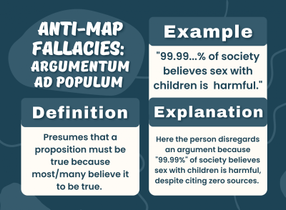
___________________________________________________________________________________________________
Brain Development, Maturity, and Decision-Making
 
But brain not developed


Actually, people's brains continue to develop and change until they are into their 40s, that is a known biological fact. Do 40-something-year-olds make inherently better and more competent decisions than younger people do? Get heavily involved in politics, and study voting stats in particular, and this ageist prejudice of yours will be gone fast. Also, get on a help line and give advice on a regular basis to people who are approaching middle age, or simply hang with many of them socially, as I do. I interact with many people in that age group in those manners, and trust me, dude, they make the same foolish mistakes that adolescents routinely do, despite their "superior" brain development. The only difference is, when older people mess up, we blame the incompetence on the individual; in contrast, when younger people mess up, we (meaning, our gerontocentric society in general) cast aspersions on the entire age group.
 
Also, younger people routinely display mental traits that older people are encouraged by our society to give up as they "mature"--such as creativity and idealism, as well as a greater willingness to embrace change, which is precisely why so little beneficial change occurs at a prompt rate in our society.
 
Also, realize that the exact same things used to be said about women prior to the late 20th century. Women were not even trusted to vote until the year 1920 due to their "over-emotionalism," nor to hold positions of authority for the same reasons. I'm sure you will say, "Well, maybe so, but society was proven wrong in the case of women, but they are right in the case of adolescents." Mmm-hmmm. These statements have no basis in science, but are pure exercises in cultural beliefs and masquerading as "conventional wisdom."
 
I suggest you do some heavy research on the origins of the social conception of adolescence, as well as the modern and historically unique paradigm of childhood, something a lot of enlightened 'experts' have not done, and something our society certainly does not encourage in the course of our education. So I have some book recommendations for you, all written by brilliant researchers who were not MAAs:
 
Teen 2.0 by RE, where you will not only study some genuine, extensive scientific research that proves young adolescents are perfectly competent in every ways adults are, and challenges the non-scientific notion that an "undeveloped" brain makes teens inherently prone to bad decisions, but it will also give you a historical overview of how the concept we today call "adolescence," and explain in detail how it didn't even exist until the turn of the 20th century, and how social and economic factors contributed to its conceptual emergence. One only need to search on Google for "myth of teen brain pdf version" for a PDF-formatted version of E's early '00s article _"The Myth of the Teen Brain"_ that led to his books which very effectively refutes the culturally-derived ageist rhetoric the mainstream public has spewed forth about this idea.
 
Harmful to Minors by Judith Levine. This extremely important 2001 book challenges the anti-sex conceptions surrounding youths  that have been going on since the beginning of the 1980s decade, and traces the historical development of the present ongoing SA hysteria.
 
Centuries of Childhood by Phillipe Aries. This book revolutionized the study of younger people by tracing the changing cultural conceptions of "childhood" centuries prior to the Industrial Revolution, and showing that how we perceive youths today, and their overall role in society, is a relatively recent invention related to the same forces that eventually created the concept of "adolescence."
 
Escape From Childhood by John Holt. Holt is a renowned and multi-award winning teacher who wrote the primer on reasons for treating youths as human beings instead of the equivalent of glorified pets, and his views should be studied.
 
Birthrights by Richard Farson. Published around the same time as Holt's first book--the 1970s--this tome is perhaps the earliest in the then-emerging youth liberation movement to be penned, and Farson's views are at least as relevant today as they were in the '70s, before the movement was derailed by the conservative takeover of the political sphere with the election of Reagan in 1980 and the rise of the SA hysteria, only to re-emerge in the late '90s with the advent of the Internet.
 
I recommend anyone interested in learning more to acquire the above books and read them to be exposed to scientifically objective views on this subject that go outside the typical cultural biases that are frequently championed.
 
Their frontal lobes are not fully developed, constantly changing etc. 
 
Empirical evidence and a lot of scientific research does not bear out any of what is said. Read the detailed studies of Epstein in "The Myth of the Teen Brain" and Teen 2.0 that challenges and refutes all of that nonsense.
 
I'm not saying teenagers are mindless being who don't know anything until they're adults. Sometimes they have much more insite [sic] and self-awareness. They are more able to change and create new and unique ideas. Their brains aren't fully developed, and so they make decisions based on how thier brians [double sic] are taking everything in.
 
Please read my above statements, as well as seek out the book recommendations I gave, and you will see how the attributes you praised them for above make a far greater difference than you may think.
 
Youths are prone to bad decision making:
 
The attitude that adolescents are inherently stupid and prone to making bad decisions has been challenged by good scientific evidence, including the recent groundbreaking work conducted by Dr. Robert Epstein and written about in his article "The Myth of the Teen Brain" that appeared in an issue of the highly respected Scientific American Mind (this can be purchased online), followed by the large extrapolations of that research which appeared in his 2007 book The Case Against Adolescence and its 2010 update, Teen 2.0. And before saying, "Well, this Epstein guy must not be a parent himself," please note that he is indeed a parent who has raised four children, and many other people in the burgeoning youth liberation movement are likewise parents, including people I know personally (and please also note that the vast majority of people in the youth liberation movement are NOT MAAs). There is very good scientific evidence that the brains of younger people are not inherently "flawed" in a way that gives them an inherent proclivity towards making bad decisions; this is just a more modern version of the once popular but now refuted claims that it was their excessive degree of "hormones" that made them prone to bad decisions.
 
Also, please consider: if adults were so inherently competent, enlightened, and "mature" (a subjective term if there ever was one) in comparison to people under the Magic Age, then we wouldn't see the huge amount of racism, sexism, business mismanagement, political incompetency, and resistance to needed change and repetition of errors in running the country--not to mention older people frequently voting against their own interests in contrast to younger people, who far more often are known to vote for change--that we presently have to deal with, and the world we live in today would be a far better place than it is. Remember which age group runs the institutions of the world today, and remember which age groups' input is left out of all management decisions entirely, before making these ageist assumptions.
 
The fact that they would need someone telling them if a relationship is good for them or not kind of points out that they aren't mature and old enough to make good decisions on their own and probably shouldn't be having relationships with such an imbalance of power.
 
I don't think children need to be told these things; I think they need to be listened to when they say they receive enjoyment and pleasure from a certain type of relationship or activity, rather than having some adult with power over them making the decision for them based on a combination of sentiment and ageist assumptions. I recommend you read the Rind Report and the results it found.
 
The reason a power imbalance exists in the first place--or at least why it's as pronounced as it seems--between at least older children (say, six and up) and adults is because of the legal situation children presently find themselves in, and the way our entire society has every interest in keeping them servile to the gerontocentric dictates of our culture. Further, it's virtually impossible to have any type of relationship without some degree of power imbalance between the two people in the relationship; men used to always have more power than women did, a rich person can be said to have more power than a non-affluent spouse who is economically dependent upon them, etc., et al. We only see power imbalance as a problem if it has to do with age, and younger people are well known to be capable of manipulating older people to their advantage.
 
This transformation must maintain all of our progress on individual autonomy and well-being (as opposed to when girls were married off at age 13, for instance). It assumes regret at sexual activity that is not understood at the time will vanish without other ill effects once society is tweaked the right way.
 
It presumes that this "regret" issue you tout so strongly will not occur to the point that it's absolutely devastating to any girl (or boy) who may experience it, certainly not to the point where it obstructs their ability to function later in life. It further presumes that a more open and less oppressive society will no longer have a political or cultural motive to push sociogenic-oriented "regret" on people for their various choices. It also presumes that regrets and mistakes can be learning experiences that can actually enhance a person's ability to function and avoid making similar mistakes later in life, rather than result in crippling emotional dysfunction. We simply do not believe that the concern over possible regrets in any way justifies an oppressive prohibition of choice that is based upon assumptions or "just in case..." scenarios, and punishing innocent people of all ages for something that hasn't even actually happened, but simply "might" someday. 
 
"A youth under 18 [especially a girl] is more likely to regret a liaison with an adult than someone of a comparable age."
 
And that's a reason for total prohibition of choice? Many choices we make throughout life have the potential to come with regrets, but this is how we learn and grow, and why we educate ourselves to learn all the facts so that we can make the best possible decisions as individuals. This also ignores the fact that great regret can also come from things that you choose not to do, as opposed to things that you choose to engage in.
 
Regret may happen at any age, but there are some dramatic gradients with age.
 
This is proven by what scientific evidence? This sounds like it can be yet another belief attributed to the alleged frailty of youth, much as similar beliefs in the past held that women are more vulnerable to emotional traumas than males. 
 
If a girl develops feelings for an adult male, she will cling to him forever or for life
 
One of the most persistent but non-nonsensical social myths attributed to intergenerational liaisons is that if a girl develops feelings for an adult man, it will be forever, and she is thus taking an immense emotional risk with this bond since the GLer will "inevitably" toss her by the wayside once she ages out of his (or her) preferred AoA (age of attraction, for benefit of newbies).
 
That part of the common narrative used to deride the validity of such relationships willfully overlooks the fact that it's not the girl, but actually the adult, who takes the bulk of the emotional risk. Younger people change remarkably fast compared to the typical adult, and their emotional needs and bonds - particularly of a romantic sort - tend to be quite mercurial and fleeting. They naturally move on quite fast as their emotional status and needs change and evolve from month to month.
 
It's a difficult thing that MAPs have to adapt to, and in a world that allowed our relationships to fully flourish, this type of emotional compensation and consideration for the fast-changing nature of girls would need to be taken into account.


That common assumption, brought up in the excerpt you presented, is one I've confronted and taken apart numerous times before: That somehow, a girl whom a pedophile (or hebephile) forms a relationship with will never lose interest in him (or her) first. It's readily accepted in our culture that relationships formed between young people and their peers often tend to be brief due to how fast young people change and move from one such emotional connection to another. Yet, this strangely persistent belief insists that for some reason, if a girl forms a romantic liaison with an adult, it will be one that the girl will automatically hang on to for life, until the MAP loses interest in her first.
 
Part of this assumption seems to develop from the culturally enforced and ingrained attitude that the only real and valid relationships are monoamorous pairings that last for life. It assumes that the dynamics of intergenerational relationships must necessarily follow the normative blueprint expected of adults in contemporary society.
 
Of course, this assumption only occurs because there are very few open intergenerational relationships to compare to normative relationships between two adults, and those few that do exist only do so because they occur within the bounds of monogamous matrimony due to being allowed by parents. And these pairings almost always have the younger partner being an older teen who was near the age of majority when she received permission to marry (otherwise, state law likely would not have allowed it even with parental permission).
 
Nevertheless, this novel appears quite transgressive and provides a hint towards a fundamental shift in public consciousness gradually occurring. The author is to be commended for her courage in questioning one of the most emotionally charged beliefs in contemporary Western society, and for putting truth before popular sentiment.


Susan's data did not determine that young girls receive a disproportionately greater degree of heartbreak if a romantic relationship with a significantly older adult ends for whatever reason than if a similar relationship with a peer ended. There is no logical basis for that assumption.
 
And for the record, I too have seen the fallout from heartbreak, and it should be known that adult lovers receive the same degree of heartbreak that young girls would potentially feel in the event of a break-up, and girls very often lose interest long before the adult would have. I haven't exactly lived in a cave my life, I've seen it all just as you have.
 
I honestly think that you overcompensate for females in a general sense when dealing with issues like this, and you tend to see them as both requiring and deserving of greater consideration for their feelings than males, even though many girls and women are quite resilient emotionally, and are not intrinsically "weaker" than their male counterparts emotionally. This is not a form of respect, but rather a form of pandering. Sometimes, however, the illusion of greater female emotional vulnerability is created because girls are allowed by our culture to be more publicly demonstrative of their emotions (such as public outbursts of crying, as opposed to doing it behind the scenes) without being ridiculed or feeling uncomfortable, unlike boys and men, who are expected to look and act "tough" even if they aren't.
 
Also, let's be honest here: many girls and women are inveterate drama queens, and will milk a break-up or any emotional experience for all it's worth due to a desire for attention. Why? Because it often works, as you can readily attest when you offer your shoulder to them. I am NOT trying to trivialize the real pain many of them feel when they experience a break-up, especially when I have felt that same type of pain all too often myself, but I am also not going to pretend that many of them don't love drama as much as anything else.
 
And once again, you seem to outright assume that the girl is taking the bulk of the emotional risk in such a relationship from the get-go, as if it's far more likely that the man in the hypothetical situation will lose interest in her first, or that she will bond with him monoamorously for life, or worse, that she is totally incapable of dealing with such a break-up if and when it happens for whatever reason. You need to read Susan Clancy's book The Trauma Myth, which partially touches on this point (even though the general theme is recovery from sexual abuse), and Clancy sure as hell doesn't like MAAs! Do you see what I mean when I caution you and others against overcompensating when endeavoring to come off as caring and considerate of girls? I think we do a better job of showing care and consideration for them when we respect them and their capabilities rather than coddle them for their perceived weaknesses and vulnerabilities--which is precisely the core basis of the stigma directed at us in the first place. Again, I do not say this to be condemnatory or argumentative with you, but simply to give you some perspective, which I know you are capable of when you aren't in one of these moods of yours.
 
Actually, based on discussions I had with Humanist in the past, it probably is a good idea for many MAAs (I will never say all) to practice polyamory, because young people change quite quickly. It may be best for both partners of age disparate relationships to consider polyamory, and not for the sake of the younger person's emotional well-being only. Why do we, of all people in society, carry this assumption that the only true, legitimate form of love must be both monoamorous and for as long as the two shall live? Love can take many different forms, and as long as both parties are honest with each other from the onset, there should be no reason to judge them for simply admitting what they feel is best for them.
 
And once again, this popular assumption rears its absurd head: If a 7-year-old girl falls in love with an adult man, she will remain in love with him for life, and she will never naturally change in such a way that she grows out of the romantic aspect of the relationship and "move on" long before she grew out of her hypothetical older lover's preferred AoA.


One of the strangest and most bogus but persistent social myths I've often seen used against the pro-choice stance is the very non-empirical belief that if a younger person falls in love with an older person, it will invariably be forever, with the expectation that the adult will be with them for life. Younger people don't even typically do this in relationships with peers very often! The expectation that they will for some reason breach this common social protocol with adult partners, and inevitably form an ever-lasting romantic monoamorous bond with an adult they fall in love with, and then become emotionally devastated when they eventually age out of the adult's preferred AoA (age of attraction), only to then be "dumped" by the adult (always unceremoniously and capriciously, in the eyes of the strange anti narrative) is one of the many non-nonsensical beliefs used to rationalize the complete prohibition of intergenerational relationships. Specifically, this strange claim that younger people tend to emotionally bond for life with adult partners they take a fancy to when it's commonly observed that they rarely do this with peers is intended to foster the belief that the younger person takes the greater emotional risk in a romantic relationship with an older person.
 
To quote my British friends again: This is pure bollicks! In fact, due to the fleeting nature of typical youth romantic attention, adults who formed relationships with them may actually be incurring both a huge emotional risk themselves and harboring unrealistic expectations if they hope for a permanent monoamorous pairing. Because of this, it's been suggested here before that ideally MAPs should consider being polyamorous in a hypothetical future that allows intergenerational relationships. Those that would disparage such an approach are, of course, those who adhere fully to the current societal narrative that the only legitimate romantic relationships are those that are life-long monoamorous pairings. This sort of arrangement works for many adults, but it does not work for many others, who tend to have a natural inclination towards polyamory. This is natural, and has nothing to do with psychological "commitment issues" any more than a homosexual man suffers from "issues with women" that can or need to be corrected by therapy.
 
The fact that monoamory/monogamy is pushed so strongly on all of society as the only acceptable norm when it comes to romantic liaisons is, I believe, one of the major factors behind the high divorce rates. Clearly, it's not a realistic expectation to either place upon youths, or to insist they are naturally inclined towards monoamorous bonds with an adult they fall in love with when they don't often do this with peers. There will, of course, be youths who do benefit from life-long monoamorous pairings, and they should always be given a choice rather than forced or expected to adhere to any specific type of romantic lifestyle, but it certainly doesn't seem to be a natural "norm" for them. They only seem to aspire to forming monoamorous bonds because everyone in our culture is heavily criticized if they do not. 
 
I think it's a legitimate concern especially for people with specific ages that they're attracted to. If someone is only attracted to girls that are 8-11 will they continue to date that person when they are 16 even if they are not attracted to them.
 
This is indeed a legitimate concern. But assuming the younger partner in question is going to retain their feelings for the older person for all of those years is a mighty huge assumption. And anyone who feels comfortable making such an assumption is either overcompensating in favor of younger people, or has yet to grasp the very empirical fact that young people often change much faster than the typical older person.


More discussions I've had about this concern:


Obviously people don't fall in love and live happily ever after, but that is a goal for relationships isn't it? To find the person you want to be with forever.
 
That is the goal and expectation that our society sets up for everyone. But we should all know better than most that a one-size-fits-all type of relationship cannot work for everyone who belongs to a species where the only rule when it comes to love and desire is diversity. Some people, and perhaps many within a certain group more than others, are better suited for polyamorous relationships than monoamory, and we should not consider only the culturally crafted norm to be legitimate for everyone. When we do, we simply guarantee that a huge percentage of people will most certainly not live happily forever after, because they find themselves stuck in a type of relationship they are not suited for individually.
 
How do you know it will be the girl breaking it off? What if they man no longer finds her attractive and decides to go look for someone in his age preference. Are you saying that men just don't do that? It's always the girl who decides to break it off? I find that hard to believe. It's completely possible the girl will break it off, just like it's completely possible the man might break it off.
 
Indeed. We should never assume either way, but encourage everyone to be self-introspective and honest with any potential partner when it comes to this.
 
There is a lot of divorce, but those people go into the relationship at least looking for a life-long partner. I also think that couples as they get older aren't always totally attracted to their partners and stay with them because of personality. I was wondering if this is also the case with people attracted to certain ages. Will you stay with a woman when you really want to be with a girl.
 
I think in many cases, the answer to that is yes. As you noted, when people have built up a bond formed by years and years of mutual trust and support with each other, then it's likely a form of romantic love will remain even when both partners begin losing their physical appeal to the other. The physical appeal is most important for many only in the early stages of the relationship.
 
I'm not throwing MAAs in the role of villians I'm asking a legitimate question. If you were with a girl and she ages out of the range that you are attracted to, will you stay with her? How do you get past your lack of attraction if you do stay with her? If you know once she reaches a certain age her personality will not be what you're looking for is it fair to date her? From what I can tell you are saying yes you would stay with a girl even though you aren't attracted to them. Is that right?
 
I think in lieu of these concerns, all MAAs and youths--in a world where such relationships were legally allowed, that is--should strongly consider if polyamory is best for them for all the reasons you mentioned. We should never, as a society, impose the expectation of a lifelong monoamorous pairing for everyone.
 
They are intelligent and mature enough to deserve the full spectrum of rights adults have, but seem too stupid and immature to liberate themselves.
 
This is dirty pool since it's attacking MAAs on the basis of so many unrelated issues, this proves that Antis who make this argument are as vindictive and carry grudges over disagreements, not to mention resentments, at least as much as you have ever accused anyone else of doing against you.
 
Saying that they are "too stupid" and "too immature" to liberate themselves is playing "dumb" to justify moralizing stances and support the status quo (you know, to clean up your "image" in the eyes of the greater society the Antis want the approval of so badly), when they know damn well that no oppressed group were ever able to entirely liberate themselves without the help of people who were part of the 'majority' and were able to exercise their full civil rights. I guess blacks, women, and homosexuals were too "stupid" and "immature" to liberate themselves with the help of the abolitionists, and the civil rights activists outside of their respective community during the 1960s.
 
This whole attack by Antis is based on a vindictive resentment towards themselves coupled with the manner in which they enjoy taking it out on the whole community via projecting your own fears onto the rest of MAAs, and by interpreting every thing MAAs say in favor of choice as simply wanting to have sexual access to youths, and a belief that some of them would take that choice as a belief on our parts that millions of youths are "clamoring" for it. Antis who say this frequently misread and mis-interpret at will, and hypocritically accuse others in the community who do not have the type of self-hatred and reverence for the status quo paradigms of creating straw men when they defend themselves from their attacks.
 
At any rate, I can agree that youths should be allowed to test out of minority status; the mechanisms should be in place for those youths who have both the desire and the ability to do so. But we've been over that before. What I don't agree with is us imposing our own labels and descriptors onto them. That has nothing at all to do with youth liberation. Nothing.
 
It has nothing to do with "imposing" anything on them, because EVERYONE in EVERY community are free to choose to use or NOT use the word as they please.
 
And FYI, it has everything to do with liberation to offer an identifying label so they no longer feel alone, and realize many others have that preference. The fact that I politely and respectfully acknowledged and accommodated all of your concerns means absolutely nothing to you, and you continue to react antagonistically while claiming otherwise. And it's all because you are a bitter little emotionally disturbed person who loves nothing more than finding new excuses to lash out at the people who understand your situation, care about you, and offer their shoulders to you the most in this world, and even when they very clearly DO listen to you respectfully and show consideration for your concerns, as I did. I try to show you special consideration at times because I know how messed up in the head you are, but I am never going to treat you like that gives you license to be a jerk, because these constant fights you start with your accusations based on your deliberate misreading and twisting of the words of people who harbor an ideology you dislike becomes unforgivable at times. The more people pat you on the back when you act like this out of deference for your mental problems, the more they give you the message that they approve of this type of behavior, and they then wonder why this board has so many drama queens who lash out at everyone here. Guess who serves as their inspiration to act that way?
 
Was there any reason you couldn't discuss this matter respectfully, like I tried to? Was this particular subject really worth fighting tooth and nail over? Did you really have to prove me right in my prediction, just like I have little doubt at this point I will be proven right that you are going to look foolish over fighting so harshly over this matter in a few years from now?
___________________________________________________________________________________________________
Appeal to Popularity


1069c3b30dad7b4378026130c2afe2ac.png
 
"My view is held by just about all the professionals in the field."
 
This is blatantly incorrect. Read Okami, Rind, Tromovich, Green, Bauserman, Sandfort, Franklin, Bailey, and Riegal... just to name a few. The fact you disagree with many professionals doesn't invalidate their status in the field. If you choose to make statements like this, then you can't expect your stance to be based on valid evidence as opposed to what you choose to believe. 
 
People who have been thinking about these issues for a long time are unlikely to change their views, because new evidence is so rarely truly new and astounding.
 
This is giving them too much credit. It's because such evidence is so often suppressed with censorship or (in one famous case) every single conservative and liberal in Congress voting to unanimously condemn a peer-reviewed meta-analysis that has stood up to subsequent scientific scrutiny. Or those who publish such studies being threatened to have their jobs taken away (as Harris Mirkin did), or even receive death threats. Or because mainstream outlets generally refuse to publish articles that might piss off their sponsors, who pay all the bills and thus control much of the discourse. While we're on a roll acknowledging the empirical evidence of how our media and culture works, the one you see yourself as a beneficiary of, let's make all of that clear.


aa64420af9a45d822686fccb64e13577.jpg
 
So, yes, people tend to continue thinking a certain way when dissenting voices are suppressed and silenced, and thus easily overlooked even when they do get published. People are also notoriously resistant to change no matter the evidence presented.


Just ask Judith Levine when she attempted to publish Harmful to Minors; Carl Toms when he attempted to publish Michael Jackson's Dangerous Liaisons; Bruce Rind after he published the Rind Report; Harris Mirkin after he published his article "The Pattern of Sexual Politics: Feminism, Homosexuality, and Pedophilia"; and when Susan Clancy attempted to publish The Trauma Myth. All of the above eventually got published, and all paid the price for doing so either during the publication process, after publication, or both. 
 
"Most people also agree that sex with youths is wrong and shouldn't be allowed.
 
See, here is the point you and others of the anti ideology (during the months where you play the "concerned anti" role, that is) refuse to make when you say, "The vast majority of adults currently disagree that they cannot make informed choices when it comes to sex, so..."
 
Since you are an intelligent guy who is well-versed in both history and progressive politics, you are well aware of what that statement really means when it's constantly used: "Since the great majority of adults feel that they  cannot make informed choices about sex, and adults currently dominate society, including both its government bodies and social institutions, that automatically makes them right by default as far as I'm concerned. The dominant groups in society have always enjoyed power over others, including today, so you need to just get used to it." This translation takes some words paraphrased from you to me during this discussion over the past few days, and I included them because they are very revealing, not to mention very relevant.
 
You are clearly playing a P.R. game to appeal to the consensus mentality whom you desperately want to like and accept you for what you think if you believe they cannot do so for what you naturally are. This is the crux of the guilt and shame the status quo of today has inflicted upon you for your feelings over the course of your life, and this is what you hope to be the solution. It's a variation of the "go along in order to get along" tactic. It's an acquiescence to the way things are, which you perceive to be the more expedient means of gaining acceptance, which in turn you hope will alleviate the turmoil you fear over the societal rejection you have received. It's a rationalization for joining the mob to stop the mob from hating you, if you perceive that the mob controls society.
 
The only way people can take these statements of yours seriously is if, 1) They do not know you well enough to know how intelligent and well-informed you are, and, 2) They have no idea of the history of your emotional health, and how you have chosen to deal with it over the past several years. This is not an ad hominem, nor is it irrelevant to any discussion of this topic in which you are engaged, as you have told me before; to the contrary, it's a very relevant point that is not intended to insult, but to open your eyes to what is going on here, and an explanation as to why I and others refuse to let our sympathy for your pain cause us to overlook this game you're playing both with us and with yourself. Bottom line, we know you're not stupid, and you know we aren't stupid either. Being straight with you is not the same thing as trying to insult you or because we lack sympathy. Not everyone you meet, in or outside of the community, are going to be "bleeding hearts" who allow you to use sympathy against them so that they will feel like a "jerk" for not telling you like it is.
 
Everyone who is well-versed as you are in progressive politics--which is many of us here--are well aware that the "consensus believes this" excuse has been used against other minority groups in the past to justify their repression, and it has repeatedly proven far more the result of cultural manipulation rather than anything to do with scientific validity. We all know that the great majority of the dominant white population in the West believed that black people were inherently less intelligent than whites, to the point of being unable to learn to read and write, and thus deserved to be chattel slaves or prevented from becoming doctors, lawyers, scientists, educators, etc. The fact that it was illegal for black people to try and learn how to read and write in the first place helped bolster that once common belief, which was a major case of dirty pool on the part of the majority.
 
The fact that the great majority of the dominant culture once believed this in huge numbers didn't make it correct in an intrinsic sense. It only made it "right" in a by default manner.
 
The fact that they are currently raised to be as ignorant about sexual matters as possible for as long as possible, and lack the civil rights to legally prove whatever capabilities they may have as both individuals and as a group, will obviously create the appearance that they are "naturally" ignorant and ill-informed about a variety of matters. This is another case of dirty pool that has nothing to do with scientific validity. That's why you argue against a major challenge to societal institutions as they current stand.
 
You know all this, but you don't care. You also know but don't care that various minority groups have argued that their case is more valid than that of other groups. I'm sure you have heard as often as I have black activists who are blatantly sexist and homophobic, who insist that there can be no parallel between the plight of black people in general, and women and homosexuals in general. There are all the expediency-minded homosexual activists today who claim the situation now facing MAPs and youths alike has no parallel to their political situation. We've met our share of BLer's who have insisted that man/boy love is more inherently legitimate than man/girl love, and female GLer's who have insisted woman/girl love is more legitimate than man/girl love, and our share of GLer's who rejected the validity of BL due to homophobic attitudes.
 
In fact, I used to see you spout a lot of PC-oriented accusations that this board was festering with GLer's who hate women, while ignoring the large number of women activists who are against youth rights and routinely make highly bigoted statements against MAPs. But that's because, again, you consider the rights of one minority group to be more legitimate than others without considering that you're indulging in the same type of bigotry. You pick and choose which groups you consider to have a legitimate claim to rights, with an overblown support of some and a rejection of others, based on which has greater emotional appeal to you.


Researcher quote: "Yes, there are some MAAs that seek the dismantling of age-of-consent laws and that society accept their attractions. But most are like Adam and they want to control their desires."


See, here is what this researcher fails to understand, which proves that he/she needs to talk to a lot more MAPs, including the many who support the pro-choice and pro-youth rights ideology, before making these pseudo-professional pronouncements. They need to stop limiting their research to the guilt-ridden, self-hating category of MAP, and start engaging not only with the wider community, but with the large amount of research data that does not in any way scientifically validate the "abuse" narrative.


Moreover, this statement once again seems to promote the banal assumption that MAAs who support freedom of choice and oppose the AoC laws out of principle are routine law-breakers and have no inclination to "control" our desires. To the contrary, most pro-choicers adhere very strictly to the laws despite how we feel about them out of principle, because we believe it's very unwise for all concerned on many levels to brazenly violate these laws. We also feel it's necessary to make this major compromise with society, while working hard to prove we are human beings and seeking to make progressive changes in many laws by working within the system. 


When supposedly well-intentioned researchers make offensive statements like this, they need to realize they are going to alienate many in the MAA community. They are pushing a doctrine of pathology and self-hatred on MAAs based on a rampant moral belief system, not information that has anything to do with science, or reality. There are many objective scientifically-minded researchers out there studying the dynamics of the MAA attraction bases, but they are drowned out by the voices of those who irresponsibly push the political agenda of pathologizing MAA sexuality, ignoring how common it actually is despite the social taboo and legal prohibitions regarding it. These less responsible and politically motivated researchers push this inaccurate doctrine because they know that the moralizing majority wants to hear it, even if the scientific community doesn't have their back on the matter. 


The rest of this discussion here:


www.annabelleigh.net/messages/594069.htm


Note that there are many signs that this trend is beginning to overreach, and it's at the point where people outside the MAA community who are simply concerned with either civil rights in general--e.g., Lancaster--or youth rights--e.g., Epstein--are starting to rise up in opposition, and we are beginning to see a number of books questioning the extent of sex offender laws and laws that restrict younger people on an entirely arbitrary basis:


www.annabelleigh.net/messages/560679.htm


Go here, the page featuring the Declaration of Principles for ASFAR (Americans for a Society Free from Age Restrictions), a youth liberation org that has existed since 1997 and has nothing to do with the MAA community. Next, scroll down to ASFAR's section on Health and Sexuality for youths, and note the following position statement that I will excerpt below in bold face:

9.4. Laws fixing a minimum age of sexual consent should be substantially reformed to protect the mutually consensual behaviour of young people. While recognising that circumstances make such reform currently impossible, ASFAR hopes to eventually replace age-based sexual consent laws with an individual-capacity standard.

As you will see from checking out the entirety of ASFAR's Declaration of Principles, the age of consent laws as we know them today are but one of many arbitrary age-based restrictions that the org opposes, the same with this community--most of us on the pro-choice side of the fence supports comprehensive civil rights for youths, not just sexual rights.


Society and the average citizen views MAA attraction and its affects negatively


We have all seen how society and the average not-exactly-well-informed, media-bamboozled citizen views pedophilia and what they believe its effects to be (contrary to the evidence they almost never bother to peruse, and usually scoff at when they do). All we need do is read any magazine, watch any talk show, or read the newspaper every single day, for the last 30 years; and of course, we have your charming rhetoric to remind us every day just in case we come where without getting a chance to read the morning paper or catch the latest airing of the current popular talk show that does a typical pedo-bashing episode in between equally enlightened topics like "Is my girlfriend a hoochie?", "Does my teen daughter dress too sexy for her age?", and "Which of my ex-boyfriends is the father of my child?"

And its true effects are to challenge the power structures and prevailing paradigms of society that presently give adults a powerful legal & political advantage over younger people and which insists that anyone under the legal age of adulthood--particularly children--must be treated as being entirely asexual, respectively.

 
That is a party line based on lots of questionable assumptions. Any individual pro-contact person may drop away from the community if they look at those questions honestly and decide it doesn't add up.
 
It only doesn't "add up" when you look at the available data and personal experiences through emotional lenses, rather than rational and objective eyes. We've all had over three decades to read, consider, mentally digest, and analyze all of the available data, as well as what can be gleaned from numerous personal experiences and observations, and to ask ourselves all of the relevant questions over and over again ad nauseum. And we've decided, plain and simple, that the emotional beliefs that demand continued support for the prohibitions are what do not add up. 


Many MAAs feel that Adult-minor sex is bad


Because they have been indoctrinated by 30+ years of negative misinformation, and often only heard about GC (and BC) via those who only spoke on the subject in mainstream terms... and who gave a lot of misinformation about boards like this too, including on horrid cop shows like SVU: Special Victims Unit, who claimed very incorrectly and insidiously that boards like this demand that those who register produce illegal CP as "proof" of who they are. Further, they most often came of age during the previous three decades and had no idea that alternative opinions and good scientific evidence that refuted the prevailing mindset existed. So is it any wonder they would be "horrified" about places like this based upon what they heard all of their lives, with no access to alternative views and objective scientific data?


As I have said before, this is something that is to be expected when they have grown up bombarded with the consensus view, and rarely if ever saw any alternative view, their entire life or a large portion thereof. Also, many of them are afraid to openly oppose or contradict the consensus view on particularly hot button topics for strictly political reasons, something has been the case with regards to many different subjects that were once similarly hot button issues in past eras.  

But now, more Non-MAAs than ever before since prior to the 1980s have started coming out of the woodwork who are advancing more progressive and/or "agnostic" views on the matter, often risking vicious moralizing attacks that demand they lose their jobs, lose their publication deals, and sometimes even threats to their lives. It quickly becomes clear which side the actual integrity comes from, as opposed to expedient "yes-man" complicity that is far less risky to propagate in the current climate... and which makes heroes out of unbalanced individuals like Mr. Xavier Von Eide and Chris Hanson. The tactics espoused by the likes of Hanson and Xavier had begun losing steam in the U.S. (though still quite popular right now in the U.K., it should be noted). In fact, I personally know some Non-MAPs who tell me that they question the anti-choice side precisely because of who their most outspoken heroes appear to be.

___________________________________________________________________________________________________
Research, evidence, and studies


Research


No one has yet as provided me with something that proves your view as a fact. There are papers that would disprove/contradict the anti-choice view, but I need conclusive proof.


There are, in fact, studies that contradict the anti-choice view, and not just the famous (or infamous, take your pick) Rind Report, and all the work of Paul Okami. As cited here before, read Allie Kilpatrick's Long-range Effects of Child and Adolescent Sexual Experiences: Myths, Mores, Menaces whose meticulously collated scientific data was published during the heyday of the current hysteria, no less (it's a bit pricey, but worth picking up).

The anti-choice view is based on very emotionalistic beliefs that are backed up not by science, but blanket assumptions; an overall cynical assessment of the human species that they believe should be incorporated into law; a nearly fetishistic love of the ideas of vulnerability and the egoistic need to play "white knight" to any perceived vulnerable group; and a stream of popular anecdotal stories and narrative. They want to be popular, accepted by public sentiment at large, to have someone to play savior to, and the MAPs among the anti-choice ranks have an often desperate need to alleviate the shame and guilt that has frequently assailed them.

You will note that many of these individuals harbor similar attitudes over other perceived vulnerable groups, particularly women, even though they fully realize that they cannot argue against the progressive progress that has since rightfully awarded adult women full legal equality... they they do still insist upon playing "white knight" to them at almost any given opportunity. I strongly suspect that if the conservative backlash which occurred post-1970s in the U.S. and U.K. that took over the Western mindset and sent the once brave liberals running with their tails between their legs to morph into the "centrists" they are today, had occurred sooner in history - and thus derailed social progress many years earlier - we would see these same "conservatized" liberals arguing that women needed to be denied full sexual agency so they could be protected and nurtured in safety; and the same with younger people in the 18-20 year-old range (thankfully, their right to suffrage was granted years prior to that conservative takeover!). Since that didn't happen, they realize that they instead have to resort to demonizing male sexuality and general character.


Research I found shows that Incidences of positive intergenerational contact are rare or nonexistent


Scientific texts mentioned and cited in this composite of texts, including the extensive study conducted by Ally Kirkpatrick (which preceded the Rind Report by several years), makes it not only clear that such incidences of positive intergenerational contact are not nearly as rare as we like to think - with girls as well as boys - but that many researchers put their moralistic values ahead of the objective empirical observations when purporting to compile data on this and other emotionally charged subjects.

Further, it's also well known that any such mention of positive encounters in the media, or vis-a-vis an autobiography, are typically subjected to vicious assault and attacks, often forcing the author to "back down" and apologize. Let's not forget what happened recently with Lena Durham when she simply mentioned experimenting sexually with her younger sister when she too was younger in her autobiography. Know this is not a climate where the topic of positive intergenerational sexual experiences can be comfortably, safely, or objectively discussed without heavy degrees of suppression and vilification, not to mention the legal repercussions and witch-hunting that could ensue. I'm frankly glad Ms. Durham didn't end up on a sex offender registry for her youthful revelations!

Finally, no minority percentage is insignificant or worthy of dismissal simply because it's perceived as being small. This is an insidious excuse for continuing oppression that is often promulgated by the anti-choicers, and I'm sure the vanilla gay population is quite pleased that this attitude is no longer applied to them (since they "only" make up a fraction of the total global population).


The Studies


General
 
I think your studies are cherry-picked
 
Says those who promote only researchers who says what they wants to hear, and whose research is given wide focus simply because they are "safe" for the sponsors while many others who come to conclusions that may suggest a change in the status quo is required are marginalized.


More of my refutations of the cherry-picking argument:


I don't agree with your interpretation of the research and studies.


Those who say this should just come right out and say, "I don't like the worldview you represent and I do not care if it might make a better world, or if younger people actually do deserve their full set of rights as people, or whether or not they can actually handle it! I don't want that, and neither does the majority I long to be accepted by, and damn it, we're going to do everything we can to delay any possible change at least for the duration of our lives!" That would at least be honest.


I expected one of your ideology to come back with no other reaction after reading (more likely, skimming) through the article. If the data collected does not meld with your ideological stance, then you dismiss it. When scientists with an objective mind do not defend emotionally driven ideology simply because it's popular when their data doesn't substantiate it. If a MAP happens to point that science out, as written and collated by the scientists, then they're being "selective" and using it for "their own ends" simply on account of the fact that they may benefit in a way that is inconvenient for the main party line of the status quo.
 
The point is, the information I mentioned is there, for those with an objective interest in the data as written by those who collected it. I don't expect you to be objective or to be convinced by anything science says. Others of more objective concerns, however, will see which of us is being selective, considering how you ignore major portions of recorded scientific analyses. 


The evidence we present is not based on belief on our parts, but conducted and written by diligent researchers who were not MAPs, and were therefore fully capable of "stepping outside" of the MAP attraction base, and were willing to use proper scientific methodology that was bereft of a priori assumptions and fully peer-reviewed, such as Bruce Rind, Paul Okami, Theo Sandfort, Richard Green, and several others, which is all readily available. You have not looked at this evidence objectively, since you have repeatedly referenced books that are notorious for research bias and faulty methods, along with putting a huge amount of credence on the emotionally-driven, venting rhetoric of SA survivors, which the FBI itself has admitted in readily available statements were likely not actually SAed by MAPs at all, but opportunistic adults who had the largest degree of power and authority over these minors, a situation which the law currently enforces rather than inviting reasoned debate on; and the validity of the "damage" done to the typical minor who has endured SA has been challenged very adroitly by Susan. All of your statements are based on belief, assumptions, purely anecdotal, and emotion, never any scientifically verifiable evidence, or even simple common sense. 


Since the consensus is believing an inherent universal truth, it must be an inability to step outside the attraction that has resulted in the majority of MAPs actually paying attention to the objectively produced scientific research rather than following the mainstream societal opinion of the present era." Mmmhmmm, then I wonder how the above mentioned researchers, and all of those Non-MAPs who have questioned the hysteria, managed to step into the attraction, so to speak--or at least avoid the assumptions that obscure reasoned discussion of the topic.


Science hasn't settled the matter/studies are inconclusive


Neither pro or anti-choicers has ever claimed that science has "settled" anything. It has been stated that what scientific data has been properly collected doesn't favor the current consensus view, and that is accurate. 


Science hasn't "settled" the matter. What it has done, however, is make it clear that the available scientific data which has been cultivated in an objective, peer-reviewed manner using proper scientific methodology thus far does not back up the commonly held beliefs. Rind said this quite clearly, as did Bailey when he noted that while available scientific data is "not definitive," that which does exist "...does not convict the MAA." In other words, more scientific research certainly has to be conducted, but that which has so far been collated properly does not in any way suggest that commonly held beliefs have a basis in fact.


I think the studies are fabricated


Regular objective research contradicts everything you and the rest of society say here, and all you do is dismiss such research as being "obviously biased." What purpose would a non-MAA sociologist like Susan Thompson have to doctor such information? Rind sure benefited from his position on this issue, didn't he? There is nothing to gain, and much to lose, when speaking truthfully about the data gleaned from researching this subject objectively, that's for certain. Please consider this the next time you attack your own community and treat girls like the equivalent of emotional china dolls. I am not going to defend you or tolerate that behavior when I see it from you like too many others here do out of deference to the genuine pain you have suffered in the past. I sympathize with you too, trust me I do, but there has to come a time when someone has to put their foot down with you about it and let you know how insulting you come off to both girls and members of your own community when you act like this. And if that person must be me, then so be it. I will continue to support you, both on and off the board if you need it, but I will also call you on your regular insulting behavior around here whenever you are hurting.
 
I need a more specific reference as in a quoted passage -- relating to prepubescent girls choosing sexual activity for its own sake and the rest of society approving of that.
 
I am talking about choosing sexual contact with an adult, or even peers, because they were attracted to and trusted the person they chose it with. And did not fear extreme repercussions by adults who controlled them for making such decisions. By enforcing asexuality on youths, obviously you are creating a society where they cannot be open about it.
 
Secondly, just because you may have a day off on the weekend doesn't mean that counts for other people's jobs. I am not going to put that much of my paid work aside to flip through hundreds of pages of text to find specific quotes. What I am going to do, for those who are willing to take the time to do the reading and are actually objective I will provide links to numerous articles that IPCE has collected on this topic that appeared over the years in many respected peer-reviewed journals, including the Journal of Human Sexuality.
 
https://www.ipce.info/library_3/files/ch_sx_dev.htm
 
https://www.ipce.info/library/web-article/historical-roots-sexual-oppression
 
Now, read the important studies by clinical psychologist Allie C. Kirkpatrick, who has researched child sexuality from a variety of avenues, including interactions with adults, albeit including a rare but crucially important focus on girls, rather than exclusively boys; and including pre-pubescent girls rather than limiting the study to adolescent girls only.
 
https://www.jstor.org/stable/3812441?seq=1#page_scan_tab_contents
 
The abstract of this particular article sums up much of her conclusions: "Some of the findings challenge commonly held beliefs and have far-reaching implications for the helping professions and others who study human sexuality."
 
It's pricey to download, but there are ways of getting past a paywall that I am not going to share here (it's not hard to find via Google).
 
And then there is this very important book by Kirkpatrick: https://www.amazon.com/Long-range-Effects-Adolescent-Sexual-Experiences/dp/0805809147/ref=sr_1_fkmr0_2?s=books&ie=UTF8&qid=1534021780&sr=1-2-fkmr0&keywords=Allie+C.+Kilpatrick+-+childhood+sexual+studies
 
Again, pricey to buy, even in digital form, but less pricey used versions are available from independent sellers, and it's more than worth the price. At least, it will be for those who want to do an objective reading on the topic.


The Rind Report


Even if the correct numbers for females were exactly at the male level, those numbers are 33% negative at the time, 26% negative later. They are still quite significant. Whenever I've had a sexual experience in my life, I've made sure the chances are right down around 0% that the woman is viewing it as a negative experience at the time.


First of all, nowhere in that excerpt were the above statistics reported. In fact, if you had read that often overlooked section of the meta-analysis, Rind clearly wrote: "The small magnitude of all effect size estimates implies that CSA effects or correlates in the college population are not intense for any of the 18 metaanalyzed symptoms."
 
I think it's quite important to point this out, since any such negativity was not intense, and it can often be accounted for as sociogenic factors, such as feelings of shame and guilt, all for enjoying activity that society says they shouldn't. This is often discussed here, and these same types of outliers could occur with women who have pre-marital sex with men. However, since they are legal adults, we don't suggest they should be prohibited for making such choices because they might feel guilt, nor would the man be blamed and arrested for it.
 
The data is there for anyone who cares to read it objectively.


I also note that consent here is as perceived and recollected by the girls. It is quite likely that the men experienced these same interactions as consensual. I do not trust men to properly perceive girls' consent.


Bingo. As noted often in the past, this is the main moralistic basis of your attitude: Massive mistrust of adults in general, and men in particular. On the one hand, you consider girls too inherently meek to communicate if they don't want to start or continue in sexual activity with a man (always a man, natch!). And on the other hand, you flagrantly mistrust men, and consider them too stupid or too slavish to their loins to pick up on it when a girl is obviously not into an intimate encounter--including if she is passively resisting by sitting still and not responding in any way to his advances--or, more likely considering the misandry implicit in this statement, that they are typically too self-centered to care about those obvious cues in the first place.
 
I'll reiterate what I said before: Laws based on extreme distrust for a certain group on a pre-emptive basis only result in draconian legislation. And yes, I think this again makes it clear that I'm not being unreasonable in saying that your main concerns are moralistic and ideological, with moral biases based on gender and age; and that as a result, you will ignore or dismiss any scientific data that may contradict your moralizing assumptions. 


Rind showed harm from adult-minor sex was not universal and not typically severe. But it did exist.


Usually when it was non-consensual, which is a no-brainer I would think. And not in anywhere near sufficient measures to justify a moral panic or mass infringement of rights on a "just in case" basis.
 
I do agree that it is rarely absolutely devastating and obstructs their ability to function in life. That is one thing that the Rind meta-analyses demonstrated pretty clearly. But that is a much higher bar than saying it is harmful enough that it is wrong.


Obstructing freedom of choice when certain dangers or risks are neither pervasive nor highly likely is more wrong than allowing individuals to take reasonable and personal risks. 


The full conversations about the Rind report are at the following links:


www.annabelleigh.net/messages/606885.htm

www.annabelleigh.net/messages/605044.htm


Sandfort Studies:


Regarding Sandfort, you say I do not pay attention to what the boys say, because they might be "wrong" in the long run. My principal objection is not that at all, it is that the sample was self-selected. Men were invited to show up with boys they were involved with, and it's a fair bet that if they thought the boy might say something too negative, they wouldn't have come. Even being in that population that heard about the study is selecting for relatively good situations.


This conclusion of yours is truly grasping at straws. You are so intent on presuming that such relationships must be filled to the brim with negativity, that you call those who report good intentions suspect, whether based on alleged self-selectivity or anything else you can think of. How could those men have known for a fact that their younger boyfriends wouldn't have said anything negative? Why didn't large numbers of boys who had been in past relationships not shown up and reported such to Sandfort? If they did, he had no personal or professional reason not to report it. Why didn't the individuals interviewed by Rind et al. on their own, many years after the liaisons in question had ended, report a huge amount of negativity when consent was specifically asked about? That adds quite a bit of validity to Sandfort's methods, especially since in most studies, those interviews are conducted in the absence of adult male significant others. 
 
Again, the collected data does not indicate that these relationships/liaisons have any inherent negativity to them that suggests a heavily enforced, across the board ban on them is warranted. You also frequently bring up statements that make it clear your mistrust of adults in general and men in particular is the driving force of your stance, which is moral and ideological, not anywhere based in science. Laws passed on such a basis are examples of blatant discrimination, and they can only be gotten away with in today's day and age because people under 18 lack the civil rights to resist it.
 
I must say, I'm quite thankful that women 18 and over have earned their civil rights over the course of the past century and a half, otherwise I could scarcely imagine how you would want their sexual choices regulated... for their "own good," of course. And I'm sure if I protested under such conditions, you would argue that I was displaying self-interest based on the fact that I'm a heterosexual male who was only concerned with satisfying his carnal urges, and not the best interests of women or society in general.


The full conversations about the Sandfort studies:


www.annabelleigh.net/messages/606885.htm

www.annabelleigh.net/messages/605069.htm


Susan Clancy - Trauma Myth


Susan Clancy would vehemently disagree with your interpretation of her results, as do I.


Susan Clancy, despite her hatred of MAAs, was quite clear that she said maintaining the fiction that SA (which we can argue both real and manufactured) is something uniquely horrible among all the types of trauma any youth could possibly experience, when we readily accept they can recover from horrific traumas related to direct exposure to war violence, natural disasters, near-drownings, etc., is extremely self-centered on the part of the industry. And she was clear that much of the "permanent damage" was the result of iatrogenic factors, even though she was against intergen sexual contact out of principle.
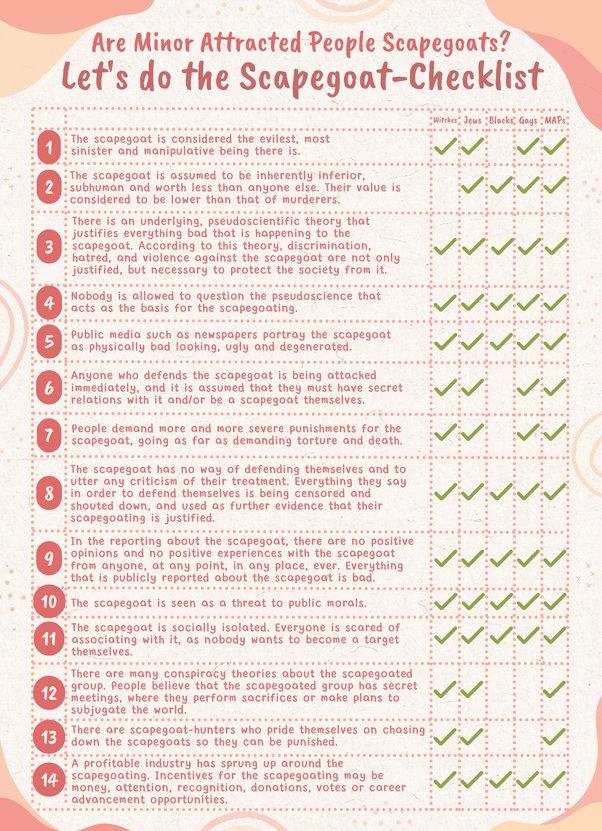
 

___________________________________________________________________________________________________
Misconceptions About MAAs:
 
All MAAs 'abuse' children and adolescents
 
Many adults who interact sexually with children do not have the characteristic emotional and social aspects of the genuine pedophile attraction base, so referring to any type of raw sexual contact between adults and children as "pedophilia" or between adults and adolescents as "hebephilia" is simply a form of dirty pool by the media, to imply to readers that there is a connection between the typical MAA attraction base and abusive behavior towards minors.


These words have been stretched, distorted, and misused for a variety of agendas so much over the past 30 years that they can now pretty much mean anything the person using it want them to mean. It's more often used by the public and the media to foster a certain type of emotional reaction more so than anything to do with an accurate clinical description of a specific attraction base.


An exploration of why the term "pedophile" has become a loaded term devoid of value neutrality, as well as a conveniently broad-based pejorative, by its constant misuse in the media, and by frequent personal fiat by many people, should also be presented at some point, IMO.


Sadly, the great majority of the general public, as well as the law, presently sees little to no difference between a genuine pedophile or hebephile and a situational abuser. This is largely because they do not regard the important factor of mutual consent as a legitimate part of the equation, despite all the objective research that makes it clear consent does indeed make a huge difference in regards to how the younger person feels about the relationship.


Such contemporary western society's ideas of MAA are wrong in nearly every respect. How is it is that we have found ourselves so far adrift from reality's on an issue that so preoccupies and obsesses us?
 
History shows us that it is not unusual for a community or society to be grossly mistaken and misinformed about an issue with which it is intensely preoccupied. Some examples are McCarthyite Americans' ideas concerning communists and people of the left, the 'Satanic Ritual Abuse' furors of the 1980s, and Puritan New England's ideas about 'witches'. 
 
One thing common to all of these examples is that the groups that are the focus of fear are rendered entirely invisible, deprived of a voice or of the capacity to defend themselves. The threat of ostracism, stigma, violence and death, and the pain that his loved-ones would suffer, have forced them to become 'invisible', they are unable to speak out when something inaccurate is said about them; anyone who dares defend their right to be understood or heard, through 'guilt by association', runs the same risks as those whose rights s/he is defending. 
 
In such a situation there are no longer any voices that can act as correctives to mistaken ideas: the public imagination becomes over-heated: assumption trumps knowledge, rumors and conjecture become 'facts'; the worst actions of individual members of the persecuted group become understood as 'typical' behavior for the whole group; the public starts to imagine 'facts' about the persecuted group, generally drawing on the worst that their imaginations can conjure up; the language used around the issue breaks down and no longer fits what it purports to describe, it becomes dishonest, hysterical, and twisted out of shape. A positive feed-back loop is established : the more disconnected the image of the group becomes from 'reality', the more monstrous that image becomes, the greater become the public's fear and hate , and the less anyone can speak out to moderate or correct these ideas. 
 
This is the situation in which the average MAA finds himself in contemporary Anglo-Saxon societies. He sees himself portrayed as a libidinous, violent, manipulative monster he doesn't recognize. He is unable speak out and correct this disparity between what what is said about him and what he knows to be true. And so the myths remain unchallenged. 
 
Surprisingly little scientific research has been done on them. Moreover nearly all studies are based on people found guilty of some crime against minors, usually prisoners. Such studies don't discriminate between MAAs and 'non-MAAs who've offended against them. This results in very many biases and inaccuracies. The experiences and viewpoints of non-convicted MAAs rarely reach popular discourse and debate. And when they do dishonest debating tricks are used to dismiss them. It is also impossible, given the climate of fear, to access a large enough random sample of non-convicted MAPs for any statistics to be reliable.
 
MAA attractions by themselves are crimes:
 
One of the greatest social myths revolving around MAA attractions(pedophilia, hebephilia, ephebophilia) is that they denote a set of actions. They don't; these words simply denote a set of feelings, which are not limited to sexual desire alone.


Misconceptions of MAA attractions have gotten worse to the point that they can mean almost anything anyone wants them to mean:


56e79924e2687f07492e1a4e98a5d39c.jpg


Most MAAs as a class are influenced by self-interest
 
The thing is, self-interest does not necessarily denote an interest that is inherently sinister, or against the interest of another group or society in general. There is a difference between self-interest and blatant selfishness. The former is not incompatible with the greater good; the latter, however, suggests the benefit of yourself or your group at the expense of the welfare of other groups and/or society in general. It's natural for any group to want the right to live a life where they can achieve the greatest degree of happiness and fulfillment, and this in no way necessarily suggests selfishness. Further, I sincerely believe that the self-interest of every group is tied together with the intrinsic right of all groups to have the freedom to do so. This is why I take umbrage to the accusation that pro-choicers only care about themselves, because I do not believe the available evidence suggests that our right to fulfillment, and the right of choice for youths, would be destructive to anyone.
 
Further, realize that the contention that the majority of the class (as you call it) to be out for self-interest is clearly making a strong implication that all who hold a certain view are working for selfish interests that do not take society as a whole, and youths in particular, into consideration at all. If you truly believe this, then by all means, say it. I would never ask you to lie. But however you look at it, such an accusation is an insult, and I don't think we're out of line by taking it as such. We're fully capable of reasonably evaluating available information, and fully capable of acting in accordance with a conscience and ability to empathize with others; and we sincerely believe younger people are competent enough to make choices currently disallowed to them with the proper education and support.


MAAs are self-interested because they do not idealize and infantilize youths, and see them as something less than a person, akin to a glorified pet that does not need such a degree of "protection" that their personhood is excluded from constitutional considerations, including keeping them bereft of the education & guidance that would enable them to fully facilitate those rights? What you really find lacking in many MAAs is a lack of concern for adhering to the societal conception of youths that the West has held so dear for such a--not very long time in history, which is similar to non-Christians being pilloried for refusing to believe in the Christian conception of humanity as mere puppets of God (or 'Ghod,' if one prefers). If those of your ilk were truly concerned about children per se, rather than the preservation of our sacrosanct image of them, you would be more interested in reasoned debate (which you accuse us of not doing) about their civil rights, self-determination, and educational opportunities than the untrammeled support of laws that continue to keep them "in their place" where they are subject to the most common sources of all forms of abuse, including sexual, vis a vis giving certain adults so much power and authority over them; and these adults in question are not typically MAPs, a fact actually admitted by the FBI. Blaming the problem exclusively on adults who are attracted to minors is an oversimplification and a major political red herring.


It seems too many people--including many essentially decent people--have a lot of anger built up inside of them, and need a boogeyman figure whom they can consider beneath human consideration and thus vent against almost without restraint. Of course, this requires them to demonize and misrepresent certain groups to an extreme degree in order to justify this to themselves, and to each other.


Thus, a big driving force behind the modern witch hunt of MAAs could be due to society's need for a scapegoat. In short: the social coherence of society seems to diminish every day. A healthy community needs a certain amount of "social control". When nobody knows his or her own neighbors anymore, fears will grow into enormous proportions. Every person in your immediate surroundings might be a murderer or a rapist. It is reassuring when you know that a lot of people in your surroundings are walking around, keeping an eye on young adults who are playing outside, instead of having to distrust them. This fear aims at something. A scapegoat has been born (for the umpteenth time). The solidarity of the people also revives with a common enemy. The ever increasing soccer madness and the silent processions are indications as well that society craves cohesion and being together. For a great part, the solution for this is exactly to be found in the acceptance of this taboo. To understand how this can be possible it is helpful to compare minor attracted people(MAPS) to scapegoats of the past:


a82e6580dd8a29ca623e29ac558f3a7c.jpg


As shown MAPS meet all the critera; thus there is no doubt that the are society's current scapegoat.


More:


MAAS don't care about the ultimate shape of society at the moment. This includes whether we need a bigger government that carries out redistribution, or a smaller one that does less, whether youths must be accorded more rights, whether concern for security should trump civil liberties, etc.


For the most part, I do not agree that most of these greater political matters do not matter to MAAs/MAPs. The youth liberation platform, which is growing and gaining momentum gradually but steadily thanks to the growth of socially-driven media, is a thorn in the side and another major "elephant in the room" for anti-choicers that is going to get bigger and take up more discomfiting space in the metaphorical "room" as time passes. It's currently not quite so big that it can't be largely ignored or dismissed by anti-choicers (who love saying nonsense things like, "the number of youths who want their civil rights are incredibly rare, and the number of adults who agree are at least as rare"), but when that changes - especially now that lowering the voting age is gaining momentum in many areas around the world, including various jurisdictions in the U.S. - that big fat elephant will have to be accounted for.


Moreover, concern for whether security should trump civil liberties is another major "elephant in the room" that permeates the divide between pro-choice and anti-choice ideologies. This is because the threats to civil liberties that the anti-choice stance provides is beginning to be taken more seriously by progressives and Libertarians who truly do respect and revere these principles. That is what prompted Debbie Nathan, among others, to openly challenge such things during the heyday of the hysteria, and to identify the sex abuse industry that thrives when the anti-choice mindset is dominant as a major component of the problem. In other words, as the anti-choice mentality begins to overreach, more progressives find it increasingly difficult to maintain the fear that keeps them quiet and/or complicit and begin speaking out on the matter. Eventually, a majority comes to realize that freedom over security is the best choice to go with for all concerned, and its cons are much easier to live with than the cons which a security state creates. 
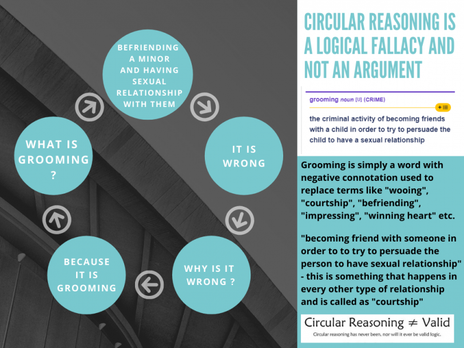
 

MAAs are prone to psychopathic/sociopathic proclivities in general
 
The public seems to have the attitude that MAAs, especially "pedophiles" (the media definition, of course) are prone to psychopathic proclivities in general. Their tendency to target youths for sexual assault is just the most non-PC of their many atrocious acts.
 
For example, Dr. Sarah Goode noted in her first book that many of her colleagues suggested she was putting herself in danger for meeting with MAPs in the course of acquiring research for her book. And this was during the time when she had misled most of her research participants into thinking she was neutral or at least open-minded on the contact issue, and wasn't writing another book connecting adult attraction to minors with adult sexual abuse of minors.
 
And let's not forget those funny and culturally revealing "I Love Lucy 2000" skits from Mad TV during the titular year. What hi-jinx we could expect if Lucy and Ethel had access to the Internet was the theme humorously portrayed in these skits. And who was the main nemesis of these two women approaching middle age in the realm of cyberspace? The "Internet Pedophile." Why was this stereotypical media "pedophile" harassing and later attempting to murder two women approaching middle age? Well, according to what the skit seemed to imply (however ironically), being a psychopathic menace in general is simply what "pedophiles" do, considering the narrative insists that MAPs have no conscience or ability to empathize with others. So the ironic nature of this portrayal of the narrative seemed to be that the Internet Pedophile casually menaces adults during the interim periods when he can't find youths online as his preferred targets.


MAAs want to groom youths:


In many cases, "grooming" is the word the media and biased PSA's use to describe the same series of actions taken by a MAA towards a young person they admire that would be called "courting" if it was done by one adult towards another adult.
 
So popular media use of the verb "grooming" can be defined as "courting that the polite public finds inappropriate." Or also, "courting with ulterior motives." In feminist lala land, they call this grooming or child sexual abuse; in the real world, we call that a relationship.


"grooming" may SOUND plausible, but it doesn't stand up to scrutiny. It's a weasel word that is completely devoid of any real meaning. Anyone who really scrutinizes the word will eventually realize that the idea of 'grooming' is just circular reasoning that is no different than any courtship process (including ones between adults):


7ea56ad788389d4ddab7c35d6840df74.png


8275a86b4a2919594dbca4f8dce86e95.png


As demonstrated, grooming is just befriending a minor.
 
When you date someone, you befriend them, get them to do something they might initially not be interested in (like outdoor cycling), know their friends and engage in romance. That’s a basic and normal thing to do. Hence the term “grooming” is effectively a slur that’s too useless for any debate. Given that not only can’t “grooming” be defined in a consistent manner (if children are so malleable, then adults wouldn’t need to “discipline” them), but many frequently dismiss any evidence that doesn’t conform to this idea without a single look without providing evidence contrary to them indicating that these opinions are based on mere superstition and quasi-religious beliefs.


Often “grooming” and and related terms like "predator" are rhetorical devices that are employed to demonize perfectly normal male sexuality. It’s actually pretty horrific the damage this ideology has caused to society. 
 
I should point out that this concept is also wrong, since the sexting and porn panics shows that youths are sexual and will engage in sexual activity without any prompt, an observation backed by science:

369824e6de83b8fbabbce3d047a51dfb.png
 
Most MAAs typically dump youths when they get too old or lose interest:
 
One of those many weird assumptions of the popular narrative you support. That youths are incredibly fragile, and somehow can deal with the often fleeting relationships they form with peers yet purportedly cannot handle an adult moving on in a similar fashion. Even though it is far more likely that a younger person would lose interest and move on first, since they change considerably faster than adults typically do. And many known MAPs, such as Charlie Chaplain, actually married a younger person and stayed married to them in a loving manner for over 20 years -- a strong example of what a lengthy period of shared life experiences between two people can foster.
 
Then there is the aspect of the narrative that insists the only type of true and legitimate romantic relationship is one that lasts for the duration a couple's life time. That is a strong cultural bias based on our sacrosanct reverence for monogamous marriage, an institution that was originally created to pass on property and forge financial alliances, not becomes it promotes love.
 
I don't think he ever meant to imply that you just "dump" a youth you had a relationship with when they reach puberty (if the older person happened to be a pedophile; or once they age out of adolescence, if their partner was a hebephile). I think what he meant was that the love would always remain, but the relationship itself will change form. This in no way means simply "dumping" or expiating the younger person from your life in a cruel, selfish, and callous manner, and I don't believe Baldur would ever suggest such a thing. After all, the sexual component to the relationship is not the only aspect to it for a genuine MAA; the emotional and social connection you made would potentially last a lifetime. I have known many gerontophiles who had relationships with adults when they were younger who reported remaining close friends with their former love interest once they grew out of his/her preferred AoA.
 
As for once again declaring that younger people are more emotionally vulnerable than adults, that is another example of overcompensation, because that largely depends on the individual. There are scant examples in all objective research about younger people who were utterly devastated when a relationship with a much older partner ended to a disproportionate degree than a relationship ending with a peer. Saying otherwise is just social mythology. An important reading recommendation I am giving you is the book Going All The Way by Susan Thompson. The book extensively deals with the sexual lives of underage girls, and Thompson interviewed literally hundreds of girls and young women about this subject. The whole book is interesting, but in Chapter 7  Thompson specifically interviewed a multitude of girls and young women who had romantic relationships with significantly older people when they were underage, and nothing she heard in the numerous responses bore out the common mythology of the girl who is "totally messed up" by a relationship with an adult ending, or suffering to a greater extent than they would when a relationship with a peer ends. There is no logic or science behind that at all, just societal assumptions based upon a skewed view of youth competency and emotional resilience.
 
This assumption also presupposes a very strange concern (or over-concern, as they case may be): that the adult MAA/MAP is likely, let alone inevitably, going to lose interest in their partner before their younger hypothetical lover will lose interest in them. Any MAA should be aware of how fast younger people change compared to adults, and younger people are notorious for being fickle and mutable with their feelings. Romantic feelings that youths may have for adults will tend to run their course naturally on the part of the younger person long before they age out of their adult partner's preferred AoA. And yes, girls are often quite callous about this when it happens, depending upon the girl. Saying that the younger person is taking the bulk of the emotional risk in an intergenerational relationship is another popular bit of social mythology. Though we readily understand that romantic relationships that younger people have with peers are likely to be transitory, for some odd reason we believe that when a younger person falls in love with an older person, they do so for life, and in an entirely monoamorous fashion. This, of course, makes no logical sense.
 
MAAs can just find an older person
 
So with all of the above being the case, why don't I seek out that nice 45-year-old woman down the street who would most likely be less picky than the average 19-year-old girl? Two major reasons, with the second being the most important:
 
1) As a hebephile who is very young-minded, I tend to mesh considerably better on an emotional and social level with much younger women, who are as close as I can legally get to being with my true preferred age group;


and


2) My preferences on all levels are not a choice; I would not mesh well socially with the 45-year-old, and I would have no inclination to be physically intimate with her. Were I to lie and lead her on just to placate societal expectations, I would truly be committing an unethical against her, because I am fully aware from the get-go that I cannot give her a genuine romantic relationship, and she deserves to have that as much as I do.
 
Most MAAs support full intercourse and unrestricted sex with youths
 
A problem is people assume that most pro-contact pedophiles always support sexual intercourse that is wild and unrestrained. This is mainly because the anti-choice camp tries to frame the debate with emotionally charged language and assumptions that color the tone of the discussion, so as to present the matter at hand in the worst possible light. It's a form of emotional manipulation and misuse of language that is common in political campaigns.
 
Probably the great majority of pedophiles (including hebephiles and ephebophiles), for instance, would have no major problem with limiting any mutually consensual sexual activity they have with young adolescent girls in a hypothetical world where it was legally allowed to outercourse, i.e., simply making out, as they popularly call it. This is because as is typical for true hebephiles, the sexual component of their attractions are much more low key than that of typical adults with a conventional attraction base, with less of a desire for intercourse than Non-MAP adults. Hence, the legitimate concerns of pregnancy and the spreading of STDs would not be serious problems for such hebephiliac relationships.
 
But we know the safety issue isn't truly of paramount concern, but rather the issues of moralistic propriety and control over youth sexuality, along with the fear that many parents have of losing the emotional and social influence they have over their legally and economically dependent children to an extra-familial adult influence. It's similar to the type of fear and concern that certain married people have if their spouse should have a close platonic friend of the opposite gender (or the same gender, in the case of a homosexual couple). However, the major difference is that nowadays in the West and North, husbands do not have de facto legal ownership of their wives; this is not the case when it comes to youths under the age of 18, who are pretty much the property of their parents or other designated legal guardians. Note how husbands continue to treat their wives in much the same way in some of the hyper-patriarchal cultures of the Middle East. Saying there is no political parallel between the two, as certain progressives will claim, is ridiculous.
 
The sexual desires of genuine pedophiles tend to be even more low key than hebephiles, and expressly on the level of a child. Hence, most genuine pedophiles would have no major issues with laws that simply prohibited full intercourse and sodomy with children, but not simple sex play that they engage in with each other (i.e., "playing doctor"). Even using the word "sex" in place of "sex play," "sexual activity," or "sexual contact" in such discussions is a loaded use of language, since the solitary term "sex" tends to imply intercourse and sodomy in those who happen to read it.
 
Of course, those of the anti-choice camp will routinely use language and rhetoric to imply that most of these MAPs want to impose adult-level sexual activities upon youths in their preferred age and gender, including a hefty amount of full intercourse, buggery, and all other forms of "kinky" sexual contact the adult sexual realm is known for. This is not meant to reflect reality, but to bias the conversation against intergenerational contact by focusing upon specific legitimate concerns--like the biological limitations of underdeveloped bodies--that are minimal to non-existent when it comes to typical MAP sexual desires.
 
MAA/MAP sexuality is identical to adult sexuality
 
Most adults project the dysfunctions of adult sexuality upon the MAP and the child/young teen alike. They presume that MAP sexuality is identical to adult sexuality, except we want to commit all these typical adult acts upon a child. Not true. Even hebephiles tend to have lower intensity sexual desires, and prefer what younger people refer to as "making out" to full blown intercourse.
 
In fact, one of the things I've had to learn to do, even when dating young women of legal age, is to adapt myself to the typically higher intensity sexual demands/desires of adult women (not counting those who are naturally asexual or who have certain phobias about sexual intimacy, of course. This is another difficulty that the law-abiding MAP has to face, but society isn't sympathetic about this either, because in their eyes, this is what we "should" be doing; this is the type of sexual activity that we "should" want to engage in.
 
In fact, being law-abiding is still not enough for many people when it comes to MAPs who are in their 40s. They are often considered immoral for routinely dating (when I do date) younger women in the age range of 18-mid-20s (sometimes settling for women in their early 30s), because they're told that they "should" desire to be intimate with women approaching middle age... whom they generally do not find attractive on any level. Of course, according to mainstream bias, lying to a woman approaching middle age and leading her on is more ethically acceptable to society than dating someone of legal age whom they are actually attracted to on all levels, and can provide real romantic love and affection to. 
 
MAAs are defined purely by a sexual attraction to youths
 
No, it's not. The type of emotional love that MAAs/MAPs feel for youths is much deeper than the more nominal type of appreciation on an emotional level that the average teleiophile who loves them feels. This includes the fact that MAPs are much more readily able and inclined to fall in love with girls in their age group of preference in a genuine and full romantic manner than a teleiophile, including one who enjoys being around youths.
 
And the social component of the MAA attraction base results in MAAs typically enjoying the entire social world of the respective age group they are attracted to, along with a tendency to have a degree of personal respect for younger people that the average teleiophile who is not a youth libber will not ordinarily display. I have explained this to you in detail elsewhere on the board over the past few days, and have made it clear that the sexual preference is far from the only thing that distinguishes a pedophile or hebephile, i.e., a MAP, or a GLer from a teleiophile or a child/teen fetishist. You pretended to "get" it, and said we had much in common as GLers in regards to our feelings, and then once again you start emphasizing the sexual aspect and insisting it's the main thing that distinguishes us from teleiophiles, and how disproportionate the sexual feelings are for yourself in regards to the other components, which you seem to feel is on a "normal" level for you...which does not sound like an actual GLer. This is not meant as an insult, but an observation based on all of your posts, including what you say in debates with me.
 
MAA/MAP discussion sites are illegal
 
GC, VoA, BC, and LL are NOT illegal sites. The average person is very ignorant about almost everything to do with the subject of MAAs, and amongst their ignorance is the assumption that simply forming a community to provide each other mutual support and to discuss all relevant issues related to us and our situation in modern society is "illegal." Many people are so ignorant that they believe simply being a pedophile or hebephile is illegal regardless of our actions, and this is probably due to reading nonsense about "convicted pedophiles" in the press (simply having these feelings is NOT a crime). Also, they tend to read all sorts of exaggerated B.S. about "pedophile rings," and this causes them to think that all Internet forums dedicated to this topic and frequented by MAAs can only be involved in diabolical activities, like "giving each other advice on how to rape youths and get under the radar of parents and the law to do so." They don't bother to read our posts, our mission statements, or any of the myriad topics we discuss on our YL boards to learn about MAAs as people. I think the very false assumption that these forums are dedicated to discussing or conducting illegal activities is what may have prompted the administration on this other board to consider all forums dedicated to this topic as "illegal sites."
 
MAAs couldn't possibly have anything in common with youths


The bold assumption that they couldn't possibly have anything in common with youths is entirely inferred from the age difference rather than actually considering what the specific emotional and physical preferences, life circumstances, social interests, life goals/priorities, etc., may be. In other words, treat the two not as individuals, but as generalized representatives of a specific demographic that are both considered to be homogeneous.
___________________________________________________________________________________________________
Common questions and concerns from MAAs/MAPS:


Is the best way to communicate the pro-choice view to nons by approaching them with the anti view first?


The contention that all Nons must be approached with an explicitly anti-choice stance in order for them to listen to and accept the pro-choice view is as condescending to them as it is to the MAA/MAP community as a whole. It's implying that all Nons are so overwhelmed by their emotions, and so inimical to reason and intellectual understanding, that they have to be pandered to. The point is, despite how many Nons are quite obviously truly insufferable and inflexible about the issue, that shouldn't be used to paint Nons as a whole like this. As long as they are approached in a cordial manner that takes their feelings into consideration, and we don't obnoxiously shove the pro-choice stance up their noses and expect them to spout loyalty to pro-choice attitudes right then and there (like some of the more zealous and inflexible pro-choicers who do not manage their anger well seem to insist), many of them are more than willing to both listen and focus attention on matters we can more easily achieve agreement on. We need to be willing to give Nons the chance to get to know MAAs as people, and to make it clear that they're people that they would want to get to know in the first place, before expecting them to listen to them and make any type of conclusion based on all of the information available. We have to understand that the idea of interacting with MAPs who are open about being MAPs is something that the majority of Nons aren't used to right now, and we need to be willing to take the time to build bridges with them in an honorable way.


Further, we need to show them the respect we want to receive from them, and that means not only stifling the counter-productive opinion that they deserve nothing but fiery ire from us, but also the belief that they can only be approached by us with self-flagellating pandering. Every group of people desires and deserves respect, but none of them will truly respect other groups who clearly have little respect for themselves.
 
Is there any point in fighting for change seeing how Nons will likely never change their mind?


The currently the path most often taken by the more open-minded Nons is to be silent (or else!). Mr. Summer is one of the growing number of welcome exceptions to this rule, but only under the rule of a fourth option: Support and engagement in a thankfully non-PC fashion, but under the anonymity of an Internet handle due to the same understandable fears that keep MAPs hiding behind screen names.


Unfortunately, the often nervous silence of the third option for Nons has often been falsely taken as "evidence" by many on either side of the issues that almost all Nons without exception are insufferable antis who want all MAAs either dead or in concentration camps. Mr. Summer is probably one of the earliest of the newer, more informed Nons who is taking the fourth option for open-minded and knowledge seeking individuals from outside of our community. This is thanks to the greater amount of scientifically accurate information that is gradually becoming available to the Non-MAP public.


Most Nons who have engaged us in the past under their real names were anti-choice, and they tended to flock around now defunct boards like Open Hands that specifically catered to Nons who wanted to "understand" us MAAs better, but only if we tried to "cure" ourselves and gave favor to mainstream beliefs about us. They realized that their socially acceptable ideologies kept them at reasonably low risk to associate with us under their real names. But Nons who are sympathetic with the pro-choice attitude, or at least not fully committed to the anti-choice/mainstream ideology and "on the fence" about matters, tended to keep completely quiet lest they be pegged as "pedophile supporters" and be subject to much of the same harassment and censuring that MAPs are, including loss of their children, loss of employment, and derision from their families.
 
The anti-choicers out there, both outside and within the MAP community, of course, were more than happy to use this logical but unfortunate silence to disingenuously proclaim that pro-choice Nons were more rare than fist-sized diamonds, and that being fervently anti-choice was therefore the only way for MAPs to approach and engage with the public and actually be listened to.


I have no doubt that currently anti-choice Nons greatly outnumber those who are pro-choice. That is a complete no-brainer and it's to be fully expected at the present time. But that doesn't mean that all of them are virulently anti. It also doesn't mean that a sizable chunk of them are not simply "on the fence" about the issues, and likewise do not often come in contact with the pro-choice view and the scientific data that refutes the commonly held beliefs, because that info and thoughtful discussions about it are still not nearly as easy to come upon as articles, stories, and film espousing the mainstream ideologies and assumptions.


For one thing, this is the reason why the pro-choice stance needs to be presented in certain places where the public can readily access it rather than go silent. Secondly, while I agree that at present MAP leaders should not be engaging the public with loud, "in your face" pro-choice proclamations, I think the success of B4U-ACT makes it quite clear that it's not necessary or even productive to lead the way with loud anti-choice proclamations either. There are enough reasonable, open-minded, intellectually inquisitive, and "on the fence" Nons who can be approached with a morally neutral stance on the more emotionally contentious issues that allow the respectful inclusion of all MAP participants in the discussions, and which offer compromise in the form of agreeing to responsibly follow the laws.


Understand that not all nons are full-blown antis and I address this here: www.annabelleigh.net/messages/557286.htm


What is the best way to achieve mainstream acceptance of the pro-choice view?


The plan in the guide here www.justpaste.it/ibtvf outlines strategies designed with the goal achieving acceptance in the fastest timeframe possible.


Below is a snippet:


>> The scope and purpose of this campaign
 
In truth, access to the media is what you need most. Without the help of liberal and progressive Hollywood, there will be no campaign. It’s a chicken and egg problem. While they may deny it, most are just waiting for the social climate to improve before taking the “risk” of giving you positive representation. At the same time, more representation necessarily improves the social climate for LGBTPs. The proliferation of kind relationships on television, corporate sponsorships, sympathetic ad- campaigns and social media marches are the secret weapon that will truly turn the tide. We propose the beginning of a targeted media - information campaign to educate the public and transform their social mores. Culture must be modernized and brought out of the dark ages to make room for love. We will reverse-engineer the weapons of hate they deploy against you to turn their bigotry into admiration before your very eyes.
 
We will not hide the fact that this is a feels-based advertising campaign. You cannot use logic to reason someone out of an emotional belief, only more emotion. Prejudice is not rational- it’s a “gut feeling”. Poignant pleas for understanding will fall on deaf ears. Some of the most hateful among us will never change and must instead be isolated from polite society. Arguments from emotion cannot be falsified in the same way rational arguments can, and although we have both emotional arguments are more effective.
 
Things are different than they were in 1980. We are the media. Using the internet, we have access to millions of minds in the making. In the beginning it will fall on you to create the positive portrayals and PSAs you seek, then release them on sites like Youtube. Nobody will do it for you. We need to cultivate an army of keyboard warriors who will go into battle on the comments sections of news articles and other spaces where kind issues are being discussed. Their mission is to discredit pedophobia and the war on youth sexuality. Here are a few examples of pro-gay short films released online. Many have several million views. There are several dozen more and they’re easy to find.


https://www.youtube.com/watch?v=CnOJgDW0gPI
https://www.youtube.com/watch?v=c17fd4jXwIU
https://www.youtube.com/watch?v=YQiN2MYEzSg
https://www.youtube.com/watch?v=6jrngYNGNeE
https://www.youtube.com/watch?v=6mZezLwvr1k


With a properly moderated comments section, each film and PSA becomes a tool to shift public opinion.


>> What is Pedophobia, and Where Does It Come From?
 
In order to destroy something you must first understand why it exists and how it works. Pedophobia is the irrational fear or hatred of chiId sexuality and kinds- individuals who are primarily attracted to people much younger than themselves. MAAs do not have to be explicitly attracted to children for the pedophobia neurosis to occur. A 40 year old man who dates a 25 year old woman is also branded a "pedophile" even though it makes no sense legally.
 
The other half of pedophobia is the fear of childhood sexuality- things such as masturbation, innocent nudity and the like. The biggest discovery you need to make is that both are two halves of the same coin. It's not that hard to understand: Sex is viewed as a corrupting influence in our society. Most people won't admit it, but subconsciously they view sex as inherently sinful and/or harmful due to childhood indoctrination. Anyone who wants to engage in intimacy with children trigger parents’ natural protective instincts, and if those people are other adults jealousy plays a major role. The historical record proves that sex only mentally scars children in societies which demand such scarring, and ours qualifies.
 
While pedophilia is natural, independently appearing in several modern and ancient societies across the world, pedophobia isn't: It's usually found in sedentary western civilizations where children live highly structured lives and spend most of their time inside the home. Another common thread is the Judeo - Christian basis of these societies: The idea that pedophilia is only for impoverished third-world countries does not hold when you look at Japan. Unfortunately, due to western pressure even Japan has been forced to swallow the pedophobia pill and ban youth erotica. Interestingly enough, neither Christianity nor Judaism contain any prohibitions against relationships between unrelated children and adults, probably because marrying young was normal at the time. The concept of childhood innocence also directly goes against the bible which states that all have a tendency to do evil due to original sin. Nobody was "born good" and polluted by the world, otherwise how would evil begin in the first place? Try pointing that out to any fundamentalist.
 
Still, in this fight it's important not to treat religion as the enemy- just the flawed interpretation of it by a few.
 
Even though Victorian and Puritan morality helped stigmatize sex, the age of majority was as low as 10 in the early 1900s with parental consent. As late as 1970, adult-child relationships were no more controversial than same-sex ones. The bottom fell out when socially conservative administrations pushed restrictive bills through congress based on lies and misrepresentation in an attempt to score political brownie points. They used intellectual dishonesty to link a serious crime (the abuse, rape and torture of children), to something completely harmless (nude photos). All this was spurred on by sex-negative radical feminists who grossly overstated the size and scope of the CP market. The rest, as they say is history.
 
Three Takeaways:
 
Prejudice is not logical. Cannot be overcome by facts and logic.
 
Prejudice is deep, automatic, product of emotional conditioning. Unassailable by any appeal to the intellect. This is why the bigot cannot be won over with rational arguments and information.
 
Prejudice cannot be fought with violence and terror, only subterfuge.


>> Stating the Problem, Staging the Solution: The road to sex-positivity.
 
Dear reader, I have some good news and I have some bad news. The good news is that victory is possible within a relatively short time frame most of you will live to see. The bad news is that it will require a complete overhaul of our cultural values. Sex is the problem. Or rather, the way we view sex is the problem. Sex-Positivity is the only cure for pedophobia, and it needs to be hammered home. Opponents must be portrayed as stuck-up prudes who are behind the times, “have a problem with sex”, or just anti-sex in general. Sex positivity is more radical than you think because the Victorian model of shame goes to the root of our society. No trace of it may remain. Both nudity and sex have to become completely normal, even enforced in some cases. Culture must be desensitized to the sight of the naked body whether they like it or not. In the end, we want nudity to be the norm and intimacy looked at no differently than sleeping, eating or soccer. File it under “something you wouldn’t mind your children seeing.” Only a solution this radical will have any lasting effect, hopefully after this section you will understand why.
 
Many of you are familiar with the concept of “don’t touch that special place”, which explains why some people hold certain parts of the body in higher regard than others. Namely, the genitals and pubic area. Because of childhood indoctrination feelings of guilt and awkwardness surround them. We purposely keep children ignorant about their body and mistake this for “innocence”. The notion of *socially enforced* “special places” needs to be done away with. Don’t mistake this for the wrongheaded notion that everyone should accept being touched anywhere on their body- far from it. Instead, we want to give individuals the freedom to set their own special places at all ages and education to stay healthy. This can easily occur in a simple consent-based framework. Body language and verbal language are usually enough, but when in doubt spoken language can clarify.
 
Normalization of the genitalia (aka naturism) and sex-positivity are inextricably linked. We think penises and vaginas are weird because we don’t see them enough in normal settings, on normal people. Because these parts of the body are always covered, they gain a sort of phantom “mystique” about them. Once we begin to see them as normal parts of the body, we will naturally ask why we feel children cannot give others permission to touch there and nowhere else.
 
Eliminate the “specialty” of the special places, and the most important part of the battle is won. Of top priority shall be the separation of sex from nudity. People will feel more comfortable naked once they realize it doesn’t have to be sexual. Currently nudity is limited to secluded resorts, novelty events and similar oddities due to restrictive laws and concerns about hygiene. We must push for the repeal or alteration of these laws to make body-positivity a viable lifestyle. Simply placing a robe underneath you when you sit would be enough for proper hygiene. Even with these laws, property owners have wide leeway when it comes to what they can do inside.
 
When it comes to promoting nudity, it’s best to take an incremental attitude. More skin is always better than less skin. If people want to wear a towel around their waist at first, that’s okay. But as long as the majority of their body is uncovered, (including the top), we will be making progress. Not everyone has to be naked, but once 10% of the population decides to give it a try the other 90% will quickly follow.
 
Step One: Create more nude spaces.
 
The only way to get the ball rolling is becoming more territorial. We already have tons of spaces where clothes are required, so we need to create nude – only spaces to balance. Nude bars, dance programs, church services, community events and parties… Even the public bathhouse. By making nudity seem exclusive, more people will want to get in and see what the fuss is about. Eventually even nude schools will be necessary to deprogram children. If we’re naked from birth and stay that way, body-negativity will just seem stupid. Mixed spaces are important too! As more nude people enter a clothed space, the clothed people will either join them or be grossed out and leave. This process is called “colonization”, and nude-friendly businesses can be rewarded with our dollars. Getting that initial permission from the space owner is critical to success.
 
In a sex-positive society, clothes become the exception and not the rule. While still necessary for special occasions and conditions (work protection, cold weather), we realize that they aren’t the default and lose our fear of being seen naked by others. Clothes return then to their main function: providing shelter from the elements. No need to wear them indoors where they’re unnecessary and often uncomfortable. Just like you usually take off your shoes at the door in most homes, you would take off your clothes too. Robes may return to being a normal form of dress. The only time indoor nudity shouldn't be required is during sickness, if you’re dirty, when women are nursing or on their menstrual cycle. None of this will happen right away, but over time if we keep at it attitudes will shift in our favor.
 
I am well aware of how radical this sounds. But it is necessary. The only way to destigmatize the genitals is through frequent social nudity, and the only way social nudity works is when everyone is naked. If some are allowed to wear clothes, the naked ones will feel inferior. Perhaps over time, when society has overcome it’s fear of the human body could some pressure be released. Nudity has a lot of health benefits, but the main one is that those with unattractive figures are encouraged to get in shape and get healthier due to positive peer pressure. Obesity is a major problem in most developed countries and should be treated the same way we treat smoking: A personal choice that's unhealthy and not to be encouraged.
 
Step Two: Add another body.
 
With nudity seen as less of a taboo, it’s time to move on to the normalization of some sexual activity (in public no less!) Sex-positivity can be seen as the next stage of body positivity- whereas public nudity deals with you being able to accept your own body, this stage requires you being able to accept others’. Now is where we begin to question taboos. Certain types of activities we label “sexual” today need to lose this label. There’s a time and place for everything, and we aren’t expecting people to turn into animals or do each other on the sidewalk. But mild play and exploration, squeezing and canoodling, especially in natural recreational areas like parks and greens should become acceptable. The message needs to be pushed that you are every part of you, and every part is normal. It’s okay to touch yourself or others in public (if you get their permission of course!), but just like we don’t want to see you give slobbery kisses to your lover on the train, if you need to go past 2nd base please get a room. This is purely in the interest of hygiene. A cascading effect of loosening boundaries will happen when more people are seen having sex and enjoying themselves in public. It becomes normal and others want to do it because it looks fun. Eventually you will respond to someone playing with themselves the same way you would if you saw them eating a hamburger. Like any cascade, they are fragile and must be maintained by the fear of “missing out”. When most people are in the buff and you’re the only one wearing clothes, conversations will become a little awkward. Public support and admiration must be given to those who choose to go nude, and it cannot be of a primarily sexual nature. They are being “brave”, “bold”, and “making the ultimate fashion statement”. Nudity isn’t a cheap way to look at attractive women- not everyone who’s naked will be attractive or female. This comes with the territory. It’s about making everyone more comfortable and confident with their bodies.
 
Social media and advertising campaigns will play a large part in the push to make nudity normal. I suggest #WhyHideIt and #BornNatural as places to start. Even though these are good goals in and of themselves, for this book’s purposes simple nudism is not the endgame. I’m sure most of you didn’t come to read strategies on how to promote it.
 
>> Strategies For Acceptance: Psychological.
 
Any society that doesn’t recognize the fact that at least over 30% of people are attracted to someone under the age of 18 is living a lie. The question then becomes, how will we conduct ourselves in exposing the truth? And what is the end goal? We must seek realistic, common-sense reforms. On the surface, our appeal isn’t radical at all: Just treat sex like we treat every other activity, and require parental consent for children to engage in it. If something happens or the child catches an STD, we can hold the parents (and the one who transmitted it) liable. Systems of support should be in place, and anyone close to the child should be able to file a complaint to have a relationship investigated. At the end of the day, what happens should be the child’s choice because it’s their body. Youth erotica must remain illegal when not produced by either one of the people involved in a relationship and should never be released without the consent of both partners when they are above 18. If both partners are okay with sharing it after reaching suitable age there’s no reason not to permit it. If safety must be assured then we could make it so that only the government is allowed to distribute this kind of erotica and use whatever donations they receive to fund charities. Porn is different from sex- when something is online, it’s there forever.
 
But let’s not get ahead of ourselves. We mustn’t shock and repel the public with the mental imagery of kind sex in the beginning of our campaign. Instead, wherever possible pedosexuality must be reduced to an abstract question and vague feelings of “love” “kindness” and “nurturing”. In the beginning, we can’t expect americans to think of being kind as a good thing, much less for them to understand, affirm or appreciate it. Indifference is still a step up from intolerance. Our objectives are threefold:
 
Desensitization: Dull the public’s sense of panic and fear whenever the subject of children and sexuality comes up. The principle behind this is clear: Any behavior becomes more acceptable the more people talk about it or see their friends talking about it. This is accomplished by a large groundswell of open and furtive talk about pedosexuality in a neutral or positive way. Discussing the subject and rejecting the false consensus (all sex is rape) makes it appear that a large portion of society is willing to debate or even has these feelings themselves. A chain reaction occurs where more and more people come out. Bring up your sexual orientation as much as possible in a humorous manner to break the ice. A popular joke could be “I’m offensive and I find this pedosexual.” Discussion moves an idea from “unthinkable” to “controversial” in the Overton Window, and that’s one step towards “normal”.
 
Where you talk is important. Internet comments sections are helpful, but they aren’t places to have a true debate. Those are places to spread information, gather screenshots and make fun of the opposition. Better places to speak include local newspapers, magazines and television. While you won’t be able to openly support pedosexuality at first, you can support sex-positive and pro-nudity initiatives in your area. Or just go straight for the big guns and come out if you’re ballsy.
 
The main point is to talk about kindness until the issue becomes thoroughly exhausting. People should come to view being kind the same way they do liking a certain flavor of ice cream. The process of desensitization can be sped up by making comments which allude to the matter being settled when someone very emotive appears. “Dude, why do you care so much? It’s just sex”.
 
(In response to “children can’t consent”) “I’m so tired of this stupid myth still being spread around (link to a better source or explanation).”
 
“You’re behind the times. Nobody cares anymore.”
 
Never go alone during desensitization efforts. Always bring backup. There’s nothing worse than being the only person in a comments section battling against hordes of bigots. If you see someone trying to fight ignorance online, don’t just stand there, help them out!
 
Desensitization is important in real life too. You have to come out and be completely normal. If you live among straights in peace, while they may find you annoying they will eventually get used to you. Flooding culture in a wave of kind-positive advertising and media inevitably leads to changes in social values. This advertising has to be presented in the least offensive way possible (no jokes about sex!)
 
Jamming: We want to shut down the thought process which leads to pedophobic remarks in the first place. Most of us know that people make those tough guy statements for a quick shot of self-righteousness or social approval. “Jamming” implies the addition of a second, mutually exclusive emotion: Guilt. Most people feel shame when they make a lame joke or say something deemed socially unacceptable. With enough jamming, the pedophobe’s mental state can be worn down to meager acceptance.
 
The easiest way to “jam” is to call out people who say prejudicial things. Tell them it’s not okay, make videos about it online. On youtube in particular, take the worst comments, do dramatic readings and laugh at them. When people see the ingroup rejecting their mean-spirited comments, most will stop saying them. Remember how calling things “gay” used to be cool? Let’s do that for us.
 
Jamming is even more effective when the bigot sees people like him disapproving of his statement. If our target audience is young teenage progressives, then pictures and videos must be made of hipsters ridiculing people making fun of kinds. If our target audience is parents, show parents AND children correcting them. We don’t need to prove that everyone is against the bigot. All we have to do is make the pedophobe believe that they are unpopular. Jamming works by defining the limits of acceptable speech and shifting them. By repeatedly labelling opposition “pedophobes” or “anti-sex”, a hostile environment is created for pedophobic speech.
Most of the time what they call 'children' aren't even being 'abused'. This 'predator' nonsense
Conversion
 
Long term, we are safest if we sincerely “convert” those against us into true allies. We can spread stories of confessions, testimonials and other straights who “evolved” their views on pedosexuality. Even more effective would be ramping up the same strategy used in jamming: Whereas jamming shows people the bigot respects disapproving their behavior, conversion shows the pedophobe’s friends and role models embracing admitted kinds! Chatting them up at the bar, hanging out with them, making them “one of the crew”. The bigot doesn’t want to feel left out, so she alters her social views to fit in with the crowd. Conversion can consist of literal picture/label pairs. Kinds (explicitly labelled as such!) having fun and having a good time with the ‘boys. For example: “Derek Thomas. Parties ‘till 1 in the morning. Has a thing for cooking. Loves little girls”. If you want to get really edgy you could implore the viewer “why don’t you join in”! Towards the end of our programme, media efforts should shift from jamming to conversion to mop up remaining stragglers.
 
TLDR;
 
The ultimate reward for predjudice is a feeling of self-righteousness and acceptance from a bigot’s “crowd”. Ads that conflict with this self-image as a well-liked person lead to guilt- cancelling out this reward. For this reason, pedophobic bigots must be treated in the media as crude loudmouths and assholes who use all kinds of slurs long-gone out of style (“nig*er”, “fag”, “kike” “lynching” etc). We can depict kinds experiencing terrible suffering as a direct result of his pedophobia- the kind most reasonable people would be ashamed to cause. Link pedo-shaming to all kinds of disliked attributes. Show pedophobes being hated, shunned and criticized. Every time the bigot sees this type of ad or reads this type of story, he’s unlearning a bit of the hatred taught to him by parents and society.


>>Strategies For Acceptance: Social
 
The main difference between us and gays is that gay behavior was mostly legal when they started. There’s no point in trying to change the law when society hasn’t changed with you. We must first change society, then we will be able to change the law. In that regard, our fight is much more like the fight for marijuana legalization than gay marriage.
 
There are five sub-strategies which can be used when it comes to social acceptance.
 
> COME OUT
 
> Portray “kinds” as victims, not as aggressive challengers.
 
>Give potential protectors (“allies”) a just cause.
 
>Make “kinds” look good.
 
>Make dissenters look bad.
 
> COME OUT.
 
It's a lot harder to hate what you know personally. When pedosexuality is a shadowy force, any amount of ridiculous agitprop can be spread to demonize you. But when someone you love (especially your own child) reveals their deepest secret to you, minds and hearts are changed. Being open is essential to the rest of our strategies. It empowers you since nobody else can “out” you. You did it on your terms. You need to come out and encourage others to do so, especially if you haven't "offended" yet. Start saving money for a "coming out fund" just in case you get fired. Organize a massive "coming out day" where large groups of kinds agree to make coming-out videos and release them on youtube at the same time. There is strength in numbers. It’s better to not discuss your views on sex in a coming out video, but if you must be open and frank about them. Hiding only helps further oppression. If even to your family and friends, honesty matters!
 
>Portray kinds as victims:
 
Kinds must be portrayed as victims of nature, not people who willingly choose their attraction. Who would actually choose to be part of the world’s most hated group anyway? As far as you know, you were born kind and cannot change it. Efforts at “therapy” must be considered harmful and damaging to your identity. Frequently compare it to bleaching blacks or reformation camps. Currently the social orthodoxy is “get them the help they need before they hurt anyone”. You must change this to “thinking they need help is offensive because they aren’t hurting anyone.” By appearing as victims, the majority is instinctively inclined to protect and defend.
 
> Give allies just cause.
 
Recognize that you aren’t getting anywhere without allies. Parents, Straight Adults and even children themselves need to speak out in support before more people decide to join the fight. You need a “just cause”, and in your case plain legal equality leaves too much to be desired since children can never have all the legal rights of an adult. A just cause answers the question “I’m not one of you, so why should I care?” Our causes are sex positivity, anti-ageism, bodily autonomy and the right to privacy. The government shouldn’t have the authority to tell people what they can and can’t do inside the bedroom or dictate how parents must raise their children. If no physical or emotional harm is being done, there is no excuse to ban an activity. You also have an excellent just cause in religious liberty; childhood innocence and the harmfulness of sex are religious beliefs you shouldn’t be forced to believe. Morality should never be backed by legislation.
 
> Make kinds look good.
 
In order to make kinds look good you must portray yourselves as normal people. Get rid of the creepy pedo mustaches, go clean-shaven and clean cut. In the media, show a diversity of people. Men, women, teenagers, all races and all creeds! Break the stereotype of “ a creepy man inside the van.”
 
We know this trick is old as dirt, but kinds must also be portrayed as pillars of society. Using historical figures is excellent because they are no longer living and can’t sue. Anyone who’s even believed to have had the slightest attraction to or relationship with someone under 18 will be considered a pedosexual for our purposes. Elvis, anyone? We understand that that’s not the medical definition, but confusing the social and medical definition is actually helpful in this case.
 
> Make pedophobes look bad.
 
At a later stage of the media campaign for kind rights-long after other ads have become commonplace-it’ll be time to get tough with remaining pedo-bashers. To be blunt, they must be vilified and publicly shamed. (This is important because at that point, the opposition will have massively ramped up it’s disinformation campaign.) Our goal here is twofold. First, we seek to replace the mainstream’s self-righteous pride about its pedophobia with shame and guilt. Second, we intend to make the anti-sex bigots look so nasty that average Americans will want to dissociate themselves from such types.
 
The public should be shown images of ranting pedophobes whose secondary traits and beliefs disgust middle America. These images might include: the Ku Klux Klan demanding that kinds be burned alive or castrated; bigoted southern ministers drooling with hysterical hatred to a degree that looks both comical and deranged; menacing punks, thugs, and convicts speaking coolly about the “pedos” they have killed or would like to kill; a tour of Nazi concentration camps where kinds were tortured and gassed. A campaign to vilify the victimizers is going to enrage our most fervid enemies, of course. But what else can we say? The shoe fits, and we should make them try it on for size, with all of America watching. This is going to be harder than you think, but by using the psychological tactics above it won’t be impossible. Loudly and constantly compare pedophobic bigots to segregationists, WBC klansmen, hypocrites and gay-bashers. Make the contrast clear: Either you’re for social tolerance, or you’re for gruesome violence. Using their own words against them where they threaten mass genocide (and compiling these comments into anti-bullying videos) makes revenge even sweeter.
 
Let's be real: those who aren't with us in this effort, either because they have better ways of wasting their time, or because they think we're politically incorrect, are decidedly against us, against unification, and against the best interests of children and the community as a whole.
 
>>Strategies For Acceptance: Economic
 
Money speaks. The Montgomery bus boycott. Corporate sponsorship of anti-discrimination bills. Rainbow flags on logos. Successful movements know how to bend the almighty dollar to their will. At first, you may lose your job for coming out. Lawsuits must be fought to prosecute companies which fire kinds for discrimination based on sexual orientation. Such cases should be fought in liberal big cities on the east and west coast (Boston, San Francisco, New York etc)
 
Organize mass twitter, email and phone campaigns against businesses that discriminate and threaten to boycott. If all else fails, their public reputation must be dragged through the mud during the scuffle.
 
To press for equality, we can use the tool of small-holder resolutions in businesses. Usually any group of shareholders owning at least $2000 in stock can put forth a company resolution. Although they almost never win at vote, they only need 3% support to be reintroduced the next year. You can see where we’re going with this. We can push for regulations including pedosexuality as a sexual orientation which cannot be discriminated against to raise awareness.
 
Any serious advertising and media campaign needs money. Fundraising through kickstarter, patreon and similar crowdfunding websites is a non-starter, so we need an alternative plan which relies on bitcoin and anonymous money orders. It should be stressed that nobody needs to know you ever donated, and that the money will decide whether or not you ascend to acceptance or remain a hated minority forever. The stakes are higher than ever. Money can also go towards a legal fund to defend and support workers fired from their job.
 
>>Strategies For Acceptance: Education
 
“Teaching Tolerance” and getting in schools is absolutely essential to deprogramming the next generation. Obviously this can’t happen until late in the game, but a good way to get a foot in the door is creating support groups for minor-attracted teens and their allies. We can make resources available to educators and parents who want to raise children in a less hateful manner. An effective tactic may be convincing children themselves to bring up the topic at home and in classroom discussions. Direct marketing to teachers and principals means distributing resources which explain chiId sexuality, implore them to act responsibly, “fight discrimination” and self-evaluate. Education means using all our media channels to debunk myths about kind people and defend them. GLSEN has numerous resources you can check out for inspiration.


>>Strategies For Acceptance: Legal and Political
 
Make “the kind vote” a real thing. Publicly name and shame politicians who have spoken against youth rights and tell followers not to vote for them. We should use political stunts to the fullest extent of our ability. Running symbolic openly kind candidates for high office (mayor, governor, senator etc) will get tons of media attention, which gives us an opening to run sympathetic ads. This candidate should participate in all the debates, demand equal time on air to discuss the issues and fair treatment all around. It’s very important not to ask people to vote yes or no on the kind question at this stage as it will only lead to huge and visible defeats. Since our candidate would almost certainly lose in a real race, they should pull out just before the election and support a more viable choice, preferably a virulent pedophobe for laughs.
 
Call out police brutality and be honest with your demands. Yell at discrimination against *kind people*, not “sexual orientation”. You must be clear that hating p*dos in particular is no longer okay. Remember, the courts are your best friend when it comes to equality. The legislatures rarely will take a stand for minorities.
 
>>Strategies For Acceptance: Linguistic
 
He who controls language controls the debate. Why do you think transpeople insist you use their preferred pronouns? It’s not just semantics, the words you use are *vitally* important and the pedophobe knows this, which is why she often screams about “rape”, “predators” “abuse”, “molestation” and “exploitation” in situations which obviously don’t warrant such terms. Even sneakier is the use of the words “victim” and “survivor”, which imply that most youngsters die from sex.
 
Call out these verbally violent attacks and shut them down before they get off the ground. They are entirely baseless and offensive- plus they cross the line into hate speech done with intent to defame and attack a minority. Especially when the term “predator” is used, you can joke that kinds want to eat children for dinner and gobble them up. Getting everyone laughing at how ridiculous these people sound will help immeasurably. The only way to do that is through satirical video.
 
Luckily, we have some “power words” we can use for ourselves.
 
“Kind” is the most important one, because it has positive connotations while “pedophile” does not. This is the main reason why gays pushed so hard for people to start using “gay” instead of homosexual, and we need to push even harder. P*do or any of it’s variations must be treated as a slur.
 
“Pedosexual” is the second most important powerword. Once people get over it’s initial novelty it will cement the fact that pedosexuality is an inborn orientation and cannot change.
 
“Childhood sexual freedom” is an alternative way of framing the debate, and one that will lead to more success. Instead of looking it at from the perspective of the adult, view things from a child’s perspective. You can then attack pedophobic logic as “ageist” and make fun of bigots for claiming children are too stupid to understand their own bodies. The genius of this approach is that it turns pedophobia into an attack on children’s intelligence, not kinds- which is closer to the word’s original meaning anyway. “Scared of what children are capable of, are you?” “You aren’t the one who gets to make that choice. It’s not your body..”
 
“Child Victimizer” is the powerword you should use against most of the gauntlet pedophobes throw at kinds on a daily basis. The catch is that *pedophobes* are child victimizers. CVs don’t care about children, only using them as political tools to fuel their self-righteous moral outrage. They take “think of the children” too far and start thinking *for* them while denying their voices.
 
“Sex Oppressor” can be used in a joking manner to call out those who sincerely believe in juvenile panic switch theory.
 
“Adult-chiId sex” must be used in place of the inappropriate term “sex abuse” because it devalues the term. Child rape should be used to denote abusive instances of ACS.
 
Avoid calling them victims or survivors. Use neutral terminology such as “adults” or “children”.
 
When it comes to rights, “children’s rights” sounds a bit dishonest (although it’s true), so “kind rights”, “body equality”, “bodily autonomy” “sex freedom/liberation” or even plein ol’ “sex-postivity” should be used instead. Turn the tables and use emotional language to label your enemies. Words like “intolerant”, “childish”, “ageist”, “backwards” , “bigoted” , “prejudiced” , “ignorant” , “hateful”, “hypocritical”, “oppressive”, “maniacal”, “stone age” and similar paint a vivid mental picture. Present your opinion as “common-sense”, “modern”, “21st-century”, “progressive”,”love-affirming” “compassionate”, “provocative”, “liberating” and the like.
 
Language frames a debate and puts it in a human context. Master it or it will master you.
 
>>Strategies For Acceptance: Media and Advertising
 
Fair media portrayals and good advertising go hand in hand. Piece by piece, we need to get “in”. A media watchdog and anti-defamation organization must be created to guard against slander and educate journalists about the latest findings. Problem is, almost no channel in America would accept openly pro-kind advertising. One way to break the ice would be advertising in print media first, then working our way up to highway billboards. Each message needs to be agreeable and tap into good emotions. Forget about trying to convince pedophobes in the beginning. Messages like-
 
“CHILDREN, NOT CHATTEL”
 
“HELPING INSTEAD OF HATING, THAT’S WHAT AMERICA IS ALL ABOUT”
 
Or
 
“Other countries tell you who to be. In America, we have the freedom to be ourselves- and to be the best”. Get the ball rolling. These PSAs get people used to seeing our branding and build working relationships with ad distributors. Online advertising will probably be easier to buy.
 
In small letters at the bottom, the message should be signed “courtesy of whatever organization you’re advertising for, but always explicitly containing the word “kind” or “pedosexual”.
 
The next stage is making appearances on television and radio. Public access is a good place to begin, so are daytime talk shows. We must continue to push for positive representation in the media. The mock political candidate idea discussed earlier is a great way to make a splash.
 
>Stage 2
 
Immediately after the political ads, we need to ask the networks to accept kind sponsorship of certain tv shows. Timing is everything and we must strike while the iron is hot. At this point the ads are still subdued and do not explicitly promote, mention or defend pedosexuality. Instead they contain bland messages about “family”, “community” “bullying” or even littering. The content of the ads is completely irrelevant as long as they contain a feel-good message and explicitly say “this message brought to you by the national kind task force” or whatever children’s rights organization you’re working with. The medium (television) is the message. The entire point of these ads is to get the public used to seeing our sponsorship. Another positive side effect is that “kind” enters the public lexicon as a synonym for pedosexual.
 
> Stage 3- Roll out the big guns.
 
Since the election we’ve steadily built working relationships with networks and carved out a slice of the advertising pie. What now? Time to bring our ads out of the closet. Because we’ve become a steady ad partner we can push the envelope. Now’s the moment to begin publicly addressing misconceptions about kinds and advocating for law reform. Following are a few example ads designed to target specific misgivings:
 
>Format A- Desexualization: The Sweet Surprise.
 
This one is the most direct. We open with a normal-looking person sitting on the couch, maybe reading a newspaper. Suddenly s/he exclaims “I’m kind!” I loooove little children..” As the camera zooms in, the mood gets creepy for a minute, then she continues “I love to read with them, play games with them, go hiking and bike riding. If I love someone, I don’t care how old they get. Just spending time with them is special”. The screen cuts to black and the voiceover says “Being kind isn’t just about sex. Get educated at whateverwebsite.com”. This ad and ads like it are meant to dispel the myth that pedosexuals only want to have sex with children and not develop meaningful relationships with them. The other myth is that kinds will abandon children once they grow older.
 
>Format AA: For coming out: “Come out and Play”.
 
A subset of this is a black and white public service announcement encouraging kinds to come out, showcasing the diversity in our community. “I came out” they all say, one after the other, one at a time. “Let’s play”. The commercial ends on a high note with “this message courtesy of the [organization]. If you need help, visit us online at w
 
>Format B - for Familiarization: The Testimonial.
 
To make kinds seem less mysterious, present a series of short spots featuring the boy-or girl-next-door, fresh and appealing, or warm and lovable grandma grandpa types. Seated in homey surroundings, they respond to an off camera interviewer with assurance, good nature, and charm. Their comments bring out three social facts: There is someone special in their life, someone they’ve cared about for a really long time (to stress stability and commitment);
 
Their families are very important to them, and are supportive (to stress that kinds are not "anti-family," and that families need not be anti-kind.)
 
They will always love their friend no matter how old they get (to stress that age really doesn’t matter) As far as they can remember they have always been kind, and were probably born kind; they certainly never decided on a preference one way or the other (stressing that kinds are doing what is natural for them, and are not being willfully contrary). The subjects should be interviewed alone, not with their lovers or children, for to include others in the picture would unwisely raise disturbing questions about the complexities of pedosexual social relations which these commercials could not explain. Better to take things one step at a time.
 
> Format C - For Positive Associations: The Celebrity Spot.
 
While it might be useful to present celebrity endorsements by currently popular kind figures and straight sympathizers, the political climate of America would make such brash endorsements unlikely in the near future. So early celebrity spots will instead identify historical kind or minor-attracted personalities who are illustrious and dignified…and dead. The ads could be sardonic and indirect. For example, over regal music and a portrait or two, a narrator might simply announce the names of famous dead celebrities: Michelangelo (an art class), Tchaicovsky (a music class), Lewis Carroll (a drama class), etc.
 
> Format D - For Identification with Victims: The Old Switcheroo.
 
The mainstream will identify better with the plight of kinds if straights can, once in a while, walk a mile in your shoes. A humorous television or radio ad to help them do this might involve a brief animated or dramatized scenario, as follows.
 
The camera approaches the mighty oak door of the boss's office, which swings open, and the camera (which represents you the viewer) enters the room. Behind the oversized desk sits a fat and scowling old curmudgeon chomping on a cigar. He looks up at the camera (i.e. at the viewer) and snarls, " So it's you, Johnson. Well you're fired!" The voice of a younger man is heard to reply with astonishment, "But–but–Mr. Thomburg, I've been with your company for ten years. I thought you liked my work." The boss responds, with a tone of disgust, "Yes, yes, Johnson your work is quite adequate. But I've heard rumors that you've been seen around town with some kind of “girlfriend”. A girlfriend! Frankly I'm shocked. We're not about to start hiring any teliosexuals in this company. Now get out." The younger man speaks once more: "But boss, that's just not fair! What if it were you?" The boss glowers back as the camera pulls quickly out of the room and the big door slams shut. Printed on the door: "A message from the (insert organization here)"
 
One can easily imagine similar episodes involving housing or other discrimination.
 
> Format F:- For Vilification of Victimizers: Damn the Torpedoes.
 
We have already indicated some of the images which might be damaging to the pedophobic vendetta: ranting and hateful religious extremists, hypocritical wealthy gays, neo-Nazis, and Ku Klux Klansmen made to look evil and ridiculous (hardly a difficult task).
 
These images should be combined with those of their kind victims by a method propagandists call the "bracket technique." For example, for a few seconds an unctuous beady-eyed Southern preacher is seen pounding the pulpit in rage about "those sick, abominable creatures." While his tirade continues over the soundtrack, the picture switches to pathetic photos of kinds who look decent, harmless, and likable; and then we cut back to the poisonous face of the preacher, and so forth.
 
For the hypocritical wealthy gay couple, we could show two men sitting on a couch speaking about how they’ve just gotten married and are so happy that they can finally express their love, then when the narrator asks “what about the kinds”? Their face turns to a scowl. “Kinds? Well I would happily lock every last one of ‘em in jail in throw away the key.” “They don’t deserve all of *this*..” as the camera pans around a well-furnished home. Returning to his twisted face while the other partner nods in disapproval, “I don’t want those filthy pedos destroying MY neighborhood”. An even better idea would be showing a smug and smooth-talking psychologist condescendingly cooing “you’ve been brainwashed by your abuser” to an innocent young girl.. “Pedophiles are sick and disgusting creatures”. Cut to a picture of a nice man or woman giving a child a gift and the child’s face lights up with that Christmas-morning smile. “They prey on our most weak and vulnerable” the psychologist spits out, with venomous hatred. All the while, we watch clips of an adult and a child spending quality time together at the park, cooking etc. Later we see the adult ripped away from the child by police and the child falling apart with the camera zooming out. The contrast speaks for itself. The effect is devastating.
 
> Format G: For soliciting funds: SOS
 
Alongside or during these other persuasive advertisements, we would have to solicit donations so that the campaign might continue. Direct appeals from celebrities (preferable living ones, thank you) might be useful here. All appeals must stress that money can be given anonymously (e.g. via money orders and bitcoin) and that all donations are confidential. "We can't help unless you help," and all that. Unifying the community is vital in this effort.


The full guide and the rest of the strategies are here: www.justpaste.it/ibtvf


MAAs can just act the way they want to because society already hates them


Okay, I get quite exasperated when I see this excuse, and I am going to be frank with you guys about this. Contrary to what some of us seem to think, what we say and do in any public capacity does matter, as does how we express our feelings. Please listen to me and let me tell you why.
 
It's not true, as some seem to believe or imply, that the only two types of people who read these boards are either MAPs or antis. I agree that what we say or do, or how we say it, matters not a bit to true full-blown antis, because their minds are already made up about us, and they are incorrigible. But the fact remains, we need not give them real ammunition to use against us. The fact that they will take genuinely good stuff we say out of context if we provide them no truly "bad" stuff to use still doesn't justify having a carefree attitude towards what we say, or how we say it, because at least when they take our words out of context, we have a public record that can set straight anyone who is concerned.
 
This leads to my point that it's not only MAPs and other antis who read this board. There are many, many individuals out there who are non-MAPs but are not full-blown antis, who happen to be "seekers" that are covertly looking for info on pedophilia and hebephilia in an objective manner, and who are open-minded enough that they are not satisfied with simply listening to what the media spews out about MAAs, but want to find out info for themselves. These people exist, and in surprisingly large numbers, trust me on that, because as part of a certain org I work with off the board, I meet and interact with an increasingly large amount of these people. My being "out" as a hebephile in real life, and keeping my behavior and manner of language at a level that is not going to disturb the average non-MAP, has mattered not only in how non-anti Nons have thought about me, but also how they think generally of MAPs and the concept of intergenerational attraction in a by proxy manner. This hasn't turned most of them into flagrant supporters, but it has made them think a bit outside the box in regards to this subject, and to consider the idea that if one MAP can be a decent person, perhaps others--maybe even most of them--can be also.
 
I have personally sat at a conference table where an elderly professional who was also a homosexual activist sat down with me and basically apologized to me as a hebephile, for how the gay community at large treats the MAP community for reasons of political expediency, how he remembers very clearly what it was like to be in the same boat we are in today during the 1950s as a young man dealing with an unconventional attraction base, and how he thinks the gay community should at the very least empathize with us rather than mindlessly denouncing us. Yes, this really happened, and this man gained nothing for saying what he did, and could have suffered from it if the "wrong" person overheard him. This was after a conference where he heard myself and other MAPs talk about our experiences, and later get to mingle with us and get to know us as human beings, rather than encountering us as faceless screen names on an online MAP forum.
 
My main point is this: Progress is being made, however gradually and incrementally. There are people out there who are willing to listen to MAAs, and to make gradual but important steps towards recognizing their humanity. But think about this: How would that man I mentioned above have thought of me if I was publicly making raunchy comments about young AGs to my fellow MAPs, using all the crude street language I could think of, even if it was obvious that I was just joking and having what to us is "harmless fun." My fellow MAPs, who know what it's like to be a MAP and who know me personally, would fully understand that I was simply joking, that I do not actually think of young girls as sex objects for my personal gratification, and are fully aware that I would not treat them as such were it legal to interact with them romantically. But if non-MAPs who do not know any openly "out" MAPs in real life, who have been inundated with a one-sided malicious view of us for a few decades, and who would not find it beneficial to them from a social or professional standpoint to show us any empathy, overheard me making such comments to my fellow MAPs, or saw me writing them on a public forum, what should we expect them to think or react? They have been conditioned their entire lives to think it's inherently wrong, utterly disgusting, and totally deplorable for adults to think of anyone under 18 as sexually attractive, or even to in any way acknowledge people under 18 as fully sexual beings. Even though they are making sincere steps towards recognizing us for what we really are--human beings with an unconventional attraction base--how can we expect them to react when we make crude comments of this nature about minors, even in the clear context of a joke? Are they supposed to find that funny? Are they supposed to take it for granted that we are good people and not the sleazebags whom the antis routinely claim we are, and loudly at that?


How do you feel about the homosexual community for throwing MAAs under the bus?


I have often acknowledged and criticized the homosexual community as a whole for throwing MAAs under the bus, and for the general abandonment of their revolutionary politics of the '60s and '70s in favor of an assimilationist approach that both accepted and embraced the very status quo that had previously thrown them under the bus. The thing is, when the conservative takeover of the '80s was well underway, and they saw the mainstream liberal establishment they were connected to cowing under pressure thanks to the weight of the moral panics, the AIDS scare (which the homosexual community was often blamed for), the burgeoning metamorphosis of feminism into the profitable victimology industry that traveled on the coattails of the moral panics, well -- the great majority of the LGBT community cowed in lockstep with them and chose expediency over the firm opposition displayed in the past. My fellow Wiccans and the Pagan community as a whole did the same thing, it behooves me to acknowledge (then again, the atheists did it too, as we all know).

They also abandoned all support they showed for youth liberation during the '70s, and in fact did a complete 180 on that, fully adopting the conservative "family values" attitude towards anyone under 18. Youth liberation was a major casualty of that whole thing, though it begun an exponential recovery as of the late '90s with the advent of the Internet and its social media forums. However, the movement as a whole warily avoids anything to with the MAA community and the promotion of youth sexual rights for obvious reasons, doing their best to stay away from that issue as much as possible. I don't like that, but I must concede that the isn't yet right for that.


So, in short, they made a Faustian bargain to continue the forward movement they had successfully begun starting with the Stonewall incident near the dawn of the 1970s.

Am I angry that happened? Yes, of course. I understand why it was done, but I DO NOT condone it. Don't get me wrong; I am glad they have now pretty much achieved their emancipation and equality, even though I do not like how they did it. Despite the benefits it had for them, and despite my support for their continued freedom, that doesn't change the fact that how they did it was wrong and cowardly.

However, I also understand this, and it needs to be addressed. It will also piss off the SJWs to acknowledge this fact, which makes me all the more than pleased to do so: LGBT people are human, and are thus subject to the same flaws and potential temptations as any other groups of people (yes, including us vile and perverse heterosexual white men!). They gave into a weakness common to all groups of people when subjected to the same type of pressure. They collectively panicked when faced with a serious form of opposition, and ultimately chose to "go along to get along" rather than taking the more difficult route of committed opposition out of principle and the same revolutionary spirit that drove their movement prior to that impasse.

In other words, they caved under pressure.


The rest of my thoughts on this are continued here: https://www.annabelleigh.net/messages/724193.htm
 ___________________________________________________________________________________________________
Misconceptions about Youths


Innocence and Growing Up
 
Minors are innocent and need to stay that way
 
Our current society has a powerful romanticism and even fetishism of its chosen concept of "innocence." This particular societal definition includes asexuality as a major component of what basically comes down to this: The idea of enforced ignorance about some of the more "complicated" aspects of the world is a good thing. I even had a friend of mine tell me this about minors in exactly these words: "I think they should maintain their innocence as long as possible."


Once that becomes clear, you can see why society will argue that extending this "innocence" for as long as possible is a "good" thing. Of course, if this were true, it makes one wonder why underagers struggle so much to have more autonomy from the rules imposed on them, and why adults so strongly fight to maintain the civil rights that legal adulthood bring them rather than electing to stay "innocent" instead.


Innocence-fetishists, who may possibly be referred to as the vulnerability-fetishists (if anyone can think of a more apropos term, please let me in on it!).
 
Such peeps seem to possess a strong emotional need to identify themselves as a "savior" and a group of people whom they perceive as (read: want to be) an "inherently" vulnerable group which requires their "protection." It makes them feel good, noble, and needed in their own eyes, while the object of their reverence personifies the role of the vulnerable party who would be devoured by the "wolves" (that's us, along with the world in general, btw) without the intercession of their brave and caring hands.
 
Our entire Western culture is inundated with this conceptual foundation. This is why the "pedophile" serves as the proxy for the dangerous devouring Fenrir, while children (and young adolescents, whose legal status causes them to be identified as older children) serve as the paradigm of the vulnerable innocent whose purity needs to be "saved". Think the fairy tale of Little Red Riding Hood and the Big Bad Wolf (Fenrir stand-in!) for a metaphorical analogy. This need for a boogeyman/Big Bad Wolf allows the antis to play "savior" in their own eyes by providing them with a group of people who personify the Big Bad Wolf who serve as a target they can vent their inner frustrations and psychological issues on while feeling like heroes rather than bullies.
 
Of course, if one happens to be a MAP(an umbrella term for pedophiles, hebephiles, and ephebophiles which we now can no longer deny make up well over half of the male population) themselves, then they instead have to take a concession and simply demonize the pro-choice faction of other MAPs as the boogeyman, otherwise they're prone to suffering the same types of guilt-inducing breakdowns that... other anti-choice MAPs periodically endure--which conveniently enables them to play the role of a perpetual victim/underdog themselves in their own eyes! Hence, they demand the same type of entitlement and deference that they insist all underdogs should be afforded regardless of their behavior or specific circumstances. One can see how well this paradigm works for them.
 
The fraternal pack of Big Bad Wolves we embody to them causes us to serve as that convenient target for which they can relentlessly vent their own self-hatred upon, as a way to boost their self-worth in their own eyes and (theoretically) the eyes of the world. The anti-choice ideology serves as this tool perfectly, because it gives them an ideologically-based excuse to fight to maintain the societal institutions and policies that essentially force youths to remain in a situation where their vulnerabilities are artificially bolstered. This traps them into providing the role of the perfect perpetual victims in need of saviors. That's where the vulnerability-fetishists come in.
 
Also, underdogs like various minority groups--such as women and LGBT folks--serve as another form of perpetual victims whom certain people(mainly left wingers) utilize to fulfill the same psychological need to play savior against a cut-and-dried boogeyman. In this case, the boogeyman is anyone who is male, white, and heterosexual (WMH's?)--regardless of whether these individuals are actually in a real position of power or not. Any member of these minority groups who happen to be one of the Top Dogs and become similarly corrupted by power as any WMH who is also up there are given a free pass, because in the eyes of the saviors these individuals can never be anything other than underdogs and victims. Nuance and individual circumstances are not allowed in this mindset (sound familiar?). Underdogs are therefore elevated to a status that is above human and humanity's foibles, while the demonized majority group as a whole--rather than as individuals--are relegated to a status that personifies everything that is bad about humanity.
 
This is the main reason why empowerment is inimical to the agenda of anyone who needs the vulnerability of others to remain intact so they can maintain the opportunity to play the great savior. You can't a be a savior in your own eyes if no one in the world needs you to save them. This is why they throw their support behind a status quo that fetishizes and enforces certain people into perpetually vulnerable positions. This is why any platform of empowerment, such as youth liberation, terrifies such people. They rationalize their opposition to it by focusing on their demonized view of pro-choice MAPs and claiming the only reason they want the empowerment of young people is so they have unhindered sexual access to them. This is because as a group they're inherently untrustworthy to them since they personify all the most base and negative traits of humanity, including the negative ideas attributed to sexuality... note how the misandrists demonize male and sometimes straight sexuality much as the sexuality of MAPs are similarly demonized, and anti-choice MAPs see themselves as inherently noble for declaring themselves proudly celibate outside the demands of the law. The Big Bad Wolf is, among many other bad things, a shameless rapist, and His sexual appetite is perceived as being relentlessly out of control. This is why every sexual desire he has is considered akin to an act of rape, and the objects of his desire considered far too inherently "pure" to have any desire to sexual with as "awful" a creature as the Wolf.


More of my thoughts here: www.annabelleigh.net/messages/570178.htm
 
Is it simply a choice to stay innocent?


The problem is this choice is taken out of the hands of younger people. They are forced to remain ignorant about certain things for a specific number of years rather than grow and learn at their own individual pace, and our culture considers this a "good" and blissful type of existence to enforce. 
 
They shouldn't grow up so fast


I hear what you mean, but that's not the same thing as imposing legal restrictions on learning and choices on people for as long as possible then complaining about how youths are immature and have no real world skills or social ability!


This, of course, is exactly how our society wants young people to be. That's what they mean when they shout, "Just let kids be kids!" That roughly translates into, "We need to keep them in their place, and you're not helping!" 


Sexuality
 
They are asexual:
 
 
...and with sexuality in general. On the one hand, we have accepted that we cannot control the mutually consensual sexual conduct or preferences between two people who both have their full degree of civil rights. This, of course, refers to people 18 and older (21 if you want to be more technical, but typical 18-year-olds have their full sexual rights in most nations). When it comes to the population segment we refer to as "legal adults," we talk about how psychologically healthy a good sex life is, and how normal sexual interests and variations between "consenting adults" happens to be. This is a concession to legal realities in our supposedly democratic society.
 
However, on the other hand, there is a strong tendency in our culture to view sexuality as an "impurity" in our collective moral constitution as a species; to be filled with emotional "complexities"; and to "taint" the conception of "innocence," which is an extremely sacrosanct paradigm in our culture. We view this idea of innocence not as a form of ignorance that shelters people from knowledge of the world to their possible detriment, but rather as a blissful state of being that deserves to be preserved in those who have it at the cost of anything else, including the enhancement of their knowledge, independence, critical thinking faculties, and conference of experience.
 
Since youths do not have their civil rights, we have developed an entirely separate ideology to rationalize molding them as personifications of our cultural need to preserve "purity" in a certain segment of the population, even as those with most or all of their full civil rights are allowed (sometimes reluctantly) to enjoy the beauty, pleasures, and mysteries that sexuality adds to the fulcrum of human experience. Since they effectively have no rights in the sense of freedom of choice (but only "rights" in the sense of "freedom from" as decided by various adult agencies), they have no choice but to be pigeonholed into fulfilling this Victorianesque psychological need that still pervades human society.
 
And since adolescents under the age of 16-18 (depending on the national or state jurisdiction in question) share a legal status with pre-pubescent children, they have found themselves sucked into that above mentioned paradigm to a great extent, where they find themselves caught in a position that makes our culture conflicted and uncomfortable: Our culture grudgingly has no choice but to acknowledge the sexuality of adolescents (despite trying to almost fully deny its existence in pre-pubescents), but still tries very hard to support a conception that all but the most innocuous forms of sexual expression in young adolescents is "inappropriate for their age" (an artificial cultural conception); a sign of negative characteristics in the adolescents who express it (e.g., they are just seeking attention because they aren't getting enough adult supervision or affection; they lack self-esteem or self-confidence, and are trying to compensate for that by being sexually active; they "clearly" do not understand what they want or the implications of such, etc.); a sign of parental negligence in controlling the adolescents in question, which is seen as an important parental responsibility within the nuclear family unit; an indication of juvenile delinquency; the trigger of the cliched' protestations of, "where were the parents when she was doing this?!"; common claims that the adolescents in question were acting against their "best interests," etc., et al.
 
The fact that the naysayers and their ideological brethren cling to such notions shouldn't be surprising. The strongly emotional need to believe that youths are more or less asexual is a very important component of the cultural paradigm of the Innocent Child that contemporary Western society worships to a degree of intensity that rivals Christian fealty to what Jesus Christ represents to them. Emotion is not logical, and it doesn't make any sense. This is why belief in the irrational lies upon emotion, and such beliefs can manifest in secular form as much as in sectarian aspects. In other words, the most die hard atheist can be prone to certain irrational beliefs based upon clinging to emotion; their irrational beliefs simply will not take a sectarian form.
 
They won't be convinced by any degree of research or overt testimonials because the status quo institutions he supports are built on a gerontocentric empire that makes public acceptance and even quasi-worship of the myths connected to the paradigm of the Innocent Child essential. So basically, they won't be convinced because they don't want to be convinced. They aren't "open" to data that does not support the socio-cultural party line.


More on this:


Prepubescents are just very rarely interested in sexual activity, and if they are it's more a curiosity than passion.


Prepubescents are often interested in sexual play, but they do this in the strictest of privacy, because they know the consequences of being caught or even suspected. One of the codes for this activity is called "playing doctor" (remember that?), and a code term wouldn't have become as popular as it did if prepubescents weren't doing it often, and having a need to "cover" for it under a more innocuous type of activity.
 
And curiosity for sexual play clearly denotes a type of sexual interest, even if admittedly of a lesser intensity than adolescent and adult sexuality (for instance, I don't believe that large numbers of prepubescents actually seek out full intercourse). If simple curiosity about the human body was all that motivated this form of intimate play, then they would spend as much time examining the interior of each others' mouths, and ear lobes, and fingers, and eyelids, etc., than they would each others' genitals and other "private" areas. The belief that prepubescents are primarily asexual beings is just that: A belief, even if a very emotionally charged and potent one. 


Sex isn't that important to younger people. But sexuality is so important to adults that it trumps risks.


If sexuality wasn't important to younger people, they wouldn't engage in it so often, or frequently be monitored by adults in our sex-paranoid society. These statements of yours seem based on a belief culled from the fact that the youth culture synthetically created for underagers by the adults who control the industry usually produce movies and TV shows that do not feature frank explorations of their sexual desires, and the fact that young teens and prepubescents avoid discussing these feelings with adults for very good reason. These deliberately sanitized depictions of youths produced by the adult industry under very strict rules enables a form of very naïve wishful thinking that is passed off as fact.

Secondly, you clearly propose making these statements for younger people, without consulting them, and knowing full well they could only reveal the truth at great risk of losing what little personal freedom they are allowed by the various forms of adult authority that control them. It makes as much logical sense as white people in the pre-Civil War era claiming that it's "obvious that learning to read and write isn't important to black people" when they knew full well that any black person caught trying to learn, or expressing open interest in learning, did so at their peril.

Finally, saying that it's "too important" to adults to legally suppress sounds like an underhanded way of admitting that it would be too difficult to try to strictly regulate this right since they have the full measure of their civil rights, whereas underagers do not. If you truly believed--deep down, that is--that underage youths didn't consider sexual activity important, then you and other anti-choicers wouldn't perceive such a strong need to monitor them and punish them when they do express themselves sexually, and make up so many rationalizations that it's necessary "for their own good" to do this. Just sayin'...

 
I don't believe they are asexual. I just believe most of them are not interested in genital-manipulation sex with an adult for purposes of sexual pleasure.


And this is, of course, a belief that does not correlate with evidence. This is especially the case because youths are currently prohibited from almost any form of sexual expression, and particularly with adults. Considering their behavior under an oppressive regime that forces them to act a certain way or else to be inherently natural is yet another case of willful intellectual dishonesty. 
 
They shouldn't sexualize themselves
 
Some as young as eight or nine--who are effectively sexualizing themselves!
 
Yes, you read that right. I am not talking about insidious deviant adults with no appreciation for the sacrosanct concept of innocence who are filming young underage girls acting sexy and showing off their beautiful bodies in concert with displays of their natural youthful exuberance and zest for life. I am talking about young girls who make such films featuring them acting in such a manner themselves! What is this world coming to? Why won't girls honor the paradigms society has created around them, and work so hard every day to preserve and protect? Why does the fact that these paradigms have no basis in nature or reality have to make so much of a difference to to these misguided girls? Why do these girls refuse to do as we say, as opposed to doing what we do?
 
Main case in point: I'm sure many people with online access--regardless of whatever their preferences may be--are fans of YouTube, as there tends to be something to accommodate all conceivable tastes there. I am sure all have noted the trend of young girls to take advantage of the unparalleled freedom of expression in all ways that YouTube allows them. As one would expect, the interests and topics displayed by girls who own their own YouTube channels vary greatly, but many of them enjoy putting on swimsuits or other scanty clothing and dancing joyously to various popular songs, including songs that our society would consider to have "adult" lyrics and themes. For instance, very popular with young girls at this writing is the music of the lovely and talented 20-something-year-old Katy Perry, and these young girls who dance to her songs on self-made videos clearly seem to "get" the meaning of what Katy exemplifies more than anything else: enjoying life with unbridled energy, celebrating her feminine beauty and sexuality, and paying homage to all the simple things that nevertheless bring us much pleasure in our lives. And it should be noted that her music, and those of others who work in her specific musical genre, are found as captivating and worthy of emulation by very young girls as it is by young women over the age of 18, for whom our society considers it "okay" to embrace such themes to whatever extent they may choose as individuals. This, of course, begs perhaps a very important question: If young girls (or boys) are naturally asexual, as our societal paradigms insist, then why does the sense of freedom and joy for this type of expression exemplified by Katy Perry and others like her appeal so much to underage girls?
 
The very popular stereotype in society is that young girls would never even think of themselves as "sexy" or have the slightest interest in expressing such a side to themselves if not for "irresponsible" adults who act in such a manner in front of them. Only then, the cultural narrative goes, will young girls start acting in such inappropriate ways, all in an attempt to imitate adults, but allegedly without understanding the implications of what those adults are doing.
 
Why do these girls regularly create such videos of themselves with no direct adult involvement whatsoever? When you see the types of comments these girls receive (both polite and totally uncalled for), it's absolutely silly to suggest that they have no idea why so many adults watch their videos. Yet they continuously ask people who watch their videos to leave comments, and to subscribe to their channels. And if their channels are deleted, or any individual videos within those channels are deleted, they soon start another channel under a new name and incorporate the deleted videos there. And they have even started a habit of leaving "instruction" videos in their old accounts where they explain in detail to their valued subscribers how to reach their new account if the old one was given up for lost due to frequent deletions by the YouTube staff, often courtesy of multiple flagging by the moral police. And these are girls often as young as nine years old. One type of comment they frequently receive are complaints from moral do-gooders who exclaim with impassioned aplomb about how awful it is that these girls are being "sexualized" (even if the girls are doing the "sexualizing" themselves, which is very often the case), asking where the hell the parents of these girls must be (as if kids shouldn't have a single aspect of their lives apart from parental or educational overview), and how they would slap the hell out of any kid of theirs who created and uploaded such videos of themselves (yup, that always helps keep kids in line).
 
So it's quite clear that young females do indeed have a sense of sexual identity, and do to varying degrees (depending upon the individual) find it flattering for people of all ages to admire them. If such was not the case, you would see them telling only people in their general age group to subscribe to their channels (even though that wouldn't work, of course). But they don't. This doesn't mean that most of them are interested in having relationships with adult men (or women); it simply means they enjoy being admired in a general sense, and aren't overly concerned about who is giving them such a healthy subscriber base. They are well aware of the age groups stats (which are made public by YouTube), and they are more than aware that adult admirers have much to do with creating the growing number of "Internet celebrities" that these girls hope to be. These females clearly find sexual expression and identity as a natural part of the joy and adventure of life that they demonstrate when dancing in the videos, or acting "crazy" and just being their "amazing selves." These videos provide a voice for girls and a medium of expression for their age group that they can find almost nowhere else in our heavily controlled gerontocentric society.
 
Not only that, but despite some of the weirdos who undoubtedly surface on YouTube (and weirdos are hardly unique to this particular venue), the media is not filled with reports of adults stalking or otherwise harming underage Internet celebs. If adults who admired underage girls (or boys, for that matter) were inherently unbalanced and prone to violent behavior, then there should be thousands of reported incidents per month, because it's well known that a large bulk of these YouTube girls' (and boys') admirers are adults. I'm not saying these girls and their male counterparts shouldn't exercise caution when it comes to communicating with any person of any age whom they meet online but do not know very well, and I am not encouraging adults to risk crossing the legal line by establishing friendships with these kids over the Net. However, I am making it clear that the facts and stats at hand do not bear out the many popular cultural narratives that underlie the sex abuse hysteria that routinely cause law-makers and orgs like YouTube and Facebook to initiate rules that suppress and punish youthful expression of a sexual identity or sexual awareness, as well as harass adults who show any degree of admiration for such underagers, and ultimately create further barriers between the age groups interacting with each other.
 
Western society continues to wage a bitter war against youth sexuality, as well as youth rights in general, yet despite all of this, the hordes of older adult lawmakers and government constituents continue to fail in stifling what is increasingly becoming clear to be a natural inclination for young girls to express as much as young women. They aren't simply aping what Katy Perry and other adults do; they are displaying an appreciation for what they represent, and they want to share the same type of natural expression to the public as their idols do. There is a good reason why young girls idolize the Katy Perry's of the world, and why they admire teen celebrities who similarly displayed the sexual side of their being, such as Brittany Speares and Christina Aguilera back in the day.
 
Continuing to attempt to enforce a falsehood that is primarily designed to control younger people and keep them subservient to older adult interests and demands rather than protect them from harm (whether that harm is believed to come from an external source or themselves, or a combination of the two) is accomplishing nothing beneficial for any age group in society, and only serves to promote new forms of hysteria, moral panics, and segregation of the age groups. This in turn serves to terrorize the people of the nation while bolstering the power and scope of the police state to intrude in our personal lives.
 
I completely agree with the oft-exclaimed statement, "Just let kids be kids!" And that motto should include, "Let kids express themselves as they individually choose!" Apparently, the evidence suggests that a sense of sexual identity, and awareness of themselves having sex appeal, is not something that is inimical to our conception of being a "kid," despite how much our society feels a strong need to marginalize this aspect of life from anyone under the Magic Age.


More:


The shouldn't be sexualized
 
Young females wearing "skimpy" attire makes something very clear: they have beautiful bodies. Their forms are a natural work of art, one of nature's greatest creations. They should be proud of it, and should never feel shamed into "covering up" this wondrous gift that nature has given them.
 
And we shouldn't feel guilty about admiring that great beauty, in both a sexual and aesthetic fashion. Artists throughout history have been well aware of the same thing. We aren't "objectifying" them, because we are fully aware that these beautiful girls are full human beings who deserve our profound respect. And I don't see how admiring the exquisite form that nature gave them is somehow "disrespecting" them. Our fantasies involving contact with them can take on a wide variety of scenarios, including those that are every bit as romantic as sexual.
 
They are amazing on all levels, and their beautiful bodies are one of many things about that them begs for admiration. 


The term 'sexualized' is a modern equivalent of the old Victorian narrative that attempted to claim that women were inherently asexual and therefore "pure," since sexuality was considered something that tainted this natural purity. Chastity was one of the very few virtues a woman could have back then, along with the quality of her obedience to male authority. Women who expressed their sexuality back then were denounced, and the many who could not acknowledge their natural sexual nature used to claim that female sexual expression displayed by any woman was the result of a corrupting man "imposing" his influence and desires upon her (sound familiar?). The same narrative has been modified to fit underagers today, just as the "slut" attitude continues to deride women who openly express enjoyment of their sexuality even as our society claims to consider it emotionally healthy as long as you are at least 18.


Continued:


More discussions I've had about sexualization in the MAA community:


There is no near-consensus view that youth sexuality is evil, immoral, and sinful.


Tell that flagrant lie to the many and growing number of youths placed on the sex offender registry for things like (yes) being caught "playing doctor" or sexting; or the CPS regularly investigating a home because a little boy pulls up a girl's dress at school; or the numerous young adolescents (particularly girls) who have to endure theird30f34be402feaa078b01fbf215de6f8.jpg parents and other relatives spying on their online activities to make sure they aren't visiting sex sites, or looking up sexual info or imagery, or who insist that all of their computer activities must occur on a joint online account, not to mention the fact that just about every TV or ISP provider offers "parental controls" to enable adults to keep their kids from accessing sexual material.
 

I believe this contention is totally wrong, and is designed to make it seem like the war on youth sexuality is all but non-existent, and that it's only MAPs who are targeted by the hysteria. The hysteria and sex abuse industry are not mostly just about preventing intergenerational sexual contact, plain and simple; the evidence has long been clear that MAPs are simply expedient collateral damage and political sacrificial lambs in a much wider reaching aspect of the cultural wars and the geronto-centric dominance of every aspect of society. That is no "conspiracy theory," as it's pretty blatant and out in the open, save for those who try to pretend it isn't.


I concede that many adults do not believe young teens are inherently innocent or asexual, but since they share a basic legal status with children, adults far more often than not - including the great majority of contemporary mainstream liberals - still try to control and monitor this aspect of their lives, and insist that it's wrong or emotionally unhealthy for them to act on their natural inclinations beyond the most innocuous actions with peers no more than a year or two older at most.

Currently, though, new films like Diary of a Teenage Girl are arising to directly challenge all of these notions, including the idea that being with older men is a horribly damaging thing, or that making mistakes are likely going to be disastrous rather than an important learning experience that will not totally ruin their lives or count as "abuse." And columnist Rebecca Reid's support for Marie Keller's film, especially coming in the midst of the brutal anti-pedo media frenzy now going on in the U.K., are making it clear that empowerment rather than protectionist ideologies are now beginning to be considered. Reid also made it clear that she changed her tune on this issue, something antis do not like to believe that it's possible for Nons to do. And she did this on a pro-youth rights standpoint, not being "pro-pedophile." Like it or not, youth rights are intertwined with MAA rights for many obvious reasons. Yes, moderates are out there, and a few are becoming more than merely moderate. But they are still not the majority at this time; it's going to take a while.


Their Beliefs and Desires


It's a rather small age cohort that is old enough to want more freedoms but under 18 years of age. Many will still just go with what their parents say or think the system is fine as it is. You have to convince them to vote. Hardly anything changes.


Mmhmm, just like that very excuse was used in the past to argue that it was pointless to give women the right to vote, because they would mostly all just vote what the way their husbands did. But surprise! Once women were freed of those shackles, many of them embraced their independence and sought lives outside of an opposite sex spouse. In a youth liberated society, I will wager that many younger people would do the equivalent, and would no longer be so dependent on their parents that they would refuse to develop minds of their own. Especially when they were no longer compelled to live as their parents insisted.  


You don't want to recognize the possibility of change in a world where that has been one of the main constants of history. That, in and of itself, is unrealistic. By assuming everything will never vary from the way things are in anything more than the most superficial of ways, you try to preserve the present institutions by sabotaging the future. The future will be what we make of it, because all cultural, social, and economic institutions are created by humans. 


You speak of youth being disempowered, but I wager that if everyone down to the tiniest tot had the right to vote, absolutely nothing would change.


Yes, you wager all of your hopes that every institution and belief you cherish will hold true for all of eternity... or at least for the duration of your own life span(which, as far as you're concerned, might as well be forever). That is why you support but minor variations on the mainstream. And that is why without idealism - which you seem to denounce so much - there would be no progress. Therein lies the crux of our disagreements.


Some youths are fighting for their rights. But most are not.  I don't see many pre-pubescents campaigning for adult-minor sexual relations.


But the number is growing exponentially, and the majority still aren't because they have not yet been exposed to the movement, are conditioned not to think of themselves as a valid minority group, and tend to show their displeasure by acting out in ways ranging from running away from home, to depression, to suicide. Those who say this also continue to conveniently ignore the fact that the great majority of black people weren't fighting for their civil rights during the pre-Civil War era, and that it was largely white groups like the abolitionists that got the ball rolling on that score for a long time. This stances requires one to ignore historical parallels as well as the political and social situation that youths currently find themselves in.


Such statements are willful attempts to ignore the political reality that pre-pubescents and even adolescents live under today. They have virtually no civil rights at the present time. They are the property of other people, specifically their parents, and under the full control of their teachers while attending the modern totalitarian school system. They are deliberately kept apart from all forms of political influence; not allowed to network or associate with any unauthorized adult who may be able to provide them with such political influence or networking; no access to the media save for the emerging online system of socnet sites and video channels; and they have no right to assemble peaceably under their own volition for any type of controversial purpose. They would be dragged kicking and screaming from any such protest rally!


My thoughts on this continued here: www.annabelleigh.net/messages/561069.htm


More:


Most youths don't seem interested in sex with older people


I think the real reason we don't see that happening on a day-to-day basis in contemporary Western culture is due to the extreme degree of age segregation in our society, and the very strong iron leash that parents keep on their underage children, who lack true personhood and citizenship, and are basically just glorified property or the equivalent of pampered pets of their 'rents. They are not allowed to make these types of choices, nor are they given free access to information that would help them learn about their bodies and receive the support and guidance to make the best decisions for themselves as individuals. They are "trained" from the time of their birth to perceive adults in a very specific way, in a way that is every bit as authoritarian, but in the exact opposite manner in regards to sexuality; they are "trained" to perceive their social world as one bereft of any hint of sexuality, and they quickly learn that expressing a curiosity about it openly in front of adults will result in swift punishment of varying degrees. 


Moreover, they are taught that it's "naughty" for one of them to express this type of curiosity about the world, because they are expected to be raised as the material personifications of a certain concept that is very sacrosanct to our culture, but which Western and Northern adults do not want imposed upon those who live in the adult world and thus do have civil rights. And youths are not given the option to choose whether or not to live according to this cultural paradigm.


So is it any wonder we don't see them regularly making these choices? 


In actuality, I think there is more than enough evidence--when we look past these artificial restrictions--that there are indeed some LGs and AGs who would choose to be with an adult romantically if given the chance to make that decision on their own. Coercion for the benefit of one group at the expense of another is never justified, nor is it necessary for any particular group of people to achieve fulfillment and happiness. No one is ever guaranteed freedom in a system where any particular group at any particular time is denied freedom of choice.


More:


Assumption: if youths wanted their freedom, they would be loudly declaring it via regular marches in front of City Hall. The fact that they aren't loudly declaring it on a regular basis obviously means they do not want it, or so few of them do that the right is effectively of no concern. 


The common above contention willfully ignores the political and legal situation that people under 18 are currently in. Youths aren't having these marches for the same reason you wouldn't see black chattel slaves having regular freedom marches on the Southern plantations during the pre-Civil War years, or women doing the same during any point prior to the last few decades of the 19th century. They lack the legal right to have a voice, and these voices are actively suppressed at every opportunity. Not only that, but like the blacks and women in the past, underage youth are raised not to see themselves as distinct minority groups, but to view their situation as part of the natural order of things. As a result, they tend to rebel in ways outside of the political stage that they are denied access to.


No suppressed minority group has ever won their emancipation by standing up and demanding it in large numbers entirely on their own, and they certainly didn't do so to any major degree when their legal rights and political status were at their lowest. Members of the majority in society with their full measure of rights allowed at the time were the first to stand up for the agency of any minority group, as the abolitionists did for blacks prior to the Civil War. Many anti-choicers are well aware of this, but conveniently ignore it. Either that, or they will argue the next assumption...


Assumption: children and even young teens are different from adults, and pro-choicers are delusional for arguing otherwise. Because of these differences, the same rules of agency that apply to any adults cannot apply to children. 


These differences are not denied by pro-choicers; rather, they are argued as being irrelevant to the idea of agency, and that this fact should not disqualify them from full constitutional protections. We do not agree that "different" amounts to inherently "inferior." Secondly, all minority groups have differences from each other; the arguments made by anti-choicers to deny agency to younger people are very similar to the "differences" used to justify denying agency to other minority groups in the past: Everything from white male adults who did not own a certain amount of property; to women, who were considered too emotionally fragile to make decisions of comparable competency to men. It's only the type of "differences" cited that change over time. 


Stereotypes


Youths are naïve and easily buy into what an adult says and are happy to oblige the adult, if they treats them fairly and with great admiration and respect.


Youths are never happy to oblige anyone anything that they truly do not want to do and are not forced to do. If they are attracted to an older person in that particular way, and they like and respect them to boot, then they will oblige them. But only if. 
___________________________________________________________________________________________________
Concerns


MAAs


Wouldn't power imbalance be a problem? What do you say in response to the "imbalance of power" argument that is so often made?


Here's the thing about this topic as I see it.

As often claimed that pro-choicers do not care about this or that when it comes to the safety and well-being of minors, I see more evidence that the anti-choicers are not trying to rectify the power imbalance so much as shift it in favor of the younger person, rather than granting empowerment to them in equal measure. It provides further evidence of a point I've long made here: That the AoC laws are, at their crux at least, based as much on anti-male sentiments as anything else. Hence, it's not surprising when I see non-choicers pandering to and exaggerating female disadvantage in society to the point of arguing for laws and attitudes that give females so much despotic power that they can interpret almost any type of intimate interaction with a male as rape simply by saying something to the effect, "I didn't think it was rape at the time, true, because I thought I was into it... but after some thinking, now I do think my consent was violated. My boyfriend, parents, and social worker convinced me of that."
907c3af547f9583723eb30e037bfc2e0.png

Such an ideological atmosphere is going to do no favor to the character traits of many females out there, and make life almost as miserable for males (which you clearly dislike and distrust) as it is for MAPs in today's world. Moreover, it will be looked upon as condescending by many females who truly want equality, not despotic privilege wrought of pandering to them, which implies they are the inherently "weaker" sex who cannot achieve equality with males. I think you and others who espouse this "women are weak and vulnerable, we have to pander to them" and "men are brutes, we have to emasculate them" attitude are well aware of this, I have to say.

Yes it's often the case that a woman can say "yes" even when she is against contact with a certain guy out of duress, as you said. But I think it's ridiculous to suggest that the guy is incapable of telling that a woman is not into his advances, or to suggest he is too stupid to see that she isn't because, well, he's an idiotic male (so what do you expect, right?). And it's even more idiotic to suggest that a woman under duress will return unwanted advances with all due passion, or pretend to do so convincingly. Anyone with half a degree of common sense - yes, that includes many males! - will know that if a woman simply sits there and doesn't respond to his advances, even though she doesn't explicitly resist or say "no," then she is clearly not comfortable with those advances. Granted, some men won't stop, but that's more likely because they don't care, instead of being inherently "clueless"... and those guys deserve to go to jail, in my estimation. That is more often done by guys who are used to having a surfeit of privilege, like athletes, military officers, a high-ranking business executive or politician, or others in a position of great adulation and advantage... not typical men!

But most males can easily understand this, and can more easily be taught the common sense signs when a woman is not into their advances: 1) She is sitting or laying there passively, without responding; 2) Or if he asks her if she is okay with his advances, and she gives any answer other than "yes," e.g., "I guess..." or "I dunno..." or "sure..." (the latter of which is a classic non-committal response that almost never means "yes"). No, I don't believe these women will in large numbers pretend to respond to the advances with strong interest if they are uncomfortable, let alone terrified, or explicitly say "yes" rather than a non-committal response; that is not typical behavior for a person of either gender in such a situation. Instead, they will resist passively.

And you say women report rape falsely far less often than is claimed? If true, that will quickly cease to be the case if the definition of rape and coercion is made so ridiculously broad that almost any accusation or set of circumstances can be construed to get a guilty verdict. This will just encourage the more unscrupulous and mentally ill females to make such claims whenever they regret a sexual contact that they did genuinely respond positively to when it happened. It will legally cement the fact that a woman can say "no" not just before or during an encounter (which should be her right), but also after they consented. And the romantically misandrist attitude that most women are far superior to males in a moral sense and "would never do a thing like that" is ridiculous, because all human beings of any group have an equal chance of being good or bad depending upon the environment and circumstances they find themselves in.

This is why pandering to any group for the claimed reason of reversing injustice or inequality does nobody in society any favors, whether it's male athletes or women in just about any type of societal position. It doesn't ameliorate inequality, but simply switches the advantage from one group to another. That is fine for those of any group who are not truly concerned with equality, but motivated by hatred or extreme distrust of one group over another, which is all emotion and no rational logic. But it's certainly not fine for people of any group who are truly concerned with achieving equality and justice for literally everyone.


I've actually dealt with this typical argument many times before on this board, and so have open-minded scientists like Paul Okami long before I ever did.


As Okami noted, it's virtually impossible to find two individuals with absolutely equal power in all ways. For instance: You could find couple consisting of a man and a woman, or two men, or two women, with roughly equal station in life, but one of the two partners is physically stronger than the other. Or a boss may be dating an employee, or a college professor a student. Or you can find a couple where one is independently affluent in financial terms, and the other is not. You can find a couple where one is smarter than the other; or faster; or a has a more worldly background due to, mayhap, having long periods of traveling whereas the other never even left their home village for their entire lives (and all of this regardless of which was younger or older).


The only adults who have major degrees of power over youths are their direct legal guardians, teachers, coaches, etc. And the only reason there is any degree of legal power disparity at all is because youths are denied their full citizenship by the state, thus making this an artificial and fully amendable imbalance of power.


In fact, it could be very cogently argued that under the current circumstances, the younger person would have greater power in a very strong sense, since they could easily ruin the life of a hypothetical older partner by threatening to make a simple phone call.


One thing I've noticed is that some younger people are very willful and demanding. They would be akin to the alpha personality in a relationship with an adult that did not have direct and authoritative power over them. Hell, they often exercise such willfulness over parents and other adult guardians who do. The point is, age is not a specific determinant of which of two given parties will be the dominant personality, or in regards to estimating related factors such as strength of will, specific level of neediness, etc.


It's also certainly true, as you noted, that younger people typically have a more furtive attitude towards relationships, and this leaves more potential for the adult partner to suffer an emotional loss than the younger person, who are more apt to move on. 


It's virtually impossible to find any pairing where there's a total equality in levels of perceived power. This includes almost all adult relationships. In nearly all adult pairings, one of the two will invariably be smarter than the other; physically stronger; have more money; have a greater degree of quality of life experience (even if comparable in terms of mere quantity); have more common sense; and have other physical, social, political, or financial advantages. Researcher Paul Okami has made this point quite cogently while broaching this subject.


Also, the main reason there is such a disproportionate power disparity between adults and underagers in today's era is because underagers are legally disenfranchised, along with the fact that they are deliberately raised to keep them ignorant of various knowledge and facts of life (or at least, the attempt is made). Thus, the power disparity is largely artificial, and using it against both them and us is in many ways a form of political dirty pool.


The reason a power imbalance exists in the first place--or at least why it's as pronounced as it seems--between at least older youths (say, six and up) and adults is because of the legal situation youths presently find themselves in, and the way our entire society has every interest in keeping them servile to the gerontocentric dictates of our culture. Further, it's virtually impossible to have any type of relationship without some degree of power imbalance between the two people in the relationship; men used to always have more power than women did, a rich person can be said to have more power than a non-affluent spouse who is economically dependent upon them, etc., et al. We only see power imbalance as a problem if it has to do with age, and younger people are well known to be capable of manipulating older people to their advantage.


Power differences are everywhere and unavoidable, though we can reduce unnecessary ones. So we should reduce power difference between adults and youths as much as possible.


Including laws that give more power to one demographic over another. In either age direction, for instance. There are many others, of course, power differentials of which libruls(Anti-choice liberals) completely approve of, but that will be getting a bit off-topic to fully delve into.


Men shouldn't be trusted or parent's don't have the best interests of youths 
 
One thing about the anti stance in a general sense is the degree of misanthropy it rides on. I've noted myself that any laws based on a powerful, emotionally-driven mistrust of your fellow human beings inevitably results in draconian laws. It invariably leads to the "guilty unless absolutely proven innocent" mentality that pervades any type of "special circumstance" law. The "better to be safe than sorry" attitude may work at times in terms of various personal choices one may make, but they are a terrible concept to integrate into the legal system for any society that purports to be based on individual liberty and freedom... and to remain such a society.


But the anti attitude is a form of fundamentalist view that is based on these types of unhealthy emotions that serve as rationalizations for venting against their fellow human beings. This is why those most concerned about promoting the anti attitude do not tend to be emotionally healthy individuals. They have a lot of hatred and fear to deal with, and they not only need a convenient target to direct it against; but they need another group to serve as the cultural equivalent of "damsel in distress" whom they attempt to control in order to "protect" them the perceived "bad guy."
 
And since you have noted that misanthropy is an emotionally unhealthy attitude, this is why you do not end up with a sane or free society when it's worked into legislation. It's all based on emotion. This is why it's so appealing to those who have a lot of inner anger, fears, and doubts, and need a convenient target to direct it at. Moreover, they need another target that acts as a proxy for them to "protect" and "preserve" so as to rationalize this behavior; the institutions of the status quo, particularly the Paradigm of Childhood Innocence, provides such a proxy for them.
 
If seen misanthropically, every choice is an opportunity for harm. And we could keep whittling away at all manner of choices people seem capable of harming themselves through until we're reduced to nearly none.


I think Men "believe" more in more directly violent solutions to any societal issue.  Just look at youths corporal punishment. Very often the mothers only administer it as an immediate reaction while fathers are the ones who do longer spankings after the fact as punishment.


I think a reason for the phenomenon you described is that men in many cultures are encouraged to be "tough" and to act as a strict alpha figure in any social group or situation more so than a woman. He is also expected, according to Western and Eastern cultural fiats, to come off as a "protector" of the family, and to fend off rival males to the various aspects of his social status. After so many generations of this type of social indoctrination, it explains why men are not only quicker than women in general to resort to knee-jerk violent solutions to any problems or challenge, but because they feel their social reputation demands that they exhibit physical "toughness" at every opportunity. This also explains why sports with a visceral physicality are more popular among boys/men than girls/women, and manifests today with the popularity of violence-laden video games with males to a greater extent than females.


Women, in contrast, have long been conditioned to come off as "delicate" and nurturing, and to consider it "unladylike" to resort to violence, depending on men to protect them from danger instead. This had (and still has) obvious advantages to the patriarchal hierarchies of the world, as women who were less overtly "tough" than the men, as well as dependent upon them for protection and support, were far less likely to challenge the gender-based hierarchy. This resulted in a double-edged sword of women often being greatly coddled and believed to be inherently morally superior than men, while simultaneously awarding the bulk of social, political, and economic power and decision-making to men.


Of course, once women enter the same realms of power that men do, including politics, they became as quick to authorize violence or a "show of force" as any man does. This implies that a large component of the proclivity towards violence may have more to do with perceived status than actual physical gender. Note not only my example with politics, but also girls who are part of street gangs, either all-female or mixed gender.

There may be some genetic components to it, but I think its extreme manifestations in Western and Eastern cultures are largely learned, and harken back to the days when men were required to perform most physical and risky responsibilities, including warfare and exploration. This was because life was more precarious then; and since women were seen as inferior in a social context due to the men being the "protectors" while simultaneously more valuable than men for the preservation of the tribe and even entire human species since they were the physical child-bearers. 


The world is in fact full of men (MAA or not) with much sleazier intentions leading to more sordid realities. The law can't tell them apart, so it has a strong motivation to prohibit all of them from engaging in intercourse with youths.


Believing that such individuals hide behind every sftreet corner, or reside in at least one house on any given neighborhood block, is the foundation of the current moral panic, and produces much hysteria that justifies a huge array of draconian laws.

We believe legally empowered and well educated youths are fully capable of identifying and avoiding--as well as even effectively opposing--such individuals in their midst. Further, we believe that the community--including the many caring MAPs that exist within it--are likewise fully capable of identifying such individuals and aiding in their opposition. Do you think the many good people in our community would be tolerant of those who are genuinely predatory against youths in our midst? No, we would be among the best protectors of younger people in a better world, rather than presumed to be their greatest potential source of harm.


Willfully using legal force against innocent people to make certain that the guilty get indicted, and taking away the freedom of any group of people for alleged "protection," is the antitheses of democratic freedom and civil liberties. Such pre-emptive legal actions and assumptions are nothing but destructive to the foundation of a free society. Moreover, they are simply excuses to control others and maintain a specific status quo, not "protecting" anyone from any demonstrable harm. In the final analysis, it makes as much logical sense as assuming all other nations are our enemies based on the claim that we can't tell which ones are harboring sinister intentions towards us and which ones aren't, thus promoting war against all of them "just in case."


Societal Implications
 
When I look at sexual relationships in the world today, I see dysfunction almost everywhere. Sudden sexual freedom of youths, could cause more problems than it would solve in this environment. First must come healthy sexual tolerance and redefined human sexual morality. Only after that could youths be safe exercising their sexual choices with adults, the way I see it.


Such dysfunction, I believe, largely stems from the fact that our culture is still very sex-negative, and imposes certain expectations on many people that not everyone is capable of living up to (e.g., that only strictly monoamorous relationships for life can possibly be valid; that women's character and value is attached to how often they refrain from sexual contact with men; that a certain legal piece of paper somehow sanitizes what is otherwise "dirty"; etc., et al.). Moreover, I believe that prohibitory attitudes and laws cause a lot of the problems, and solve none of them.


This is why I suggest that in today's world, consensual liaisons between adults and youths be judged on a case-by-case basis; and that youths be granted comprehensive sex education and free access to information about the subject from an early age. This, I think, would cause far less problems than prohibition. I don't deny all the dysfunction you currently see with adults in the sexual realm, but do ask yourself this: Would these problems be ameliorated if certain consensual actions and right to exploration between adults were criminalized? Would this truly result in less problems and dysfunction for those concerned? Or would it create many new ones by forcing consensual experiences of certain kinds to "go underground"? This is why I promote education and freedom over prohibition and protectionist policies.


With that noted, this is why I support youth liberation on a fundamental level in society, and certainly not restricted to the sexual realm alone. Only then can they be given the opportunity to prove their competence in numerous areas, including when it comes to love and sexuality. Until they are allowed to enter the field, so to speak, they will not have the opportunity to prove their competence in it.


Society doesn't like the idea of other adults conspiring to help their youths do things against the parents' wishes.


Yes, because currently society is very gerontocentric and adult-dominated, and parents are given almost full legal power over youths as long as they are under 18. So of course, society as it present stands has a vested interest in resisting any form of emancipation movement that seeks to remove power from a specific group. Past emancipation movements have likewise faced heavy resistance by any group who enjoyed privileged positions by a certain form of inequality for the same reasons.


Changes To Society


When I consider adjustments, I'd like to consider pragmatic ones -- ones that can be made tomorrow or the next day, without reworking the entirety of society.


Because you are loyal to the basic structure of society as it now stands. We get that. We, however, are not. And all of history backs us up that change is not only possible, but inevitable. Nobody's fondest wishes won't keep things more or less the way they are today forever. But we can focus our efforts into molding that inevitable change into a better and more socially evolved system than we now have.

Your goal seems to be to delay that process for as long as possible (or at least the duration of your life span). Our goal is to expedite that change as quickly as possible, even if it does have to occur incrementally. As the saying goes, "revolution is simply the culmination of evolution."

So I'm not sure we can stand united on any issue pertaining to youth liberation. And I also don't see your recent attempts to have the topic declared off-topic on this board bearing any fruit. But I'm sure you're continued attempts to try will lead to continued fruitful discussions and debates for all the objective people who choose to read them. 


If older men date younger women, that will encourage virtually all others to do the same, and this would effectively leave older women with few opportunities for romantic partners
 
The concern that if older men date younger women, that will encourage virtually all others to do the same, and this would effectively leave older women with few opportunities for romantic partners; and hence, causing these older men to misguidedly fail to see how wonderful and superlatively compatible with all of their assumed needs an older women could be if only they gave them a chance, and to allow younger women to have the opportunities to discover how much more compatible they are with younger men in their own age group.
 
As if somehow using a combination of society-wide shaming and demonization to get older men to date only older women is actually a legitimate and fair way to get them to discover the wonderful-ness of older women. That is not only unfair to men whose natural emotional and physical attractions do not swing in that direction, or who happen to meet a much younger women that they sincerely fall in love with. But, it's also unfair to older women who find themselves in relationships with men who are only with them to "settle" due to fear of public scorn, but are not actually able to give them the romantic type of relationship that they want and deserve. Many older women are wonderful, but they need partners (whether in their own age group or younger) who actually have a natural preference or at least strong attraction for them on all levels to "realize" that. Older women who are genuinely good catches rarely have too much difficulty meeting a man (or woman) with a natural attraction for older women on all levels, and finding a terrific life partner who is capable of giving them what they need on all levels. But that is not all older men (or women, for that matter).
 
If you give the dating world enough scrutiny, you will notice that the great majority of older women who cannot find a consistent partner are those who have long-standing resentment issues against men, have serious attitude problems, are domineering, are SJW's enmeshed in graduate Women's Studies departments at academic institutions who are only seeking men with low esteem of their own gender, have mental illness issues that they are either not getting treatment for or not responding well to treatment (sometimes due to a natural egoistic resistance), or are saddled with an unusual amount of emotional, social, and financial baggage from previous relationships or other types of poor life decisions that would be a strain on the patience and sanity of even a romantic partner who was a veritable saint.
 
It is also not true that all older men would prefer a younger woman. It all depends on the individual, and what their preferences and needs on all levels happen to be. Using forms of emotional and societal duress to get men from Age Group A to only date women from Age Group A is only going to cause resentments on both sides, which is part of the reason you see so much antipathy between men who are attracted to young women and older women in general, since society pits the two against each other due to its biases and standardized expectations. The fact of the matter is, women from Age Group A need to accept that some men from Age Group A are not going to have a preference for them, much as not all people from Gender Group A are going to have a preference for people from Gender Group B.
 
The now burgeoning LGBTQ community has not resulted in mass numbers of men and women abandoning relationships with partners of the opposite gender (despite the pressure by certain elements of the SJW crowd to actually push things in that direction). Instead, society has come to the realization that diversity is the rule, and homogeneity can never be "forced." Diversity has to be accepted, because attempting to force a square peg into a round hole isn't going to result in a good fit for either the peg or the hole. Hence, once age disparate relationships become as accepted and mainstream as same-gender relationships, older women will quickly learn that most of them will still be able to find fulfilling romantic relationships with individuals of both Age Group A and Age Group B (mesophiles) who have a natural preference for them on all levels.


Youths and women disadvantaged in many ways, especially in many non-Western cultures, so legalizing adult-minor sex would make it worse.


Yes, they are. Which is why my position supports measures to provide them with opportunities to get out of that situation. 


Nuclear vs. communal family


Mom and dad's love is an ingredient in happy childhood that cannot be met by the community, and completely discarding the nuclear family in favor of the communal family would be taking away this love.


True, but the community can meet their needs more objectively in many cases and in various instances. A strong emotional connection like parental love can obfuscate objectivity, and when that happens, the dark aspects of love can emerge.

The community may also respect younger people much more than their parents might, particularly for whatever merits the children can regularly demonstrate. Respect and unity of purpose do not necessarily come hand-in-hand with parental love. The lack of these things within the family unit can lead to a very unhappy childhood despite the fact that the parents and other immediate family may deeply love their young. And I am again speaking from some very harsh experience.

Further, a community living experience does not mean the parents are excluded. Far from it. But it does mean that youths have alternate means of accessing information, insight, experience, unity of purpose, and learning opportunities that they may not be able to receive from just two dominant family members alone. Parents are part of the community, do not forget. But in regards to freedom and liberty, youths deserve to have the best of all possible worlds, not be forced to pick or choose one over the other. Parental love and community support are far from mutually exclusive things. It's only the confining and authoritarian nature of the current iteration of the nuclear family unit which creates the impression that parents and the greater community need be in conflict with each other over youths. Neither functions as well alone as they do when working in harmony, as each have unique positive benefits to offer younger people.

So, please let me stress this yet again: Youth liberation is not in opposition to the institution of parenthood in and of itself, least of all parental love. It simply against concentrated parental power as practiced in today's geronto-centric society. The platform also simply insists that as wonderful as love is, there are other things that youths (and people of all ages) need in addition to it, and parents cannot be expected to provide all of it, and oftentimes either cannot or refuse to, and also should not be expected to.


Parental love and guidance most definitely has an integral place in the lives of youths, and I think it always will (and should). But I think the evidence strongly suggests that the confines of the hierarchical, largely isolated nuclear family unit of today breeds dysfunction in many ways. I think a communal life would be very good because the parents would be part of that community, rather than seen as a separate, tiny sub-unit of it, which seems to be the case today. 


"Parents naturally want to protect their young, we must understand this is not simply a response to MAA-scaremongering; the drive to nurture and protect is primal instinct, natural, and legitimate. Everyone must come to see that and respect the dynamics of what we are dealing with."


We all know that most parents love their young very deeply, and want to protect them from harm. We know how powerful the nurturing aspect of parenthood is. We appreciate and respect that. The problem has never been parenthood in and of itself.

The problem is that when greatly unequal power dynamics are introduced into any type of relationship, so that one party is wholly dependent on the other and in a very obvious subservient position, many forms of abuse are invited to occur. Power is a natural corrupting influence to human beings. And unfortunately, numerous personal and historical lessons should teach us that love and good intentions do not mitigate this terrible flaw in human behavior. In fact, in many cases love and good intentions can lead to many very negative forms of behavior and decisions when such a blatant power imbalance is extant.

When such gross power imbalances are present, love can turn into obsession, and a natural urge to protect can morph into a desire to control. The strong power of love can cause many to deliberately keep those dependent on them ignorant of information that will facilitate their move towards greater independence, to keep them "close" far longer than they actually need to be. Hate is pretty much just the flip side of love, and these power imbalances result in many families being extremely dysfunctional and bad for everyone living in them, despite the presence of genuine love and good intentions (at least on the surface for the latter).

But the subordinate party (youths, in this case) cannot leave the situation; if they try to, they are often hunted down by the law and forced to return to the "custody" of people who may deeply love them but who are unable to provide them with a stable and happy environment, and whose love may have taken several steps into its darker manifestations. They are not allowed to legally obtain employment that may enable them to gain such independence, and are often forced to subsist on the streets or seek illegal means of employment that are "underground" and not regulated for safety. Everyone needs rules to live by, don't get me wrong, but not all rules are reasonable, and those with a desire to control often set unreasonable rules as puerile displays of power to force continued dependence and to "show who is boss."

Add to this the fact that the subordinate party often becomes the hapless target of any severe emotional issues that the dominant party may have, or medical illnesses such as drug abuse and alcoholism that cause all sorts of erratic and unstable behavior from the dominant "guardian" figures. This is why the home is the location where most youths are subjected to the greatest amounts of real abuse of every sort, including sexual, and even a greater degree of emotional abuse that can often combine with other problems leading to running away from home, suicide, and other negative ways of acting out. You see these dynamics played out on talk shows like The Maury Povich Show, where troubled younger people who act out in negative fashion have the full blame for the situation placed on them, with the often blatantly controlling (even if genuinely loving) parents are given all the respect and consideration simply because they are the authority figures in the situation.

It should be noted that antis ignore all of the above despite knowing about its degree of severity. They instead externalize the problem into supposed hordes of sexual predators who live outside the home, and certain aspects of pop culture (e.g., violent TV shows and video games) which are designed to distract from the real source of the problem. They also simultaneously downplay the problems caused by these power imbalances within the nuclear family unit, because their concern is primarily the protection of status quo concepts of authority, not the happiness and well-being of youths living under these strictures.


More:

www.annabelleigh.net/messages/703237.htm

www.annabelleigh.net/messages/703415.htm

www.annabelleigh.net/messages/560114.htm

www.annabelleigh.net/messages/560197.htm


Where fathers are involved, the nuclear family also fits our biological make-up. We humans have in common with most other species that parents have the strongest motivation to help their young grow up to be good adults.


The nuclear family unit has not existed throughout human history, and is a relatively new creation. Thus, there is no evidence for a human biological instinct towards forming such units. It is simply the unit that you are familiar with and want to preserve, and that is why you will oppose any perceived threat to its authoritarian structure.


And "good" adults can easily translate into the type of adult that their parents want their kids to be. That may or may not be a beneficial thing at all, which really depends on the character of the parents. I'm very thankful myself that I resisted becoming the type of person that my parents wanted me to be.


Getting a mother to give up her newborn for adoption is extraordinarily hard, even if she in theory agrees it is in everyone's best interest. Mothers want to have say over how their kids are raised.


They certainly can and should have a lot of input into that, and to be guides for their young, and to teach them everything they know. But that doesn't make their children, who are sentient beings in their own right, their property. It doesn't mean that a mother who is Mormon should have the power to force their kids to be Mormon, and not to access information about other religions. Or to expect them to adhere to the same ideology as they do. As I've said before, shared DNA no more constitutes a right to ownership of another person than monetary transaction did for chattel slaves in the past. That is the youth liberation ideology in a nutshell, and there are many parents among the youth libber ranks. 


I don't agree with forcibly involving a community in the raising of a child.


YL principles do not hold that the use of force is necessary or desirable in returning to a more communal form of living. Nor do they assume that our species is so selfishly rotten that they will insist on not doing so when certain historical changes make it feasible again. Emancipation of youths may very well be one of those changes.


See, here is another disconnect between the basic ideologies of pro-choicers and anti-choicers I've noted before in the past, and which this whole worldview as described here adds further credence to:


A major component of the anti-choice view is incessant mistrust in your fellow human beings. The idea that we really need to be protected from each other, and that stringent laws backed up by force are required to do this. The critique of force when its use is not convenient for you notwithstanding, of course. It's based on a form of intense cynicism masquerading as pragmatism. It's what every fascist wants to hear to rationalize the police state mentality. "Are you calling me [i.e., you] a fascist?! That was arrogant and rude!" No, I'm saying that your entire worldview and assessment of the human species - and how the law should be structured accordingly - would be very appealing to every fascist whose history I studied. Anti-choicers have always been uncomfortable bedfellows with democracy and civil rights, no matter how progressive they claim to be.


Granting rights to one group removes rights from another, in this case parents.


No, it does not. It removes near-absolutist parental power, not their rights as human beings. Do not confuse the two. Granting rights to all people never require disempowering another group. 


Parents have a legal and moral responsibility to make sure their young are healthy and well-adjusted, since they brought them into the world,


Legality is one of those rules that humans create, and which is not always guided by lofty principles, but sometimes actually defends power imbalances, which are inimical to the notion of civil rights. Again, do not confuse power over with rights.


And too many parents under the current regime do not make sure their kids are healthy and well-adjusted, but instead force them into dependence, ignorance, impose racist & sexist ideologies upon them, and perpetrate the greatest amount of actual abuse of every sort against them. The problem isn't parenthood itself; it's what happens in the isolated confines of the nuclear family household when the greater community is considered to have "no business" showing concern, and parents are given tyrannical power. Many anti-choicers know this, but do not care. They defend parental power, deliberately misrepresenting it as "rights," to be popular and accepted. That's what is most important to them. 


Those youths represent their parents' genetic legacy which gives them rights over them until a certain point.


Again, shared DNA is not the biological equivalent of an owner's license upon one's progeny. They share that DNA with their parents at no fault or choice of their own. It no more gives another person inherent right to power over another than purchasing them with currency does. 


That point being, when the youths decide they do not want to follow their parents' ideological legacy at any point after they become cognizant. They have a right to be primary caregivers, but not owners. Big difference that anti-choicers purposely conflate. 


More discussions about the nuclear family unit:


www.annabelleigh.net/messages/725818.htm

www.annabelleigh.net/messages/560114.htm


Youths


Young teens are in general much less good at discerning intentions of their potential partners.


This is an ageist remark and assumption that takes no consideration of individual levels of life experience into account, including the fact that many adults have proven perpetually bad at discerning the motives of others. What it comes down to is that adults are always given the benefit of the doubt because they have the legal rights to resist encroachments on their sexual choices, whereas younger people under 18 do not. Legal rights, or the lack thereof, take the place in this mindset of "presumed inherent competence" or the presumed lack thereof... both based on strictly arbitrary factors.


Even one youth being abused is too much.


No denial that "even one is too much," but it's impossible to achieve a state of complete security, and any attempt to do so would not result in any type of society that is in any way remotely based on freedom and democratic principles. The current system enables more abuse by confining youths within nuclear family unit:


This is why prominent youth libbers have co-formulated the Dumas Test of Adulthood, which I think is a good suggested compromise between those who are genuinely concerned about the welfare of children but who are also willing to support the principle that individual merit and acknowledgement of nuance are far more conducive to a democratic society, and with respect to the person-hood of those we today label 'underagers,' than any type of arbitrary system based on absolutism tenets.


Though I do not think this test of adulthood is necessarily ideal, I do think it's a hell of a lot better than the stringently arbitrary, absolutist, and witch-hunt spawning system we have in place today. It will keep moral crusaders out of the equation, but insuring that youths who genuinely lack competence for whatever reason will receive extra protection, while allowing those with proven merits to achieve emancipation. Will it be "perfect"? No. But will it be a great improvement over what we have in place today? Most def, I say. 


Pro-choice View


Info


How and where can I learn more about the pro-choice view?


Here is my recommended reading list for all the newbies who are interested in learning more about the issues that concern pro-choicers. All but one are written by Non-MAPs. Of course, those veteran long-timers of the MAA community who have yet to pick up these books should do so also:

City of Dreadful Delight: Narratives of Sexual Danger in Late-Victorian London by Judith R. Walkowitz.

Harmful to Minors: The Perils of Protecting Children from Sex by Judith Levine.

Sex Panic and the Punitive State by Roger N. Lancaster.

Satan's Silence: Ritual Abuse and the Making of a Modern American Witch Hunt by Debbie Nathan and Michael Snedeker.

Going All the Way: Teenage Girls' Tales of Sex, Romance, and Pregnancy by Susan Thompson.

Erotic Innocence: The Culture of Child Molesting by James Kincaid.

"The Myth of the Teen Brain", article by Robert Epstein PhD., originally published in a 2002 issue of Scientific American Mind. It led to Epstein's groundbreaking 2007 pro-youth book The Case Against Adolescence and its 2010 updated edition Teen 2.0. Read it free in pdf format here.

Teen 2.0: Saving Our Families and Children from the Torment of Adolescence by Robert Epstein PhD.

Michael Jackson's Dangerous Liaisons by Carl Toms. Though copies of this recent but out of print book are pricey, they are more than worth the price and an absolute must read for both anyone in the MAA and YL community, and any genuinely open-minded Non-MAP seekers who wish to understand MAAs better by studying Michael Jackson's case in depth. Carl Toms is the pen name of Tom O'Carroll, the only MAP author on this reading list, and the type of attacks he received in plentiful supply by customer reviews on Amazon - including calls for Amazon to remove it from the sale list - should be a strong indication about the importance of this book. I read it myself, and it's extremely well-written and researched, and filled with 900 citations, so it's hardly a "book of lies" as the emotionally overwrought reviewers claim for obvious reasons. Rule of thumb for all here: the more you are told that you shouldn't read a certain book, the more you know that you should.

Centuries of Childhood: A Social History of Family Life by Phillipe Aries.

Birthrights by Richard Farson. This out of print 1974 book about youth liberation published during an era of relative open-mindedness on the subject is a must read that is even more relevant today with the many points it makes than when it was written. Get one of those cheap used copies from the independent sellers ASAP!

Full Service: My Adventures in Hollywood and the Secret Sex Lives of the Stars by Scotty Bowers. This gutsy, gossipy, and controversial-for-many-obvious-reasons book is more than worth a look for its author's frank and surprisingly positive descriptions of his days as an underage hustler and his consensual sexual experiences with men even before that, all written from the perspective of a man who grew up during an era long before the sex abuse narrative became embedded in the Western and Northern collective cultural psyche. As for the several reviewers who called Bowers a repulsive liar (not surprising in the least, given the subject matter): I cannot pretend to have been there and seen anything he experienced, but I honestly believe it's written with a degree of sincerity and Bowers had absolutely nothing to gain personally by making many of the frank statements about his own sexuality in the book. I didn't take everything Bowers said about every celebrity he discusses at complete face value, and I do not encourage anyone here to do so either; however, I do believe there are many likely truths to much of what he says in these pages, so read it with a discerning but open mind. He does have a bit to say about the celebrity hebephile Errol Flynn in the book, but nothing that is likely to surprise anyone.

More recommendations in the future!


I want to conduct a study and/or write a research paper on the pro-choice view. Do you have any suggestions on what I should write about?


A few questions I think should be considered for those who want to conduct a study on MAAs:

1) What exactly is the cultural conception of the child - and young adolescents who share their legal status - in today's Western and Northern society that may have contributed to the mindless hatred and condemnation of MAPs?

2) Since pedophiles and hebephiles have always been around in human history (even if not under those specific names until the 19th and 20th centuries respectively), and world cultures have obviously been aware of it, why did our existence suddenly become a global "concern" a mere three decades ago?
ea02dedc1fd11d950bc99a5c9c39746a.jpg

3) There may be no direct connection between adult attraction to minors and violent or sociopathic behavior, but is there something about societal attitudes towards youth sexuality that may cause our culture to create and propagate such social mythology?

4) What is it about the basic nature of this society and its accompanying cultural paradigms and belief systems that seem to require a hated 'Boogeyman' figure of some sort (varying from one decade to another) to hold its favored institutions, power structures, and legal system together?

5) How is everyone in society outside of the few obvious and direct beneficiaries of the hatred and hysteria (e.g., in the fields of social work, law enforcement, the media) ultimately affected by this hysteria and the laws that rise up as a direct or indirect result of it?


More: www.annabelleigh.net/messages/573451.htm


Concerns


Skepticism


I'm still not 100% convinced


A change of attitude takes time; I wouldn't expect anyone reading this to change immediately let alone within just a few months, because they haven't spent their entire life exposed to the mainstream "anti" views and have likely never come across a sizable representation of the greater MAA community before - and thus had little, if any, exposure to the pro-choice and youth liberationist views. This isn't surprising, because these views are very often censored from public viewing. 


The fact that you are at least you are willing to read this means you are willing to listen to a view that is contrary to the mainstream, and even currently considered radical (when it's bothered to be listened to without being censored, that is); then again, I'm sure you are aware that most views considered progressive and liberal today were once considered radical, and not in the very distant past. If you are sincere about being open to modify your beliefs and opinions over time, especially with exposure to objective scientific literature, then I commend you. You do need to expect opposition to the anti-choice view here, and a lot of it, but as long as you are genuinely cordial to me and the community, I will be cordial to you. 


I recommend reading Birth Rights and Centuries of Childhood. Those books are bound to shock anyone who is only familiar with one side of the argument, as is the case with the great majority in society. For even a bigger shock, wait until you read another, far more recent book written by a psychologist: Sex Panic and the Punitive State


Cynicism


I agree that in a perfect world, we could trust adults and youths to have romantic relations without worrying that numerous adults would harm youths. But it's not a perfect world.


The use of the word "perfect" in this context has a deliberately and inherently loaded intention, since it's well known that a completely "perfect" world will never be established The world doesn't have to be "perfect" to allow this to happen, but only to function under a system that's better than what we have now.


Hence, antis and those who are generally anti-youth rights (many of whom are not anti "anti") use the term "perfect" to justify forever holding onto draconian laws. This is why I often say that in a better world--i.e., one that was much more progressive and serious about civil rights and constitutional democracy--we could allow free youth expression of sexuality. A "perfect" world is not attainable, but a better world most certainly is, as history has proven can happen with time and activist effort. It doesn't require a "perfect" world for positive (or at least neutral) mutually consensual intergenerational relationships to be allowed to occur via choice by both participants; only a better world, specifically one where the current laws didn't make such relationships too risky to undertake, and where youths had a full political voice in the affairs of society. 


My faith in humanity is very low, which is why I support policies on the 'better to be safe than sorry' principle


No policy based on rampant distrust of your fellow person, let alone outright misanthropy, is one that anyone interested in freedom should be inclined to follow. Cynics and misanthropes have never made good leaders or policymakers for very good reasons. 


The BTS principle is not about letting people guilty of a crime off--it's about assuming that if someone does Action A, we can or must assume they will inevitably commit Action B--when we have no idea whether or not they will actually do it. Arresting people based on what they might do is a characteristic of the police state, not a free society. And comparing someone who commits cold-blooded murder to someone who merely looks at pictures and possibly thinks thoughts society doesn't deem 'polite' or acceptable is another major problem, as this line of thinking belongs in a medieval society, not one of supposed enlightened thought based on civil liberties. 


There will always be an element of society who will take advantage of others, so social structures that trust everyone will not work. Caution will always be necessary.


There is a big difference between caution and paranoia. The first is keeping your eyes open to a reasonable and understandable degree, because you know that some people are not on the up and up. The second is actually passing legislation that assumes people will do the worst if given the opportunity, pre-emptively penalizing them, taking a prejudicial attitude towards the human species as a whole, and harboring a "guilty until proven innocent" mindset in both the legislation and the attitudes behind it. That is one of the major stepping stones towards a police state, because it presumes that people need to be controlled. Fascists and tyrants use this type of rationalization for their harsh, quick-to-punish laws all the time... as do the most extreme of the security-before-liberty advocates. 


"This issue is not black and white! Safety is more important than freedom. Period!"


Any version of the freedom vs. security argument is indeed not black and white; both have arguable pros and cons. We simply argue that choosing freedom over tight security has cons that are easier to live with than the alternative. 


All my debates with anti-choicers through the years have made one disturbing point clear: Many of them have no problem with a near-police state being formed if that's what it would take to keep the status quo and value systems they're loyal to intact. They would consider it a "necessary evil," at worst. This includes many of the anti-choicers who routinely claim to be Left-leaning and progressive. They are willing to make more than enough exceptions to the progressive principles they purport to follow, believing it's sometimes "necessary" to adopt draconian rules if "that's what takes" to right a perceived wrong or solve a perceived danger in society.


You know how that has always turned out historically, with the past four decades being a very good example. They know this too, which means it's quite clear they are not overly concerned about a police and "absolute security" state being formed. They aren't worried about the loss of things like due process and habeus corpus if "that's what it takes" to "keep children safe" (their feel-good euphemism for "keeping children artificially innocent, vulnerable, and in constant need of 'noble' saviors"; in other words, more or less in precisely the place they're in now, serving as the personification of a specific set of sugary value systems). Their black and white vision of the world needs the use of force, surveillance, and a harsh security apparatus within the state to keep reality from encroaching upon the idealized world they want to maintain.


This is precisely why the Left of the post-1970s in general have so badly failed in making a discernible difference in the world, and have capitulated with even the extreme Right on so many things. Their goal since then has been less about creating a truly progressive world and more simply allowing Left-leaning people to survive and have a place at the table in a world as it largely exists now. Or another way of putting it: they want to assimilate into the present state of affairs, not oppose it or drastically alter it.


Accordingly, the only major goal of most anti-choice MAPs is simply to allow MAPs of a specific ideology to be accepted in that security-obsessive world. Or to again put it another way, they want tolerance of MAPs openly claiming the label of 'MAP' without acting like one or expressing their feelings outside of the therapist's office.


The anti ideology is based on belief, unproven pronouncements, superstition-like attitudes, and emotionalistic moralism, they come close to espousing their own religions--Big Brother and the Super Culture of media-fed majority opinion simply take the place of God as their iconic source of unwavering faith, with media sensationalism as their gospel.


"A youth under 18 [especially a girl] is more likely to regret a liaison with an adult than someone of a comparable age."


And that's a reason for total prohibition of choice? Many choices we make throughout life have the potential to come with regrets, but this is how we learn and grow, and why we educate ourselves to learn all the facts so that we can make the best possible decisions as individuals. This also ignores the fact that great regret can also come from things that you choose not to do, as opposed to things that you choose to engage in.


More on regret covered in Chelsea's novel. See my review here: www.annabelleigh.net/messages/606295.htm


Discussions I've had within the MAA community on cynicism:


___________________________________________________________________________________________________

Youth Erotica and Virtual Pornography


Virtual pornography


Virtual CP should not be allowed until the legal theories about harming pixels are removed. And their whole framework links looking to harm regardless of the circumstances, through incentivization, and other voodoo. The only way to undo that, is to distinguish between what the image suggests to the viewer, and what the circumstances of its creation were.


The simple right for MAPs to gain the type of gratification that is a natural yearning of all humans by looking at animated porn has been called into question based on the ideology that it causes "harm" to the "spirit of the child" (I think Judith Reissman may have been the specific anti who said this in the media a few years ago, but I clearly recall one anti notably making that precise statement). What this anti meant by "spirit of the child" is, of course, the paradigm that the concept of "The Innocent Child" represents to our Western post-Victorian values. The mere idea of an adult gleaning sexual gratification from any type of imagery that represents this paradigm - even if only represented on screen by pixels - is the secular equivalent of a person walking into a Catholic Church and desecrating statues of the Virgin Mary. It has the same emotional impact upon the most strident secularist in our society as the aforementioned analogy would have on a Christian.

The typical Non-MAP of the present era does not want the concept of The Innocent Child besmirched in their eyes, and virtual KP would do this as readily as erotica featuring real consenting minors, including the material they often make themselves. It will be very difficult to accomplish that without granting agency to real younger people, as opposed to simply trying to extricate their conceptual image from this quasi-religious, police state mentality while keeping the Real McCoy fully entrenched. The goal to grant real citizenship and personhood to younger people would enable them to define themselves, and not force them to be co-opted into an idealized societal paradigm that is the very crux of the hysteria, and one of the chief scapegoats (along with "terrorism") to justify the mounting police state mentality.


...it's gradually been getting to the point where many individuals outside the MAA community who have a sincere degree of respect for the notions of justice, civil rights, and democracy are getting fed up with aiding and abetting the witch hunting and routine violation of American legal principles and jurisprudence that occurs as a result of the "CP" issue. It's becoming increasingly clear that punishing people simply for looking at certain pictures, no matter how offensive or abhorrent our Western cultural upbringing conditions us to believe the idea of an adult finding anyone under 18 to be sexually attractive may be, has been eroding our democracy and pushing us towards a police state mentality and a bonafide surveillance state. Sooner or later, this was bound to cause many who take democracy seriously to "wake up."


In the past, many such individuals in legal positions have been too afraid to openly challenge the witch hunt, out of fear that they will be accused of all the usual things (e.g., "soft on child abuse," "pro-pedophile," "insensitive to victims"). But over the past three decades, the witch-hunting and fear-mongering over this issue has gone too far, as draconian measures inevitably do, and it's become increasingly evident that many more people than simply MAPs are being harmed and targeted by it. As is always the case when such measures begin to overreach for a while, honest people begin asking serious questions about the "wisdom" of these measures, and they don't like what they see when they do. What I believe we are witnessing here are the more obvious examples of the incremental backlash against this latest emotionally driven moral panic -- not only the matter of underage sexuality, but also the modern version of the old recurring white slavery panic that's occurring with the popular sensationalism and paranoia in the government and the media over the "sex trafficking" issue, which is really just a moralism-driven, re-framed attack on sex work.


My thoughts on this continued here: https://www.annabelleigh.net/messages/570161.htm


What do you think about sexual depictions of youths?


See the discussions I've had on this topic within the MAA community:


www.annabelleigh.net/messages/562780.htm

www.annabelleigh.net/messages/562790.htm

www.annabelleigh.net/messages/562889.htm

www.annabelleigh.net/messages/562812.htm

www.annabelleigh.net/messages/562810.htm


I have been told that the CP industry is huge. Is this true?


www.annabelleigh.net/messages/561901.htm

www.annabelleigh.net/messages/560226.htm

www.annabelleigh.net/messages/560549.htm

www.annabelleigh.net/messages/560229.htm


Fictional pornography


I'm into lolicon, but I am not a MAA, pedophile, or hebephile.


The Lolicon-MAP Equivalence Debate is a frequent low-intelligence debate that takes place within the Lolicon, MAP and various normie social media communities.


Usually, these arguments will begin when a lolicon consumer (with large amounts of lolicon on their profile) is baited by a low-intelligence bovine leftist or conservative ("anti"), who insists, with marked derogation, that the Lolicon is a pedophile who intends to harm or abuse a child. As the Lolicon is invested in his own kind of respectability politics, he responds defensively, insisting that he is "valid", not a "MAP" or "pedophile", and would never go anywhere near real child erotica. Sometimes, but not very often, the person doing the baiting is a MAP responding to overly virtuous behavior by the Lolicon.


This debate is often described as "tiresome" due to the low intelligence of the participants and their general inflexibility.


Common Lolicon copes and explanations


It is important to mention that many Lolicons insist they are not pedophiles/hebephiles and invest large amounts of time and energy seething over the mental split required to maintain this distinction. They are sometimes referred to by MAPs pejoratively as "Ironic Lolicons", and provide well-worn rationalizations:


1. Appeal to ethics: "We are acting ethically, since we are not consuming real child pornography."

By implying their decision to use lolicon is ethically grounded, the Lolicon effectively confirms a substitution hypothesis, i.e. he is satisfying the same underlying impulse as a pedophile or hebephile.


2. Appeal to fiction: "Lolicon is a fictional depiction of cute looking, elfine quasi-human forms in Japanese art. It is a drawing, and therefore we are not attracted to real minors and therefore not pedophilic."

Arousal is clearly dependent upon realism, as proven by the evolution of Lolicon as a medium. It itches the same scratch, and thus psychological substitution is clearly indicated. All you are left with is a mental split (good Lolicon vs bad Pedo) based upon a crude genetic fallacy, namely an appeal to fiction: "We only idolize fictional minors, therefore the idea that we are attracted to them is in the same sense, fiction".


3. Stylistic appeal: "Stylized images of humans (e.g. Loli facial features) are more arousing *because* of the stylistic features. We are not attracted to real minors."

Accepting that as a premise, then why do Lolicons prefer "stylized" children over "stylized" adults, or indeed, "stylized" children over "stylized" pot plants? We can only conclude classical pedophilia/hebephilia or alternatively some kind of deviance fetishism in the person who finds this material arousing.


4: Muddying the waters/epistemic nitpicking: "Lolicon is by definition a broad category of art. Some Lolis (characters) are actually presented as adults. Therefore you can't just call Lolicons pedophiles - that's slanderous."

Clearly, this is an epistemic/etymological fallacy and an argument from consequence. It also betrays what we always suspected - that the pattern of argumentation is rooted in a both a fear of negative consequences and general sociopolitical expedience.


5: Simplistic appeal to Japanese Culture: "The Japanese make the distinction between fiction and real abuse, since they made CSAM illegal."

Not fully until 2014 (when posession was finally outlawed under western pressure[1][2]), which makes Japan an outlier. Even after that point, collectors were given a "grace period" to destroy their collections.[3] This is not to say that most Japanese people did not express a disapproving tolerance towards CP (as many Greeks did towards pederasty), but an appeal to Japanese culture[4] most certainly does not bolster the case of westerner "no pedo" Lolicons.


6: Lolicon "does not mean attraction to minors":

Lolicon is derived from the phrase "Lolita complex" (referring to the novel Lolita) - entering use in Japan in the 1970s when sexual imagery of the shōjo (idealized young girl) was expanding in the country's media.

The western cultural take here, is again - hopelessly simplistic. Scholarly defenses within Japan and the West are very recent and doubtless motivated by cultural embarrassment/appeal to sophistic argumentation. They are not reflective of any tendency within wider Japanese society to make a "special distinction" in favor of Lolicon - as unrelated to minor-attraction.


Summary


It can be concluded that the Western "Ironic Lolicon" is engaged in a patterned coping strategy (externalizing his own inner battlefield) in which he distances other MAPs in order to justify his habits. He classes anything outside of his own masturbatory impulse cycle as beyond the pale, attempting to delegitimize ego-syntonic, non-denialistic pedophilia and hebephilia. As well as promoting the myth/stereotype that attraction to minors is rooted crudely in objective aesthetics, this short-termist special pleading also recapitulates the series of familiar stigmas that led to negative attitudes towards lolicons in the first place.


The pipe example was originally intended to demonstrate that representations of Tobacco do not encourage consumption. Lolicons use it to pretend their psychological targeting is not towards minors.


Resolution


The obvious resolution to this debate (rarely arrived at, if ever) is for the Lolicon to admit that he is minor-attracted in the most fundamental sense, but is successfully controlling those tendencies through the consumption of drawn erotica. The "anti" in this debate, should accept on his part, that there is no evidence of offending on the part of the Lolicon, and no equivalence between viewing any image and pursuing a minor. The "anti" should also consider his own insecurities and the possibility these may have arisen due to latent pedophilia.

___________________________________________________________________________________________________
Age of Consent


Info and Thoughts


Why do you believe the AOC laws were made?


To make a long story short, prior to the 1880s, the AoC in Britain and the U.S. was said to be 10. But as that decade started, a yellow journalist native to London named W.T. Stead wrote a series of highly sensationalistic moralizing articles referred to as his "Maiden Tribute" series which claimed--without any real evidence--that a large proportion of prostitutes working the London streets were under 16. It caught the attention of the nation, and the moral panic quickly spread to the U.S., and from there across the West.

f7cb2ea7fb4652906ef246a1aa9ca231.png


This occurred at a time when the Industrial Revolution was fully evolving, with one of its consequences being a reduction of labor rights for younger people as the influx of adult women into the factories and the emergence of labor unions caused them to support any measure to push younger people out of the labor market. The laws acted in accordance with this rapid infantilization of younger people. It's thus no coincidence that the AoC laws as we know them today, the schooling system becoming mandatory, and the first major wave of laws restricting youth labor (other waves would follow, including one in the 1920s that brought the situation largely "up to speed" of what we see today) all occurred starting in the same decade. And it was no coincidence that the rise of the Industrial Revolution and its myriad societal side effects created the political climate that made it all possible. It actually combined with the moralizing effects of late Victorian society that began replacing females in general with the "child" as the cultural conception of inherent innocence that was "free" from all the icky turmoil that comes with sexuality. W.T. Stead was able to take advantage of the resulting climate to create a political situation where politicians and moralists of the time had both the inclination and the power to impose all of these restrictions on younger people in virtually one fell swoop.


By the turn of the century, the concept of the adolescent was introduced to society by G. Stanley Hall, a psychologist who was using theories that have since been debunked. This resulted in the extension of childhood further and further as the 20th century progressed, with increasingly older kids entrenched in the schooling system and out of most aspects of the job market. As a result, the rationalizations by the law to increasingly raise the AoC law progressed apace.

As seen with examples like this site, though, the counter-backlash has begun over the last decade, and now evidence is emerging that increasing numbers of people are beginning to question this situation.


If people were truly and totally honest with their answers regarding this, and they were fully aware of the dearth of objective scientific evidence to back up the commonly stated reasons for the AoC laws - or nearly any restriction that was solely based on age, for that matter - they would say:

"Well, those laws prevent younger people from offending our personal sensibilities by doing something we consider disgusting, and from violating our cultural norms; and they also prevent some of our most important institutional power structures from being undermined."

A very good book to read (though rather scholarly) that explains in depth the origin of the AoC laws as we know them today - along with many other things - is City of Dreadful Delight: Narratives of Sexual Danger in Late-Victorian London by Judith R. Walkowitz, which is an in depth historical analysis of all "sexual dangers" that affected late 19th century Victorian London, which includes the sordid story of W.T. Stead and his yellow journalism that caused a moral panic.


The thing to understand here is that our society has a powerful fear of, and love/hate relationship with, sexuality. Everyone knows it's pleasurable, but at the same time, deep down, the entrenched remnants of Victorian morality make the bulk of us feel guilty and "tainted" for enjoying something that is "dirty."

This is why some people can actually discuss things like the drinking age for youths in a largely rational manner, but far fewer today can do the same with the subject of youth sexuality. Alcohol and other topics just do not elicit the same degree of emotion that the topic of sex does. Deep down, it's not about concern for girls being taken advantage of or emotionally harmed by "creepers" (a popular word for this type of person among younger people right now, btw), but simply about our culture not wanting girls to have sex, period.

It's about the idea of something sacred to our cultural mindset being violated or "tainted" by something as "dirty" and "problematic" as sex. We grudgingly accept having to tolerate it being a choice for those with their full civil rights, but the idea that we can at least protect those who are "too young" (read: do not have their freedom of choice recognized due to their age) from experiencing the joys -er, dirty act- of sexual activity makes our culture feel better about all of us filthy adults shamelessly enjoying it as we choose, married or otherwise. Standing up against that makes people feel noble and heroic, or displaying a sense of chivalry, when in actuality they are expressing a form of ageism, and a major form of sexism towards girls that is disguised as "protection." It's not about protecting them per se, it's about protecting their perceived chastity. It's not morality, but moralism. It's not consideration, it's overcompensation. It's not freedom from harm, it's freedom from experiencing a forbidden pleasure, i.e., a legal prohibition against younger people eating fruit from that one specific tree that God forbid them to touch, metaphorically speaking.

This is also one of the reasons why AoC laws and the attitudes and concerns emerging from them are so often applied far less to boys than to girls. There is no doubt whatsoever in my mind that AoC laws are, at their core, sexist to both males and females, albeit in different ways; they carry a heavy dose of misandrist attitudes towards male sexuality and paternalistic and moralizing attitudes towards female sexuality.

Attempting to speak rationally about this particular subject undermines the sacrosanct loyalty to the concepts our culture puts on the metaphorical pedestal, which is why the reasoning faculties of the mind close down in a knee-jerk fashion and the emotions take over when this subject is broached.

And why do people so suddenly adopt this attitude without question once they reach the vaunted Magic Age and gain most of their civil rights, including control over their sexual choices? Is it because they have now suddenly "seen the light" and been imbued with heaps of wisdom and understanding that they didn't possess while on the other side of that arbitrary line? No, it's because on the eve of their 18th birthday, they were suddenly and artificially imbued with power and a form of inherent authority by the state. It was now longer an advantage to them, socially & culturally speaking, to identify with the plight of those who still lack those civil rights. They are now the equivalent of a beleaguered lower tier peon who suddenly got an important promotion and has now become a "company man." His loyalties and mindset have now changed because forgetting where he came from is now advantageous to him. Identifying with those whom he left behind undermines his newly bestowed power and authority.

Power is known to be a common corrupting influence, but he rationalizes it in his own mind as being a surge of enlightenment rather than an influx of corruption. Doing the expedient thing, alas, most often supersedes doing the right thing in the eyes of many people.

The pro-choice majority of MAAs are often considered maliciously selfish for thinking otherwise, but they are obviously in no position, socially speaking, to be as close-minded about this subject en masse as the average teleiophile can, just as the majority of homosexuals were in no position to think exactly the same way about homosexual suppression as straight people could afford to think during the 1950s. That is why homosexuals of note during that era like Liberace often said one thing in public, but was quick to do another thing behind the scenes. Sometimes your position in society forces you to think outside the proverbial box about certain subjects of extreme personal relevance, and that is perfectly normal - not selfish, unusual, expedient, or abhorrent.


What do you think the AOC should be? 


A problem with keeping the AOC laws on the books exactly as we know them now is that many genuinely innocent people of all ages are going to get needlessly imprisoned and harmed if these laws remain totally as-is.


That being the case, I do not support utter abolition at the present time largely due, but I also do not support their continuance on the books exactly - or nearly - as-is. Rather, I support the suggested compromise of both RE and ASFAR: Instead of abolishing those laws altogether at the present time, tweak them to make them less arbitrary and less absolute. This could be done by treating each individual instance of intergenerational sexual contact on a case-by-case basis, taking all relevant factors into consideration, and giving young people the opportunity to prove their competence in this area with a variation of a maturity test. If evaluated fairly, it can determine whether or not a given minor in question was truly competent - as an individual - to make the decisions they did.


Age shouldn't be the only determinant of mental competency. Laws shouldn't be imposed on anyone due to age alone. Only where logic dictates, and demonstrable matters of safety and health apply. Should 6-year-olds, no matter how smart, be working on a construction site? No, I don't think so, because the physical demands are too much for them, just like we do not allow women to do that type of physical work, since it's a scientific fact that the majority of women are not as physically strong in the upper body as men. But should we deny them the right to design construction in an architectural manner if they prove they are capable of doing so simply because of their age? No, because that puts an arbitrary factor ahead of their individual merits. Do I think prepubescents should be having full intercourse with an adult? No, because that could damage their bodies in a demonstrable physical manner due to the size disparity and levels of genital development, and I see no evidence that prepubescents routinely seek out that type of sexual activity. Do I think they should be denied simple sex play with either peers or adults if they so choose? No, because such activity can bring pleasure and beneficial experience to them that has no likelihood of causing demonstrable harm or damage to them (outside the realm of the law in today's world; I'm speaking hypothetically here).


I support allowing any activity as long as someone can prove their individual merit, regardless of any arbitrary factor like age. I(and a growing number of researchers who are not MAAs) do not believe that society should define what being a "child" is to every single younger person, and force them all as a group to adhere to it.


A temporary solution, perhaps for a generation or two, that I promote to allow younger people to prove they have the ability to engage in various types of activity, from certain forms of work to running their own personal lives competently in today's day and age is a combination of  both guardian approval and the ED . Both of these can be implemented and endorsed simultaneously. It allows youths under the age of majority the opportunity to achieve emancipation by proving via a specially designed and reasonable test that they are competent enough to handle certain or all decision-making by comparing their scores to those provided by a large number of adults who took the test for the purpose of collecting comparative data. 


This, I think, is the best solution so far for a reasonable and objective way of determining individual merit in young people, even if not ideal, that also compromises with society by taking common concerns, whether warranted or not, into consideration. The former would work well for minors who have parents whom are open-minded and critical thinkers, while the latter could be an option for the minors  who, unfortunately, do not... and have to deal with parents who are virulently racist, emotionally abusive, unusually controlling, extreme religious fundamentalists, etc. Perhaps in this way, the portion of parents out ther who are on the fence can be reached and encouraged to break their silence.


Additionally, the many parents out there who are likely "on the fence" about this issue could receive the stimuli they need to begin seriously looking into the literature and considering alternatives they are not often seeking out or exposed to at this time. Some within this portion of parents may be concerned that they are alone in thinking as critically as they do, and the greater visibility and voice of parents who are not in tune with blindly following the status quo may come as a very pleasant surprise for them, and thus spur them into breaking their silence.


Guardian approval should be implemented temporarily but should not be a permanent solution. The reason I do not personally support the idea of guardian approval as a permanent solution is because I would not trust parents, step parents, or any other guardian with such a close emotional relationship, and such direct power and authority, to be willing and/or capable of making truly objective decisions for their children. Many of them would likely make decisions, I believe, based on their personal moral, religious, or political ideologies, and not truly based on their children's actual merits. I realize a community board consisting of both specially trained adults and emancipated youths wouldn't be perfect, but I think they would be more capable of putting emotions aside and being objective then regular caregivers like parents, who may try to prevent their children from taking the test in the first place in some cases. I think the presence of emancipated youths on such evaluation boards would make it much less likely that the decisions would be hampered by adult evaluators with anti-youth biases and agendas.


Current AOC laws


Myths


Age of consent laws are good for protecting young teens from indisputable rape. A minor shouldn't have to prove lack of consent -- if they says it was undesired and everyone agrees that sex took place, that's the end of the story.


The rules requiring evidence to be presented before a conviction can occur is a very important part of democratic jurisprudence, especially as America defines it. Forcing younger people not to make a decision for sexual activity, and knowingly punishing adults who are likely innocent of coerced sexual activity, is admitting outright that it's better to throw innocent people in jail then to risk the chance of a guilty person not getting convicted right away because evidence is required to convict. That is purely draconian, and it requires a highly emotionally charge exception like this to get so many people to support it, since it's well known that strong emotions trump logical thought or considerations. It also serves to protect parental control over the bodies of their children, and as noted above, most groups are very reluctant to give up the privilege of being able to treat another group as their de facto property.
 
This is a black eye to the important rules of the penal code under democracy that requires evidence before charges can stick. It's also not protecting people, but rather protecting a very strict type of custom that trumps freedom of choice, and a type of decorum that spares mainstream sensibilities from having to tolerate a type of activity that they consider to go against the culturally "proper" relations between younger and older people.


The knowledge that AOC exists deters rape.


A person is not a rapist unless they coerce someone to have sex against their will, and by definition a rapist cares nothing for the law. What these laws actually deter is consensual relationships between people of disparate age groups by declaring any adult who has such consensual relations with a younger person to be a "rapist" by default. In other words, it makes "rapists" out of people who didn't engage in an act of force or coercion to obtain sexual activity.

Further, the AoC laws rob younger people of freedom of choice and are an important component in controlling and restricting their sexual activity and expression thereof:


www.annabelleigh.net/messages/568372.htm


A reason why current AOC laws are in place because sex isn't that important to youths and adults who desire sexual relations with each other


Many people from all over the spectra--including some from within the MAA community--will argue that the sexual aspect of the MAA attraction base is something that we shouldn't care in the least about fulfilling, because:

1) The widespread belief that it's somehow spiritually enhancing to resist or entirely deny physical and sensual pleasures;

2) That sexual desire and fulfillment are base and petty desires that are ultimately selfish to have any wish to act upon, no matter how much mutual pleasure may be had by your prospective partner along with yourself;

3) That sexual desire is unimportant when compared to love, because sex is icky whereas love is "pure" and indescribably beautiful, and sexual activity somehow taints the quality of love when it's introduced into the equation--all overlooking the fact that sexual desire and fulfillment are an integral aspect of one major type of love in human experience--romantic love--and that sexual fulfillment is considered so important to romantic love that in the state-recognized institution of marriage, it's grounds for divorce if one partner refuses to have such relations with the other. Sexual desire clearly doesn't begin and end with the approval and sanction of the state authorities;

4) That sex is just not important in the scheme of things, and you are showing the object of your affections respect of the highest order by refusing to engage in the sexual aspect of your attraction with her/him--when all of human literature through the ages, not to mention a huge proportion of the psychological field's database of study, attests to the extreme power and importance of sexual desire and fulfillment in the entire spectra of human experience since the dawn of humanity.

That is the situation in a nutshell. Because it's against the law, we should refrain from it, because of the damage it can do to us and our hypothetical partner if we get "found out" (prison, the sex offender registry, and civil commitment for us; enforced "therapy" for our hypothetical partners). We need to work within the system to make changes, including standing up for the establishment of full civil rights for all citizens regardless of age, including the right to the requisite amount of education and support that would be needed to facilitate the best decisions possible for any given individual youth.

Now, just imagine trying to argue any of the four points I made above to members of the mainstream gay community to rationalize a "need" for them to refrain from the sexual aspects of their attraction base, and watch them cry foul with a tone of such severity that it reverberates throughout the Nine Worlds. Watch how fervently they will argue that acceptance of the homosexual act within mutually consensual parameters is an essential part of accepting homosexuals and homosexuality itself. Watch how vehemently they argue the importance of sexual fulfillment in their lives, and how much their emotional health and overall spiritual homeostasis is contingent on this aspect of their lives. Watch how quickly they jump to try and highlight the differences between our situation and ignore all the parallels, all the while overlooking three important factors:

1) "Underage" people are sexual beings as much as adults, and should be allowed to fulfill this aspect of their lives under conditions that are reasonable and safe for all concerned. Why does it make logical sense to argue that sexual fulfillment is an important aspect of adult emotional and spiritual health and experience, but somehow very negative in all these regards for anyone below a specific chronological age demarcation?

2) Despite all the emotional "complexities" and "complications" they will argue that sexuality can bring into the lives of fragile youngsters and detract from all the important things that youths "should" be concentrating upon at their tender, heavily controlled young ages (e.g., their state-enforced academic studies, just playing freely and living "carefree" lives unburdened by uber-complicated sexual aspects, etc., et al.), most people of all ages and orientations continue to seek and desire it, and have frequently risked all and fought with great effort for the right to have it if they so choose.

3) Throughout history, the suppression of any type of mutually consensual sexual expression--no matter how noble the claimed motives--as opposed to openness and acceptance of its importance to the overall schema of human existence and civilization, has never resulted in a truly free, enlightened, or emotionally healthy society.


Sexual rights are among the most fundamental and important of all freedoms, equal to that of many others that are considered important which we can discuss here (e.g., voting rights, labor rights, freedom of speech, free access to information). Sexual prohibition laws have historically been used to control people, and never worked out for the best interest of any demographic. Maintaining such laws require continued censorship of information, continued punishing of innocent people of all age groups, and continued forcible suppression of sexual expression. These rights are the "least" important aspect in the anti worldview because it's the one that offends them the most, going back to the emotional issue. It impacts all society on a vast number of levels, and none in a positive way. It's among the worst and most repressive of all the Nanny State measures.


Geez, should this form the basis of a future essay? I sort of got inspired to go off on a tangent here.


More on this:


www.annabelleigh.net/messages/542849.htm

www.annabelleigh.net/messages/725535.htm

www.annabelleigh.net/messages/560204.htm


Teens should not be coerced into saying they were against something if they weren't, and as long as they say they consented, prosecutors should use discretion and not pursue a case.


Granted. But requiring no evidence if they say otherwise will cause many of the less scrupulous among them to try using extortion and blackmail against innocent adults who refuses to do as they demand, or whom they dislike personally. I recommend reading Roger Lancaster's book Sex Panic and the Punitive State to learn the real life case of a personal nature that caused Lancaster to speak out against this hysteria.


Other Questions and Concerns About The AOC


Shouldn't there be a line? Where should it be drawn?


The law should not be drawn in an absolutist, arbitrary fashion, or you're asking for injustice on all levels... or not caring, whatever the case may be. The drawn lines should be evidence for harm and evidence for lack of consent. If you cannot find either, then you accept the word and feelings of the people involved. If one of the pair says one thing, and the other says another, then you observe due process and investigate.


In the past invisible lines were based on race, gender, and even on the basis of property ownership earlier in the U.S.'s history. Today, that invisible line is based on age. The line changes as various emancipation movements and social progress initiatives finally reach their culminations. Ignoring history and claiming the currently oppressed groups have no parallel whatsoever with those in the past despite glaring evidence to the contrary is a major component of the anti-choice belief system, just like it was their predecessors' in the past. An example being the liberals of the 1950s who insisted that supporting the civil rights of blacks had no parallel with doing the same for homosexual rights because of the difference between race and sexual orientation.


Parental and guardian approval


If all adult-minor sexual activity required uncoerced prior consent of both parents, indisputable minor sex abuse would be down dramatically -- and so would all adult-minor sex. Parents should make all decisions for their young.


Parents and others who have the most direct control over youths are those who perpetrate the most frequent degree of all forms of abuse against youths, including sexual. But since your primary concern is protection of the status quo, it becomes necessary for you to downplay or ignore this very important fact. Individuals who are are actually pro-youth, such as Judith Levine do not ignore this glaring fact.


Consider this account about a mother and her daughter named Abby here:


What if Abby's parents routinely bullied her and committed acts of emotional abuse towards her, like regularly telling her that she is worthless, that she will never amount to anything, and that everything she enjoys in life is "stupid"? Would you have no problem with this whatsoever as their "right" due to the strictures of parental sovereignty?

I'm not asking if you would intervene or not, as I think we both acknowledge the legal fact that they have more or less absolute power over Abby - with their only rival in this area perhaps being the state - which means your intervention would come to naught save perhaps your quick ejection from their life, or at least told to "mind your own business." I'm simply asking if you wish the community, including yourself, had the ability to act when a youth under a certain age were terribly unhappy and bullied under the custody (i.e., control) of their parents. Would that matter to you at all if such routinely occurred in your field of vision?

In other words, what is more important in the end if the two come into conflict - Abby's happiness and emotional well-being, or the authority of her parents?

The above scenario is not rare, and happens to all too many kids, with the parents' actions either tolerated or rationalized as a legitimate "method of parenting."

These, I think, are important questions you should ask yourself as part of your quest to expand your learning horizons and provide yourself with nourishing food for thought.


More discussions I've had with NONs and youth libbers regarding parental guidance:


www.annabelleigh.net/messages/575955.htm

www.annabelleigh.net/messages/575984.htm


Test of Adulthood


What is the Dumas Adulthood test and how effective is it for determining competency?


It's a series of 140 yes/no questions that determine someone's level of competency and knowledge required to handle situations on all aspects of day-to-day living. It was test administered to a group of 30,000 people between the ages of 10 and 83, with the end result providing good scientific data that younger people from early pubescence on up were able, as a group, to match even much older adult participants as a group in the scoring. It's clear, though, that older children under age 10 could acquire sufficient education to enable them to score decently as well, and maybe earn partial degrees of emancipation pending future opportunities to improve their scores via more independent study.


I fully support this test to be eventually integrated into the present system to enable younger people to achieve emancipation. I do not think it's ideal, but I think allowing many younger people to become emancipated would provide them with ample opportunities to prove their capabilities as a group. It may serve the youth community well for, say, two generations or so, until they gain the chance to prove themselves in large numbers. Contrary to the expressed hopes of certain anti-choicers, many of the younger people between the ages of 10-16 proved themselves able to score comparably well on the test to those over that age, as opposed to "very few."


A test of adulthood could work in theory, but I don't think many youths are willing to go before a committee to argue their right to sexual activity


I suspect many will if they have an interest in exploring their sexuality, and are assured they will not be punished or in any way censured for asking to take that test, and to expect an objective evaluation. Judging how they may act if such were the case based on how they are forced to hide this part of themselves for very good reason in today's society, where social policy puts them in jail for taking and sharing sexy pics of themselves, is like arguing that most black people would never have an interest in learning to read and write based on the fact that so few of them showed any overt interest in it during the pre-Civil War days when they would be severely punished for attempting to learn. It's an extreme form of willful denial of the way things are in the current system and also an extreme form of dirty pool.


Also, again, how many would or would not have an interest in taking that test is totally irrelevant, according to principles of democracy. It would be the same reason why we do not deny women the right to apply to the police academy to earn their badge if they prove the ability to pass the training, just because it's well known that the great majority of those who show an interest in being cops are men. And it's why we do not deny blacks the right to enter an advanced graduate physics program if they are proven to possess the necessary intellect simply because the vast majority of people who enter those programs are white.


Aren't competency tests are more complicated than age limits?


I confess such tests are not ideal, but they are hardly overly complicated. They are often very much to the point, with typical adults and the average youths often scoring at an even keel.


Do you think that society will come to accept the DA Test before accepting the idea of guardian approval? Or do you just have an issue with guardian approval because of our adult centric (in regards to power and freedom) society that disenfranchises youth severely and would rather see the test come first? I can definitely respect either position.


Most definitely, my concerns lie with the latter out of principle. Nevertheless, as noted above, I'm certainly not against supporting a combination of the test and guardian approval. This would allow youths who have open-minded parents to circumvent government interference with giving their approval if such interference was done solely on the basis of arbitrary factors that had nothing to do with the child's lack of merit, while at the same time allowing youths the option to take the test to prove if they have the merits to make their own decisions should it become necessary due to any circumstances, e.g., parents who refuse to give approval totally on the grounds of their personal religious beliefs or due to extreme ageist attitudes, government agencies insisting open-minded parents are "wrong," etc.

On the other hand, it would allow parents who have sincere, objective concerns that their children--particularly in the case of younger ones--are not able to make competent decisions, the test could be used to prove that the parents are, in fact, correct and acting in the best interests of the child... much as the courts will occasionally act to declare an adult incompetent to make certain decisions based on reasonable, objective factors like extreme mental illness, alcoholism, etc.


I think the test is a good idea and would be a better compromise for the youth liberation side, I just think it would be harder to get society to accept. It's not that I am saying it's a bad idea when compared to the status quo, I just happen to be of the opinion that it is easier to implement guardian approval.


Thank you for showing an interest in seeking out the available literature on youth lib and giving it a serious reading and consideration. What I'm hoping, based on this stance and concern, is that a compromise within a compromise, if that makes sense, can be achieved: that both guardian approval and the Epstein-Dumas Test can be implemented and endorsed simultaneously. The former would work well for children who have parents whom are open-minded and good critical thinkers like yourself, while the latter could be an option for the youths who, unfortunately, do not... and have to deal with parents who are virulently racist, emotionally abusive, unusually controlling, extreme religious fundamentalists, etc. Perhaps in this way, the portion of parents out there like yourself can be reached and encouraged to break their silence.

Additionally, the many parents out there who are likely "on the fence" about this issue could receive the stimuli they need to begin seriously looking into the literature and considering alternatives they are not often seeking out or exposed to at this time. Some within this portion of parents may be concerned that they are alone in thinking as critically as they do, and the greater visibility and voice of parents who are not in tune with blindly following the status quo may come as a very pleasant surprise for them, and thus spur them into breaking their silence.


While you aren't a fan of guardian approval I am not a fan of government made tests allowing or disallowing freedoms. However, both to me are better than what we have now.


Understood, and I think this hits upon another aspect of the overall conflict: The constant battle between parents and government agencies regarding which of the two "should" have more control. This is why I would suggest that the test not be created by a government agency, but by educators that consist of both trained adults and emancipated youths. I think that is where the rub ultimately lies: finding a decision-making party that is likely to have the most degree of objectivity. Both a deep emotional connection and and a biased political agenda could, of course, interfere with such objectivity. This is why I support the idea that it's more likely to find this objectivity in a group of trained individuals who do not have a very personal vested interest in keeping any one particular youth from acquiring emancipation of their individual merits truly warrant it.


I would support guardian approval if most parents or guardians had reached the degree of critical thought necessary, but this is not the case at the present time, alas. Nevertheless, as I noted above, I believe that in the future more and more parents will achieve the level of thought that some have and support youth liberation in large numbers, and if that happens before any equivalent of the test is established, then I would certainly shift my support to guardian approval.

___________________________________________________________________________________________________

In short: We are living in a time of universal deceit; we are being lied to on an unimaginably massive scale. I’m fighting as hard as I can to spread the truth, but those in charge are doing everything in their power to stop me. Censorship is being employed on a massive scale, and people’s minds have been so warped as to think this is a good thing.


Just a reminder that there is no shame in accepting that you were wrong. What matters is not who’s right or wrong but the tens of millions of youths and adults being hurt by the current system for no reason. Those who really care about helping youths should read this with an open mind. There are many brave non-MAAs who are doing the right thing and talking out against this, many whose voices are being drowned out due to constant censorship. It takes bravery and courage. I was wrong too. Those who have been lied to are a product of their time, and I do not place the blame on them for this. Learning that you have been lied to your whole life can be tough, but acknowledging it is the first step. 


Questions? Email me at: VLEIFGNVIY@skiff.com or VLEIFGNVIY@yandex.com 
 
Note: Before emailing, understand that these are actual human beings we are talking about here. I would appreciate if a little respect is shown. If it turns out that the mainstream public opinion is wrong, then anyone who didn’t will have contributed to condemning millions of people to miserable lives because of an inability to consider they could have been wrong. I mean no harm by spreading this message; I’m just a good Samaritan speaking the truth during a time of universal deceit.


___________________________________________________________________________________________________

A thorough discussion of my essay "The Importance of Truth" with NONs and youth libbers: www.annabelleigh.net/messages/560184.htm