
Buying a vanadium flow battery is a significant investment that requires careful technical and financial evaluation. Before choosing a system, businesses and project developers need to understand their energy storage requirements, battery capacity, performance, installation needs and long-term operating costs.
Comparing suppliers based only on the initial price can lead to problems if important equipment, installation services or maintenance requirements are overlooked. A suitable system should meet the project's operating requirements while providing reliable performance and appropriate long-term support.
This guide explains what to check before buying a vanadium redox flow battery and which questions to ask suppliers before making a purchasing decision.
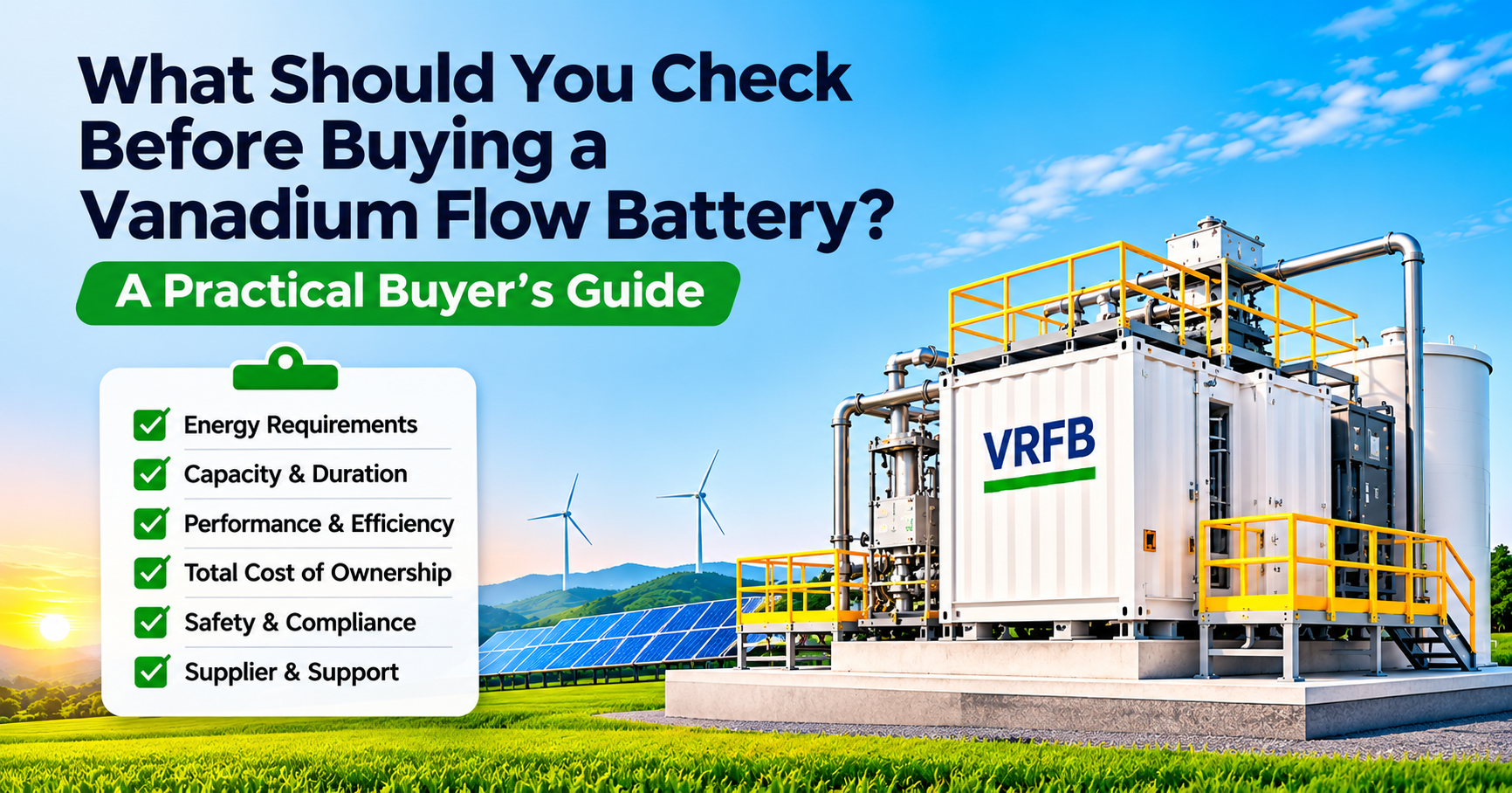
Understand Your Energy Storage Requirements
The first step is to identify what the battery needs to achieve. A system designed for solar energy storage may have different requirements from one intended for industrial energy management or grid support.
Start by defining the following:
-
Power capacity: How much electricity must the battery deliver at a given time?
-
Energy capacity: How much electricity needs to be stored?
-
Storage duration: How many hours must the system supply electricity?
-
Operating schedule: How frequently will the battery charge and discharge?
-
Application: Will it support solar generation, wind power, grid services or commercial operations?
-
Future demand: Will additional storage capacity be required as energy consumption increases?
Power capacity is measured in kilowatts (kW) or megawatts (MW), while energy capacity is measured in kilowatt-hours (kWh) or megawatt-hours (MWh).
For example, a system delivering 1 MW of power for 8 hours requires approximately 8 MWh of usable energy capacity, before accounting for operating reserves and system losses.
Clearly defining these requirements helps suppliers recommend an appropriate configuration and prepare a quotation based on actual project needs.
If you are still comparing battery technologies, start with our guide to vanadium redox flow batteries to understand their design and operating principles.
Check Battery Capacity and Storage Duration
Battery capacity is one of the most important factors when selecting a vanadium flow battery.
Unlike conventional battery systems where power and energy capacity are closely linked through the battery modules, vanadium flow batteries use external electrolyte storage. This allows power output and energy capacity to be configured separately.
Power capacity: Primarily determined by the number and configuration of battery stacks. It determines how much electricity the system can deliver.
Energy capacity: Mainly determined by the amount and concentration of electrolyte available for energy storage.
Storage duration: Depends on the relationship between usable energy capacity and power output.
Before purchasing, check:
-
Rated power output.
-
Total and usable energy capacity.
-
Required discharge duration.
-
Charging and discharging requirements.
-
Electrolyte storage capacity.
-
Potential for future energy capacity expansion.
For example, a project requiring longer discharge duration will generally need additional electrolyte volume and larger storage tanks. This can increase the overall system size and investment.
Ask suppliers whether the proposed system can be expanded if your future energy requirements change. This is particularly relevant for long-duration energy storage applications involving renewable energy integration and grid support.
Evaluate Battery Performance and Efficiency
A battery's rated capacity does not tell you everything about its operating performance. Buyers should review technical specifications and understand how the system performs under expected operating conditions.
Important performance factors include:
Round-trip efficiency: Measures the energy recovered during discharge compared with the energy used during charging. Ask whether the quoted figure represents the battery stack or the complete system.
Auxiliary energy consumption: Pumps, controls and other supporting equipment consume electricity. These loads should be included when evaluating overall system performance.
Charging and discharging performance: Confirm the charging requirements, rated discharge power and expected operating profile.
Operating temperature: Check the manufacturer's specified operating temperature range and any temperature management requirements.
System availability: Understand the expected operating availability and whether the supplier provides an availability guarantee.
Performance guarantees: Ask for documented test results and the conditions under which the stated performance figures were measured.
A useful comparison should include the complete system rather than relying only on battery stack specifications. Learn more about the factors that influence redox flow battery.
Understand Electrolyte Quality and Battery Components
Vanadium electrolyte plays a central role in the operation of a vanadium redox flow battery. It stores energy through chemical reactions and circulates between external storage tanks and the battery stacks.
Buyers should understand the electrolyte specifications and the quality of the equipment supplied with the system.
Vanadium electrolyte: Check the chemical composition, concentration, volume, quality specifications and supply arrangements.
Battery stacks: Review their rated power, construction, materials and performance specifications.
Membranes and electrodes: Ask about the materials used, expected operating requirements and replacement arrangements.
Electrolyte tanks: Confirm storage capacity, construction materials, containment arrangements and inspection access.
Pumps and piping: Review pump specifications, electrolyte circulation requirements, leakage protection and maintenance access.
Monitoring and control systems: Check which operating parameters are monitored and how alarms and protective functions operate.
The compatibility of these components is important. A battery should be evaluated as a complete integrated system rather than as a collection of separate pieces of equipment.
Our battery energy storage system components guide explains the main equipment used in a complete battery storage installation.
Compare the Total Cost of Ownership
The initial purchase price is only one part of a vanadium flow battery investment. Buyers should evaluate the costs associated with installation, operation, maintenance and component replacement.
Consider the following cost categories:
|
Cost category |
What to evaluate |
|
Battery equipment |
Stacks, tanks, pumps and supporting components |
|
Electrolyte |
Required volume, specifications and supply arrangements |
|
Installation |
Civil work, equipment positioning and electrical connections |
|
Integration |
Power conversion, control systems and grid connection |
|
Commissioning |
Testing, configuration and acceptance |
|
Operating expenses |
Pumping electricity and auxiliary consumption |
|
Maintenance |
Inspections, servicing and repairs |
|
Replacement |
Components that may require refurbishment or replacement |
The expected operating life, maintenance requirements and warranty coverage should also be considered.
When comparing quotations, make sure each supplier is pricing the same power capacity, energy capacity, discharge duration and installation scope.
For a more detailed understanding of the factors influencing investment, see our guide to vanadium battery price.
A lower initial quotation may exclude important equipment or services. Request an itemised cost breakdown so that you can compare proposals accurately.
Check Safety Requirements and Certifications
Safety should be considered during system selection, site planning, installation and operation.
Vanadium flow battery systems contain electrical equipment, circulating electrolytes, pumps, piping and storage tanks. Their design should include appropriate protection against electrical, mechanical and electrolyte-related hazards.
Before purchasing, review:
-
Electrical protection and emergency shutdown arrangements.
-
Electrolyte containment and leakage detection.
-
Tank and piping specifications.
-
Monitoring and alarm systems.
-
Equipment access and maintenance procedures.
-
Operating instructions and emergency response documentation.
-
Applicable international and local safety requirements.
One relevant international reference is IEC 62932-2-2:2020, which addresses safety requirements for stationary flow battery energy systems and their installations.
Read the IEC 62932-2-2:2020 safety standard.
Ask suppliers to identify the standards their specific system has been designed and tested against. Request relevant test reports and compliance documentation rather than relying on general statements about certification.
Local electrical, building, environmental and workplace requirements must also be checked for the project location.
Evaluate Installation and Site Requirements
A vanadium flow battery requires sufficient space for battery stacks, electrolyte tanks, pumps, piping and supporting equipment. The site must also allow safe installation, electrical integration and future maintenance.
Before approving a system design, check the following:
Available installation space: Confirm that the site can accommodate the complete system and provide sufficient access around the equipment.
Foundations and civil work: Review the requirements for equipment support, tank positioning and installation surfaces.
Electrical infrastructure: Check connection requirements, protection equipment and compatibility with existing electrical systems.
Environmental conditions: Confirm the permitted operating temperature range and any site-specific requirements.
Maintenance access: Ensure technicians can inspect tanks, pumps, valves and electrical equipment safely.
Grid and renewable integration: Confirm how the battery will connect to the electricity network, solar installation or other generation equipment.
Installation requirements should be established during project planning rather than after the equipment has been ordered.
Commissioning also needs to be included in the project scope. Our guide to BESS commissioning in New Zealand explains the importance of testing, acceptance and handover.
Choose a Reliable Vanadium Flow Battery Supplier
The supplier's technical capability is just as important as the battery specifications. A suitable supplier should be able to explain how the proposed system meets your project requirements and provide documentation to support its claims.
Before choosing a supplier, assess the following:
Technical experience: Ask about experience with vanadium flow battery projects of comparable size and application.
Project references: Request details of relevant installations and their operating conditions.
Technical documentation: Review system specifications, drawings, performance data and installation requirements.
Product quality: Understand the equipment specifications, component sourcing and quality assurance procedures.
Engineering and installation: Confirm whether the supplier provides system design, installation and commissioning services.
Warranty coverage: Check which components and performance conditions are covered.
After-sales support: Confirm the availability of technical assistance, spare parts and maintenance services.
A supplier should also explain the limitations of the proposed system. Be cautious of performance claims that are not supported by technical documents or clearly defined operating conditions.
Review Warranty, Maintenance and Long-Term Support
Battery storage projects require support throughout their operating life. Before signing a purchase agreement, understand the supplier's responsibilities after installation.
Review these areas:
Battery stack warranty: Check the warranty period, covered components and operating conditions.
Electrolyte arrangements: Confirm electrolyte specifications, handling requirements and procedures for monitoring and managing electrolyte condition.
Pump and auxiliary equipment warranty: Check the coverage for mechanical and electrical components.
Maintenance schedule: Request details of routine inspections, servicing intervals and recommended maintenance activities.
Monitoring and technical support: Confirm whether remote monitoring is available and how operating problems are reported.
Replacement parts: Ask about spare parts availability and expected support arrangements.
Warranty terms should clearly identify exclusions, performance guarantees, operating conditions and responsibilities for servicing.
Long-term support can affect system availability and maintenance planning, so it should be evaluated before purchasing rather than treated as an additional consideration after installation.
Questions to Ask Before Purchasing a Vanadium Flow Battery
Use this checklist when evaluating suppliers and comparing proposals.
|
Question |
Why it matters |
|
What are the rated power and energy capacities? |
Confirms system sizing |
|
What is the usable energy capacity? |
Clarifies available stored energy |
|
What discharge duration can the system provide? |
Checks application suitability |
|
What is the guaranteed round-trip efficiency? |
Helps assess energy performance |
|
Are auxiliary loads included in the efficiency calculation? |
Avoids misleading comparisons |
|
What electrolyte specifications are provided? |
Helps assess system requirements |
|
What safety standards and test documents are available? |
Supports safety evaluation |
|
What is included in the total quotation? |
Identifies additional costs |
|
Who handles installation and commissioning? |
Clarifies project responsibilities |
|
What warranties and maintenance services are offered? |
Establishes long-term support |
Request written answers and supporting documents wherever possible. This makes it easier to compare supplier proposals using consistent technical and commercial criteria.
Conclusion: Making the Right Vanadium Flow Battery Investment
Buying a vanadium flow battery requires careful evaluation of energy requirements, system capacity, performance, electrolyte specifications, safety, installation and long-term costs.
The right system should match the project's power requirements and operating profile. Buyers should also assess the supplier's technical documentation, warranty coverage and ability to provide ongoing support.
Comparing complete project proposals rather than initial equipment prices helps businesses and project developers make better-informed investment decisions.
Zion Technologies provides redox flow battery for stationary energy storage applications. Contact the team to discuss your project requirements and explore suitable battery storage configurations.
Frequently Asked Questions
1. What should I consider before buying a vanadium flow battery?
Consider power capacity, energy capacity, discharge duration, efficiency, electrolyte specifications, safety, installation requirements, total ownership costs and supplier support.
2. How do I choose the right vanadium flow battery capacity?
Start with the required power output, usable energy capacity and discharge duration. Also consider the charging schedule, expected operating profile and potential future demand. A supplier can use these requirements to recommend a suitable system configuration.
3. How much does a vanadium flow battery cost?
The price depends on system capacity, electrolyte volume, battery stack configuration, supporting equipment, installation and project requirements. Request an itemised quotation based on your required power and energy capacity.
4. Are vanadium flow batteries suitable for commercial energy storage?
They can be suitable for stationary commercial applications where the required storage duration, site conditions and financial requirements match the technology's characteristics. Each project should be evaluated individually.
5. What maintenance does a vanadium flow battery require?
Maintenance may include inspecting pumps, valves, piping, tanks, electrical equipment and monitoring systems. Electrolyte condition and system operating parameters should also be monitored according to the manufacturer's procedures.
6. How long does a vanadium redox flow battery last?
Service life depends on system design, operating conditions, maintenance and component quality. Buyers should request separate information about expected stack life, electrolyte management and warranty coverage for supporting equipment.
7. What safety standards apply to vanadium flow batteries?
IEC 62932-2-2:2020 is an international safety standard for stationary flow battery energy systems. Buyers should also check the electrical, environmental and workplace requirements applicable to their installation location.