
The Role of Calibration in Microscopy
Microscope calibration is the process of aligning the measurement scale of a microscope with a known reference standard. A Stage Micrometer provides that reference. Without this step, measurements made through the eyepiece or digital imaging system may not accurately reflect the true dimensions of the sample. This matters in all quantitative microscopy applications — from pharmaceutical particle size analysis to histological tissue measurement.
Components That Define Performance
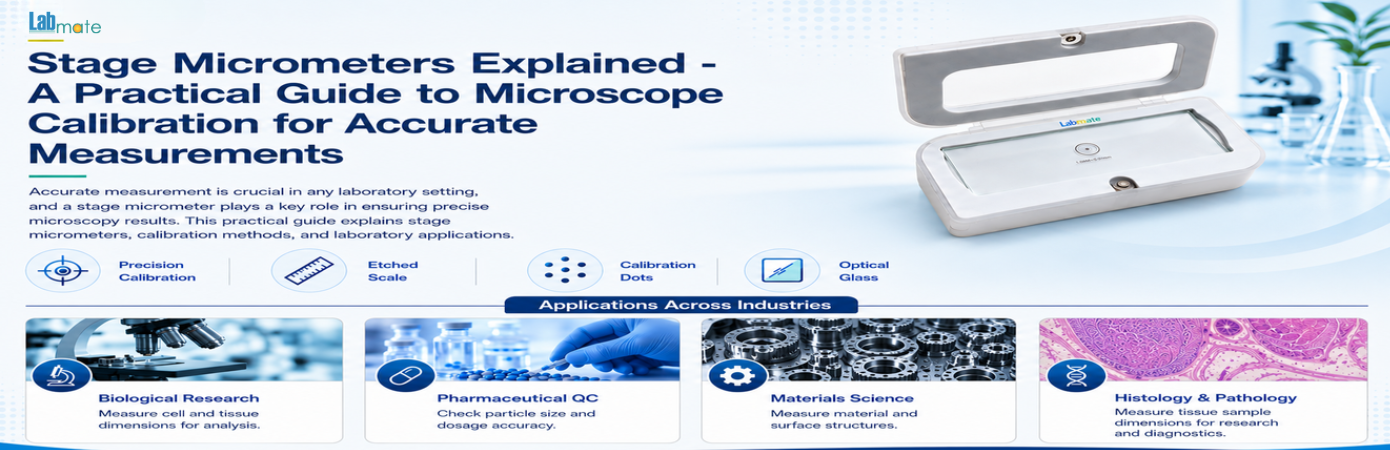
The Stage Micrometer consists of a glass slide base that provides structural support for the etched scale. The division value — either 0.01 mm or 0.1 mm depending on the model — determines the resolution of the calibration. Calibration dots may also be present, with dot sizes of 0.07 mm and 0.15 mm on certain models, or a broader range of 0.01 mm, 0.05 mm, 0.1 mm, 1 mm, 5 mm, and 10 mm on others. These dots help verify optical distortion and image quality at different magnifications.
Step-by-Step Calibration Process
Insert the Stage Micrometer onto the microscope stage. Begin with the lowest available objective lens to locate and focus on the etched scale. Increase magnification as needed, refocusing at each step. Superimpose the eyepiece reticle over the micrometer scale and count how many reticle divisions align with a known number of Stage Micrometer divisions. Divide the known distance by the number of reticle divisions to calculate the scale factor for that objective. Repeat this process for each objective lens and document all values.
Choosing the Right Model
Standard Stage Micrometers with 1 mm to 10 mm scales are suited to routine calibration across a wide range of applications. High-precision models with 0.01 mm divisions are appropriate for advanced research where fine measurement resolution is required. Industrial or metallurgical applications that require broader calibration fields may use a 0.1 mm division with a 10 mm total range. Selecting the correct model depends on the magnification range, the size of the objects being measured, and the accuracy required by the application.
Stage Micrometer vs. Eyepiece Micrometer
An eyepiece micrometer is built into the microscope, but it requires calibration against a Stage Micrometer before it can provide accurate measurements. The Stage Micrometer calibration step accounts for variations in optics, magnification, and objective lens design, ensuring that the eyepiece micrometer reading reflects the true dimensions of the sample.
Conclusion
Calibration with a Stage Micrometer is a fundamental step in any microscopy workflow that requires measurement accuracy. Documenting calibration values for each objective lens and maintaining the optical glass slide in good condition supports consistent, traceable measurement throughout the life of the instrument.
For more information, click here or contact us at
Email: info@labmate.com