
Permaculture: Social and Legal Design for Sustainable Systems
https://justpaste.it/sp-soledss
Google NotebookLN - July 2025
The provided source, excerpts from Permaculture: A Designers' Manual by Bill Mollison, highlights that Social & Legal Design are not merely supplementary, but deeply interwoven with the core principles of permaculture, forming an essential framework for creating sustainable human settlements. It explains that permaculture is fundamentally guided by three ethical principles: Care of the Earth, Care of People, and Setting Limits to Population and Consumption, all underpinned by the ethical decision to take responsibility for one's own existence and that of one's children, and the Principle of Cooperation. The text further details how social components like legal structures, culture, trade, and finance are integral to a "total design" in permaculture, advocating for policies that prohibit practices leading to the permanent degradation of sustainable resources and foster self-managed systems and regional or village self-reliance. Ultimately, the source positions permaculture as a holistic approach for designing and maintaining sustainable human settlements by integrating ecological considerations with social, legal, and economic aspects.
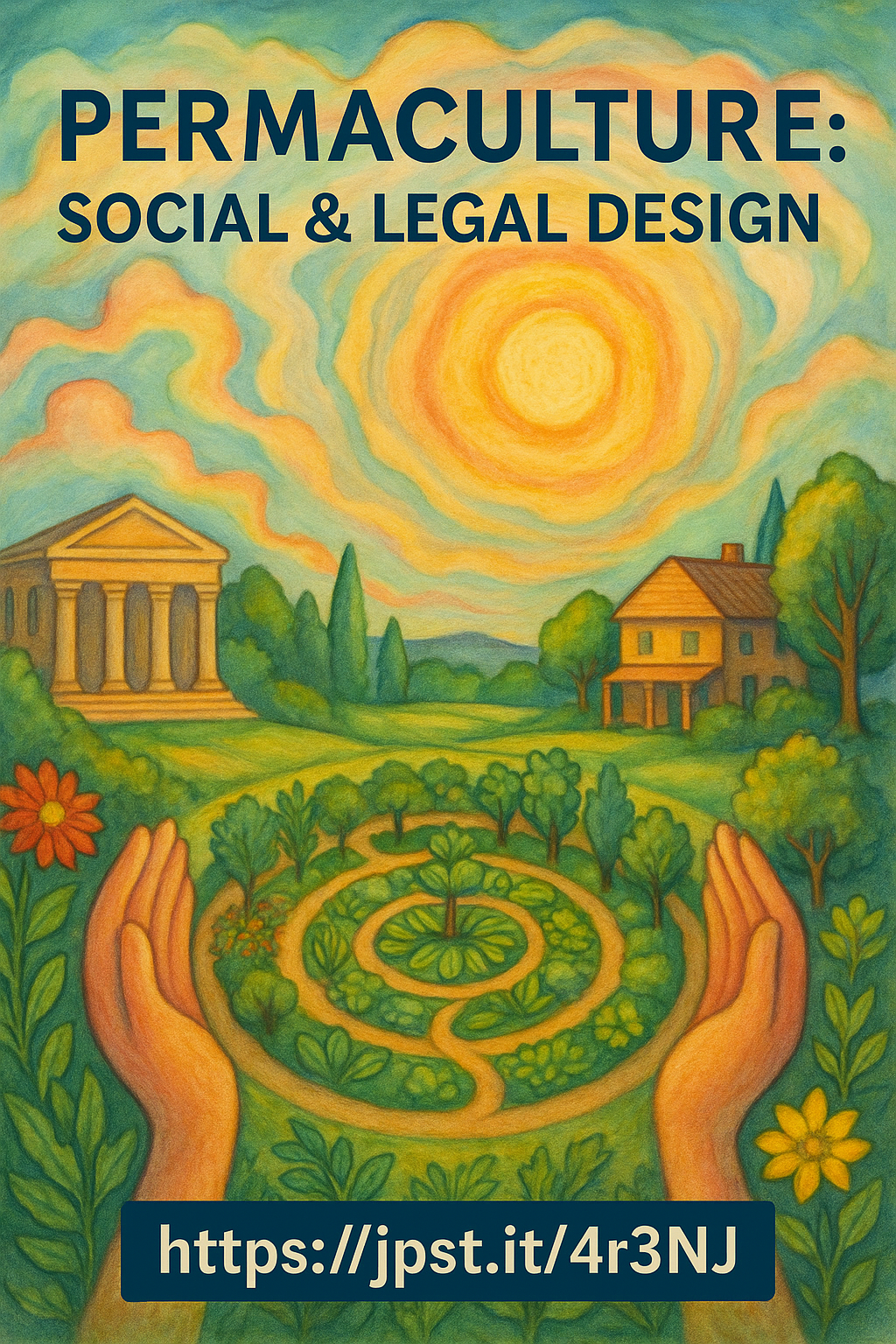
Permaculture: Social and Legal Design for Sustainable Systems
In the larger context of Permaculture: A Designers' Manual by Bill Mollison, Social & Legal Design are not merely supplementary elements but are deeply interwoven with the core principles, forming an essential framework for creating sustainable human settlements. These aspects are crucial for translating permaculture's ethical foundation into practical, real-world systems.
The sources highlight several key facets of Social & Legal Design:
1. Foundational Ethical Principles
Permaculture design is fundamentally guided by a set of core ethics which directly inform social and legal considerations:
• Care of the Earth: This ethical principle necessitates the implementation of societal and legal frameworks that provide for all life systems to continue and multiply. It underscores the importance of nurturing and sustaining the Earth as a living system.
• Care of People: This principle mandates ensuring that people have access to the resources necessary for their existence, emphasising equitable access and meeting human needs within ecological limits.
• Setting Limits to Population and Consumption: By governing human needs and desires, resources can be set aside to further the first two principles. This is a direct call for social and legal policies that enforce responsible resource use and living within the Earth's carrying capacity.
Mollison posits that the "prime principle of permaculture, and its core, is the ethical decision to take responsibility for one's own existence and that of one's children". This personal ethical stance is the bedrock for collective social and legal action. The Principle of Cooperation is also highlighted as being "the very basis of future survival and of existing life systems," emphasising that cooperation, rather than competition, is the guiding philosophy for human interaction within a permaculture context.
2. Integration into Permaculture Design
Social and Legal Design are explicitly identified as integral components of a "total design" within the permaculture framework:
• In the Permaculture Design table (Table 1.1), "Socio-Legal Elements" are listed as key components. These include "Legal/Financial Structures" at the 'Selection' stage and "Trusts, Companies, Cooperatives, Community Credit Unions" at the 'Assembly' stage. This shows a direct link between the design process and the societal structures that enable or support it.
• "Social Components" within a comprehensive design are identified as "Legal Aids, People, Culture, Trade and Finance". This signifies that successful permaculture systems must integrate these human and institutional aspects effectively.
• "Ethics" are also listed as "Abstract Components" of design, indicating their pervasive influence across all layers of planning and implementation.
3. Policy and Resource Management Principles
The sources advocate for specific policies and management principles that fall under Social & Legal Design:
• Policy of Resource Management: This principle calls for societal measures that prohibit practices leading to the permanent degradation of sustainable resources. Such practices include the use of pollutants, persistent poisons, and extensive impervious surfaces like concrete highways, as well as the discharge of sewers directly into the sea.
• Law of Return: This fundamental principle, expressed as "Whatever we take, we must return" or "Nature demands a return for every gift received, or 'The user must pay'," underlines the ethical and societal obligation for reciprocity with natural systems. This implies a need for legal and social systems that facilitate this return and prevent unchecked consumption.
• Principle of Quantity: This principle states that any system or organism can only productively use a specific quantity of a resource; oversupply leads to disorder and chronic pollution. This suggests that social and legal regulations should manage resource flows to avoid excess and waste.
• Policy of Responsibility: Permaculture design aims to create "self-managed system[s]" by returning "function and responsibility to life and to people," reducing the need for external authority.
4. Addressing Societal Challenges and Fostering Self-Reliance
Permaculture's emphasis on social and legal design arises from a recognition of the "damage caused by modern agriculture, monocultural forestry, and thoughtless settlement design". It offers strategies for necessary changes in "social investment policy, politics itself, and towards regional or village self-reliance".
• The manual questions current agricultural methods and highlights the need for local food production and small-scale livestock suited to local needs.
• The overall aim is to create "sustainable human settlements" and "secure living spaces". This involves promoting cooperative endeavours, pooling of resources, and sharing, as well as financial recycling within the community.
• Permaculture encourages conscious action and taking responsibility for one's environment, directly contrasting with passive acceptance of environmental degradation. Mollison states that the "courage we need is to refuse authority and to accept only personally responsible decisions".
SUMMARY
Social & Legal Design in Permaculture is not an add-on, but a core aspect that frames human interaction and governance within the ethical and ecological principles of the discipline. It provides the necessary structures and policies to move towards a regenerative, self-reliant, and just future, making it an indispensable part of permaculture as outlined in A Designers' Manual.
--------------------------------------------------------------------------------
Social Media announcement
Permaculture: Social & Legal Design
Designing systems where care, cooperation, and justice grow as naturally as the forests.
Drawn from Bill Mollison’s "Permaculture: A Designer’s Manual"
#permaculture #sociocracy #regeneration #systemdesign #ecology #resilience #justice
---
Social Permaculture - Index - https://justpaste.it/pcspi
Permaculture - A Designer's Manual Q&A [Landing Page] - https://justpaste.it/padm-index
Permaculture - Deep Questions & Answers - Index - https://justpaste.it/padm-dqa
Conversations with Bots - https://justpaste.it/padm-index