
"What does "Permaculture A Designers' Manual" say about the nation-state?"
https://justpaste.it/sp-ns
Google NotebookLN - July 2025
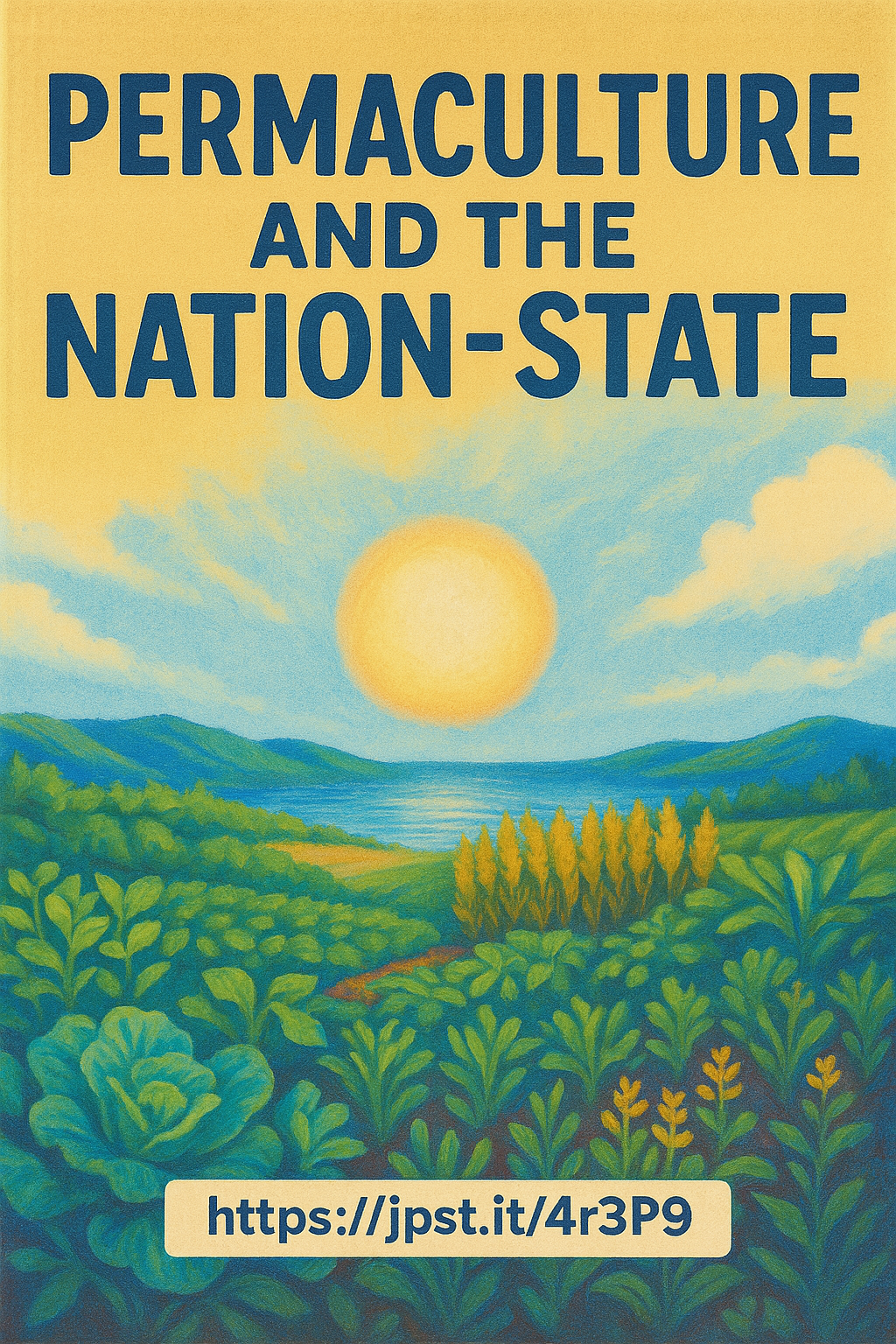
The concept of the nation-state is discussed in the sources, particularly in the context of permaculture's alternative approaches to global and societal structures.
Here's what is said in relation to the nation-state:
* Permaculture is described as having the potential to provide a "safe state" for people.
This implies a shift away from traditional nation-state structures towards self-reliant and sustainable human settlements.
* The manual presents "Permaculture A Designers' Manual" as a guide to the form of a future in which children have a chance of a reasonable existence, suggesting that the current global debate must transcend the limitations of traditional political and economic structures.
* It is noted that modern societies, particularly those of the nation-state, are heavily dependent on imported food and raw materials, and that food production often occurs in wastelands and excessive monoculture within towns and cities. This highlights a critique of how the current nation-state model manages resources and food security.
* One of the principles for applying law and principles to design in permaculture is "THE STATE: Provision of law for all life systems to continue and increase". This redefines the role of the state to serve all life systems, not just human ones.
* The "Philosopher-gardeners" or "farmer-poets" are described as working to build human artifacts and generate love and respect for all living systems as a witness to the potential of creation. This vision implies a different kind of societal organisation than the current nation-state, focusing on a deep connection to the Earth.
* The book calls into question the current methods of agriculture employed by the nation-state, which often involve large-scale, monocultural forestry, and thoughtless settlement design. It suggests that "the world can no longer sustain the damage caused by modern agriculture, monocultural forestry, and thoughtless settlement design, and in the near future we will see the end of wasted energy, or the end of civilization as we know it, due to human-caused pollution and climate changes". This implies that the existing nation-state framework contributes to, rather than solves, environmental and social crises.
* Strategies for necessary changes in social investment policy, politics, and towards regional or village self-reliance are seen as desperately needed.
* The manual provides examples of these strategies. This emphasis on regional and village self-reliance suggests a movement away from the centralised control often associated with the nation-state.
* The concept of a "new global nation" is explored, with Chapter 14 specifically titled "THE STRATEGIES OF AN ALTERNATIVE GLOBAL NATION". This chapter delves into related topics such as the ethical basis of an alternative nation, alternatives to political systems, bioregional organisation, extended families, trusts, village development, effective working groups, right livelihood, money and finance, land access, ethical investment, and effective aid.
* The permaculture design process aims for "a total design in evolution to maturity," encompassing organic elements (species, people), inorganic and derived organic elements (materials and fuels, technology, constructs), and socio-legal elements (trusts, companies, cooperatives, community credit unions). This broad scope suggests a comprehensive societal re-design that goes beyond the current nation-state model, incorporating diverse social and economic structures.
* It is suggested that "Permaculture is a design system primarily with the third statement above, but all people who act responsibly in fact subscribe to the first two statements". The third statement focuses on the world as a total physical system, implying a global perspective that transcends national boundaries.
* The book highlights that great changes are taking place, and it may not be possible for everyone to do permaculture work within a formal group or as a result of one group teaching it. It suggests that for many, "we usually point the finger at ourselves! It doesn't matter if the work we do carries the 'permaculture' label or that we do it". This decentralised approach contrasts with the top-down control often seen in nation-state initiatives.
* The text notes that "the common wealth of humans and the state is an unmeasurable quantity of fuel production or food production, and is related to total production". This indicates a re-evaluation of how wealth and production are measured, moving beyond purely economic terms typically used by nation-states.
* It is asserted that "the world can provide no shortage of a useful state or other entity to which we may want to independently verify that information". This statement seems to critically assess the reliability of information and authority typically provided by state entities.
* The sources also touch on "ethical investment movement," which could be seen as an alternative to traditional economic systems often managed by nation-states.
* The "Preface" states that "To many of us who experienced the ferment of the late 1960's there seemed to be no positive direction forward, although most everybody could define those aspects of the global society that they rejected, and these include military adventurism, the bomb, ruthless land exploitation, the arrogance of polluters, and a general insensitivity to human and environmental needs". This historical context suggests that permaculture emerged from a critique of destructive trends associated with global powers and potentially the nation-state's role in them.
* Permaculture aims to empower the powerless and create a "great team of people which increases in numbers daily" to replace nation-states with a "safe future for the preservation of the biosphere". This clearly indicates a vision for alternative governance and societal organisation that supersedes the current nation-state model.
* The concept of "social landscapes" is introduced as an alternative to "political landscapes," often associated with the nation-state. This implies a focus on community and ecological relationships over rigid political boundaries.
* The sources describe a path to an "alternative" or "global" nation, where social responsibility and ecological principles are central, moving beyond the traditional nation-state's focus on material wealth and power. The "ethical basis of permaculture" includes "CARE OF THE EARTH," "CARE OF PEOPLE," and "SETTING LIMITS TO POPULATION AND CONSUMPTION," which are presented as guidelines for establishing a "reasonable existence" for future generations.
SUMMARY
In summary, the sources suggest that the permaculture movement offers a comprehensive redesign of human settlement and societal organisation that fundamentally challenges the current model of the nation-state, advocating for self-reliance, bioregionalism, ethical investment, and a redefinition of the "state" to serve all life systems.
Social media announcement:
Permaculture and the Nation-State
What if our future was rooted in care for all life, beyond borders and hierarchies?
Drawn from Bill Mollison's "Permaculture: A Designer's Manual".
https://jpst.it/4r3P9
#permaculture #sociocracy #postcolonialism #bioregionalism #regenerativeculture #climatejustice #decolonize #resilience
Related:
"Nation-State, Nationalism and the Need for Roots"
By Yavor Tarinski
---
Permaculture - A Designer's Manual Q&A [Landing Page] - https://justpaste.it/padm-index
Social Permaculture - Index - https://justpaste.it/pcspi
Permaculture [Index] - https://justpaste.it/o-p
Permaculture - Deep Questions & Answers - Index - https://justpaste.it/padm-dqa
Conversations with Bots - https://justpaste.it/padm-index