
The Ethics of Permaculture
This page is a backup copy from
ranchomastatal.com/blognewsletter/the-ethics-of-permaculture
February 10, 2024
By core team member, Sam Hansen
Philosophy is the study of knowledge, truth, and meaning. Ethics or “moral philosophy”
embraces those principles as they influence human behavior. Socrates, who was a
foundational figure in western philosophy thought that ethics are based on the premise
that all people are essentially good and given the choice will make good decisions.
Aristotle called this behavior “virtue,” a striving to do the right thing and make the ethical
decision.
When these concepts are applied in practice, the seeking after right and wrong gets a
little more complicated. Are ethics universal, or are they subjective, governed by
individual attitudes and circumstances? And if that is the case, how can anyone be sure
that they have “good ethics” and are always making the right decision? And by what
means can we design a future in which every choice leads to the wellbeing of all
humanity and to the wellbeing of the planet?
In 1978 Bill Mollison and David Holmgren, two Australian ecologists took on that
challenge by developing an interdisciplinary design manual which they believed, if
followed would result in a positive, integrated and prosperous future. They called their
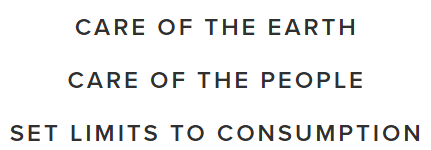
enterprise “permaculture” and created three fundamental ethical formations as its
foundation.
“The only ethical decision is to take responsibility for our own existence
and that of our children. Make it now.” – Bill Mollison
Earth Care
The permaculture ethic of caring for the earth is founded on an understanding of the
interconnectedness we share with all nature and that our survival as a species is
dependent on that of the planet earth. While some might argue that this ethic stems from
our own self-interest, Bill and David believed that the “survival of natural systems” is
based on cooperation with, rather than domination over, the natural systems that provide
a healthy habitat for us.
“When we lose plant and animal species due to our actions,
we lose many survival opportunities”- B. Mollison.
Permaculture states that we leave these natural systems to flourish and when we
require resources, we harvest them applying the rules of “necessitous use” which
includes reducing waste, avoiding pollution, and safeguarding against any process with
negative environmental or human impacts.
The Earth care ethic reminds us that our best, our only future, depends on the common
goal of living together in harmony and cooperation on a thriving sustainable Earth.
When we come together and agree on the common goal of taking care of the earth and
ensuring its existence and our survival on it, we can then focus on our relationships with
others. From an early age we are taught to look out for our family and keep each other
safe. As global citizens it is essential to treat all humanity as part of our family and
extend the same care to all. A population that values each and every individual’s
contribution and functions to support each other is more likely to thrive than one based
on competition and opposition. Sadly, most political and state systems function by
setting us on opposing teams. How much better would it be for everyone if we were on
the same side working towards a unified and prosperous future?
What Bill Mollison called “communal permanence” is creating a strong sense of
interconnectedness with nature and with each other so that we can thrive for many
generations. For example, knowing that the forests we plant today will be nurtured and
cherished for the future and not harvested for short term gain. This ethic is not a simple
one in which to find balance, given that we have such a diverse range of cultures,
customs, values and philosophies in the world. However, by working together towards
common goals that allow us to live in harmony with nature, ensure that everyone has
access to clean water and healthy food and enjoys the right to free expression, all the
while not imposing on other’s well-being, we can strive to create a future in which we
protect our planet and each other.
Set Limits to consumption – redistribute surplus
“Beneficial behavior involves managing natural systems for their own,
and our, long-term benefit, not for our immediate and exploitative personal gain”
- Bill Mollison
In a world of rampant consumption and waste the third ethic of Permaculture is based on
setting limits and seeking to live a sustainable life by relying on the rule of necessitous
use. When we free ourselves from competitive and wasteful economic systems, and
organize equitable distribution systems, we discover that there are certainly enough
resources to meet everyone’s needs.
The “Fair-share” ethic teaches us to look after our neighbor when they have fewer yields
and in turn they will look after us when our yields are low. We can extend this ethic to all
of nature and leave space for ecosystems to thrive. Minimizing waste and developing as
many renewable resources and systems as possible will help us achieve a balance
where we can all enjoy the bounty the earth has to offer, and we can care for each other.
Transitioning into a permanent agriculture and a permanent culture
Since the first permaculture design manuals were written in the late 70’s, much work has
been done that has advanced all aspects of permaculture both in design and philosophy.
As a result, a fourth ethic has been added to the original three, the “transition ethic.” As
we endeavor to make our planet a better and more equitable one, and to protect the
natural world and all who inhabit it, the reality of the tremendous inequities of the people
who share it, make that a formidable task.
Differing perspectives based on vastly different realities and experiences, make
consensus on any and every decision extremely challenging. For example, so many of
the agricultural practices employed in conventional farming are hugely destructive to the
health of the soil and the people who are fed by it. But persuading a farmer not to use
pesticides, tilling or monocropping, when they are convinced that their livelihood
depends upon it, is not a simple matter. But neither is it impossible. Through education
and support and the awareness of sustainable agricultural practices, farmers could
make the necessary transition into rewarding, diversified agro-ecological systems that
are resilient, respect the earth and provide plenty for all.
Transitioning people from a globalized individualistic consumption-based economy into
one that is rooted in local communities and tied to resource sharing, also poses a
challenge. Meeting people where they are and having patience with the fact that not
everyone can immediately escape from under the thumb of the current economic
paradigm comes with the understanding and application of permaculture ethics and their
application in creating a better future.
Breaking down existing systems and interacting with each other in respect and harmony
will lead to the just future we seek. The process is a long one, but the transition ethic
teaches us to be compassionate and patient as well as understanding that not everyone
can simply make that immediate “switch.”
In a perfect world
The path humanity has taken since the industrial revolution, colonial exploration and
exploitation, has been a hugely destructive and divisive one. The planet has been
massively degraded and political elites acting in their own narrow interests have kept
entire peoples and societies apart and impoverished. While the ethics permaculture
proposes may seem utopic and difficult to achieve in the short term or on any significant
scale, it’s important to remember that living mindfully, guided by these ethics and
practices, can have a significant impact.
They can guide us to living in a harmonious relationship to the earth, ourselves and each
other if only we keep them close in all aspects of our daily life. By starting out small and
applying the ethics and practices of permaculture in our homes, neighborhoods and
communities, every positive decision we make or action we take, has ripple effects that
contribute to the transformations we yearn to see in the world.
This is the goal of the permaculture movement on a global scale, to share ancient
wisdom that largely has been forgotten and that can be used to connect us with a
collective vision, behaviors and actions that will lead all who participate, to a just, equal
and abundant way of life.
“Meaning in life is lost by striving after status and future glory; it is gained and
realized by action towards a common ideal, in serving the whole according to our
physical, mental, educational and understanding capacities. It is never enough to
mean well, rather, it is necessary to ensure that it gets done.”
- Bill Mollison

This page is a backup copy from ranchomastatal.com/blognewsletter/the-ethics-of-permaculture
---
Social Permaculture - Index: https://justpaste.it/pcspi