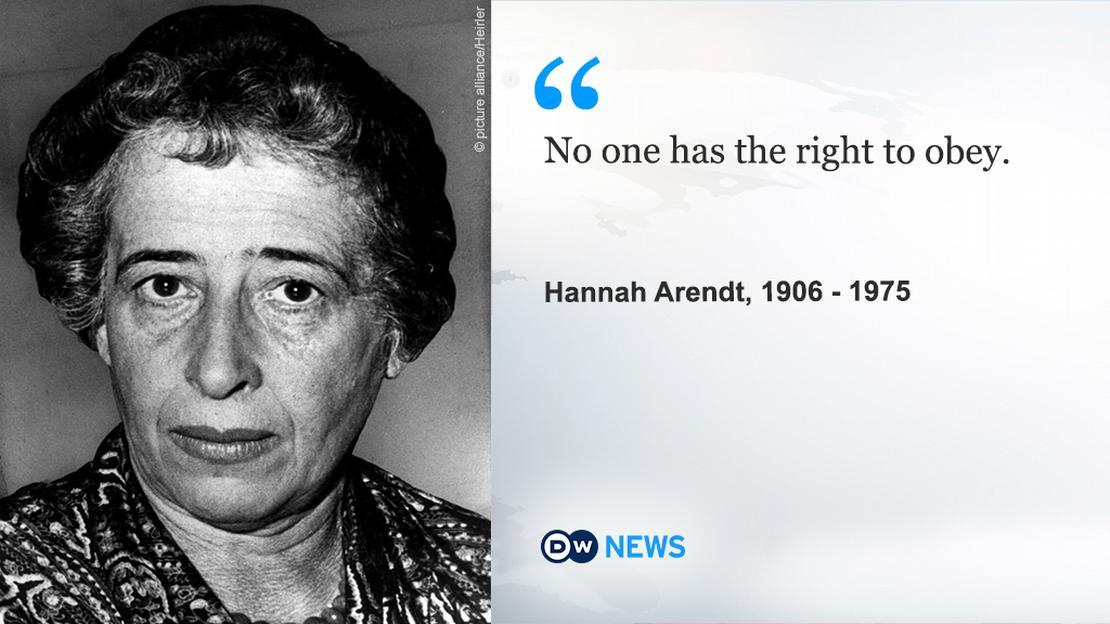
Why the world is turning to Hannah Arendt to explain Trump
Elizabeth Grenier
February 2, 2017
George Orwell's "1984" is not the only classic that's celebrating a comeback. Hannah Arendt's
philosophical essay "The Origins of Totalitarianism" has also spiked in interest recently. Here's why it's so
relevant.
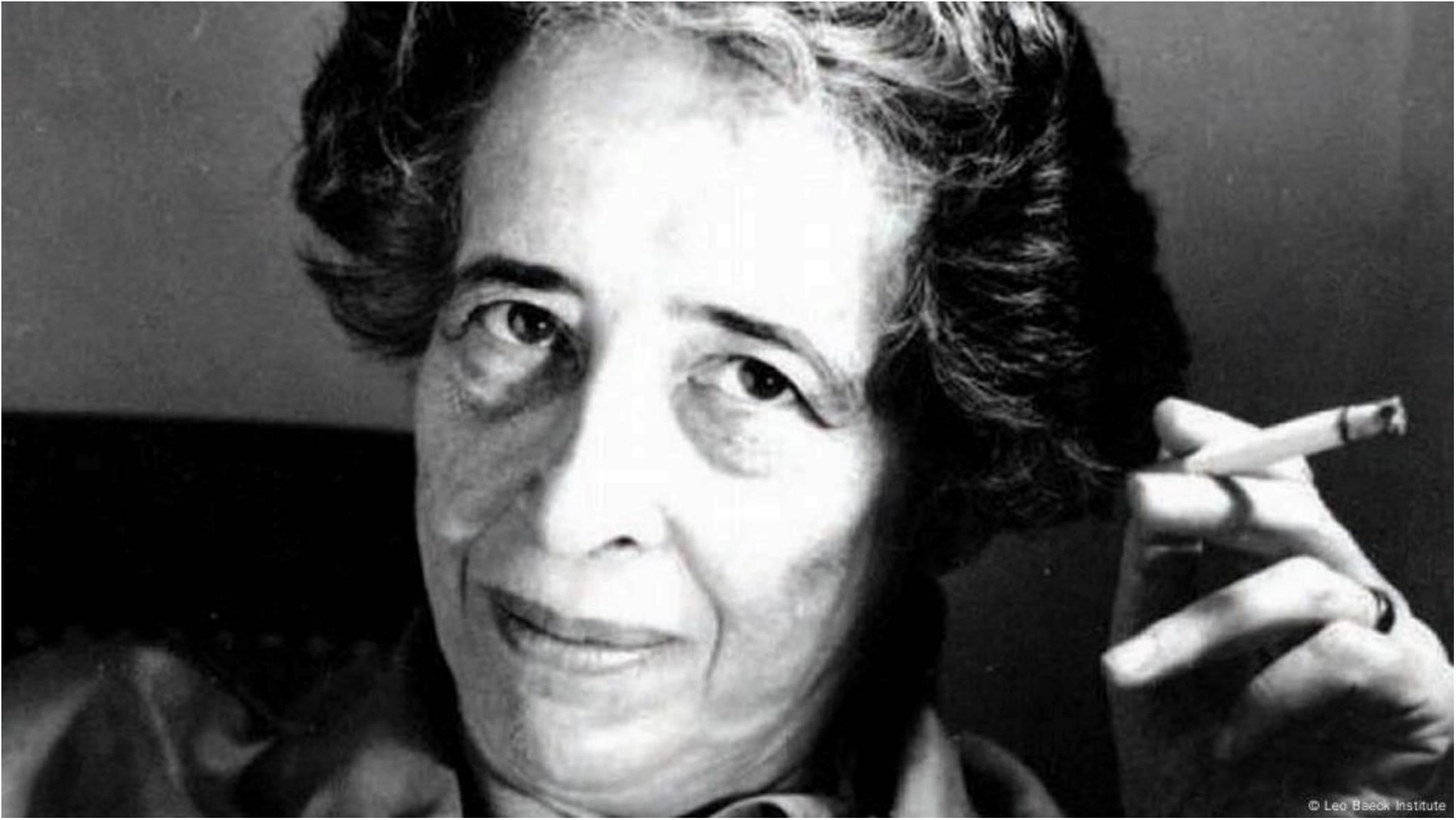
Image: Leo Baeck Institute
Born in Germany to a Jewish family, Hannah Arendt (1906-1975) fled when Adolf Hitler rose to power in
1933. She spent time as a stateless refugee in France and was deported to an internment camp under
the Vichy regime. She emigrated to the United States in 1941, later becoming a US citizen.
Having experienced first-hand the near collapse of an advanced civilization, she also became one of the
first political theorists to analyze how totalitarian political movements could rise in the early 20th century.
The roots of Nazism and Stalinism are described in her first major book, "The Origins of Totalitarianism,"
originally published in English in 1951.
It has been compulsory reading for many college students ever since, but the dense political work of over
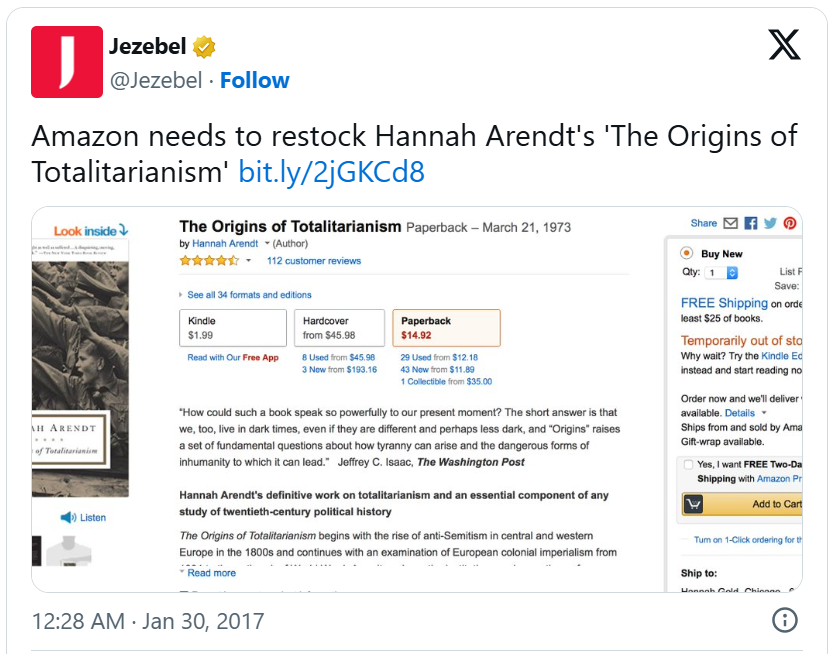
500 pages isn't typically a bestseller. It has been flying off bookshelves in the US since Trump's
inauguration; Amazon even briefly ran out of stock this week.
These new Arendt fans are presumably trying to understand what Trump's presidency could lead to. As it
might take a while for readers to get through her heavy essays, here are a few spoilers: "Trump is not a
totalitarian in her understanding; he incorporates what she calls 'elements' of totalitarianism," Roger
Berkowitz, professor and head of the Hannah Arendt Center for Politics and Humanity at Bard College in
New York, explained in a recent DW interview.
However, strong warning signs shouldn't be ignored, added Berkowitz: Arendt believed that "one of the
core elements of totalitarianism is that it's based in a movement... and Trump has explicitly called himself
the mouthpiece of a movement. That's a very dangerous position for a politician."
Populism: easy fixes in times of global anxiety
Arendt's analysis focuses on the events of that period. Although her observations obviously couldn't
explain everything about today's complex political developments, many are still revealing even now,
as the right-wing populism that's spreading throughout Europe and the US is reminiscent in different
ways of the situation in the 1920s and 30s that allowed the Nazis and Communists to rise.
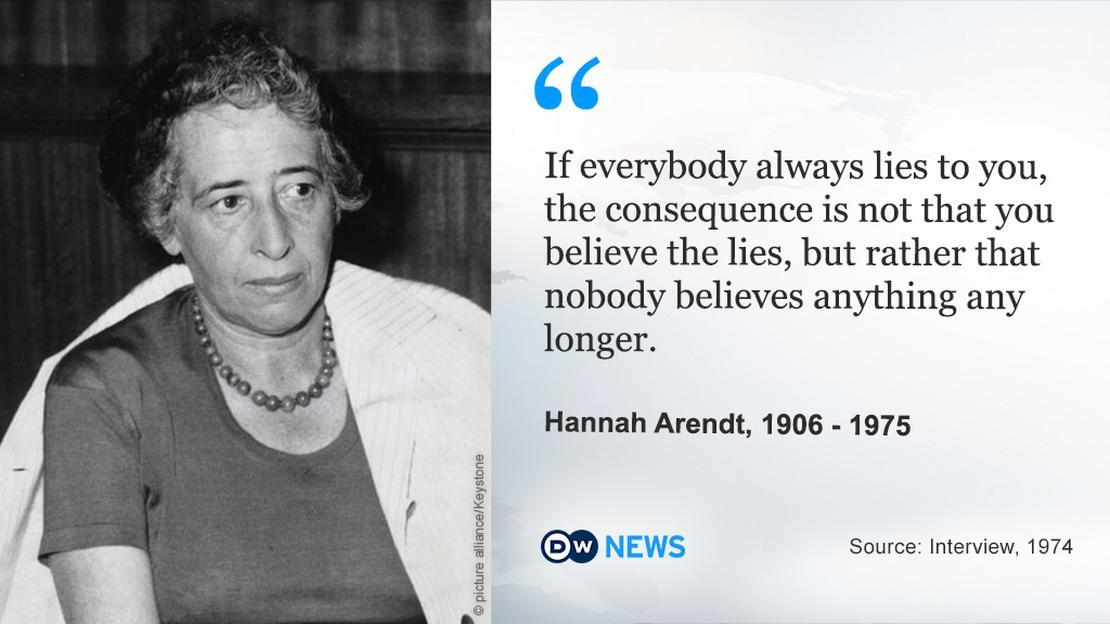
Her books provide insight into the mechanisms that allow so many people to readily accept lies in times
of global uncertainty. While major newspapers - from "The New York Times" to "The Washington Post" -
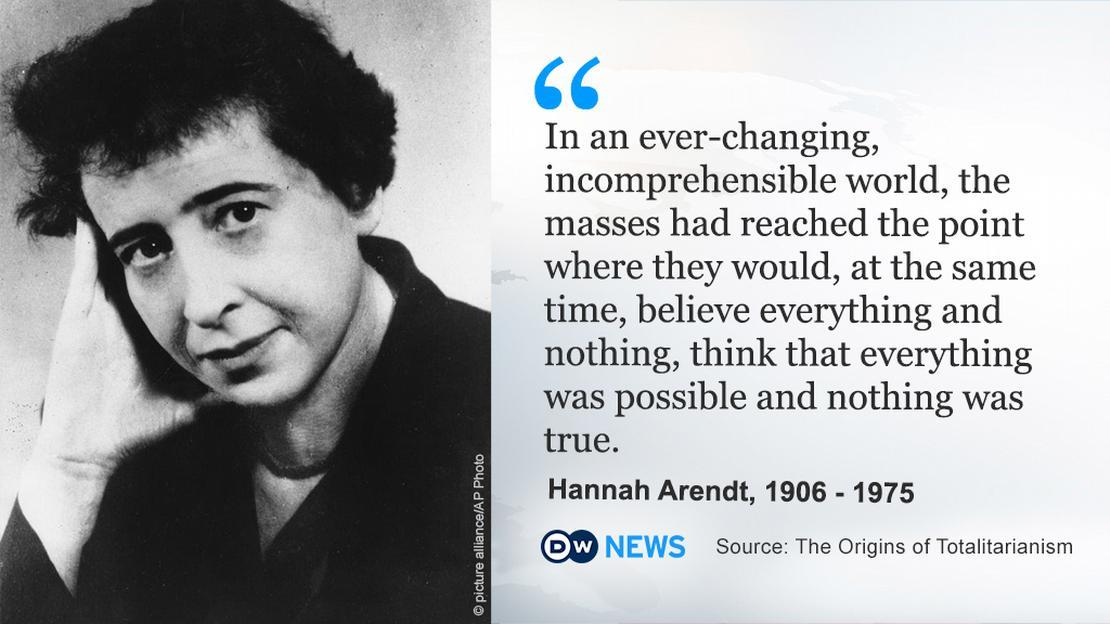
are revisiting her writings, social media users are widely sharing quotes such as this one:
'Fantastic statements' seen as tactical cleverness
In such a context, repeated, simplified - and false - storylines, which blame scapegoats and offer easy
solutions, are preferred over deeper analysis leading to informed opinions. This approach was applied by
totalitarian leaders such as Hitler, Arendt wrote. In this sense, Trump's strategy of placing blanket
blame Muslims or Mexicans for terrorism, crime or unemployment, and claiming that a travel ban or a
wall will be an easy solution, is not new.
According to Arendt, totalitarian leaders at the beginning of the 20th century based their propaganda on
this assumption:
• "One could make people believe the most fantastic statements one day, and trust that if the next
day they were given irrefutable proof of their falsehood, they would take refuge in cynicism; instead
of deserting the leaders who had lied to them, they would protest that they had known all along that
the statement was a lie and would admire the leaders for their superior tactical cleverness."
- Hannah Arendt, "The Origins of Totalitarianism"
Trump has pushed this approach to new extremes; even though there are more fact-checkers than ever
dedicated to exposing his blatant lies, the president's cunning tactic is to discredit these reports as
coming from the established, "dishonest" media. Meanwhile, his movement's beliefs are backed by
widely available alternative sources.
The 'banality of evil'
In Arendt's reporting on the 1961 trial of one of the major organizers of the Holocaust, Adolf Eichmann,
she famously came up with the phrase "the banality of evil" to describe her view that evil might not be as
radical as one might expect.
The resulting book, "Eichmann in Jerusalem: A Report on the Banality of Evil," explains how crimes were
committed through people who thoughtlessly obeyed orders to conform to the masses.
• "There is a strange interdependence between thoughtlessness and evil." - Hannah Arendt,
"Eichmann in Jerusalem"
The definition of thoughtlessness that she provided in a work first published in 1958, "The Human
Condition," could just as well have been written to describe President Trump's hastily drawn executive
orders and his struggles to justify them:
• "Thoughtlessness - the heedless recklessness or hopeless confusion or complacent repetition of
'truths' which have become trivial and empty - seems to be among the outstanding characteristics
of our time." - Hannah Arendt, "The Human Condition"
Of course, such quotes taken out of context may be easy and comforting to share online, but they do not
reflect the entirety of Arendt's ideas. Similarly, those hoping to find all answers to "The Origins of
Totalitarianism" are bound to be disappointed. Arendt didn't pick that title herself - her publisher did. She
believed the world was way too complex and messy to pinpoint the roots of totalitarianism, according to
Berkowitz.
While revisiting her works, impossibly trying to predict if we'll be overtaken by new forms of totalitarianism
in the future, one can also find consolation in another of Arendt's observations: She considered civil
disobedience an essential part of the United States' political system - and the country's strong protest
movements currently demonstrate this again.
As she famously said: