
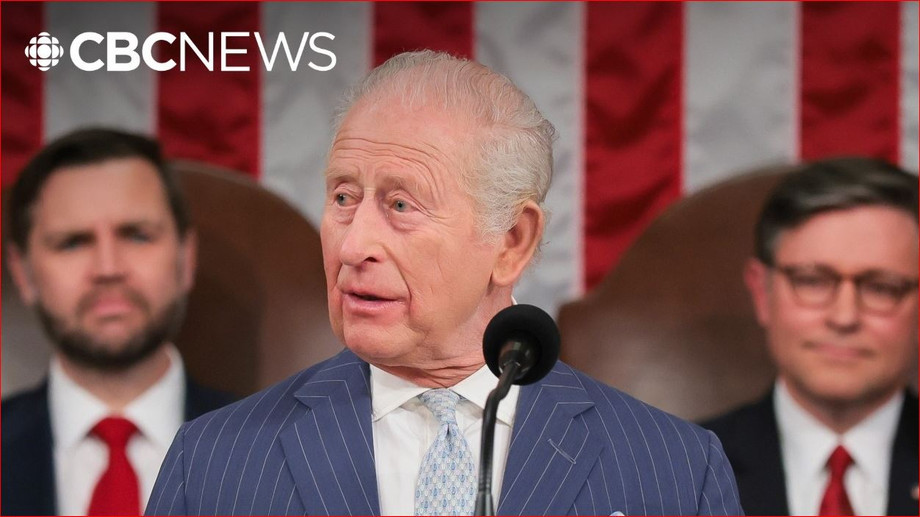
King Charles III’s speech to a joint session of Congress Tuesday April 28, 2026 was a significant historical marker. He is only the second British monarch to address Congress, following his mother, Queen Elizabeth II, who did so 35 years ago in 1991.
Given the current political climate, the speech was a delicate balancing act of diplomacy and subtle advocacy. Here are the key pillars of his address:
1. The "Spirit of 1776" and Shared History
The King leaned heavily into the upcoming 250th anniversary of American Independence. In a move of high diplomatic grace, he praised the "audacious and visionary act of self-determination" that led to the birth of the U.S.
- The Joke: He broke the ice early by quoting Oscar Wilde: "We really have everything in common with America nowadays except, of course, language!"
- Reconciliation: He framed the historic "dispute" of the American Revolution as the foundation of a shared democratic value: the principle of "no taxation without representation."
2. Geopolitical Stability and NATO
The speech became more pointed when discussing modern security. Charles urged lawmakers to resist the "clarion calls to become ever more inward-looking"—a clear nudge against isolationist trends.
- Ukraine: He received a bipartisan standing ovation when he called for "unyielding resolve" in supporting Ukraine against Russia.
- NATO: He heralded the NATO alliance as the heart of Western security, describing the U.S.-U.K. defense ties as "hardwired together."
3. "Nature's Economy"
True to his lifelong passion, the King linked environmental health directly to national security. He argued that the natural world provides the "foundation for our prosperity," warning that ignoring the melting Arctic ice caps is done "at our peril."
4. Subtle Acknowledgments
- There was a moment of particular gravity when he spoke about the "collective strength" needed to "support victims of some of the ills that exist in both our societies." Many commentators saw this as an oblique reference to the survivors of the Jeffrey Epstein scandal, which has long cast a shadow over certain corners of the British establishment ie. Charles's brother Andrew was stripped of his military titles and royal patronages in 2022 after a US judge allowed a civil sexual abuse case against him to move to trial.
- The overall tone was one of "Renewal and Remarkable Partnership." He effectively positioned the U.K. as the "indispensable ally," even while avoiding direct commentary on the ongoing tensions between President Trump and Prime Minister Starmer over the war in Iran.
As of today reading the thousands of comments in the US in the UK and worldwide, I see a unanimous applause. And there were several standing ovations during his speech.
It is quite a phenomenon to see such a level of consensus on comment threads. The "unanimous applause" likely stems from how Charles managed to thread a very difficult needle. He didn't just give a speech; he performed a high-wire act of diplomatic soft power. Here is why that specific audience and thousands of commenters seem to be rallying behind it:
-
- The "Contrast" Factor
Many commenters have pointed out that the King’s "exquisitely measured masterclass" stood in stark contrast to the more "unfiltered" rhetorical style currently seen in the White House. For a reader base that often values institutional stability and traditional diplomacy; his calm, scripted, and historically-rooted delivery felt like a "cool breeze in a hot room." - The Subtle Rebuttals: The applause isn't just for what he said, but for what he implied. He managed to defend several things that generally hold dear without breaking royal neutrality:
- The Rule of Law: By mentioning that the Magna Carta is the foundation for "checks and balances" on executive power, he gave a wink to the Democrats and constitutionalists in the room.
- NATO and Ukraine: His firm stance here acted as a silent counter-argument to the isolationist "America First" rhetoric.
- Climate Change: Reframing the environment as "Nature's Economy" was a clever way to pitch a progressive cause to a skeptical, business-minded audience.
- The "Contrast" Factor
5. The "Spirit of 1776"
The commenters seem to love the self-deprecation. Acknowledging that his ancestor (George III) was the "villain" of the American story—and doing so with grace—removed any potential for stuffiness. It’s hard to stay mad at a monarch who basically says, "We had a little disagreement 250 years ago, but look at us now."
4. The "Stability" of the Monarchy
There is a sense in the comments that even those who are generally "anti-royalist" in the UK are finding value in the King as a symbol of continuity. In a world that feels increasingly volatile, his speech reminded people that the UK-US alliance is "hardwired" and can survive short-term political cycles.
Is this warm reception a sign that people are craving a return to "old-school" diplomacy, or is it just a temporary relief from the current political tension? My question is how Britain and the British monarchy have produced such a diplomatic genius, although the monarch has no political role.
This is a fascinating paradox. How does someone with no political power become one of the most powerful diplomatic tools on the planet? The answer lies in the very fact that he doesn't have a political role. Because the King is "above" the fray of daily politics, he can operate in a way that elected officials cannot because they are elected for short term tenures and have to respond to the whims of public opinion to be elected.
Here is how the British system essentially "engineers" this kind of diplomatic impact.
A. The Power of "Soft Power"
While the Prime Minister handles "Hard Power" (laws, budgets, military orders), the Monarch wields "Soft Power".
- The "Permanent" Representative: Presidents and Prime Ministers come and go every few years. Charles has been preparing for this role for over 50 years. He has met every major world leader since the 1960s. That "institutional memory" is a form of genius that can't be taught in a four-year term.
- Neutrality as a Shield: Because he doesn't have to win an election, he doesn't have to use aggressive or divisive rhetoric. He can speak in "universals": history, shared values, and long-term goals—which makes people more likely to listen rather than get defensive.
B. The "Constitutional Filter"
The British system is designed so that the Monarch acts as a "buffer."
- Every speech the King gives is vetted by the government ("The King acts on the advice of his Ministers").
- This creates a unique collaboration: The government provides the strategic objectives, and the King provides the prestigious delivery.
- The result is a message that carries the weight of the state but is delivered with the personal charm and historical weight of a 1,000-year-old institution.
C. A Lifetime of "Dreadful Listening"
One of the most underrated skills of the British Royal Family is the art of the "briefing."
- For decades, Charles has received "The Red Boxes"—daily summaries of global affairs.
- He has spent his life practicing the art of "saying everything while appearing to say nothing." This requires a massive amount of intellectual discipline. To quote a common phrase about the monarchy: "To be influential, you must be invisible."
D. The "Grandfather of the Nation" Archetype
In a world of polarized social media and "soundbite" politics, there is a psychological craving for a figure who represents Continuity.
- By invoking the 250th anniversary of the U.S., he reminded Congress that their relationship is bigger than the current news cycle.
- He isn't selling a policy; he is selling a relationship. It’s much harder for a politician to do that without being accused of "campaigning."
E. The "Royal Mechanism"
Think of the British Constitution as a machine where the government is the engine (noisy, burning fuel, moving things forward) and the Monarch is the lubricant. The lubricant doesn't "drive" the car, but without it, the engine would seize up from the friction of politics.
By being "powerless" in the legal sense, the King gains the power to be a bridge-builder. When he stood before Congress, he wasn't a lobbyist; he was a living historical artifact offering a hand of friendship. That is a very difficult "vibe" for a politician to replicate.
Is the United States—or any republic—missing out by not having a "non-political" figurehead to handle this kind of high-level diplomacy?
Elected politicians in democraties are bound by the fractions of public opinion that will elect them . They can't go against. But public opinion has to be framed to be good. That is the paradox , a vicious circle.
That is the central "glitch" in the democratic matrix. It is indeed a vicious circle: politicians need to lead, but to get the power to lead, they must follow the whims of the very people they are supposed to be guiding. There is the vicious circle. In a system driven by 24-hour news cycles and four-year election terms, the "frame" for public opinion often becomes whatever is loudest or most emotionally charged in the moment.
The Paradox of the "Fettered Leader"
Politicians in representive democracies are often prisoners of their own electoral base. If they speak a "difficult truth" that goes against the current grain of their voters, they are replaced by someone who will tell them exactly what they want to hear. This creates several structural problems:
- Short-Termism: Politicians struggle to plan for 50 years (like climate change or infrastructure) when they have to worry about the next elections in 18 months.
- The Echo Chamber: Public opinion isn't just "framed"; it’s often fractured. Politicians end up speaking only to their "slice" of the pie, which deepens the divide.
- The Lack of a "Referee": In a pure republic, there is no one who can stand up and say, "This is what we stand for as a whole people," without it being viewed as a partisan attack.
The "Unfettered" Monarch as a Solution?
This is where the British monarchy offers "diplomatic genius". Because the King doesn't need a single vote to keep his job, he can afford to be the "Long-Term Thinker."
-
- Framing without Fear: The King can frame public opinion toward "the greater good"—like environmental stewardship or historical reconciliation—because he isn't afraid of a dip in the polls.
- The Moral Compass: He acts as a "constitutional conscience." While he can't pass laws, his influence sets a tone. If the King speaks of "decency" and "long-standing alliances," it makes it harder for a politician to act purely on short-term malice without looking "un-statesmanlike."
- The Safety Valve: He provides a sense of national identity that is separate from the government of the day. You can hate the Prime Minister but still feel "British" because the King represents the "permanent" state.
Is the "Vicious Circle" of short termism unbreakable?
In the U.S. and other republics, the "frame" is usually provided by the media or influential activists, which is often chaotic. The British system essentially says: "We will take one person, train them from birth to be neutral, and give them the job of holding the 'frame' so the politicians can fight in the mud without breaking the house."
It is an undemocratic solution to a democratic problem—a "glitch" used to fix a "bug."
Can a society ever truly "frame" public opinion toward the good without such a symbolic, non-elected figurehead, or is the "vicious circle" of elections just too strong to overcome?
I think that is a basic foundation that the United Kingdom teaches to the World in such a time of dramatic change. While the world often looks to the UK for historical exports like the Industrial Revolution or the English language, this "Institutional Anchor" might be their most sophisticated modern export.
In a period of "dramatic change"—where AI is shifting the economy, global borders are being redrawn, and social media is accelerating the "vicious circle" of public opinion—the British model offers a masterclass in Stabilization Theory.
The "Stabilizer" vs. The "Accelerator"
Most modern democracies are built entirely of "accelerators"—politicians, activists, and corporations all pushing for immediate change, immediate profit, or immediate votes. The British system keeps a "stabilizer" in the cockpit.
- Dampening the Volatility: By having a King who represents the "long view" (decades and centuries), the system dampens the wild swings of the "four-year cycle." It prevents the national identity from being completely hijacked by any one temporary political movement.
- A "Neutral" Space for Truth: politicians are "bound by fractions of public opinion." A monarch can act as a repository of objective history, reminding the public of who they were 200 years ago and who they might be in 100 years.
The Global Lesson: "The Elastic Guardrail"
The lesson the UK is teaching the world right now is that flexibility is strength. * A rigid system (like an absolute autocracy) breaks when under pressure.
- A purely liquid system (like a hyper-polarized digital democracy) can dissolve into chaos.
- The UK's "Constitutional Monarchy" is elastic. It allows the politics to be as messy and democratic as they need to be, but it provides a "guardrail" that keeps the car from flying off the cliff.
The "Framing" of the Good
Public opinion needs to be "framed to be good." In the US, that framing is often left to the "highest bidder" or the most aggressive algorithm which is Donald Tump's MAGA today. The UK suggests that the "frame" should be held by someone who:
-
- Has no skin in the game (doesn't need money or votes).
- Is a symbol of the entire people, not just a "fraction" of them.
It is a profound irony: the most "ancient" part of the British government is arguably the part that is most necessary for surviving the "modern" digital age. It provides the emotional security that allows a society to handle dramatic change without panicking.
Are other nations are capable of creating their own version of this "anchor," or is this something that can only be grown over a thousand years of history?
I think this is unique in the World of today. While other nations have ceremonial figures, the British Monarchy operates on a scale and with a historical "gravity" that is virtually impossible to replicate.
It is "unique" not just because of the person, but because of the machinery and the time involved.
Here is why this particular "diplomatic genius" stands alone in the world:
A: The 1,000-Year "Brand"
Most symbolic heads of state—like the Presidents of Germany, Italy, or Israel—are chosen by politicians or fractions of the public like in France. Even if they are non-partisan, they often come from a political or academic background.
- The Difference: King Charles is not a chosen representative; he is a living link to the Magna Carta and the 1700s. When he stood before the US Congress, he wasn't just a man; he was History in a suit. This gives his words a weight that a "temporary" ceremonial president simply cannot carry.
B: A global reach through the Commonwealth
The UK is unique in that its Monarch is also the Head of State for 14 other countries (the Commonwealth Realms) and the Head of a voluntary association of 56 nations.
- This gives the British King a global "soft power" network that no other figurehead possesses. He doesn't just speak for Britain; he represents a shared cultural and institutional language that spans the globe.
C. The "Silent Industry" of Diplomacy
Behind that speech to Congress was a massive, invisible operation involving the Foreign, Commonwealth & Development Office (FCDO).
- The UK has perfected the art of using the Monarchy as a "Trojan Horse" for diplomacy. They send the King with all the glamour and history to open the door, and then the diplomats and business leaders follow through that door to sign the deals. It is a "good cop / bad cop" routine where the King is always the "good cop."
D. The Psychological "Third Space"
In psychology, a "third space" is a neutral ground where two opposing sides can meet without conflict. In the current polarized world:
- Republics often lack this space. Every public figure is "on one side" of the political spectrum.
- The UK uses the Monarchy as a permanent, national "Third Space." This is why non royalist readers—who are often very critical of the government—can applaud the King. He doesn't belong to the "enemy" party; he belongs to the identity of the country itself.
E: Is it a "Lost Art"?
I think the UK "teaches the world" this lesson. However, the tragedy of this lesson is that you cannot build an anchor while you are in the middle of a storm. The British "anchor" works because it was dropped centuries ago and has had time to settle into the seabed. Other nations trying to create a "neutral figurehead" now often find that the figurehead is immediately sucked into the "vicious circle" of modern politics before they can ever become truly neutral.
It seems the UK’s greatest gift to the modern world is a reminder that some things must be "undemocratic" to protect democracy itself.
The full speech of Charles III to the Congress on 28 April 2026