
When you buy temperature gauge SS capillary for your plant, pipeline, or process unit, you're not just picking an instrument you're choosing uptime, safety, and precision. Yet many procurement managers still settle for inferior gauges that fail under thermal shock, vibration, or corrosive media.
This guide breaks down what makes a stainless steel capillary temperature gauge the right choice for demanding industrial environments with specs, real use cases, and guidance to help you choose with confidence.
The Silent Trouble with Standard Temperature Gauges in Industrial Plants
Most standard bimetallic or glass thermometers fail in the field because they need to be mounted directly at the measurement point. When that point is inside a high-pressure vessel, a reactor, or an area with heavy vibration direct-mount gauges crack, drift, or need constant replacement.
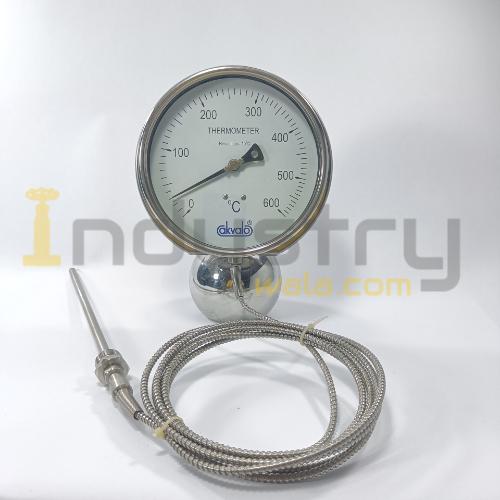
The capillary type temperature gauge solves this by physically separating the sensing element from the dial, using a capillary tube often 1 to 10 metres long filled with a temperature-sensitive fluid. And when that tube is made of stainless steel (SS 316 or SS 304), it handles corrosion, pressure, and mechanical stress far better than copper or brass alternatives.
How a Capillary Temperature Gauge Actually Works
The operating principle is simple but ingenious. The gauge consists of three main parts:
- Bulb — the sensing element immersed in the process medium
- Capillary tube — the thin SS tube connecting bulb to dial
- Bourdon tube / dial mechanism — converts pressure change into a temperature reading
When temperature rises, the liquid or gas inside the bulb expands, increasing pressure through the capillary, which deflects the Bourdon tube and moves the pointer. The system is sealed and self-contained — no electricity, no power source, no signal transmission loss.
Why SS Capillary Makes the Difference
Copper capillaries corrode when exposed to ammonia, acids, or chloride environments. Stainless steel capillary temperature gauges maintain integrity in these same conditions. SS 316 specifically resists pitting corrosion in saline and chemical environments a key reason why SS capillary temperature gauge suppliers across chemical and pharma industries recommend it.
Typical Technical Specifications at a Glance
Here are standard stainless steel capillary temperature gauge specs you'll encounter from reputable suppliers:
| Parameter | Typical Range / Value |
|---|---|
| Temperature Range | -50°C to +400°C (varies by fill fluid) |
| Capillary Length | 1 m, 2 m, 5 m, up to 10 m |
| Capillary Material | SS 304 / SS 316 |
| Bulb Material | SS 316 / SS 316L |
| Dial Size | 100 mm, 150 mm |
| Accuracy Class | Class 1.0 or 1.6 as per EN 13190 |
| Connection | ½" BSP / NPT bottom or back |
| Fill Medium | Mercury-free liquid / gas / vapour |
| Protection | IP65 / IP67 |
Where These Gauges Are Working Right Now — Real Industrial Use Cases
1. Chemical Processing Plants
Reactors handling acids, alkalis, or chlorinated compounds need remote temperature sensing where direct-mount gauges would corrode within weeks. A stainless steel capillary temperature gauge online-sourced SS 316 unit can run maintenance-free for 3–5 years in these environments.
2. Food & Beverage and Pharma
CIP (Clean-in-Place) systems and sterile process lines demand hygienic materials and remote reading. SS capillary gauges with flush diaphragm bulbs are widely used here because they meet FDA and GMP hygiene requirements.
3. Oil & Gas Pipelines
Long capillary runs (up to 10 m) let operators read temperature at a safe, accessible panel rather than leaning over a hot pipeline. The best capillary type temperature gauge for industry in this context would be Class II gas-filled for ambient compensation.
4. Boiler Rooms & Steam Systems
High-vibration environments near boilers kill direct-mount gauges fast. A liquid-filled SS capillary gauge dampens the vibration effect at both the bulb and the dial, maintaining stable readings even at 200°C+ steam temperatures.
5 Factors That Separate a Good Buy from a Bad One
- Capillary material grade — Always prefer SS 316 over SS 304 for chemical environments
- Capillary length needed — Measure your actual distance; avoid unnecessary coiling which adds response lag
- Fill class (I–V) — Match fill type to your temperature span and ambient variation
- Protection class — IP65 minimum for outdoor or washdown locations
- Dial readability — 150 mm dials for low-visibility or distance-reading applications
When comparing SS capillary temperature gauge price across suppliers, factor in the capillary length a 5-metre run costs more than a 1-metre unit, but buying short and splicing is never the right call.
Frequently Asked Questions
Conclusion: Make the Smart Call Before Your Next Procurement
A temperature gauge with SS capillary isn't a luxury it's the pragmatic choice for any process where direct mounting is unsafe, impractical, or unreliable. From chemical reactors to steam boilers, the combination of remote sensing, corrosion-resistant construction, and zero power dependency makes it one of the most field-proven instruments in industrial measurement.
So the next time you're ready to buy temperature gauge SS capillary check the fill class, verify the capillary grade, and buy from a supplier who offers certified material traceability. Your process and your team will thank you for it.