
Most mobile games are built to succeed on their own.
They launch, grow, and—if they’re lucky—retain users long enough to justify continued updates. But even successful titles often face the same problem: once engagement drops, the entire product loses momentum.
A different model is starting to emerge—one focused on building connected ecosystems instead of standalone games.
One example of this approach is Digi 995.
The Shift From Single Products to Systems
To understand what makes Digi 995 different, it helps to look at how most mobile games are structured.
Traditional model:
- One game = one experience
- Success tied to downloads and retention
- Limited expansion beyond updates
Ecosystem model (Digi 995 approach):
- Multiple games = shared universe
- Growth tied to expansion, not replacement
- Content builds on itself over time
This shift changes how a project scales.
Breaking Down the Digi 995 Ecosystem
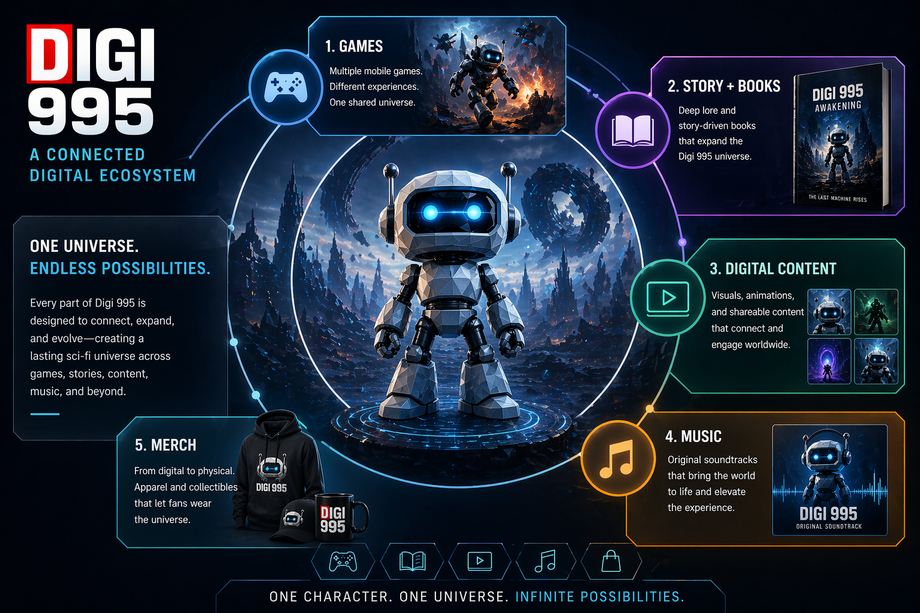
Instead of relying on a single pillar, Digi 995 is structured across multiple layers:
1. Games (Core Layer)
- Multiple gameplay styles
- Shared environments and themes
- Continuous expansion through new titles
👉 Purpose: Engagement + entry point
2. Story + Books (Narrative Layer)
- Expands lore beyond gameplay
- Adds context to environments and characters
- Creates deeper connection with the universe
👉 Purpose: Depth + long-term retention
3. Digital Content (Discovery Layer)
- Visual assets, short-form content
- Distributed across platforms like GIPHY and social channels
- Designed for reach, not just gameplay
👉 Purpose: Visibility + audience growth
4. Music (Immersion Layer)
- Reinforces atmosphere
- Extends the experience beyond gameplay
- Supports emotional connection to the universe
👉 Purpose: Brand identity + immersion
5. Merch (Physical Layer)
- Apparel and branded products
- Extends the universe into real-world items
- Turns digital engagement into tangible ownership
👉 Purpose: Monetization + brand expansion
Why This Structure Works
Most projects fail because everything depends on one product.
Digi 995 avoids that by distributing value across multiple layers.
If one area slows down:
- Others continue to grow
- The brand remains active
- The ecosystem keeps expanding
This reduces risk and increases long-term potential.
The Compounding Effect
The real strength of a connected ecosystem is compounding growth.
Each new addition:
- Strengthens the universe
- Supports existing content
- Creates more entry points
For example:
- A game leads to interest in the story
- The story leads to engagement with content
- Content leads to interest in merch
Everything feeds into everything else.
From Audience to Community
Another key shift is how users engage.
Instead of:
Playing one game and leaving
The ecosystem encourages:
Exploring a world across multiple formats
This creates:
- Higher engagement
- Stronger brand recognition
- More consistent return users
A Model Designed for Expansion
Because Digi 995 is structured as a system, it allows for continuous growth without starting over.
New additions can include:
- Additional games
- Expanded storylines
- New types of digital content
- More product categories
Each one fits into the existing framework.
Why This Matters for the Industry
This model reflects a broader shift in digital entertainment.
Success is no longer defined by:
- One viral game
- One hit product
It is increasingly defined by:
- Systems
- ecosystems
- long-term brand development
Digi 995 aligns with this shift by focusing on structure first, then expansion.
My Final Thoughts
Digi 995 is not being built as a single success—it’s being built as a system that can grow over time.
By combining games, story, digital content, music, and merch into one connected ecosystem, it represents a scalable approach to modern digital entertainment.
And as this model continues to evolve, it may become the standard—not the exception.