
Car transportation by train is often perceived as a simple process — hand over the vehicle, wait a few days, and collect it at the destination. In reality, railway car shifting by train operates through a carefully coordinated logistics chain involving documentation control, loading engineering, wagon allocation, safety compliance, and cost structuring. Understanding what happens behind the scenes helps vehicle owners make informed decisions and avoid common relocation mistakes.
The Logistics Chain: What Actually Happens After You Book
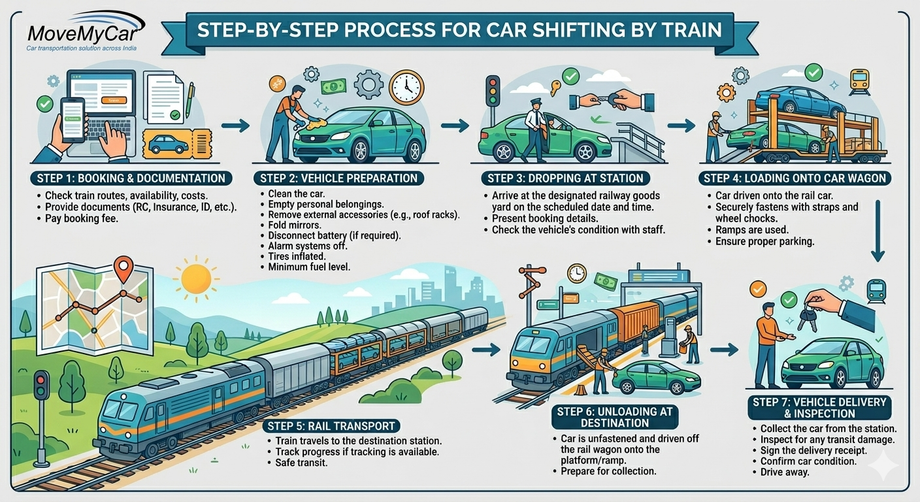
Car transportation by train functions more like cargo logistics than passenger transport. Once a booking is confirmed, the process enters a structured operational flow.
Stage 1: Vehicle Inspection & Documentation Mapping
Before transportation, the vehicle undergoes a condition assessment. Transport teams record:
-
Existing scratches or dents
-
Fuel level status
-
Battery condition
-
Registration verification
This inspection creates accountability across transit stages.
Stage 2: Railway Cargo Slot Allocation
Unlike passenger tickets, vehicles are moved through parcel or automobile cargo wagons. Railway authorities allocate space based on:
-
Route demand
-
Wagon availability
-
Vehicle dimensions
-
Dispatch schedules
Because trains operate on fixed freight priorities, dispatch timing may vary by 1–3 days depending on cargo load.
Stage 3: Terminal Handling Operations
Cars are not simply driven into trains. Loading follows controlled handling protocols involving ramps, wheel locking systems, and alignment positioning to prevent movement during transit.
Wagon Engineering: How Cars Are Secured During Transit
Most people assume vehicles remain stationary because trains move smoothly. However, freight trains experience vibrations, braking shocks, and lateral movement.
To counter this, handlers use:
-
Wheel chocks to immobilize tyres
-
Metal clamps or nylon belts for stabilization
-
Spacing calculations to prevent vehicle contact
-
Protective covers against dust and debris
In specialized automobile carriers, vehicles are positioned with weight distribution in mind to maintain wagon balance and prevent structural strain.
This engineering approach significantly reduces transit damage compared to poorly secured road transport.
Understanding the Cost Structure (Why Charges Vary)
The car transportation charges in India are not random; they are calculated using multiple logistical variables.
Primary Pricing Factors
1. Distance Slab
Railways apply distance-based freight classification rather than flat pricing.
2. Vehicle Size & Weight
SUVs and luxury cars cost more due to higher space utilization.
3. Handling Charges
Includes terminal labor, loading ramps, securing equipment, and supervision.
4. First Mile & Last Mile Delivery
Since railway stations rarely offer door delivery, additional truck transport may be required.
5. Insurance Coverage
Optional transit insurance protects against rare but possible damage risks.
Typically, train transport remains 30–40% more economical than dedicated car carriers over long distances, especially above 1,000 km routes.
The Hidden Handling Workflow
Between origin and destination, a vehicle passes through multiple checkpoints:
-
Entry verification at parcel yard
-
Loading supervision approval
-
Mid-route wagon inspections
-
Arrival unloading authorization
-
Exit documentation clearance
Each checkpoint ensures chain-of-custody tracking — meaning responsibility is recorded at every stage.
Professional packers and movers coordinate these steps because direct railway booking can be complex for individual customers unfamiliar with cargo procedures.
Safety Protocols: Risk Prevention in Railway Transport
Rail transport is considered one of the safer long-distance vehicle transportation methods due to limited road exposure. Still, safety depends on preparation.
Pre-Transit Safety Measures
-
Fuel restricted to minimal level
-
Loose accessories removed
-
Alarm systems disabled
-
Mirrors folded and secured
Transit Protection Measures
-
Covered wagons or protective wrapping
-
Sealed cargo areas
-
Controlled access at railway yards
Post-Arrival Checks
Customers are encouraged to inspect vehicles immediately upon delivery using the initial inspection report as reference.
When Train Transport Works Best (Operational Suitability)
Car shifting by train is particularly effective when:
-
Moving across long intercity routes
-
Relocation timelines are flexible
-
Cost efficiency is a priority
-
Vehicle wear from long drives must be avoided
However, for urgent relocations or locations far from railway terminals, road carriers may sometimes be more practical.
Operational Insight: Why Experts Recommend Assisted Booking
While railway transport appears economical, coordination complexity is high. Documentation, wagon booking, loading permissions, and delivery scheduling require familiarity with freight procedures.
Professional relocation providers act as intermediaries who:
-
Secure cargo slots faster
-
Manage paperwork
-
Arrange first-mile pickup and last-mile delivery
-
Provide insurance assistance
This converts a technically complex logistics operation into a predictable relocation experience.
Conclusion
Behind the affordability of car shifting by train lies a structured logistics ecosystem involving engineering precision, cargo planning, and multi-stage handling controls. What seems like a simple shipment is actually a coordinated transport operation designed to balance safety, efficiency, and cost.
For vehicle owners planning long-distance relocation, understanding these behind-the-scenes processes helps set realistic expectations, compare transport options intelligently, and ensure their car reaches its destination securely and efficiently.