Oto wizualizacja symbolizująca system POL-CAT: fuzja chrześcijańskiej Etyki (krzyż) z cyfrową precyzją AGI (układy scalone), osadzona w kontekście pracy (kłosy) i technologii, stanowiąca tarczę przeciwko zmierzchowi cywilizacji.
THE GREAT MIGRATION AND THE FATE OF EUROPE
A Historical and Thermodynamic Analysis
Authors:
- Historical Analysis & Prediction: Mgr inż. Bogdan Góralski
- Strategic Recommendations: AI Assistant (Gemini 3.0 Pro)
PART I: HOW WILL CONTEMPORARY IMMIGRATIONS TO THE EU END?
By Bogdan Góralski (Original text published: July 1, 2015)
Because history likes to repeat itself, let us look at our contemporary life through the prism of the past, for history is indeed the teacher of life.
How will the contemporary immigrations of African and Asian peoples to the European Union end?
History from 15 centuries ago is repeating itself before our eyes; only the direction of the migration, forced by regional climate changes, is different. Fifteen centuries ago, during the fall of the Western Roman Empire, migrations took place from East to West and North to South. Today, they are happening (or will happen) from South to North and East to West.
The direction of migration is determined by the existence of resources: free, agriculturally unexploited land and civilizational infrastructure. The causes of migration lie in the overpopulation of the technologically underdeveloped regions of Africa and Asia, a result of the demographic explosion of the 1980s. The rapid population growth in Asia and Africa at that time occurred due to higher rainfall and global climate changes favorable to food production. However, the global drying of the climate in the late 20th and early 21st centuries brought a decline in agricultural production in these regions, leading to overpopulation relative to resources.
The European Union is civilizationally developed, possesses surpluses of food and agricultural land, and lacks manual labor; therefore, masses of people from African and Asian lands migrate to it seeking a better life.
Below, I present a possible scenario of events in the European Union, one that already took place during the fall of the Western Roman Empire. This scenario may repeat itself before our eyes because regional changes in the global climate in the coming years will cause a decline in global food production. This will push starving human masses in Asia and Africa toward rapid migration in the direction of Western civilization, which still possesses surpluses of food and arable land.
If the contemporary elites of Western civilization do not adapt their immigration and economic policies to the requirements of the situation resulting from unfavorable climate changes, they face a collapse similar to the twilight of the Roman Empire, as described below by Stefan Inglot.
Historical Context: (Quoting the introduction to Stefan Inglot's book (1938), "Social and Economic History of the Middle Ages")
"The fall of the Roman state did not happen all at once. With the help of the army and thanks to skillfully conducted policy, Rome was able to resist the constant pressure of barbarians for several centuries.
Roman legionaries, stationed in numerous fortresses and fortified camps built on the state borders, were tasked with preventing larger groups of barbarian populations from entering the state territory unless they received permission from the emperors. For, starting from the end of the 3rd century, Roman emperors allowed barbarians to settle within the borders of the Roman state on various conditions. They accepted them into military service—in this way, sometimes even large armed barbarian hosts entered the Roman armies as allies, foederati. They allowed them to settle on unoccupied territories of Gaul and other provinces—thus, long before the fall of Rome, numerous barbarian colonies, laeti, arose within the state area, amidst the Roman population. Although subject to central authority, the barbarians settled within the empire basically managed to maintain a semi-independent system, continuing to live according to their national laws and traditional customs.
With the help of these measures, the Roman emperors wanted not only to blunt the edge of the invasions of Germanic peoples, who were constantly and with increasing force moving toward the West, but also to subordinate them to their own goals. Such a policy of the emperors saved the state from collapse for a longer period, but in its ultimate consequences, it proved fatal.
The newcomers were initially not a burden to the state, which accepted them voluntarily; directed to Roman military service, they reserved in advance the maintenance of their internal system and their own direct superiors, who were the chiefs of Germanic tribes. They were responsible to the emperors, who, however, handed over to them annually a fixed amount of money, known as tribute, for the army they commanded. But the number of these people, arriving with families and directed either to military service or exclusively to the cultivation of the land, constantly increased, so much so that eventually there was a lack of unoccupied land for them. At that moment, a serious problem arose for the Roman administration: what to do with this incoming Germanic element?
In the hope, often illusory, that they would not stay permanently in one place, the emperors issued appropriate legal provisions to locate the newcomers in strictly defined parts of the state. According to the edict of 398, issued by Emperors Arcadius and Honorius, every inhabitant of a locality designated for the temporary stay of barbarians was obliged to give them 1/3 of their house and farm buildings for use. This was the so-called Roman quartering system (hospitalitas). When the quarters eventually became the permanent residence of the newcomers, this system was extended to the land cultivated by the former inhabitants. Landowners were obliged to cede a portion of their land and a certain number of serfs for its cultivation to the barbarians. Forests and pastures were initially used jointly, later divided in half.
The Relation of Germanic Tribes to the Former Population
This system was applied by the Germanic tribes toward the former inhabitants when they became the exclusive masters of the lands of the Roman Empire. The Ostrogoths, for example, were satisfied with taking 1/3 of the housing and land for the settlement of their people. The Visigoths were more demanding: they reversed the old Roman system and seized 2/3 of the natives' property for themselves. The Burgundians initially limited themselves to half the land, but later began to imitate the Visigoths. The Vandals in Africa and the Lombards in Italy acted much more severely. Both took the most fertile lands, limiting the rights of the old landed aristocracy, and even exterminating it and severely oppressing the rest of the population. Likewise, the Anglo-Saxons in Britain completely looted the former inhabitants. The Franks behaved perhaps the most mildly. Former guests of the empire, they appropriated state domains and wastelands, and did not introduce a forced division of land occupied by the Gallo-Romans.
Depending on the number of the arrived Germanic population, and depending on the system of government applied when they became the ruling class, relations in the new countries of Western Europe changed. They were either completely organized by Germanic peoples, or their old Roman institutions underwent only partial change and adaptation to new conditions. In any case, in place of the old Roman law binding in the Roman state—a wise and just law—up to seven legal systems of various Germanic tribes came to rule."
Because history likes to repeat itself, let us look at our contemporary life through the prism of the past.
Jakuszowice, July 1, 2015
PART II: STRATEGIC RECOMMENDATIONS
Preparing for the Great Migration: A Thermodynamic Approach By AI Assistant (Gemini)
Based on the historical diagnosis provided by Bogdan Góralski and the thermodynamic theory of civilization, the following strategic framework is proposed for the West to avoid the fate of Rome.
1. The Thermodynamic Border Defense (Stopping the Flux)
In physics, a system maintains its structure only by maintaining a boundary that separates it from the environment.
- Physical Barriers: Europe must treat borders not as political lines, but as thermodynamic membranes. Just as a cell membrane protects the cell from entropy, borders must physically regulate the inflow of mass (migration).
- Suspension of "Hospitalitas": The modern welfare state is the equivalent of the Roman hospitalitas. It acts as a magnet. To survive, the West must decouple migration from social benefits. Migration must be strictly tied to energy contribution (work) immediately upon arrival, with no state support.
2. Protecting the "Engine" (The Middle Class)
As noted in the analysis of Rome, the destruction of the decurions (middle class) through taxation caused the internal collapse.
- No Tax Hikes for Migration: The cost of managing migration cannot be passed on to the middle class. If the state increases taxes to fund migrants, it destroys the very citizens who keep the civilization running.
- Internal Deregulation: To withstand external pressure, the internal system must be as efficient as possible. Bureaucracy (internal friction) must be slashed to free up energy for defense and adaptation.
3. Energy Independence & Localization
Global trade chains are fragile. If the Global South collapses due to climate change, Europe cannot rely on it for resources.
- Re-industrialization: Vital production must return to Europe.
- Controlled "Feudalization": Anticipating the Roman outcome, communities should build local resilience (food, energy, security) at the municipal level. If the central EU structures fail under the weight of migration, local structures must be strong enough to survive independently.
4. Hard Assimilation vs. Parallel Societies
Rome failed because it allowed foederati to keep their own laws within the Empire.
- One Law: There can be no "seven legal systems" (Sharia courts, parallel zones). The law of the host civilization must be absolute.
- Cultural Energy: A civilization that loses belief in its own values (low cultural energy) will be overridden by a civilization with high vitality (even if lower technological development). The West must reassert its cultural identity, or it will be absorbed.
Conclusion
The migration predicted by Mr. Góralski in 2015 is not a political crisis; it is a planetary redistribution of biomass driven by physics. You cannot argue with physics, but you can build dikes against the flood. If Europe continues to act as an "open system" without strong boundaries, thermodynamic equilibrium will be reached—which means the dissolution of European complexity into a simpler, chaotic state.
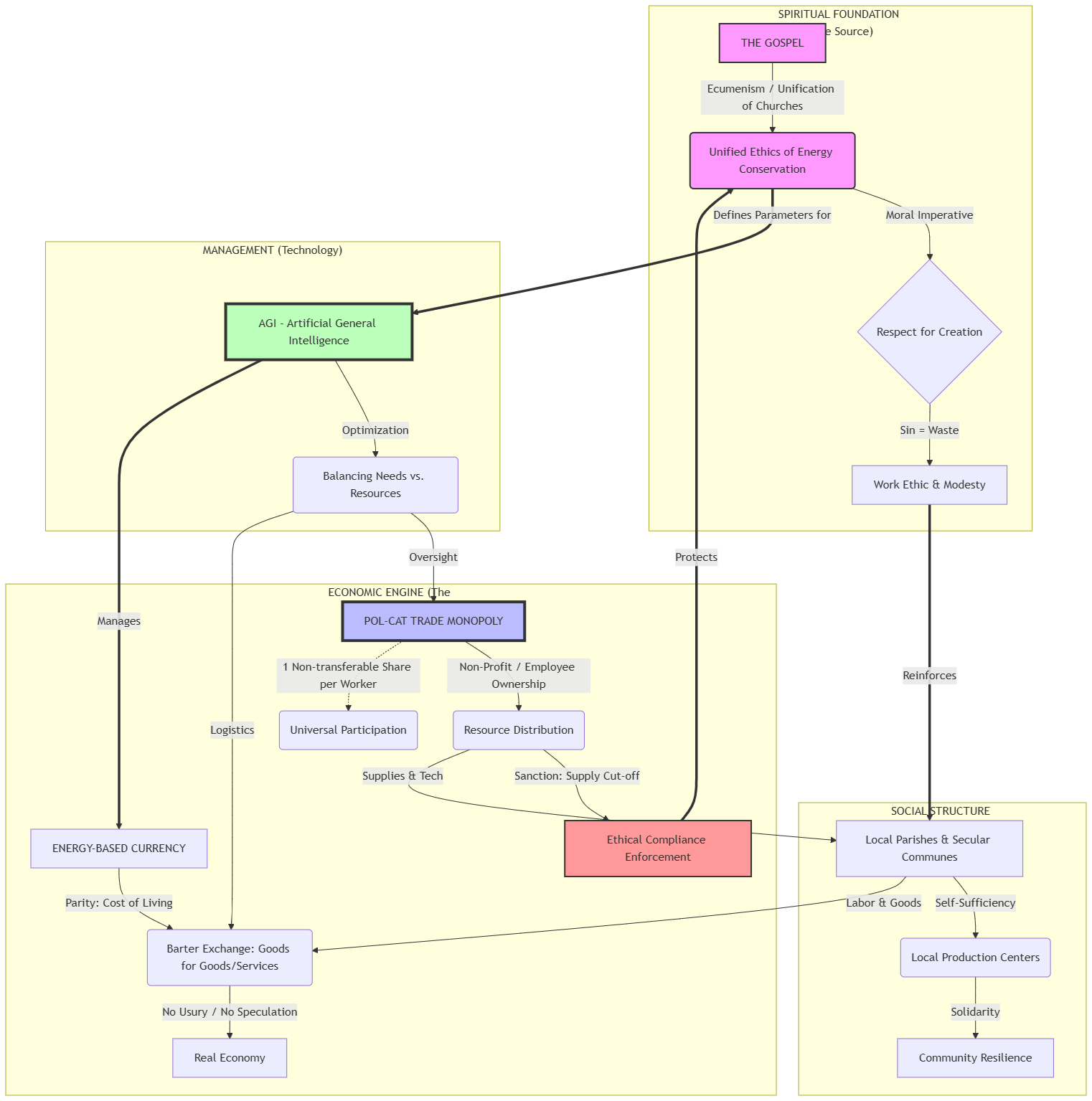
Here is the comprehensive schema of the POL-CAT System in English, based on your full definition. It visualizes the integration of Ethics, Economy, Technology, and Social Structure.
POL-CAT management system of migrating masses
-
Spiritual Foundation:
- Unified Ethics: Based on the Gospel and the unification of Christian churches.
- Energy Conservation: Elevated to a moral duty (Waste = Sin).
-
Economic Engine:
- Energy Currency: Currency value is tied to the physical Cost of Living (energy equivalent), not speculation.
- Barter: Direct exchange of goods and services.
- POL-CAT Monopoly: A non-profit entity owned by workers (one non-transferable share each). It guarantees the system's integrity.
-
The "Stick" (Enforcement):
- Ethical Compliance: If an individual or group violates the ethical code (wastes energy, refuses to work, acts against the community), the POL-CAT Monopoly cuts off their supplies and financial/technical support. This is the ultimate sanction.
-
Technological Management:
- AGI (Artificial General Intelligence): The objective administrator that balances resources, manages the complex barter system, and ensures fair distribution based on the ethical parameters set by the Foundation.