
The right hajj dua at the right moment transforms your pilgrimage from ritual into a living conversation with Allah.
Many pilgrims arrive at the Kaaba, at Arafat, at Muzdalifah, and feel overwhelmed. They want to say the right words. They want to make the most of every sacred moment. But they stand unsure of what to recite, when to recite it, and whether their personal words in English are enough.
Here is the truth: Allah hears every language, every whisper, and every tear. There are no magic words that unlock His mercy. But knowing the duas taught by the Prophet Muhammad ﷺ enriches every stage of your pilgrimage with deeper meaning and spiritual connection.
This complete dua for hajj guide gives you the Arabic text, transliteration, and English translation for every major stage of Hajj and Umrah. Whether you are a first-time pilgrim or preparing your tenth Umrah, these supplications will deepen every moment of your sacred journey.
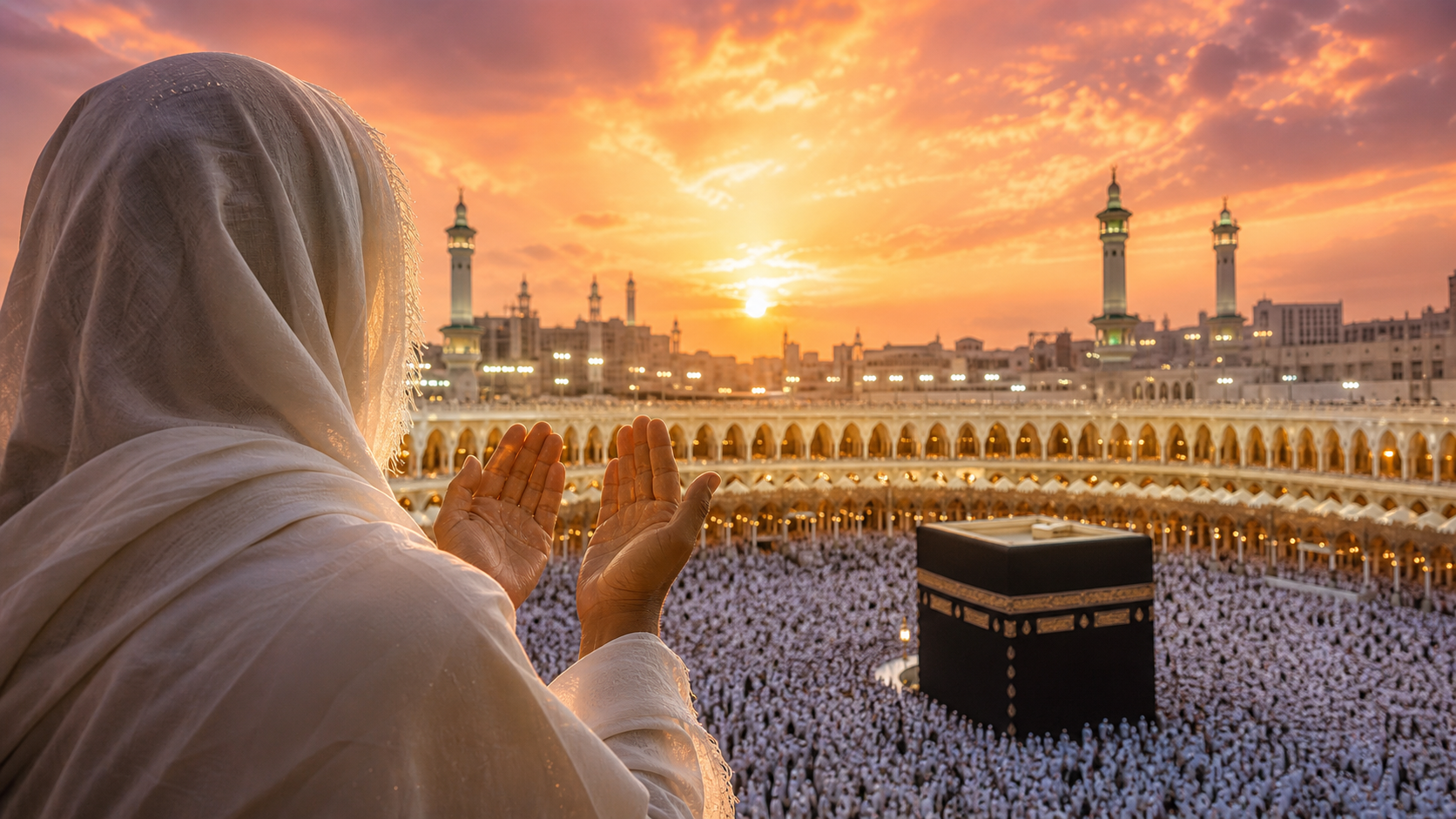
Before You Begin - The Talbiyah and Ihram Dua
The journey begins before you reach Makkah. From the moment you enter Ihram at the Miqat, your words and intentions become acts of worship. These are the first duas for hajj every pilgrim must know.
Niyyah (Intention) and Ihram Dua
Before entering Ihram, make your intention clearly in your heart and on your lips. Intention is the foundation of every act of worship in Islam.
For Umrah:
Arabic: لَبَّيْكَ اللَّهُمَّ عُمْرَةً
Transliteration: "Labbayk Allahumma Umrah"
Translation: "Here I am O Allah, for Umrah"
For Hajj Tamattu (most common for UK pilgrims):
Arabic: لَبَّيْكَ اللَّهُمَّ حَجًّا
Transliteration: "Labbayk Allahumma Hajjan"
Translation: "Here I am O Allah, for Hajj"
After making your intention, pray two rakah of Sunnah prayer. Then raise your hands and begin reciting the Talbiyah. This signals to Allah and to yourself that you have entered the sacred state. Your pilgrimage has officially begun.
For a complete understanding of the Ihram process and what follows, read our complete Hajj step by step guide.
The Talbiyah Your Constant Companion
The Talbiyah is the heartbeat of Hajj. From the moment you enter Ihram until you begin Tawaf, you recite it constantly walking, sitting, travelling, and waking at night.
Arabic:
لَبَّيْكَ اللَّهُمَّ لَبَّيْكَ، لَبَّيْكَ لَا شَرِيكَ لَكَ لَبَّيْكَ، إِنَّ الْحَمْدَ وَالنِّعْمَةَ لَكَ وَالْمُلْكَ، لَا شَرِيكَ لَكَ
Transliteration: "Labbayk Allahumma Labbayk. Labbayk la shareeka laka Labbayk. Innal hamda wan ni'mata laka wal mulk. La shareeka lak."
Translation: "Here I am O Allah, here I am. Here I am, You have no partner, here I am. Verily all praise, grace and sovereignty belong to You. You have no partner."
Men recite the Talbiyah loudly. Women recite it quietly so only they can hear. Recite it on the plane, in the bus, walking to the Haram, waking for Fajr. Every recitation is an act of worship.
The Talbiyah stops when you begin your first circle of Tawaf. That transition marks a profound shift: you have answered Allah's call, and now you stand before His House.
Duas During Tawaf
Tawaf - circling the Kaaba seven times is one of the most emotionally powerful moments of any pilgrim's life. Many pilgrims weep without knowing why when they first see the Kaaba. That feeling is a gift. Let these duas channel it.
Opening Dua When Seeing the Kaaba
When you first set eyes on the Kaaba, stop walking. Raise your hands. This moment carries a special answered prayer.
The Prophet ﷺ said that dua made upon first seeing the Kaaba is accepted. Make whatever dua is in your heart. Then recite:
Arabic: اللَّهُمَّ أَنْتَ السَّلَامُ وَمِنْكَ السَّلَامُ، فَحَيِّنَا رَبَّنَا بِالسَّلَامِ
Transliteration: "Allahumma Antas Salaam wa minkas salaam, fa hayyina Rabbana bis salaam"
Translation: "O Allah, You are Peace and from You comes peace. Greet us O Lord with peace."
After this opening dua, face the Black Stone (Hajar al-Aswad) to begin your first circle. Say:
Transliteration: "Bismillah, Allahu Akbar"
Translation: "In the name of Allah, Allah is the Greatest"
Point toward the Black Stone with your right hand each time you pass it during all seven circles, repeating this phrase.
Dua at Hajar al-Aswad and Between Yemeni Corner
There is no single prescribed dua for the full Tawaf. The Prophet ﷺ left this open intentionally. Between the Yemeni Corner (Rukn al-Yamani) and the Black Stone, however, he taught a specific supplication:
Arabic: رَبَّنَا آتِنَا فِي الدُّنْيَا حَسَنَةً وَفِي الْآخِرَةِ حَسَنَةً وَقِنَا عَذَابَ النَّارِ
Transliteration: "Rabbana atina fid dunya hasanatan wa fil akhirati hasanatan wa qina adhaban naar"
Translation: "Our Lord, give us good in this world and good in the Hereafter, and protect us from the punishment of the Fire."
Recite this between the Yemeni Corner and the Black Stone during every circle. For the rest of Tawaf, make any dua you wish. Ask for your children, your parents, your health, your rizq, your faith. Ask for the entire Ummah. Allah is listening to every word.
After completing seven circles, pray two rakah at Maqam Ibrahim if possible. Then drink Zamzam water with intention and dua. For duas during Umrah specifically, read our guide on how to perform Umrah step by step.
Duas at Safa and Marwa (Sa'i)
Sa'i - walking seven times between Safa and Marwa relives Hajar's desperate search for water for her son Ismail. As you walk, remember her faith. Remember that Allah answered her. He will answer you too.
Dua at Mount Safa
When you reach Mount Safa for the first time, face the Kaaba (you can see it from here). Raise your hands and recite:
Arabic: إِنَّ الصَّفَا وَالْمَرْوَةَ مِنْ شَعَائِرِ اللَّهِ
Transliteration: "Innas Safa wal Marwata min sha'airillah"
Translation: "Indeed Safa and Marwa are among the symbols of Allah." (Quran 2:158)
Then face the Kaaba, raise your hands three times, and recite between each raising:
Arabic: لَا إِلَهَ إِلَّا اللَّهُ وَحْدَهُ لَا شَرِيكَ لَهُ، لَهُ الْمُلْكُ وَلَهُ الْحَمْدُ وَهُوَ عَلَى كُلِّ شَيْءٍ قَدِيرٌ
Transliteration: "La ilaha illallah wahdahu la sharika lah, lahul mulku wa lahul hamdu wa huwa 'ala kulli shay'in qadir"
Translation: "There is no god but Allah alone, with no partner. To Him belongs the dominion and all praise, and He has power over all things."
Dua at Mount Marwa and During Sa'i
When you reach Marwa, turn to face the Kaaba direction and repeat the same dua you recited at Safa. This is the Sunnah.
During the walking portions of Sa'i, there is no specific prescribed dua. Make personal supplications throughout. Ask for whatever your heart holds. Walk with the memory of Hajar , she did not sit and wait for water. She ran with full trust that Allah would provide.
Men jog lightly in the green-lit section between the two green markers. Women walk at a normal pace throughout. Keep your lips moving in dua and dhikr throughout all seven lengths.
Duas at Arafat - The Most Important
If there is one place in the world where your dua will be heard and answered, it is the plains of Arafat on the 9th of Dhul Hijjah. Make the most of every minute here. This is the spiritual peak of your entire life.
The Best Dua to Recite at Arafat
The Prophet Muhammad ﷺ said the best dua is the dua of the Day of Arafat. According to authentic Hadith (Tirmidhi: 3585), the best supplication on this day is:
Arabic: لَا إِلَهَ إِلَّا اللَّهُ وَحْدَهُ لَا شَرِيكَ لَهُ، لَهُ الْمُلْكُ وَلَهُ الْحَمْدُ وَهُوَ عَلَى كُلِّ شَيْءٍ قَدِيرٌ
Transliteration: "La ilaha illallah wahdahu la sharika lah, lahul mulku wa lahul hamdu wa huwa 'ala kulli shay'in qadir"
Translation: "There is no god but Allah alone, with no partner. To Him belongs the dominion and all praise, and He has power over all things."
Repeat this as often as possible throughout the afternoon at Arafat. Between repetitions, make your personal duas. The combination of this dhikr and heartfelt personal supplication is the complete Arafat worship.
Also recite abundantly:
Transliteration: "Subhanallah, Alhamdulillah, La ilaha illallah, Allahu Akbar"
Translation: "Glory be to Allah, All praise to Allah, There is no god but Allah, Allah is the Greatest"
Personal Dua and How to Make It
Many pilgrims ask: what should I ask for at Arafat? The answer is everything.
Prepare a personal dua list before Hajj. Write down every person you want to pray for. Write every difficulty in your life. Write your deepest spiritual desires. Bring this list to Arafat and pray through it systematically.
Pray for your parents living and deceased. Pray for your children's faith, health, and futures. Pray for your marriage, your health, your rizq. Pray for the sick Muslims across the world. Pray for the oppressed. Pray for guidance for those who have lost their way. Pray for your own heart to remain firm.
There is no protocol for how long each dua should be. Some pilgrims pray in Arabic. Some in English. Some in Urdu or Bengali. Allah understands all languages. He hears the language of the heart above all others.
Example: Khalid from Edinburgh arrived at Arafat with a handwritten list of 40 duas. He had spent two weeks writing them before departure. Names of sick relatives. Duas for his children's marriages. Duas for his deceased parents. He said: "I stood there for four hours and went through every single dua on that list three times. By the time the sun set, I felt completely empty of burden. Like I had handed everything to Allah and He had taken it."
Duas at Muzdalifah and Mina
Dua at Muzdalifah
After leaving Arafat at sunset, you travel to Muzdalifah to spend the night under the open sky. After arriving and praying Maghrib and Isha combined, make this dua:
Transliteration: "Allahumma inna nas'aluka an tarzuqana khayral mas'al, wa nas'aluka khayral mawrid, wa na'udhu bika min sharri ma sa'ala minhu ahad"
Translation: "O Allah, we ask You for the best of what is asked, and we ask You for the best of what is sought, and we seek refuge in You from the evil of what anyone has ever asked for."
At Mash'ar al-Haram (the sacred monument in Muzdalifah), face the Qibla, raise your hands, and make dua until the sky begins to lighten before Fajr. The Prophet ﷺ stood here specifically for dua before departing for Mina.
Recite abundantly throughout the night:
Transliteration: "Allahu Akbar, Allahu Akbar, La ilaha illallah, Allahu Akbar, Allahu Akbar, wa lillahil hamd"
Translation: "Allah is Greatest, Allah is Greatest, There is no god but Allah, Allah is Greatest, Allah is Greatest, and to Allah belongs all praise"
Dua at Jamarat (Stoning)
When throwing pebbles at the pillars in Mina, recite with each throw:
Arabic: بِسْمِ اللَّهِ، اللَّهُ أَكْبَرُ
Transliteration: "Bismillah, Allahu Akbar"
Translation: "In the name of Allah, Allah is the Greatest"
Say this once for each of the seven pebbles you throw at each pillar. Do not make longer dua while throwing the dua is this simple phrase with each stone.
After throwing at the first pillar (small), step aside and make a longer personal dua facing the Qibla. After the second pillar (medium), do the same. After the third pillar (large Jamarat al-Aqabah), leave immediately without stopping for additional dua.
For the full context of what happens during these days in Mina, read our 5 days of Hajj complete guide.
Dua After Completing Hajj and Umrah
Dua After Shaving (Halq or Taqsir)
After cutting or shaving your hair to exit Ihram, make this dua:
Arabic: اللَّهُمَّ اغْفِرْ لِلْمُحَلِّقِينَ
Transliteration: "Allahummaghfir lil muhalliqqeen"
Translation: "O Allah, forgive those who shave their heads"
The Prophet ﷺ repeated this dua three times for those who shaved completely. He repeated it once for those who trimmed. This is why shaving carries greater reward: it earned three times the Prophet's specific dua.
After cutting your hair, your Ihram restrictions are lifted. You have completed the major rituals. Alhamdulillah. At this point, make a long personal dua of gratitude:
"O Allah, You brought me to Your House. You allowed me to complete this pilgrimage. Accept it from me as You accepted from Ibrahim. Forgive my mistakes. Make me among the Hajj mabrur the accepted pilgrims."
Farewell Dua at Tawaf al-Wada
Your final act before leaving Makkah is Tawaf al-Wada (the Farewell Tawaf). After completing your final seven circles, stand near the Kaaba or anywhere in Masjid al-Haram and make this farewell dua:
Transliteration: "Allahumma innal bayta baytuka wal abda abduka wa ibnu abdika hamalani ma la qibala li bihi min fadlika wa karramtani bi ziyarati baytika, Allahumma in kunta radiytan anni fa zdad anni ridan wa illa fa min al-aana qabla an tana'a biha an daarika"
Translation: "O Allah, this House is Your House, and I am Your servant and the son of Your servant. You carried me here with what I could not have managed on my own, through Your grace. You honored me by allowing me to visit Your House. O Allah, if You are pleased with me, increase Your pleasure with me. And if not, then from now, before I leave Your sacred precincts, I ask for Your forgiveness."
Then turn and walk. Do not look back at the Kaaba while exiting this is the Sunnah. Your eyes may fill with tears. Let them. This farewell may be the last time you see the Kaaba in this life. Make the moment complete with full gratitude and hope in Allah's acceptance.
Beautiful Hajj Quotes and Sayings
Prophetic Sayings About Hajj
These authenticated Hadiths capture the extraordinary reward of Hajj and Umrah:
The Prophet Muhammad ﷺ said:
"Whoever performs Hajj and does not commit any obscenity or wrongdoing, he returns as the day his mother gave birth to him." (Bukhari and Muslim)
"An accepted Hajj has no reward except Paradise." (Bukhari)
"Perform Hajj and Umrah consecutively, for they remove poverty and sins as a furnace removes the impurities from iron." (Tirmidhi)
"From one Umrah to another is expiration for what comes between them. And the accepted Hajj has no reward except Paradise." (Bukhari)
"There is no day on which Allah frees more of His slaves from the Fire than the Day of Arafat." (Muslim)
These are not merely motivational words. They are promises from the Prophet ﷺ, authenticated across generations. Hold them in your heart throughout your journey. They remind you that every difficult step, every blistered foot, every sleepless night in Mina is building a reward beyond imagination.
For the complete collection of authenticated Hadiths on Hajj virtues, visit Prophetic Hadiths on Hajj virtues.
Inspiring Reflections on Pilgrimage
Beyond Hadith, Muslims across history have expressed the experience of Hajj in words that resonate across centuries:
"Hajj is not a journey. It is a conversation with Allah that you spend the rest of your life trying to understand."
"You do not choose Hajj. Hajj chooses you. If Allah did not will it, no money, no health, and no plan would take you there."
"The Kaaba does not move. But you spend your whole life moving toward it."
"Every step at Arafat is a step away from who you were and toward who Allah created you to be."
"The pilgrim returns home empty of sin and full of purpose. That emptiness is the greatest gift Allah gives."
"You may cry at the Kaaba without knowing why. Trust that cry. It is your soul recognizing where it belongs."
These reflections have circulated among Muslim scholars and pilgrims for generations. They capture what Hajj feels like from the inside the transformation that statistics and rituals alone cannot convey.
Your Printable Hajj Dua Card
Essential Duas to Memorize Before Departure
Before your Hajj or Umrah, memorize these core duas. They cover every major stage and require no dua book during the rituals:
Must-memorize duas before departure:
-
Talbiyah Labbayk Allahumma Labbayk (full text)
-
Ihram intention Labbayk Allahumma Umrah/Hajjan
-
First sight of Kaaba Allahumma Antas Salaam...
-
Black Stone passing Bismillah, Allahu Akbar
-
Between Yemeni Corner and Black Stone Rabbana atina fid dunya...
-
At Safa and Marwa La ilaha illallah wahdahu...
-
Best dua of Arafat La ilaha illallah wahdahu... (same as above)
-
Stoning dua Bismillah, Allahu Akbar (each pebble)
-
After shaving Allahummaghfir lil muhalliqqeen
-
General dhikr throughout Subhanallah, Alhamdulillah, Allahu Akbar
If you memorize only these ten duas, you are prepared for every ritual. Everything else is personal dua in your own words and language.
Download Your Free Dua Card
Premier Hajj has prepared a complete printable Hajj dua card with Arabic text, transliteration, and English translation for every stage. It is designed to fit in your pocket or Ihram pouch and is printed on waterproof card for Saudi conditions.
This free resource is available to all registered Premier Hajj pilgrims and anyone preparing for their pilgrimage. Download free Premier Hajj resources including the complete dua card, Hajj preparation checklist, and packing guide.
Print it. Laminate it. Keep it with you every moment of your pilgrimage.
Conclusion
Every hajj dua in this guide is a door. A door opened by the Prophet Muhammad ﷺ, kept open by millions of pilgrims across fourteen centuries, waiting for you to walk through.
You do not need perfect Arabic pronunciation. You do not need to memorize every dua in this guide. You need sincerity, preparation, and the willingness to stand before Allah and speak from your heart.
Memorize the Talbiyah. Learn the Arafat dua. Prepare your personal dua list. And when you stand before the Kaaba for the first time, trust the tears that come. They are not weak. They are recognition.
Download your free printable dua card from Premier Hajj free resources and carry it throughout your pilgrimage. When you are ready to book your Hajj or Umrah, Premier Hajj is here to guide every step of your journey.
May Allah accept every dua you make, forgive every sin you carry, and grant you Hajj mabrur. Ameen.
Frequently Asked Questions
What dua should I recite during Tawaf?
There is no single prescribed dua for the full Tawaf. Between the Yemeni Corner and Black Stone, recite: "Rabbana atina fid dunya hasanatan wa fil akhirati hasanatan wa qina adhaban naar." For the rest of Tawaf, make personal duas in any language. When passing the Black Stone in each circle, say: "Bismillah, Allahu Akbar."
What is the most important dua at Hajj?
The most important dua is the one you make at Arafat on the 9th of Dhul Hijjah. The Prophet ﷺ said the best dua is the dua of Arafat. The most recommended dhikr is: "La ilaha illallah wahdahu la sharika lah, lahul mulku wa lahul hamdu wa huwa 'ala kulli shay'in qadir." Combined with sincere personal supplication, this is the heart of Hajj dua.
Can I make dua in English during Hajj?
Yes, absolutely. Allah understands every language. The Prophet ﷺ never restricted dua to Arabic for personal supplications. Arabic duas are Sunnah and carry blessings from their prophetic source, but your sincere personal dua in English, Urdu, Bengali, or any language is completely valid and beloved to Allah. The language of the heart matters more than the language of the tongue.
What should I recite at Arafat?
Recite the best dua of Arafat frequently: "La ilaha illallah wahdahu la sharika lah..." Also recite: "Subhanallah, Alhamdulillah, La ilaha illallah, Allahu Akbar" abundantly. Between these, make personal duas for everything in your heart. Prepare a personal dua list before departure and work through it systematically during your hours at Arafat.
Are there specific duas for Umrah only?
The core duas for Umrah are the same as Hajj: Talbiyah during Ihram, Black Stone dua during Tawaf, Rabbana atina between Yemeni Corner and Black Stone, and the Safa dua during Sa'i. The main difference is the Talbiyah intention: say "Labbayk Allahumma Umrah" for Umrah instead of Hajj. All other duas apply to both.