
Renewable energy is transforming electricity generation, but integrating large amounts of solar and wind power into the grid presents a different challenge from simply installing more renewable capacity. Electricity must be generated and consumed at the same time, yet renewable generation depends on weather conditions rather than when consumers need power.
As renewable penetration increases, this mismatch becomes more pronounced. During some hours, renewable generation exceeds demand, while at other times electricity demand remains high even though renewable output has fallen. Maintaining a reliable electricity supply therefore requires more than additional renewable generation it requires greater flexibility across the electricity system.
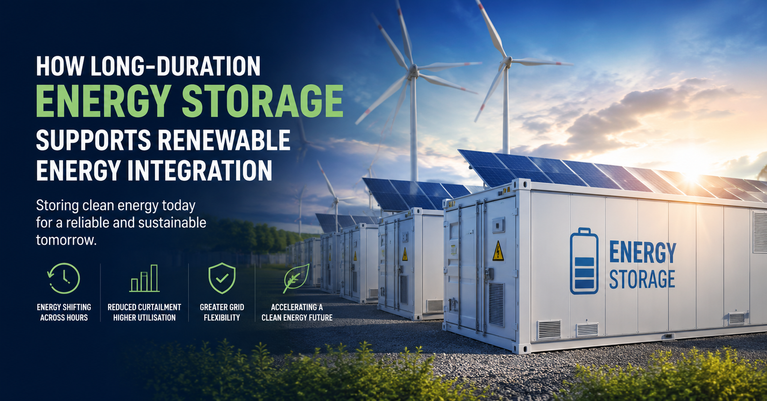
Long-Duration Energy Storage (LDES) provides that flexibility by storing renewable electricity during periods of surplus generation and delivering it when demand exceeds renewable output. This allows utilities to use more renewable electricity without compromising grid stability or reliability.
Understanding the Mismatch Between Renewable Generation and Electricity Demand
Solar and wind power each have unique generation characteristics, but neither consistently follows electricity demand.
Solar energy is highly predictable but limited by daylight hours. Production usually peaks around midday, while electricity demand in many regions reaches its highest level during the early evening when residential and commercial activity increases.
Wind energy behaves differently. Wind farms often generate significant amounts of electricity overnight when demand is relatively low, while prolonged periods of weak wind can reduce renewable generation across multiple sites for several hours or even days.
Electricity demand adds another layer of complexity. Consumption changes continuously based on factors such as:
-
Residential activity
-
Commercial operating hours
-
Industrial production schedules
-
Electric vehicle charging
-
Seasonal heating and cooling requirements
Because these demand patterns rarely align with renewable generation, grid operators must continuously balance supply and demand to maintain stable system operation.
Engineering Example
A utility-scale solar farm may reach maximum output at 1:00 PM on a clear day. However, regional electricity demand may not peak until 7:00 PM, after solar generation has already declined. Without energy storage, utilities must either curtail surplus midday solar generation or rely on dispatchable generation during the evening demand peak.
Long-Duration Energy Storage bridges this timing gap by shifting renewable electricity from periods of excess generation to periods of higher demand.
The Grid Challenges Long-Duration Energy Storage Helps Solve
As renewable generation becomes a larger share of the electricity mix, utilities face operational challenges that extend beyond simply balancing energy supply. Long-Duration Energy Storage helps address several of these issues while enabling higher renewable penetration.
Renewable Curtailment
Renewable curtailment occurs when available solar or wind generation cannot be delivered to the grid, even though renewable resources are capable of producing electricity.
The most common reasons include:
-
Renewable generation exceeds electricity demand.
-
Transmission infrastructure reaches its operating limits.
-
Local grid congestion limits power flow.
-
Grid operators must maintain system stability and reserve margins.
Curtailment represents lost renewable energy that has already been generated but cannot be used effectively.
Instead of reducing renewable output, Long-Duration Energy Storage captures surplus electricity and stores it until the grid requires additional energy. This increases renewable utilisation and allows existing renewable assets to deliver greater value without increasing generation capacity.
The Duck Curve
The duck curve describes how high levels of solar generation change daily electricity demand seen by grid operators.
During the middle of the day, abundant solar generation significantly reduces net grid demand. As the sun sets, however, solar production decreases rapidly while residential electricity demand rises sharply.
This creates a steep evening ramp that conventional generators must respond to within a short period.
By charging during midday and discharging during the evening, Long-Duration Energy Storage smooths this transition and reduces the need for rapid increases in conventional generation.
Grid Flexibility
Modern electricity systems require flexible resources capable of responding quickly to changing operating conditions.
Long-Duration Energy Storage contributes to grid flexibility by supporting services such as:
-
Energy shifting
-
Frequency regulation
-
Voltage support
-
Operating reserves
-
Renewable generation balancing
Rather than serving a single purpose, LDES allows utilities to manage renewable variability while maintaining reliable electricity delivery across the network.
Engineering Example
Consider a wind farm that produces excess electricity overnight when regional demand is low. Instead of curtailing generation, an LDES system stores the surplus energy and discharges it during the morning demand peak. This improves renewable utilisation while reducing reliance on conventional generation.
Read Also: 7 Benefits of Long-Duration Energy Storage for Commercial and Industrial Businesses
Why Four-Hour Battery Storage Is Not Always Enough
Four-hour Battery Energy Storage Systems (BESS) have become a common choice for integrating renewable energy because they effectively support daily energy shifting and short-duration grid services. However, not every renewable integration challenge can be solved within a four-hour discharge window.
Several operating conditions require energy storage over much longer periods, including:
-
High electricity demand that extends well beyond the evening peak
-
Multiple consecutive cloudy days that reduce solar generation
-
Extended periods of low wind output, sometimes referred to as wind droughts
-
Seasonal variations in renewable generation
-
Grid events requiring prolonged energy support
For example, a manufacturing facility operating overnight may rely on daytime solar generation to reduce grid electricity consumption. While a four-hour battery may support production during the early evening, additional storage duration is needed to continue supplying renewable electricity throughout the night.
Similarly, utilities planning for higher renewable penetration must consider storage systems capable of supporting electricity demand beyond a single daily charging cycle. As renewable generation replaces conventional power plants, longer-duration storage becomes increasingly important for maintaining reliability during extended renewable shortfalls.
This does not mean four-hour batteries are inadequate. They remain highly effective for many applications. However, selecting the appropriate Renewable Energy Storage Technology should always be based on the renewable generation profile, electricity demand patterns, and operational objectives of the project rather than assuming one storage duration is suitable for every application.
Real-World Applications of Long-Duration Energy Storage
Long-Duration Energy Storage is no longer an emerging concept confined to research projects. Around the world, utilities, renewable energy developers, industries, and microgrid operators are deploying long-duration storage solutions to improve grid reliability and maximise the value of renewable energy investments.
While the specific application varies from one project to another, the objective remains the same: store renewable electricity when it is abundant and make it available when it is needed most.
Utility-Scale Renewable Energy Projects
Large-scale solar and wind farms often generate more electricity than the grid can immediately consume, particularly during periods of high renewable output and lower demand. In these situations, utilities may curtail renewable generation to maintain grid stability.
Long-Duration Energy Storage helps capture this surplus electricity instead of allowing it to go unused, making it an effective Grid-scale Energy Storage solution. The stored energy can then be dispatched during periods of higher demand, reducing renewable curtailment and increasing the amount of clean electricity delivered to consumers.
For utility operators, this means better utilisation of existing renewable assets and improved flexibility as renewable penetration continues to grow.
Commercial and Industrial Facilities
Many commercial and industrial (C&I) facilities are investing in on-site solar generation to reduce electricity costs and improve sustainability. However, solar production is often highest during working hours and falls sharply in the evening, when some facilities continue to operate.
By pairing renewable generation with Long-Duration Energy Storage, businesses can extend the use of their own renewable electricity beyond daylight hours. This reduces dependence on grid electricity during peak pricing periods and provides greater operational resilience during power disruptions.
Industries with continuous or energy-intensive operations such as manufacturing, mining, food processing, and data centres can particularly benefit from storage systems capable of supplying power over extended durations.
Microgrids and Remote Communities
Remote communities and isolated industrial sites frequently depend on diesel generators because grid connections are limited or unavailable. Although renewable generation can reduce fuel consumption, intermittent solar and wind resources alone cannot always provide a continuous electricity supply.
Long-Duration Energy Storage enables microgrids to store renewable electricity and use it during periods of low generation, reducing reliance on diesel generation while improving energy security and lowering operating costs.
For island communities and off-grid operations, this creates a more reliable and sustainable energy system.
Supporting the Transition to Cleaner Power Systems
As governments and utilities work towards decarbonising electricity networks, maintaining reliability becomes just as important as increasing renewable generation.
Long-Duration Energy Storage supports this transition by helping electricity systems:
-
Reduce renewable energy curtailment.
-
Improve grid flexibility and resilience.
-
Integrate higher levels of solar and wind generation.
-
Reduce dependence on fossil-fuel peaking plants.
-
Enhance energy security during periods of high demand or renewable shortfalls.
Rather than replacing renewable energy, LDES enables renewable resources to play a larger and more dependable role in the electricity system.
Read Also: How AI Is Transforming Renewable Energy Storage Technology
Choosing the Right Long-Duration Energy Storage Solution
Selecting a Long-Duration Energy Storage solution involves more than comparing battery technologies. Every renewable energy project has different operational objectives, and the most suitable storage system depends on how it will be used throughout its lifetime.
Before choosing a solution, project developers should evaluate several technical and commercial factors.
Storage Duration Requirements
The first consideration is how long the storage system needs to supply electricity.
Projects designed for daily solar energy shifting may require only several hours of storage, while applications supporting multi-day renewable shortfalls or seasonal balancing require significantly longer discharge durations.
Understanding the intended operating profile helps narrow the range of suitable technologies.
Renewable Generation Profile
The characteristics of the renewable energy source also influence storage requirements.
For example:
-
Solar projects generally require storage to shift energy from daytime to evening demand.
-
Wind projects may need storage capable of managing overnight generation or prolonged periods of low wind.
-
Hybrid renewable projects often require greater operational flexibility because generation patterns vary throughout the day.
Matching storage duration with renewable generation patterns improves system performance and renewable energy utilisation.
Lifetime Performance and Cycling
Not all storage technologies perform the same over long operating periods.
When comparing solutions, it is important to consider factors such as:
-
Expected service life.
-
Capacity degradation over time.
-
Maintenance requirements.
-
Charging and discharging frequency.
-
Overall lifecycle cost rather than upfront capital cost alone.
A technology with a higher initial investment may deliver better long-term value if it maintains consistent performance over thousands of operating cycles.
Integration with Existing Energy Systems
Storage systems should also integrate effectively with existing renewable assets and grid infrastructure.
Key considerations include:
-
Compatibility with Energy Management Systems (EMS).
-
Grid connection requirements.
-
Available installation space.
-
Safety and environmental considerations.
-
Future expansion opportunities.
Planning for scalability from the outset allows projects to adapt as renewable capacity and electricity demand continue to grow.
Ultimately, the right Long-Duration Energy Storage solution is the one that aligns with the technical, operational, and economic requirements of the project—not necessarily the technology with the highest power rating or the newest chemistry.
Conclusion
Renewable energy is reshaping the global electricity sector, but generating clean power is only one part of the equation. The ability to store and dispatch that energy when it is needed is becoming equally important as renewable penetration continues to grow.
Long-Duration Energy Storage addresses one of the biggest challenges facing modern power systems: the mismatch between renewable electricity generation and consumer demand. By storing surplus energy and delivering it during periods of lower renewable output or higher demand, LDES helps reduce curtailment, improve grid flexibility, and support a more reliable electricity supply.
Whether supporting utility-scale solar farms, wind projects, commercial facilities, or remote microgrids, Long-Duration Energy Storage enables renewable energy to become a more dependable resource rather than an intermittent one. It also provides utilities and project developers with greater operational flexibility as electricity systems transition towards lower-carbon generation.
Choosing the right storage technology depends on the specific requirements of each project, including storage duration, cycling frequency, operational objectives, and long-term performance. Evaluating these factors carefully ensures that energy storage delivers lasting value while supporting future renewable energy growth.
As countries continue investing in cleaner and more resilient electricity systems, Long-Duration Energy Storage will play an increasingly important role in enabling reliable renewable energy integration and accelerating the transition to a sustainable energy future.
Frequently Asked Questions
1. What is Long-Duration Energy Storage?
Long-Duration Energy Storage (LDES) refers to technologies capable of storing electricity for extended periods—typically longer than four hours—and releasing it when needed. These systems help balance renewable energy generation with electricity demand while improving grid reliability.
2. Why is Long-Duration Energy Storage important for renewable energy integration?
Solar and wind power generate electricity based on weather conditions rather than demand. LDES stores excess renewable electricity when production is high and supplies it later, helping reduce renewable curtailment, improve grid stability, and increase the use of clean energy.
3. Which industries benefit from Long-Duration Energy Storage?
LDES supports a wide range of applications, including:
-
Utility-scale renewable energy projects
-
Commercial and industrial facilities
-
Manufacturing and mining operations
-
Data centres
-
Microgrids and remote communities
-
Public infrastructure and critical facilities
4. What is the difference between Long-Duration Energy Storage and conventional battery storage?
Conventional battery systems are often designed for short-duration applications such as peak shaving or frequency regulation. Long-Duration Energy Storage is intended to deliver electricity over longer periods, making it more suitable for renewable energy integration, multi-hour energy shifting, and improving grid resilience.
5. Which Long-Duration Energy Storage technology is best?
There is no single technology that is best for every application. The most suitable solution depends on factors such as:
-
Required storage duration
-
Renewable energy source
-
Project size
-
Cycling requirements
-
Site conditions
-
Lifecycle cost
Technologies such as vanadium flow batteries, pumped hydro, hydrogen energy storage, and emerging long-duration battery systems each have advantages for different use cases.
6. How does Long-Duration Energy Storage support a more reliable electricity grid?
By storing surplus renewable electricity and supplying it when generation decreases or demand increases, LDES helps maintain the balance between electricity supply and demand. It also supports grid services such as frequency regulation, operating reserves, and renewable energy firming, contributing to a more stable and resilient electricity system.