
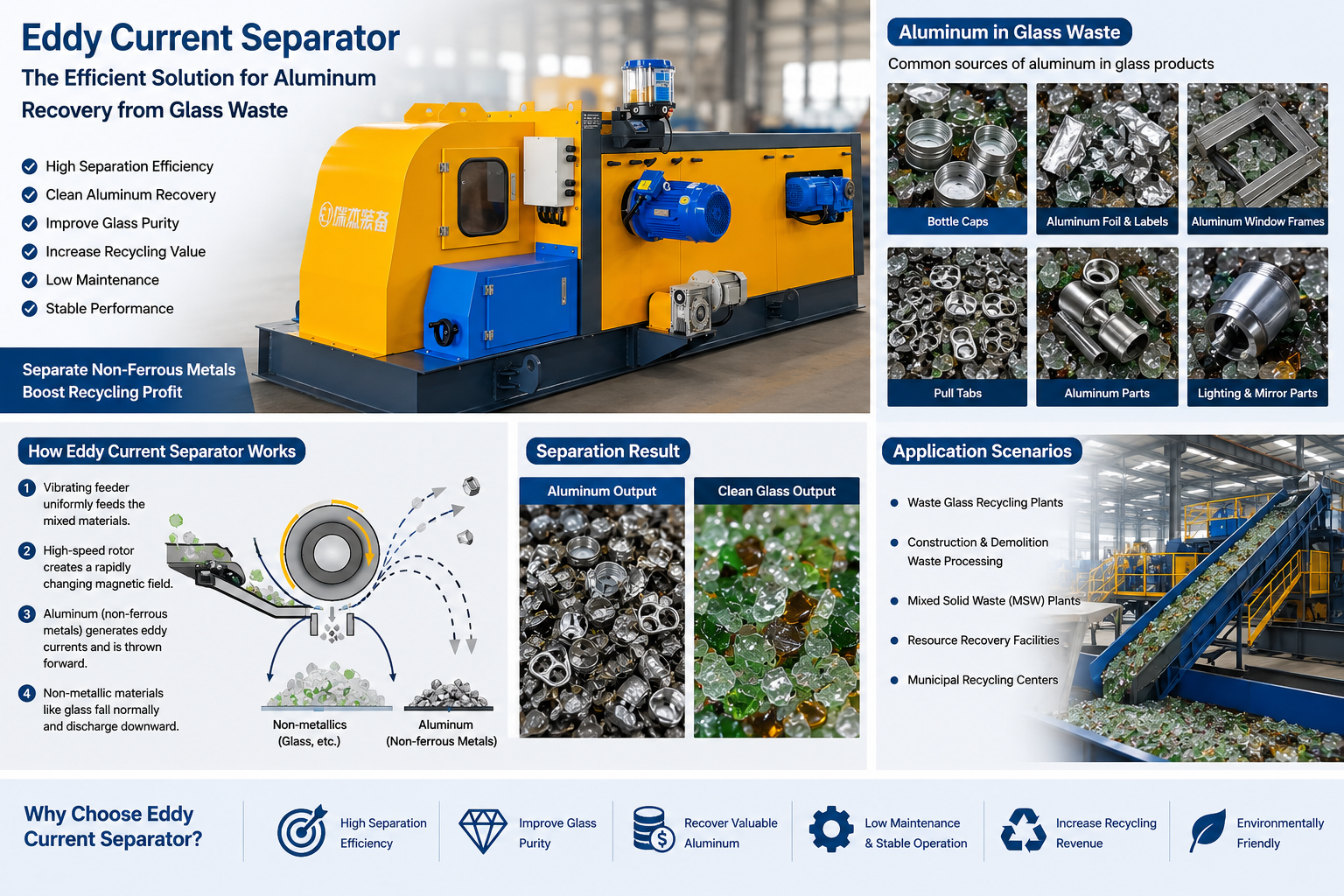
Every year, millions of tons of waste glass are generated from beverage bottles, architectural glass, household products, and industrial materials. While most people focus on recycling the glass itself, another valuable material is often overlooked — aluminum.
From aluminum bottle caps to window frame fragments and coated glass accessories, aluminum frequently appears in mixed glass waste streams. Recovering these metals not only improves recycling efficiency but also creates additional economic value for recycling companies.
So, how do recycling plants separate aluminum from broken glass mixtures safely and efficiently? The answer lies in understanding the properties of aluminum and choosing the right separation technology.
Where Does Aluminum Come From in Glass Waste?
Aluminum can be found in many types of glass-related products and post-consumer waste. Common sources include:
Beverage and Packaging Waste
- Aluminum caps from glass bottles
- Pull tabs and seals
- Aluminum foil labels or packaging materials
Construction and Demolition Waste
- Aluminum window and door frames attached to glass
- Curtain wall components
- Decorative aluminum strips and accessories
Household and Industrial Glass Products
- Glass cookware with aluminum handles
- Electronic display glass with aluminum parts
- Lighting products and mirrors
During crushing and recycling processes, these aluminum materials become mixed with broken glass cullet, plastics, and other non-metallic impurities.
How Is Aluminum Traditionally Removed from Glass Mixtures?
In many traditional recycling systems, mixed glass waste is first crushed and screened by particle size. Ferrous metals such as iron and steel are usually removed using magnetic separators.
However, aluminum presents a different challenge.
Unlike iron, aluminum is a non-ferrous metal, meaning it is not attracted by ordinary magnetic separators. Because of this, many older recycling systems either:
- leave aluminum inside the glass cullet,
- remove it manually,
- or fail to recover it efficiently.
This can reduce the purity of recycled glass and lower the final market value of the recovered materials.
As recycling standards become stricter, modern facilities are increasingly turning to automated non-ferrous metal separation systems.
Why Is Aluminum Difficult to Separate?
Aluminum has several unique characteristics:
- Lightweight
- Non-magnetic
- Conductive
- Resistant to corrosion
Because aluminum does not respond to standard magnetic force, conventional magnetic equipment cannot effectively extract it from crushed glass.
At the same time, aluminum fragments are often small, irregular, and mixed with sharp glass particles, making manual sorting inefficient and unsafe.
This is why advanced physical separation technology is essential.
The Most Effective Solution: Eddy Current Separator
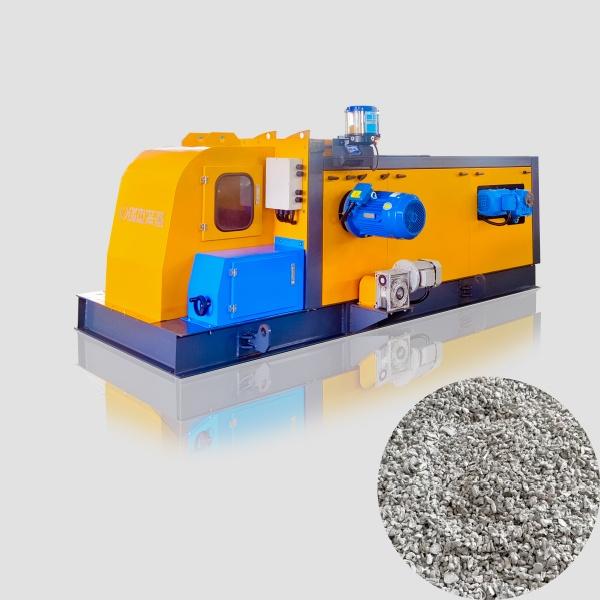
For modern recycling plants, the most widely used equipment for recovering aluminum from glass mixtures is the Eddy Current Separator.
This machine is specifically designed to separate non-ferrous metals such as:
- Aluminum
- Copper
- Brass
- Zinc
from non-metallic materials like glass, plastic, rubber, and sand.
How Does It Work?
The system uses a high-speed rotating magnetic rotor to create rapidly changing magnetic fields. When conductive non-ferrous metals pass through the magnetic field, eddy currents are generated inside the metal pieces.
These induced currents create a repelling force, literally throwing aluminum particles away from the glass stream into a separate collection area.
Meanwhile, the glass and other non-conductive materials continue falling normally.
The process is:
- Fully automatic
- Continuous
- High-speed
- Highly efficient
Advantages of Using an Eddy Current Separator in Glass Recycling
1. High Separation Efficiency
Even small aluminum fragments can be separated effectively from crushed glass mixtures, improving recovery rates significantly.
2. Improved Glass Purity
Removing aluminum contamination helps produce cleaner recycled glass cullet, which is more valuable for downstream manufacturing.
3. Reduced Labor Costs
Automatic separation greatly reduces the need for manual sorting and improves workplace safety.
4. Higher Recycling Revenue
Recovered aluminum itself has strong resale value, allowing recycling plants to generate additional profit from waste streams.
5. Environmentally Friendly Operation
The system works through physical separation without chemicals or water pollution, making it suitable for sustainable recycling operations.
A Growing Trend in Modern Recycling Plants
As global recycling regulations become stricter and resource recovery becomes more important, advanced metal separation technology is rapidly becoming standard equipment in glass recycling facilities.
Many plants now combine:
- Magnetic separators for ferrous metals
- Eddy current separators for non-ferrous metals
- Optical sorting systems
- Vibrating screens
to create highly efficient automated recycling lines.
This integrated approach allows recyclers to maximize material recovery while reducing waste sent to landfills.
Final Thoughts
Aluminum hidden inside glass waste may look insignificant, but it represents both an environmental challenge and a valuable recycling opportunity.
Because aluminum is non-magnetic, ordinary magnetic separators cannot remove it effectively. For recycling facilities seeking higher purity, better efficiency, and greater profitability, the Eddy Current Separator has become one of the most reliable solutions available today.
As recycling technology continues evolving, smarter separation systems will play an increasingly important role in transforming waste into valuable reusable resources.
Https://www.ruijie-equipment.com
WhatsApp:+86 19175279015
Email:R01@ruijie-equipment.com