
Introduction
Machine learning is becoming part of almost every business today. Many companies want to use machine learning models to make better decisions, serve customers faster, and improve products.
But making a model in a notebook is not enough. The real challenge is to run that model in the real world every day, keep it healthy, and update it safely when things change. This is where MLOps comes in. MLOps is the way to manage the full life of a machine learning model, from first idea to regular production use. The MLOps Certified Professional (MLOCP) certification is designed to help you learn this complete process in a clear and practical way. In this blog, we will talk about what this certification is, who should take it, what skills you will learn, what kind of projects you can handle after it, and what to study next in your career path.
What MLOCP certification is
MLOps Certified Professional (MLOCP) is a hands‑on certification that focuses on building, deploying, monitoring, and improving machine learning systems in production environments.
It teaches you best practices, tools, and workflows so you can move safely from experiments to stable services.
The whole idea is to make machine learning reliable, repeatable, and easier to manage for teams and organizations.
Who should take MLOps Certified Professional
This certification is suitable for many technical roles that touch data or machine learning. You should think about it if you are:
-
A data scientist who wants to push models beyond notebooks and into real applications used by customers or internal teams.
-
A machine learning engineer who wants a solid framework for pipelines, deployments, and model lifecycle management.
-
A DevOps engineer who has started supporting ML workloads and wants to understand the unique requirements of models, data, and experiments.
-
A Site Reliability Engineer (SRE) responsible for keeping systems healthy and now facing ML‑driven services.
-
A software engineer working on AI‑powered products who needs to integrate models with APIs, microservices, and back‑end systems.
-
A technical lead, architect, or manager who must design or supervise ML platforms and workflows for the team.
If you already work with data, cloud, DevOps, AI, or software delivery, MLOCP helps you grow into a role where you can handle real production ML responsibilities.
Skills you will gain
After completing the MLOps Certified Professional program, you can expect to build strong skills across different parts of the ML lifecycle, such as:
-
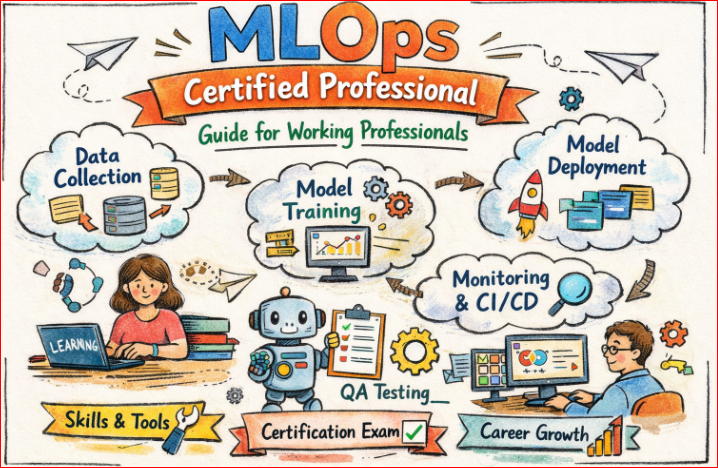
Understanding each stage of the ML lifecycle: data collection, cleaning, feature development, training, testing, deployment, monitoring, and retraining.
-
Designing repeatable ML workflows using pipelines, so the same steps can be run again and again with less manual effort.
-
Applying version control not only to code, but also to data sets, model files, configuration, and experiments.
-
Setting up experiment tracking to record model versions, parameters, metrics, and results in a structured way.
-
Building CI/CD flows specially designed for ML projects, including steps for data checks, model validation, and safe rollout.
-
Deploying models as services through containers, APIs, and orchestration platforms so applications can use them easily.
-
Working with both real‑time (online) and batch (offline) inference patterns, depending on the business need.
-
Monitoring models in production for accuracy, latency, errors, and changes in data patterns.
-
Detecting issues such as data drift and concept drift and planning how to respond.
-
Designing retraining strategies so models can be updated smoothly when performance goes down or data changes.
-
Collaborating as part of a cross‑functional team with data scientists, engineers, and operations staff using shared tools and processes.
These skills turn you into someone who can take responsibility for ML systems from start to finish, not just a small part of the pipeline.
Real‑world projects you should be able to do after it
Once you have completed the MLOCP certification, you should feel confident taking on practical, real‑world projects like:
-
Building an end‑to‑end ML pipeline for a business problem such as churn prediction, fraud detection, recommendation, or demand forecasting, and pushing it into production.
-
Packaging a trained model into a container and exposing it through a simple, secure API that can be called from web or mobile applications.
-
Creating a simple but effective experiment tracking setup where your team can compare many models, choose the best, and understand why it is better.
-
Designing CI/CD workflows that automatically test model code, check data quality, run evaluation, and then deploy the selected model to staging and production.
-
Setting up dashboards and alerts for model performance, for example tracking accuracy, response time, and error rates along with key business metrics.
-
Planning and implementing a retraining pipeline that regularly refreshes models using new data so they stay accurate.
-
Turning a one‑time, manual notebook process into a clean, automated, documented pipeline that other team members can understand and maintain.
-
Integrating model serving into a microservices architecture so that ML becomes a stable part of your existing systems instead of a separate, fragile piece.
These kinds of projects show clear business value and prove that you can handle both the technical and operational sides of machine learning.
Common mistakes MLOps helps you avoid
Without MLOps practices, many ML projects run into the same problems again and again. The MLOCP certification trains you to see these risks early and avoid them, such as:
-
Treating ML work as a one‑time handover from data science to engineering, instead of a continuous, shared lifecycle.
-
Not tracking versions of data, models, and experiments, making it impossible to reproduce results or investigate incidents properly.
-
Deploying models manually, with no automated tests, no validation, and no rollback plan if something goes wrong.
-
Ignoring proper monitoring of models and pipelines, so problems are only discovered after they hurt customers or business metrics.
-
Mixing experimental code and production code in the same messy environment, which makes debugging and maintenance very hard.
-
Forgetting about access control, compliance, and security for datasets, models, and ML endpoints.
-
Not thinking about performance and scale, which leads to slow or unstable services when traffic increases.
-
Allowing communication gaps between data scientists, developers, and operations teams so that no one owns the full system.
By using MLOps approaches, you make your ML work more organized, safer, and easier to handle as it grows.
Best next certification after MLOps Certified Professional
After MLOCP, your ideal next certification depends on where you want to go deeper. Some popular directions are:
-
A DevOps or cloud certification, if you want to strengthen your foundations in automation, infrastructure as code, and platform design.
-
A DataOps or data engineering certification, if you want to focus on building and managing strong data pipelines that feed your models.
-
An SRE or reliability‑focused certification, if you want to become an expert in keeping complex ML systems fast, stable, and resilient.
-
A more advanced ML or AI certification, if you want to grow further on the modeling and algorithm side while still using your MLOps skills.
Choosing a next certification that complements your MLOps knowledge helps you become either a deep specialist or a broad technical leader, depending on your career goals.
Choose your path: six connected learning paths
To think clearly about your long‑term growth, it helps to imagine six connected learning paths. You do not have to pick only one forever, but you can choose where to start and where to grow next.
1. DevOps path
In the DevOps path, you focus on continuous integration, continuous delivery, automation, and strong collaboration between development and operations.
This path teaches you how to build reliable pipelines, manage infrastructure using code, and keep deployments frequent but safe.
For MLOps, these core DevOps skills are like the base of the house—without them, ML systems will struggle to be stable.
2. DevSecOps path
In the DevSecOps path, you bring security into every step of the delivery process.
For ML, this means securing datasets, models, repositories, pipelines, and runtime environments from the beginning.
You learn how to check for vulnerabilities, manage secrets, handle permissions, and respect compliance rules while still moving fast.
3. SRE (Site Reliability Engineering) path
The SRE path is all about reliability, uptime, performance, and efficient operations.
When you apply SRE ideas to ML systems, you treat models as services with clear service‑level objectives and error budgets.
You learn how to design monitoring, alerting, capacity planning, and incident response so ML systems stay healthy under real‑world pressure.
4. AIOps / MLOps path
In the AIOps and MLOps path, you double down on automation and intelligence for both infrastructure and machine learning.
You learn patterns and platforms that make it easier to manage many models, many experiments, and many pipelines at scale.
This path is good if you want to become a specialist in ML lifecycle management and intelligent operations.
5. DataOps path
The DataOps path centers on data quality, speed, and reliability in data pipelines.
Here you focus on practices like data versioning, data tests, pipeline orchestration, and close cooperation between data and engineering teams.
For someone in MLOps, strong DataOps knowledge ensures that every model you run has trustworthy, fresh data to work with.
6. FinOps path
The FinOps path focuses on managing cloud and infrastructure costs in a smart, transparent way.
For ML workloads, this includes the cost of training, experiments, storage, and serving models at scale.
With FinOps skills, you design ML systems that are not only technically correct but also cost‑efficient and aligned with business value.
Next certifications to take: three directions
After MLOCP, you can think about your next move in three big directions. This helps you plan a sensible learning roadmap.
1. Same track: deepen your MLOps and ML expertise
In this direction, you choose certifications that go deeper into MLOps, ML engineering, or specific ML platforms and tools.
You continue to build deeper knowledge about production ML patterns, advanced workflows, and platform‑level design.
This is a good choice if you want to be recognized as the main MLOps or ML engineering expert in your team or company.
2. Cross‑track: broaden across related disciplines
Here, you add certifications in DevOps, SRE, DataOps, or cloud engineering.
By doing this, you gain a wide view of the full environment around ML systems, from infrastructure to data pipelines to reliability and operations.
This direction is useful if you enjoy connecting different areas and solving complex, end‑to‑end problems.
3. Leadership track: move toward lead or architect roles
In this path, you look at certifications focused on architecture, technical leadership, or cloud and platform strategy.
You learn how to design entire AI and data platforms, make technology choices, and guide teams from a higher level.
This is a good path if you want to mentor others, lead projects, and influence the long‑term direction of AI and ML in your organization.
FAQs (8 questions and answers) on MLOps Certified Professional (MLOCP)
1. What is the main goal of the MLOps Certified Professional certification?
The main goal of MLOCP is to teach you how to manage the complete lifecycle of machine learning models in production.
It helps you move from “I can build a model” to “I can run and maintain this model in real systems safely and reliably.”
2. Do I need to be a very advanced data scientist to take MLOCP?
No, you do not need to be an advanced data scientist.
You should understand basic ML concepts and be comfortable with simple programming and scripting, but the focus is on operations and lifecycle, not on heavy math.
3. Is this certification only for people already working in AI?
It is most useful if you are already close to data, AI, DevOps, or software engineering.
However, motivated professionals from nearby roles can also use it to enter the world of production ML with the right mindset and practices.
4. What kind of tools and technologies are covered in MLOCP?
The certification focuses on commonly used tools and patterns in ML pipelines, experiment tracking, CI/CD, and model deployment.
You learn ideas that can be applied across many different platforms, rather than being locked into a single vendor or product.
5. How does MLOCP help a data scientist in daily work?
For a data scientist, MLOCP shows how to structure experiments, track them properly, and collaborate with engineering and operations.
It helps you design your work from the beginning with deployment and maintenance in mind, not just model accuracy.
6. How does MLOCP help a DevOps engineer?
For a DevOps engineer, MLOCP explains the special needs of ML workflows, such as data pipelines, training jobs, and model artifacts.
You learn how to extend your existing CI/CD, monitoring, and automation skills to support machine learning teams smoothly.
7. Can MLOCP improve my chances of working on high‑impact AI projects?
Yes. Many organizations want to use AI but struggle with production ML problems.
If you can show that you understand MLOps, you become a natural choice for important projects where reliability and business impact really matter.
8. Is MLOCP a one‑time learning or a base for future growth?
MLOCP is a strong base for future growth.
You can build on it with more advanced ML, DevOps, SRE, DataOps, or leadership certifications and keep growing into more senior roles over time.
Why choose DevOpsSchool for MLOCP?
DevOpsSchool has long experience in training professionals in DevOps, cloud, automation, and related fields, and it brings that depth into its MLOps programs.
The teaching style focuses on clear explanations, real examples, and hands‑on understanding rather than only theory.
Because DevOpsSchool covers many connected areas—DevOps, SRE, Security, Data, and ML—you can plan a complete learning path in one place.
You can start with MLOCP and then continue with other certifications without losing continuity or having to change your approach completely.
You also get guidance on how to apply what you learn in actual projects, which makes it easier to bring value to your current job or future roles.
Conclusion
MLOps Certified Professional (MLOCP) is an important certification for anyone who wants to turn machine learning from small experiments into strong, real‑world systems.
It teaches you how to think about the entire lifecycle of a model, plan for operations from the start, and work smoothly with both data and infrastructure.
By taking this certification, you gain skills that are in high demand as more companies move from “we have data” to “we have ML in production that really works.”
From here, you can go deeper in MLOps, move sideways into DevOps or DataOps, or grow into leadership and architecture roles around AI and data platforms.