
What Is the ACL and Why Does It Tear?
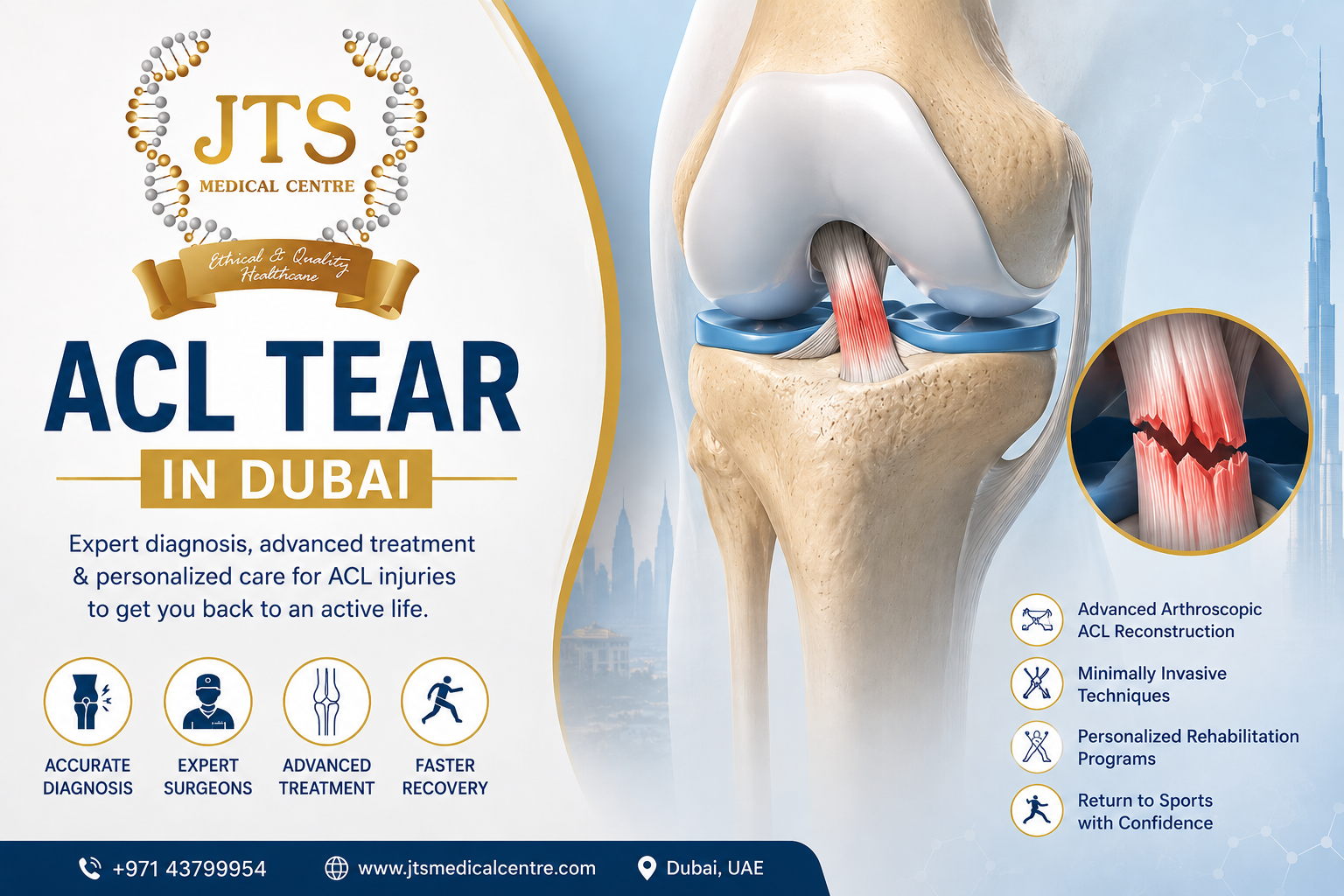
The anterior cruciate ligament (ACL) is one of four major ligaments stabilising the knee. It runs diagonally through the middle of the joint, controlling rotational movement and preventing the tibia (shinbone) from sliding forward relative to the femur (thigh bone).
ACL tears are graded by severity:
-
Grade 1 Mild sprain. Fibres are stretched but intact.
-
Grade 2 Partial tear. The ligament is loosened but still connected.
-
Grade 3 Complete tear. The ligament is fully ruptured, and the knee becomes unstable.
Most ACL injuries are non-contact, meaning they don't require a collision. A sudden deceleration, pivot, or landing from a jump is enough. This is why football, basketball, tennis, and skiing account for the majority of ACL tears in Dubai's active expat and local population.
Signs You May Have Torn Your ACL
Not every knee injury is a torn ACL, but some symptoms are red flags that warrant immediate assessment.
The Classic Warning Signs
1. An audible or felt "pop" Many patients describe hearing or feeling a distinct pop at the moment of injury. This is often the ligament rupturing.
2. Immediate swelling Within 2–6 hours of injury, the knee typically fills with blood (hemarthrosis). Swelling that appears this quickly usually signals significant ligament or cartilage damage, not just a minor strain.
3. Inability to bear weight: Pain and instability make it difficult or impossible to walk normally immediately after the injury.
4. A feeling of the knee "giving way" This is the hallmark symptom, the sensation that the knee will buckle under load. If your knee feels unstable when pivoting, squatting, or descending stairs, an ACL injury is likely.
5. Loss of full range of motion. Swelling and pain often prevent full extension or flexion of the joint in the days following injury.
What to Do Immediately
Follow the RICE protocol in the first 48 hours: Rest, Ice (20 minutes on, 20 off), Compression, Elevation. Avoid heat, alcohol, and aggressive massage. Book a specialist assessment as soon as possible. The sooner an accurate diagnosis is made, the better your treatment outcomes.
How Is an ACL Tear Diagnosed?
A proper diagnosis goes beyond a physical exam. At JTS Medical Centre, assessment typically involves:
-
Clinical examination: The Lachman Test and Anterior Drawer Test assess joint laxity and ligament integrity.
-
MRI scan: The gold standard for confirming ACL tears and detecting associated injuries (meniscus tears, bone bruising, cartilage damage are common alongside ACL ruptures).
-
X-ray: Rules out fractures, particularly in younger patients or high-impact injuries.
A thorough workup matters because up to 50% of ACL tears are accompanied by other knee injuries, and missing those complicates recovery.
ACL Tear Treatment Options in Dubai
Here's where things get nuanced. Not every ACL tear requires surgery, and not everyone who has surgery needs to wait six months to return to sport.
Conservative (Non-Surgical) Management
For Grade 1–2 tears, older or less active patients, or individuals whose daily life doesn't demand rotational knee stability, conservative treatment is often effective.
This typically includes:
-
Structured physiotherapy to rebuild quadriceps, hamstrings, and hip strength
-
Neuromuscular retraining to improve proprioception and joint stability
-
Activity modification during the healing phase
-
Bracing for activities that load the knee
At JTS Medical Centre, conservative protocols are individualised based on injury grade, patient activity level, and biomechanical assessment. Some partial tears treated conservatively return patients to sport within 10–16 weeks.
Surgical Reconstruction
For Grade 3 (complete) tears, especially in athletes under 40 who wish to return to pivoting or high-demand sports, ACL reconstruction surgery is the standard of care.
What the Surgery Involves
ACL reconstruction is performed arthroscopically (keyhole surgery), typically under general or spinal anaesthesia. It takes 60–90 minutes. Most patients go home the same day or after one night. The ligament isn't sutured, it's replaced, and the new graft gradually integrates with the bone over several months (a process called ligamentisation).
The 6-Month Myth and What Recovery Actually Looks Like
The "6 months off" timeline gets repeated so often that many athletes assume it's inevitable. It isn't, or at least, it doesn't have to mean 6 months of doing nothing.
What a Modern ACL Recovery Timeline Looks Like
Weeks 1–2: Post-operative phase Pain management, swelling control, regaining range of motion, walking without crutches.
Weeks 3–6: Early rehab, progressive weight-bearing, quad activation, cycling, pool walking. Many patients resume upper-body training and core work within this window.
Weeks 6–12: Strength and neuromuscular phase. Strength training resumes in earnest. Cycling, swimming, and resistance training are fully back on the table for most patients.
Months 3–5: Functional and sport-specific training Jogging typically begins around week 12–16, depending on strength symmetry. Sport-specific drills, agility training, and return-to-sport testing follow.
Month 6+: Return to competition Clearance for full return to sport typically follows objective testing, not just a calendar date. Limb symmetry indices (LSI), hop tests, and psychological readiness are assessed.
The key insight: the 6-month timeline refers to returning to competitive sport, not to returning to the gym, pool, or structured exercise. Most athletes are training hard again within 8–12 weeks.
Factors That Speed Recovery
-
Starting rehabilitation within days of injury (prehab before surgery improves post-op outcomes)
-
Working with a physiotherapy team experienced in ACL recovery protocols
-
Maintaining fitness during recovery through low-impact alternatives
-
Nutrition: adequate protein (1.6–2.2g/kg body weight), anti-inflammatory foods, and targeted supplementation
Why Dubai Athletes Choose JTS Medical Centre for ACL Treatment
JTS Medical Centre offers a full continuum of care for ACL injuries from initial diagnosis through surgical reconstruction and sport-specific rehabilitation.
Key advantages for patients in Dubai:
-
Same-week MRI and specialist consultation, no long waits for diagnosis
-
Experienced orthopaedic surgeons with subspecialty training in knee reconstruction
-
Integrated physiotherapy rehab starts within 24 hours of surgery under coordinated care
-
An Arabic and English-speaking clinical team serving Dubai's diverse patient population
-
Transparent pricing with insurance coordination for most major UAE providers
Whether you're a competitive athlete, weekend warrior, or someone who simply wants to get back to pain-free movement, the team at JTS Medical Centre will build a recovery plan around your goals, not just a textbook average.
JTS Medical Centre, Dubai
Book a consultation: +971 56 291 3634
Frequently Asked Questions
Can I walk with a torn ACL? Many people can walk with a Grade 1–2 tear, though with discomfort. A complete Grade 3 tear makes weight-bearing painful and the knee is unstable. Walking is possible but inadvisable without assessment.
Do I always need surgery for an ACL tear in Dubai? No. Partial tears and tears in less active individuals often respond well to physiotherapy. Surgical reconstruction is typically recommended for complete tears in athletes who want to return to high-demand sports.
How soon after injury should I see a doctor? Within 24–48 hours for assessment. Swelling makes clinical examination more difficult after a few days. Early, accurate diagnosis significantly improves outcomes.
Will I need to travel for ACL surgery? No. Dubai has world-class orthopaedic facilities. JTS Medical Centre performs ACL reconstruction to international standards, with post-operative care managed locally.
What's the risk of re-tearing an ACL? Re-tear rates are highest when athletes return to sport too early, before objective strength and neuromuscular criteria are met. Following a protocol-driven return-to-sport process, not just a calendar, significantly reduces this risk.