
Introduction
The field of infrastructure management is being transformed by machine learning and automated systems. Traditional monitoring systems can no longer handle the massive volume of logs, metrics, and traces generated by modern distributed applications. To address this complexity, artificial intelligence for IT operations, commonly known as AIOps, has become an essential practice for maintaining system uptime.
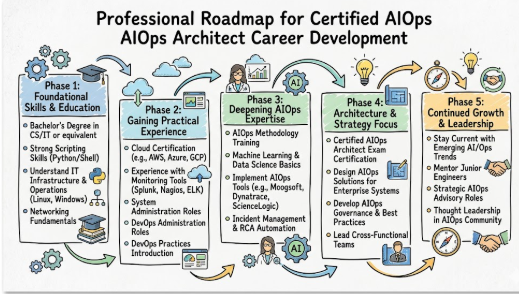
Engineering platforms must be designed with intelligent automation built directly into the infrastructure core. This master-level guide provides a complete overview of the CCertified AIOps Architect program, covering the strategic learning path, core exam tracks, practical preparation milestones, and professional development paths.
What is Certified AIOps Architect
The Certified AIOps Architect is an expert-level credential designed for senior technical professionals who design, build, and oversee enterprise-scale intelligent operations platforms. This certification validates an engineer's ability to construct comprehensive reference architectures that integrate data ingestion pipelines, machine learning inference engines, and automated self-healing frameworks.
Moving beyond basic tool configuration, this program confirms mastery over complex architectural trade-offs, multi-cloud system dependencies, and large-scale data lake engineering. The program acts as a definitive benchmark for professionals capable of driving full-scale operational transformations across global engineering organizations.
Why it matters today?
Modern infrastructure landscapes are growing too fast for manual engineering teams to manage safely. With systems spanning multi-cloud platforms, thousands of microservices, and continuous deployment cycles, the amount of data generated is overwhelming. Organizations face severe alert fatigue, delayed root-cause analysis, and critical system downtime because traditional monitoring tools rely on rigid, manual thresholds.
AIOps solves these challenges by applying machine learning to operations data. It allows platforms to automatically group related alerts, spot anomalies before they cause a crash, and run automated scripts to fix issues without human intervention. Earning a validation like the CCertified AIOps Architect demonstrates that a technical leader can design systems that handle massive data throughput, reducing operational noise and maintaining excellent platform stability.
Why Certified AIOps Architect certifications are important
-
Validation of Architectural Leadership: It proves that an engineer can design resilient, self-healing platforms capable of serving hundreds of development teams across an entire enterprise.
-
Reduction of Operational Noise: Certified architects possess the skills to build smart correlation engines that eliminate alert fatigue and help operations teams focus on real infrastructure threats.
-
Systemic Downtime Prevention: By learning to implement predictive analytics, systems can be designed to address capacity issues and performance bottlenecks before end-users are impacted.
-
Data-Driven Operations: It provides the technical foundation needed to build operational data lakes that unify logs, metrics, traces, and events for advanced machine learning analysis.
-
Global Market Competitiveness: Achieving this credential sets professionals apart in competitive markets, demonstrating a clear path forward for systems modernization and infrastructure scaling.
Why choose AIOps School?
AIOps School stands out as a specialized provider because its programs focus entirely on the intersection of artificial intelligence and enterprise IT operations. Rather than offering generic cloud courses, the platform provides deep, role-specific curriculum tracks that span from foundational concepts up to complex architecture designs.
The certification programs are built on real-world engineering demands, incorporating structured laboratory environments, multi-signal telemetry ingestion patterns, and production-ready automation workflows. Their certifications are globally recognized and trusted by enterprise organizations looking to build proactive, highly automated engineering teams.
Certification Deep-Dive
What is this certification?
The CCertified AIOps Architect is the highest-level credential in the AIOps School curriculum track. It certifies that a professional can design multi-cloud reference architectures, build internal observability platforms, and lead complex organizational transformations using intelligent operations framework tools.
Who should take this certification?
This certification is built for senior infrastructure professionals, including Staff and Principal Site Reliability Engineers, Enterprise Cloud Architects, Platform Engineering Leads, and Observability Directors who are responsible for designing large-scale operational systems.
Certification Overview Table
| Track | Level | Who it’s for | Prerequisites | Skills Covered | Recommended Order |
| AIOps Foundation | Entry-Level | IT Analysts, NOC Engineers, Developers | Basic understanding of IT monitoring | Event correlation, ML in IT ops, self-healing basics | First |
| Certified AIOps Engineer | Mid-Level | DevOps Engineers, SREs, Automation Techs | AIOps Foundation or hands-on script experience | Data pipeline building, anomaly detection, runbooks | Second |
| Certified AIOps Manager | Leadership | IT Managers, Program Leads, Directors | Experience managing infrastructure teams | AIOps roadmapping, vendor selection, ROI tracking | Optional / Leadership |
| Certified AIOps Professional | Advanced | Senior SREs, Systems Consultants | Certified AIOps Engineer background | Multi-cloud monitoring, incident intelligence, NLP logs | Third |
| Certified AIOps Architect | Expert | Platform Architects, Principal Engineers | Certified AIOps Professional background | Reference architecture, scalability patterns, data lakes | Fourth |
Skills you will gain
-
Reference Architecture Design: The ability to define enterprise-wide operational blueprints covering ingestion layers, ML engines, and action orchestration systems.
-
Platform Engineering: Skills to build internal self-service observability portals that provide standardized instrumentation and shared dashboarding for development teams.
-
Extreme Telemetry Ingestion: Mastery over high-scale architectural patterns including partitioned ingestion, tiered storage systems, and query federation.
-
Operational Data Lake Architecture: Designing structured schemas for multi-signal data, along with setting up proper data governance and pipeline workflows.
-
Security & Compliance Architecture: Implementing zero-trust access controls, data encryption rules, and audit trails within automated tracking platforms.
Real-world projects you should be able to do after this certification
-
Enterprise AIOps Platform Rollout: Designing a self-service platform that handles petabyte-scale telemetry for hundreds of distributed applications safely.
-
Intelligent Noise-Reduction Engine: Building a cross-domain correlation framework that cuts down infrastructure alert volume by over eighty percent.
-
Autonomous Remediation Loop: Constructing a safe, closed-loop automation workflow that detects anomalies and triggers self-healing runbooks without manual intervention.
-
Multi-Cloud Observability Architecture: Deploying a unified monitoring framework across AWS, Azure, and GCP that maintains sub-second query latency.
Preparation plan
7–14 days plan
Focus entirely on reviewing the core architecture blueprints and the official exam blueprint documentation. Dedicate two hours daily to studying the five core modules of the certification syllabus. Spend time analyzing reference design patterns for data lakes and telemetry stream processing topologies. Take initial practice tests to identify knowledge gaps regarding stream-processing configurations and data retention compliance.
30 days plan
Dedicate the first two weeks to building practical lab environments focusing on multi-signal data pipelines. Practice configuring isolation forests, autoencoders, and time-series forecasting models using sample infrastructure datasets. Spend the remaining two weeks reviewing advanced enterprise case studies, focusing on multi-cloud alerting strategies and incident triage workflows. Take weekly scenario-based practice exams to build speed and accuracy.
60 days plan
Establish a daily study routine covering deep architectural patterns, statistical anomaly detection math, and complex change-management frameworks. Spend thirty days building end-to-end sandbox projects that tie telemetry collection to automated runbook triggers. Use the final thirty days for intensive practice exams, studying platform governance rules, and practicing the architecture design challenge components of the evaluation.
Common mistakes to avoid
-
Ignoring the Data Ingestion Layer: Focusing too much on machine learning models while neglecting the underlying scalability of the data pipeline will cause production systems to fail under heavy telemetry loads.
-
Treating AIOps as a Single Tool Purchase: Assuming that buying a commercial platform solves operational problems without redesigning internal engineering processes and team workflows.
-
Neglecting Alert Noise Controls: Building overly sensitive anomaly detection models that increase alert volumes rather than reducing noise, which leads directly to severe engineering team fatigue.
-
Omiting Team Culture and Training: Deploying highly automated self-healing workflows without training the existing operations staff, creating distrust and resistance toward the new platforms.
Choose Your Learning Path
DevOps Path
This path is designed for engineers focused on delivery speed, continuous integration, and automated deployments. The curriculum teaches you how to embed intelligent gates into software delivery pipelines, allowing automated systems to predict whether a new code deployment will cause a production infrastructure failure before it goes live.
DevSecOps Path
Built for security-focused infrastructure professionals who want to automate threat detection and compliance checks. This path centers on integrating real-time security tracking into continuous pipelines, using automated anomaly detection to flag unauthorized system access, data leaks, and configuration drifts instantly.
Site Reliability Engineering (SRE) Path
Designed for engineers responsible for maintaining massive system uptime, service stability, and efficient incident management. This track covers how to connect machine learning alerts directly to error budget tracking and how to design automated remediation loops that fix infrastructure faults before users experience problems.
AIOps / MLOps Path
This specialty path is tailored for engineers who sit at the intersection of data science and systems engineering. The learning journey guides you through building scalable machine learning pipelines, managing feature stores, tracking data drift, and ensuring that operational models are automatically retrained as system behavior changes.
DataOps Path
Perfect for data engineers and pipeline architects who manage large-scale data systems. The curriculum concentrates on ensuring data quality, automating data pipeline testing, and building resilient data architectures that can handle high-throughput operational telemetry without experiencing processing delays.
FinOps Path
This track is built for cloud professionals who want to combine financial accountability with cloud engineering practices. It teaches you how to implement machine learning algorithms to forecast resource demands, analyze cloud spend patterns across multiple providers, and automate cost-optimization scaling rules safely.
Role → Recommended Certifications Mapping
| Professional Role | Foundational Step | Core Specialization | Master / Architect Level |
| DevOps Engineer | AIOps Foundation | Certified AIOps Engineer | Certified AIOps Architect |
| Site Reliability Engineer (SRE) | AIOps Foundation | Certified AIOps Professional | Certified AIOps Architect |
| Platform Engineer | AIOps Foundation | Certified AIOps Engineer | Certified AIOps Architect |
| Cloud Engineer | AIOps Foundation | Certified AIOps Professional | Certified AIOps Architect |
| Security Engineer | AIOps Foundation | DevSecOps Specialized Track | Certified AIOps Architect |
| Data Engineer | AIOps Foundation | DataOps Core Track | Certified MLOps Architect |
| FinOps Practitioner | AIOps Foundation | FinOps Core Track | Certified AIOps Manager |
| Engineering Manager | AIOps Foundation | Certified AIOps Manager | Certified AIOps Architect |
Next Certifications to Take
One same-track certification
The Certified MLOps Professional program can be pursued next to expand upon advanced machine learning lifecycle management, helping engineers master the deployment, versioning, and tracking of production models at scale.
One cross-track certification
The Site Reliability Engineering Certified Professional can be completed to blend automated intelligence with core reliability frameworks, focusing deeply on service level objectives, error budget policies, and advanced chaos engineering practices.
One leadership-focused certification
The Certified DevOps Manager certification represents an ideal next step for senior engineers transitionining into organizational governance, providing advanced training in multi-phase roadmap design, vendor procurement strategies, and enterprise change management.
Training & Certification Support Institutions
DevOpsSchool
This institution delivers comprehensive live, instructor-led training programs focused on modern infrastructure automation and continuous delivery toolchains. Their courses include extensive hands-on labs designed to help engineers transition smoothly into advanced operational roles.
Cotocus
Specializing in enterprise-grade technical training, this organization provides tailored deep-dives into container orchestration, cloud architecture, and platform engineering. Their programs focus on helping corporate engineering teams adopt modern infrastructure patterns quickly.
ScmGalaxy
A well-established knowledge hub that offers rich educational content, tutorials, and structured bootcamps covering software configuration management, build automation, and deployment engineering. It serves as a valuable resource center for community-driven technical learning.
BestDevOps
This training provider delivers focused certification preparation courses that target core cloud competencies and automated systems management. Their curriculum emphasizes practical troubleshooting and real-world infrastructure scenario building.
devsecopsschool.com
An educational platform dedicated entirely to security automation within the delivery lifecycle. Their courses provide clear, step-by-step guidance on shifting security practices left by incorporating automated compliance, vulnerability scanning, and threat modeling into deployment pipelines.
sreschool.com
This learning portal is focused strictly on the principles and practices of site reliability engineering. It provides high-quality instructional material covering infrastructure resilience, incident management frameworks, error budget creation, and complex post-mortem analysis.
aiopsschool.com
The premier training and validation platform for intelligent IT operations. This institution provides the complete learning track from introductory foundational courses up to expert-level architecture programs, enabling engineers to master machine learning applications within cloud infrastructure.
dataopsschool.com
An enterprise training provider focused on data pipeline automation, data reliability engineering, and data governance. Their programs prepare architects to manage complex data lifecycles and build high-throughput data operations platforms safely.
finopsschool.com
This specialized platform provides structured training centered on cloud financial management. It helps engineering leads and business professionals learn how to manage cloud budgets, predict resource costs using automated tools, and optimize infrastructure spend across multi-cloud setups.
FAQs Section
What is the difficulty level of the advanced AIOps certification exams?
The introductory exams are accessible to general technical professionals, whereas the expert and architect levels are highly challenging. These upper-level assessments require a strong grasp of data systems, statistical machine learning, and multi-cloud infrastructure design.
How much time is required to prepare for an expert AIOps certification?
Preparation time varies based on prior experience, but most senior professionals dedicate thirty to sixty days of regular study. This timeframe allows enough room to thoroughly review theoretical frameworks and complete the required practical laboratory exercises.
What are the baseline prerequisites for entering the architecture track?
Candidates should possess a working knowledge of cloud computing platforms, basic terminal operations, and standard infrastructure monitoring concepts. Progressing through the lower-tier certifications helps build the required background knowledge smoothly.
What is the recommended certification sequence for an absolute beginner?
An absolute beginner should start with the foundation program to learn the core terminology and basic concepts. From there, the engineer can advance sequentially through the engineer track, the professional tier, and finally the architect track.
What long-term career value does an AIOps credential offer?
Earning this type of credential positions professionals at the cutting edge of infrastructure modernization, making them highly competitive for senior architecture roles. Organizations actively seek out these specialized skills to handle growing system complexities.
Which job roles benefit most from completing these certification programs?
Site reliability engineers, platform architects, DevOps leads, cloud monitoring specialists, and engineering directors benefit immensely from these tracks. The material directly applies to the challenges faced when managing high-growth production systems.
Is recertification required, and how long are the credentials valid?
The foundational certifications generally feature lifetime validity because they cover timeless core principles. In contrast, advanced and expert credentials remain valid for three years, requiring professionals to complete ongoing learning credits or pass a renewal exam.
How do these programs address multi-cloud infrastructure monitoring challenges?
The advanced curriculum explicitly focuses on building vendor-agnostic observability frameworks. Engineers learn to correlate telemetry signals coming simultaneously from different cloud providers like AWS, Azure, and Google Cloud Platform.
Are there hands-on practical components included in the training packages?
Yes, the engineering and architecture tracks require the completion of structured laboratory exercises and capstone projects. These practical segments ensure that professionals can build actual data pipelines and configure functioning anomaly models.
How does an engineering manager benefit from an operations management track?
The management track provides non-technical leadership skills centered on calculating platform return on investment, evaluating software vendors, structuring engineering teams, and managing cultural shifts during digital transformations.
Can these certifications help reduce enterprise platform alert fatigue?
Yes, a core focus of the technical curriculum involves setting up intelligent correlation rules and dynamic thresholds. This training helps engineers design systems that eliminate repetitive notifications and filter out operational background noise.
Are the examinations delivered in an online format or at physical centers?
The certification examinations are delivered through secure, online proctored platforms, allowing global professionals to complete their tests from any location with a stable internet connection and a webcam.
CCertified AIOps Architect Focused FAQ
1. What specific exam format is used for the CCertified AIOps Architect evaluation?
The evaluation consists of sixty multiple-choice questions along with a comprehensive architecture design challenge. Candidates are given a total of one hundred and eighty minutes to complete both sections of the exam.
2. What is the minimum passing score required to achieve the architect credential?
Candidates must achieve a minimum score of seventy-eight percent to successfully pass the examination. This high bar ensures that certified individuals possess a thorough understanding of advanced system design principles.
3. Does the architect exam include a practical lab or capstone project review?
Yes, the program requires the review of advanced architectural scenarios and design patterns. Candidates must demonstrate that they can document trade-offs and define clear reference blueprints for large-scale enterprise deployments.
4. How long does the CCertified AIOps Architect credential remain valid after passing?
The certification is officially granted for a period of three years. To maintain the active status of the credential, architects must engage in renewable continuing education programs or complete the updated exam path.
5. What are the primary core topics covered within the architect syllabus?
The curriculum focuses heavily on five key domains: enterprise reference architecture design, platform engineering product delivery, extreme scalability telemetry patterns, operational data lake schemas, and zero-trust security governance.
6. How does the architecture program approach petabyte-scale data processing?
The course teaches specific scalability patterns designed to handle massive throughput volumes. This includes setting up partitioned data ingestion, stream processing topologies, tiered storage architectures, and federated query systems.
7. Is there an alumni directory available for verified enterprise architects?
Yes, successful candidates receive a featured listing in the premium expert directory page. This registry is visible to global enterprise clients and organizations looking to hire certified cloud infrastructure leaders.
8. What kind of career opportunities open up after achieving this expert badge?
Professionals are well-prepared to step into high-level positions such as Principal Site Reliability Engineer, Enterprise Platform Architect, Chief Infrastructure Officer, or Director of Observability Systems.
Testimonials
The architectural frameworks provided in this track allowed our platform team to unify monitoring across three different cloud environments. The training gave us clear guidance on how to build scalable telemetry data lakes that serve hundreds of internal services without lag.
— Senior DevOps Engineer
Our team struggled constantly with severe alert fatigue and delayed incident responses during major system failures. After completing the architecture program, a smart alert correlation layer was deployed that cut our daily notifications by eighty-five percent.
— Staff Site Reliability Enginee
This certification track helped change how our enterprise approaches system scaling and predictive maintenance. The design patterns for high-throughput stream processing allowed us to build an automated capacity planning system that optimizes our cloud spending.
— Principal Cloud Engineer
Security cannot be an afterthought when building high-scale automated self-healing workflows. The security and governance modules in this course showed us exactly how to set up zero-trust access controls and detailed audit paths for all automated processes.
— Lead Security Engineer
Managing a major digital transformation requires a clear technical roadmap and strong business justification data. This curriculum gave our management team the precise framework needed to evaluate software vendors, calculate clear ROI metrics, and guide our engineering teams forward.
— Engineering Manager
Conclusion
Building modern, high-scale infrastructure platforms requires moving past traditional manual monitoring setups. The CCertified AIOps Architect program offers a complete, highly structured pathway for engineering leaders to master the integration of machine learning within enterprise operations. Navigating through these specialized certification tracks allows systems professionals to validate their technical skills, lower platform downtime, and lead long-term infrastructure modernization projects successfully. Taking a strategic approach to ongoing professional development ensures that engineering teams stay resilient, automated, and fully prepared for complex, multi-cloud challenges ahead.