
Introduction
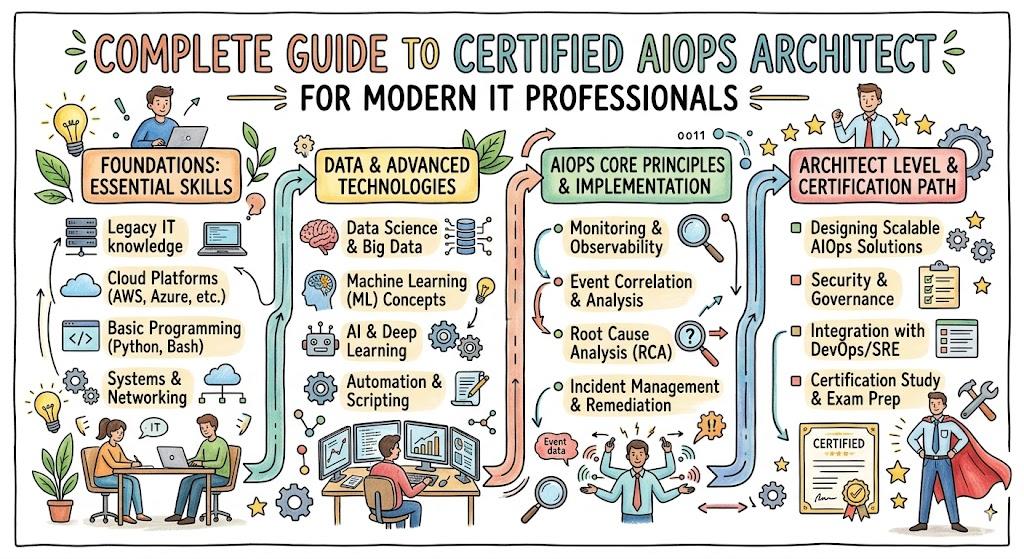
Artificial Intelligence for IT Operations, commonly known as AIOps, is becoming one of the most important skill areas for modern IT teams. Today, businesses run applications across cloud, containers, microservices, DevOps pipelines, monitoring tools, security platforms, and large-scale infrastructure. Managing all this manually is difficult, slow, and risky.This is where AIOps helps.AIOps uses artificial intelligence, machine learning, automation, analytics, and observability practices to improve IT operations. It helps teams detect incidents faster, reduce alert noise, predict failures, automate responses, and make better operational decisions.The Certified AIOps Architect certification is designed for engineers, managers, architects, DevOps professionals, SRE teams, cloud engineers, and software engineers who want to understand how to design and manage intelligent IT operations systems.This guide will help you understand what this certification is, who should take it, what skills it covers, how to prepare, what projects you should be able to build, and which learning path you can choose next.
Why Certified AIOps Architect Matters
Modern IT systems generate a huge amount of data every second. Logs, metrics, traces, alerts, events, tickets, deployment data, security signals, user experience data, and cloud usage reports are all part of daily operations.
Without AIOps, teams often face problems like:
- Too many alerts
- Slow incident response
- Repeated production issues
- Poor root cause analysis
- Manual troubleshooting
- High downtime risk
- Poor visibility across systems
- Weak collaboration between teams
AIOps helps solve these problems by combining automation, intelligence, monitoring, data correlation, and predictive analysis.
The Certified AIOps Architect certification helps professionals learn how to design AIOps systems, connect tools, build operational workflows, improve incident management, and align technology with business needs.
For working engineers and managers, this certification can be useful because it connects technical skills with real business operations.
Who Should Read This Guide
This guide is useful for:
- Software Engineers
- DevOps Engineers
- Site Reliability Engineers
- Cloud Engineers
- Infrastructure Engineers
- Platform Engineers
- IT Operations Managers
- Monitoring and Observability Engineers
- DevSecOps Engineers
- AIOps and MLOps learners
- Technical Leads
- Engineering Managers
- IT Service Management professionals
If you are working in software delivery, infrastructure, monitoring, cloud operations, automation, or reliability engineering, this certification can help you understand the bigger picture of intelligent IT operations.
Certified AIOps Architect Overview
| Track | Level | Who it’s for | Prerequisites | Skills Covered | Recommended Order | |
|---|---|---|---|---|---|---|
| AIOps | Architect Level | Software Engineers, DevOps Engineers, SREs, Cloud Engineers, IT Managers, Platform Teams | Basic understanding of IT operations, cloud, monitoring, DevOps, and automation | AIOps strategy, observability, incident automation, analytics, ML concepts, root cause analysis, tool integration, architecture planning | After basic DevOps, monitoring, cloud, or SRE foundation |
What Is Certified AIOps Architect?
Certified AIOps Architect is a professional certification focused on designing, implementing, and managing AIOps practices in modern IT environments. It helps learners understand how AI, machine learning, observability, automation, and operations data work together.
The certification is useful for professionals who want to move beyond basic monitoring and learn how to build intelligent, automated, and scalable IT operations systems.
Who Should Take Certified AIOps Architect?
This certification is suitable for professionals who want to build strong knowledge in intelligent operations and automation.
You should consider this certification if you are:
- A Software Engineer who wants to understand modern operations
- A DevOps Engineer moving toward AIOps
- An SRE working on reliability and incident reduction
- A Cloud Engineer managing complex cloud systems
- A Monitoring Engineer handling alerts, logs, and metrics
- An IT Manager responsible for operational improvement
- A Platform Engineer designing internal developer platforms
- A Technical Lead planning automation and observability strategy
It is also useful for managers because AIOps is not only a technical topic. It also improves service quality, team productivity, operational cost control, and business reliability.
Skills You’ll Gain
After completing Certified AIOps Architect preparation, you should gain practical knowledge in areas such as:
- Understanding AIOps concepts and architecture
- Designing intelligent IT operations workflows
- Using logs, metrics, traces, and events for better visibility
- Reducing alert noise through correlation and filtering
- Applying machine learning ideas in IT operations
- Improving incident detection and response
- Supporting root cause analysis
- Planning automation for common operational issues
- Understanding observability and monitoring strategy
- Connecting AIOps with DevOps, SRE, cloud, and ITSM practices
- Evaluating AIOps tools and platforms
- Building dashboards and reporting models
- Creating operational improvement plans
- Aligning AIOps with business reliability goals
These skills are important because companies need professionals who can not only manage tools, but also design better operational systems.
Real-World Projects You Should Be Able to Do After It
After learning Certified AIOps Architect concepts, you should be able to work on practical projects such as:
- Build an AIOps architecture for a cloud-based application
- Design an observability workflow using logs, metrics, and traces
- Create an alert correlation model to reduce duplicate alerts
- Build an incident response automation workflow
- Design a root cause analysis process for production incidents
- Connect monitoring tools with ticketing or ITSM workflows
- Create dashboards for service health and business impact
- Design a predictive failure detection approach
- Build a noise reduction strategy for operations teams
- Create an AIOps maturity roadmap for an organization
- Map DevOps, SRE, and AIOps practices together
- Plan automation for repeated infrastructure issues
- Build reporting for uptime, incident trends, and reliability metrics
These projects help learners move from theory to practical implementation.
Why AIOps Is Important for Software Engineers
Many software engineers think operations are only the responsibility of DevOps or infrastructure teams. But modern software engineering is changing. Developers now work with CI/CD, containers, cloud services, APIs, logs, monitoring, deployment pipelines, and production feedback.
AIOps helps software engineers understand how their applications behave in real environments.
It helps them answer questions like:
- Why is the application slow?
- Which service is causing failure?
- Which deployment created the issue?
- Why are users facing errors?
- Which logs matter during an incident?
- How can repeated issues be prevented?
For software engineers, AIOps knowledge improves production awareness and helps build more reliable applications.
Why AIOps Is Important for Managers
Managers need visibility, control, and predictability. They are responsible for service delivery, uptime, team productivity, cost control, customer experience, and business continuity.
AIOps helps managers by improving:
- Incident visibility
- Team collaboration
- Root cause clarity
- Operational reporting
- SLA and SLO tracking
- Automation planning
- Business impact analysis
- Risk reduction
- Cost control
- Decision-making
Certified AIOps Architect helps managers understand how to guide teams toward better operations instead of only reacting to problems.
Core Topics Covered in Certified AIOps Architect
The certification generally focuses on practical and architecture-level AIOps knowledge.
Important learning areas include:
AIOps Foundation
This covers the meaning of AIOps, why it is needed, how it works, and how it changes traditional IT operations.
Observability
Observability includes logs, metrics, traces, events, dashboards, service maps, and user experience data. It helps teams understand what is happening inside systems.
Data Collection and Correlation
AIOps depends on data. Learners need to understand how operational data is collected, normalized, analyzed, and connected across tools.
Machine Learning for Operations
This includes basic ML concepts used for anomaly detection, pattern recognition, event grouping, prediction, and noise reduction.
Incident Management
AIOps improves incident detection, prioritization, escalation, root cause analysis, and resolution.
Automation
Automation helps teams reduce manual work. It can support ticket creation, remediation steps, scaling, restart workflows, notification, and response actions.
Tool Integration
AIOps works best when monitoring, cloud, CI/CD, ITSM, security, and collaboration tools are connected properly.
Architecture Design
An AIOps Architect should understand how to design scalable, secure, and useful AIOps systems for real organizations.
Preparation Plan
7–14 Days Plan
This plan is suitable if you already have experience in DevOps, SRE, cloud, monitoring, or IT operations.
Day 1–2: Understand AIOps basics
Learn what AIOps means, why it is needed, and how it improves IT operations.
Day 3–4: Study observability
Focus on logs, metrics, traces, dashboards, alerts, and service health.
Day 5–6: Learn incident management
Understand alert noise, event correlation, root cause analysis, and escalation flows.
Day 7–8: Study automation
Learn how automation helps in response, remediation, and operational efficiency.
Day 9–10: Learn AIOps architecture
Focus on data flow, integrations, tool selection, and architecture planning.
Day 11–12: Practice real scenarios
Create sample workflows for incident detection, alert correlation, and dashboard design.
Day 13–14: Revision and exam readiness
Review important concepts, common mistakes, and practical use cases.
30 Days Plan
This plan is suitable for working professionals who can study regularly with job responsibilities.
Week 1: Foundation
- Understand AIOps concepts
- Learn traditional IT operations challenges
- Study DevOps, SRE, and AIOps relationship
- Learn key terms like anomaly detection, correlation, and automation
Week 2: Observability and Data
- Study logs, metrics, traces, and events
- Learn data collection and normalization
- Understand monitoring dashboards
- Learn how alerts are created and managed
Week 3: Automation and Incident Management
- Study incident lifecycle
- Learn root cause analysis
- Understand noise reduction
- Study automated remediation workflows
- Learn ticketing and collaboration integration
Week 4: Architecture and Practice
- Design a sample AIOps architecture
- Create a service health dashboard plan
- Map AIOps tools with DevOps and SRE practices
- Review certification topics
- Practice scenario-based questions
60 Days Plan
This plan is best for beginners or professionals who want deeper understanding.
Days 1–10: IT Operations and DevOps Basics
Learn how modern IT operations work. Understand CI/CD, cloud, infrastructure, monitoring, and deployment flow.
Days 11–20: Monitoring and Observability
Study logs, metrics, traces, dashboards, alerting, and service maps. Understand how teams observe system behavior.
Days 21–30: AIOps Concepts
Learn anomaly detection, event correlation, data pipelines, machine learning basics, prediction, and operational intelligence.
Days 31–40: Incident and Automation
Study incident response, escalation, root cause analysis, automated remediation, ticketing workflows, and collaboration tools.
Days 41–50: AIOps Architecture
Learn how to design AIOps systems. Focus on integrations, security, scalability, governance, and business alignment.
Days 51–60: Projects and Revision
Build sample projects, revise all major topics, review mistakes, and prepare for assessment.
Common Mistakes
Many learners make simple mistakes while preparing for AIOps certification.
Avoid these common issues:
- Learning only tool names without understanding architecture
- Ignoring observability basics
- Thinking AIOps means only artificial intelligence
- Not understanding incident management workflow
- Skipping logs, metrics, and traces
- Ignoring business impact and service reliability
- Not learning automation use cases
- Confusing DevOps, SRE, MLOps, and AIOps
- Depending only on theory without practical examples
- Not preparing real-world scenarios
AIOps is not only about AI. It is about improving IT operations using data, automation, and intelligent decision-making.
Best Next Certification After This
After Certified AIOps Architect, the best next certification depends on your career direction.
Good next options may include:
- DevOps Architect certification
- SRE certification
- DevSecOps certification
- MLOps certification
- DataOps certification
- FinOps certification
- Cloud architecture certification
- Kubernetes or platform engineering certification
If your goal is reliability, choose SRE.
If your goal is AI-driven operations, choose AIOps/MLOps.
If your goal is security operations, choose DevSecOps.
If your goal is cost optimization, choose FinOps.
If your goal is data pipeline operations, choose DataOps.
Choose Your Path
AIOps connects with many modern engineering career paths. Here are 6 learning paths you can follow.
1. DevOps Path
This path is for professionals who want to improve software delivery, automation, CI/CD, infrastructure management, and deployment reliability.
Recommended learning order:
- Linux and scripting basics
- Git and CI/CD
- Docker and Kubernetes
- Cloud fundamentals
- Monitoring and observability
- AIOps automation
- Certified AIOps Architect
This path is useful for DevOps Engineers, Build and Release Engineers, Platform Engineers, and Cloud Engineers.
2. DevSecOps Path
This path is for professionals who want to combine security with DevOps and intelligent operations.
Recommended learning order:
- DevOps fundamentals
- Security basics
- CI/CD security
- Container and cloud security
- Security monitoring
- AIOps for security events and incident response
- Certified AIOps Architect
This path is useful for DevSecOps Engineers, Security Engineers, Cloud Security Engineers, and Compliance-focused teams.
3. SRE Path
This path is for professionals who want to focus on reliability, uptime, performance, incident response, and service health.
Recommended learning order:
- Linux and networking
- Monitoring fundamentals
- SLI, SLO, and SLA concepts
- Incident management
- Observability engineering
- Automation and reliability practices
- Certified AIOps Architect
This path is useful for Site Reliability Engineers, Production Engineers, Operations Engineers, and Reliability Managers.
4. AIOps/MLOps Path
This path is for professionals who want to work with AI-driven operations, machine learning systems, model operations, and intelligent automation.
Recommended learning order:
- Python basics
- Data handling basics
- Machine learning fundamentals
- Monitoring and observability
- AIOps concepts
- MLOps workflows
- Certified AIOps Architect
This path is useful for AIOps Engineers, MLOps Engineers, AI Platform Engineers, and Data-focused operations teams.
5. DataOps Path
This path is for professionals who want to manage data pipelines, data quality, data monitoring, and analytics operations.
Recommended learning order:
- Database and data pipeline basics
- ETL and workflow automation
- Data quality checks
- Data observability
- Data incident management
- AIOps for data operations
- Certified AIOps Architect
This path is useful for Data Engineers, DataOps Engineers, Analytics Engineers, and Data Platform teams.
6. FinOps Path
This path is for professionals who want to manage cloud cost, resource optimization, financial accountability, and operational efficiency.
Recommended learning order:
- Cloud fundamentals
- Cloud billing and cost models
- Resource optimization
- Monitoring cloud usage
- Cost anomaly detection
- AIOps for cost intelligence
- Certified AIOps Architect
This path is useful for Cloud Engineers, FinOps Practitioners, Engineering Managers, and Cloud Cost Optimization teams.
Role-Based Recommendation
| Role | Why Certified AIOps Architect Helps |
|---|---|
| Software Engineer | Helps understand production behavior, logs, metrics, and reliability impact |
| DevOps Engineer | Helps improve automation, monitoring, and incident response |
| SRE | Helps reduce downtime, improve root cause analysis, and support reliability |
| Cloud Engineer | Helps manage cloud alerts, cost signals, performance, and infrastructure events |
| IT Manager | Helps plan smarter operations, reporting, and team efficiency |
| Platform Engineer | Helps design better internal platforms with observability and automation |
| Security Engineer | Helps understand intelligent event correlation and response patterns |
| Data Engineer | Helps apply operational intelligence to data pipelines and failures |
Top Institutions Providing Training cum Certifications Help for Certified AIOps Architect
DevOpsSchool
DevOpsSchool is known for training programs across DevOps, DevSecOps, SRE, Cloud, Kubernetes, and related technologies. For learners preparing for Certified AIOps Architect, it can help with practical training, mentoring, and structured learning support. Its approach is useful for working professionals who need real-world examples along with certification preparation.
Cotocus
Cotocus provides technology consulting, DevOps implementation, cloud support, automation, and enterprise training help. For AIOps learners, Cotocus can be useful because it connects training with practical enterprise use cases. Professionals who want to understand how AIOps fits into real company environments can benefit from this type of practical exposure.
Scmgalaxy
Scmgalaxy focuses on software configuration management, DevOps, automation, cloud, and related technical learning. It can support learners who want to strengthen the foundation required before moving into AIOps architecture. Its training approach is useful for engineers who want to connect DevOps practices with intelligent IT operations.
BestDevOps
BestDevOps provides learning resources and career-focused guidance around DevOps and modern IT practices. For Certified AIOps Architect learners, it can help with awareness, career direction, and understanding where AIOps fits in the larger DevOps ecosystem. It is useful for learners who want career clarity along with technical learning.
devsecopsschool
devsecopsschool focuses on DevSecOps, security automation, secure pipelines, and security-focused engineering practices. AIOps learners can benefit from this because security signals and operational alerts often overlap in real environments. It is helpful for professionals who want to connect AIOps with intelligent security operations.
sreschool
sreschool is useful for learners who want to build strong knowledge in reliability engineering, incident management, observability, and service health. Since AIOps is closely connected with SRE, this institution can help professionals understand how intelligent operations improve uptime, performance, and incident response.
aiopsschool
aiopsschool is the direct provider for Certified AIOps Architect and focuses on AIOps learning, certification, and practical knowledge. It is suitable for learners who want a focused path in artificial intelligence for IT operations. The official certification page helps learners understand the program and begin preparation through the provided certification route.
dataopsschool
dataopsschool focuses on DataOps, data pipeline management, data quality, and analytics operations. AIOps learners working with data-heavy systems can benefit from this because modern operations often depend on clean, reliable, and observable data. It is useful for data engineers and platform teams who want to combine DataOps with AIOps.
finopsschool
finopsschool focuses on cloud cost management, financial operations, and cloud optimization practices. AIOps and FinOps are connected because intelligent operations can help detect cost anomalies, usage spikes, and wasteful resource patterns. This is helpful for cloud teams, managers, and architects who want to improve both reliability and cost control.
How to Study Effectively
To prepare well, do not study only for the certificate. Study for practical understanding.
Follow these tips:
- Learn the meaning of AIOps clearly
- Understand how monitoring and observability work
- Practice incident-based scenarios
- Study how data flows from tools into analysis systems
- Learn basic machine learning use cases in operations
- Understand automation workflows
- Connect concepts with DevOps and SRE practices
- Build small diagrams for AIOps architecture
- Practice explaining business value
- Revise common mistakes before assessment
AIOps is a practical subject. The more you connect it with real incidents, the easier it becomes.
Career Value of Certified AIOps Architect
Certified AIOps Architect can support many career goals.
It can help you move toward roles such as:
- AIOps Architect
- DevOps Architect
- SRE Lead
- Cloud Operations Architect
- Platform Engineering Lead
- Observability Engineer
- Automation Architect
- IT Operations Manager
- Reliability Consultant
- Technical Program Manager for operations
This certification can also help managers speak the same language as engineering teams. It gives them better clarity about automation, reliability, tooling, reporting, and operational maturity.
Final Recommendation
Certified AIOps Architect is a strong certification choice for professionals who want to understand the future of IT operations. It is especially useful for Software Engineers, DevOps Engineers, SREs, Cloud Engineers, Platform Engineers, and IT Managers who want to move from reactive operations to intelligent, automated, and data-driven operations.
If you already work with monitoring, cloud, DevOps, incidents, or automation, this certification can help you organize your knowledge into a clear architecture-level understanding. If you are a manager, it can help you plan better operational strategy and improve team outcomes.
Start with the official certification page, understand the structure, follow a practical preparation plan, and focus on real-world use cases. AIOps is not only about tools or artificial intelligence. It is about making IT operations smarter, faster, and more reliable.
Conclusion
The Certified AIOps Architect certification is a valuable learning path for professionals who want to build strong expertise in intelligent IT operations. As businesses continue to depend on cloud systems, microservices, automation, and continuous delivery, the need for better monitoring, faster incident response, and smarter operations will keep growing.
This certification helps you understand how AIOps connects data, automation, observability, machine learning, incident management, and architecture planning. It is useful for both technical professionals and managers because it explains how modern operations should be designed, improved, and scaled.
For software engineers, it builds production awareness. For DevOps and SRE professionals, it improves reliability thinking. For managers, it gives a better way to plan operational maturity. For architects, it provides a structured approach to designing intelligent systems.