
Small modifications in treatment can yield disproportionately in terms of operation and cost, and this is known by the professionals in water. In case your project requires a consistent and important separation and constant quality of the permeate, a modern ultrafiltration membrane manufacturer solution would be the difference between a frequent maintenance and a long-lasting uptime.
Hinada specializes in membranes and systems of municipal and industrial application that are built upon well-established hollow-fiber technology with simple services and easily measurable performance. This introduction brings out the importance of the choice of uf membranes in determining the level of SDI, turbidity and organics removal when performance objectives are irreplaceable.
ultrafiltration membrane manufacturer: Why Specification Matters
The process of choosing the appropriate system is initiated by the process of aligning the characteristics of feed water with the module design. During the treatment of river or urban water with a daily rate over 30 m3/hour, uf membranes modules are used with good results as NM-UF-250 and NM-UF-90. Some of the performance targets that can be expected include:
Suspended matter (>2 µm): 100% removal
Organics removal: 99.99%
Output turbidity: ≤ 0.2 NTU
SDI of output: ≤ 2.5
Product Snapshots and Application Notes
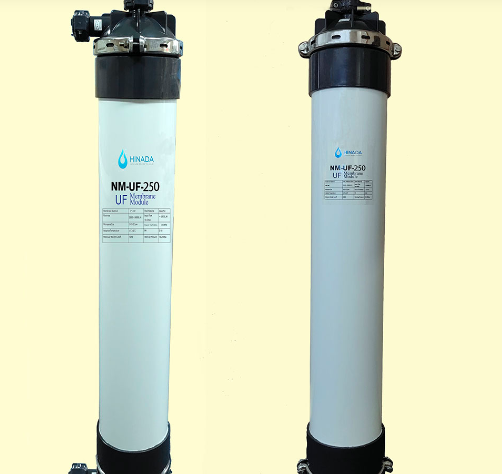
Hinada NM-UF-250 (PVC or PVDF variants)
Application: Projects >30 m³/hour; suitable for river and city water.
Membrane material: PVC or PVDF; hollow-fiber inside-out (PVC) or outside-in (PVDF).
Module dimensions: ø250 × 1715 mm.
Effective membrane area: 48 m² (PVC) or 78 m² (PVDF).
Design flux: 3500–4500 L/H (PVC) or 3500–5500 L/H (PVDF).
MWCO: 100,000 Daltons.
Applicable temperature: 5–45 °C.
Recommended pre-filtration: 50–150 µm; max inlet turbidity: ≤15 NTU (PVC) or ≤50 NTU (PVDF).
Backwash and maintenance: backwash every 15–60 minutes; CIP every 30–90 days using NaClO or NaOH.
NM-UF-90 (4-inch) – Compact Industrial Option
Designed for small industrial projects (<5,000 L/hour).
Hollow fibers: PVDF or PVC; membrane areas 8 m² (PVDF) and 4.8 m² (PVC).
Design flow: 500–1200 L/hour (PVDF) and 300–800 L/hour (PVC).
Filtration: outside-in (PVDF) or inside-out (PVC).
Max inlet turbidity: ≤50 NTU (PVDF) or ≤15 NTU (PVC).
Same CIP chemistry and backwash intervals as larger modules.
How to Compare Suppliers
After-sales service: It is also essential; select ultrafiltration membrane manufacturers which provide on-site commissioning service, spares parts lists, and planned maintenance. The presence of warranty conditions and easy access to technical specifications are more important than temporary cost-related analyses.
Ensure the area of the uf membranes, the flux and the tolerance level to residual chlorine and pH range. Request information on continuous residual chlorine tolerance (in these modules up to 100 ppm) and interval tolerance (up to 200 ppm). The risk involved in commissioning and operation is minimized by a vendor that publishes the specific backwash intervals and CIP procedures.
Why Reputable ultrafiltration membrane manufacturer Manufacturers Matter
They are reputable suppliers that assist in commissioning by providing data and service recommendations that minimise ramp up time and unplanned downtime.
Installation and Operation Instructions.
Using established ultrafiltration membrane manufacturer vendors guarantees sourced materials are traceable, al luf membranes modules are uniform in size and the MWCO is recorded.
Installation and Operational Tips
-
Match pre-filtration screens to the recommended 50–150 µm range.
-
Monitor SDI and turbidity at the feed and permeate to judge cleaning frequency.
-
Set backwash intervals according to feed quality; typical intervals are 15–60 minutes.
-
Schedule CIP every 30–90 days and use approved chemicals (NaClO, NaOH).
The choice of a supplier tends to influence the long-term project results. Find suppliers of ultrafiltration membrane manufacturers which supply complete datasheets, evidence of flux operation under actual feed conditions and do give easy instructions on backwash times and CIP chemistry.
A manufacturer that provides details on measured turbidity and SDI performance saves time and cost of commissioning along with surprises.
Operational note: a properly sized ultrafiltration membrane manufacturer module matched to feed quality keeps SDI and fouling manageable. Verify module dimensions, potting materials, and whether the supplier provides PVDF or PVC hollow-fiber options suited to your site.
FAQS
Q: What do you consider as the expected maintenance schedule of industrial ultrafiltration modules?
A: Anticipate periodic backwashing after every 15-60 minutes and regular CIP after every 30-90 days, based on quality of feed.
Question: Are these membranes capable of dealing with high variability surface water?
A: Yes; select PVDF modules with greater resistance to inlet turbidity and greater anti-fouling capability.
Q: What quality of water can be produced by ultrafiltration to be used downstream in RO, or drinkable?
A: Ultrafiltration regularly provides turbidity [?]0.2NTU and SDI [?]2.5 and is therefore a good pretreatment.
Final Thoughts and Next Steps
Selecting an appropriate membrane solution and a responsive supplier is a workable process that introduces a dependable water quality and forecastable operation costs. In the case of project consultations or specifications or to seek pricing, contact the Hinada team and request a technical datasheet our experts will find the necessary uf membranes module selection to suit site conditions and project objectives.
To customize the selection or technical datasheet, ask the sales staff to prepare a module performance report and so that you can compare the options to site specific feed water conditions.