
Mobile applications have become an important part of how modern businesses deliver products, communicate with customers, and manage daily operations. From online shopping and digital payments to healthcare services and enterprise platforms, mobile technology is creating new opportunities for organizations across industries.
However, developing separate applications for Android and iOS can introduce additional development efforts, maintenance requirements, and project costs. Businesses therefore need development approaches that balance functionality, performance, and budget.
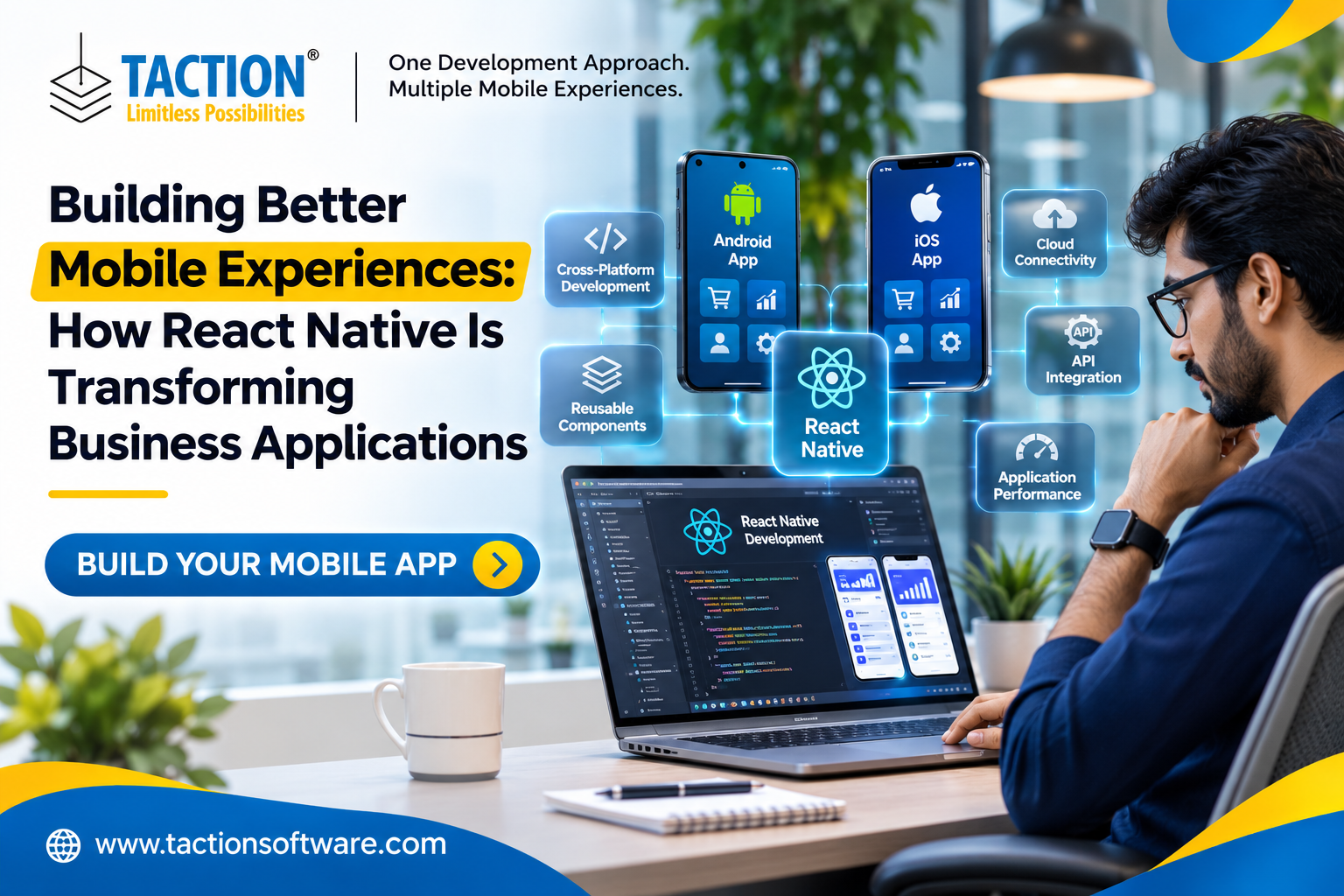
React Native has emerged as a practical solution for companies looking to build applications for multiple mobile platforms using a shared development approach. It allows businesses to create engaging mobile experiences while making development and maintenance more manageable.
With professional React Native App Development Services, organizations can turn their ideas into scalable digital products that support changing customer expectations.
Taction Software helps businesses develop cross-platform mobile applications that combine modern technology, intuitive interfaces, and business-focused functionality.
1. Understanding the Growing Importance of Cross-Platform Applications
Customers use different devices and operating systems to access digital services. A business targeting a wider audience may need to provide consistent application experiences across both Android and iOS.
Traditionally, organizations developed separate native applications for each platform. Although this approach offers extensive platform-specific flexibility, it can require separate development resources and maintenance processes.
Cross-platform development offers another approach.
Using React Native, developers can share application logic and reusable components across platforms while adapting specific features to individual operating systems.
This approach can help businesses:
-
Reach Android and iOS users through a coordinated product.
-
Reduce duplicated development work.
-
Maintain consistent application functionality.
-
Introduce updates more efficiently.
-
Simplify long-term application maintenance.
-
Accelerate the development of minimum viable products.
For startups and growing businesses, these advantages can make cross-platform development an attractive option.
2. What Makes React Native a Valuable Development Framework?
React Native is an open-source framework that enables developers to build mobile applications using JavaScript or TypeScript and React concepts.
It allows businesses to share significant portions of their application code across Android and iOS while using native platform capabilities where necessary.
Some important characteristics include:
Reusable Components: Developers can create reusable interface elements and application functionality, reducing repetitive development work.
Native UI Components: React Native renders platform-native interface components, helping applications provide familiar mobile experiences.
Flexible Development: Its ecosystem supports different libraries, integrations, and development tools.
Native Module Integration: When an application requires specific device capabilities, developers can integrate native functionality using platform-specific code.
Developer Ecosystem: React Native benefits from a broad ecosystem of libraries, development resources, and community contributions.
Businesses exploring this framework can learn more about professional React Native App Development Services offered by Taction Software.
3. Business Applications That Can Benefit From React Native
React Native supports different application categories, making it suitable for businesses with diverse digital requirements.
E-Commerce and Retail Applications
Retail businesses can build mobile shopping experiences featuring product catalogs, search filters, shopping carts, payment integration, and order tracking.
A consistent experience across mobile platforms can help customers interact with the brand more conveniently.
Healthcare Applications
Healthcare organizations can develop applications for appointment scheduling, patient communication, telehealth services, and healthcare information access.
Applications involving sensitive health information must also consider appropriate security, privacy, and regulatory requirements.
Education and Learning Platforms
Educational businesses can use React Native to create applications featuring video lessons, online assessments, learning dashboards, and student communication tools.
Finance and Payment Applications
Financial organizations can develop mobile interfaces for account management, transaction monitoring, payment activities, and customer notifications.
Security architecture and appropriate compliance requirements should be considered throughout development.
On-Demand Service Applications
Businesses offering delivery, transportation, home services, and booking platforms can use React Native to connect customers, service providers, and administrators.
The framework's flexibility allows developers to create different interfaces for different user roles within one application ecosystem.
4. Essential Features of a Successful React Native Application
A mobile application should provide practical value to its users. Its functionality should be selected according to the business model and customer expectations.
Here are some important features worth considering.
Secure User Authentication
Registration, login, password recovery, and appropriate authentication mechanisms help protect user accounts.
Push Notifications
Notifications allow businesses to share reminders, announcements, transaction updates, and relevant information.
Payment Gateway Integration
Payment integration enables customers to complete purchases and transactions through supported payment providers.
Real-Time Communication
Messaging and chat features can improve customer support and communication between users.
Location and Mapping Integration
GPS and mapping services support delivery tracking, navigation, location-based services, and nearby business discovery.
Analytics and Reporting
Application analytics help organizations understand user interactions, identify improvement opportunities, and evaluate product performance.
CRM and Backend Integration
Connecting applications with existing business systems helps synchronize information and support more efficient workflows.
Choosing the right features from the beginning makes the application more useful and easier to maintain.
5. How React Native Supports Faster Application Development
Development speed is an important consideration for companies introducing new digital products.
React Native helps streamline development by allowing teams to share business logic and reusable components across Android and iOS applications.
Instead of maintaining two completely separate codebases for every feature, developers can reuse substantial portions of the implementation.
Some development advantages include:
-
Shared application architecture.
-
Reusable UI components.
-
Efficient development workflows.
-
Easier implementation of common features.
-
Coordinated updates across platforms.
-
Simplified development of MVP applications.
However, development time still depends on application complexity, integrations, design requirements, testing, and platform-specific functionality.
Businesses should evaluate the complete project scope rather than assuming every application can be developed within the same timeframe.
6. React Native UI/UX Design: Creating Consistent Experiences
An application may offer advanced functionality, but users will struggle to adopt it if the interface is confusing.
User experience should therefore be an important part of React Native development.
A good application design should include:
-
Clear navigation and organized content.
-
Responsive layouts for different devices.
-
Consistent buttons, typography, and visual elements.
-
Easy-to-understand forms and interactions.
-
Accessible interface components.
-
Smooth screen transitions.
-
Platform-appropriate navigation patterns.
Designers should consider the expectations of both Android and iOS users.
For example, an application can share its overall branding and functionality while adapting navigation patterns to match the conventions of each platform.
This balance helps businesses maintain brand consistency without ignoring platform-specific user expectations.
7. Security, Performance, and Scalability Considerations
A business application must be reliable as its user base and functionality grow.
React Native projects should incorporate security and performance considerations throughout development.
Application Security
Developers should implement secure authentication, protected API communication, appropriate data storage, and access controls.
Performance Optimization
Efficient component rendering, optimized images, appropriate state management, and performance monitoring help improve application responsiveness.
Backend Architecture
A well-designed backend supports data processing, user management, application integrations, and business logic.
Businesses may also require custom Web Development Services to build supporting web platforms and backend systems.
Third-Party Integrations
Payment services, analytics platforms, cloud infrastructure, CRM systems, and external APIs can extend application capabilities.
Long-Term Maintenance
Regular updates, bug fixes, framework upgrades, and compatibility testing help keep applications reliable over time.
Security and scalability should be planned before launch rather than treated as optional improvements later.
8. React Native vs Native Android and iOS Development
Choosing between cross-platform and native development depends on the application's technical requirements.
React Native is suitable for many business applications that need to support both Android and iOS through a shared codebase.
Native development may be more appropriate when an application depends heavily on specialized hardware, advanced platform-specific capabilities, or highly demanding performance requirements.
For businesses requiring dedicated Android applications, Android App Development Services provide a platform-specific development approach.
Organizations targeting Apple devices can also explore iOS App Development.
A suitable development strategy should consider:
-
Target audience and operating systems.
-
Application complexity.
-
Device hardware requirements.
-
Budget and development timeline.
-
Existing technical infrastructure.
-
Long-term maintenance expectations.
There is no single development approach that works best for every business. The right choice depends on the product and its intended users.
9. The React Native Development Journey: From Planning to Launch
A successful mobile application requires a structured development process.
Requirement Discovery
The project begins with understanding business objectives, target users, required features, and technical expectations.
Product Strategy and Architecture
Developers identify the appropriate framework configuration, application architecture, backend requirements, and integration approach.
UI/UX Prototyping
Designers prepare wireframes and interactive prototypes to demonstrate the application experience before implementation.
Development and Integration
The development team builds application functionality, integrates APIs, and connects the application with required backend services.
Quality Assurance
Testing covers functionality, security, responsiveness, device compatibility, and platform-specific behavior.
Store Deployment
The application is prepared for submission to the Apple App Store and Google Play Store.
Post-Launch Improvements
After launch, the development team monitors application performance, resolves issues, and introduces new functionality based on user feedback.
Following a well-defined lifecycle helps businesses manage project requirements and improve application quality.
10. Why Taction Software for React Native App Development?
Choosing an experienced development partner can make a meaningful difference to a mobile application's architecture, usability, and long-term performance.
Taction Software provides React Native development solutions for startups, small businesses, and enterprises looking to build applications for Android and iOS.
Its development capabilities cover different stages of the application lifecycle, including:
-
Custom React Native application development.
-
Cross-platform Android and iOS solutions.
-
Mobile UI/UX design and prototyping.
-
Enterprise mobile application development.
-
Third-party API and SDK integration.
-
Native module and hardware integration.
-
Application migration and modernization.
-
Performance optimization and testing.
-
App Store and Google Play deployment.
-
Post-launch maintenance and support.
The company also offers broader Mobile App Development Services for businesses considering different mobile technologies.
With its development team in Noida, India, and experience serving businesses in India and the USA, Taction Software focuses on creating applications aligned with individual business objectives.
Explore its React Native App Development Services to learn more about its cross-platform development capabilities.
Conclusion
React Native has created new possibilities for businesses looking to develop mobile applications across Android and iOS without maintaining entirely separate development approaches.
Its reusable components, flexible ecosystem, and integration capabilities make it a practical option for many business applications.
However, successful implementation still depends on thoughtful planning, intuitive UI/UX design, secure architecture, reliable testing, and continuous maintenance.
Businesses looking to introduce a new mobile product or modernize an existing application can benefit from selecting a development partner with the right technical experience.
Taction Software helps organizations transform their concepts into scalable cross-platform applications through custom React Native development and end-to-end mobile engineering.
Explore React Native App Development Services by Taction Software to take the next step toward building a modern mobile application for your business.