
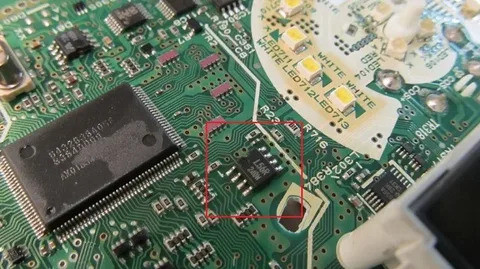
Understanding the Architecture and Functionality of EEPROM
Electrically Erasable Programmable Read Only Memory (EEPROM) represents a class of non-volatile memory that retains data even when power is removed. The core architecture of EEPROM consists of floating-gate transistors that store discrete bits by trapping electrons on an insulated gate.
During a write operation, a precise voltage is applied to inject electrons onto this floating gate through quantum
tunneling, while an erase cycle uses reverse bias to remove stored charges. Read operations occur at a lower voltage, ensuring minimal disturbance to stored data. Endurance, or write/erase cycle limit, typically ranges from 10,000 to 1,000,000 cycles depending on process technology, whereas data retention can exceed 20 years under optimal conditions.
Key specifications like access time, program time, and data integrity under temperature variations are critical for selecting the best Electrically Erasable Programmable Read Only Memory solution for embedded systems, automotive control units, and portable electronics. Understanding these parameters helps engineers optimize performance, power consumption, and reliability in diverse applications.
Key Advantages and Limitations in Modern Electronics
EEPROM provides several compelling advantages over alternative non-volatile memories. Its byte-level erase capability allows selective data updates without the need to erase entire memory sectors, reducing power consumption and speeding up firmware revisions.
The absence of moving parts and the robust tolerance to electromagnetic interference make it a cost-effective, reliable choice for industrial instrumentation and aerospace applications. However, limitations include slower write speeds compared to Flash memory and higher cost per bit, factors that influence commercial purchasing decisions. Designers must balance endurance requirements against cost constraints, with advanced EEPROM variants offering extended cycle life at premium pricing.
Key commercial criteria—such as power efficiency, form factor diversity (SOP, TSSOP, UDFN), and automotive-grade temperature ratings—enable purchasing managers to evaluate product datasheets and request a quote or buy sample units through authorized distributors. Careful comparison of product specifications ensures selection of the most reliable and performance-optimized memory solution.
Diverse Applications Across Consumer and Industrial Sectors
EEPROM chips find ubiquitous use in consumer electronics for storing calibration constants, configuration parameters, and personalization settings. In smartphones, Wi-Fi modules, and smart home devices, small-density EEPROMs ensure fast and frequent updates for user preferences.
Industrial automation controllers rely on mid-density variants to log operational histories and machine diagnostics, facilitating predictive maintenance workflows. In the automotive domain, safety-critical functions like airbag deployment systems and electronic control units depend on EEPROM’s data retention stability under wide temperature swings.
Medical devices leverage high-reliability EEPROMs for patient data logging, while smart utility meters use them for periodic usage recording. Transactional demands for “buy evaluation kits” and “order EEPROM modules” often rise during new product development cycles, with procurement teams seeking sample units and technical datasheets. By understanding sector-specific use cases, stakeholders can identify the best available memory chip options to support scalability and regulatory compliance.
Segment Analysis by Type, Density, and End-User Industry
The EEPROM market segments encompass serial and parallel interface types, density ranges from 1 Kbit to 8 Mbit, and a broad spectrum of end-user industries. Serial EEPROMs, featuring I²C, SPI, or Microwire protocols, enable compact designs and easy integration into microcontroller systems.
Parallel variants deliver higher throughput and are preferred in applications requiring fast bulk data transfers. Low-density parts suit embedded sensor calibration, while higher-density options accommodate complex firmware storage and data logging.
Commercial buyers often compare pricing tiers for 64 Kbit, 512 Kbit, and 2 Mbit parts, assessing cost-effectiveness against required performance. Industry-specific segmentation highlights that consumer electronics account for the largest demand share, followed by automotive, industrial, and healthcare.
Engineering teams can download detailed comparison charts, request a quote for specific densities, or purchase sample lots to evaluate performance in prototype devices. This granular breakdown supports informed procurement and development strategies.
Regional Dynamics Driving EEPROM Adoption Worldwide
Regional analysis reveals North America and Europe as mature markets characterized by stringent quality and regulatory standards, driving uptake of automotive-grade and industrial-grade EEPROMs.
Asia Pacific, particularly China, South Korea, and Japan, leads in manufacturing capacity and consumer electronics deployment, with significant demand for low-cost, high-volume components.
Emerging economies in Latin America and Southeast Asia are witnessing accelerated adoption driven by smart grid projects, IoT deployments, and portable medical equipment. Each region presents unique distribution channels, pricing sensitivity, and certification requirements—UL, AEC-Q100, ISO/TS 16949—impacting purchasing decisions.
Commercial procurement teams focusing on import duties, lead times, and local technical support can navigate regional variations by accessing a comprehensive market research report that outlines regional regulatory landscapes, key application hubs, and competitive benchmarks. This navigational guide enables users to pinpoint growth hotspots and align sourcing strategies with regional developments.
Competitive Landscape Among Leading Memory Chip Manufacturers
The competitive arena for EEPROM technology features both established semiconductor giants and specialized niche players. Market leaders differentiate through advanced process nodes, proprietary cell designs, and extended temperature ratings.
Competitive factors include product portfolio breadth, global distribution networks, and customization capabilities for volume orders. Buyers evaluating suppliers often compare total cost of ownership, after-sales support, and lifecycle management services. Premium offerings target high-reliability sectors, with tailored design-ins for military, aerospace, and medical end-markets.
Entry-level competitors emphasize affordability and rapid lead times for consumer electronics prototypes. Procurement managers can compare supplier profiles, request demo samples, or initiate a purchase inquiry to secure volume discounts. Insight into strategic partnerships, recent product launches, and patent portfolios informs negotiation tactics and supplier selection, ensuring acquisition of the most innovative and reliable products.
Latest Trends Shaping the Future of EEPROM Technology
Ongoing trends in EEPROM technology focus on enhancing endurance, reducing power consumption, and integrating security features. Advanced silicon processes are enabling densities beyond 8 Mbit while shrinking cell size to fit compact IoT devices. Low-voltage programming techniques and digital trimming ensure energy-efficient operation in battery-powered applications.
Embedded security modules with hardware-based encryption and tamper detection cater to data-sensitive automotive and payment systems. The convergence of EEPROM functions with other memory types, such as FRAM or MRAM, hints at hybrid non-volatile solutions that combine fast write speeds with near-infinite endurance.
Companies looking to stay ahead can subscribe for technology newsletters, compare whitepapers, or request a personalized product demo to evaluate the latest evaluation boards. As the industry advances, decision-makers will benefit from continuous updates on technology roadmaps, benchmark tests, and cost-performance analyses to guide future system architectures.
Get this report in Japanese language- 電気的に消去可能なプログラマブル読み出し専用メモリ
Get this report in Korean language- 전기적으로 지울 수 있는 프로그래머블 읽기 전용 메모리
About Author:
Vaagisha brings over three years of expertise as a content editor in the market research domain. Originally a creative writer, she discovered her passion for editing, combining her flair for writing with a meticulous eye for detail. Her ability to craft and refine compelling content makes her an invaluable asset in delivering polished and engaging write-ups.
(LinkedIn: https://www.linkedin.com/in/vaagisha-singh-8080b91)