
A drill bit can strike rebar, a post-tension cable, or electrical conduit before a crew realizes what is inside the slab. Concrete scanning in Corona helps contractors investigate these hidden hazards before cutting or drilling. Ground-penetrating radar provides subsurface information without damaging the concrete, but understanding its readings and limitations is essential for making informed decisions.
How GPR Concrete Scanning Works Beneath the Surface
Ground-penetrating radar (GPR) uses electromagnetic energy to detect changes inside concrete. Unlike traditional imaging methods, radar does not produce a photograph of the slab's interior. Instead, it records reflected signals that technicians interpret to identify possible embedded objects.
When radar energy travels through concrete, some of it reflects from materials with different electrical properties. Steel reinforcement produces strong reflections, while air gaps, conduit, and changes in concrete composition may create other detectable patterns.
The scanner measures how long the reflected energy takes to return. This measurement, called two-way travel time, helps estimate the depth of an object when the radar wave velocity through the concrete is known or estimated.
Radar measures differences in electromagnetic properties, not the density of an object or its exact material identity.
At Superior Scanning, technicians use equipment such as the Proceq GP8000, which uses stepped-frequency continuous-wave radar technology to collect subsurface information for field interpretation.
Why Does Rebar Appear as a Curved Shape on a Radar Display?
Rebar often creates a hyperbola, or arch-shaped reflection, because the scanner detects the steel from different positions as it moves across the surface.
The curve does not mean the rebar itself is bent. Its shape results from changes in the distance between the antenna and the embedded object.
Technicians examine these reflections across multiple scan passes to estimate reinforcement spacing and alignment.
The Federal Highway Administration's explanation of GPR reinforcement detection describes how radar reflections help identify embedded steel in concrete structures.
Locating Embedded Steel With Radar: What the Patterns Reveal
For contractors using ground penetrating radar in Corona, the challenge is not simply detecting a strong signal. Technicians must determine whether the pattern is consistent with reinforcement, conduit, or another buried feature.
Different observations support different interpretations.
|
Radar Observation |
Possible Interpretation |
What Remains Uncertain |
|
Repeated, evenly spaced reflections |
Rebar arranged in a reinforcement grid |
Bar size, grade, and structural role |
|
Strong reflections along a continuous path |
Reinforcement, tendon, or embedded conduit |
Exact material and function |
|
Reflection associated with a slab boundary |
Possible back surface or material interface |
Actual slab thickness without reliable velocity information |
|
Weak or overlapping signals |
Dense steel, moisture effects, or other interference |
Whether deeper hazards are concealed |
A single scan line rarely tells the whole story.
For GPR rebar scanning in Corona, technicians typically collect readings in different directions to understand how the reinforcement runs through the slab.
This matters when a contractor needs several anchor holes or a core opening between closely spaced bars. Knowing the approximate reinforcement layout can help identify potential conflicts before the drill reaches the concrete.
Can GPR Distinguish Rebar From Electrical Conduit?
Not always. GPR can detect reflections associated with both objects, but radar data alone may not establish their exact identity.
Metallic conduit and reinforcing steel can generate similar responses. Plastic conduit may also be detectable when its electromagnetic properties contrast sufficiently with the surrounding concrete.
Electrical drawings, field observations, and additional verification may be necessary to distinguish a conduit from reinforcement. GPR cannot determine whether a conduit contains energized wiring.
What Are the Limits of Non-Destructive Testing in Corona?
Non-destructive testing in Corona allows contractors to inspect concrete without cutting, drilling, or removing material. However, GPR performance depends on the physical condition of the structure.
Concrete moisture, embedded steel density, thickness, and surface accessibility all influence the quality of radar readings.
In heavily reinforced slabs, closely spaced steel may reflect or block enough radar energy to obscure deeper objects. Moisture and electrically conductive materials can weaken the returning signal, reducing the effective investigation depth.
Metal decking is another challenge. A continuous metal surface can prevent radar energy from passing into the material beneath it.
These conditions are especially relevant when examining reinforced foundations, parking structures, and commercial floors.
An area with no visible radar target is not proof that the concrete contains no hidden hazards.
How Deep Can GPR Scan Into Concrete?
There is no single reliable detection depth because radar penetration varies with concrete conditions, antenna characteristics, target size, and reinforcement density.
Higher-frequency measurements can provide greater detail for small, shallow objects but generally face depth limitations. Lower-frequency measurements may penetrate farther under favorable conditions, with less detail.
Technicians must evaluate the actual readings rather than promise a fixed detection depth for every slab.
Why Concrete Slab Scanning in Corona Matters Before Core Drilling
Consider a contractor preparing to install plumbing through a reinforced warehouse floor in Corona.
The structural plans show a possible reinforcement grid, but the exact bar locations are unclear. The contractor has marked several four-inch core openings for the new plumbing lines.
During concrete slab scanning in Corona, radar identifies a series of reflections crossing one proposed opening. Additional passes suggest the features follow a consistent reinforcement pattern.
The scanning results give the project team a reason to review that location before drilling.
However, moving the core a few inches is not automatically acceptable. The revised opening must be checked for other embedded features, and any structural restrictions still apply.
A scan can help identify where a conflict exists, but structural approval determines whether the penetration is permitted.
Does GPR Scanning Guarantee a Safe Drilling Location?
No. GPR scanning helps identify possible obstructions, but it cannot guarantee that every embedded object is detected or that a proposed opening is structurally acceptable.
The contractor must consider the complete drill-bit diameter, penetration depth, and equipment anchoring requirements.
For post-tensioned concrete, a qualified structural engineer should review the proposed opening before any tendon or reinforcement is disturbed.
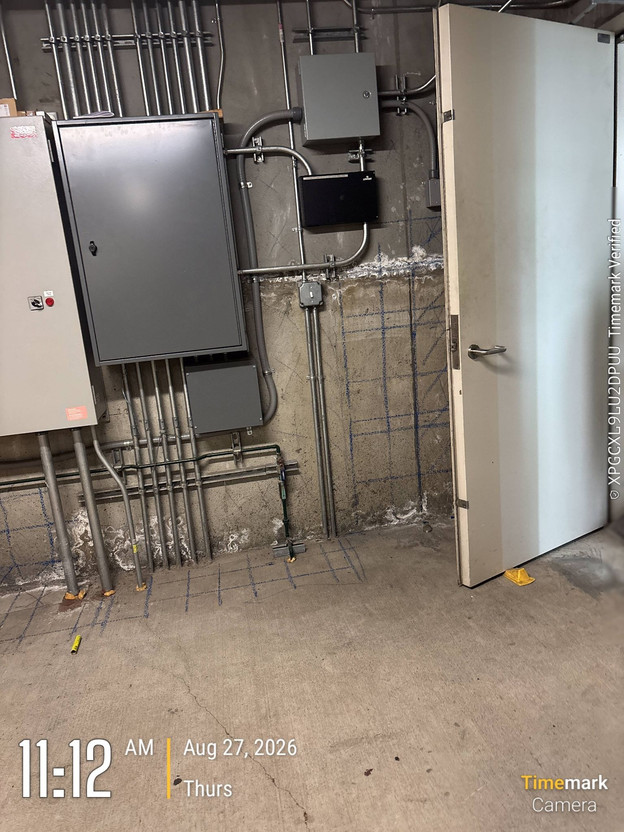
How Technicians Turn Radar Data Into Useful Field Markings
Professional GPR scanning services in Corona should give construction crews information they can use when reviewing planned penetrations.
At Superior Scanning, the field investigation generally involves five activities:
-
Reviewing the work area: Confirming the proposed core locations, slab conditions, and access limitations.
-
Scanning the concrete: Moving the radar across the designated area in multiple directions.
-
Interpreting reflections: Evaluating signal patterns associated with reinforcement, conduits, and other features.
-
Marking detected objects: Transferring interpreted locations onto the concrete surface.
-
Discussing findings: Explaining detected hazards, uncertain areas, and locations requiring further evaluation.
For more complex projects, documentation and scan images may be requested to support communication between contractors and engineers.
Field markings represent interpreted findings, not blanket permission to cut or drill.
If the crew changes a penetration location or removes the original markings, the revised work area may need another assessment.
When Should Contractors Schedule Concrete Scanning Services in Corona?
Concrete scanning is most useful before intrusive work begins, particularly when structural drawings are incomplete or the existing slab contains unknown reinforcement.
Common applications include core drilling for plumbing, electrical conduit penetrations, anchor installation, concrete saw cutting, and commercial renovations.
Contractors searching for concrete scanning services near me should consider more than availability. Experience interpreting radar data, appropriate equipment, clear field markings, and an explanation of detection limitations all matter.
Scanning should be scheduled early enough to allow time for design adjustments if a conflict is detected. Bringing in a technician only after drilling equipment arrives may leave fewer options when the proposed location contains a hazard.
Book Concrete Scanning in Corona With Superior Scanning
At Superior Scanning, experienced field technicians use equipment such as the Proceq GP8000 to investigate embedded reinforcement, post-tension cables, conduit, and other potential hazards before drilling or cutting begins.
The company has supported demanding Southern California projects, including facilities such as LAX, Cedars-Sinai, and the Hammer Museum. Field findings and surface markings help project teams make more informed decisions about planned concrete penetrations.
Need concrete scanning in Corona before an upcoming project? Request GPR scanning services through Superior Scanning's contact form. Include the jobsite address, proposed drilling locations, approximate scan area, and project schedule to arrange a field assessment before construction begins.