
From January 12th year, to May 14th year of the current eon, we spent time in the Eastern and Western European Unions, where we were refused asylum in all thirteen countries we visited. During our stay in three asylum centers and three deportation prisons, among other things, we encountered the cacophony of languages spoken by asylum seekers from all over the world, also lingustic and misunderstandings of a broader nature. In the desire to overcome the existing misunderstanding, with the hope that if we understand each other linguistically, we will be able to understand each other better in other areas of our lives, the Universal Phonetic Script was created
Perhaps you know the meaning of these three inscriptions in Chinese, Hindi and Arabic?
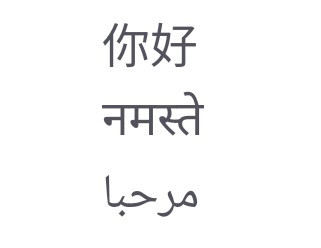
You don't know?
This is not surprising, because not many people on our continent speak these languages and they are mostly linguists working as translators or people who have lived and worked for some time in countries where these languages are spoken. However, when we talk about not knowing languages, this applies not only to these exotic and distant languages, but also to European ones - after all, do you know the languages of the countries that border your country?
No?!
If we return for a moment to the example from the beginning of this text, then if we knew these three languages, we would read the Chinese name as "ni hao", Hindi "namaste" and Arabic "marhaba".
Ah, they sound familiar to you, perhaps you remember them from movies or from meeting people from these countries, so you know that all three are greetings and mean "hello".
The world we live in is a world of misunderstanding and division, and the large number of different languages is to blame for this, with over 7,000 currently in use, with countless dialects - say, 36 dialects in Hindi alone. This is why we literally do not understand each other, and it is no wonder that this misunderstanding extends to other areas of life.
The importance of language is also demonstrated by the fact that over a period of time one language has always been dominant, and that as social and historical circumstances change, another language will change: at one time it was Greek, then Latin, Spanish, then French, and now English is used as an unofficial international language.
You will notice that the dominance of a language in a certain socio-historical period has always been associated with the cultural, economic, political and military dominance of a particular country. That is why each state protects its population from the influence of foreign languages, because otherwise there is a real danger that a foreign country, through music, films, magazines, computer games, cartoons, entertainment, fantasy and science fiction... language and exert cultural, economic, political and military influence on the population of this country.
That is why serious countries do not translate, but synchronize foreign films.
It may seem that the danger of a foreign language is exaggerated, but we must remind you that it is an important part of one of several strategies used, which has proven its effectiveness throughout history, compared to military force, because connected with mentioned area of people's interest and activities, it affects its emotional part, which is not critical and is based on the pleasure principle.
Fast food, snacks, sweets and sweet drinks (sweets = happiness) cause physical pleasure, accompanied by a corresponding emotional pleasure. This is what the saying "Love enters through the stomach" says. Music, cartoons and science fiction, computer games, the Internet, fantasy and science fiction, ... and in general entertainment + snacks, sweets, fast food and soft drinks that captivate children and teenagers considered irrelevant categories of the population, do not matter when we talk about social power, forgetting that these same children and teenagers will be employees, scientists, politicians in 20 or 10 years ... and consciously or subconsciously they will feel love, gratitude and loyalty to those who allowed them a lot of emotional satisfaction.
In other words, for them it will be more important for the benefit of other countries than for their own, because they will want to continue these pleasures.
When we talk about states, if you want to enter into a military-economic alliance with - for example, a neighboring state, then the main problem that will arise is communication, that is, language, because neither side will accept the imposition of a foreign language on people, which makes this alliance impossible. A possible solution to this problem could be to learn the language of the neighboring country at the population level through the school system, which has not given remarkable results anywhere in the world, if learning is not simultaneously used in everyday activities: during communication with family and friends, watching cartoons and movies, music, magazines, computer games, the Internet, food…
Therefore, learning the desired foreign language at the national level should be linked to these areas of life (+ school), so, for example, under the sign "chocolate milk" written in your native language, the corresponding words in a foreign language should be written, and this rule should apply to all products, especially children's products and in the areas we mentioned above ... but this process gives the first results after 15-20 years of application.
The fact is that a large number of languages, that is, scripts, hinders the integration of nations and if we recall the example from the beginning of this text, it will be clear to us that the biggest problem in learning a foreign language is writing and reading, because the same letters or combinations of letters do not represent the same fonrms in another language, and the meaning of the word is learned quickly and easily. The grammar of the language can be simple, but also quite complex, but even if you pronounce a word / sentence grammatically incorrectly, you will be able to successfully communicate with a person.
So, there is a problem with scripts.
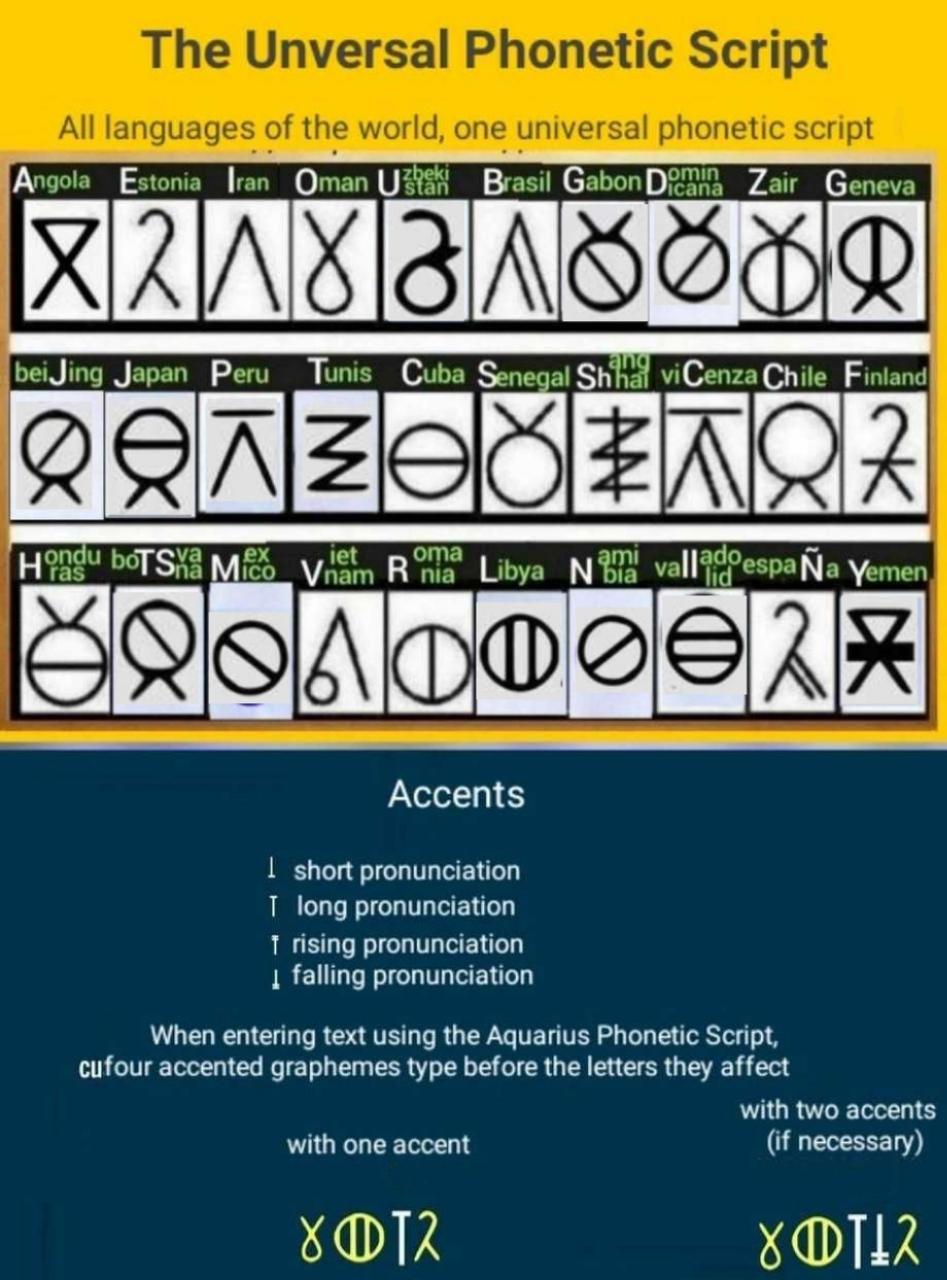
The symbols that you see in the photo represent the graphemes of the Universal Phonetic Script, with which you can write words of any language in the world. So the languages are still different, but the script is common and you can write and read words in Chinese, Hindi, Arabic or any other language, which removes the biggest barrier to learning a foreign language. The words are read by the system: one grapheme = one phonem, and the audio files that follow will certainly help you associate the symbols of the Universal Phonetic Script with the corresponding phonemes. As a printed reminder, you can use the image above, where the corresponding phonemes in the names of countries/cities are marked in capital white words.
The essence of the Universal Phonetic Script is that it is a set of commonly used phonemes in different languages of the world, associated with new graphemes, which allows all the peoples of the world to adopt it without fear that their identity as a citizen will be cancelled by the use of other people's script. The meaning of words is the easier part of learning a language, since it is learned through conversation and life situations, grammar depends on the language; in some it is easy, while in others it takes time to understand their grammatical structure.
Due to the large number of different scripts used and the rules for pronouncing letters and diphthongs, writing and reading are a difficult part of learning and account for almost 60% of the language. Imagine that you initially knew 60% of all the languages in the world: using the Universal Phonetic Script would greatly facilitate the study of foreign languages, improve communication, and the exchange of ideas and culture between peoples.
Of course, the script in its current form is not perfect, and we are simply presenting this idea to the general public. If the idea of the Universal Phonetic Script were recognized as good by public experts and if there was a political decision by the Mighty Ones, an international group of professional linguists would standardize the phonems and accents with the corresponding graphemes of the Universal Phonetic Script, while teachers would decide at what age the Universal Phonetic Script would be included in primary education.
Oliver
All texts from the site without any changes or abbreviations can be printed and published for private and commercial purposes, both domestically and abroad, by anyone who wants it. The rights to publish are provided free of charge, with a preliminary agreement regarding the choice, design and authorization of texts