
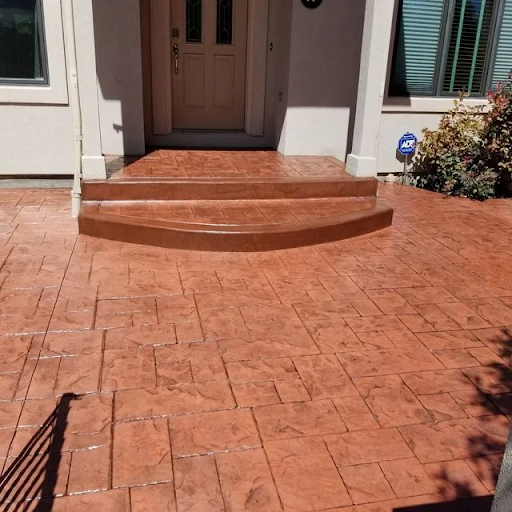
Freeze-thaw damage can leave Denver concrete slabs with cracks, flaking surfaces, and uneven sections after winter. Choosing the right concrete contractors in Denver means checking more than strength. Drainage, mix design, and curing all affect durability.
In this guide, you’ll learn which questions to ask about subgrade preparation, air entrainment, and cold-weather protection so you can compare written bids and choose a contractor with confidence.
What Weather-Ready Concrete Actually Involves
Weather-ready concrete resists freeze-thaw cycles through a drained subgrade, an air-entrained mix, and protected curing.
-
How Freeze-Thaw Damage Starts
Concrete is porous, so water enters, freezes, and expands. Front Range winters bring rapid freeze-thaw cycles, and expansive soils add movement beneath the slab. Each cycle stresses the surface a little more, and flaking or cracking shows that water has reached the pores.
Engineers treat the mix and the curing conditions as separate risk factors. One laboratory study published in PLOS ONE tested equal-strength, air-entrained concrete cured under standard, 5 degrees C, and -3 degrees C conditions to examine how curing temperature changes freeze-thaw failure.
Laboratory conditions differ from a Denver job site, so treat the study as a prompt to question curing, not as a field result.
-
What Buyers Get Wrong
PSI is an easy number to compare, but it measures strength only. Strength tells you how much load a slab carries. It does not tell you how well the slab survives repeated freezing.
The laboratory design compares concrete of equal strength across different curing temperatures. Strength, air content, and curing each need their own answer from your contractor.
A second mistake is treating every quote as equal. Two bids can show the same thickness and PSI, while one skips base compaction, drainage slope, or curing protection. Compare the scope item by item, not only the total.
What to Look for in Concrete Contractors in Denver
Strong concrete contractors Denver homeowners hire answer questions about subgrade, mix, and curing with specifics, not slogans.
-
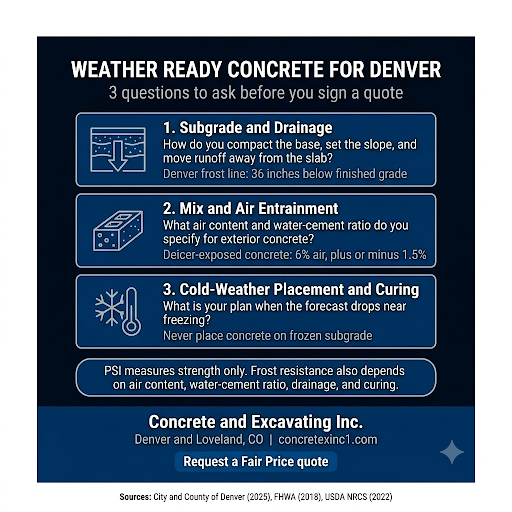
Criterion 1: Subgrade and Drainage
Start here: "How do you compact the base, set the slope, and move runoff away from the slab?"
Hardened concrete suffers freeze-thaw damage when water saturates its pores, so a slab that sheds water has less to freeze. This is reasoning from the mechanism, not a Denver measurement.
A qualified crew removes unsuitable organic soil, compacts granular base in layers, and checks elevations before the pour. Contractors who also handle excavation and grading control this step.
The frost line for the City and County of Denver is 36 inches below the finished grade. For foundations, ask how deep the footings sit against that line.
-
Criterion 2: Mix Design and Air Entrainment
Next: "What air content and water-cement ratio do you specify for exterior concrete?" Concrete exposed to deicers needs air entrainment, with a total air content of 6 plus or minus 1.5 percent for typical paving and bridge deck concrete, as per FHWA.
Residential flatwork differs from highway paving, so listen for a stated target and a named standard such as ASTM C94.
-
Criterion 3: Cold-Weather Placement and Curing
Then: "What is your plan when the forecast drops near freezing?" Crews must remove all snow, ice, and frost before placement and must not place concrete on frozen subgrade, according to the USDA NRCS guidelines.
Qualified crews also avoid adding extra water to ease placement and protect fresh concrete while it cures.
Request every answer, including control joint spacing, in the written quote.
How Concrete and Excavating Inc. Approaches Weather-Ready Concrete
Concrete and Excavating Inc. builds weather-ready concrete in Denver and Loveland by combining excavation, fine grading, and concrete flatwork in one team.
Its documented process covers site evaluation, compacted subgrades, drainage integration, climate-optimized mixes, and planned control joints. One team stays accountable from soil to finished surface.
-
Documented Process Steps
Concrete and Excavating Inc. follows these steps for flatwork and foundations:
-
Site survey: crews check benchmark elevations and water-flow patterns against local codes.
-
Fine grading: laser-guided and GPS-guided equipment sets subgrade elevations, and crews compact the soil in lifts.
-
Mix specification: concrete meets ASTM C94, with set air entrainment and water-cement ratios.
-
Placement guidance: the firm references NRMCA CIP 14, which bars placing concrete on cold or frozen subgrades and adding excess water.
-
Joints and curing: crews place control joints to ACI spacing standards and protect the slab with curing compounds or covers.
-
Final inspection: surveyors confirm elevations and drainage slopes before the pour begins.
-
What You Can Verify
Concrete and Excavating Inc. is licensed and insured. Its Fair Price model starts with an on-site inspection and an open quote, so you see scope and cost before work begins. Before-and-after updates keep you informed, and you deal directly with the owner.
Limits apply. Soil and drainage conditions vary by site, and no contractor can promise a slab will never crack. Joints control where cracks form, and the site visit sets the scope.
Frequently Asked Questions
These answers help you compare bids before you commit.
-
How do I know a Denver concrete contractor builds for freeze-thaw?
Request four written details: the subgrade compaction method, the drainage slope, the air-entrained mix specification, and the cold-weather curing plan. A contractor who builds for freeze-thaw answers each with specifics, puts them in the quote, and explains why each choice protects the slab.
-
Does higher PSI mean concrete resists freezing better?
No. Frost resistance also depends on air content, water-cement ratio, drainage, and curing.
-
Can concrete contractors in Denver pour in winter?
Sometimes, with planning. The crew must avoid frozen ground and protect the slab while it cures.
-
What should a Denver concrete quote include?
A fair price quote lists the scope from an on-site inspection, including subgrade preparation, mix specification, joints, finishing, and curing. Concrete and Excavating Inc. builds quotes this way, with open pricing that exposes hidden fees and sudden upcharges before you sign.
-
Does Concrete and Excavating Inc. handle site prep and concrete in Denver?
Yes. Concrete and Excavating Inc. offers excavation, grading, concrete foundations, and flatwork in Denver and Loveland.
Conclusion
Before hiring concrete contractors in Denver, compare their written plans for subgrade preparation, drainage, mix design, and cold-weather curing. A detailed scope helps you understand what each quote includes and make an informed decision.
Ready to plan your concrete project? Contact Concrete and Excavating Inc. for a Fair Price quote in Denver or Loveland. Visit concretexinc1.com to request an estimate for your project.
CONTACT US
Website: https://concretexinc1.com/
Mail: concretexinc@gmail.com
Phone: +1-9704439171
Address: Loveland, CO, USA