
A Quotation That Came Back Wrong
Rajkot, March. A pump-parts shop owner rang me with two quotes on his desk and a tone I could hear through the phone. One was for a vertical machine, the other for a horizontal, and the gap between them was bigger than his whole previous year's profit. He wanted to know what the real cnc milling machine price india buyers pay actually was. I told him neither number was it. Those were starting figures, and they hadn't been through the part of the process where the invoice grows.
He'd been running castings on an old manual knee mill for years. Good hands, bad throughput. Two orders had slipped on him that winter and a customer in Jamnagar had quietly moved a repeat job elsewhere.
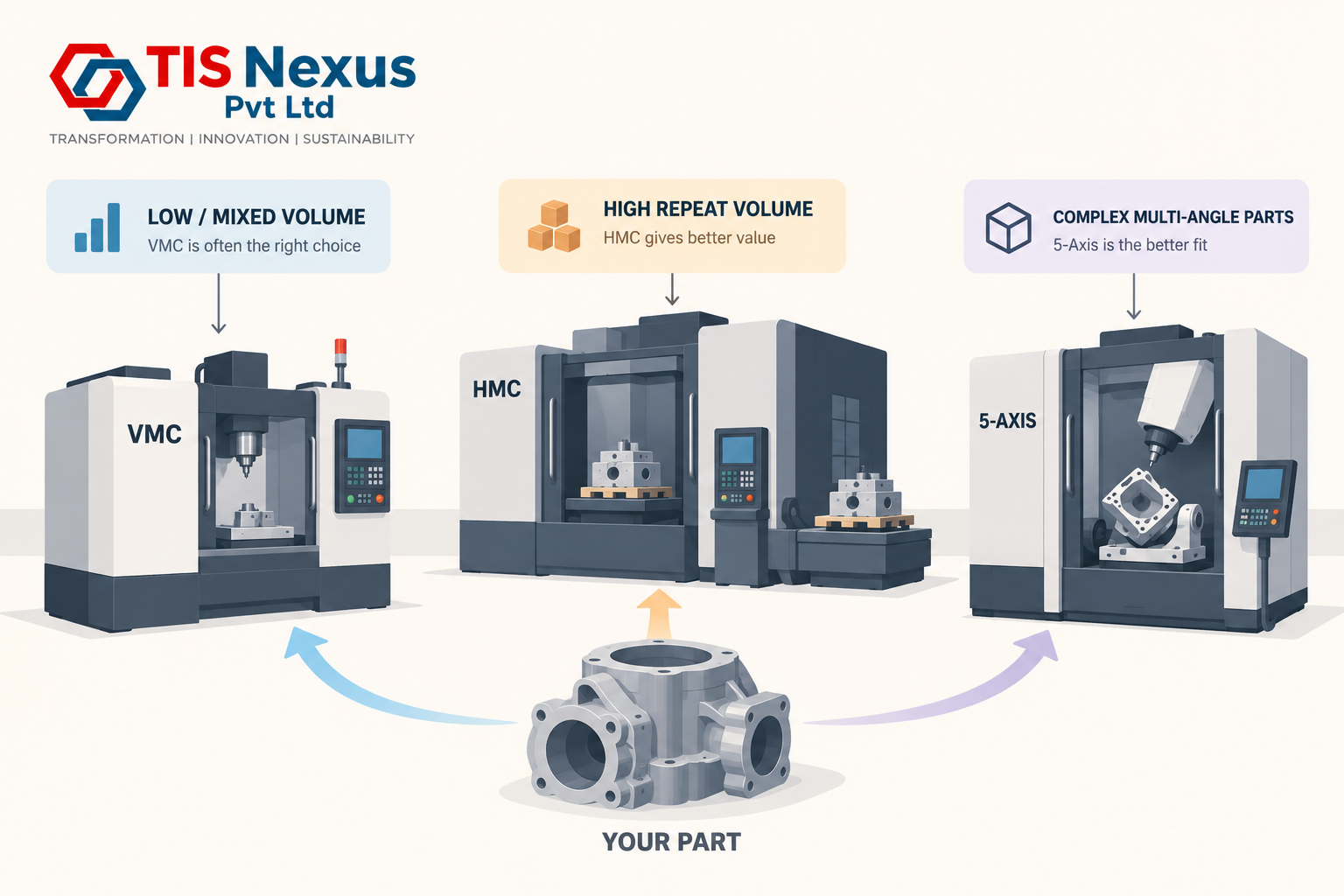
Why VMC Machine Price Looks Friendly
The vertical quote was the one he liked. Something in the twenty to thirty lakh range for a decent mid-size machine with a standard controller, and he could picture it fitting where the old mill sat. He'd already measured the floor with a tape.
I'd put a lot of small shops on verticals by then. A VMC is forgiving. The operator stands in front, sees the cut, adjusts the offset, and the learning curve is a few weeks rather than a few months. A man who has only ever worked a manual mill can run one by the second month. That counts for more than most spec sheets admit.
Where the vmc machine price starts to hurt is after the first quote. Fixtures, vices, a probe if you want one, the foundation pad, the stabiliser, tooling for the first ten jobs. The machine arrives, and then you find out it needs a few lakh more before it cuts anything worth selling.
Chips Fall Where They Fall
A shop I visited in Coimbatore was milling deep aluminium pockets on a vertical. Chips piled in the pocket, got recut, and scratched the finish. They fixed it with more coolant pressure and an air blast, then a slower feed, then eventually a different toolpath. All of that cost cycle time. Nobody had mentioned it when the machine was sold, because on a vertical the chips just sit on top of the part unless something moves them.
The HMC Side of the Comparison
Horizontal machines cost a lot more. A buyer looking at the milling machine rate india dealers quote for an HMC will often see a number two or three times the vertical, sometimes worse once the pallet changer is in. It stings.
I'll tell the Pune story, because it's the one I keep coming back to.
Gearbox Housings, Pune, Monsoon Season
A shop there was cutting gearbox housings, something like four hundred a month, on two verticals. Each housing needed machining on several faces, so every one went through a second setup, sometimes a third. The operator spent roughly six minutes per piece loading, clamping, and indicating. Six times four hundred is twenty-four hundred minutes, call it forty hours a month where the spindle did nothing because a man was bending over a fixture.
The owner thought forty hours was a rounding error. I thought it was a whole machine's worth of Saturdays.
They moved to a horizontal with two pallets. While one pallet was cutting, the operator loaded the other one, standing safely at the side. The chips dropped straight down off the tombstone and into the conveyor, which also removed the Coimbatore problem entirely. The spindle stayed busy for most of the shift.
Did the payback arrive in the first year? No. It took closer to three, and the owner complained about it every month until the second year, when the Jamnagar-style customers started calling him instead of the other way round.
What CNC Machine Cost Really Includes
People ask about cnc machine cost as if it were one figure. I've never seen it behave that way.
The first year has a pile of things sitting behind the headline price. Freight from the port, and in monsoon, the crane hire and a day of rain that nobody planned for. A compressor that turns out to be too small. Coolant, which sounds trivial until you've bought three drums. Operator training, whether the supplier's engineer does it for a week or you send somebody to another plant.
Then the second-year costs. Spindle service, ball screw wear, the electrical panel that runs hot in a shed without ventilation. A buyer in Ludhiana told me his panel failed in the first May because the shop hit forty-four degrees inside. The machine was fine. The cabinet wasn't.
I add something like fifteen to twenty percent to any quote before I show it to a buyer, though it moves around. Some jobs were cleaner. A few were worse.
The Mistake I See Buyers Make Most
Buying on the horizontal because it looks serious. I've watched shops with forty housings a month, maybe fifty, sign up for an HMC because a competitor had one. That's a waste of money. The machine sits half-idle and the loan keeps ticking.
The reverse mistake happens too, but less often and less expensively. A shop that really does run high volume stays on verticals for years because the quote looked friendlier, and the forty hours a month turn into eighty, and nobody counts them.
Honestly, most buyers should start with a vertical. I'd say that to anyone whose volume is uneven or whose parts change every few weeks. A horizontal wants repetition. It wants the same family of parts coming back on the same fixtures, month after month, and a job-shop mix of one-offs doesn't give it that.
Looking at the Actual Machines
When the Rajkot owner finally got past the quotes, I sent him to see a few running machines rather than brochures. It helps to stand next to one while it cuts. The sound tells you a lot, and so does how the coolant behaves. Buyers who want to compare what's out there can look through the 5 axis and VMC milling machines on offer before talking to anyone, just to see which configurations even exist at their size.
The five-axis ones came up in that conversation too. He laughed. Too much for his shop, and he was right. But a quote for one made his vertical quote look sensible, which is its own kind of use.
What I'd Have Put in His Shop
For the pump-parts shop, a vertical. Mid-size, a rotary table on the side so he could reach a second face without re-clamping, and a proper vice set. Maybe twenty-six, twenty-eight lakh all in, plus the extras I mentioned. He grumbled about the extras.
Eight months later he rang again. Orders had picked up, two regular customers had sent drawings for parts with angled bores, and he asked whether the rotary table could be swapped for something bigger. It could. I'd sized the machine's table with that in mind.
If the volume had been four hundred housings a month like Pune, I'd have quoted him the horizontal and sat through the argument. He didn't have that volume. He might in two years.
Talking to a Supplier
Some buyers want to see a few machines side by side before they decide, and others want to speak to an engineer who has installed them in a plant like theirs. TIS Nexus handles both conversations, and in my experience the engineer's questions about part size and monthly volume are better than the sales pitch.
The Rajkot owner still sends me photos of his first finished batch. A pump body, fresh off the table, with the tool marks showing. I keep one on my phone. For anyone sizing up their own floor, this milling page has the configurations that were on his shortlist, and the tape measure goes out again after that.