
Halogens and sulfur can be present in many difficult sample types, including fuels, polymers, chemicals, electronic materials, environmental solids and pharmaceutical products. The challenge is that these samples cannot always be introduced directly into a conventional ion chromatography system.
Combustion ion chromatography solves this by adding a controlled combustion step before the chromatographic measurement. The sample is first broken down at high temperature, the target elements are converted into measurable ionic forms, and the resulting solution is then analysed by ion chromatography.
Why Complex Samples Need More Than Direct IC Analysis
Direct ion chromatography works well when the target ions are already present in a suitable liquid sample.
Complex solid or organic samples are different. Fluorine, chlorine, bromine, iodine or sulfur may be chemically bound within the material, so they need to be released before accurate measurement can begin.
Combustion Converts the Sample into a Measurable Form
In combustion ion chromatography, the sample is introduced into a high-temperature furnace.
During this stage:
· The sample is combusted under controlled conditions
· Halogen- and sulfur-containing compounds are converted into gaseous products
· These products are transferred into an absorption solution
· The resulting ions are separated and measured using ion chromatography
Prin-Cen describes this process as a way to determine total fluorine, chlorine, bromine, iodine and sulfur in samples that are difficult to analyse by direct liquid injection.
This makes combustion IC useful when the main challenge is getting the target elements out of a difficult matrix before analysis.
Where Combustion IC Can Be Useful
The method can be applied to materials such as:
· Petroleum products and fuels
· Lubricants
· Plastics and resins
· Rubber
· Electronic materials
· Environmental solids
· Chemical intermediates
· Pharmaceutical raw materials
Prin-Cen also lists applications across petroleum, chemical, environmental, electronics and pharmaceutical testing.
The value of the method is not simply that it measures halogens and sulfur. It allows laboratories to work with samples that may otherwise require more complicated preparation before they can be analysed.
The CIC-200 Combines Combustion and Ion Chromatography
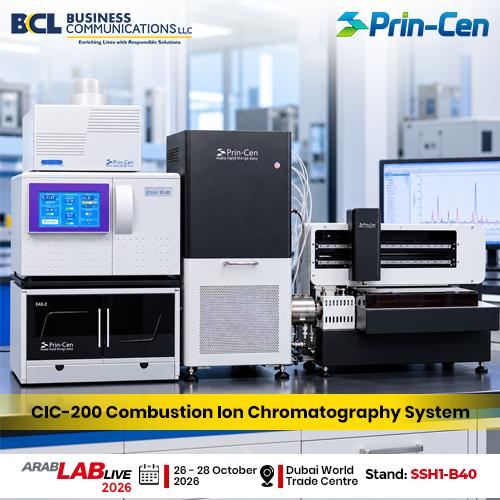
The Prin-Cen CIC-200 is a combustion ion chromatograph that combines sample introduction, pyrolysis, combustion, absorption, ion separation and data calculation within one workflow.
According to Prin-Cen, the system uses a furnace with a maximum temperature of 1200°C and is designed for measuring total F, Cl, Br, I and S, with a stated detection limit below 2 ppm under suitable conditions.
The system also supports automated stages such as:
· Sample introduction
· Controlled combustion
· Collection of combustion products
· Solution transfer
· Ion chromatographic separation
· Data processing
This reduces the need to treat combustion and ion chromatography as completely separate laboratory steps.
Reliable Results Depend on More Than Furnace Temperature
High-temperature combustion is important, but it is only one part of the process.
Accurate results also depend on how the sample is introduced, whether combustion is complete, how efficiently the gaseous products are absorbed, and how well blanks and calibration are controlled.
Sample Type Can Change the Combustion Conditions
Different materials do not burn in the same way.
A fuel, polymer, catalyst or environmental solid may require different combustion settings.
Factors that can influence the result include:
· Sample amount
· Furnace temperature
· Oxygen flow
· Sample introduction rate
· Residence time
· Absorption efficiency
· Blank contamination
· Calibration range
Prin-Cen notes that its CIC systems allow programmable combustion conditions, including adjustable temperature, gas flow and introduction settings to accommodate different sample types.
This flexibility is important because reliable recovery depends on complete and controlled conversion of the target elements before the IC measurement begins.
Blank Control Matters at Low Concentrations
When halogens are present at low levels, contamination from water, gases, tubing or laboratory consumables can influence the result.
For this reason, laboratories may need to control:
· Reagent blanks
· System blanks
· Carryover
· Calibration standards
· Sample loading
· Reference materials
The stated instrument detection limit does not automatically become the final method detection limit for every sample. The practical result can still depend on the sample matrix and the complete analytical procedure.
Combustion IC at ARABLAB 2026
ARABLAB LIVE 2026 will take place from 26–28 October 2026 at Dubai World Trade Centre, bringing together laboratory technologies used across different analytical and testing applications.
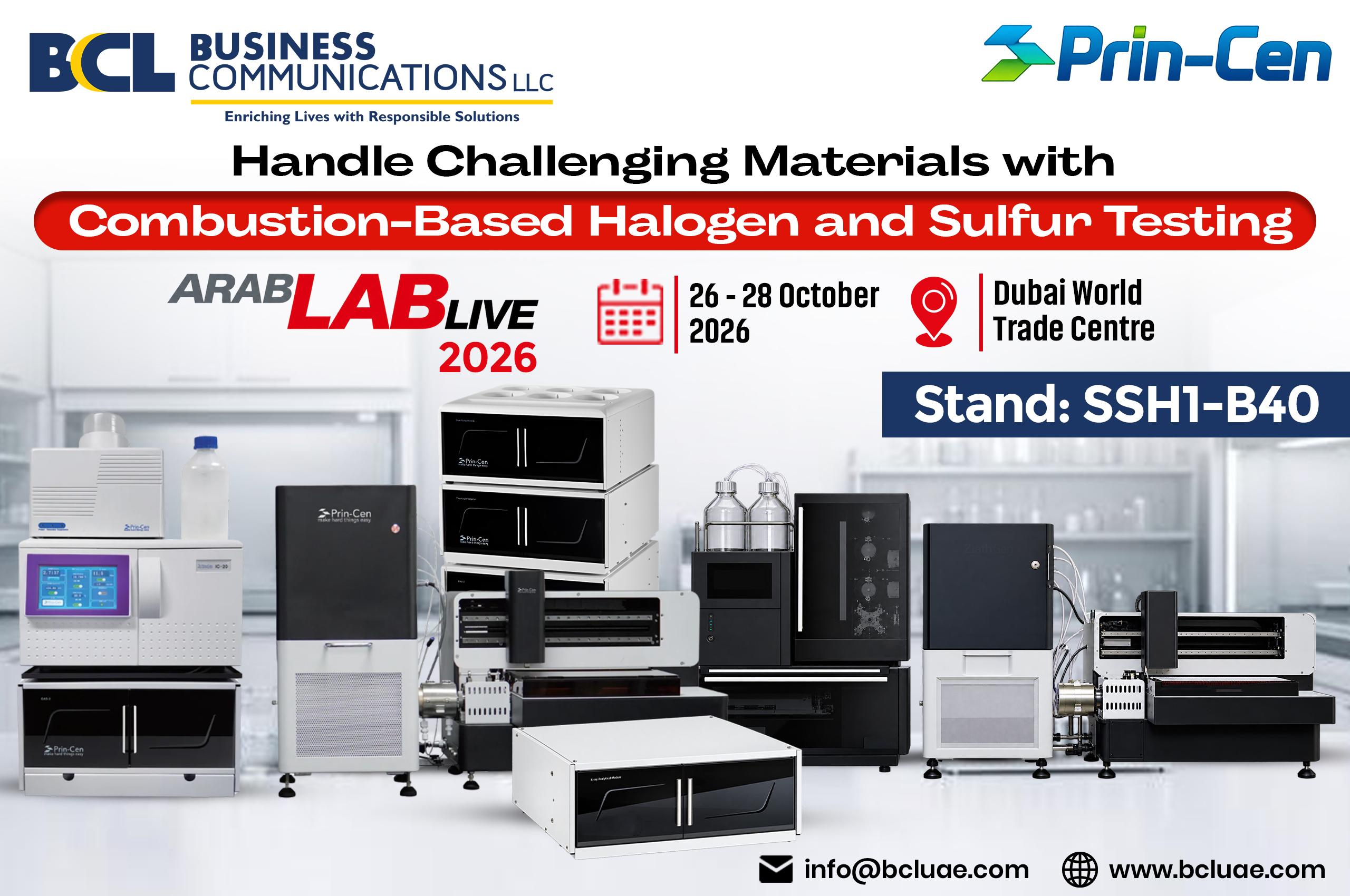
Business Communications LLC will be at Sheikh Saeed Hall 1, Stand SSH1-B40, showcasing selected Prin-Cen Scientific technologies, including the CIC-200 Combustion Ion Chromatography System.
For professionals reviewing arablab exhibitors 2026, the system provides a practical example of how combustion and ion chromatography can be combined when the sample is too complex for direct IC analysis.
The important point is that total halogen and sulfur measurement begins with the sample itself. When the matrix is difficult, combustion ion chromatography can provide a more suitable route by converting the material into a form that can be separated and measured reliably.