
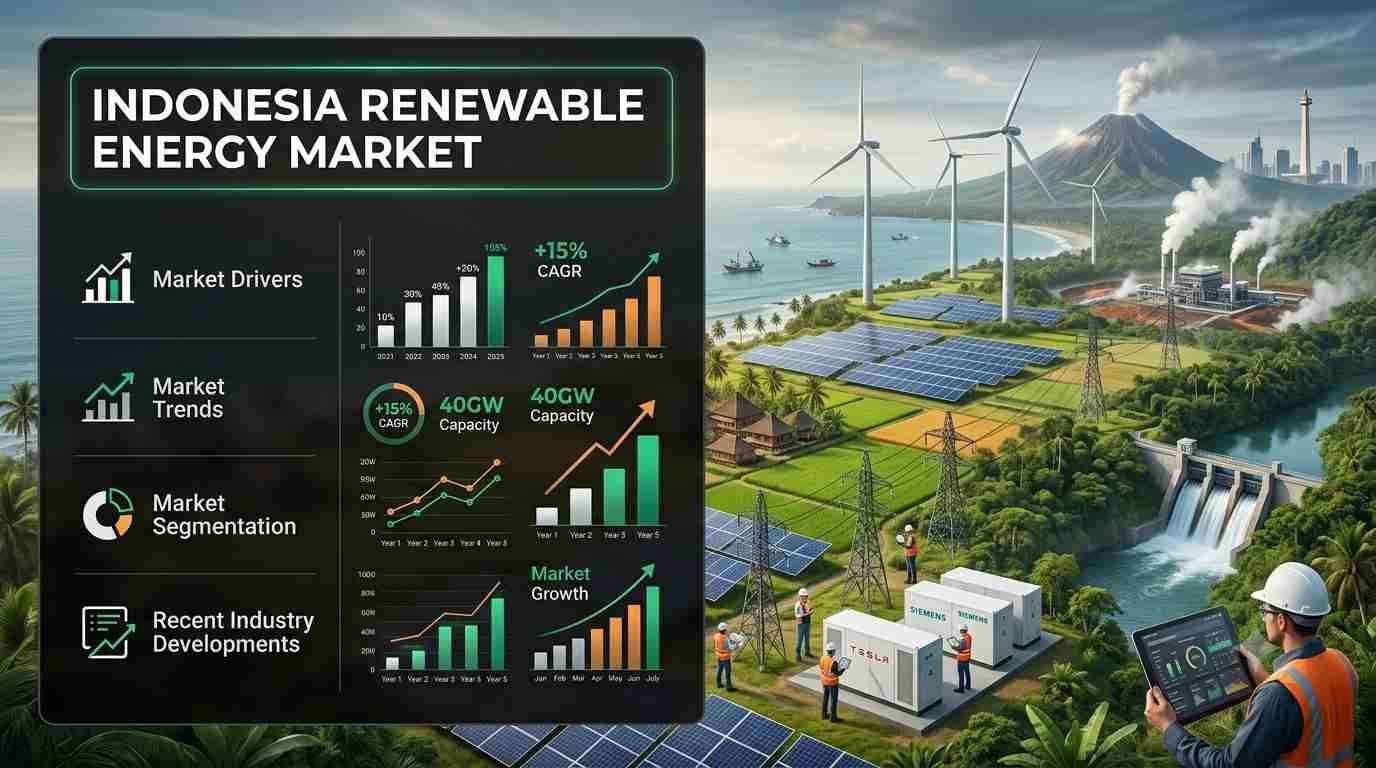
IMARC Group, a leading global market research and management consulting firm, has published its latest market intelligence report on the Indonesia Renewable Energy Market. The Indonesia renewable energy market size was valued at 57.0 TWh in 2025 and is projected to reach 118.6 TWh by 2034, exhibiting a CAGR of 8.48% during 2026-2034. Growth is being driven by abundant geothermal, solar, wind and hydro resources, supportive government policy and financing, rising electricity demand from population growth and industrialization, and rural electrification.
Renewable energy is central to Indonesia's plan to power a fast-growing economy while cutting emissions. Renewable capacity stood at about 15.6 GW in 2025, around 15.75 percent of installed power capacity, with solar reaching 1.49 GW after about 546 MW was added during the year, according to Climate Scorecard. At the same time, the government has set out the RUPTL 2025-2034 plan to add 69.5 GW of capacity, 42.6 GW of it renewable, and launched a 100 GW solar program in August 2026, while the Just Energy Transition Partnership (JETP) mobilizes international financing and relaxed local content requirements attract investors. Combined with off-grid solar and mini-hydro for remote communities, geothermal strength in volcanic regions and growing demand from industry and data centers across Java, Sumatra, Kalimantan and Sulawesi, these forces are reshaping the competitive landscape and setting the stage for steady, long-term growth.
Indonesia Renewable Energy Market at a Glance:
- Market Size (2025): 57.0 TWh
- Market Forecast (2034): 118.6 TWh
- Growth Rate (2026-2034): CAGR of 8.48%
- Base Year: 2025 | Historical Period: 2020-2025 | Forecast Period: 2026-2034
How AI is Reshaping the Future of the Indonesia Renewable Energy Market
- AI-Driven Data Center Power Demand: In August 2026, JLL and CBRE reported that Indonesian data centers, driven mainly by AI demand, typically need about 100 to 200 MW each, with hyperscale projects now exceeding 500 MW, and that renewable energy players are working with PLN to supply about 16 GW in 2026 and up to 100 GW over the next two years.
- Clean Power for Digital Infrastructure: Industrial users, including data centers, must source about 70 percent of their electricity from PLN, with the rest available from independent renewable producers using solar, geothermal, wind and hydro, and the property sector is calling for a more flexible energy mix framework, creating a new commercial route for renewable power purchase.
- Storage and Grid Readiness for Variable Renewables: The 100 GW solar program includes battery storage, with a flagship project in Gilimanuk, west Bali, combining a 305 MW solar plant with a 1 GWh battery system owned by PLN, while PLN notes that substations and transformers are the main grid bottlenecks, underscoring the role of smarter grid and storage investment.
Grab a sample PDF of this report: https://www.imarcgroup.com/indonesia-renewable-energy-market/requestsample
Indonesia Renewable Energy Market Trends and Drivers:
Demand for renewable energy in Indonesia is being underpinned by natural resources and policy support. Indonesia has abundant geothermal, solar, wind and hydro potential and is considered a leader in geothermal thanks to its volcanic activity, while government policy, including relaxed local content requirements introduced in September 2024 to attract concessional international funding, is encouraging investment.
The market's structural differentiator is the breadth of demand behind it. Population growth, industrialization and urbanization are lifting electricity use, while rural electrification, through off-grid solar and mini-hydro, brings renewable power to remote communities, and climate awareness and emission reduction goals are supporting onshore wind and solar investment.
A third driver is private and international investment. Barito Renewables partnered with ACEN in August 2024 to develop wind projects, and PLN has expanded new and renewable energy plant development, a dynamic that is set to intensify as the RUPTL 2025-2034 targets 17.1 GW of solar, 11.7 GW of hydro, 7.2 GW of wind and 5.2 GW of geothermal by 2034.
Government Schemes and Initiatives Driving Demand:
- RUPTL 2025-2034: The national electricity supply plan targets 69.5 GW of new capacity by 2034, of which 42.6 GW, or about 76 percent, is renewable, including 17.1 GW of solar, 11.7 GW of hydro, 7.2 GW of wind, 5.2 GW of geothermal and 900 MW of bioenergy, along with 3 GW of energy storage in the first five years.
- 100 GW Solar Program: Launched at a groundbreaking ceremony in August 2026, the program targets 100 GW of solar within about three years, with an investment of about USD 73 billion cited by Energy Minister Bahlil Lahadalia, a first phase of 17 GW, a focus on 80,000 villages and the replacement of diesel generation.
- Just Energy Transition Partnership: The JETP investment plan aims to mobilize USD 20 billion and cut on-grid power-sector CO2 emissions to 250 million metric tons by 2030, supporting financing for renewable projects.
- Local Content Relaxation and Renewable Energy Fund: Relaxed local content requirements from September 2024 and the Renewable Energy Fund support the deployment of green technology and attract concessional international funding, alongside rural and remote electrification goals.
Indonesia Renewable Energy Market Industry Segmentation:
The report has segmented the market into the following categories:
Breakup By Source:
- Solar
- Wind
- Hydro
- Bioenergy
- Others
The report provides a detailed breakup of solar, wind, hydro, bioenergy and other sources, including geothermal. Solar is the priority technology in national plans, while hydro and geothermal anchor existing renewable capacity and wind is a smaller but stable contributor.
Breakup By Region:
- Java
- Sumatra
- Kalimantan
- Sulawesi
- Others
The report analyzes demand across Java, Sumatra, Kalimantan, Sulawesi and Others, with Java anchoring electricity demand, Sumatra and Sulawesi offering geothermal and hydro resources, and Bali and other islands receiving large solar and storage projects.
Competitive Landscape:
The Indonesia renewable energy market is shaped by the state utility, domestic energy groups and international developers. Key players include:
- PT PLN (Persero)
- Barito Renewables
- ACEN
Competition centers on project pipelines, access to financing, grid connection and power purchase agreements with PLN, and partnerships between local groups and international developers, such as Barito Renewables and ACEN in wind.
What Does The Full Report Cover?
- Historical, current, and forecast market size for the Indonesia renewable energy market from 2020 to 2034, in TWh
- Market breakup by source and region
- Regional analysis covering Java, Sumatra, Kalimantan, Sulawesi, and Others
- Key growth drivers and trends shaping the market, including natural resources, policy support, rural electrification, and green financing
- Government policy on local content, renewable financing, and energy transition
- Competitive landscape, market structure, key player positioning, top winning strategies, competitive dashboard, and company evaluation quadrant
- Detailed profiles of major renewable energy companies
Recent News and Developments in the Indonesia Renewable Energy Market
- June 2025: Indonesia's RUPTL 2025-2034 set a target to add 69.5 GW of new power capacity by 2034, including 42.6 GW of renewables, 17.1 GW of solar and 3 GW of energy storage.
- July 2026: Climate Scorecard reported that Indonesia's solar capacity reached about 1.49 GW and wind about 152 MW in 2025, with renewables at around 15.75 percent of installed power capacity and a 2026 renewable capacity target of about 16.6 GW.
- August 2026: Indonesia launched its 100 GW solar program, with a first phase of 17 GW, a cited investment of about USD 73 billion and a flagship 305 MW solar and 1 GWh battery project in Gilimanuk, west Bali.
- August 2026: JLL and CBRE said AI-driven data center growth is lifting Indonesian power needs to 100 to 200 MW per facility, with hyperscale projects above 500 MW, as renewable energy players work with PLN to supply about 16 GW in 2026.
Note: If you require specific details, data, or insights that are not currently included in the scope of this report, we are happy to accommodate your request. As part of our customization service, we will gather and provide the additional information you need, tailored to your specific requirements. Please let us know your exact needs, and we will ensure the report is updated accordingly to meet your expectations.
Key Questions This Report Answers
- How big is the Indonesia renewable energy market and what is its growth outlook through 2034?
- What are the key growth drivers and trends in the Indonesia renewable energy market?
- Which renewable sources, including solar, wind, hydro, and bioenergy, are driving the market?
- How are regions across Indonesia contributing to renewable energy generation?
- How are government targets, financing, and local content policy shaping the market?
- Who are the key players in the Indonesia renewable energy market, and how is the competitive landscape evolving?
- What role are rural electrification, storage, and growing power demand playing in the future of renewable energy in Indonesia?
About Us
IMARC Group is a global management consulting firm that helps the world's most ambitious changemakers to create a lasting impact. The company provides a comprehensive suite of market entry and expansion services. IMARC offerings include thorough market assessment, feasibility studies, company incorporation assistance, factory setup support, regulatory approvals and licensing navigation, branding, marketing and sales strategies, competitive landscape and benchmarking analyses, pricing and cost research, and procurement research.
Media and Sales Contact
IMARC Group
Email: sales@imarcgroup.com
United States: +1-201-971-6302
India: +91-120-433-0800
United Kingdom: +44-753-714-6104