
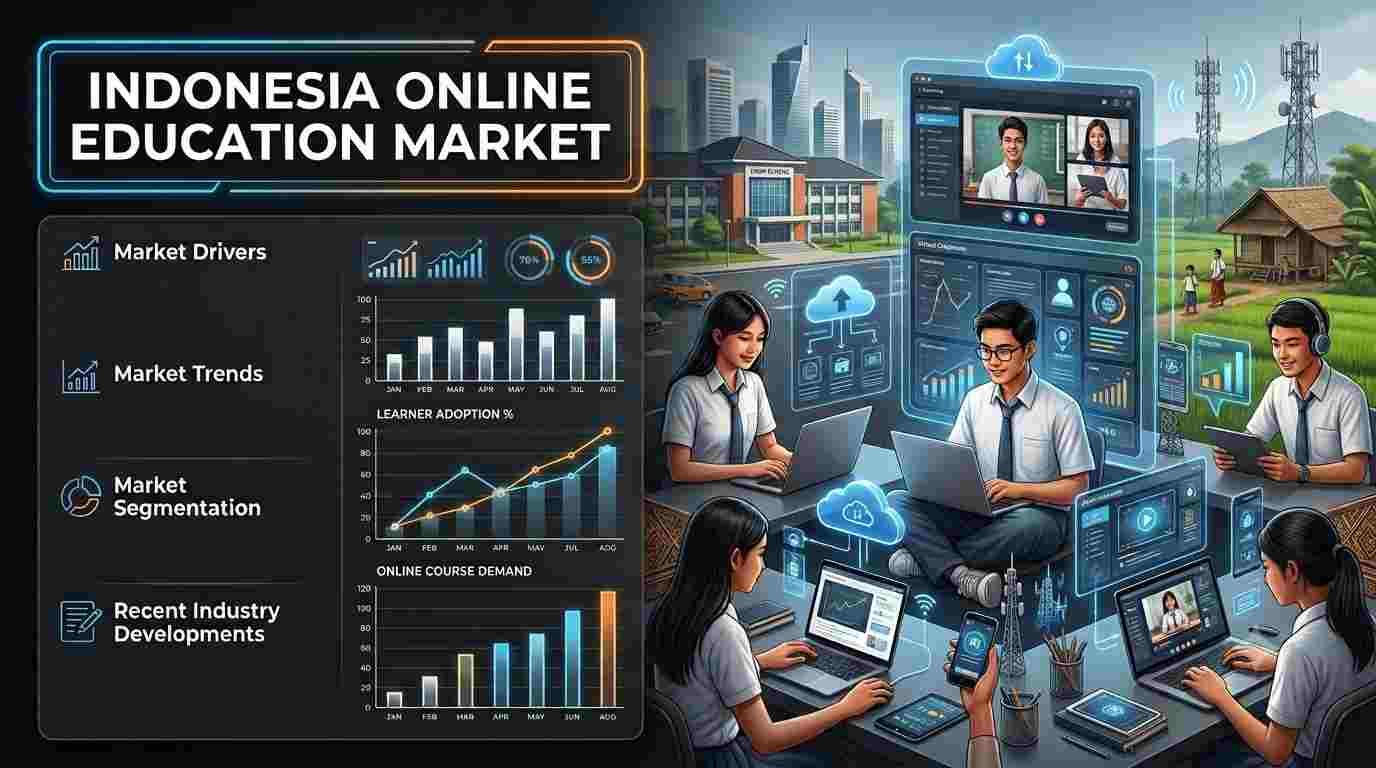
IMARC Group, a leading global market research and management consulting firm, has published its latest market intelligence report on the Indonesia Online Education Market. The Indonesia online education market size was valued at USD 1,423.1 Million in 2025 and is projected to reach USD 9,356.6 Million by 2034, exhibiting a CAGR of 23.28% during 2026-2034. Growth is being driven by government support for digital learning, demand for workforce-oriented courses, mobile-based learning, and rising internet and smartphone penetration.
Online learning is becoming a core part of how Indonesians study and upskill, from K-12 and higher education to vocational and corporate training. Internet users reached 235.2 million in 2026, or 81.72 percent of the population, according to APJII, with smartphones the main access device for 84.31 percent of users. At the same time, the government is placing interactive digital panels in schools, issuing guidelines for AI in education and partnering with private technology providers to narrow urban-rural gaps, while learners seek IT, entrepreneurship, finance and English courses and certifications. Combined with gamified mobile content, telecom data packages and the push for lifelong learning across Java, Sumatra, Kalimantan and Sulawesi, these forces are reshaping the competitive landscape and setting the stage for steady, long-term growth.
Indonesia Online Education Market at a Glance:
- Market Size (2025): USD 1,423.1 Million
- Market Forecast (2034): USD 9,356.6 Million
- Growth Rate (2026-2034): CAGR of 23.28%
- Base Year: 2025 | Historical Period: 2020-2025 | Forecast Period: 2026-2034
How AI is Reshaping the Future of the Indonesia Online Education Market
- National Rules for AI in Education: In March 2026, seven cabinet ministers signed a joint decree setting guidelines for digital technology and AI use in education, from early childhood through higher education. It restricts instant AI apps that generate answers directly in primary and secondary schools while allowing AI tools built for educational purposes, such as AI-supported robotics simulations in primary schools.
- AI-Assisted Teacher Training: Pearson and Indonesia's Ministry of Education partnered to improve English proficiency in all schools by 2027, with online, AI-assisted training and assessment for over 180,000 English teachers, showing how AI is entering large-scale online learning delivery.
- Smart Classroom Infrastructure at Scale: The government plans to install 800,000 interactive flat panels in schools nationwide in 2026, following more than 280,000 distributed in 2025, with teacher training so the technology is used effectively, building the digital foundation on which AI-enabled learning tools can run.
Grab a sample PDF of this report: https://www.imarcgroup.com/indonesia-online-education-market/requestsample
Indonesia Online Education Market Trends and Drivers:
Demand for online education in Indonesia is being underpinned by government support for digital learning. Public programs are pushing digital tools into schools, with the Ministry of Education collaborating with private technology providers to close urban-rural gaps in access to quality learning.
The market's structural differentiator is demand for workforce-oriented skills. Learners and employers are seeking courses in IT, entrepreneurship, finance and English, along with certifications and corporate e-learning, which suits flexible, skill-based online formats and lifelong learning.
A third driver is mobile-based learning and expanding connectivity. Smartphone access, gamified content and telecom-subsidized data packages are extending reach beyond major cities, a dynamic that is set to intensify even as the digital divide remains a challenge, with Java at 85.95 percent internet penetration versus 69.74 percent in Maluku and Papua according to APJII.
Government Schemes and Initiatives Driving Demand:
- Merdeka Belajar and Digital School: The Merdeka Belajar (Freedom to Learn) and Digital School initiatives promote digital tools in classrooms, supported by Ministry of Education collaboration with private technology providers to close urban-rural gaps.
- Interactive Flat Panel Program: More than 280,000 interactive flat panels were distributed to schools in 2025, with a focus on disadvantaged, frontier and outermost areas, and a plan announced in July 2026 to install 800,000 panels in schools nationwide with teacher training.
- Joint Decree on Digital Technology and AI in Education: Signed in March 2026 by seven ministries, the decree sets guidelines on minimum age, permitted types of use and recommended duration of digital technology and AI use at each education level, supporting responsible adoption of online learning.
- Ministry of Education and Pearson English Partnership: Announced in August 2024, the partnership aims to improve English proficiency in all schools by 2027, including online, AI-assisted training and assessment for over 180,000 English teachers.
Indonesia Online Education Market Industry Segmentation:
The report has segmented the market into the following categories:
Breakup By Type:
- Academic (Higher Education, Vocational Training, K-12 Education)
- Corporate (Large Enterprises, SMBs)
- Government
The report provides a detailed breakup of academic, corporate and government learning. Workforce-oriented demand is strong in vocational and corporate learning, while government programs are driving adoption in schools.
Breakup By Provider:
- Content
- Services
The report analyzes content providers and service providers, including platforms, tutoring, training and assessment delivery.
Breakup By Technology:
- Mobile E-Learning
- Rapid E-Learning
- Virtual Classroom
- Others
Mobile e-learning benefits from smartphone use by 84.31 percent of internet users, gamified content and telecom-subsidized data packages, while virtual classrooms and rapid e-learning serve schools, universities and corporate training.
Breakup By End-User:
- Higher Education Institutions
- K-12 Schools
Higher education institutions and K-12 schools are adopting online platforms, supported by digital panels, teacher training and national guidelines on technology and AI use.
Breakup By Region:
- Java
- Sumatra
- Kalimantan
- Sulawesi
- Others
The report analyzes demand across Java, Sumatra, Kalimantan, Sulawesi and Others. Java has the highest internet penetration, while eastern regions such as Maluku and Papua show lower penetration, making connectivity and affordable data central to wider adoption.
Competitive Landscape:
The Indonesia online education market includes homegrown edtech platforms, global education companies and government-led programs. Key players include:
- Pearson
- Ruangguru
- Cakap
Competition centers on content quality, workforce-relevant skills, mobile experience, partnerships with government and institutions, and, increasingly, responsible AI-enabled learning, as seen in Pearson's AI-assisted teacher training partnership with the Ministry of Education.
What Does The Full Report Cover?
- Historical, current, and forecast market size for the Indonesia online education market from 2020 to 2034, in Million USD
- Market breakup by type, provider, technology, end-user, and region
- Regional analysis covering Java, Sumatra, Kalimantan, Sulawesi, and Others
- Key growth drivers and trends shaping the market, including government digital learning programs, workforce-oriented courses, and mobile-based learning
- Government policy and public-private partnerships in digital education
- Competitive landscape, market structure, key player positioning, top winning strategies, competitive dashboard, and company evaluation quadrant
- Detailed profiles of major online education companies
Recent News and Developments in the Indonesia Online Education Market
- February 2026: Indonesia's Cabinet Secretary said more than 280,000 interactive flat panels had been distributed to schools nationwide in 2025, with the number set to increase in 2026, focusing on disadvantaged, frontier and outermost areas.
- March 2026: Seven ministries signed a joint decree on the use of digital technology and AI in education, banning instant answer-generating AI apps in primary and secondary schools while allowing AI tools designed for educational purposes.
- May 2026: APJII reported that Indonesia's internet users reached 235.2 million in 2026, or 81.72 percent of the population, with smartphones the main access device for 84.31 percent of users.
- July 2026: The government announced plans to deploy 800,000 interactive flat panels in schools nationwide in 2026, with teacher training, as part of its school digitalization program.
Note: If you require specific details, data, or insights that are not currently included in the scope of this report, we are happy to accommodate your request. As part of our customization service, we will gather and provide the additional information you need, tailored to your specific requirements. Please let us know your exact needs, and we will ensure the report is updated accordingly to meet your expectations.
Key Questions This Report Answers
- How big is the Indonesia online education market and what is its growth outlook through 2034?
- What are the key growth drivers and trends in the Indonesia online education market?
- Which type, provider, technology, and end user segments are driving the market?
- How are regions across Indonesia contributing to demand?
- How are government digital learning programs and AI guidelines shaping the market?
- Who are the key players in the Indonesia online education market, and how is the competitive landscape evolving?
- What role are mobile learning, AI-assisted training, and workforce-oriented courses playing in the future of online education in Indonesia?
About Us
IMARC Group is a global management consulting firm that helps the world's most ambitious changemakers to create a lasting impact. The company provides a comprehensive suite of market entry and expansion services. IMARC offerings include thorough market assessment, feasibility studies, company incorporation assistance, factory setup support, regulatory approvals and licensing navigation, branding, marketing and sales strategies, competitive landscape and benchmarking analyses, pricing and cost research, and procurement research.
Media and Sales Contact
IMARC Group
Email: sales@imarcgroup.com
United States: +1-201-971-6302
India: +91-120-433-0800
United Kingdom: +44-753-714-6104