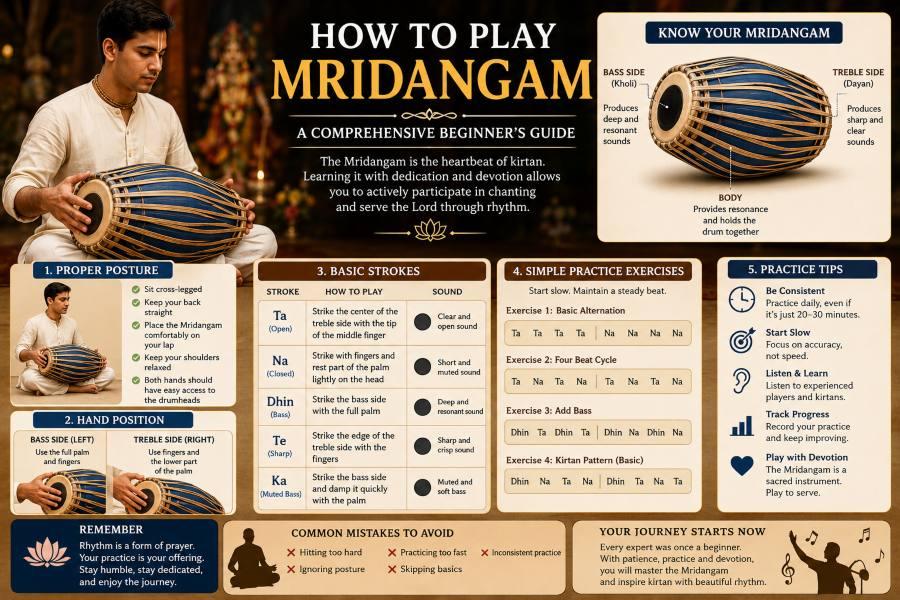
How to Play Mridangam: A Comprehensive Beginner’s Guide
Imagine sitting in the middle of a vibrant kirtan. Voices are rising, kartals are ringing, and a deep rhythmic pulse is holding everything together. The energy feels alive. The devotion feels tangible. At the center of it all is the Mridangam, one of the most beloved instruments in devotional music.
For many aspiring musicians and devotees, learning this sacred drum is the first step toward actively participating in kirtan. Those seeking authentic devotional instruments often explore the Mayapur Store, where traditional spiritual products and musical instruments connected with bhakti culture are available for practitioners around the world.
Learning the Mridangam may seem intimidating at first. After all, experienced players can produce astonishingly complex rhythms with incredible speed and precision. Yet every expert began exactly where you are now—with curiosity, enthusiasm, and a willingness to practice one stroke at a time.
This guide will help you understand not only how to play the Mridangam but also how to develop the mindset, technique, and habits needed for steady progress.
Before You Play a Single Beat
Many beginners make the same mistake.
They become obsessed with advanced rhythms before learning the fundamentals.
The truth is simple: a strong foundation saves years of frustration.
Think of the Mridangam like learning a language. Before writing poetry, you must learn the alphabet. Before performing advanced rhythmic patterns, you need to understand posture, hand placement, and basic strokes.
The students who progress fastest are often those who spend the most time refining fundamentals.
Understanding the Instrument in Your Hands
A Mridangam consists of two playing surfaces, each producing a different sound.
The Bass Side
This side creates deeper and fuller tones.
Its purpose is to provide rhythmic weight and resonance.
The bass head contributes warmth and power to kirtan accompaniment.
The Treble Side
The opposite side produces sharper and more articulate sounds.
Most beginner strokes are learned on this side first because the notes are easier to distinguish clearly.
The Body
Traditional Mridangams may be made from:
- Clay
- Fiberglass
- Wood
- Composite materials
Each material influences sound quality, durability, and portability.
Before practicing, spend time becoming familiar with every part of the instrument.
Comfort breeds confidence.
The Sitting Position Matters More Than You Think
Many beginners focus entirely on hand movements while ignoring posture.
Poor posture creates unnecessary tension and slows improvement.
A proper sitting position should allow:
- Relaxed shoulders
- Straight back
- Comfortable arm movement
- Easy access to both drumheads
The Mridangam is usually placed horizontally across the lap.
Avoid hunching forward.
Avoid raising the shoulders.
Your body should feel stable but relaxed.
When posture is correct, your hands can move naturally without strain.
Your First Lesson: Learning to Relax
A surprising number of beginners hit the drum too hard.
They assume louder means better.
It doesn't.
The best Mridangam players are not fighting the instrument. They are working with it.
Try this simple exercise:
- Place your hand gently on the drumhead.
- Strike lightly.
- Listen carefully.
- Repeat several times.
Notice how different levels of force affect tone quality.
Good sound comes from control, not aggression.
Developing a relaxed touch early will improve every aspect of your playing.
The Building Blocks of Mridangam Playing
Every rhythm is constructed from individual strokes.
Think of these strokes as letters forming words.
Open Strokes
Open strokes allow the drumhead to resonate freely.
They create clear and sustained sounds.
Closed Strokes
Closed strokes stop vibration quickly.
These produce shorter and more controlled tones.
Bass Strokes
Bass strokes create depth and rhythmic power.
They often serve as accents during kirtan accompaniment.
Combination Strokes
As your skills improve, individual strokes combine into rhythmic phrases.
These combinations eventually become the patterns heard in advanced performances.
Master each stroke separately before attempting speed.
Accuracy always comes before velocity.
Why Slow Practice Creates Fast Progress
Everyone wants to play quickly.
Very few want to practice slowly.
Ironically, slow practice is the fastest route to mastery.
When you practice slowly:
- Mistakes become obvious.
- Timing improves.
- Muscle memory develops correctly.
- Hand coordination strengthens.
Playing a pattern incorrectly at high speed simply reinforces bad habits.
Professional musicians understand this principle.
Many spend significant time practicing slowly even after years of experience.
The goal is not merely to play fast.
The goal is to play correctly.
Training Your Hands to Work Together
One challenge every beginner faces is coordination.
At first, the hands seem to operate independently.
One hand follows instructions while the other appears confused.
This is completely normal.
Coordination develops through repetition.
Try practicing simple alternating strokes:
Right hand.
Left hand.
Right hand.
Left hand.
Maintain a steady pulse.
Resist the temptation to speed up.
Over time, your hands begin communicating more efficiently.
What initially feels awkward gradually becomes automatic.
Finding the Pulse: The Secret Behind Good Rhythm
Many beginners focus entirely on the drum and forget about timing.
Rhythm is not simply striking the correct surface.
Rhythm means placing each stroke exactly where it belongs.
A simple exercise:
- Count aloud.
- Tap steadily.
- Maintain equal spacing between beats.
This develops internal timing.
Without steady timing, even technically correct strokes sound unstable.
The strongest Mridangam players possess a dependable internal pulse.
Everything else grows from that foundation.
Playing Along With Kirtan
Most devotees learn the Mridangam because they want to participate in kirtan.
This is where learning becomes exciting.
Kirtan accompaniment requires a slightly different mindset than solo performance.
Your job is not to dominate the music.
Your role is to support the chanting.
Good accompaniment involves:
- Listening carefully
- Maintaining steady rhythm
- Supporting singers
- Following tempo changes
- Enhancing group participation
The best kirtan players understand that simplicity often serves the music better than complexity.
A clean rhythm played steadily is far more valuable than flashy patterns played inconsistently.
Common Beginner Mistakes That Slow Progress
Recognizing mistakes early can save months of frustration.
Practicing Too Fast
Speed without control creates bad habits.
Ignoring Tone Quality
Every stroke should sound intentional.
Inconsistent Practice
Ten minutes daily often produces better results than two hours once a week.
Excessive Tension
Tight muscles reduce speed and accuracy.
Skipping Fundamentals
Advanced patterns become difficult when basic strokes remain weak.
Avoiding these pitfalls accelerates improvement dramatically.
How Much Should You Practice?
A common question among beginners is:
"How many hours do I need?"
The answer depends more on consistency than duration.
A practical beginner schedule:
Daily Routine
- 10 minutes basic strokes
- 10 minutes coordination exercises
- 10 minutes rhythm practice
- 10 minutes kirtan accompaniment
Forty focused minutes each day can produce impressive progress over time.
Consistency beats intensity.
The student who practices regularly usually surpasses the student who practices occasionally for long periods.
Developing Musical Listening Skills
Playing is only half the equation.
Listening is equally important.
Spend time observing experienced Mridangam players.
Pay attention to:
- Timing
- Dynamics
- Tone quality
- Transitions
Interaction with singers
Many insights can be learned simply through careful observation.
Your ears become valuable teachers.
The Spiritual Side of Learning Mridangam
The Mridangam occupies a unique position among musical instruments.
For many practitioners, learning is not merely a musical activity.
It becomes an act of service.
Each practice session can be approached with gratitude and purpose.
The goal extends beyond personal achievement.
The instrument helps support sacred chanting and devotional gatherings.
This perspective often changes the learning experience entirely.
Progress becomes less about impressing others and more about contributing meaningfully to kirtan.
Staying Motivated During the Difficult Stages
Every student encounters periods where improvement seems slow.
This happens to everyone.
Skills often develop beneath the surface before becoming visible.
During challenging periods:
- Focus on consistency.
- Celebrate small improvements.
- Record practice sessions.
- Compare progress monthly rather than daily.
- Remember why you started.
The students who continue practicing eventually experience breakthroughs.
Patience is part of the journey.
When You’re Ready for the Next Level
After mastering the basics, new opportunities open up.
You can begin exploring:
- Advanced rhythmic patterns
- Traditional compositions
- Tempo variations
- Improvisation
- Ensemble performance
At this stage, fundamentals remain important.
Even advanced players continue refining the basics throughout their musical lives.
Growth never truly ends.
Each level reveals new possibilities.
The Journey Begins With a Single Beat
Learning the Mridangam is not about becoming perfect overnight.
It is about steady progress.
One stroke becomes two.
Two strokes become patterns.
Patterns become rhythm.
Rhythm becomes music.
Music becomes service.
The most accomplished players are simply those who remained committed through thousands of small practice sessions.
Approach the instrument with patience, curiosity, and respect. Focus on consistency rather than speed. Celebrate gradual improvement.
The sacred Mridangam has inspired generations of devotees and musicians. With dedication and sincere practice, its rhythms can become part of your own spiritual and musical journey—one beat at a time.