
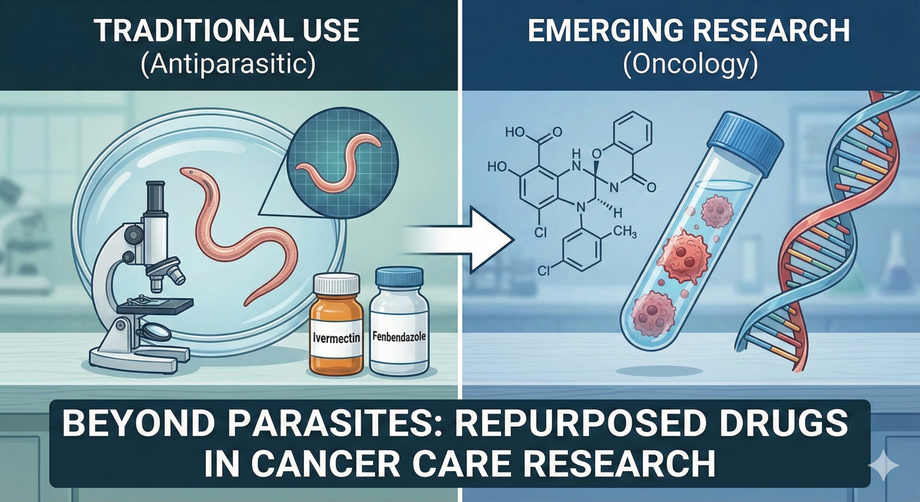
Why scientists are taking a second look at Ivermectin and Fenbendazole for cancer care, and what the current clinical data actually says.
In the world of medical research, the concept of "drug repurposing" is gaining significant momentum. This strategy involves taking existing, FDA-approved medications—originally designed for one condition—and investigating their potential to treat entirely different diseases, including cancer.
Two drugs, in particular, have moved from the veterinary and tropical medicine shelf to the oncology research lab: Ivermectin and Fenbendazole. While social media abounds with anecdotes, it is vital to separate confirmed scientific mechanisms from unproven hype.
Here is a look at the current state of research into these antiparasitic agents as of late 2025.
1. Ivermectin: From Nobel Prize to Cancer Trials
Ivermectin is best known for its role in eradicating river blindness, a discovery that won the Nobel Prize in 2015. However, recent studies suggest it may possess properties that interfere with tumor growth.
The Mechanism of Interest: Researchers have observed that Ivermectin may modulate several signaling pathways used by cancer cells to survive, specifically the Wnt/β-catenin and PI3K/Akt/mTOR pathways. By disrupting these signals, the drug has been shown in laboratory settings (in vitro) to induce apoptosis (programmed cell death) in certain cancer cell lines.
Current Status: While preclinical results are promising, human data is still emerging. There are currently Phase II clinical trials underway (such as NCT05318469) investigating the combination of Ivermectin with immunotherapy drugs like pembrolizumab for metastatic breast cancer. These studies aim to see if Ivermectin can turn "cold" tumors "hot," making them more visible to the immune system.
2. Fenbendazole: The Metabolic Angle
Fenbendazole is a standard veterinary dewormer that gained public attention after anecdotal reports of cancer remission. Scientifically, interest in this compound stems from its effect on cell structure and energy.
The Mechanism of Interest: Fenbendazole belongs to the benzimidazole class of drugs, which work by destabilizing microtubules—the "skeleton" of the cell. Cancer cells rely heavily on rapid cell division (mitosis), which requires stable microtubules. By disrupting this structure, Fenbendazole theoretically stops cancer cells from dividing. Additionally, research indicates it may block glucose uptake (the "Warburg effect"), effectively starving cancer cells of the massive amounts of sugar they need to grow.
Current Status: Unlike Ivermectin, Fenbendazole has fewer human clinical trials. Most data currently comes from cell cultures or animal models, which have shown tumor regression in some cases. However, major health organizations emphasize that safety profiles for high-dose, long-term use in humans are not yet fully established.
The Importance of Safe Sourcing
Whether used for their labeled antiparasitic purposes or as part of an approved clinical trial, the quality of the medication matters. The rise in interest has unfortunately led to a flood of counterfeit or low-grade products entering the market from overseas.
For patients and caregivers, ensuring that any medication comes from a reliable domestic source is critical. Domestic (US-to-US) shipping eliminates the risks of customs seizures, temperature damage during long international transit, and counterfeit formulas often found in unregulated cross-border trade.
Resource for Verified Sourcing: If you are looking for reliable access to standard antiparasitic medications like Ivermectin (Stromectol) or Mebendazole/Fenbendazole analogs, The Medicine Villa provides secure US-to-US delivery. We prioritize speed and product integrity, ensuring you receive your order in days, not weeks.