
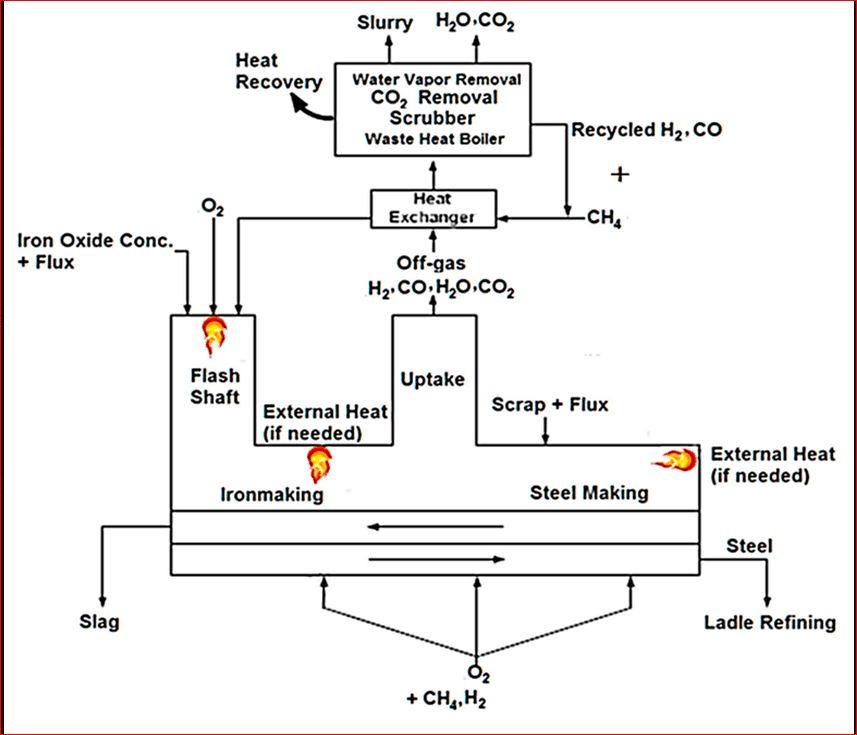
Steel is used in a wide variety of manufactured products, such as skyscrapers, automobiles, and bridges. The coke oven/blast furnace process that produces pig iron for steelmaking requires additional energy to prepare the raw iron ore as sinter and pellets, and consumes large amounts of carbon which is emitted as the greenhouse gas carbon dioxide. Alternative processes can avoid some of these issues, but are limited by low production capacities and raw material restrictions. Therefore, the U.S. steel industry would beneft from the development of a low capital cost process, scalable to large capacities that can take advantage of the availability of inexpensive iron ore concentrate, and can use fuels that signifcantly reduce potentially harmful greenhouse gas emissions.
The novel, high-intensity fash ironmaking process is a viable alternative that uses iron ore concentrates that are plentiful in the United States. The process would use inexpensive, abundant natural gas (or hydrogen) to both heat the ore in the furnace and to remove oxygen, converting the ore to iron metal. Although similar to Direct Reduced Iron, this advance would process fine powder ore, eliminating the briquetting process. The product could be added to Electric Arc Furnaces or Basic Oxygen Furnaces for cleaner steelmaking.
A major advantage of fash ironmaking over powder-based processes that use shaft or fuidized-bed furnaces is the elimination of sticking and particle fusion at high temperatures. The ability to use ore fines provides a cost advantage over processes that require ore to be agglomerated into pellets for ironmaking. The fie particles also cut the furnace’s processing time to seconds. This translates to a smaller system for the same output, reducing both capital costs and operating costs. Other potential benefits include improved refractory life, and ease of feeding raw materials into the vessel.
Potential Benefts for Our Industry and Our Nation
The fash ironmaking process would reduce energy consumption up to 15% over competitive processes by eliminating pelletizing, briquetting, or sintering.
Greenhouse gas emissions could be signifcantly reduced by using natural gas or hydrogen as the reducing agent instead of coke. Preliminary estimates show that the use of natural gas would emit 39% less carbon dioxide than with a blast furnace-based process.
Applications in Our Nation’s Industry
The fash ironmaking process could provide steel plants with signifcantly more energy efficient and customized iron production facilities than that of competing processes.
Project Description
The project objective was to conduct a comprehensive bench-scale testing campaign for the flash ironmaking process concept to:
•Validate the design concept of the flash ironmaking reactor in terms of heat supply and metallization degree.
•Determine optimum operating conditions in terms of reaction temperature, reducing gas composition, and particle residence time.
•Identify and address potential technical hurdles, such as refractory lining and iron powder collection.
•Identify and address potential safety challenges, including emergency shut- off procedures.
•Design an industrial-scale pilot plant.
•Estimate costs for the industrial-scale pilot system.
Barriers
•Achieving 1300°C–1600°C by reducing heat loss
•Achieving required particle residence time by optimizing the gas flow in the system to avoid “short circuit” paths
•Identifying suitable refractory lining for extended service
Pathways
Researchers designed and constructed a large-scale bench reactor, addressing administration, safety, and operation issues. The reactor was commissioned in 2015 and validation tests were then performed for two years. The experiments were focused on achieving metallization targets (how much oxide was converted to metal) and production rates.
Large bench reactor testing explored a wide range of operating parameters including temperature, gas velocity, supplemental heating, and refractory types. Optimum operating parameters were established through a series of designed experiments.
The design team also used a physics-based computer simulation with reactive flow combustion, fluid dynamics and heat transfer to assist in the design of a next generation pilot facility.
In the final phase of the project, the team developed an advanced design concept with construction and operating cost estimates for a 3000 tonne/year pilot-plant.
Milestones
This project began in 2012 and was completed in August 2018.
•Completed system design, specifications, and build requirements for a 1 kg/hr bench reactor at University of Utah, compliant with all safety and environmental regulations
•Built the system and commissioned the reactor, confirming temperatures to be greater than 1400°C, ore feed rate to be greater than 1 kg/hr, and operation time to be greater than six hours
•Achieved greater than 95%metallization with 1.5 times the theoretical minimum amount of reducing gas
•Determined optimum conditions for the flash ironmaking process
•Provided detailed cost estimates and design for industrial pilot plant
Technology Transition
Options regarding the pilot plant were provided and considered by the industrial steel participants. The American Iron and Steel Institute (AISI) developed a commercialization plan and, at the end of the project, was actively seeking funding for construction of a pilot plant. AISI will also maintain and coordinate intellectual property activities regarding patents. Initial entry into the mainstream market will likely be via steel manufacturing facilities looking for a more cost-effcient alternative ironmaking process with reduced carbon emissions.
Project Partners
American Iron and Steel Institute Washington, D.C. Project Director: Michael Sortwell Email: msortwell@steel.org
University of Utah (Lead Research Organization) Salt Lake City, UTAH Principal Investigator: H. Y. Sohn Email: h.y.sohn@utah.edu
Berry Metal Company Harmony, PA
ArcelorMittal USA East Chicago, IN
The Timken Company Canton, Ohio
United States Steel Corporation Pittsburgh, PA
For additional information, please contact
Bill Prymak Technical Project Officer U.S. Department of Energy Advanced Manufacturing Office Phone: (720) 356-1754 E-mail: Bill.Prymak@ee.doe.gov ^
The final report is available at: www.osti. gov/scitech: OSTI Identifier: 1485414 Here it is.