
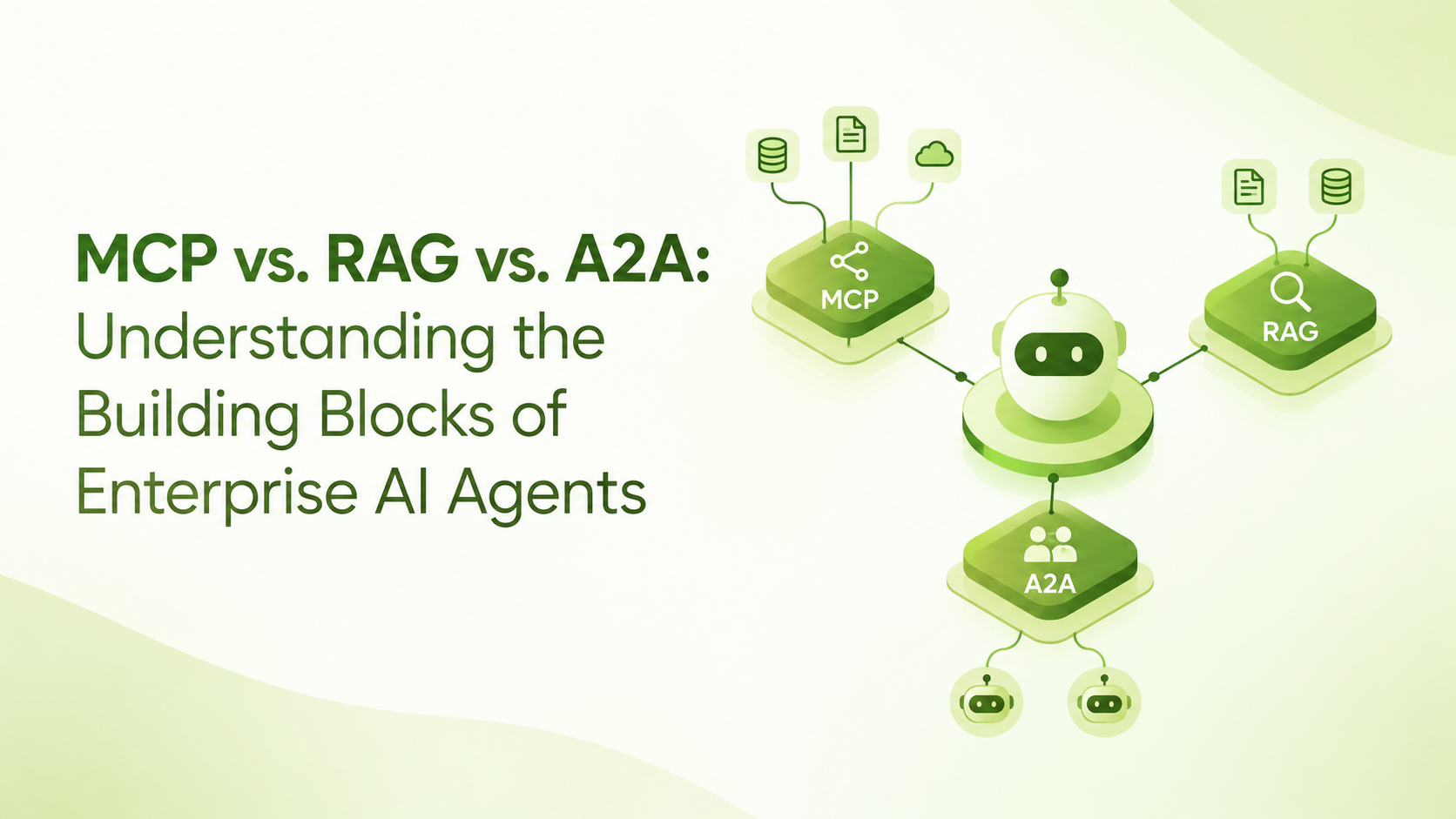
“MCP,” “RAG,” and “A2A” turn up in the same conversations often enough that they start to sound like three names for the same idea. They are not.
· The Model Context Protocol (MCP) is a connection standard: one consistent way for an AI application to reach tools, files, and business systems, instead of a custom integration per source.
· Retrieval-augmented generation (RAG) is a reasoning technique that relies on the retrieval and citation of passages to inform the model's response, which is why “what is RAG” is one of the most searched enterprise AI questions this year.
· The Agent2Agent protocol (A2A) is a standard of coordination: allows different vendors to build agents whose internals do not need to be shared with one another when passing a task between them.
If any is used as a representative for the other, then they will generate an agent that can reach a tool but can't cite a source, or retrieve an answer but can't pass a task off. The point of picking on a favourite isn't the actual guarantees that each layer gives, it's the fact that governance must lie below all three of them.
MCP: The Connection Layer
Anthropic introduced the Model Context Protocol in November 2024, describing it as an open standard for connecting AI applications to “the systems where data lives, including content repositories, business tools, and development environments.” Before MCP, connecting an assistant to a new data source usually meant a custom integration for each pairing of model and tool. MCP replaces that with one interface: any MCP-compatible application can talk to any MCP-compatible server the same way, the comparison of the protocol’s own documentation draws to a USB-C port for AI applications, a single connector that works everywhere rather than one per device.
Adoption moved fast. Early partners Block and Apollo built MCP into their own products within months, and developer tools including Zed, Replit, Codeium, and Sourcegraph followed soon after. By 2026, support runs well past Anthropic’s own Claude: OpenAI’s developer documentation now describes MCP as “becoming the industry standard for extending AI models with additional tools and knowledge,” and the protocol ships in Visual Studio Code and Cursor too. What MCP guarantees is narrower than that momentum suggests: a consistent way to expose a tool or data source, nothing about whether the agent should see everything the connection exposes. That is a governance question for the layer underneath, not the protocol itself.
RAG: The Knowledge Layer
Where MCP governs how an agent reaches a system, retrieval-augmented generation governs what it does with what it finds there. The technique was introduced in a 2020 paper (Lewis et al., NeurIPS 2020) pairing a language model’s own parameters with a retrieval step over an external source, so the model does not need to already know an answer, only how to find one. A rag platform built for the enterprise retrieves the passages most relevant to a question the moment it is asked, then generates an answer grounded in what it found, source attached, rather than a list to open and read. Most deployments expose that retrieval step through a rag API that other internal applications call directly.
That grounding is a large part of why “what is RAG” ranks among the highest-volume enterprise AI questions searched this year: it turns an assistant that answers from memory into one that answers from a company’s own current records. The limitation runs the other way. RAG describes how retrieval and generation combine; it says nothing about which connections an agent has in the first place, MCP’s job, or how several agents divide a task, A2A’s. A governed data layer underneath retrieval, the kind Vaulti Lake (Vaultiscan’s data layer) provides, is what keeps a cited answer from quietly becoming an inference assembled from fragments nobody meant to expose together.
A2A: The Coordination Layer
Google introduced the Agent2Agent protocol in April 2025, an open standard letting agents built by different vendors communicate and coordinate work without exposing their internal logic to each other.
A2A enables agent-to-agent interactions: a procurement agent assigning a contract review task to a legal agent, a finance agent retrieving a verified figure from an operations agent, or any other agent-to-agent interaction on different infrastructures without any custom handoff between them. Google joined A2A with over 50 technology partners, including Salesforce, SAP, ServiceNow, MongoDB and PayPal, and integrators including Accenture, Deloitte and McKinsey.
A2A answers a real, growing problem: a multi-agent AI system built from specialised agents needs a way to talk to each other without every pair being custom-built. It does not answer which agent should hand off which task, or what happens once one agent’s output feeds a real-consequence action. That permission and audit question is what Vaulti GPT, Vaultiscan’s governed assistant layer, logs at the point each agent acts, not after the fact.
MCP, RAG, and A2A Side by Side
The three protocols solve different problems well enough that a mature enterprise AI stack typically runs all of them at once. Some breakdowns of this stack list four layers instead of three, adding “AI agents” alongside MCP, RAG, and A2A. That framing conflates the actor with its tools: the agent is what connects, retrieves, and coordinates, not a fourth protocol to weigh against the other three. The table below separates what each of the three actually standardises from what it leaves for someone else to govern.
|
Layer |
What It Standardises |
What It Connects |
What It Leaves Open |
|
MCP |
How an agent reaches a tool or data source |
Agent to tool or system |
Which parts of that source the agent should actually be allowed to see |
|
RAG |
How retrieval becomes a generated answer |
Agent to a knowledge base or document set |
Whether the retrieval pulled the right passages, or blended sources it should not have combined |
|
A2A |
How one agent hands work to another |
Agent to agent, across vendors and frameworks |
A record of which agent acted, on whose authority, once the task has moved on |
How the Three Work Together in Practice
Take a commercial property claim moving through a claims handler’s agent. The agent needs MCP to reach the policy management system and the document repository in the first place, one connection standard instead of a custom integration for each. Once connected, it needs RAG to retrieve the specific coverage clause and the prior loss history relevant to this claim, cited rather than recalled from a general sense of how similar policies usually read. If the claim value crosses a threshold that requires underwriting sign-off, it needs A2A to hand the file to a separately built underwriting agent, one the claims team did not build and does not control end to end. Take any one layer away and the claim stalls: no connection, nothing to retrieve from; no retrieval, an answer with no source; no handoff, a task stuck with an agent that was never meant to finish it alone.
This is also why the three rarely arrive on a project plan in the same order they get discussed. Most teams reach for MCP and RAG together from the start, since an agent usually needs to connect before it has anything worth retrieving. A2A tends to show up later, once a second agent, often owned by a different team or a different vendor, enters the picture and the work has to cross that boundary.
The Ecosystem Behind the Protocols
Both protocols are young but growing fast. By August 2026, the Linux Foundation’s Agentic AI Foundation (AAIF) counted 247 member organisations tracking 116 open-source projects across five layers of the agentic AI stack. Anthropic’s MCP was an anchor project when the foundation launched in December 2025, and Google’s A2A joined the same foundation later in 2026. “Top financial institutions like Visa and Wells Fargo, alongside major APAC technology leaders like Alibaba, recognise that building agents at scale requires neutral infrastructure they can depend on,” said Mazin Gilbert, the foundation’s executive director, announcing that growth.
The ecosystem still has growing pains: Wiz researchers found roughly 100 of the 3,500 servers listed on one public MCP registry linked to repositories that no longer existed, alongside typosquatted packages and “rug pull” updates that turn a previously safe server malicious. In other words, this immaturity must be considered in the construction of these protocols, rather than their momentum.
Frequently Asked Questions
1. What is the difference between MCP and RAG?
MCP is a connection standard: it defines how an AI application reaches a tool or data source. RAG is a reasoning technique: it defines how a model turns what it retrieves into a grounded, cited answer. An agent can use MCP to reach a document store and still need RAG on top of that connection to answer a question well.
2. Do I need A2A if I only run one AI agent?
No. A2A solves coordination between separately built agents. A single agent talking to its own tools and data needs MCP and, usually, RAG; A2A becomes relevant once a second agent, often built by a different team or vendor, needs to hand off work or exchange results with the first.
3. Is MCP secure enough for enterprise use?
While the protocol is actively maintained, its open ecosystem is still very young. A study revealed that there were significant gaps in the trust of registries and supply chain among public MCP servers. An MCP connection should be treated like all new connections, rather than as an auto-trusted connection, since it is based on a standard protocol.
4. How do MCP, RAG, and A2A fit together in one enterprise AI stack?
MCP typically sits at the bottom, connecting an agent to its tools and data. RAG sits above that, turning retrieved content into an answer. A2A sits on top of both, and passes a task to another agent when it falls into a domain it does not have. Governance, permissions, retrieval provenance, and audit logging all have to run through every layer rather than live in just one of them.
5. Which one do I actually need: MCP, RAG, or A2A?
Start with what the agent has to do. If it needs to reach a tool or a data source it cannot already see, that is MCP. If it needs to answer a question from current, cited company knowledge rather than only what the model learned in training, that is RAG. If the work has to cross from one agent to a separately built one, whether that is a different team or a different vendor, that is A2A. Most production deployments end up needing MCP and RAG together from day one; A2A becomes relevant once a second agent enters the picture.
Three Blocks, One Working Stack
MCP, RAG, and A2A are not competing choices; they are three building blocks a working enterprise agent stack is made of, each answering a different part of how do AI agents work end-to-end. Reach for MCP when the gap is a tool or system the agent cannot yet see. Reach for RAG when the gap is an answer that has to come from current, citable company knowledge rather than the model’s training. Reach for A2A once the work has to cross from one independently built agent to another. Most agents in production today start with the first two; the third arrives the moment a second agent enters the picture. Standardising how the blocks connect most of the job. What still needs a name is who is allowed to use each connection, retrieve each document, and act on each handoff, the layer a platform like Vaultiscan is built to sit underneath all three.