
The Syrian Democratic Forces (SDF) commander Mazloum Abdi has called for a secular and decentralised Syria following the fall of Bashar al-Assad’s regime in December. He said negotiations with the new authorities in Damascus are ongoing with US-led coalition mediation.
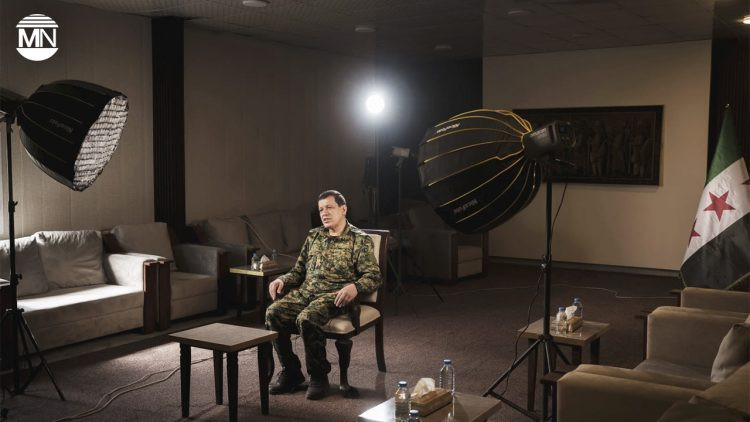
“The fall of the regime was a historic step, and based on that, a new Syria should be built without restoring the Ba’ath party or its ideology,” Mazloum Abdi, commander of the US-backed Syrian Democratic Forces (SDF), said in an interview with AP on Sunday, outlining his vision for the country’s future.

Abdi stressed that Syria must be rebuilt as a decentralised and secular state that guarantees equal rights for all its ethnic and religious communities. His comments come after the Assad family’s 54-year rule collapsed on December 8, when insurgents led by the Islamist Hayat Tahrir al-Sham (HTS) seized Damascus after a conflict which has gone on since 2011, leaving half a million dead and displacing millions.
Abdi confirmed that he recently met with Syria’s interim President Ahmad al-Shara’a in Damascus and that negotiations are ongoing between the SDF and the new authorities with the mediation of the US-led Coalition to Defeat Da’esh (ISIS), which includes the United States, Britain and France. “We will continuously try to see how Syria of the future will look like,” he said, adding that the talks aim to determine the country’s governance structure and the future of the Kurdish-led forces.
While he did not comment on the meeting where al-Shara’a was declared interim president, Abdi stressed that the SDF had not been present at the discussions that led to the suspension of the 2012 constitution and the dissolution of the Syrian army and security apparatus. “The matter was not discussed with us,” he noted. The SDF’s stance, he said, would depend on the outcome of negotiations with the new leadership.
Regarding Syria’s political future, Abdi reaffirmed that the SDF envisions a united country under a decentralised system rather than Kurdish independence. “Syria is not Iraq, and Iraq is not Syria, and northeast Syria is not (Iraqi) Kurdistan,” he stated, dismissing any aspirations for autonomy similar to that of Iraq’s Kurdish region.
Despite ongoing discussions about security integration, the SDF has not yet agreed to dissolve and merge into the new Syrian military structure. “In principle, we want to be part of the defence ministry and part of Syria’s defence strategy,” Abdi said, adding that a proposal had been sent to Damascus and that they were awaiting a response. He insisted that the rights of SDF fighters, who have been battling Islamic State (ISIS) for over a decade, must be protected in any agreement.
Abdi also warned that ISIS has capitalised on Assad’s downfall, seizing abandoned military posts and stockpiling weapons. He emphasised that the continued presence of US troops in Syria remains essential to prevent a resurgence of the extremist group. “The reason for them [US troops] to stay is still present because Da’esh is still strong,” he said.
With the situation in Syria rapidly evolving, the SDF remains engaged in dialogue to shape the country’s post-Assad future. Abdi maintained that their vision is based on democratic values, ensuring all Syrians, regardless of ethnicity or religion, have a place in the country’s governance.