
Managing infrastructure across multiple public cloud providers has become an essential operational practice for scaling businesses. Relying on a single cloud vendor introduces risks such as provider lock-in, unexpected pricing increases, and regional service interruptions. Deploying workloads across platforms such as Amazon Web Services (AWS), Microsoft Azure, and Google Cloud Platform (GCP) allows organizations to maximize uptime, comply with data sovereignty mandates, and optimize infrastructure spend.
However, operating a multi-cloud footprint introduces administrative challenges. Fragmented control panels make system visibility difficult, create security policy inconsistencies, and compli
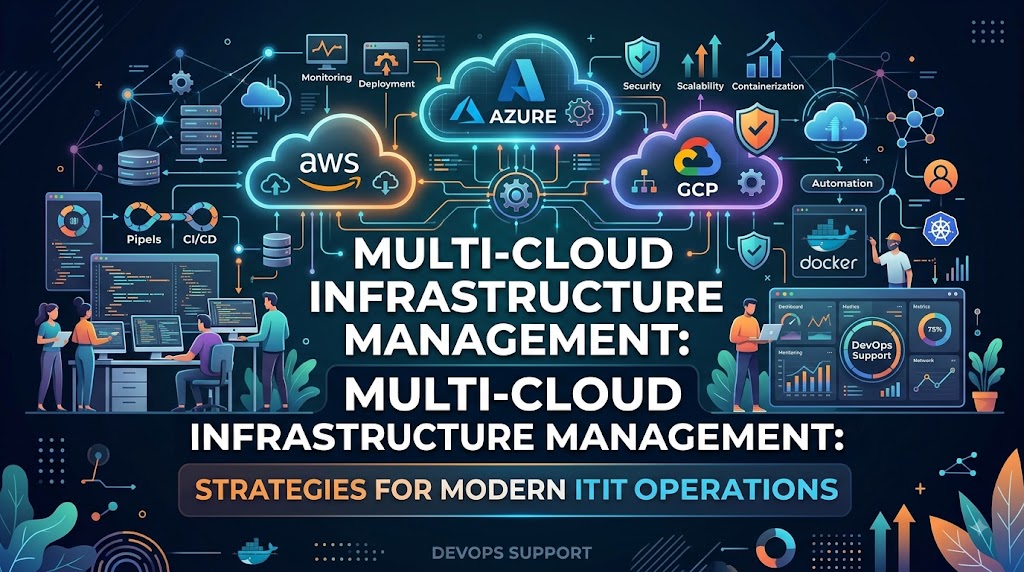
cate software deployments. Without unified automation, standardized container management, and centralized monitoring, multi-cloud setups can result in unmanaged cloud spend and unexpected downtime. Achieving operational resilience requires a structured framework based on Infrastructure as Code, containerization, and continuous observability.
What Multi-Cloud Infrastructure Management Means
Multi-Cloud Infrastructure Management involves the administration, deployment, monitoring, and security of software applications running across two or more public or private cloud environments.
┌────────────────────────────────────────────────────────────────────────┐
│                        UNIFIED GOVERNANCE LAYER                        │
│         (Policy as Code | Continuous Delivery | Orchestration)         │
└──────────────────────────────────┬─────────────────────────────────────┘
                                   │
          ┌────────────────────────┼────────────────────────┐
          │                        │                        │
          ▼                        ▼                        ▼
┌──────────────────┐     ┌──────────────────┐     ┌──────────────────┐
│    AWS CLOUD     │     │   AZURE CLOUD    │     │    GCP CLOUD     │
│  (Compute / EKS) │     │  (Compute / AKS) │     │  (Compute / GKE) │
└──────────────────┘     └──────────────────┘     └──────────────────┘
Unlike hybrid cloud models—which specifically combine on-premise hardware with public cloud resources—a multi-cloud strategy deliberately divides workloads across multiple public cloud vendors.
Key motivators for adopting a multi-cloud framework include:
-
Operational Risk Reduction: Distributing services across distinct providers prevents total platform outages if one cloud vendor suffers a major regional failure.
-
Workload-Specific Deployment: Teams can run compute-heavy artificial intelligence workloads on clouds tailored for data processing while running core databases on platforms designed for enterprise integrations.
-
Geographic Data Sovereignty: Local privacy laws often require regional user data to stay within specific borders, making targeted local cloud setups necessary.
-
Commercial Freedom: Maintaining portable infrastructure prevents total reliance on a single vendor's contract terms and pricing models.
In modern DevOps workflows, multi-cloud management decouples application software from the underlying host provider. Containerization and cloud-agnostic tools allow development teams to build applications once and run them consistently across any cloud platform.
Why Multi-Cloud Optimization Matters for Growing Businesses
Running workloads across cloud boundaries without an optimization framework creates compounding technical friction. Growing companies require high system availability and fast deployment velocity, both of which suffer when systems are fragmented.
Maximum Uptime and Automated Failover
System downtime damages customer trust and top-line revenue. Multi-cloud setups allow organizations to run active-active or active-passive traffic strategies. If a primary cloud provider experiences network issues, automated DNS routing shifts user requests to healthy secondary clusters without manual intervention.
Controlling Cloud Expenditures
Unmanaged cloud infrastructure leads to resource waste—idle compute instances, forgotten storage volumes, and unattached virtual disks generate unnecessary costs across isolated accounts. Centralized platform monitoring gives administrators clear visibility to right-size compute nodes, use spot capacity, and keep monthly cloud billing predictable.
Uniform Security and Compliance
Security frameworks vary across cloud platforms. AWS uses IAM, Azure relies on Microsoft Entra ID, and GCP uses Google Cloud IAM. Unifying access permissions, data encryption rules, and compliance policies across providers eliminates misconfigurations—the leading cause of cloud security breaches.
Core Pillars of a Multi-Cloud Infrastructure
Constructing an adaptable multi-cloud platform relies on foundational operational standards that maintain structural consistency across all deployment targets.
+-------------------------------------------------------------------+
|                  CORE MULTI-CLOUD BUILD BLOCKS                    |
+-------------------------------------------------------------------+
|  1. Infrastructure as Code (IaC)  --> Declarative Configuration   |
|  2. Container Orchestration       --> Universal Runtime API       |
|  3. Centralized Observability     --> Unified Metrics & Tracing   |
|  4. Cloud-Agnostic CI/CD          --> Automated Build Pipelines   |
+-------------------------------------------------------------------+
Declarative Infrastructure as Code (IaC)
Configuring resources manually inside cloud consoles causes configuration drift and human error. Declarative IaC tools—such as Terraform or Pulumi—let teams define networking, security rules, and compute resources as code files that can be version-controlled, reviewed, and deployed identically across any cloud.
Kubernetes for Standardized Orchestration
Containers isolate application software from host operating systems, making Kubernetes the industry standard runtime for multi-cloud deployments. Managed Kubernetes solutions enable software teams to deploy, scale, and maintain microservices uniformly across AWS, Azure, GCP, or bare-metal servers.
Unified Observability and Telemetry
Collecting metrics, logs, and trace data in a central location is vital when microservices span distinct networks. Routing telemetry data into a consolidated observability platform ensures that Site Reliability Engineering (SRE) teams can monitor system health and isolate bottlenecks without switching between vendor dashboards.
Vendor-Agnostic Continuous Delivery
Deployment workflows must remain decoupled from target cloud platforms. Continuous Integration and Continuous Delivery (CI/CD) pipelines should compile source code, execute unit tests, perform vulnerability scans, and push updates to destination clusters regardless of physical host location.
Practical Industry Use Cases
Organizations across diverse technical sectors implement multi-cloud strategies to resolve specific operational challenges:
-
Financial Technology (FinTech): Payment processing platforms host core transaction engines across isolated cloud vendors to meet strict regulatory uptime rules, ensuring continuity during vendor disruptions.
-
Global E-Commerce: Retail platforms experience extreme seasonal traffic spikes. Multi-cloud deployments allow engineers to distribute incoming user traffic beyond the single-region compute quotas of individual cloud providers.
-
Healthcare Technology: Healthtech applications handle sensitive patient records subject to regional privacy laws. Localized cloud facilities handle compliant data storage, while non-sensitive analytics processing runs on public cloud clusters.
-
Enterprise SaaS Platforms: Business-to-business software vendors offering single-tenant instances let enterprise customers select their preferred cloud vendor to match existing internal IT policies.
Common Multi-Cloud Operational Challenges
While multi-cloud deployment provides clear resilience benefits, it introduces technical complexities that platform teams must manage:
-
Increased Operational Complexity: Navigating multiple management portals, complex cross-cloud network interconnects, and distinct identity models increases cognitive load on systems administrators.
-
Bandwidth Data Egress Fees: Transporting large volumes of data across cloud provider boundaries incurs bandwidth egress charges. Architectures that rely on continuous cross-cloud data replication risk escalating operational expenses.
-
Security Policy Drift: Keeping firewall rules and access permissions aligned across distinct platforms is difficult. Applying a security rule on one cloud while missing it on another opens up immediate security vulnerabilities.
-
Specialized Engineering Skill Gaps: Hiring engineering talent proficient across AWS, Azure, GCP, Kubernetes, and specialized platform security tooling remains a major recruiting challenge.
Best Practices for Multi-Cloud Management
To control operational costs while maintaining deployment velocity, engineering teams should follow these core practices:
-
Enforce Declarative Infrastructure: Define all cloud environments using version-controlled IaC templates. Avoid manual edits inside vendor management consoles to prevent configuration drift.
-
Centralize Identity and Access Management: Implement single sign-on (SSO) and federated identity management so engineers and automation pipelines operate using short-lived credentials grounded in least-privilege principles.
-
Consolidate Telemetry Collection: Direct log streams, performance traces, and performance metrics from all cloud platforms into a unified monitoring suite.
-
Design for Data Locality: Keep compute resources close to their associated databases within the same cloud region to minimize latency and avoid cross-cloud egress fees.
-
Automate Security Audit Procedures: Deploy policy-as-code security scanners to continuously audit multi-cloud configurations against standard security baselines like CIS and NIST.
Role of Professional DevOps Support Partners
Architecting and maintaining a multi-cloud infrastructure requires specialized expertise that can stretch internal resources. To keep core engineering teams focused on product development, organizations frequently partner with external technical specialists to build automation pipelines, maintain security, and monitor infrastructure.
Partnering with an experienced technical team provides immediate access to cloud expertise without extended hiring cycles. Working with a dedicated DevOps Support Company India gives growing platform teams access to skilled engineers experienced in Kubernetes, cloud networking, and automated pipeline governance.
Depending on technical requirements, external support typically targets specific operational areas:
-
Managed DevOps Services: Full oversight of deployment pipelines, IaC setups, and multi-cloud governance structures.
-
Kubernetes Support Services: Production cluster hardening, automated scaling, and cross-cloud management for EKS, AKS, and GKE.
-
Cloud Infrastructure Optimization: Targeted AWS DevOps Support Services or Azure DevOps Support Services designed to improve cloud configurations, strengthen security posture, and optimize monthly costs.
-
DevSecOps Support Services: Direct integration of automated code scanning, dependency auditing, and secrets management into active CI/CD build cycles.
-
SRE Support Services: Establishing strict Service Level Objectives (SLOs), managing error budgets, and organizing structured incident response protocols.
-
MLOps Support Services: Dedicated infrastructure management to train, deploy, and monitor machine learning models across distributed cloud compute environments.
Engaging specialized technical partners like DevOps Support allows internal product teams to focus on software innovation, leaving infrastructure stability, automated scaling, and compliance to systems specialists.
Comparing Multi-Cloud Operating Approaches
Selecting an appropriate operating framework depends on internal team capacity, technical requirements, and strategic goals.
Future Trends in Multi-Cloud Infrastructure
As cloud technology matures, multi-cloud operations are moving toward higher abstraction layers, automated decisions, and improved developer tooling.
Platform Engineering and Developer Portals
Organizations are increasingly forming platform engineering teams to build Internal Developer Platforms (IDPs). IDPs abstract complex multi-cloud mechanics away from application developers. Software engineers can deploy services using self-service portals, while the underlying platform automatically handles infrastructure provisioning, networking, and policy compliance.
AIOps and Automated Incident Remediation
Artificial intelligence platforms are changing observability by analyzing system telemetry streams in real time. Advanced AIOps tools identify system anomalies early, forecast resource constraints, and execute automated remediation scripts across multi-cloud environments before end-users experience performance drops.
Edge Computing Integrations
Multi-cloud architectures are expanding beyond centralized data centers out to the physical network edge. Processing data close to end-users dramatically reduces network latency for real-time applications, mobile platforms, and IoT networks—making unified edge-to-cloud management a top priority for engineering teams.
Frequently Asked Questions
What is the main difference between hybrid cloud and multi-cloud?
A hybrid cloud model explicitly combines private on-premise infrastructure with public cloud resources. A multi-cloud strategy specifically describes using services from two or more distinct public cloud vendors (such as AWS, Azure, or GCP).
How does a multi-cloud strategy affect monthly operational costs?
A multi-cloud approach can improve cost efficiency by allowing organizations to run specific workloads on platforms offering the best performance-to-price ratio. However, unmanaged environments can lead to unexpected charges due to resource waste, unoptimized instances, and cross-cloud egress bandwidth fees.
Why is Kubernetes important for multi-cloud deployments?
Kubernetes acts as a universal abstraction layer over diverse cloud platforms. Because Kubernetes APIs function consistently across all target environments, engineering teams can containerize software and deploy it uniformly across AWS, Azure, GCP, or bare-metal systems using standard manifest files.
How can security policies remain consistent across multiple clouds?
Security consistency is maintained by defining configurations strictly through declarative Infrastructure as Code, establishing federated single sign-on (SSO), centralizing secrets management, and using automated policy-as-code scanning tools to continuously evaluate configurations against unified compliance standards.
When should an organization consider external DevOps support?
An organization should consider external support when internal teams face operational bottlenecks, struggle to maintain 24/7 incident coverage, lack specialized skills in container orchestration or multi-cloud security, or need to accelerate infrastructure timelines without hiring additional internal headcount.
Conclusion
Deploying a well-structured multi-cloud architecture provides enterprise organizations with high system availability, operational flexibility, and protection against single-vendor reliance. While managing multi-provider environments introduces technical complexity, prioritizing Infrastructure as Code, container orchestration, federated identity, and centralized observability creates a reliable foundation for enterprise software operations.
Whether managed entirely through internal platform teams or supported by specialized technical partners, a modern multi-cloud platform delivers the stability and agility needed to support ongoing business growth.