
'I continue to protest, but with a knot in my stomach': How Sweden is discouraging foreigners from taking climate action
By Anne-Françoise Hivert (Malmö (Sweden) regional correspondent)
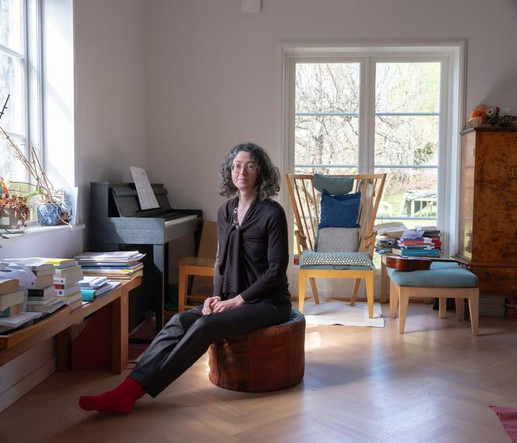 Isabelle Letellier, a French climate activist and university lecturer in Stockholm, poses for a portrait in the living room of the house she shares with her partner and their two sons in a neighborhood in western Stockholm. LOULOU D'AKI FOR M LE MAGAZINE DU MONDE
On September 17, 2023, Isabelle Letellier left her home in western Stockholm early in the morning. Active for just over four years with the group Scientist Rebellion, a branch of the environmental movement Extinction Rebellion, the university lecturer – who holds a PhD in psychology – was due to meet others at Bromma airport, three kilometers from her home, to join a protest against private jets, which are major emitters of CO₂. Her sons, now 9 and 11, had a basketball game and a birthday party that afternoon. She expected to be home by lunchtime. But nothing went as planned.
With curly hair and round glasses, sitting in her living room with books lining the walls, 43-year-old Letellier recalled the moment everything changed. There were 17 activists that day, gathered in the parking lot in front of the private jet terminal. She was holding a banner calling for a ban on private jets when two of her fellow activists threw red paint on a hangar and a jet. Armed police arrived and placed all the demonstrators under arrest.
In mid-April 2026, all 17 activists stood trial for "vandalism and complicity in vandalism" at the Attunda court, in the north of the capital, during a three-day hearing where they justified their actions as a response to the "climate emergency." The Frenchwoman's case drew particular attention. Beyond illustrating the growing crackdown on environmental activists in Sweden, it shed light on a double penalty for foreign nationals: In August 2024, Letellier was denied Swedish citizenship. "To obtain Swedish citizenship, the applicant must have led and continue to lead a calm and respectable life in Sweden," the immigration authorities argued.
Awakening
This university lecturer in Stockholm said she did not understand how things had come to this. In September 2023, she had not taken part in any act of vandalism. At no point did she imagine she would end up at the police station, where she was strip-searched before being placed in a cell – without her glasses or her phone – questioned without her lawyer, and released only eight hours later.
Letellier has lived in Sweden since 2013. She met her partner, who is Swedish and also a researcher, at a conference in Italy. "That was when we still flew without a second thought." Five years later, the couple decided to stop flying. It was a time of growing awareness. In the summer of 2018, temperatures in Sweden hit record highs, and the country's forests were ravaged by wildfires.
One month before the legislative elections held on September 9, 2018, 15-year-old Greta Thunberg, with her signature brown braids, began her school strike for the climate. "Seeing that little girl sitting alone outside the Parliament, facing the world, did something to me," Letellier recalled. She read everything she could find on the climate crisis, to the point of developing "a kind of addiction." She was traumatized by the scale of the threat she discovered and by her own sense of powerlessness. She then began "frantically" signing petitions but realized "that wouldn't save the world."
'Chilling effect'
In the United Kingdom, the civil disobedience movement Extinction Rebellion had emerged just a few months earlier. The first protests were organized in Sweden. In spring 2019, Letellier joined a small group of activists staging a die-in (a protest in which participants lie down on the ground) outside Parliament.
An opera singer performed an aria by composer George Frideric Handel, taken up by the protesters. "Aesthetically, it was sublime," recalled the researcher, who at the time appreciated the dialogue with law enforcement. Delighted by the experience, she took part again. But the atmosphere gradually changed. In September 2022, the right-wing liberal conservatives and the far right won the elections. As the country's CO₂ emissions rose, the rhetoric against environmental activists hardened.
When Letellier left the police station on September 17, 2023, she discovered that the protest at Bromma's private jet terminal was making headlines across Swedish media. The state-owned company Swedavia, which operates the country's airports, accused the activists of preventing the landing of an air ambulance. "If the person being transported (...) dies, the activists should be prosecuted for murder," a conservative MP wrote on X. The information, amplified by the police, later proved to be false. But "many people still believe it today."
In March 2025, the United Nations special rapporteur on environmental defenders, Michel Forst, traveled to Stockholm to call for "the immediate cessation of proceedings" against the academic. To no avail. In a letter to the Attunda court dated March 23, 2026, he warned of "the chilling effect" of the trial, which "may have a devastating impact on the exercise by members of the public in Sweden of their fundamental rights associated with peaceful protest."
Letellier continues her activism, but "with a knot in her stomach," leaving as soon as law enforcement appears. She does not want to risk having her conduct questioned again, especially as a new and highly controversial law will, starting this summer, allow authorities to suspend the residence permits of those accused of not having an "honest and conscientious lifestyle." The court's decision is expected on May 4.
Anne-Françoise Hivert (Malmö (Sweden) regional correspondent)