
PVDF tubes are widely used in industries where excellent chemical resistance, durability, and reliable performance are required. Polyvinylidene fluoride (PVDF) is a high-performance fluoropolymer known for its resistance to aggressive chemicals, moisture, UV exposure, and elevated temperatures. Because of these properties, PVDF tubes are used in chemical processing, semiconductor manufacturing, pharmaceutical applications, water treatment, food processing, and other demanding industrial environments.
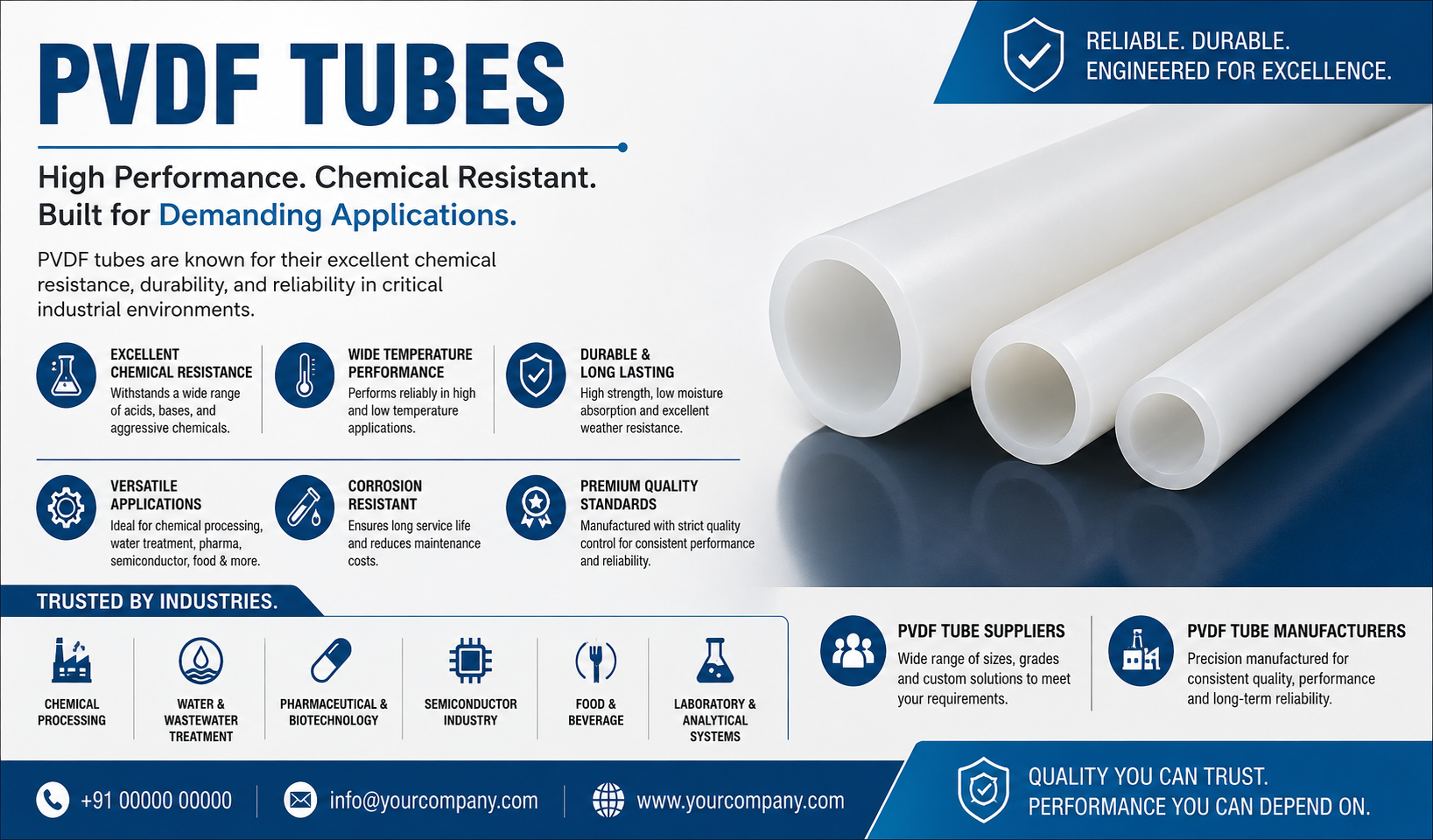
Choosing the right PVDF tube is important because tube quality, dimensions, material grade, and manufacturing consistency can directly affect the performance and service life of an application. Companies looking for dependable PVDF tube suppliers should evaluate more than price and availability. Material quality, technical specifications, manufacturing capabilities, and application suitability are equally important.
What Are PVDF Tubes?
PVDF tubes are tubular components manufactured from polyvinylidene fluoride, a thermoplastic fluoropolymer with strong chemical and mechanical properties. PVDF can withstand exposure to many corrosive chemicals and aggressive environments while maintaining good dimensional stability.
Unlike conventional plastic tubing, PVDF tubing is designed for applications where ordinary polymers may not provide adequate chemical resistance or long-term reliability. Its combination of strength, low moisture absorption, weather resistance, and chemical stability makes it suitable for specialized industrial applications.
PVDF tubes are available in different sizes, wall thicknesses, grades, and configurations depending on the intended application. The appropriate specification should be selected according to operating temperature, pressure, chemical exposure, and mechanical requirements.
Key Properties of PVDF Tubes
One of the major advantages of PVDF is its excellent chemical resistance. PVDF tubes can provide reliable performance in environments involving many acids, bases, solvents, and other aggressive substances. However, compatibility should always be verified for the specific chemical, concentration, temperature, and operating conditions.
PVDF also offers good mechanical strength and abrasion resistance. This allows PVDF tubing to maintain its structural integrity in demanding environments where durability is important.
Another important characteristic is temperature resistance. PVDF can perform across a relatively wide temperature range, making it useful for applications involving elevated temperatures. The actual service temperature depends on the specific grade, design, pressure, and operating environment.
PVDF is also resistant to UV radiation and weathering. This makes it suitable for certain outdoor applications where long-term exposure to sunlight and environmental conditions could affect less-resistant materials.
Low moisture absorption is another useful property. PVDF maintains relatively stable physical characteristics in humid environments, which can be advantageous for industrial applications involving water or moisture.
Common Applications of PVDF Tubes
PVDF tubes are used across numerous industries because of their combination of chemical resistance and durability. Chemical processing is one of the most common application areas. PVDF tubing can be used for transferring or handling compatible chemicals and fluids in processing systems.
Water and wastewater treatment facilities also use PVDF components because the material can withstand many chemicals commonly found in treatment processes. Depending on the system design and chemical compatibility, PVDF tubes can be incorporated into fluid handling and chemical dosing applications.
The semiconductor industry requires materials capable of maintaining cleanliness and chemical resistance. PVDF is used in certain fluid handling systems and equipment where contamination control and resistance to aggressive chemicals are important.
Pharmaceutical and biotechnology applications may also use PVDF tubing and components in suitable systems. Material selection in these applications should consider regulatory requirements, cleanliness, sterilization methods, and the specific process environment.
PVDF tubes can also be found in laboratory equipment, analytical systems, industrial machinery, chemical storage systems, and specialized fluid handling applications.
Advantages of Using PVDF Tubes
The biggest advantage of PVDF tubes is their ability to perform in chemically demanding environments. Compared with many conventional thermoplastics, PVDF offers a useful combination of chemical resistance and mechanical performance.
Durability is another benefit. Properly selected PVDF tubing can provide long service life when used within the manufacturer's recommended operating conditions.
PVDF is also relatively lightweight compared with many metallic alternatives. This can simplify handling and installation while potentially reducing system weight.
Its resistance to weathering and UV exposure can make PVDF useful in selected outdoor environments. Additionally, its relatively low moisture absorption helps maintain consistent performance in humid applications.
How to Choose the Right PVDF Tube
Selecting the right PVDF tube requires understanding the application's technical requirements. The first consideration should be the fluid or chemical that will come into contact with the tube. Chemical compatibility can vary depending on concentration, temperature, exposure duration, and other operating conditions.
Tube dimensions are equally important. Buyers should verify the required outer diameter, inner diameter, wall thickness, length, and dimensional tolerances before placing an order.
Operating temperature and pressure should also be considered. A tube that performs well under one set of conditions may not be suitable for another. Always check the manufacturer's technical specifications and recommended operating limits.
Material grade is another important factor. Different grades may be designed for different performance requirements. Depending on the application, customers may need to consider purity, mechanical properties, processing characteristics, or regulatory requirements.
Manufacturing consistency should not be overlooked. Consistent dimensions and material quality can help improve installation, reliability, and overall system performance.
Choosing Reliable PVDF Tube Suppliers
Working with experienced PVDF tube suppliers can make the material selection process easier. A reliable supplier should be able to provide clear information about material grades, dimensions, tolerances, technical specifications, and available customization options.
Customers should also ask about quality control and manufacturing standards. Consistent production processes can help ensure that tubes meet the required specifications from batch to batch.
Technical support can be another important consideration. A knowledgeable supplier should be able to discuss the application requirements and help customers identify an appropriate PVDF tube specification.
For specialized applications, it can also be useful to choose a supplier capable of producing custom dimensions or configurations. This can help reduce compatibility problems during installation.
Why Experienced PVDF Tube Manufacturers Matter
The quality of a PVDF tube depends significantly on manufacturing processes and quality control. Reputable PVDF tube manufacturers typically maintain controlled production processes to achieve consistent dimensions and material characteristics.
Manufacturers with experience in fluoropolymer processing may also be better equipped to handle specialized requirements, including custom sizes, specific tolerances, and application-specific configurations.
Before choosing a manufacturer, buyers should review product specifications, quality documentation, manufacturing capabilities, and relevant industry experience. For critical applications, asking for technical data and material certification can also help with product evaluation.
PVDF Tubes vs. Other Plastic Tubing
PVDF is not automatically the best choice for every application. Different engineering plastics have different strengths, and material selection should be based on the actual operating environment.
For example, some applications may prioritize flexibility, while others require maximum chemical resistance, temperature performance, mechanical strength, or low friction. Comparing PVDF with materials such as PTFE, PEEK, polypropylene, or other engineering polymers can help identify the most appropriate option.
The chemical being handled, operating temperature, pressure, mechanical loading, flexibility requirements, and regulatory considerations should all be evaluated before selecting a tubing material.
Quality Considerations When Buying PVDF Tubes
Quality should be a major consideration when sourcing PVDF tubing for industrial applications. Buyers should verify that the product meets the required dimensions and material specifications.
Important factors may include material grade, dimensional tolerances, surface finish, wall thickness, mechanical properties, chemical compatibility, and temperature limitations.
For specialized or critical applications, customers may also request technical datasheets, certificates, inspection information, and other relevant documentation from the supplier or manufacturer.
Conclusion
PVDF tubes offer a valuable combination of chemical resistance, mechanical durability, temperature performance, weather resistance, and dimensional stability. These properties make them suitable for a wide range of industrial applications, including chemical processing, water treatment, semiconductor manufacturing, pharmaceutical systems, and specialized fluid handling.
When sourcing PVDF tubing, businesses should focus on application requirements rather than selecting a product based solely on price. Evaluating material grade, dimensions, chemical compatibility, operating conditions, quality control, and manufacturing capabilities can help ensure better long-term performance.
Choosing experienced PVDF tube suppliers and reliable PVDF tube manufacturers can also provide access to consistent products, technical information, and customized solutions when required. A careful evaluation of both the material and supplier can help businesses select PVDF tubes that are appropriate for their specific industrial requirements.